ALCOHOL IN PREGNANCY
JEONG SHIN OK
Mothersafe round
Division of Maternal-Fetal Medicine, Department of Obstetrics and Gynecology,
Cheil General Hospital & Women 's Healthcare Center,
Dankook University College of Medicine
Contents
Introduction
Fetal alcohol spectrum disorders
Clinical manifestations of FASD
Conclusion
Alcohol…
 Teratogen
 Alcohol passes through the placenta directly to the
baby’s bloodstream
 No known safe amount of alcohol use during pregnancy
 No safe time during pregnancy to drink
 All types of alcohol are equally harmful
 Binge drinking is especially harmful
Introduction
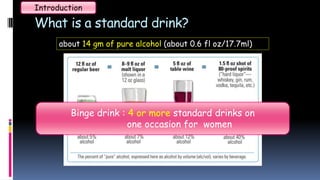
What is a standard drink?
Binge drink : 4 or more standard drinks on
one occasion for women
Introduction
about 14 gm of pure alcohol (about 0.6 fl oz/17.7ml)
Alcohol use during pregnancy
 Fetal alcohol spectrum disorders (FASDs)
 Birth defects
 Developmental disabilities
 Other pregnancy problems
 Miscarriage
 Stillbirth
 Prematurity
Introduction
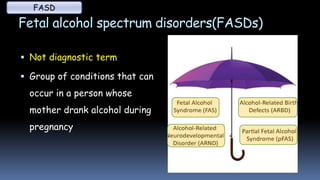
Fetal alcohol spectrum disorders(FASDs)
 Not diagnostic term
 Group of conditions that can
occur in a person whose
mother drank alcohol during
pregnancy
FASD
Discovery of FASD (I)
 1960’
 “alcohol embryopathy” – Lemoine et al.
 1970’
 Fetal alcohol syndrome – Jones and Smith
 Fetal alcohol effect – Clare and Smith
 1996, Institute of Medicine(IOM)
 FAE  ARBD and ARND
FASD
Classification of FASDs (IOM)
 Fetal alcohol syndrome
 Most severe end outcome of FASDs
 Partial FAS
 Alcohol related birth defect
 Alcohol related neurodevelopmental disorders
FASD
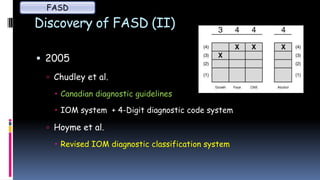
Discovery of FASD (II)
 2005
 Chudley et al.
 Canadian diagnostic guidelines
 IOM system + 4-Digit diagnostic code system
 Hoyme et al.
 Revised IOM diagnostic classification system
FASD
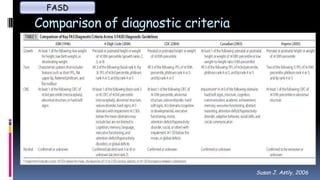
Comparison of diagnostic criteria
FASD
Susan J. Astly, 2006
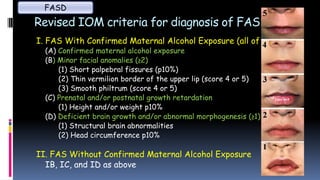
Revised IOM criteria for diagnosis of FASD (I)
I. FAS With Confirmed Maternal Alcohol Exposure (all of A–D)
(A) Confirmed maternal alcohol exposure
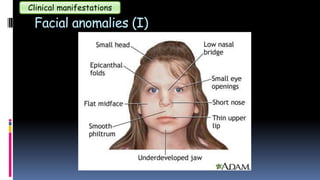
(B) Minor facial anomalies (≥2)
(1) Short palpebral fissures (p10%)
(2) Thin vermilion border of the upper lip (score 4 or 5)
(3) Smooth philtrum (score 4 or 5)
(C) Prenatal and/or postnatal growth retardation
(1) Height and/or weight p10%
(D) Deficient brain growth and/or abnormal morphogenesis (≥1)
(1) Structural brain abnormalities
(2) Head circumference p10%
II. FAS Without Confirmed Maternal Alcohol Exposure
IB, IC, and ID as above
FASD
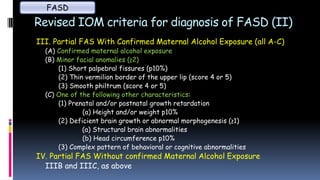
Revised IOM criteria for diagnosis of FASD (II)
III. Partial FAS With Confirmed Maternal Alcohol Exposure (all A-C)
(A) Confirmed maternal alcohol exposure
(B) Minor facial anomalies (≥2)
(1) Short palpebral fissures (p10%)
(2) Thin vermilion border of the upper lip (score 4 or 5)
(3) Smooth philtrum (score 4 or 5)
(C) One of the following other characteristics:
(1) Prenatal and/or postnatal growth retardation
(a) Height and/or weight p10%
(2) Deficient brain growth or abnormal morphogenesis (≥1)
(a) Structural brain abnormalities
(b) Head circumference p10%
(3) Complex pattern of behavioral or cognitive abnormalities
IV. Partial FAS Without confirmed Maternal Alcohol Exposure
IIIB and IIIC, as above
FASD
Revised IOM criteria for diagnosis of FASD(III)
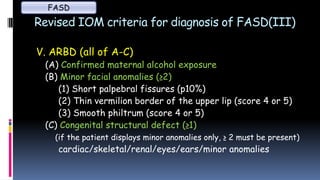
V. ARBD (all of A-C)
(A) Confirmed maternal alcohol exposure
(B) Minor facial anomalies (≥2)
(1) Short palpebral fissures (p10%)
(2) Thin vermilion border of the upper lip (score 4 or 5)
(3) Smooth philtrum (score 4 or 5)
(C) Congenital structural defect (≥1)
(if the patient displays minor anomalies only, ≥ 2 must be present)
cardiac/skeletal/renal/eyes/ears/minor anomalies
FASD
Revised IOM criteria for diagnosis of FASD(IV)
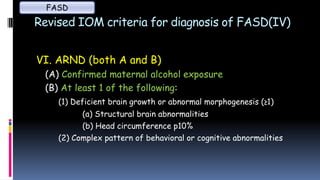
VI. ARND (both A and B)
(A) Confirmed maternal alcohol exposure
(B) At least 1 of the following:
(1) Deficient brain growth or abnormal morphogenesis (≥1)
(a) Structural brain abnormalities
(b) Head circumference p10%
(2) Complex pattern of behavioral or cognitive abnormalities
FASD
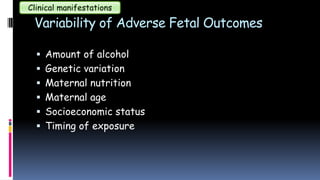
Variability of Adverse Fetal Outcomes
Clinical manifestations
 Amount of alcohol
 Genetic variation
 Maternal nutrition
 Maternal age
 Socioeconomic status
 Timing of exposure
Facial anomalies (I)
Clinical manifestations
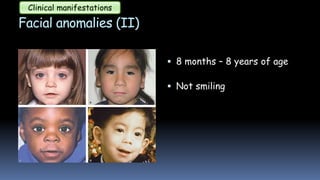
Facial anomalies (II)
 8 months – 8 years of age
 Not smiling
Clinical manifestations
Growth retardation
 Usually presents in the prenatal period and persists as
a consistent impairment over time
 Below 10 percentile
 Diminish in adolescence and adult
Clinical manifestations
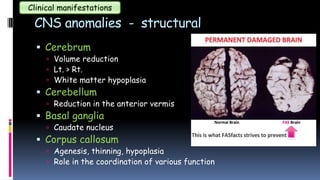
CNS anomalies - structural
 Cerebrum
 Volume reduction
 Lt. > Rt.
 White matter hypoplasia
 Cerebellum
 Reduction in the anterior vermis
 Basal ganglia
 Caudate nucleus
 Corpus callosum
 Agenesis, thinning, hypoplasia
 Role in the coordination of various function
Clinical manifestations
CNS anomalies - functional (I)
 Cognitive defects
 General intelligence ↓
 Low IQ (70 for FAS, 80 for nondysmorphic individuals)
 Learning disabilities
 Significant relation between general cognitive function and
degree of dysmorphic features and growth deficiency
Clinical manifestations
Ervalahti et al. 2007
CNS anomalies - functional (II)
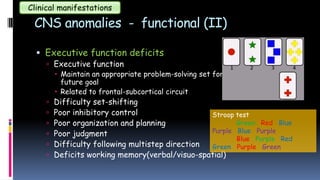
 Executive function deficits
 Executive function
 Maintain an appropriate problem-solving set for attainment of a
future goal
 Related to frontal-subcortical circuit
 Difficulty set-shifting
 Poor inhibitory control
 Poor organization and planning
 Poor judgment
 Difficulty following multistep direction
 Deficits working memory(verbal/visuo-spatial)
Clinical manifestations
Stroop test
Green Red Blue
Purple Blue Purple
Blue Purple Red
Green Purple Green
CNS anomalies - functional (III)
 Motor function delay
 Affect muscle control
 Gross motor skill – delay in walking
 Fine motor skill – difficulty writing or drawing
 Balanced problems
 Tremors
 Dexterity
 Poor sucking
Clinical manifestations
CNS anomalies - functional (IV)
 Attention problems and hyperactivity
 Higher rate of ADHD
 Hyperkinetic disorders
 Difficulty complete tasks
 Difficulty moving from one activity to the next
Clinical manifestations
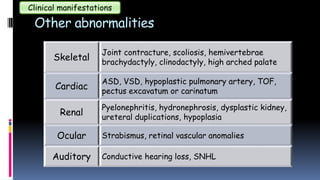
Other abnormalities
Clinical manifestations
Skeletal
Joint contracture, scoliosis, hemivertebrae
brachydactyly, clinodactyly, high arched palate
Cardiac
ASD, VSD, hypoplastic pulmonary artery, TOF,
pectus excavatum or carinatum
Renal
Pyelonephritis, hydronephrosis, dysplastic kidney,
ureteral duplications, hypoplasia
Ocular Strabismus, retinal vascular anomalies
Auditory Conductive hearing loss, SNHL
Secondary Disabilities
 Wide range of maladaptive, behavioral and emotional
disturbances
 Psychiatric problem
 ADHD
 Schizophrenia, depression, PD
 Disrupted school experience
 Dependent living
 Trouble with the law
 Addiction
Clinical manifestations
Conclusions
 Fetal Alcohol Syndrome (FAS) is the leading cause of
preventable mental retardation
 FASD is a lifelong disability that causes health,learning and
behavioural problems
 Awareness about dangers of drinking alcohol during pregnancy
can help to prevent FAS
FAS is 100% preventable if a woman does not
drink alcohol while she is pregnant
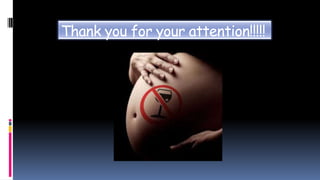
Thank you for your attention!!!!!

(마더세이프 라운드) 임신 중 알콜 Alcohol in Pregnancy

  • 1.
    ALCOHOL IN PREGNANCY JEONGSHIN OK Mothersafe round Division of Maternal-Fetal Medicine, Department of Obstetrics and Gynecology, Cheil General Hospital & Women 's Healthcare Center, Dankook University College of Medicine
  • 2.
    Contents Introduction Fetal alcohol spectrumdisorders Clinical manifestations of FASD Conclusion
  • 3.
    Alcohol…  Teratogen  Alcoholpasses through the placenta directly to the baby’s bloodstream  No known safe amount of alcohol use during pregnancy  No safe time during pregnancy to drink  All types of alcohol are equally harmful  Binge drinking is especially harmful Introduction
  • 4.
    What is astandard drink? Binge drink : 4 or more standard drinks on one occasion for women Introduction about 14 gm of pure alcohol (about 0.6 fl oz/17.7ml)
  • 5.
    Alcohol use duringpregnancy  Fetal alcohol spectrum disorders (FASDs)  Birth defects  Developmental disabilities  Other pregnancy problems  Miscarriage  Stillbirth  Prematurity Introduction
  • 6.
    Fetal alcohol spectrumdisorders(FASDs)  Not diagnostic term  Group of conditions that can occur in a person whose mother drank alcohol during pregnancy FASD
  • 7.
    Discovery of FASD(I)  1960’  “alcohol embryopathy” – Lemoine et al.  1970’  Fetal alcohol syndrome – Jones and Smith  Fetal alcohol effect – Clare and Smith  1996, Institute of Medicine(IOM)  FAE  ARBD and ARND FASD
  • 8.
    Classification of FASDs(IOM)  Fetal alcohol syndrome  Most severe end outcome of FASDs  Partial FAS  Alcohol related birth defect  Alcohol related neurodevelopmental disorders FASD
  • 9.
    Discovery of FASD(II)  2005  Chudley et al.  Canadian diagnostic guidelines  IOM system + 4-Digit diagnostic code system  Hoyme et al.  Revised IOM diagnostic classification system FASD
  • 10.
    Comparison of diagnosticcriteria FASD Susan J. Astly, 2006
  • 11.
    Revised IOM criteriafor diagnosis of FASD (I) I. FAS With Confirmed Maternal Alcohol Exposure (all of A–D) (A) Confirmed maternal alcohol exposure (B) Minor facial anomalies (≥2) (1) Short palpebral fissures (p10%) (2) Thin vermilion border of the upper lip (score 4 or 5) (3) Smooth philtrum (score 4 or 5) (C) Prenatal and/or postnatal growth retardation (1) Height and/or weight p10% (D) Deficient brain growth and/or abnormal morphogenesis (≥1) (1) Structural brain abnormalities (2) Head circumference p10% II. FAS Without Confirmed Maternal Alcohol Exposure IB, IC, and ID as above FASD
  • 12.
    Revised IOM criteriafor diagnosis of FASD (II) III. Partial FAS With Confirmed Maternal Alcohol Exposure (all A-C) (A) Confirmed maternal alcohol exposure (B) Minor facial anomalies (≥2) (1) Short palpebral fissures (p10%) (2) Thin vermilion border of the upper lip (score 4 or 5) (3) Smooth philtrum (score 4 or 5) (C) One of the following other characteristics: (1) Prenatal and/or postnatal growth retardation (a) Height and/or weight p10% (2) Deficient brain growth or abnormal morphogenesis (≥1) (a) Structural brain abnormalities (b) Head circumference p10% (3) Complex pattern of behavioral or cognitive abnormalities IV. Partial FAS Without confirmed Maternal Alcohol Exposure IIIB and IIIC, as above FASD
  • 13.
    Revised IOM criteriafor diagnosis of FASD(III) V. ARBD (all of A-C) (A) Confirmed maternal alcohol exposure (B) Minor facial anomalies (≥2) (1) Short palpebral fissures (p10%) (2) Thin vermilion border of the upper lip (score 4 or 5) (3) Smooth philtrum (score 4 or 5) (C) Congenital structural defect (≥1) (if the patient displays minor anomalies only, ≥ 2 must be present) cardiac/skeletal/renal/eyes/ears/minor anomalies FASD
  • 14.
    Revised IOM criteriafor diagnosis of FASD(IV) VI. ARND (both A and B) (A) Confirmed maternal alcohol exposure (B) At least 1 of the following: (1) Deficient brain growth or abnormal morphogenesis (≥1) (a) Structural brain abnormalities (b) Head circumference p10% (2) Complex pattern of behavioral or cognitive abnormalities FASD
  • 15.
    Variability of AdverseFetal Outcomes Clinical manifestations  Amount of alcohol  Genetic variation  Maternal nutrition  Maternal age  Socioeconomic status  Timing of exposure
  • 16.
  • 17.
    Facial anomalies (II) 8 months – 8 years of age  Not smiling Clinical manifestations
  • 18.
    Growth retardation  Usuallypresents in the prenatal period and persists as a consistent impairment over time  Below 10 percentile  Diminish in adolescence and adult Clinical manifestations
  • 19.
    CNS anomalies -structural  Cerebrum  Volume reduction  Lt. > Rt.  White matter hypoplasia  Cerebellum  Reduction in the anterior vermis  Basal ganglia  Caudate nucleus  Corpus callosum  Agenesis, thinning, hypoplasia  Role in the coordination of various function Clinical manifestations
  • 20.
    CNS anomalies -functional (I)  Cognitive defects  General intelligence ↓  Low IQ (70 for FAS, 80 for nondysmorphic individuals)  Learning disabilities  Significant relation between general cognitive function and degree of dysmorphic features and growth deficiency Clinical manifestations Ervalahti et al. 2007
  • 21.
    CNS anomalies -functional (II)  Executive function deficits  Executive function  Maintain an appropriate problem-solving set for attainment of a future goal  Related to frontal-subcortical circuit  Difficulty set-shifting  Poor inhibitory control  Poor organization and planning  Poor judgment  Difficulty following multistep direction  Deficits working memory(verbal/visuo-spatial) Clinical manifestations Stroop test Green Red Blue Purple Blue Purple Blue Purple Red Green Purple Green
  • 22.
    CNS anomalies -functional (III)  Motor function delay  Affect muscle control  Gross motor skill – delay in walking  Fine motor skill – difficulty writing or drawing  Balanced problems  Tremors  Dexterity  Poor sucking Clinical manifestations
  • 23.
    CNS anomalies -functional (IV)  Attention problems and hyperactivity  Higher rate of ADHD  Hyperkinetic disorders  Difficulty complete tasks  Difficulty moving from one activity to the next Clinical manifestations
  • 24.
    Other abnormalities Clinical manifestations Skeletal Jointcontracture, scoliosis, hemivertebrae brachydactyly, clinodactyly, high arched palate Cardiac ASD, VSD, hypoplastic pulmonary artery, TOF, pectus excavatum or carinatum Renal Pyelonephritis, hydronephrosis, dysplastic kidney, ureteral duplications, hypoplasia Ocular Strabismus, retinal vascular anomalies Auditory Conductive hearing loss, SNHL
  • 25.
    Secondary Disabilities  Widerange of maladaptive, behavioral and emotional disturbances  Psychiatric problem  ADHD  Schizophrenia, depression, PD  Disrupted school experience  Dependent living  Trouble with the law  Addiction Clinical manifestations
  • 26.
    Conclusions  Fetal AlcoholSyndrome (FAS) is the leading cause of preventable mental retardation  FASD is a lifelong disability that causes health,learning and behavioural problems  Awareness about dangers of drinking alcohol during pregnancy can help to prevent FAS FAS is 100% preventable if a woman does not drink alcohol while she is pregnant
  • 27.
    Thank you foryour attention!!!!!

Editor's Notes

  • #7 Umbrella terminology