Albert Einstein
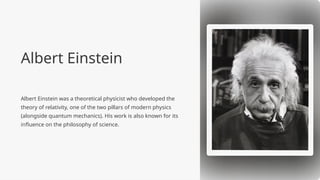
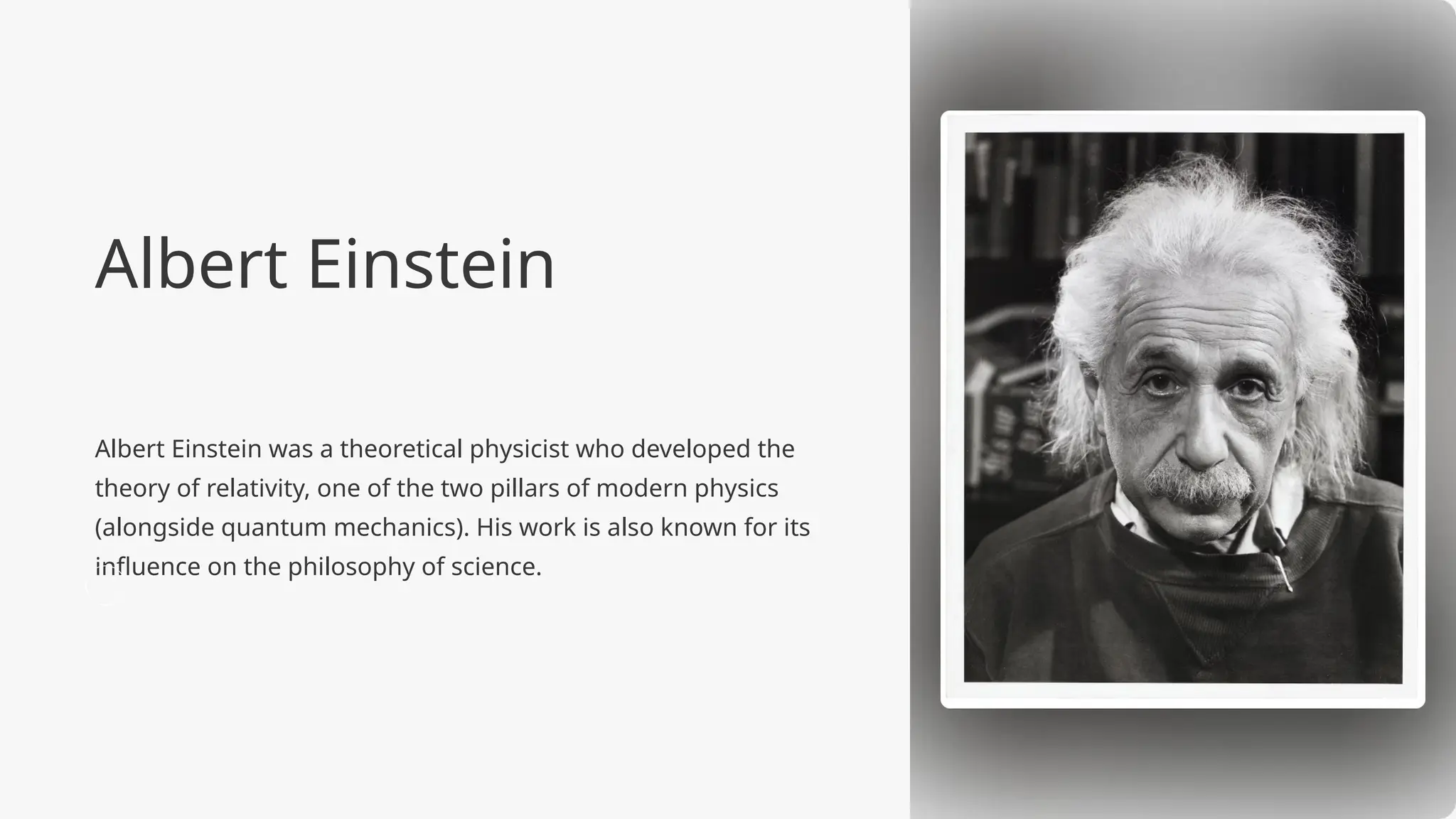
Albert Einstein was a theoretical physicist who developed the
theory of relativity, one of the two pillars of modern physics
(alongside quantum mechanics). His work is also known for its
influence on the philosophy of science.
Early Life and Education
1 Early Years
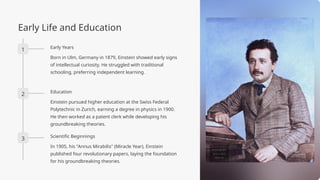
Born in Ulm, Germany in 1879, Einstein showed early signs
of intellectual curiosity. He struggled with traditional
schooling, preferring independent learning.
2 Education
Einstein pursued higher education at the Swiss Federal
Polytechnic in Zurich, earning a degree in physics in 1900.
He then worked as a patent clerk while developing his
groundbreaking theories.
3 Scientific Beginnings
In 1905, his "Annus Mirabilis" (Miracle Year), Einstein
published four revolutionary papers, laying the foundation
for his groundbreaking theories.
Groundbreaking Contributions
Special Relativity
Einstein's theory of
special relativity
revolutionized our
understanding of space,
time, and gravity. It
introduced the famous
equation E=mc²,
demonstrating the
equivalence of mass and
energy.
General Relativity
This theory expanded on
special relativity,
describing gravity as a
curvature of spacetime
caused by massive
objects. It explained
phenomena like the
bending of light around
stars and the expansion
of the universe.
Photoelectric Effect
Einstein's explanation of
the photoelectric effect,
the emission of electrons
from a metal when light
shines on it, earned him
the Nobel Prize in Physics
in 1921.
Influence on Modern Science
Particle Physics
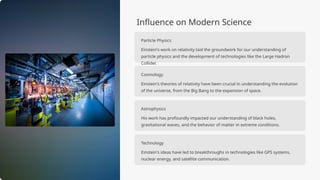
Einstein's work on relativity laid the groundwork for our understanding of
particle physics and the development of technologies like the Large Hadron
Collider.
Cosmology
Einstein's theories of relativity have been crucial in understanding the evolution
of the universe, from the Big Bang to the expansion of space.
Astrophysics
His work has profoundly impacted our understanding of black holes,
gravitational waves, and the behavior of matter in extreme conditions.
Technology
Einstein's ideas have led to breakthroughs in technologies like GPS systems,
nuclear energy, and satellite communication.
Legacy and Future Implications
Future of Physics
Einstein's theories continue to inspire new scientific discoveries and drive research in areas
like quantum gravity and the search for a unified theory of everything.
Cosmic Exploration
His work provides a framework for exploring the universe, from understanding black holes
to searching for exoplanets and the origins of the cosmos.
Sustainable Technology
Einstein's legacy motivates the development of sustainable technologies, like renewable
energy sources and advanced materials, to address global challenges.
Education and Inspiration

Albert-Einstein-Past-Present-and-Future.pptx

  • 1.
    Albert Einstein Albert Einsteinwas a theoretical physicist who developed the theory of relativity, one of the two pillars of modern physics (alongside quantum mechanics). His work is also known for its influence on the philosophy of science.
  • 2.
    Early Life andEducation 1 Early Years Born in Ulm, Germany in 1879, Einstein showed early signs of intellectual curiosity. He struggled with traditional schooling, preferring independent learning. 2 Education Einstein pursued higher education at the Swiss Federal Polytechnic in Zurich, earning a degree in physics in 1900. He then worked as a patent clerk while developing his groundbreaking theories. 3 Scientific Beginnings In 1905, his "Annus Mirabilis" (Miracle Year), Einstein published four revolutionary papers, laying the foundation for his groundbreaking theories.
  • 3.
    Groundbreaking Contributions Special Relativity Einstein'stheory of special relativity revolutionized our understanding of space, time, and gravity. It introduced the famous equation E=mc², demonstrating the equivalence of mass and energy. General Relativity This theory expanded on special relativity, describing gravity as a curvature of spacetime caused by massive objects. It explained phenomena like the bending of light around stars and the expansion of the universe. Photoelectric Effect Einstein's explanation of the photoelectric effect, the emission of electrons from a metal when light shines on it, earned him the Nobel Prize in Physics in 1921.
  • 4.
    Influence on ModernScience Particle Physics Einstein's work on relativity laid the groundwork for our understanding of particle physics and the development of technologies like the Large Hadron Collider. Cosmology Einstein's theories of relativity have been crucial in understanding the evolution of the universe, from the Big Bang to the expansion of space. Astrophysics His work has profoundly impacted our understanding of black holes, gravitational waves, and the behavior of matter in extreme conditions. Technology Einstein's ideas have led to breakthroughs in technologies like GPS systems, nuclear energy, and satellite communication.
  • 5.
    Legacy and FutureImplications Future of Physics Einstein's theories continue to inspire new scientific discoveries and drive research in areas like quantum gravity and the search for a unified theory of everything. Cosmic Exploration His work provides a framework for exploring the universe, from understanding black holes to searching for exoplanets and the origins of the cosmos. Sustainable Technology Einstein's legacy motivates the development of sustainable technologies, like renewable energy sources and advanced materials, to address global challenges. Education and Inspiration