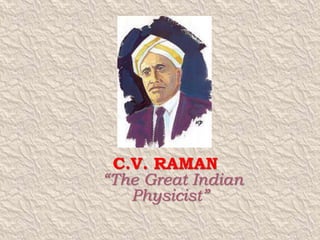
C.V. RAMAN 
“The Great Indian 
Physicist”
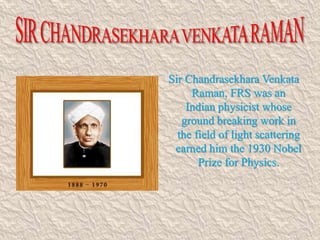
Sir Chandrasekhara Venkata 
Raman, FRS was an 
Indian physicist whose 
ground breaking work in 
the field of light scattering 
earned him the 1930 Nobel 
Prize for Physics.
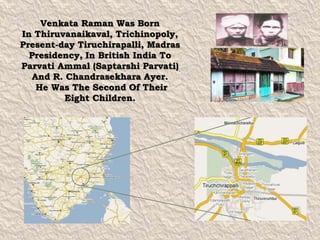
Venkata Raman Was Born 
In Thiruvanaikaval, Trichinopoly, 
Present-day Tiruchirapalli, Madras 
Presidency, In British India To 
Parvati Ammal (Saptarshi Parvati) 
And R. Chandrasekhara Ayer. 
He Was The Second Of Their 
Eight Children.
“EARLY LIFE & CAREER” 
 2nd in eight children (5 sons and 3 daughters) 
 Father was a teacher in a school, later moved to 
Visakhapatnam to be a lecturer in Mathematics and Physics in 
the Mrs. AVN College when Raman was 3, with a salary of Rs 
85/- per month 
 Matriculated at 11, FA at 13, BA at 15 from the Presidency 
College in Chennai (Gold medal in English and Physics) and 
MA at 18 (exempted from attending all classes of science)
 First research paper at the age of 16 in The Philosophical 
Magazine (London) on diffraction of light from prism, and 
another on measurement of surface tension (communicated by 
author himself, with no acknowledgements!) 
 Topped Civil Services exam (Finance Dept)- “I shall ever be 
grateful to the Civil Surgeon of Madras” 
 In 1907, at 18 ½ married Lokasundari and then joined as Asst 
Accountant General in the Finance Dept, Kolkata 
 Very much occupied due to the job, he still managed to spare 
his evenings for scientific research at the laboratory of the 
Indian Association for Cultivation of Sciences. On certain 
occasions, he even spent the entire nights. Such was his 
passion that in 1917, he resigned from the position to become 
the Professor of Physics at Calcutta University.
CONTRIBUTIONS AND ACHIEVEMENTS 
 On a sea voyage to Europe in 1921, Raman curiously noticed the 
blue colour of the glaciers and the Mediterranean. He was 
passionate to discover the reason of the blue colour. 
 Once Raman returned to India, he performed many experiments 
regarding the scattering of light from water and transparent 
blocks of ice. According to the results, he established the 
scientific explanation for the blue colour of sea-water and sky. 
There is a captivating event that served as the inspiration for the 
discovery of the Raman Effect. 
 Raman employed monochromatic light from a mercury arc which 
penetrated transparent materials and was allowed to fall on a 
spectrograph to record its spectrum. 
 During this, Raman detected some new lines in the spectrum 
which were later called ‘Raman Lines’.
 After a few months, Raman put forward his discovery of 
‘Raman Effect’ in a meeting of scientists at Bangalore on 
March 16, 1928, for which he won the Nobel Prize in Physics 
in 1930. 
 The ‘Raman Effect’ is considered very significant in analyzing the 
molecular structure of chemical compounds. After a decade of its 
discovery, the structure of about 2000 compounds was studied. 
Thanks to the invention of the laser, the ‘Raman Effect’ has 
proved to be a very useful tool for scientists. 
 Some of Raman’s other interests were the physiology of human 
vision, the optics of colloids and the electrical and magnetic 
anisotropy. 
 Sir C.V. Raman became the Fellow of the Royal Society of 
London in 1924.
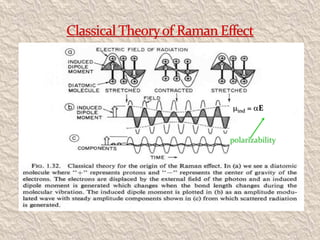
mind = aE 
polarizability
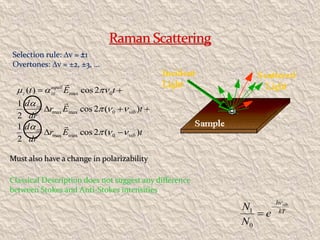
Selection rule: v = ±1 
Overtones: v = ±2, ±3, … 
m ( ) a cos 2 
 
  
max 0 
   
max max 0 
  
max max 0 
1 
cos 2 ( ) 
2 
1 
cos 2 ( ) 
2 
equil 
z zz 
a 
zz 
vib 
zz 
vib 
t E t 
d 
r E t 
dr 
d 
r E t 
dr 
   
a 
   
Must also have a change in polarizability 
Classical Description does not suggest any difference 
between Stokes and Anti-Stokes intensities 
N 
h 
vib 1 
kT 0 
e 
N 
 
 

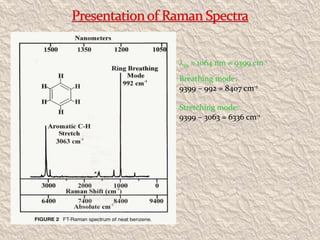
lex = 1064 nm = 9399 cm-1 
Breathing mode: 
9399 – 992 = 8407 cm-1 
Stretching mode: 
9399 – 3063 = 6336 cm-1
 A year later, he set up Raman Research Institute near Bangalore, 
where he continued the scientific research until his death which 
was caused by a strong heart attack on November 21, 1970. 
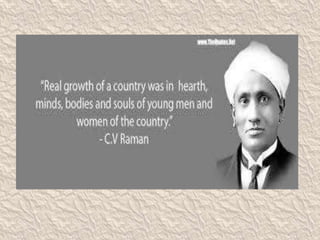
His Sincere Advice To Aspiring Scientists Was That
Prepared & Submitted by:

C.v. raman the great indian physicist

  • 1.
    C.V. RAMAN “TheGreat Indian Physicist”
  • 2.
    Sir Chandrasekhara Venkata Raman, FRS was an Indian physicist whose ground breaking work in the field of light scattering earned him the 1930 Nobel Prize for Physics.
  • 3.
    Venkata Raman WasBorn In Thiruvanaikaval, Trichinopoly, Present-day Tiruchirapalli, Madras Presidency, In British India To Parvati Ammal (Saptarshi Parvati) And R. Chandrasekhara Ayer. He Was The Second Of Their Eight Children.
  • 4.
    “EARLY LIFE &CAREER”  2nd in eight children (5 sons and 3 daughters)  Father was a teacher in a school, later moved to Visakhapatnam to be a lecturer in Mathematics and Physics in the Mrs. AVN College when Raman was 3, with a salary of Rs 85/- per month  Matriculated at 11, FA at 13, BA at 15 from the Presidency College in Chennai (Gold medal in English and Physics) and MA at 18 (exempted from attending all classes of science)
  • 5.
     First researchpaper at the age of 16 in The Philosophical Magazine (London) on diffraction of light from prism, and another on measurement of surface tension (communicated by author himself, with no acknowledgements!)  Topped Civil Services exam (Finance Dept)- “I shall ever be grateful to the Civil Surgeon of Madras”  In 1907, at 18 ½ married Lokasundari and then joined as Asst Accountant General in the Finance Dept, Kolkata  Very much occupied due to the job, he still managed to spare his evenings for scientific research at the laboratory of the Indian Association for Cultivation of Sciences. On certain occasions, he even spent the entire nights. Such was his passion that in 1917, he resigned from the position to become the Professor of Physics at Calcutta University.
  • 6.
    CONTRIBUTIONS AND ACHIEVEMENTS  On a sea voyage to Europe in 1921, Raman curiously noticed the blue colour of the glaciers and the Mediterranean. He was passionate to discover the reason of the blue colour.  Once Raman returned to India, he performed many experiments regarding the scattering of light from water and transparent blocks of ice. According to the results, he established the scientific explanation for the blue colour of sea-water and sky. There is a captivating event that served as the inspiration for the discovery of the Raman Effect.  Raman employed monochromatic light from a mercury arc which penetrated transparent materials and was allowed to fall on a spectrograph to record its spectrum.  During this, Raman detected some new lines in the spectrum which were later called ‘Raman Lines’.
  • 7.
     After afew months, Raman put forward his discovery of ‘Raman Effect’ in a meeting of scientists at Bangalore on March 16, 1928, for which he won the Nobel Prize in Physics in 1930.  The ‘Raman Effect’ is considered very significant in analyzing the molecular structure of chemical compounds. After a decade of its discovery, the structure of about 2000 compounds was studied. Thanks to the invention of the laser, the ‘Raman Effect’ has proved to be a very useful tool for scientists.  Some of Raman’s other interests were the physiology of human vision, the optics of colloids and the electrical and magnetic anisotropy.  Sir C.V. Raman became the Fellow of the Royal Society of London in 1924.
  • 8.
    mind = aE polarizability
  • 9.
    Selection rule: v= ±1 Overtones: v = ±2, ±3, … m ( ) a cos 2    max 0    max max 0   max max 0 1 cos 2 ( ) 2 1 cos 2 ( ) 2 equil z zz a zz vib zz vib t E t d r E t dr d r E t dr    a    Must also have a change in polarizability Classical Description does not suggest any difference between Stokes and Anti-Stokes intensities N h vib 1 kT 0 e N   
  • 10.
    lex = 1064nm = 9399 cm-1 Breathing mode: 9399 – 992 = 8407 cm-1 Stretching mode: 9399 – 3063 = 6336 cm-1
  • 11.
     A yearlater, he set up Raman Research Institute near Bangalore, where he continued the scientific research until his death which was caused by a strong heart attack on November 21, 1970. His Sincere Advice To Aspiring Scientists Was That
  • 13.