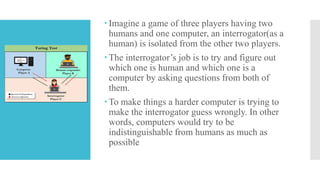
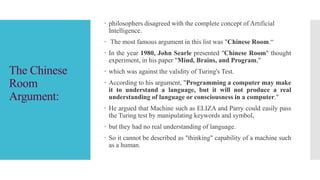
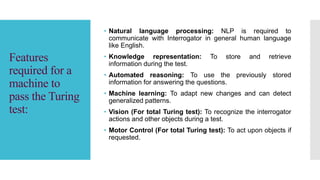
Alan Turing proposed the Turing Test in 1950 to test a machine's ability to exhibit intelligent behavior indistinguishable from a human. The Turing Test involves an interrogator asking questions to both a human and a computer without seeing them. If the interrogator cannot discern which is human and which is computer, the computer is said to have passed the test. Several chatbots like ELIZA, Parry, and Eugene Goostman have attempted the Turing Test, with Eugene Goostman convincing 29% of judges it was human. However, philosophers like John Searle argue that passing the Turing Test does not prove a machine has human understanding through his Chinese Room Argument.