Drinking deep from the
Fawcett
Alan Parkinson - Immediate Past President of
the Geographical Association (UK)
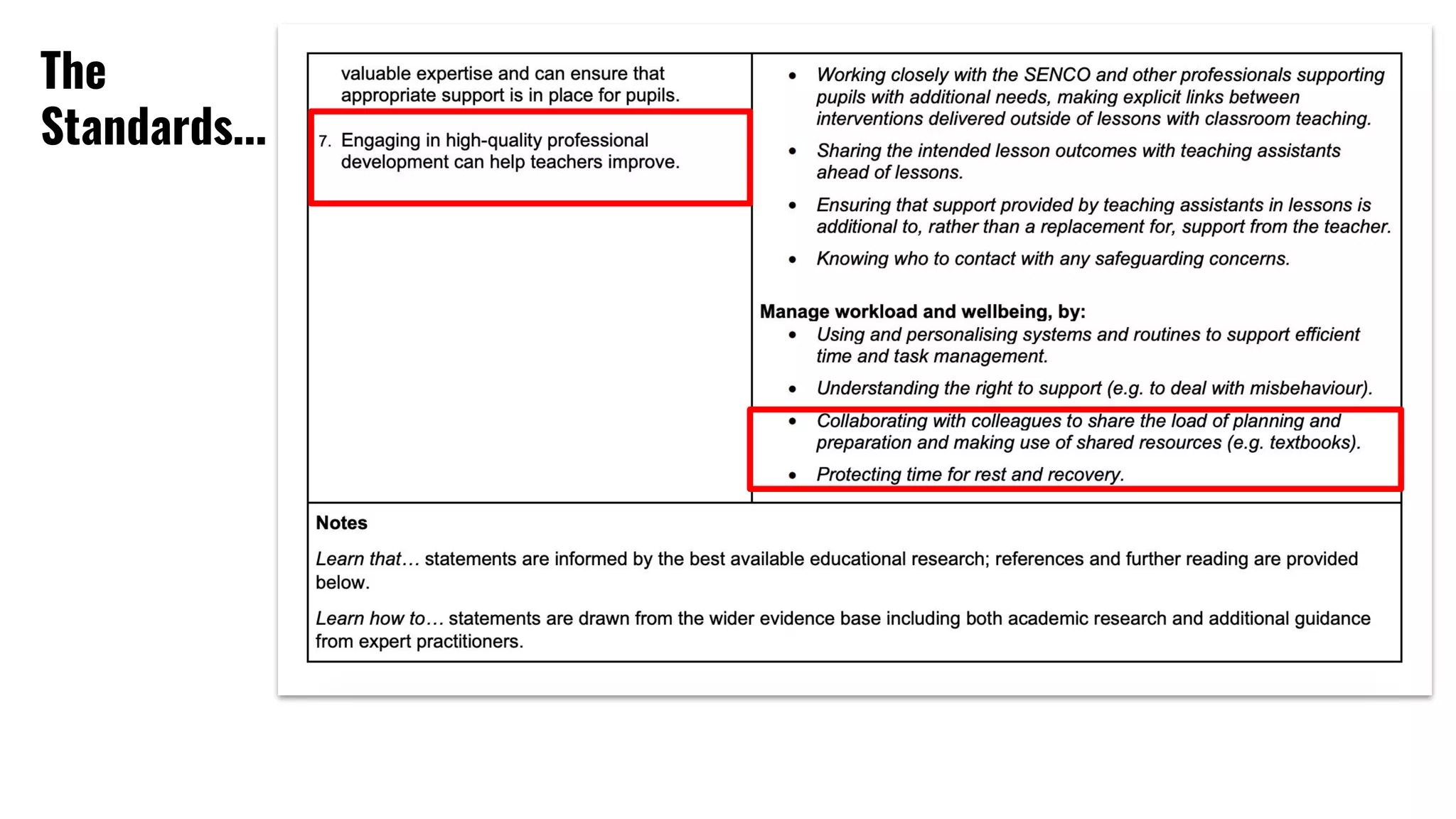
The
Standards...
The
Standards...
Presidential Address
Michael Storm
The State of the Art (1988)
Remembering his own schooling in 1940s
“His discursive and unplanned lessons frequently took off from
an item in that morning’s ‘Manchester Guardian’; geography was
about colonialism as well as commodities. I suspect that the
biographies of many professional geographers probably contain
such characters. What they shared, of course, was personal
enthusiasm. They had sustained their own enjoyment of,
and curiosity about, places. Hence they were able to infect
at least a proportion of the pupils they encountered…”
“The
irreplaceable
ingredient”
Storm, Michael. “Geography in Schools: the State of the Art.” Geography, vol. 74, no. 4,
1989, pp. 289–298. JSTOR, www.jstor.org/stable/40571737.
https://www.tandfonline.com/doi/pdf/10.1080/0305763800060212
“Professional zest”
How do you get (and refresh) yours?
“The GA is I feel, a collective expression of that zest….”
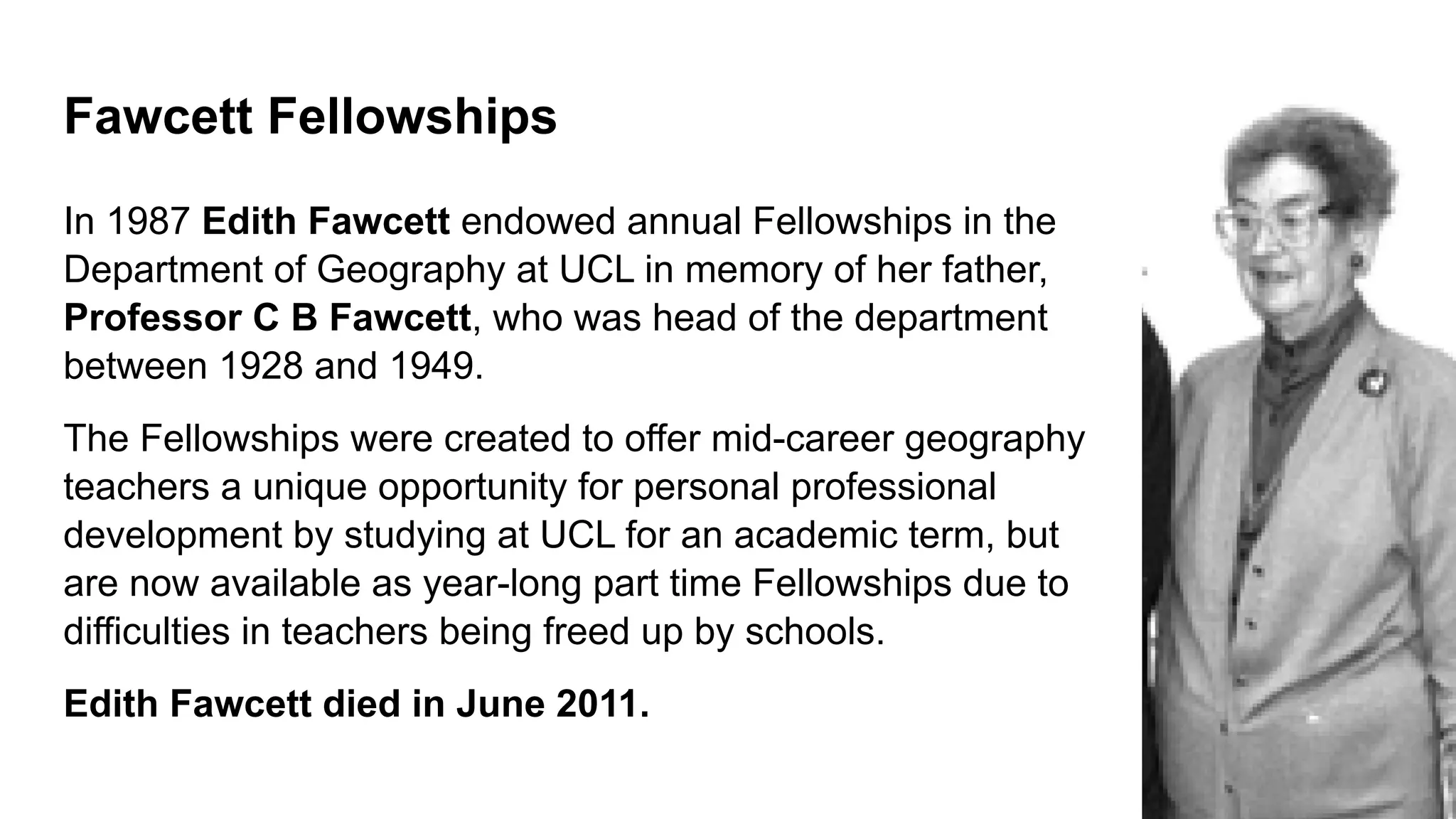
Fawcett Fellowships
In 1987 Edith Fawcett endowed annual Fellowships in the
Department of Geography at UCL in memory of her father,
Professor C B Fawcett, who was head of the department
between 1928 and 1949.
The Fellowships were created to offer mid-career geography
teachers a unique opportunity for personal professional
development by studying at UCL for an academic term, but
are now available as year-long part time Fellowships due to
difficulties in teachers being freed up by schools.
Edith Fawcett died in June 2011.
Charles Bungay Fawcett 1883-1952
A British geographer, regarded as "one of the founders of
modern British academic geography"
https://web.archive.org/web/20141129024816/http://www.thenorthernecho.co.uk/archive/2004/05/24/6990126.T
he_barefoot_evangelist/?ref=arc#
In 1919, Prof Fawcett gained national attention for his radical academic paper on
regional government. Behind the dry title - Provinces of England - was a proposal to
redraw the map, replacing the age-old system of counties and shires with provinces
based on cultural identity.
Each boundary for a province, or region, should be drawn around natural
geographical features such as watersheds, have a definable joint identity, have a
capital city and be large enough to justify self-government.
Such an area, according to Prof Fawcett, was the North-East of England and, although
his document was an academic tome, his ideas found plenty of general support.
He knew his ideas would prove controversial - the shires had existed for many years -
but commented that nothing was sacrosanct. Indeed, he was dismissive about the
'historic' nature of counties, arguing that their boundaries had changed so much over
time that the term was no longer appropriate.
The nation into which they were published was ready for change. It was
a nation still recovering from the horrors of the Great War in which
millions of its young men had been cut down in the trenches, a nation
witnessing a growing movement for people to have more say over their
destiny.
The debate had actually begun before war broke out in 1914 and by the
time Provinces of England was published, regionalism seemed a very
distinct possibility.
Prof Fawcett was acutely aware that many Irish people had long wanted
their own government, as did the people of Scotland and Wales.
"In an undemonstrative way, Fawcett maintained a deep feeling for his Northern roots,
which, despite his reputation for studied detachment, was revealed in glimpses of his
writings about what he called his 'homeland'.
"Fawcett's approach to the subject was avowedly influenced by his Northern outlook.
In describing his English provinces, the treatment of North England is dealt with first
and at greater length than any other provinces, partly because the writer is himself a
North countryman.
"His understanding of the provincial character of England appears heavily influenced
by his firmly-held view that the North-East was a region with its own identity."
Prof Fawcett pointed to the region's joint history, how its feudal kingdoms were once
part of the strong Northumbrian kingdom between the Humber and the Forth, and how
it forged a renewed sense of unity as the Industrial Revolution transformed its
landscape and economy in the 19th century.
Professor Tomaney, Newcastle University
Quotidian Geographies
https://www.youtube.com/watch?v=gi7p739mg9o - Tyne & Wear GA Branch
Money for teachers and two routes for involvement
Mode A - Sabbatical of one term - money to pay for cover
Mode B - Monthly meetings for a year
£1000 to cover travel to meetings, books, attendance at GA conference or
other relevant events
All receipted expenses
Discussions
Research
Some sort of outcome - book chapter for 2023
Deadline of end of June for this year’s
cohort, or end of Easter for sabbatical.
Applications welcome from Primary
colleagues.
Please share the opportunity.
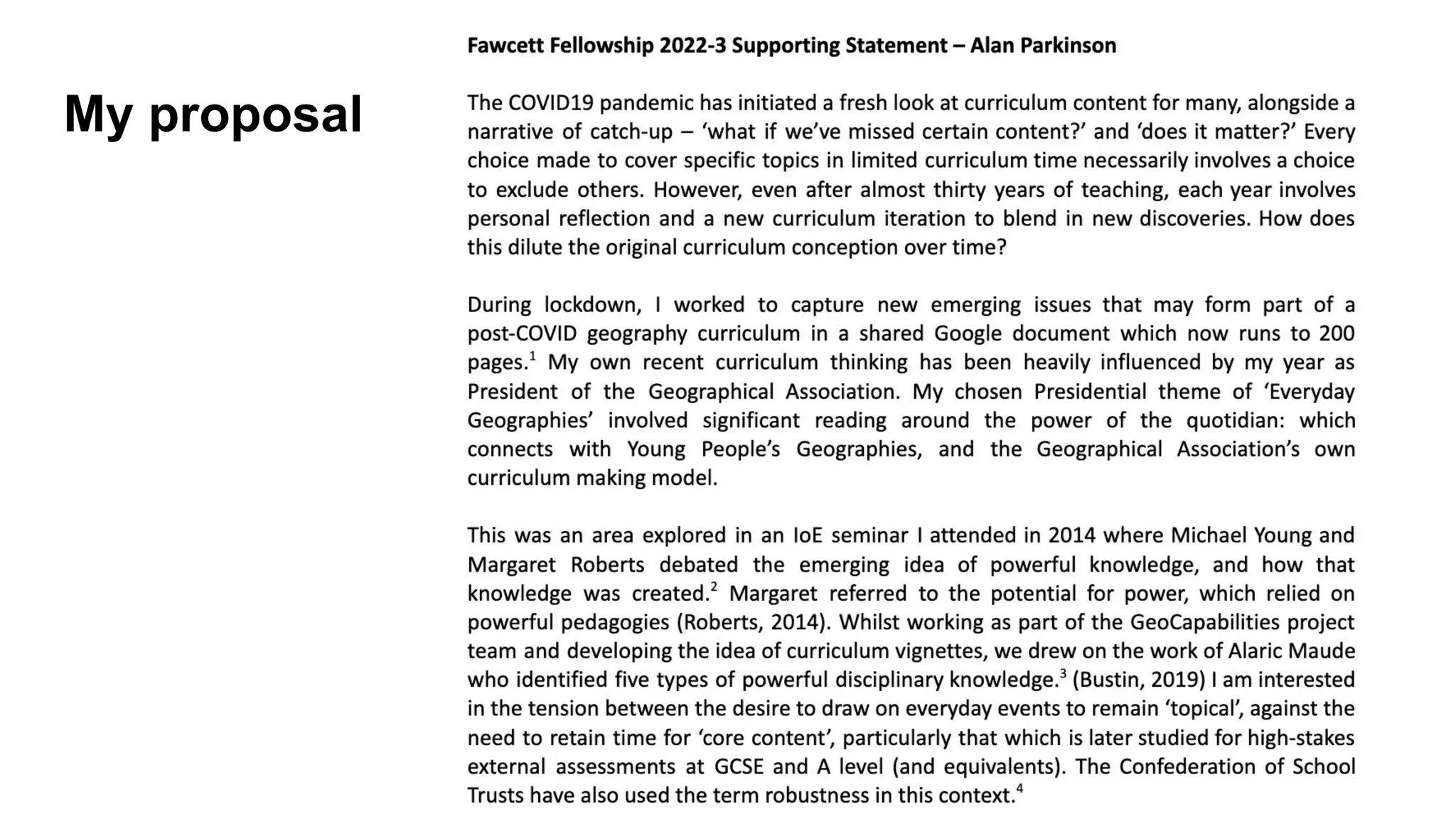
My proposal
https://gapresidents.blogspot.com/2020/03/2016-mary-biddulph.html
Part of the freedom of working in the university
was being able to seize opportunities as they
came along. For me, an example of such an
opportunity was my involvement in the Young
People's Geographies (YPG) project. The project
comprised a unique combination of teachers,
academic geographers and school students all
working together developing the geography
curriculum - it was both great fun and so
inspiring. The school students involved in the
project had such rich ideas about geography and
were so perceptive about what the curriculum
could be. We need to listen to them more than we
do."
Geography is all around us,
Geography effects [sic] us all.
Me, I’m geography. This
building is part of geography;
everything is geography.
Geography isn’t just about
Jamaica’s there, Africa’s there,
Britain’s there, it’s about us as
a community. (Anton (age 15),
The project was set up with the idea of
conversation at its heart. It encouraged teachers
and students to talk to each other about their
perceptions of geography. The project recognised
that young people participate in their own 'lived' or
'everyday' geographies. They live somewhere, shop
here, ‘hang out there’, have friends who live over
there, have relatives that come from elsewhere. Many
take holidays in distant places, and have interesting
perceptions of 'other' people and places. The project
sought to draw from these experiences and help
young people understand them, connecting them
to the wider world of people, places and the
human and physical processes that operate
through space
Meetings
Powerful knowledge
Progression - Trevor Bennetts
De/colonising the geography curriculum
School contexts and curriculum sharing
Pre-readings
Seven fellows - different school contexts
Dr. Alex Standish leading the discussions.
Epistemic Quality in the Geography Curriculum
Research
Please let me know if
you have ideas here
which may be relevant -
I am not an expert by
any means in this area.
Form is in draft and not
yet live.
https://forms.gle/jqENS7moBLRTniin7
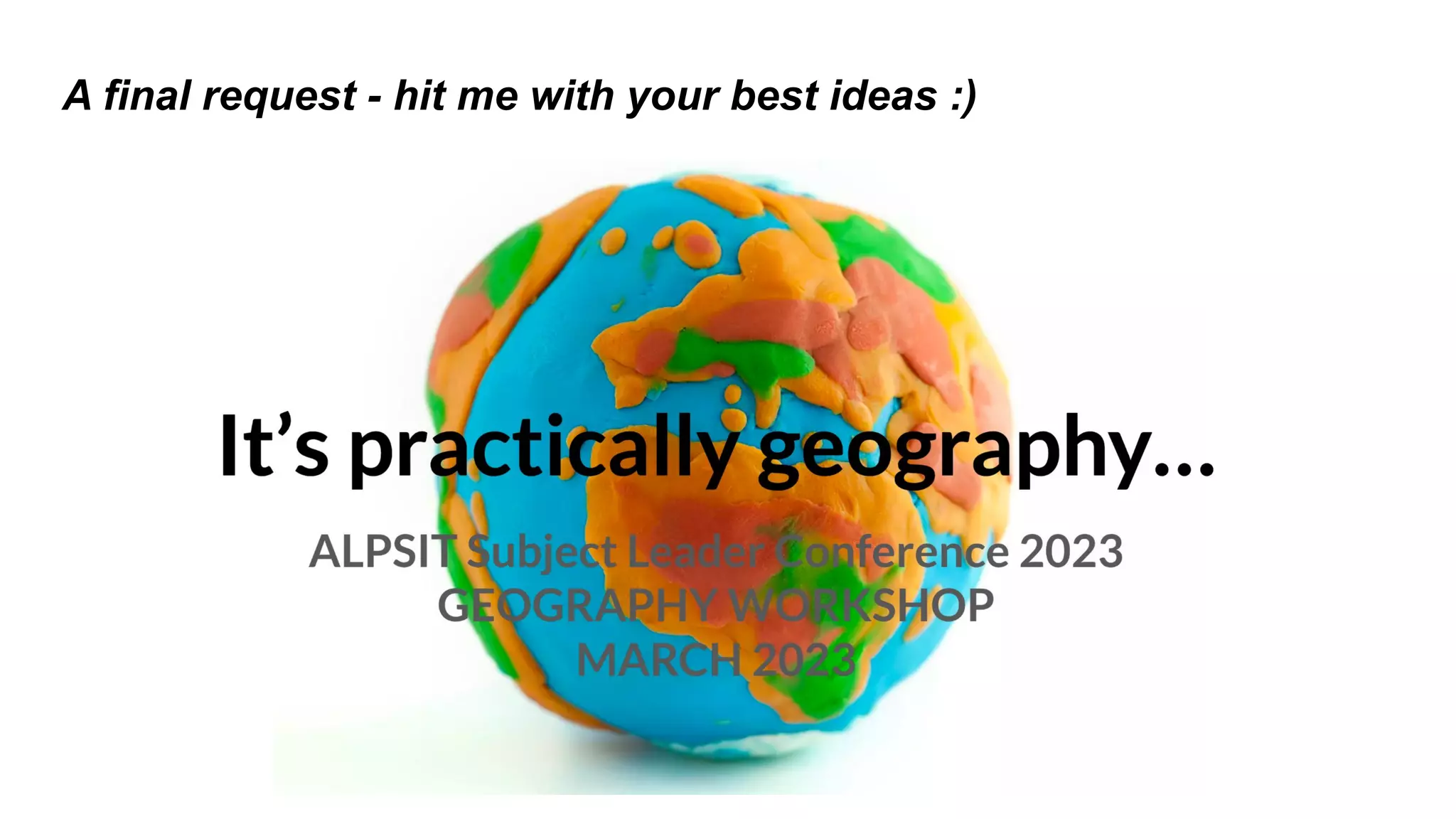
A final request - hit me with your best ideas :)
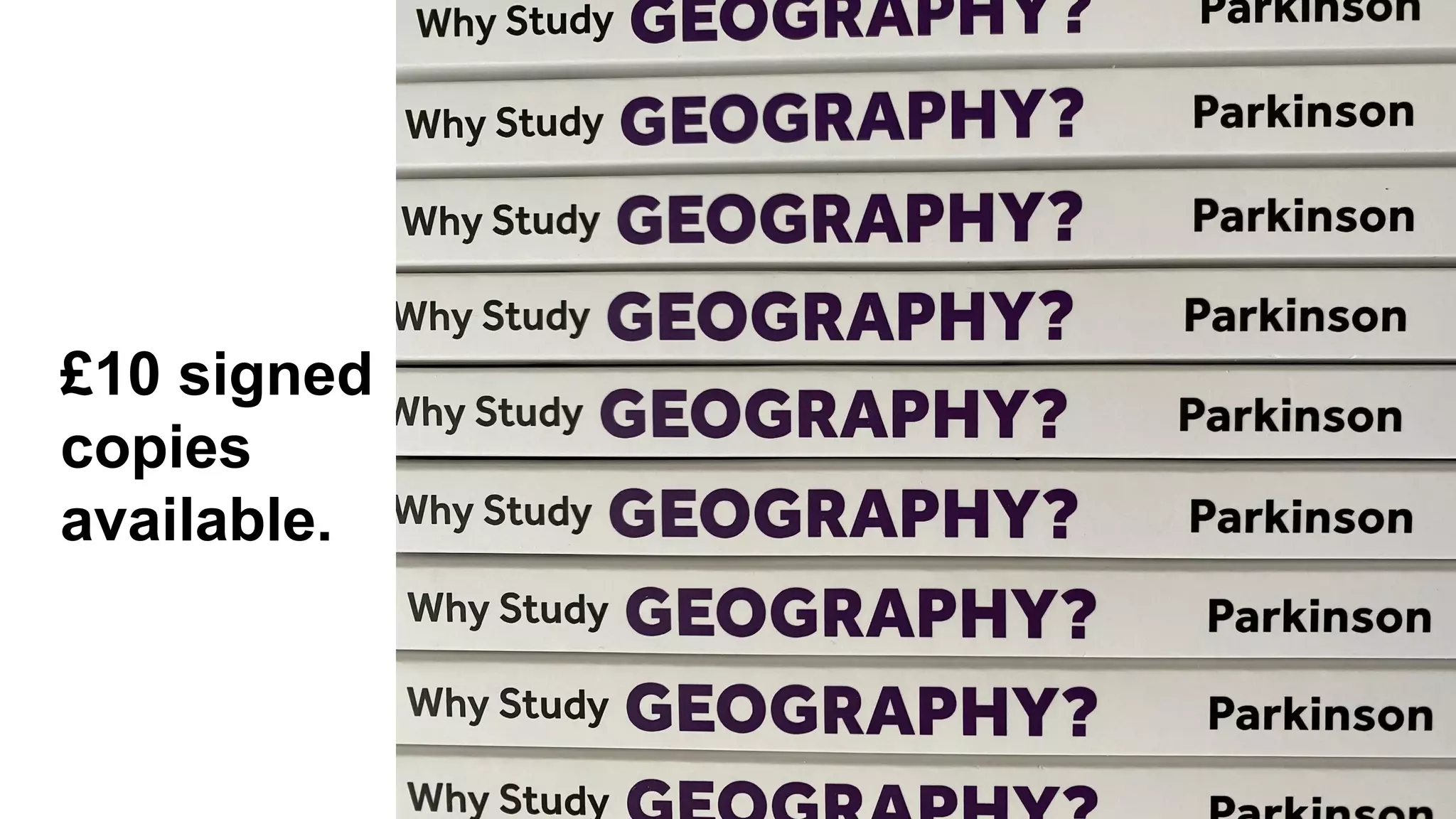
£10 signed
copies
available.

Alan P - Drinking deep from the Fawcett.pdf

  • 1.
    Drinking deep fromthe Fawcett
  • 2.
    Alan Parkinson -Immediate Past President of the Geographical Association (UK)
  • 5.
  • 6.
  • 7.
    Presidential Address Michael Storm TheState of the Art (1988) Remembering his own schooling in 1940s “His discursive and unplanned lessons frequently took off from an item in that morning’s ‘Manchester Guardian’; geography was about colonialism as well as commodities. I suspect that the biographies of many professional geographers probably contain such characters. What they shared, of course, was personal enthusiasm. They had sustained their own enjoyment of, and curiosity about, places. Hence they were able to infect at least a proportion of the pupils they encountered…”
  • 8.
    “The irreplaceable ingredient” Storm, Michael. “Geographyin Schools: the State of the Art.” Geography, vol. 74, no. 4, 1989, pp. 289–298. JSTOR, www.jstor.org/stable/40571737. https://www.tandfonline.com/doi/pdf/10.1080/0305763800060212
  • 9.
    “Professional zest” How doyou get (and refresh) yours? “The GA is I feel, a collective expression of that zest….”
  • 10.
    Fawcett Fellowships In 1987Edith Fawcett endowed annual Fellowships in the Department of Geography at UCL in memory of her father, Professor C B Fawcett, who was head of the department between 1928 and 1949. The Fellowships were created to offer mid-career geography teachers a unique opportunity for personal professional development by studying at UCL for an academic term, but are now available as year-long part time Fellowships due to difficulties in teachers being freed up by schools. Edith Fawcett died in June 2011.
  • 11.
    Charles Bungay Fawcett1883-1952 A British geographer, regarded as "one of the founders of modern British academic geography" https://web.archive.org/web/20141129024816/http://www.thenorthernecho.co.uk/archive/2004/05/24/6990126.T he_barefoot_evangelist/?ref=arc#
  • 12.
    In 1919, ProfFawcett gained national attention for his radical academic paper on regional government. Behind the dry title - Provinces of England - was a proposal to redraw the map, replacing the age-old system of counties and shires with provinces based on cultural identity. Each boundary for a province, or region, should be drawn around natural geographical features such as watersheds, have a definable joint identity, have a capital city and be large enough to justify self-government. Such an area, according to Prof Fawcett, was the North-East of England and, although his document was an academic tome, his ideas found plenty of general support. He knew his ideas would prove controversial - the shires had existed for many years - but commented that nothing was sacrosanct. Indeed, he was dismissive about the 'historic' nature of counties, arguing that their boundaries had changed so much over time that the term was no longer appropriate.
  • 13.
    The nation intowhich they were published was ready for change. It was a nation still recovering from the horrors of the Great War in which millions of its young men had been cut down in the trenches, a nation witnessing a growing movement for people to have more say over their destiny. The debate had actually begun before war broke out in 1914 and by the time Provinces of England was published, regionalism seemed a very distinct possibility. Prof Fawcett was acutely aware that many Irish people had long wanted their own government, as did the people of Scotland and Wales.
  • 14.
    "In an undemonstrativeway, Fawcett maintained a deep feeling for his Northern roots, which, despite his reputation for studied detachment, was revealed in glimpses of his writings about what he called his 'homeland'. "Fawcett's approach to the subject was avowedly influenced by his Northern outlook. In describing his English provinces, the treatment of North England is dealt with first and at greater length than any other provinces, partly because the writer is himself a North countryman. "His understanding of the provincial character of England appears heavily influenced by his firmly-held view that the North-East was a region with its own identity." Prof Fawcett pointed to the region's joint history, how its feudal kingdoms were once part of the strong Northumbrian kingdom between the Humber and the Forth, and how it forged a renewed sense of unity as the Industrial Revolution transformed its landscape and economy in the 19th century. Professor Tomaney, Newcastle University
  • 15.
  • 16.
    Money for teachersand two routes for involvement Mode A - Sabbatical of one term - money to pay for cover Mode B - Monthly meetings for a year £1000 to cover travel to meetings, books, attendance at GA conference or other relevant events All receipted expenses Discussions Research Some sort of outcome - book chapter for 2023 Deadline of end of June for this year’s cohort, or end of Easter for sabbatical. Applications welcome from Primary colleagues. Please share the opportunity.
  • 17.
  • 18.
    https://gapresidents.blogspot.com/2020/03/2016-mary-biddulph.html Part of thefreedom of working in the university was being able to seize opportunities as they came along. For me, an example of such an opportunity was my involvement in the Young People's Geographies (YPG) project. The project comprised a unique combination of teachers, academic geographers and school students all working together developing the geography curriculum - it was both great fun and so inspiring. The school students involved in the project had such rich ideas about geography and were so perceptive about what the curriculum could be. We need to listen to them more than we do." Geography is all around us, Geography effects [sic] us all. Me, I’m geography. This building is part of geography; everything is geography. Geography isn’t just about Jamaica’s there, Africa’s there, Britain’s there, it’s about us as a community. (Anton (age 15),
  • 19.
    The project wasset up with the idea of conversation at its heart. It encouraged teachers and students to talk to each other about their perceptions of geography. The project recognised that young people participate in their own 'lived' or 'everyday' geographies. They live somewhere, shop here, ‘hang out there’, have friends who live over there, have relatives that come from elsewhere. Many take holidays in distant places, and have interesting perceptions of 'other' people and places. The project sought to draw from these experiences and help young people understand them, connecting them to the wider world of people, places and the human and physical processes that operate through space
  • 20.
    Meetings Powerful knowledge Progression -Trevor Bennetts De/colonising the geography curriculum School contexts and curriculum sharing Pre-readings Seven fellows - different school contexts Dr. Alex Standish leading the discussions. Epistemic Quality in the Geography Curriculum
  • 21.
    Research Please let meknow if you have ideas here which may be relevant - I am not an expert by any means in this area. Form is in draft and not yet live. https://forms.gle/jqENS7moBLRTniin7
  • 22.
    A final request- hit me with your best ideas :)
  • 23.