GA Conference 2008 Presidential Address Sustaining Geography John Westaway, GA President
Sustaining geography Geography – past, present and future Who are geographers and where do they come from? Where is geography now and how did it get there? What next for geography? Geography for sustainable    development and the sustainable    development of geography
Who are geographers and where do they come from? Geography – past, present and future
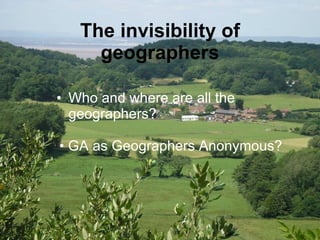
The invisibility of geographers Who and where are all the geographers? GA as Geographers Anonymous?
Guess the subject! It was his love of maps, of globes and atlases,  which had years ago led him, in a roundabout way, into the world of _______.  So many maps had he pored over in his time that he dressed, without fully realizing, in the pastels of cartography: yellow corduroy trousers (6000-9000 feet above sea level), the jacket of darkly woven maroon (Antarctic Tundra), shirt of Viyella peach (less than 1 inch of rainfall per annum), and the red fleck on his woollen tie looked like International Boundaries or population over 500 persons per square mile.’ From:  Homesickness by Murray Ball zoology and the missing word is ….
Where do geographers come from? Some are born geographers Some achieve geography Some have geography thrust upon   them
Some are born geographers Daydreams in the classroom Football (Bristol City)   Cricket (Gloucestershire)   Pop music (Rolling Stones et al)
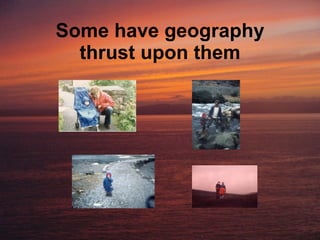
Some have geography thrust upon them
Some achieve geography What attracts young people to geography? Attractions of the subject? Charismatic teachers and/or good    teaching? Being good at it? Leads to a particular career?
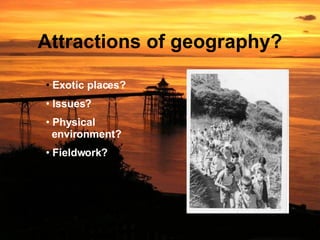
Attractions of geography? Exotic places? Issues? Physical   environment? Fieldwork?
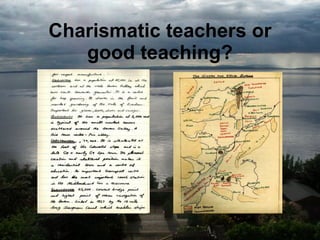
Charismatic teachers or good teaching?
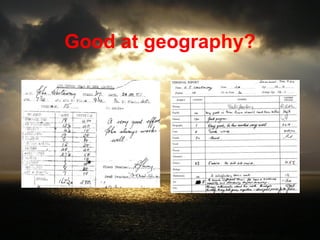
Good at geography?
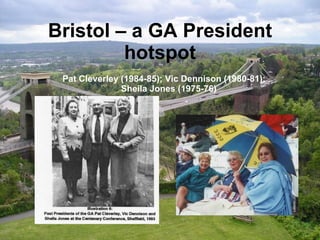
Bristol – a GA President hotspot Pat Cleverley (1984-85); Vic Dennison (1980-81); Sheila Jones (1975-76)
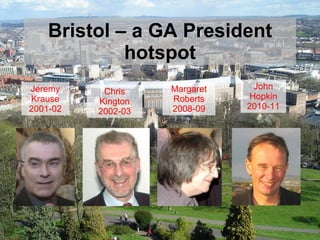
Bristol – a GA President hotspot Jeremy Krause 2001-02 Chris Kington 2002-03 Margaret Roberts 2008-09 John Hopkin 2010-11
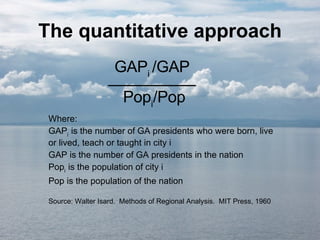
The quantitative approach GAP i  /GAP __________ Pop i /Pop Where: GAP i  is the number of GA presidents who were born, live or lived, teach or taught in city i GAP is the number of GA presidents in the nation Pop i  is the population of city i Pop is the population of the nation Source: Walter Isard.  Methods of Regional Analysis.  MIT Press, 1960
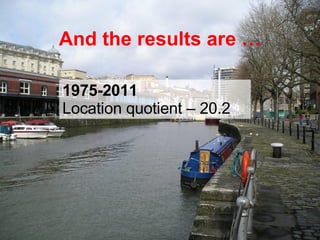
And the results are … 1975-2011 Location quotient – 20.2
How to make more young people achieve geography Ensure young people continue to    experience geography Ensure that what they experience is    high quality geography
Geography – past, present and future Where is geography now and how did it get there?
Where is geography now?  Marginalisation of geography in primary (and secondary?) schools Declining numbers at GCSE & A level Lots of satisfactory or worse    geography teaching (Ofsted) Poor public image – pub quizzes;    boring Invisibility of geographers
…  and how did it get there? The Halcyon Days of Geography(?): the whole of geography until 1991 Post-National Curriculum – the Dark Ages(?): 1991-2008 A brief history of geography
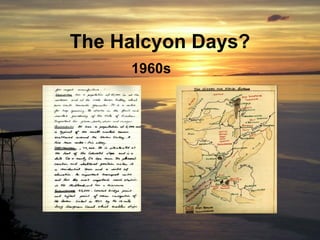
The Halcyon Days? 1960s
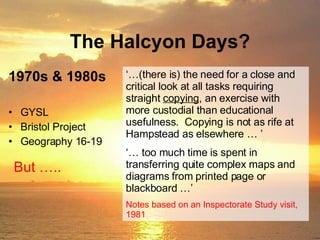
The Halcyon Days? GYSL Bristol Project Geography 16-19 But ….. ‘… (there is) the need for a close and critical look at all tasks requiring straight  copying , an exercise with more custodial than educational usefulness.  Copying is not as rife at Hampstead as elsewhere … ’ ‘…  too much time is spent in transferring quite complex maps and diagrams from printed page or blackboard …’ Notes based on an Inspectorate Study visit, 1981 1970s & 1980s
The Dark Ages? 1991-95: the 1991 National Curriculum 1995-2000: the 1995 National Curriculum 2000-08: the 2000 National Curriculum
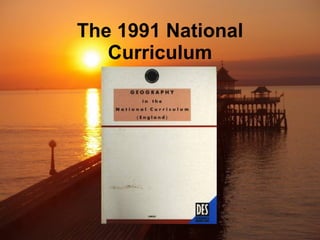
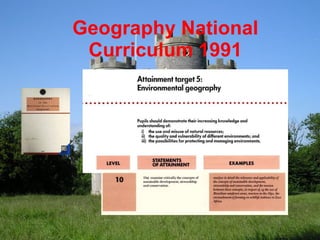
The 1991 National Curriculum
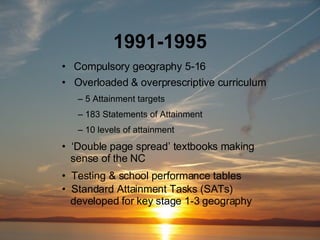
1991-1995 Compulsory geography 5-16 Overloaded & overprescriptive curriculum 5 Attainment targets 183 Statements of Attainment 10 levels of attainment Standard Attainment Tasks (SATs)    developed for key stage 1-3 geography ‘ Double page spread’ textbooks making    sense of the NC  Testing & school performance tables
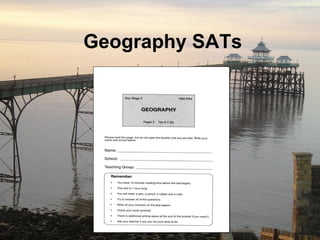
Geography SATs
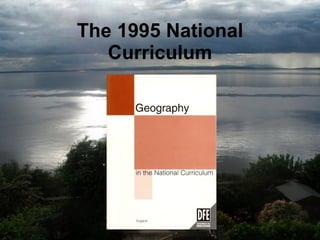
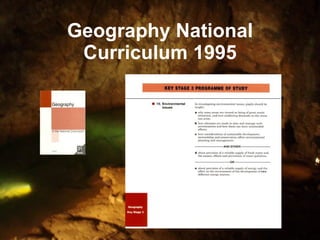
The 1995 National Curriculum
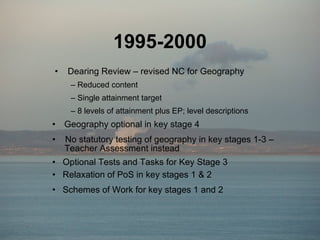
1995-2000 Geography optional in key stage 4 No statutory testing of geography in key stages 1-3 –    Teacher Assessment instead Dearing Review – revised NC for Geography Reduced content Single attainment target 8 levels of attainment plus EP; level descriptions Optional Tests and Tasks for Key Stage 3 Schemes of Work for key stages 1 and 2 Relaxation of PoS in key stages 1 & 2
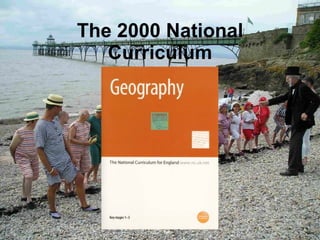
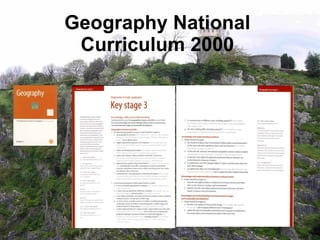
The 2000 National Curriculum
2000-08 Revised   NC for geography Further content reduction Increased flexibility through reorganisation Return to full National Curriculum in primary    schools Scheme of Work for key stage 3
So why is geography faring so badly? Are things that much worse than in 1990? Tests, league tables and subject priorities? Quality of teaching? More competition? Curriculum non-development? Non-specialist teachers/less subject support?
Geography – past, present and future What next for geography?
At the crossroads: 2008 Primary review New secondary (ie key stage 3)   curriculum  14-19 New GCSEs (2009) and A levels  Diplomas, including one for    Humanities ‘ Geography is at a crucial period in its development.  More needs to be done to make the subject relevant and more engaging for pupils, particularly at Key Stage 3’.  Christine Gilbert, HMCI
Opportunities & Challenges: Primary Review New improved geography curriculum? But: Aims of primary review – more time   for literacy & numeracy; arts &    music? PE & sport? compulsory    MFL?
Opportunities & Challenges: Key stage 3 New, improved programme of study – key concepts; flexibility But: Place of geography (& subjects    generally) in whole curriculum –    two year key stage 3? Move to    more integrated curriculum?
 
Opportunities & Challenges: 14-19 New GCSE & AS/A level specifications – scope for improving quality of geography teaching & learning But: Diplomas – new humanities    diploma - squeeze on geography    GCSE & A level?
Opportunities   provided by the new geography curriculum frameworks Opportunities & Challenges Challenges  come from the wider    curriculum framework in all key    stages & phases.  Why should    curriculum managers give geography    any sort of priority? We need to argue the case for geography (again)
A case for geography A case for geography 1987 A case for geography 2008 Different curriculum context - geography    still a statutory subject 5-14, but    subjects no longer king Audience for the case for geography    not primarily the government, but more    curriculum managers in schools
A case for geography Stick to our knitting? And become an intrinsic, pure, minority pursuit Go for legislation?  Because ‘geography is    essential’ Emphasise vocational utility – maps, GIS? Argue for extrinsic educational purpose and    the contribution geography can make to the   educated person? David Lambert.  Paper to GA Governing Body 8 Mar 2008 Choices
Geography for sustainable    development and the sustainable development of geography
A focus on sustainable development? Geography has a real opportunity to   establish itself more securely in the school   curriculum through a more explicit focus on    sustainable development Sustainable development is near the top of    society’s agenda. Government launched    Sustainable Schools strategy two years ago    - schools will be expected to become    more sustainable
The case for a sustainable development focus Sustainable development could be    to geography what literacy and    numeracy are to English and    mathematics
Sustainable development and geography The central place of English in the school curriculum owes much to the fact that it includes literacy Why can’t geography occupy a more central    place in the school curriculum because it    includes sustainable development? The central place of mathematics in the    school curriculum owes much to the fact that   it includes numeracy
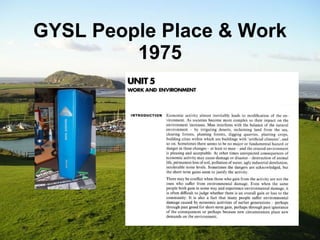
The case for a sustainable development focus We’re already doing it – and have been for many years Sustainable development could be    to geography what literacy and    numeracy are to English and    mathematics
GYSL People Place & Work 1975
Geography National Curriculum 1991
Geography National Curriculum 1995
Geography National Curriculum 2000
Geography National Curriculum 2008 Environmental interaction & sustainable development   is one of the seven key concepts identified for geography
The case for a sustainable development focus We’re already doing it – and have been for many years Significant overlap between geography    & ESD Sustainable development could be    to geography what literacy and    numeracy are to English and    mathematics
So what is ESD? ‘ ESD enables pupils to develop the knowledge, skills, understanding and values to participate in decisions about the way we do things individually and collectively, both locally and globally, that will improve the quality of life now without damaging the planet for the future’  National Curriculum 2000
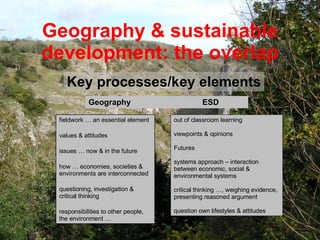
Geography & sustainable development: the overlap Key processes/key elements Geography  ESD fieldwork … an essential element values & attitudes issues … now & in the future how … economies, societies & environments are interconnected questioning, investigation & critical thinking responsibilities to other people, the environment … out of classroom learning viewpoints & opinions Futures systems approach – interaction between economic, social & environmental systems critical thinking …, weighing evidence, presenting reasoned argument question own lifestyles & attitudes
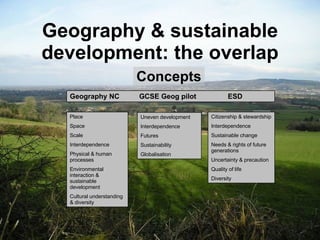
Geography & sustainable development: the overlap Concepts Geography NC  GCSE Geog pilot  ESD Place Space Scale Interdependence Physical & human processes Environmental interaction & sustainable development Cultural understanding & diversity Uneven development Interdependence Futures Sustainability Globalisation Citizenship & stewardship Interdependence Sustainable change Needs & rights of future generations Uncertainty & precaution Quality of life Diversity
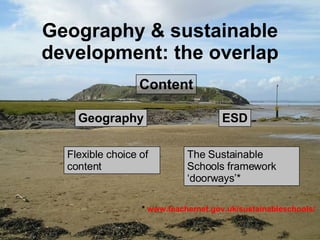
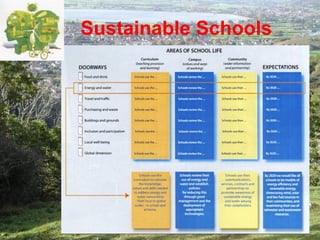
Geography & sustainable development: the overlap Content Geography Flexible choice of content ESD The Sustainable Schools framework ‘doorways’* *  www.teachernet.gov.uk/sustainableschools/
Sustainable Schools
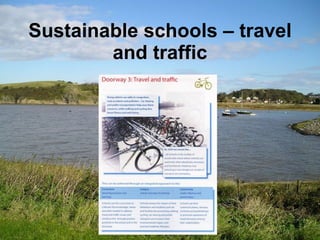
Sustainable schools – travel and traffic
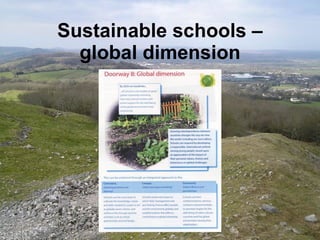
Sustainable schools – global dimension
The challenge for geography New curriculum frameworks Three more years of the    Action Plan for Geography The Sustainable Schools   strategy
Sustainable schools and geography So what do we need to do?
What can the GA do? APG sustainable development strand – curriculum development examples and online CPD on GTT website; Geography Awareness Week (23-27 June) focus on    sustainable schools Places People Want: building sustainable   communities details & online CPD on GA website; Focus on sustainable development in journals    (Primary Geographer, Autumn 2007; Teaching    Geography, articles on sustainable schools, 2008);
What can teachers do? Make sustainable development more prominent and/or explicit in your new teaching schemes Make explicit links to the Sustainable Schools framework in   your teaching schemes Check what your school is doing about the Sustainable    Schools strategy and ensure SMTs know about it and the    central role geography is, or should be, playing  Be proactive in the school’s adoption of the Sustainable Schools   framework, making clear the links to geography scheme of work Make geography indispensable – in terms of what and how you    teach and your students learn
Geography for sustainable development … …  and sustainable development of geography!

John Westaway\'s Keynote PowerPoint

  • 1.
    GA Conference 2008Presidential Address Sustaining Geography John Westaway, GA President
  • 2.
    Sustaining geography Geography– past, present and future Who are geographers and where do they come from? Where is geography now and how did it get there? What next for geography? Geography for sustainable development and the sustainable development of geography
  • 3.
    Who are geographersand where do they come from? Geography – past, present and future
  • 4.
    The invisibility ofgeographers Who and where are all the geographers? GA as Geographers Anonymous?
  • 5.
    Guess the subject!It was his love of maps, of globes and atlases, which had years ago led him, in a roundabout way, into the world of _______. So many maps had he pored over in his time that he dressed, without fully realizing, in the pastels of cartography: yellow corduroy trousers (6000-9000 feet above sea level), the jacket of darkly woven maroon (Antarctic Tundra), shirt of Viyella peach (less than 1 inch of rainfall per annum), and the red fleck on his woollen tie looked like International Boundaries or population over 500 persons per square mile.’ From: Homesickness by Murray Ball zoology and the missing word is ….
  • 6.
    Where do geographerscome from? Some are born geographers Some achieve geography Some have geography thrust upon them
  • 7.
    Some are borngeographers Daydreams in the classroom Football (Bristol City) Cricket (Gloucestershire) Pop music (Rolling Stones et al)
  • 8.
    Some have geographythrust upon them
  • 9.
    Some achieve geographyWhat attracts young people to geography? Attractions of the subject? Charismatic teachers and/or good teaching? Being good at it? Leads to a particular career?
  • 10.
    Attractions of geography?Exotic places? Issues? Physical environment? Fieldwork?
  • 11.
  • 12.
  • 13.
    Bristol – aGA President hotspot Pat Cleverley (1984-85); Vic Dennison (1980-81); Sheila Jones (1975-76)
  • 14.
    Bristol – aGA President hotspot Jeremy Krause 2001-02 Chris Kington 2002-03 Margaret Roberts 2008-09 John Hopkin 2010-11
  • 15.
    The quantitative approachGAP i /GAP __________ Pop i /Pop Where: GAP i is the number of GA presidents who were born, live or lived, teach or taught in city i GAP is the number of GA presidents in the nation Pop i is the population of city i Pop is the population of the nation Source: Walter Isard. Methods of Regional Analysis. MIT Press, 1960
  • 16.
    And the resultsare … 1975-2011 Location quotient – 20.2
  • 17.
    How to makemore young people achieve geography Ensure young people continue to experience geography Ensure that what they experience is high quality geography
  • 18.
    Geography – past,present and future Where is geography now and how did it get there?
  • 19.
    Where is geographynow? Marginalisation of geography in primary (and secondary?) schools Declining numbers at GCSE & A level Lots of satisfactory or worse geography teaching (Ofsted) Poor public image – pub quizzes; boring Invisibility of geographers
  • 20.
    … andhow did it get there? The Halcyon Days of Geography(?): the whole of geography until 1991 Post-National Curriculum – the Dark Ages(?): 1991-2008 A brief history of geography
  • 21.
  • 22.
    The Halcyon Days?GYSL Bristol Project Geography 16-19 But ….. ‘… (there is) the need for a close and critical look at all tasks requiring straight copying , an exercise with more custodial than educational usefulness. Copying is not as rife at Hampstead as elsewhere … ’ ‘… too much time is spent in transferring quite complex maps and diagrams from printed page or blackboard …’ Notes based on an Inspectorate Study visit, 1981 1970s & 1980s
  • 23.
    The Dark Ages?1991-95: the 1991 National Curriculum 1995-2000: the 1995 National Curriculum 2000-08: the 2000 National Curriculum
  • 24.
  • 25.
    1991-1995 Compulsory geography5-16 Overloaded & overprescriptive curriculum 5 Attainment targets 183 Statements of Attainment 10 levels of attainment Standard Attainment Tasks (SATs) developed for key stage 1-3 geography ‘ Double page spread’ textbooks making sense of the NC Testing & school performance tables
  • 26.
  • 27.
  • 28.
    1995-2000 Geography optionalin key stage 4 No statutory testing of geography in key stages 1-3 – Teacher Assessment instead Dearing Review – revised NC for Geography Reduced content Single attainment target 8 levels of attainment plus EP; level descriptions Optional Tests and Tasks for Key Stage 3 Schemes of Work for key stages 1 and 2 Relaxation of PoS in key stages 1 & 2
  • 29.
  • 30.
    2000-08 Revised NC for geography Further content reduction Increased flexibility through reorganisation Return to full National Curriculum in primary schools Scheme of Work for key stage 3
  • 31.
    So why isgeography faring so badly? Are things that much worse than in 1990? Tests, league tables and subject priorities? Quality of teaching? More competition? Curriculum non-development? Non-specialist teachers/less subject support?
  • 32.
    Geography – past,present and future What next for geography?
  • 33.
    At the crossroads:2008 Primary review New secondary (ie key stage 3) curriculum 14-19 New GCSEs (2009) and A levels Diplomas, including one for Humanities ‘ Geography is at a crucial period in its development. More needs to be done to make the subject relevant and more engaging for pupils, particularly at Key Stage 3’. Christine Gilbert, HMCI
  • 34.
    Opportunities & Challenges:Primary Review New improved geography curriculum? But: Aims of primary review – more time for literacy & numeracy; arts & music? PE & sport? compulsory MFL?
  • 35.
    Opportunities & Challenges:Key stage 3 New, improved programme of study – key concepts; flexibility But: Place of geography (& subjects generally) in whole curriculum – two year key stage 3? Move to more integrated curriculum?
  • 36.
  • 37.
    Opportunities & Challenges:14-19 New GCSE & AS/A level specifications – scope for improving quality of geography teaching & learning But: Diplomas – new humanities diploma - squeeze on geography GCSE & A level?
  • 38.
    Opportunities provided by the new geography curriculum frameworks Opportunities & Challenges Challenges come from the wider curriculum framework in all key stages & phases. Why should curriculum managers give geography any sort of priority? We need to argue the case for geography (again)
  • 39.
    A case forgeography A case for geography 1987 A case for geography 2008 Different curriculum context - geography still a statutory subject 5-14, but subjects no longer king Audience for the case for geography not primarily the government, but more curriculum managers in schools
  • 40.
    A case forgeography Stick to our knitting? And become an intrinsic, pure, minority pursuit Go for legislation? Because ‘geography is essential’ Emphasise vocational utility – maps, GIS? Argue for extrinsic educational purpose and the contribution geography can make to the educated person? David Lambert. Paper to GA Governing Body 8 Mar 2008 Choices
  • 41.
    Geography for sustainable development and the sustainable development of geography
  • 42.
    A focus onsustainable development? Geography has a real opportunity to establish itself more securely in the school curriculum through a more explicit focus on sustainable development Sustainable development is near the top of society’s agenda. Government launched Sustainable Schools strategy two years ago - schools will be expected to become more sustainable
  • 43.
    The case fora sustainable development focus Sustainable development could be to geography what literacy and numeracy are to English and mathematics
  • 44.
    Sustainable development andgeography The central place of English in the school curriculum owes much to the fact that it includes literacy Why can’t geography occupy a more central place in the school curriculum because it includes sustainable development? The central place of mathematics in the school curriculum owes much to the fact that it includes numeracy
  • 45.
    The case fora sustainable development focus We’re already doing it – and have been for many years Sustainable development could be to geography what literacy and numeracy are to English and mathematics
  • 46.
    GYSL People Place& Work 1975
  • 47.
  • 48.
  • 49.
  • 50.
    Geography National Curriculum2008 Environmental interaction & sustainable development is one of the seven key concepts identified for geography
  • 51.
    The case fora sustainable development focus We’re already doing it – and have been for many years Significant overlap between geography & ESD Sustainable development could be to geography what literacy and numeracy are to English and mathematics
  • 52.
    So what isESD? ‘ ESD enables pupils to develop the knowledge, skills, understanding and values to participate in decisions about the way we do things individually and collectively, both locally and globally, that will improve the quality of life now without damaging the planet for the future’ National Curriculum 2000
  • 53.
    Geography & sustainabledevelopment: the overlap Key processes/key elements Geography ESD fieldwork … an essential element values & attitudes issues … now & in the future how … economies, societies & environments are interconnected questioning, investigation & critical thinking responsibilities to other people, the environment … out of classroom learning viewpoints & opinions Futures systems approach – interaction between economic, social & environmental systems critical thinking …, weighing evidence, presenting reasoned argument question own lifestyles & attitudes
  • 54.
    Geography & sustainabledevelopment: the overlap Concepts Geography NC GCSE Geog pilot ESD Place Space Scale Interdependence Physical & human processes Environmental interaction & sustainable development Cultural understanding & diversity Uneven development Interdependence Futures Sustainability Globalisation Citizenship & stewardship Interdependence Sustainable change Needs & rights of future generations Uncertainty & precaution Quality of life Diversity
  • 55.
    Geography & sustainabledevelopment: the overlap Content Geography Flexible choice of content ESD The Sustainable Schools framework ‘doorways’* * www.teachernet.gov.uk/sustainableschools/
  • 56.
  • 57.
    Sustainable schools –travel and traffic
  • 58.
    Sustainable schools –global dimension
  • 59.
    The challenge forgeography New curriculum frameworks Three more years of the Action Plan for Geography The Sustainable Schools strategy
  • 60.
    Sustainable schools andgeography So what do we need to do?
  • 61.
    What can theGA do? APG sustainable development strand – curriculum development examples and online CPD on GTT website; Geography Awareness Week (23-27 June) focus on sustainable schools Places People Want: building sustainable communities details & online CPD on GA website; Focus on sustainable development in journals (Primary Geographer, Autumn 2007; Teaching Geography, articles on sustainable schools, 2008);
  • 62.
    What can teachersdo? Make sustainable development more prominent and/or explicit in your new teaching schemes Make explicit links to the Sustainable Schools framework in your teaching schemes Check what your school is doing about the Sustainable Schools strategy and ensure SMTs know about it and the central role geography is, or should be, playing Be proactive in the school’s adoption of the Sustainable Schools framework, making clear the links to geography scheme of work Make geography indispensable – in terms of what and how you teach and your students learn
  • 63.
    Geography for sustainabledevelopment … … and sustainable development of geography!