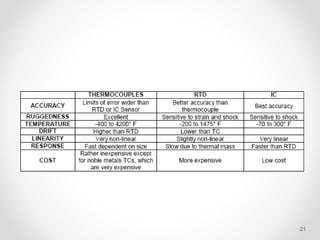
Pendahuluan
Prinsip Akusisi
Sensor dan Transduser
Koneksi dan tipe sumber sinyal
Pengkondisian Sinyal
Konversi Sinyal
2
4
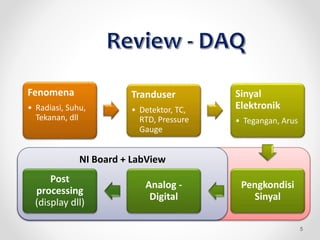
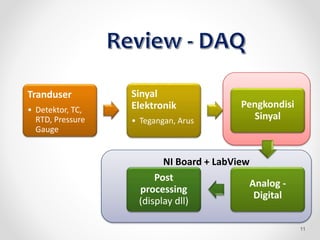
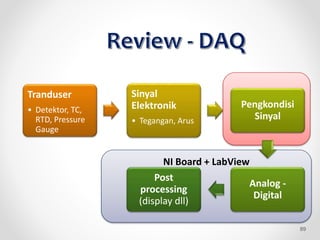
NI Board + LabView
5
Fenomena
• Radiasi, Suhu,
Tekanan, dll
Tranduser
• Detektor, TC,
RTD, Pressure
Gauge
Sinyal
Elektronik
• Tegangan, Arus
Pengkondisi
Sinyal
Analog -
Digital
Post
processing
(display dll)
6
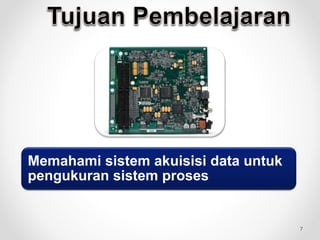
Memahami sistem akuisisi data untuk
pengukuran sistem proses
7
Indikator Keberhasilan
Mampu menjelaskan arsitektur sistem akuisisi data
Mampu menjelaskan cara kerja sensor dan transducer
Menerapkan teknik pengkondisian sinyal, akuisisi data
analog dan digital, serta pembangkitan sinyal analog dan
digital
Menerapkan fitur-fitur konfigurasi perangkat keras NI untuk
aplikasi akuisisi data
8
10
NI Board + LabView
11
Tranduser
• Detektor, TC,
RTD, Pressure
Gauge
Sinyal
Elektronik
• Tegangan, Arus
Pengkondisi
Sinyal
Analog -
Digital
Post
processing
(display dll)
12
Perangkat
Keras DAQ
Driver Perangkat Keras
(contoh NIDAQmx)
Sensor, dll
Aplikasi dg
LabVIEW
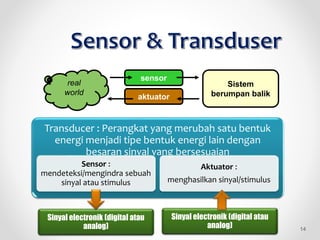
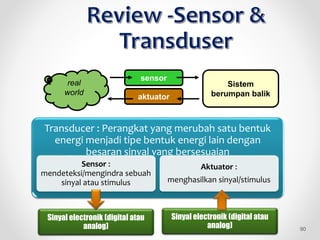
Transducer : Perangkat yang merubah satu bentuk
energi menjadi tipe bentuk energi lain dengan
besaran sinyal yang bersesuaian
Sensor :
mendeteksi/mengindra sebuah
sinyal atau stimulus
Aktuator :
menghasilkan sinyal/stimulus
14
real
world
sensor
aktuator
Sistem
berumpan balik
Sinyal electronik (digital atau
analog)
Sinyal electronik (digital atau
analog)
15
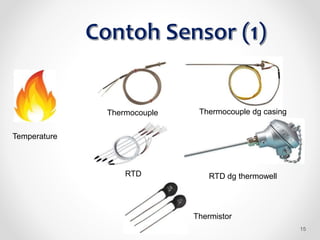
Temperature
Thermocouple Thermocouple dg casing
RTD RTD dg thermowell
Thermistor
16
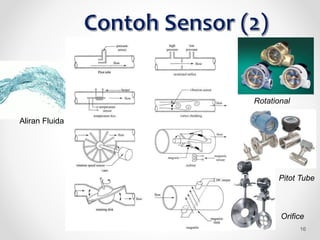
Aliran Fluida
Rotational
Pitot Tube
Orifice
17
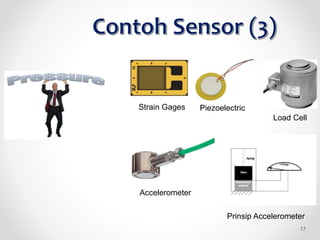
Strain Gages Piezoelectric
Accelerometer
Load Cell
Prinsip Accelerometer
18
19
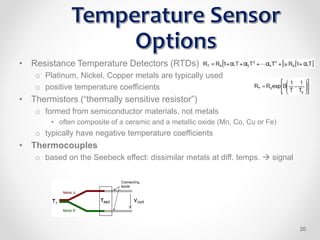
• Resistance Temperature Detectors (RTDs)
o Platinum, Nickel, Copper metals are typically used
o positive temperature coefficients
• Thermistors (“thermally sensitive resistor”)
o formed from semiconductor materials, not metals
• often composite of a ceramic and a metallic oxide (Mn, Co, Cu or Fe)
o typically have negative temperature coefficients
• Thermocouples
o based on the Seebeck effect: dissimilar metals at diff. temps.  signal
20
21
TYPE METAL  [V/oC] RANGE [OC]
B Platinum 6 % Rhodium –
Platinum 30 % Rhodium
6 0 to 1820
E Nickel – Constantan 58.5 -270 to 1000
J Iron – Constntan 50.2 -210 to 760
K Nickel 10 % Cr – Nickel 39.4 -270 to 1372
N (AWG 14) Nicrosil – Nisil 39 0 to 1300
N (AWG 28) Nicrosil – Nisil 26.2 -270 to 400
R Platinum 13 % Rhodium –
Platinum
11.5 -50 to 1768
S Platinum 10% Rhodium –
Platinum
10.3 -50 to 1768
T Copper - Constantan 38 -270 to 400
W-Re Tungsten 5 % Rhodium –
Tungsten 26 % Rhodium
19.5 0 to 2320
22
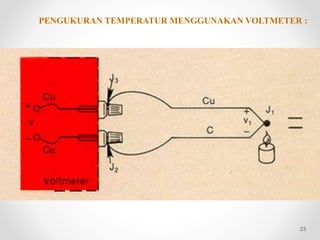
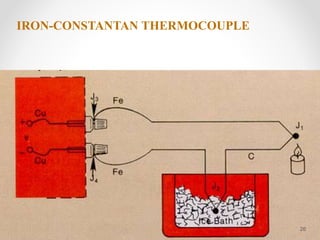
PENGUKURAN TEMPERATUR MENGGUNAKAN VOLTMETER :
23
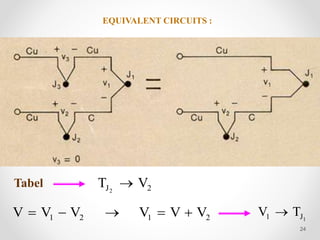
EQUIVALENT CIRCUITS :
2
1
2
1 V
V
V
V
V
V 




Tabel 2
J V
T 2

1
J
1 T
V 
24
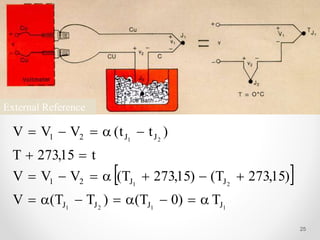
External Reference
 
1
1
2
1
2
1
2
1
J
J
J
J
J
J
2
1
J
J
2
1
T
)
0
T
(
)
T
T
(
V
)
15
,
273
T
(
)
15
,
273
T
(
V
V
V
t
15
,
273
T
)
t
t
(
V
V
V






















25
IRON-CONSTANTAN THERMOCOUPLE
26
27
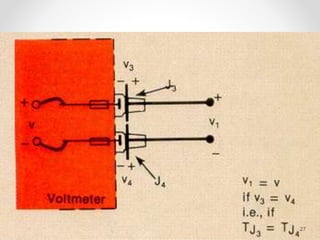
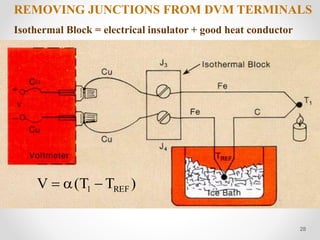
REMOVING JUNCTIONS FROM DVM TERMINALS
Isothermal Block = electrical insulator + good heat conductor
)
T
T
(
V REF
1 


28
29
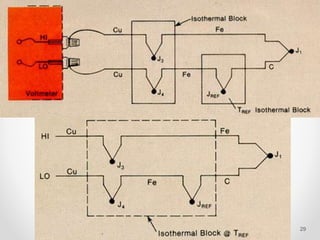
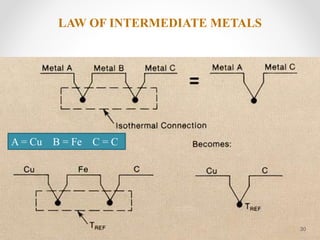
LAW OF INTERMEDIATE METALS
A = Cu B = Fe C = C
30
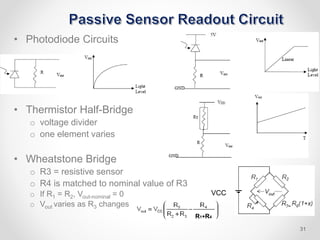
• Photodiode Circuits
• Thermistor Half-Bridge
o voltage divider
o one element varies
• Wheatstone Bridge
o R3 = resistive sensor
o R4 is matched to nominal value of R3
o If R1 = R2, Vout-nominal = 0
o Vout varies as R3 changes
VCC
R1+R4
31
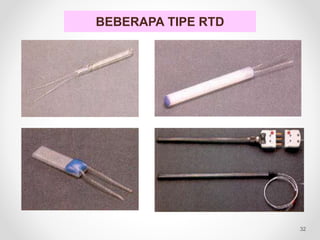
BEBERAPA TIPE RTD
32
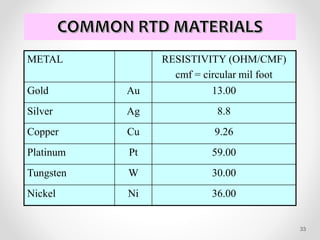
METAL RESISTIVITY (OHM/CMF)
cmf = circular mil foot
Gold Au 13.00
Silver Ag 8.8
Copper Cu 9.26
Platinum Pt 59.00
Tungsten W 30.00
Nickel Ni 36.00
33
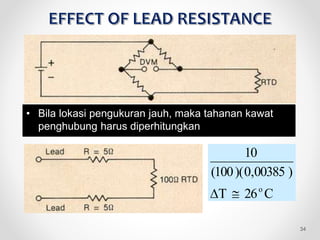
• Bila lokasi pengukuran jauh, maka tahanan kawat
penghubung harus diperhitungkan
C
26
T
)
00385
,
0
)(
100
(
10
o


34
• Bila tahanan kawat A dan B sama besar, maka efeknya
pada tegangan output akan saling meniadakan
• Hubungan antara tegangan output dan tahanan RTD
menjadi tidak linier
S
A
B
T
B
T
o V
R
R
R
R
R
R
V 













)
(
)
(
)
(
2
1
3
35
• Bila arus yang mengalir melalui RTD cukup besar,
maka daya disipasi yang terjadi akan menyebabkan
temperatur RTD naik meskipun temperatur ruangan
yang akan diukur tidak berubah.
• Terjadi kesalahan pengukuran yang disebut self heating
error, dinyatakan dengan oC/mW
• Daya disipasi dapat dihitung dari P = I2 RT
36
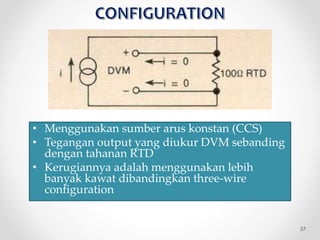
• Menggunakan sumber arus konstan (CCS)
• Tegangan output yang diukur DVM sebanding
dengan tahanan RTD
• Kerugiannya adalah menggunakan lebih
banyak kawat dibandingkan three-wire
configuration
37
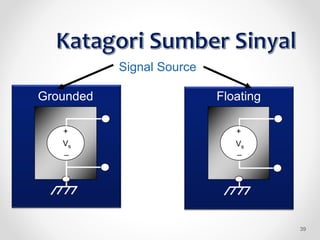
Grounded
+
_
Vs
Floating
+
_
Vs
Signal Source
39
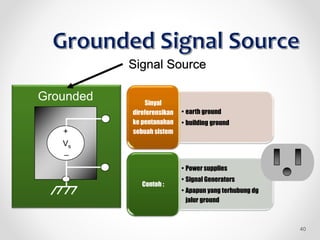
• earth ground
• building ground
Sinyal
direferensikan
ke pentanahan
sebuah sistem
• Power supplies
• Signal Generators
• Apapun yang terhubung dg
jalur ground
Contoh :
Grounded
+
_
Vs
Signal Source
40
Floating
• earth ground
• building ground
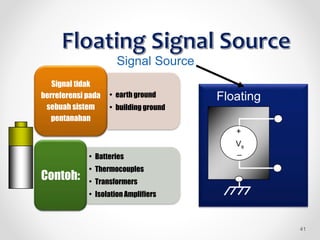
Signal tidak
berreferensi pada
sebuah sistem
pentanahan
• Batteries
• Thermocouples
• Transformers
• Isolation Amplifiers
Contoh:
+
_
Vs
Signal Source
41
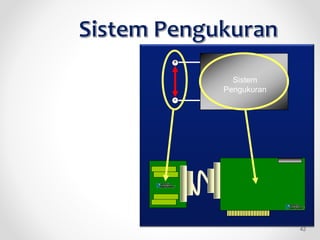
Sistem
Pengukuran
-
+
42
VM
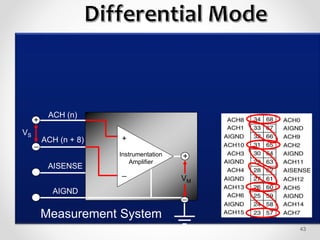
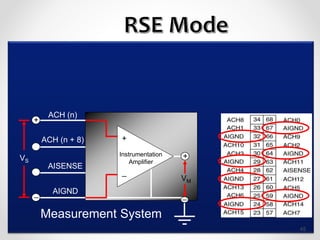
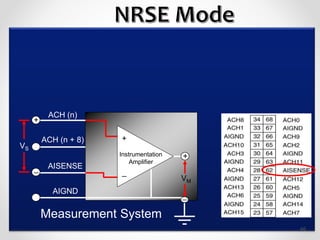
ACH (n)
ACH (n + 8)
+
_
Instrumentation
Amplifier
+
_
VS
+
_
AISENSE
AIGND
Measurement System
43
44
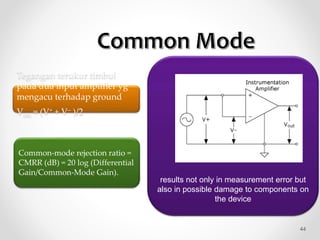
Tegangan terukur timbul
pada dua input amplifier yg
mengacu terhadap ground
Vcm = (V+ + V– )/2
Common-mode rejection ratio =
CMRR (dB) = 20 log (Differential
Gain/Common-Mode Gain).
results not only in measurement error but
also in possible damage to components on
the device
VM
ACH (n)
ACH (n + 8)
+
_
Instrumentation
Amplifier
+
_
VS
+
AISENSE
AIGND
_
Measurement System
45
VM
ACH (n)
ACH (n + 8)
+
_
Instrumentation
Amplifier
+
_
VS
+
_ AISENSE
AIGND
Measurement System
46
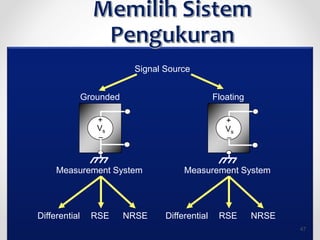
Signal Source
Differential RSE NRSE
Measurement System
Grounded
+
_
Vs
Floating
+
_
Vs
Differential RSE NRSE
Measurement System
47
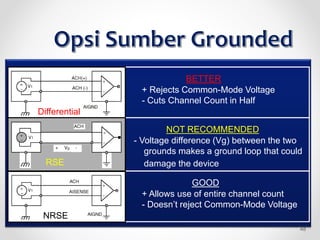
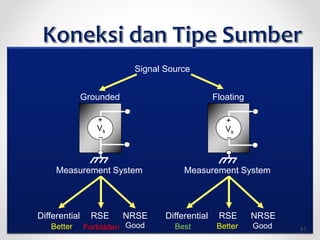
RSE
NRSE
Differential
BETTER
+ Rejects Common-Mode Voltage
- Cuts Channel Count in Half
NOT RECOMMENDED
- Voltage difference (Vg) between the two
grounds makes a ground loop that could
damage the device
GOOD
+ Allows use of entire channel count
- Doesn’t reject Common-Mode Voltage
48
RSE
NRSE
Differential
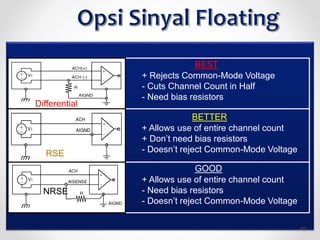
BEST
+ Rejects Common-Mode Voltage
- Cuts Channel Count in Half
- Need bias resistors
BETTER
+ Allows use of entire channel count
+ Don’t need bias resistors
- Doesn’t reject Common-Mode Voltage
GOOD
+ Allows use of entire channel count
- Need bias resistors
- Doesn’t reject Common-Mode Voltage
49
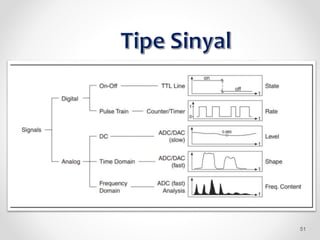
51
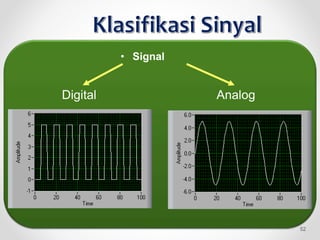
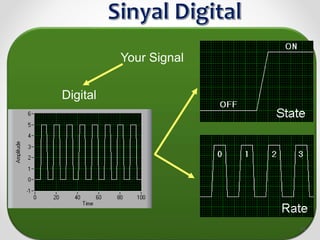
• Signal
Analog
Digital
52
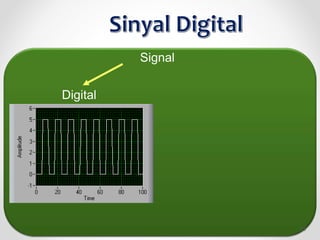
Digital
Signal
53
Digital
Your Signal
54
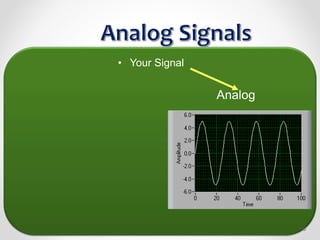
• Your Signal
Analog
55
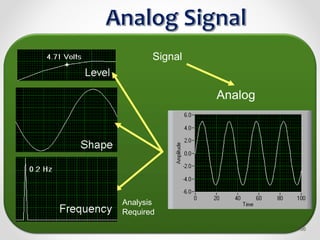
Signal
Analog
Analysis
Required
56
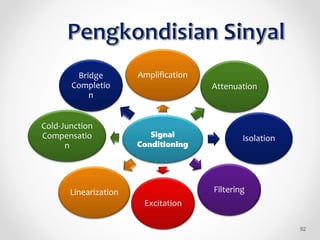
58
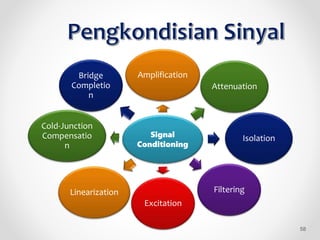
Signal
Conditioning
Amplification
Attenuation
Isolation
Filtering
Excitation
Linearization
Cold-Junction
Compensatio
n
Bridge
Completio
n
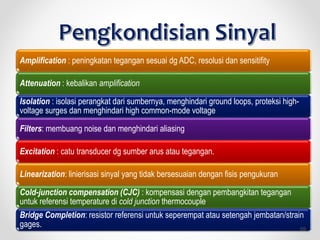
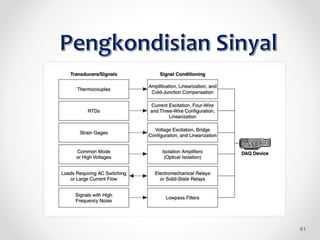
Amplification : peningkatan tegangan sesuai dg ADC, resolusi dan sensitifity
Attenuation : kebalikan amplification
Isolation : isolasi perangkat dari sumbernya, menghindari ground loops, proteksi high-
voltage surges dan menghindari high common-mode voltage
Filters: membuang noise dan menghindari aliasing
Excitation : catu transducer dg sumber arus atau tegangan.
Linearization: linierisasi sinyal yang tidak bersesuaian dengan fisis pengukuran
Cold-junction compensation (CJC) : kompensasi dengan pembangkitan tegangan
untuk referensi temperature di cold junction thermocouple
Bridge Completion: resistor referensi untuk seperempat atau setengah jembatan/strain
gages. 59
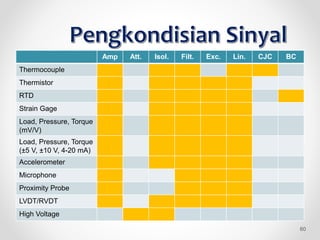
Amp Att. Isol. Filt. Exc. Lin. CJC BC
Thermocouple
Thermistor
RTD
Strain Gage
Load, Pressure, Torque
(mV/V)
Load, Pressure, Torque
(±5 V, ±10 V, 4-20 mA)
Accelerometer
Microphone
Proximity Probe
LVDT/RVDT
High Voltage
60
61
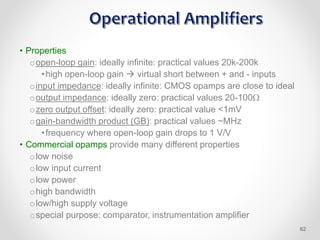
• Properties
oopen-loop gain: ideally infinite: practical values 20k-200k
•high open-loop gain  virtual short between + and - inputs
oinput impedance: ideally infinite: CMOS opamps are close to ideal
ooutput impedance: ideally zero: practical values 20-100
ozero output offset: ideally zero: practical value <1mV
ogain-bandwidth product (GB): practical values ~MHz
•frequency where open-loop gain drops to 1 V/V
• Commercial opamps provide many different properties
olow noise
olow input current
olow power
ohigh bandwidth
olow/high supply voltage
ospecial purpose: comparator, instrumentation amplifier
62
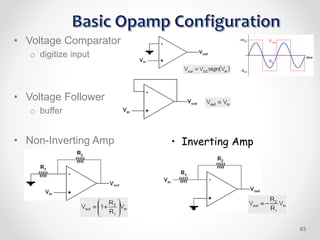
• Voltage Comparator
o digitize input
• Voltage Follower
o buffer
• Non-Inverting Amp • Inverting Amp
63
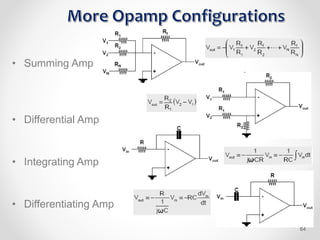
• Summing Amp
• Differential Amp
• Integrating Amp
• Differentiating Amp
64
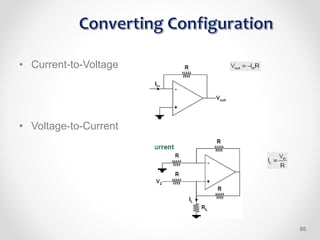
• Current-to-Voltage
• Voltage-to-Current
65
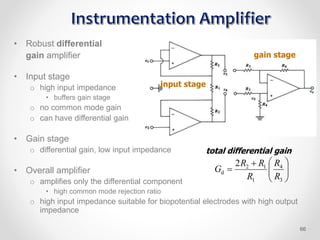
• Robust differential
gain amplifier
• Input stage
o high input impedance
• buffers gain stage
o no common mode gain
o can have differential gain
• Gain stage
o differential gain, low input impedance
• Overall amplifier
o amplifies only the differential component
• high common mode rejection ratio
o high input impedance suitable for biopotential electrodes with high output
impedance
input stage
gain stage










3
4
1
1
2
d
2
R
R
R
R
R
G
total differential gain
66
instrumentation amplifier
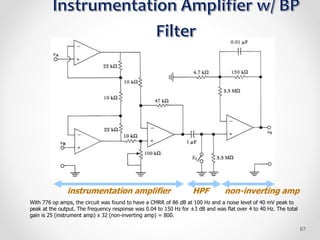
With 776 op amps, the circuit was found to have a CMRR of 86 dB at 100 Hz and a noise level of 40 mV peak to
peak at the output. The frequency response was 0.04 to 150 Hz for ±3 dB and was flat over 4 to 40 Hz. The total
gain is 25 (instrument amp) x 32 (non-inverting amp) = 800.
HPF non-inverting amp
67
69
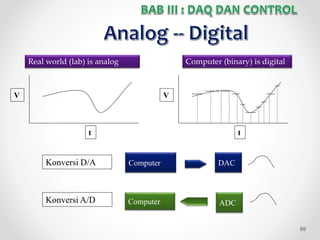
Real world (lab) is analog
V
t t
Computer (binary) is digital
Konversi D/A Computer DAC
ADC
Konversi A/D
V
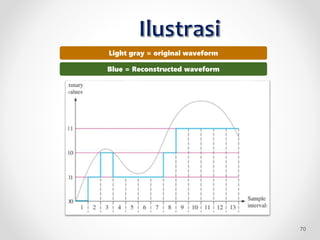
Light gray = original waveform
Blue = Reconstructed waveform
70
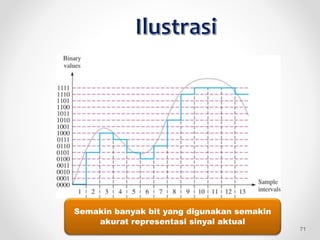
Semakin banyak bit yang digunakan semakin
akurat representasi sinyal aktual
71
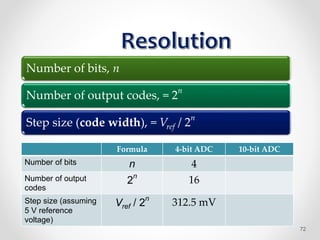
Number of bits, n
Number of output codes, = 2
n
Step size (code width), = Vref / 2
n
Formula 4-bit ADC 10-bit ADC
Number of bits n 4
Number of output
codes
2
n
16
Step size (assuming
5 V reference
voltage)
Vref / 2
n
312.5 mV
72
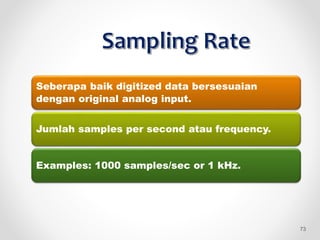
Seberapa baik digitized data bersesuaian
dengan original analog input.
Jumlah samples per second atau frequency.
Examples: 1000 samples/sec or 1 kHz.
73
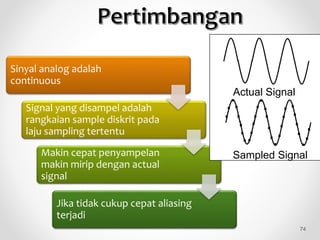
Sinyal analog adalah
continuous
Signal yang disampel adalah
rangkaian sample diskrit pada
laju sampling tertentu
Makin cepat penyampelan
makin mirip dengan actual
signal
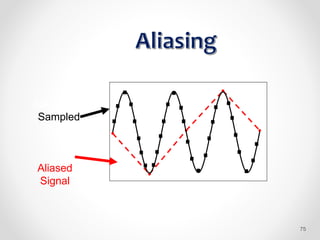
Jika tidak cukup cepat aliasing
terjadi
Actual Signal
Sampled Signal
74
Adequately
Sampled
Signal
Aliased
Signal
75
Di sample dua kali lebih besar dari
komponen frekuensi maksimum
Harus di sample antara 5 - 10 lebih besar dari
frekuensi maksimum untuk menggambarkan
bentuk sinyal dg akurat
76
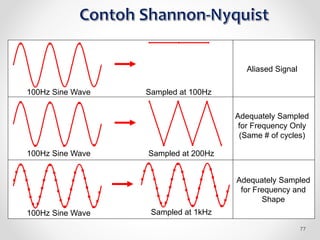
Aliased Signal
Adequately Sampled
for Frequency Only
(Same # of cycles)
Adequately Sampled
for Frequency and
Shape
100Hz Sine Wave
100Hz Sine Wave
Sampled at 100Hz
Sampled at 200Hz
Sampled at 1kHz
100Hz Sine Wave
77
79
80
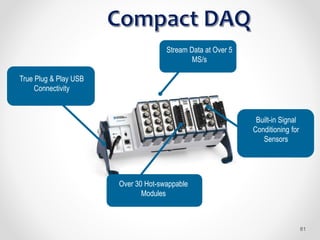
True Plug & Play USB
Connectivity
Built-in Signal Conditioning
Over 30 Hot-swappable
Modules
Built-in Signal
Conditioning for
Sensors
Stream Data at Over 5
MS/s
81
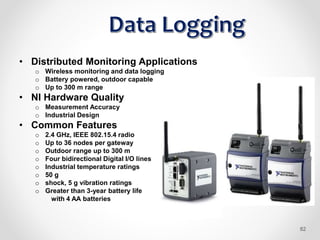
• Distributed Monitoring Applications
o Wireless monitoring and data logging
o Battery powered, outdoor capable
o Up to 300 m range
• NI Hardware Quality
o Measurement Accuracy
o Industrial Design
• Common Features
o 2.4 GHz, IEEE 802.15.4 radio
o Up to 36 nodes per gateway
o Outdoor range up to 300 m
o Four bidirectional Digital I/O lines
o Industrial temperature ratings
o 50 g
o shock, 5 g vibration ratings
o Greater than 3-year battery life
with 4 AA batteries
82
83
84
85
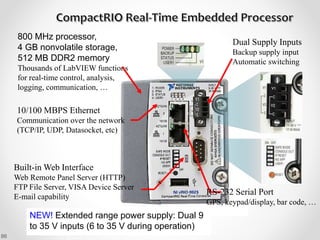
RS-232 Serial Port
GPS, keypad/display, bar code, …
800 MHz processor,
4 GB nonvolatile storage,
512 MB DDR2 memory
Thousands of LabVIEW functions
for real-time control, analysis,
logging, communication, …
10/100 MBPS Ethernet
Communication over the network
(TCP/IP, UDP, Datasocket, etc)
Built-in Web Interface
Web Remote Panel Server (HTTP)
FTP File Server, VISA Device Server
E-mail capability
Dual Supply Inputs
Backup supply input
Automatic switching
NEW! Extended range power supply: Dual 9
to 35 V inputs (6 to 35 V during operation)
86
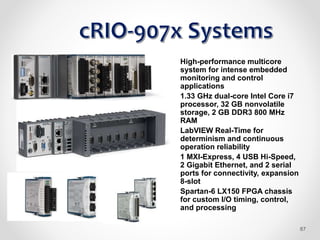
• High-performance multicore
system for intense embedded
monitoring and control
applications
• 1.33 GHz dual-core Intel Core i7
processor, 32 GB nonvolatile
storage, 2 GB DDR3 800 MHz
RAM
• LabVIEW Real-Time for
determinism and continuous
operation reliability
• 1 MXI-Express, 4 USB Hi-Speed,
2 Gigabit Ethernet, and 2 serial
ports for connectivity, expansion
8-slot
• Spartan-6 LX150 FPGA chassis
for custom I/O timing, control,
and processing
87
NI Board + LabView
89
Tranduser
• Detektor, TC,
RTD, Pressure
Gauge
Sinyal
Elektronik
• Tegangan, Arus
Pengkondisi
Sinyal
Analog -
Digital
Post
processing
(display dll)
Transducer : Perangkat yang merubah satu bentuk
energi menjadi tipe bentuk energi lain dengan
besaran sinyal yang bersesuaian
Sensor :
mendeteksi/mengindra sebuah
sinyal atau stimulus
Aktuator :
menghasilkan sinyal/stimulus
90
real
world
sensor
aktuator
Sistem
berumpan balik
Sinyal electronik (digital atau
analog)
Sinyal electronik (digital atau
analog)
Signal Source
Differential RSE NRSE
Measurement System
Grounded
+
_
Vs
Floating
+
_
Vs
Differential RSE NRSE
Measurement System
Best Better Good
Better Good
Forbidden 91
92
Signal
Conditioning
Amplification
Attenuation
Isolation
Filtering
Excitation
Linearization
Cold-Junction
Compensatio
n
Bridge
Completio
n
Akuisisi data.pptx
Akuisisi data.pptx

Akuisisi data.pptx

  • 2.
    Pendahuluan Prinsip Akusisi Sensor danTransduser Koneksi dan tipe sumber sinyal Pengkondisian Sinyal Konversi Sinyal 2
  • 4.
  • 5.
    NI Board +LabView 5 Fenomena • Radiasi, Suhu, Tekanan, dll Tranduser • Detektor, TC, RTD, Pressure Gauge Sinyal Elektronik • Tegangan, Arus Pengkondisi Sinyal Analog - Digital Post processing (display dll)
  • 6.
  • 7.
    Memahami sistem akuisisidata untuk pengukuran sistem proses 7
  • 8.
    Indikator Keberhasilan Mampu menjelaskanarsitektur sistem akuisisi data Mampu menjelaskan cara kerja sensor dan transducer Menerapkan teknik pengkondisian sinyal, akuisisi data analog dan digital, serta pembangkitan sinyal analog dan digital Menerapkan fitur-fitur konfigurasi perangkat keras NI untuk aplikasi akuisisi data 8
  • 10.
  • 11.
    NI Board +LabView 11 Tranduser • Detektor, TC, RTD, Pressure Gauge Sinyal Elektronik • Tegangan, Arus Pengkondisi Sinyal Analog - Digital Post processing (display dll)
  • 12.
    12 Perangkat Keras DAQ Driver PerangkatKeras (contoh NIDAQmx) Sensor, dll Aplikasi dg LabVIEW
  • 14.
    Transducer : Perangkatyang merubah satu bentuk energi menjadi tipe bentuk energi lain dengan besaran sinyal yang bersesuaian Sensor : mendeteksi/mengindra sebuah sinyal atau stimulus Aktuator : menghasilkan sinyal/stimulus 14 real world sensor aktuator Sistem berumpan balik Sinyal electronik (digital atau analog) Sinyal electronik (digital atau analog)
  • 15.
    15 Temperature Thermocouple Thermocouple dgcasing RTD RTD dg thermowell Thermistor
  • 16.
  • 17.
  • 18.
  • 19.
  • 20.
    • Resistance TemperatureDetectors (RTDs) o Platinum, Nickel, Copper metals are typically used o positive temperature coefficients • Thermistors (“thermally sensitive resistor”) o formed from semiconductor materials, not metals • often composite of a ceramic and a metallic oxide (Mn, Co, Cu or Fe) o typically have negative temperature coefficients • Thermocouples o based on the Seebeck effect: dissimilar metals at diff. temps.  signal 20
  • 21.
  • 22.
    TYPE METAL [V/oC] RANGE [OC] B Platinum 6 % Rhodium – Platinum 30 % Rhodium 6 0 to 1820 E Nickel – Constantan 58.5 -270 to 1000 J Iron – Constntan 50.2 -210 to 760 K Nickel 10 % Cr – Nickel 39.4 -270 to 1372 N (AWG 14) Nicrosil – Nisil 39 0 to 1300 N (AWG 28) Nicrosil – Nisil 26.2 -270 to 400 R Platinum 13 % Rhodium – Platinum 11.5 -50 to 1768 S Platinum 10% Rhodium – Platinum 10.3 -50 to 1768 T Copper - Constantan 38 -270 to 400 W-Re Tungsten 5 % Rhodium – Tungsten 26 % Rhodium 19.5 0 to 2320 22
  • 23.
  • 24.
    EQUIVALENT CIRCUITS : 2 1 2 1V V V V V V      Tabel 2 J V T 2  1 J 1 T V  24
  • 25.
  • 26.
  • 27.
  • 28.
    REMOVING JUNCTIONS FROMDVM TERMINALS Isothermal Block = electrical insulator + good heat conductor ) T T ( V REF 1    28
  • 29.
  • 30.
    LAW OF INTERMEDIATEMETALS A = Cu B = Fe C = C 30
  • 31.
    • Photodiode Circuits •Thermistor Half-Bridge o voltage divider o one element varies • Wheatstone Bridge o R3 = resistive sensor o R4 is matched to nominal value of R3 o If R1 = R2, Vout-nominal = 0 o Vout varies as R3 changes VCC R1+R4 31
  • 32.
  • 33.
    METAL RESISTIVITY (OHM/CMF) cmf= circular mil foot Gold Au 13.00 Silver Ag 8.8 Copper Cu 9.26 Platinum Pt 59.00 Tungsten W 30.00 Nickel Ni 36.00 33
  • 34.
    • Bila lokasipengukuran jauh, maka tahanan kawat penghubung harus diperhitungkan C 26 T ) 00385 , 0 )( 100 ( 10 o   34
  • 35.
    • Bila tahanankawat A dan B sama besar, maka efeknya pada tegangan output akan saling meniadakan • Hubungan antara tegangan output dan tahanan RTD menjadi tidak linier S A B T B T o V R R R R R R V               ) ( ) ( ) ( 2 1 3 35
  • 36.
    • Bila arusyang mengalir melalui RTD cukup besar, maka daya disipasi yang terjadi akan menyebabkan temperatur RTD naik meskipun temperatur ruangan yang akan diukur tidak berubah. • Terjadi kesalahan pengukuran yang disebut self heating error, dinyatakan dengan oC/mW • Daya disipasi dapat dihitung dari P = I2 RT 36
  • 37.
    • Menggunakan sumberarus konstan (CCS) • Tegangan output yang diukur DVM sebanding dengan tahanan RTD • Kerugiannya adalah menggunakan lebih banyak kawat dibandingkan three-wire configuration 37
  • 39.
  • 40.
    • earth ground •building ground Sinyal direferensikan ke pentanahan sebuah sistem • Power supplies • Signal Generators • Apapun yang terhubung dg jalur ground Contoh : Grounded + _ Vs Signal Source 40
  • 41.
    Floating • earth ground •building ground Signal tidak berreferensi pada sebuah sistem pentanahan • Batteries • Thermocouples • Transformers • Isolation Amplifiers Contoh: + _ Vs Signal Source 41
  • 42.
  • 43.
    VM ACH (n) ACH (n+ 8) + _ Instrumentation Amplifier + _ VS + _ AISENSE AIGND Measurement System 43
  • 44.
    44 Tegangan terukur timbul padadua input amplifier yg mengacu terhadap ground Vcm = (V+ + V– )/2 Common-mode rejection ratio = CMRR (dB) = 20 log (Differential Gain/Common-Mode Gain). results not only in measurement error but also in possible damage to components on the device
  • 45.
    VM ACH (n) ACH (n+ 8) + _ Instrumentation Amplifier + _ VS + AISENSE AIGND _ Measurement System 45
  • 46.
    VM ACH (n) ACH (n+ 8) + _ Instrumentation Amplifier + _ VS + _ AISENSE AIGND Measurement System 46
  • 47.
    Signal Source Differential RSENRSE Measurement System Grounded + _ Vs Floating + _ Vs Differential RSE NRSE Measurement System 47
  • 48.
    RSE NRSE Differential BETTER + Rejects Common-ModeVoltage - Cuts Channel Count in Half NOT RECOMMENDED - Voltage difference (Vg) between the two grounds makes a ground loop that could damage the device GOOD + Allows use of entire channel count - Doesn’t reject Common-Mode Voltage 48
  • 49.
    RSE NRSE Differential BEST + Rejects Common-ModeVoltage - Cuts Channel Count in Half - Need bias resistors BETTER + Allows use of entire channel count + Don’t need bias resistors - Doesn’t reject Common-Mode Voltage GOOD + Allows use of entire channel count - Need bias resistors - Doesn’t reject Common-Mode Voltage 49
  • 51.
  • 52.
  • 53.
  • 54.
  • 55.
  • 56.
  • 58.
  • 59.
    Amplification : peningkatantegangan sesuai dg ADC, resolusi dan sensitifity Attenuation : kebalikan amplification Isolation : isolasi perangkat dari sumbernya, menghindari ground loops, proteksi high- voltage surges dan menghindari high common-mode voltage Filters: membuang noise dan menghindari aliasing Excitation : catu transducer dg sumber arus atau tegangan. Linearization: linierisasi sinyal yang tidak bersesuaian dengan fisis pengukuran Cold-junction compensation (CJC) : kompensasi dengan pembangkitan tegangan untuk referensi temperature di cold junction thermocouple Bridge Completion: resistor referensi untuk seperempat atau setengah jembatan/strain gages. 59
  • 60.
    Amp Att. Isol.Filt. Exc. Lin. CJC BC Thermocouple Thermistor RTD Strain Gage Load, Pressure, Torque (mV/V) Load, Pressure, Torque (±5 V, ±10 V, 4-20 mA) Accelerometer Microphone Proximity Probe LVDT/RVDT High Voltage 60
  • 61.
  • 62.
    • Properties oopen-loop gain:ideally infinite: practical values 20k-200k •high open-loop gain  virtual short between + and - inputs oinput impedance: ideally infinite: CMOS opamps are close to ideal ooutput impedance: ideally zero: practical values 20-100 ozero output offset: ideally zero: practical value <1mV ogain-bandwidth product (GB): practical values ~MHz •frequency where open-loop gain drops to 1 V/V • Commercial opamps provide many different properties olow noise olow input current olow power ohigh bandwidth olow/high supply voltage ospecial purpose: comparator, instrumentation amplifier 62
  • 63.
    • Voltage Comparator odigitize input • Voltage Follower o buffer • Non-Inverting Amp • Inverting Amp 63
  • 64.
    • Summing Amp •Differential Amp • Integrating Amp • Differentiating Amp 64
  • 65.
  • 66.
    • Robust differential gainamplifier • Input stage o high input impedance • buffers gain stage o no common mode gain o can have differential gain • Gain stage o differential gain, low input impedance • Overall amplifier o amplifies only the differential component • high common mode rejection ratio o high input impedance suitable for biopotential electrodes with high output impedance input stage gain stage           3 4 1 1 2 d 2 R R R R R G total differential gain 66
  • 67.
    instrumentation amplifier With 776op amps, the circuit was found to have a CMRR of 86 dB at 100 Hz and a noise level of 40 mV peak to peak at the output. The frequency response was 0.04 to 150 Hz for ±3 dB and was flat over 4 to 40 Hz. The total gain is 25 (instrument amp) x 32 (non-inverting amp) = 800. HPF non-inverting amp 67
  • 69.
    69 Real world (lab)is analog V t t Computer (binary) is digital Konversi D/A Computer DAC ADC Konversi A/D V
  • 70.
    Light gray =original waveform Blue = Reconstructed waveform 70
  • 71.
    Semakin banyak bityang digunakan semakin akurat representasi sinyal aktual 71
  • 72.
    Number of bits,n Number of output codes, = 2 n Step size (code width), = Vref / 2 n Formula 4-bit ADC 10-bit ADC Number of bits n 4 Number of output codes 2 n 16 Step size (assuming 5 V reference voltage) Vref / 2 n 312.5 mV 72
  • 73.
    Seberapa baik digitizeddata bersesuaian dengan original analog input. Jumlah samples per second atau frequency. Examples: 1000 samples/sec or 1 kHz. 73
  • 74.
    Sinyal analog adalah continuous Signalyang disampel adalah rangkaian sample diskrit pada laju sampling tertentu Makin cepat penyampelan makin mirip dengan actual signal Jika tidak cukup cepat aliasing terjadi Actual Signal Sampled Signal 74
  • 75.
  • 76.
    Di sample duakali lebih besar dari komponen frekuensi maksimum Harus di sample antara 5 - 10 lebih besar dari frekuensi maksimum untuk menggambarkan bentuk sinyal dg akurat 76
  • 77.
    Aliased Signal Adequately Sampled forFrequency Only (Same # of cycles) Adequately Sampled for Frequency and Shape 100Hz Sine Wave 100Hz Sine Wave Sampled at 100Hz Sampled at 200Hz Sampled at 1kHz 100Hz Sine Wave 77
  • 79.
  • 80.
  • 81.
    True Plug &Play USB Connectivity Built-in Signal Conditioning Over 30 Hot-swappable Modules Built-in Signal Conditioning for Sensors Stream Data at Over 5 MS/s 81
  • 82.
    • Distributed MonitoringApplications o Wireless monitoring and data logging o Battery powered, outdoor capable o Up to 300 m range • NI Hardware Quality o Measurement Accuracy o Industrial Design • Common Features o 2.4 GHz, IEEE 802.15.4 radio o Up to 36 nodes per gateway o Outdoor range up to 300 m o Four bidirectional Digital I/O lines o Industrial temperature ratings o 50 g o shock, 5 g vibration ratings o Greater than 3-year battery life with 4 AA batteries 82
  • 83.
  • 84.
  • 85.
  • 86.
    RS-232 Serial Port GPS,keypad/display, bar code, … 800 MHz processor, 4 GB nonvolatile storage, 512 MB DDR2 memory Thousands of LabVIEW functions for real-time control, analysis, logging, communication, … 10/100 MBPS Ethernet Communication over the network (TCP/IP, UDP, Datasocket, etc) Built-in Web Interface Web Remote Panel Server (HTTP) FTP File Server, VISA Device Server E-mail capability Dual Supply Inputs Backup supply input Automatic switching NEW! Extended range power supply: Dual 9 to 35 V inputs (6 to 35 V during operation) 86
  • 87.
    • High-performance multicore systemfor intense embedded monitoring and control applications • 1.33 GHz dual-core Intel Core i7 processor, 32 GB nonvolatile storage, 2 GB DDR3 800 MHz RAM • LabVIEW Real-Time for determinism and continuous operation reliability • 1 MXI-Express, 4 USB Hi-Speed, 2 Gigabit Ethernet, and 2 serial ports for connectivity, expansion 8-slot • Spartan-6 LX150 FPGA chassis for custom I/O timing, control, and processing 87
  • 89.
    NI Board +LabView 89 Tranduser • Detektor, TC, RTD, Pressure Gauge Sinyal Elektronik • Tegangan, Arus Pengkondisi Sinyal Analog - Digital Post processing (display dll)
  • 90.
    Transducer : Perangkatyang merubah satu bentuk energi menjadi tipe bentuk energi lain dengan besaran sinyal yang bersesuaian Sensor : mendeteksi/mengindra sebuah sinyal atau stimulus Aktuator : menghasilkan sinyal/stimulus 90 real world sensor aktuator Sistem berumpan balik Sinyal electronik (digital atau analog) Sinyal electronik (digital atau analog)
  • 91.
    Signal Source Differential RSENRSE Measurement System Grounded + _ Vs Floating + _ Vs Differential RSE NRSE Measurement System Best Better Good Better Good Forbidden 91
  • 92.