SEMINAR 2018
SUBMITTED BY
AKHIL JOY
5.SEMESTER
GOV. COLLEGE KARIAVATOM
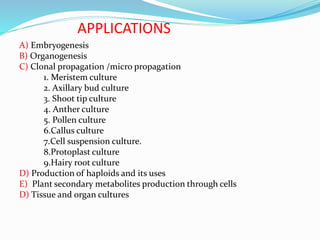
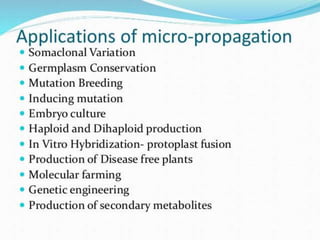
APPLICATIONS
A) Embryogenesis
B) Organogenesis
C) Clonal propagation /micro propagation
1. Meristem culture
2. Axillary bud culture
3. Shoot tip culture
4. Anther culture
5. Pollen culture
6.Callus culture
7.Cell suspension culture.
8.Protoplast culture
9.Hairy root culture
D) Production of haploids and its uses
E) Plant secondary metabolites production through cells
D) Tissue and organ cultures
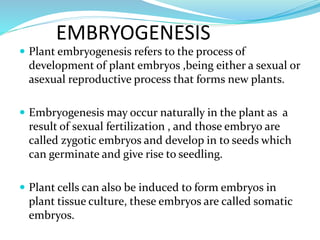
EMBRYOGENESIS
ď‚— Plant embryogenesis refers to the process of
development of plant embryos ,being either a sexual or
asexual reproductive process that forms new plants.
ď‚— Embryogenesis may occur naturally in the plant as a
result of sexual fertilization , and those embryo are
called zygotic embryos and develop in to seeds which
can germinate and give rise to seedling.
ď‚— Plant cells can also be induced to form embryos in
plant tissue culture, these embryos are called somatic
embryos.
ZYGOTIC EMBRYOGENESIS
* The zygotic embryo is formed following double
fertilization of the ovule forming the plant embryo and
the endosperm which together go in to seed , this
process is known as zygotic embryogenesis
SOMATIC EMBRYOGENESIS
* Somatic embryogenesis is a process by which
somatic cells or tissues develops in to
differentiated embryos
5
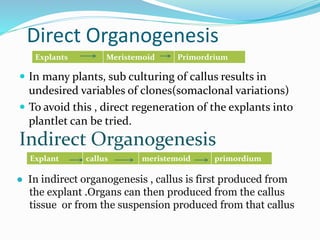
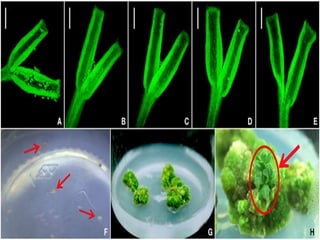
Direct Organogenesis
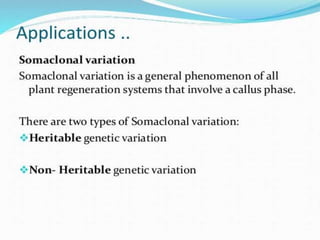
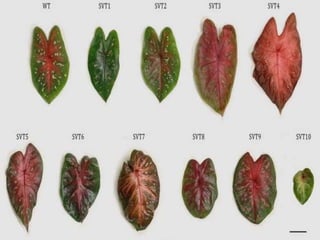
ď‚— In many plants, sub culturing of callus results in
undesired variables of clones(somaclonal variations)
ď‚— To avoid this , direct regeneration of the explants into
plantlet can be tried.
Explants Meristemoid Primordrium
Indirect Organogenesis
Explant callus meristemoid primordium
â—Ź In indirect organogenesis , callus is first produced from
the explant .Organs can then produced from the callus
tissue or from the suspension produced from that callus
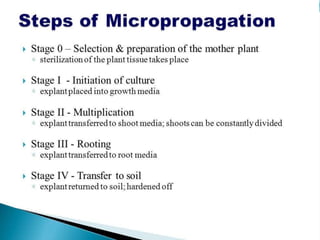
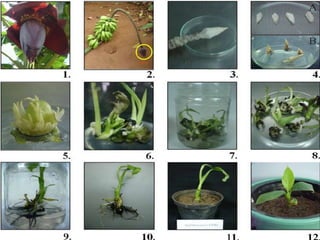
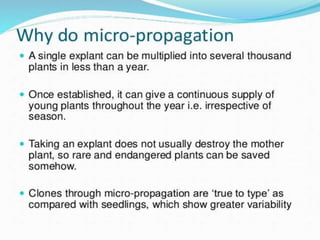
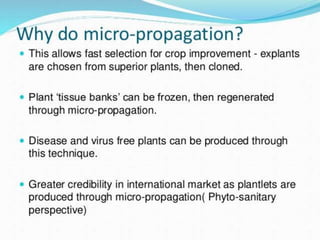
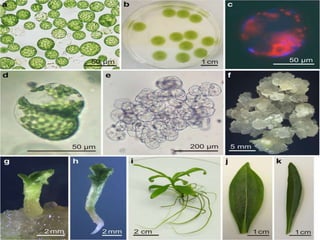
MICROPROPAGATION
ď‚— Micropropagation is an advanced vegetative
propagation technology for producing a large number
of genetically superior and pathogen-free transplants.
Micropropagation is the practice of rapidly
multiplying stock plant material to produce a large
number of progeny plants, using modern plant tissue
culture methods in a limited time and space
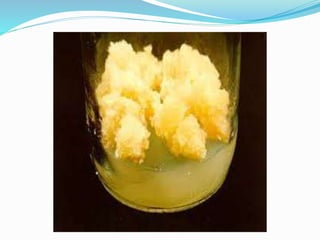
CALLUS CULTURE
ď‚— A callus need not to be necessarily be genetically
homogenous because a callus is often made from structural
tissue, not individual cells.
ď‚— Totipotency
ď‚— Used to grow genetically almost identical copies of plants with
desirable characters.
ď‚— Propagation of endangered species can be achieved by
germplasm conservation.
ď‚— Whole plant can be regenerated in large numbers.
ď‚— Somatic embryos can be developed from somatic cells of explant
tissue
ď‚— Used to produce genetically variable cells .
ď‚— Production of secondary metabolites.
ď‚— Callus can be a desirable source of cell suspension cultures.
ď‚— Suitable for protoplast isolation.
CELL SUSPENSION CULTURE
ď‚— Mutant selection
ď‚— Production of secondary metabolites .
ď‚— Biotransformation
ď‚— Single cell protein.
ď‚— Making clones
ď‚— Production of somatic embryos.
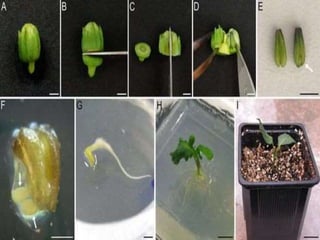
ANTHER CULTURE AND POLLEN CULTURE
 Haploid production – Major application of pollen / anther
culture is production of haploid plants. It takes much time
to produce haploid plants by conventional breeding
methods (many generations of inbreeding or
backcrossing). As pollens are haploid, plants developed
from these are homozygous (haploids).
 Protoplast isolation – Used for protoplast isolation as single
pollens (unicellular) are available.
 Transformation – Used in transgenic plant formation, it
can be done with less time consumption.
 Crop improvement – In-vitro anther culture is used for
improvement in vegetable and cereal crops e.g. asparagus,
sweet pepper, watermelon, cabbage, broccoli, wheat etc.
ď‚— Cryopreservation of haploid cells.
ď‚— Genetic engineering for gene transfer.
ď‚— Production of homozygous plants.
ď‚— Production of nullisomic tobacco from cultured anthers of
monosomic plants .
ď‚— Greater survival rate for embryos.
ď‚— Homozygous super males are produced from cultured
anthers from male plant of ASPARAGUS. When such males
are crossed with pistillate plants ,the entire progeny
consists of males.
ď‚— Anther derived haploids have been extensively used in
protoplast culture and somatic hybridization experiments
ď‚— The haploid technique in cereal breeding is a quick
method to convert heterozygote's to homozygote's.
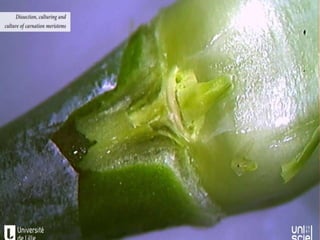
SHOOT TIP CULTURE
ď‚— Virus eradication,
ď‚— Micro-propagation
ď‚— Storage of genetic resources.
ď‚— Shoot tip or meristem culture in plant breeding.
ď‚— Propagation of haploid plants.
ď‚— Meristem or shoot tip culture in quarantine
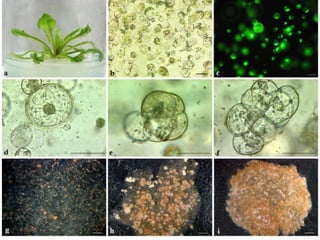
PROTOPLAST CULTURE
ď‚— Gene transformation.
ď‚— Transplantation study.
ď‚— Virus uptake.
ď‚— Study of various environmental factors on osmotic
behavior of cell .
ď‚— Study of morphogenesis.
ď‚— Study of organogenesis/embryogenesis.
ď‚— Study of plasma membrane.
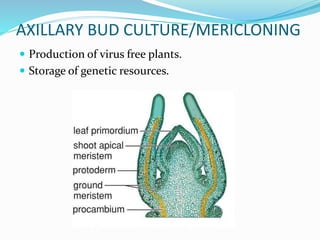
AXILLARY BUD CULTURE/MERICLONING
ď‚— Production of virus free plants.
ď‚— Storage of genetic resources.
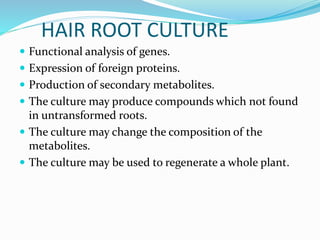
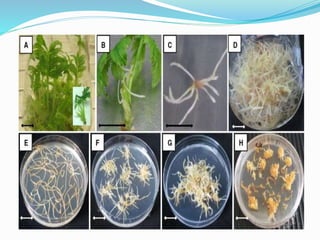
HAIR ROOT CULTURE
ď‚— Functional analysis of genes.
ď‚— Expression of foreign proteins.
ď‚— Production of secondary metabolites.
ď‚— The culture may produce compounds which not found
in untransformed roots.
ď‚— The culture may change the composition of the
metabolites.
ď‚— The culture may be used to regenerate a whole plant.
Akhil joy ppt .plant biotech

Akhil joy ppt .plant biotech

  • 1.
    SEMINAR 2018 SUBMITTED BY AKHILJOY 5.SEMESTER GOV. COLLEGE KARIAVATOM
  • 3.
    APPLICATIONS A) Embryogenesis B) Organogenesis C)Clonal propagation /micro propagation 1. Meristem culture 2. Axillary bud culture 3. Shoot tip culture 4. Anther culture 5. Pollen culture 6.Callus culture 7.Cell suspension culture. 8.Protoplast culture 9.Hairy root culture D) Production of haploids and its uses E) Plant secondary metabolites production through cells D) Tissue and organ cultures
  • 4.
    EMBRYOGENESIS ď‚— Plant embryogenesisrefers to the process of development of plant embryos ,being either a sexual or asexual reproductive process that forms new plants. ď‚— Embryogenesis may occur naturally in the plant as a result of sexual fertilization , and those embryo are called zygotic embryos and develop in to seeds which can germinate and give rise to seedling. ď‚— Plant cells can also be induced to form embryos in plant tissue culture, these embryos are called somatic embryos.
  • 5.
    ZYGOTIC EMBRYOGENESIS * Thezygotic embryo is formed following double fertilization of the ovule forming the plant embryo and the endosperm which together go in to seed , this process is known as zygotic embryogenesis SOMATIC EMBRYOGENESIS * Somatic embryogenesis is a process by which somatic cells or tissues develops in to differentiated embryos 5
  • 7.
    Direct Organogenesis ď‚— Inmany plants, sub culturing of callus results in undesired variables of clones(somaclonal variations) ď‚— To avoid this , direct regeneration of the explants into plantlet can be tried. Explants Meristemoid Primordrium Indirect Organogenesis Explant callus meristemoid primordium â—Ź In indirect organogenesis , callus is first produced from the explant .Organs can then produced from the callus tissue or from the suspension produced from that callus
  • 8.
    MICROPROPAGATION ď‚— Micropropagation isan advanced vegetative propagation technology for producing a large number of genetically superior and pathogen-free transplants. Micropropagation is the practice of rapidly multiplying stock plant material to produce a large number of progeny plants, using modern plant tissue culture methods in a limited time and space
  • 33.
    CALLUS CULTURE ď‚— Acallus need not to be necessarily be genetically homogenous because a callus is often made from structural tissue, not individual cells. ď‚— Totipotency ď‚— Used to grow genetically almost identical copies of plants with desirable characters. ď‚— Propagation of endangered species can be achieved by germplasm conservation. ď‚— Whole plant can be regenerated in large numbers. ď‚— Somatic embryos can be developed from somatic cells of explant tissue ď‚— Used to produce genetically variable cells . ď‚— Production of secondary metabolites. ď‚— Callus can be a desirable source of cell suspension cultures. ď‚— Suitable for protoplast isolation.
  • 35.
    CELL SUSPENSION CULTURE ď‚—Mutant selection ď‚— Production of secondary metabolites . ď‚— Biotransformation ď‚— Single cell protein. ď‚— Making clones ď‚— Production of somatic embryos.
  • 36.
    ANTHER CULTURE ANDPOLLEN CULTURE  Haploid production – Major application of pollen / anther culture is production of haploid plants. It takes much time to produce haploid plants by conventional breeding methods (many generations of inbreeding or backcrossing). As pollens are haploid, plants developed from these are homozygous (haploids).  Protoplast isolation – Used for protoplast isolation as single pollens (unicellular) are available.  Transformation – Used in transgenic plant formation, it can be done with less time consumption.  Crop improvement – In-vitro anther culture is used for improvement in vegetable and cereal crops e.g. asparagus, sweet pepper, watermelon, cabbage, broccoli, wheat etc.
  • 37.
    ď‚— Cryopreservation ofhaploid cells. ď‚— Genetic engineering for gene transfer. ď‚— Production of homozygous plants. ď‚— Production of nullisomic tobacco from cultured anthers of monosomic plants . ď‚— Greater survival rate for embryos. ď‚— Homozygous super males are produced from cultured anthers from male plant of ASPARAGUS. When such males are crossed with pistillate plants ,the entire progeny consists of males. ď‚— Anther derived haploids have been extensively used in protoplast culture and somatic hybridization experiments ď‚— The haploid technique in cereal breeding is a quick method to convert heterozygote's to homozygote's.
  • 40.
    SHOOT TIP CULTURE ď‚—Virus eradication, ď‚— Micro-propagation ď‚— Storage of genetic resources. ď‚— Shoot tip or meristem culture in plant breeding. ď‚— Propagation of haploid plants. ď‚— Meristem or shoot tip culture in quarantine
  • 42.
    PROTOPLAST CULTURE ď‚— Genetransformation. ď‚— Transplantation study. ď‚— Virus uptake. ď‚— Study of various environmental factors on osmotic behavior of cell . ď‚— Study of morphogenesis. ď‚— Study of organogenesis/embryogenesis. ď‚— Study of plasma membrane.
  • 44.
    AXILLARY BUD CULTURE/MERICLONING ď‚—Production of virus free plants. ď‚— Storage of genetic resources.
  • 45.
    HAIR ROOT CULTURE ď‚—Functional analysis of genes. ď‚— Expression of foreign proteins. ď‚— Production of secondary metabolites. ď‚— The culture may produce compounds which not found in untransformed roots. ď‚— The culture may change the composition of the metabolites. ď‚— The culture may be used to regenerate a whole plant.