AirAsia: Flying Low-Cost with High Hopes
Group Members
Name Student ID
Bushra Humayra Farooq 1321839
Md. Mazaharul Islam 1330438
Julker Nain 1310934
Md. Seefayet Alam 1521801
Rabby Ahmmed 1420576
Introduction
 AirAsia is a Malaysian airline company. The company started its journey on
20th December, 1993 by the hand of Malaysian government.
 Later on 2nd December, 2001 Tony Fernandes bought this airline company
 Tony Fernanded turned this Airline as a LCC (Low Cost Carrier).
 AirAsia introduced very low fare in domestic routes and even some of them
are very close to the bus fare.
Subsidiary Joint Venture
After 2004 AirAsia planned to start its regional business
in neighboring countries.
some subsidiary joint venture companies are-
 Thai AirAsia,
 Indonesia AirAsia,
 AirAsia Combodia,
 AirAsia China,
 AirAsian Japan,
 AirAsia India
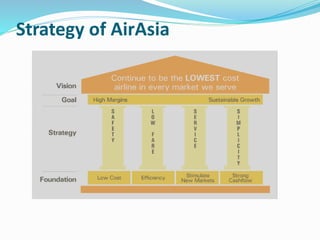
Strategy of AirAsia
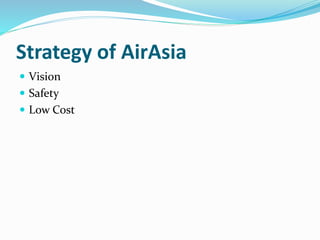
Strategy of AirAsia
 Vision
 Safety
 Low Cost
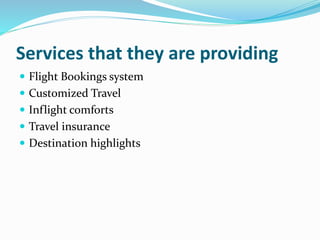
Services that they are providing
 Flight Bookings system
 Customized Travel
 Inflight comforts
 Travel insurance
 Destination highlights
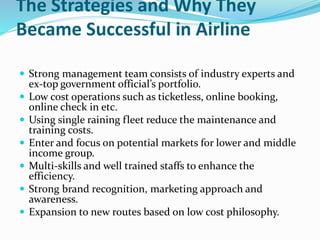
The Strategies and Why They
Became Successful in Airline
 Strong management team consists of industry experts and
ex-top government official’s portfolio.
 Low cost operations such as ticketless, online booking,
online check in etc.
 Using single raining fleet reduce the maintenance and
training costs.
 Enter and focus on potential markets for lower and middle
income group.
 Multi-skills and well trained staffs to enhance the
efficiency.
 Strong brand recognition, marketing approach and
awareness.
 Expansion to new routes based on low cost philosophy.
Key Success Factor of AirAsia
 Low cost per average seat kilometer
 Low distribution cost
 Good Management Team
 Combination
 Testament
 Offering Value in Low Fare
Can they successfully sustain in
long run ?
 AirAsia can successfully sustain in long term.
Competitive Environment Analysis
 Air Asia’s business strategy was focused on serving the
underdeveloped LCC market in Asia.
 The LCC business model offers are-
 short-haul
 low-cost
 point-to-point service between midsize cities and
secondary airports in large cities within the ASEAN
region.
Market Penetration and
Consolidation
 AirAsia penetrated the aviation industry by gaining
the competitors’ customers,
 improving the product quality and its level of service
 attracting non-users of the products or convincing
current customers to use more of the company's
products.
 promotions and obtaining substantial media coverage
due to its fairytale success.
Conclusion
 AirAsia has a vision that has always been to improve
their customers business and ultimately the lives of
their customers.
 It’s their dream of making flying possible for everyone
 a result of having a large database from 15 years of
operations, they are in a position to take their digital
journey to its logical conclusion.

AirAsia

  • 1.
    AirAsia: Flying Low-Costwith High Hopes
  • 2.
    Group Members Name StudentID Bushra Humayra Farooq 1321839 Md. Mazaharul Islam 1330438 Julker Nain 1310934 Md. Seefayet Alam 1521801 Rabby Ahmmed 1420576
  • 3.
    Introduction  AirAsia isa Malaysian airline company. The company started its journey on 20th December, 1993 by the hand of Malaysian government.  Later on 2nd December, 2001 Tony Fernandes bought this airline company  Tony Fernanded turned this Airline as a LCC (Low Cost Carrier).  AirAsia introduced very low fare in domestic routes and even some of them are very close to the bus fare.
  • 4.
    Subsidiary Joint Venture After2004 AirAsia planned to start its regional business in neighboring countries. some subsidiary joint venture companies are-  Thai AirAsia,  Indonesia AirAsia,  AirAsia Combodia,  AirAsia China,  AirAsian Japan,  AirAsia India
  • 5.
  • 6.
    Strategy of AirAsia Vision  Safety  Low Cost
  • 7.
    Services that theyare providing  Flight Bookings system  Customized Travel  Inflight comforts  Travel insurance  Destination highlights
  • 8.
    The Strategies andWhy They Became Successful in Airline  Strong management team consists of industry experts and ex-top government official’s portfolio.  Low cost operations such as ticketless, online booking, online check in etc.  Using single raining fleet reduce the maintenance and training costs.  Enter and focus on potential markets for lower and middle income group.  Multi-skills and well trained staffs to enhance the efficiency.  Strong brand recognition, marketing approach and awareness.  Expansion to new routes based on low cost philosophy.
  • 9.
    Key Success Factorof AirAsia  Low cost per average seat kilometer  Low distribution cost  Good Management Team  Combination  Testament  Offering Value in Low Fare
  • 10.
    Can they successfullysustain in long run ?  AirAsia can successfully sustain in long term.
  • 11.
    Competitive Environment Analysis Air Asia’s business strategy was focused on serving the underdeveloped LCC market in Asia.  The LCC business model offers are-  short-haul  low-cost  point-to-point service between midsize cities and secondary airports in large cities within the ASEAN region.
  • 12.
    Market Penetration and Consolidation AirAsia penetrated the aviation industry by gaining the competitors’ customers,  improving the product quality and its level of service  attracting non-users of the products or convincing current customers to use more of the company's products.  promotions and obtaining substantial media coverage due to its fairytale success.
  • 13.
    Conclusion  AirAsia hasa vision that has always been to improve their customers business and ultimately the lives of their customers.  It’s their dream of making flying possible for everyone  a result of having a large database from 15 years of operations, they are in a position to take their digital journey to its logical conclusion.