


IOT LARGE SCALE PILOTS
Opening Oct 2015
Deadline April 2016
Budget 100mil EUR
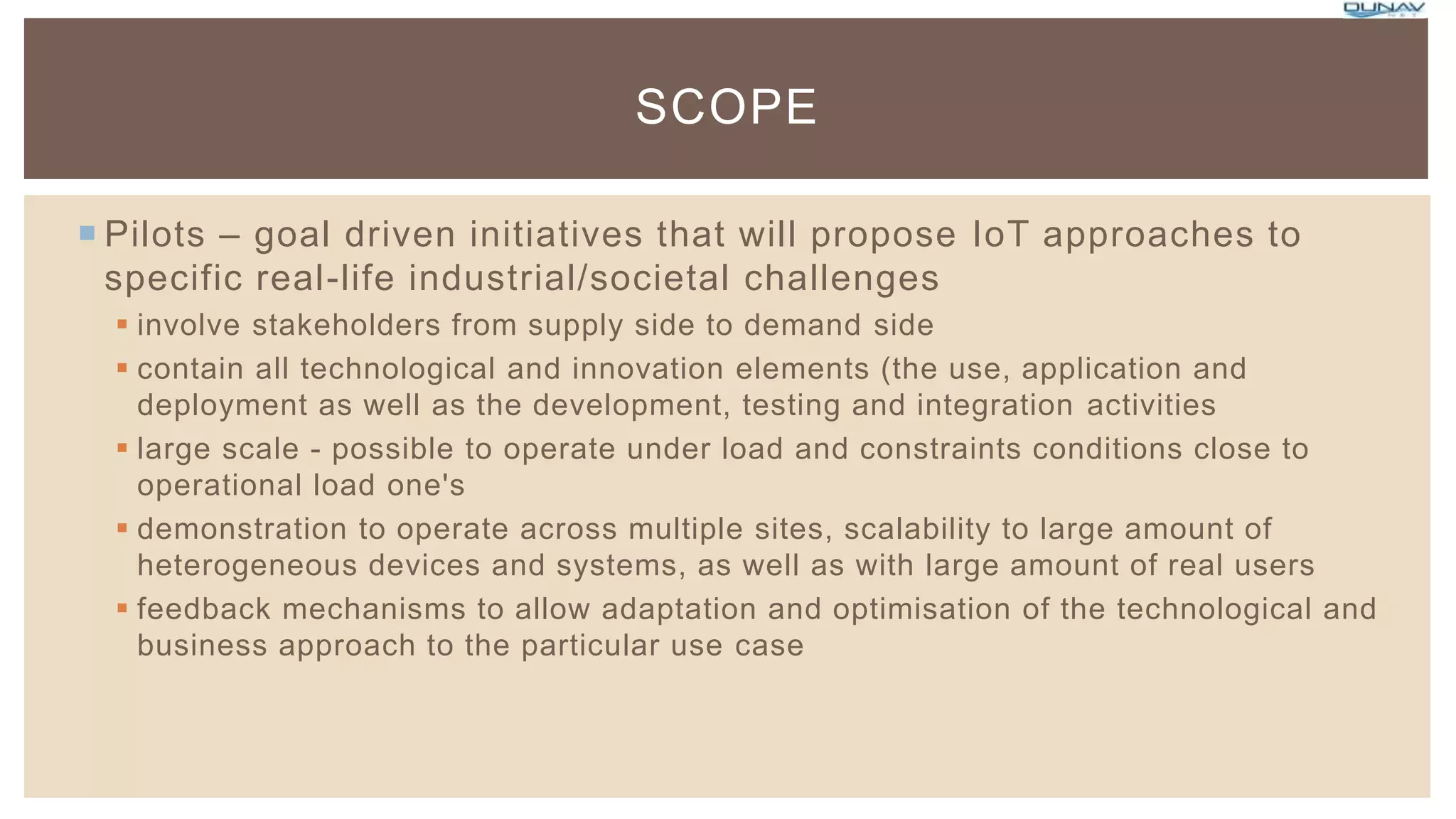
 Pilots – goal driven initiatives that will propose IoT approaches to
specific real-life industrial/societal challenges
 involve stakeholders from supply side to demand side
 contain all technological and innovation elements (the use, application and
deployment as well as the development, testing and integration activities
 large scale - possible to operate under load and constraints conditions close to
operational load one's
 demonstration to operate across multiple sites, scalability to large amount of
heterogeneous devices and systems, as well as with large amount of real users
 feedback mechanisms to allow adaptation and optimisation of the technological and
business approach to the particular use case
SCOPE
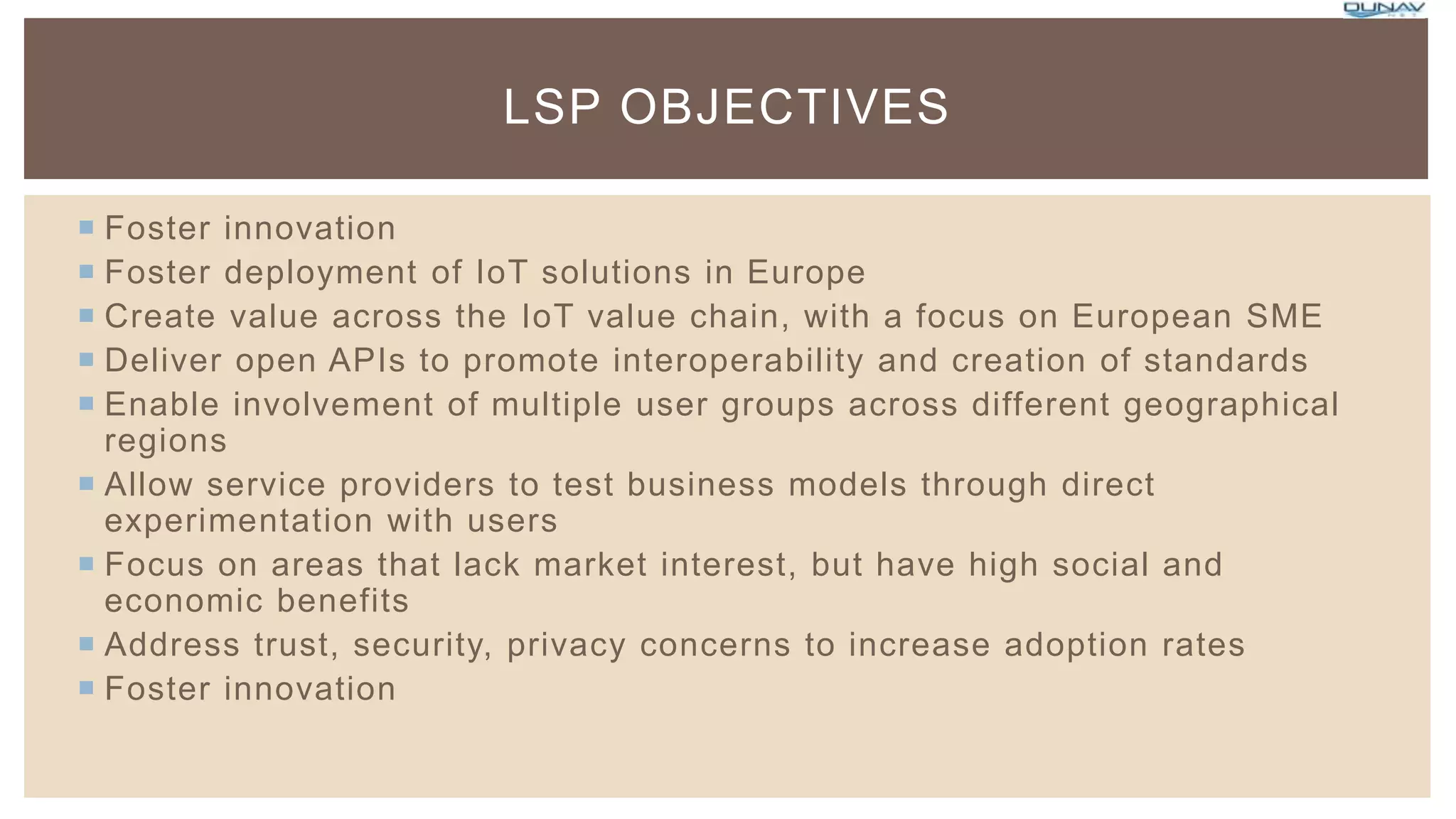
 Foster innovation
 Foster deployment of IoT solutions in Europe
 Create value across the IoT value chain, with a focus on European SME
 Deliver open APIs to promote interoperability and creation of standards
 Enable involvement of multiple user groups across different geographical
regions
 Allow service providers to test business models through direct
experimentation with users
 Focus on areas that lack market interest, but have high social and
economic benefits
 Address trust, security, privacy concerns to increase adoption rates
 Foster innovation
LSP OBJECTIVES
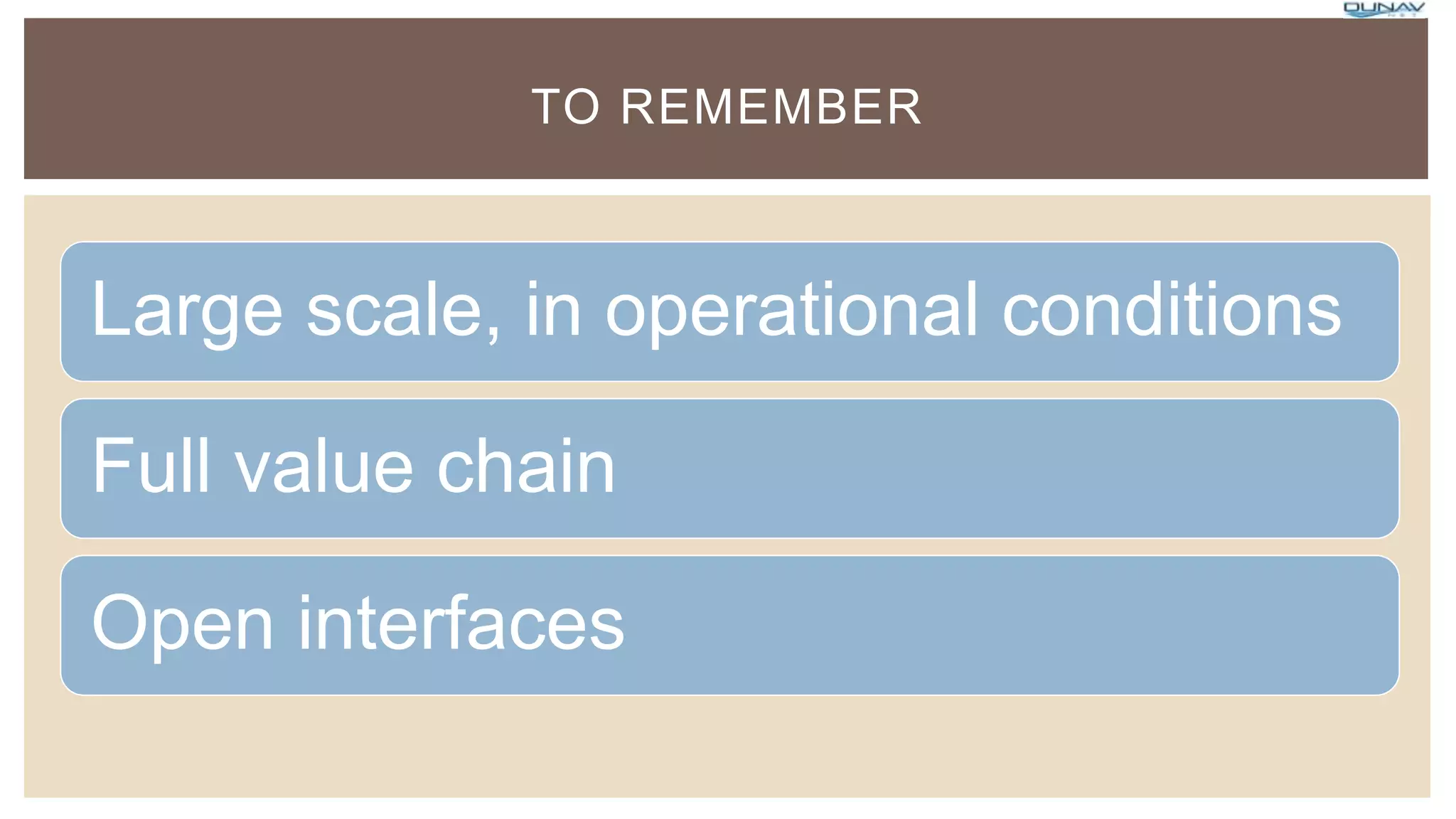
Large scale, in operational conditions
Full value chain
Open interfaces
TO REMEMBER
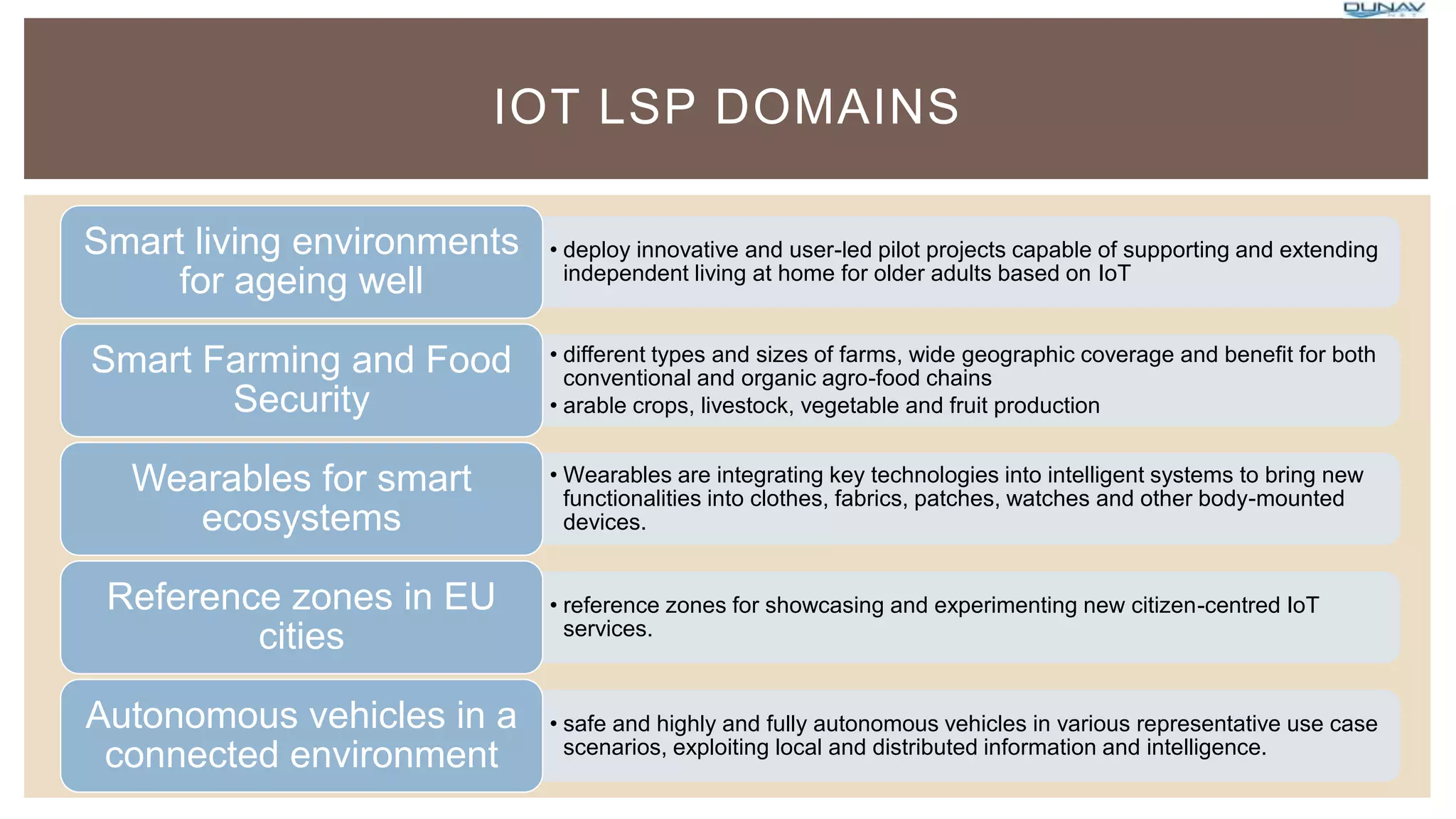
• deploy innovative and user-led pilot projects capable of supporting and extending
independent living at home for older adults based on IoT
Smart living environments
for ageing well
• different types and sizes of farms, wide geographic coverage and benefit for both
conventional and organic agro-food chains
• arable crops, livestock, vegetable and fruit production
Smart Farming and Food
Security
• Wearables are integrating key technologies into intelligent systems to bring new
functionalities into clothes, fabrics, patches, watches and other body-mounted
devices.
Wearables for smart
ecosystems
• reference zones for showcasing and experimenting new citizen-centred IoT
services.
Reference zones in EU
cities
• safe and highly and fully autonomous vehicles in various representative use case
scenarios, exploiting local and distributed information and intelligence.
Autonomous vehicles in a
connected environment
IOT LSP DOMAINS
 Sophisticated sensors, robots and sensor networks combined with procedures to
link mapped variables to appropriate farming management actions
 monitoring and control of plant and animal products during the whole life cycle from farm to fork
 helping farmers' decision making with regard to the use of inputs and management processes
 Potential to bring data management to a new level by
 enable autonomous execution of appropriate interventions in different agricultural sub-sectors
and their associated post-production value chain through to the consumer
 Challenge is to design architectures
 to “program” or track each object for optimal behaviour
 decreasing use of water as well as other natural resources and inputs
 lowering ecological footprints and economic costs
 increasing food security
 enables consumers to access trustworthy traceability information throughout the whole food
chain.
SMART FARMING AND FOOD SECURITY
 Proposals shall include an adequate combination of different farms to
ensure
 deployment of the technology is adapted to the needs of different types and sizes of
farms across Europe
 Activities should allow
 for a wide geographic coverage within Europe
 benefit both conventional and organic agro-food chains
 Proposals shall cover at least three sub-sectors
 arable crops, livestock, vegetable and fruit production
 multi-actor approach and allow for adequate involvement of the farming sector
SMART FARMING AND FOOD SECURITY
 LSP pilot will cover a series of cities to operate as reference zones for
showcasing and experimenting new citizen-centred IoT services
 Building on the past results and achievements in some cities in Europe.
 Cities will experiment and test similar new services and solutions
 starting from users' expressed preferences and needs
 involvement of creativity hubs such as fablabs, co-working spaces, and gather
experience at scale and evaluate citizens' acceptability and endorsement.
 Enable SMEs to use open demonstrators to test innovative new services.
 Pilots will provide evidence of access to city areas where legal contexts are adapted to
the demonstration requirements (i.e. 'reference zones')
 Federation and interoperability between platforms may be considered as appropriate,
as well as the ability to integrate data from different service providers.
 The number of users involved and duration of pilot services should be sufficient to
ensure statistical significance in impact analysis, with a minimum of 4 pilot sites in 4
countries.
REFERENCE ZONES IN EU CITIES
BENCHMARK STUDY FOR LSP
IN THE AREA OF INTERENT
OF THINGS
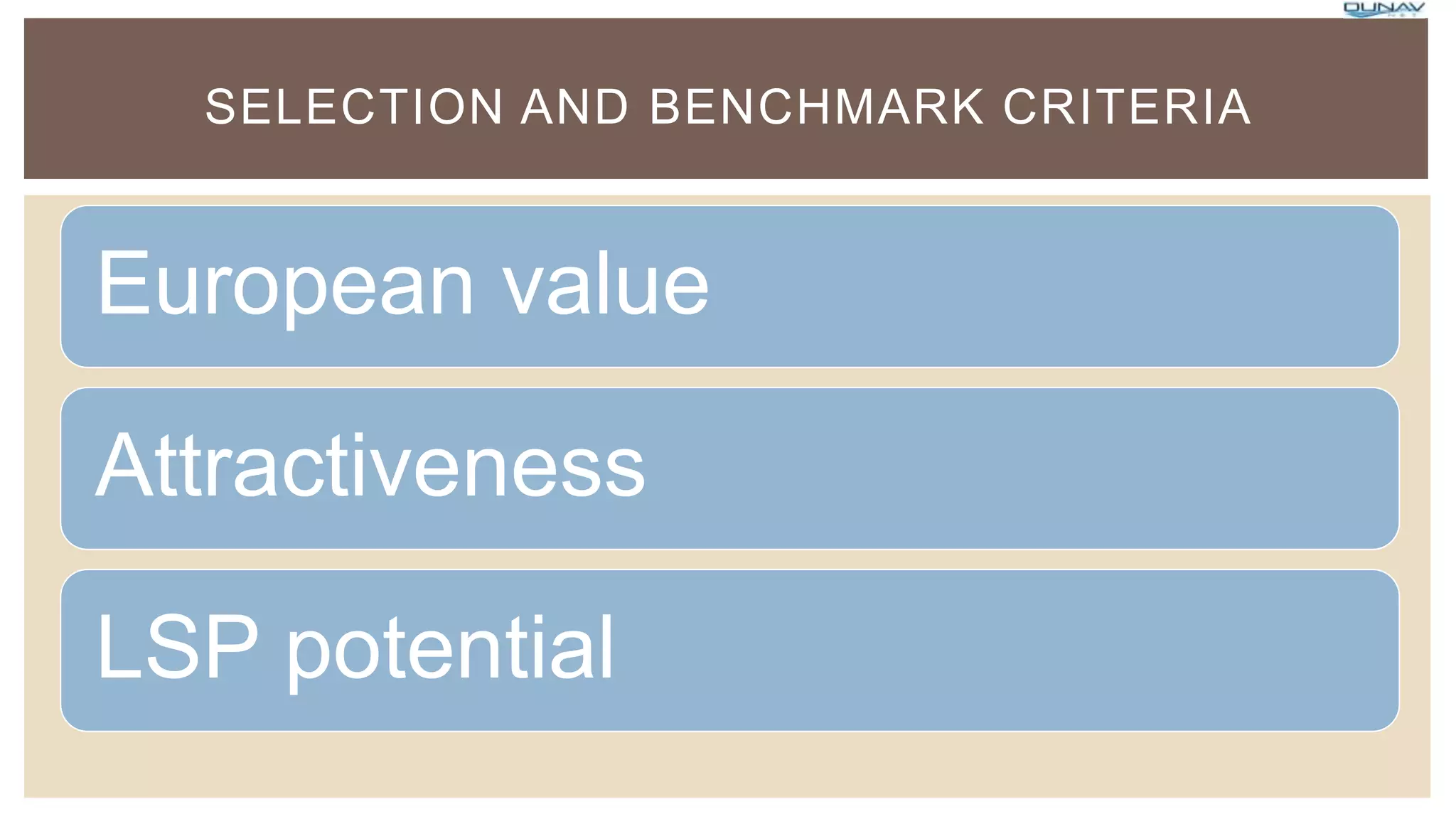
European value
Attractiveness
LSP potential
SELECTION AND BENCHMARK CRITERIA
Identification of most valuable use cases
Identification of key players
LSP deployment strategy
STUDY OBJECTIVES
IoT market is still very fragmented in the EU
Coexistence of open and proprietary solutions
Existence of vertical focus
SOME FINDINGS
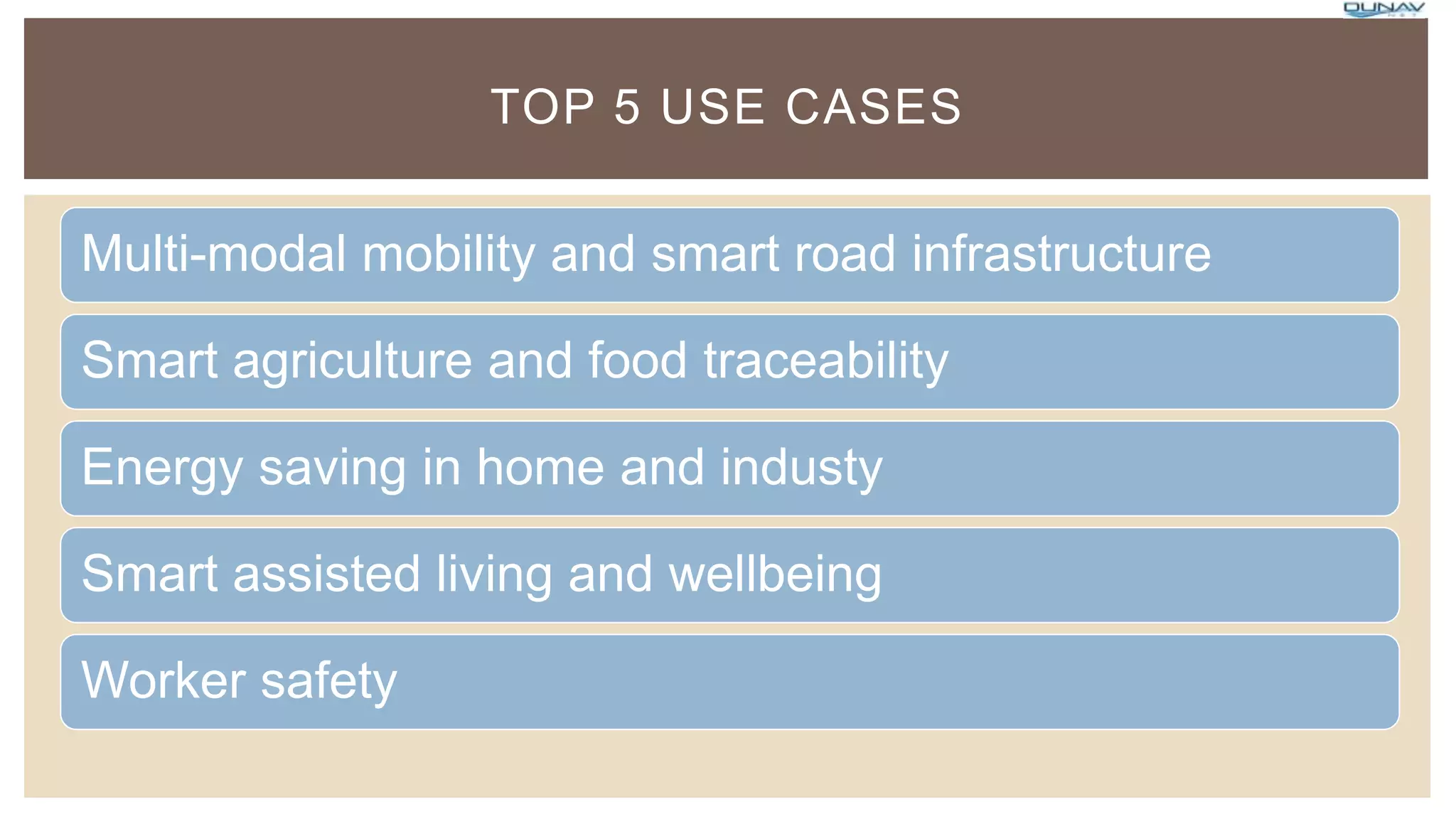
Multi-modal mobility and smart road infrastructure
Smart agriculture and food traceability
Energy saving in home and industy
Smart assisted living and wellbeing
Worker safety
TOP 5 USE CASES
 Open air agriculture and horticulture
 Automated detection of pests and diseases on crop fields
 Irrigate crop remotely and monitor soil to add necessary nutrients
 Monitor crops to optimize harvesting picking order
 Automated harvesting and lawn mowing
SMART AGRICULTURE AND FOOD TRACEABILITY
www.dunavnet.eu

AIOTI and IoT LSP

  • 1.
    IOT LARGE SCALEPILOTS Opening Oct 2015 Deadline April 2016 Budget 100mil EUR
  • 2.
     Pilots –goal driven initiatives that will propose IoT approaches to specific real-life industrial/societal challenges  involve stakeholders from supply side to demand side  contain all technological and innovation elements (the use, application and deployment as well as the development, testing and integration activities  large scale - possible to operate under load and constraints conditions close to operational load one's  demonstration to operate across multiple sites, scalability to large amount of heterogeneous devices and systems, as well as with large amount of real users  feedback mechanisms to allow adaptation and optimisation of the technological and business approach to the particular use case SCOPE
  • 3.
     Foster innovation Foster deployment of IoT solutions in Europe  Create value across the IoT value chain, with a focus on European SME  Deliver open APIs to promote interoperability and creation of standards  Enable involvement of multiple user groups across different geographical regions  Allow service providers to test business models through direct experimentation with users  Focus on areas that lack market interest, but have high social and economic benefits  Address trust, security, privacy concerns to increase adoption rates  Foster innovation LSP OBJECTIVES
  • 4.
    Large scale, inoperational conditions Full value chain Open interfaces TO REMEMBER
  • 5.
    • deploy innovativeand user-led pilot projects capable of supporting and extending independent living at home for older adults based on IoT Smart living environments for ageing well • different types and sizes of farms, wide geographic coverage and benefit for both conventional and organic agro-food chains • arable crops, livestock, vegetable and fruit production Smart Farming and Food Security • Wearables are integrating key technologies into intelligent systems to bring new functionalities into clothes, fabrics, patches, watches and other body-mounted devices. Wearables for smart ecosystems • reference zones for showcasing and experimenting new citizen-centred IoT services. Reference zones in EU cities • safe and highly and fully autonomous vehicles in various representative use case scenarios, exploiting local and distributed information and intelligence. Autonomous vehicles in a connected environment IOT LSP DOMAINS
  • 6.
     Sophisticated sensors,robots and sensor networks combined with procedures to link mapped variables to appropriate farming management actions  monitoring and control of plant and animal products during the whole life cycle from farm to fork  helping farmers' decision making with regard to the use of inputs and management processes  Potential to bring data management to a new level by  enable autonomous execution of appropriate interventions in different agricultural sub-sectors and their associated post-production value chain through to the consumer  Challenge is to design architectures  to “program” or track each object for optimal behaviour  decreasing use of water as well as other natural resources and inputs  lowering ecological footprints and economic costs  increasing food security  enables consumers to access trustworthy traceability information throughout the whole food chain. SMART FARMING AND FOOD SECURITY
  • 7.
     Proposals shallinclude an adequate combination of different farms to ensure  deployment of the technology is adapted to the needs of different types and sizes of farms across Europe  Activities should allow  for a wide geographic coverage within Europe  benefit both conventional and organic agro-food chains  Proposals shall cover at least three sub-sectors  arable crops, livestock, vegetable and fruit production  multi-actor approach and allow for adequate involvement of the farming sector SMART FARMING AND FOOD SECURITY
  • 8.
     LSP pilotwill cover a series of cities to operate as reference zones for showcasing and experimenting new citizen-centred IoT services  Building on the past results and achievements in some cities in Europe.  Cities will experiment and test similar new services and solutions  starting from users' expressed preferences and needs  involvement of creativity hubs such as fablabs, co-working spaces, and gather experience at scale and evaluate citizens' acceptability and endorsement.  Enable SMEs to use open demonstrators to test innovative new services.  Pilots will provide evidence of access to city areas where legal contexts are adapted to the demonstration requirements (i.e. 'reference zones')  Federation and interoperability between platforms may be considered as appropriate, as well as the ability to integrate data from different service providers.  The number of users involved and duration of pilot services should be sufficient to ensure statistical significance in impact analysis, with a minimum of 4 pilot sites in 4 countries. REFERENCE ZONES IN EU CITIES
  • 9.
    BENCHMARK STUDY FORLSP IN THE AREA OF INTERENT OF THINGS
  • 10.
  • 11.
    Identification of mostvaluable use cases Identification of key players LSP deployment strategy STUDY OBJECTIVES
  • 12.
    IoT market isstill very fragmented in the EU Coexistence of open and proprietary solutions Existence of vertical focus SOME FINDINGS
  • 13.
    Multi-modal mobility andsmart road infrastructure Smart agriculture and food traceability Energy saving in home and industy Smart assisted living and wellbeing Worker safety TOP 5 USE CASES
  • 14.
     Open airagriculture and horticulture  Automated detection of pests and diseases on crop fields  Irrigate crop remotely and monitor soil to add necessary nutrients  Monitor crops to optimize harvesting picking order  Automated harvesting and lawn mowing SMART AGRICULTURE AND FOOD TRACEABILITY
  • 15.