

Franck Boissière
European Commission - DG CONNECT
IoT Standardisation and Interoperability
The H2020 and AIOTI approach
from sensors to AI through data lakes
EBDVF 2019 - Helsinki
Thank You Rigo!!!
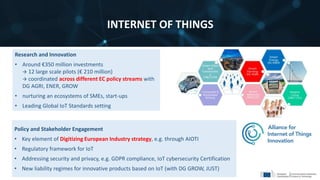
INTERNET OF THINGS
Research and Innovation
• Around €350 million investments
 12 large scale pilots (€ 210 million)
 coordinated across different EC policy streams with
DG AGRI, ENER, GROW
• nurturing an ecosystems of SMEs, start-ups
• Leading Global IoT Standards setting
Policy and Stakeholder Engagement
• Key element of Digitizing European Industry strategy, e.g. through AIOTI
• Regulatory framework for IoT
• Addressing security and privacy, e.g. GDPR compliance, IoT cybersecurity Certification
• New liability regimes for innovative products based on IoT (with DG GROW, JUST)
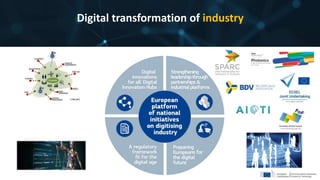
Digital transformation of industry
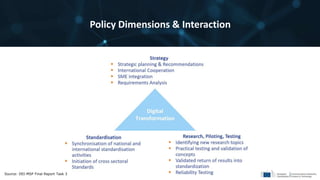
Policy Dimensions & Interaction
Source: DEI-MSP Final Report Task 3
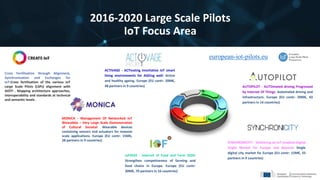
2016-2020 Large Scale Pilots
IoT Focus Area
SYNCHRONICITY - Delivering an IoT enabled Digital
Single Market for Europe and Beyond: Single
digital city market for Europe (EU contr: 15M€, 33
partners in 9 countries)
MONICA - Management Of Networked IoT
Wearables – Very Large Scale Demonstration
of Cultural Societal: Wearable devices
containing sensors and actuators for massive
scale applications. Europe (EU contr: 15M€,
28 partners in 9 countries)
ACTIVAGE - ACTivating InnoVative IoT smart
living environments for AGEing well: Active
and healthy ageing. Europe (EU contr: 20M€,
48 partners in 9 countries)
IoF2020 - Internet of Food and Farm 2020:
Strengthen competiveness of farming and
food chains in Europe. Europe (EU contr:
30M€, 70 partners in 16 countries)
european-iot-pilots.eu
AUTOPILOT - AUTOmated driving Progressed
by Internet Of Things: Automated driving and
infrastructure. Europe (EU contr: 20M€, 43
partners in 14 countries)
Cross Fertilisation through Alignment,
Synchronisation and Exchanges for
IoT:Cross fertilisation of the various IoT
Large Scale Pilots (LSPs) alignment with
AIOTI . Mapping architecture approaches,
interoperability and standards at technical
and semantic levels .
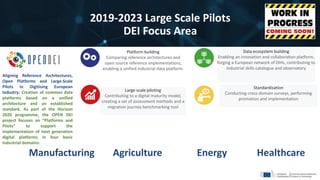
2019-2023 Large Scale Pilots
DEI Focus Area
Aligning Reference Architectures,
Open Platforms and Large-Scale
Pilots in Digitising European
Industry: Creation of common data
platforms based on a unified
architecture and an established
standard. As part of the Horizon
2020 programme, the OPEN DEI
project focuses on “Platforms and
Pilots” to support the
implementation of next generation
digital platforms in four basic
industrial domains:
Manufacturing Agriculture Energy Healthcare
Standardisation
Conducting cross-domain surveys, performing
promotion and implementation
Platform building
Comparing reference architectures and
open source reference implementations,
enabling a unified industrial data platform.
Large scale piloting
Contributing to a digital maturity model,
creating a set of assessment methods and a
migration journey benchmarking tool
Data ecosystem building
Enabling an innovation and collaboration platform,
forging a European network of DIHs, contributing to
industrial skills catalogue and observatory
AI CSA?
Oct 20–Dec 23
Automotive
Auto-pilot (26m€) Jan 17–Dec 19
Assisted Living
Activage (25m€) Jan 17–Jun 20
Wearables
Monica (17 m€) Jan 17–Dec 19
Agri
IoF2020 (34m€) Jan 17–Dec 20
Smart Cities
Synchronicity (20m€) Jan 17–Dec 19
CSA
Create-IoT Jan 17–Dec 19
CSA
U4IoT Jan 17–Dec 19
Agri
Atlas (15m€) Oct 19–Sept 22
Energy
Interconnect (35m€) Oct 19–Sept 23
Agri
Demeter (17m€) Sept 19–Feb 23
2017 2018 2019 2020 2021 2022 2023
CSA
Digiplace
Sept 19–Feb 21
CSA
OpenDei Jun 19–May 22
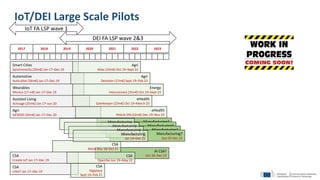
IoT/DEI Large Scale Pilots
IoT FA LSP wave 1
DEI FA LSP wave 2&3
CSA
NGIot Nov 18–Oct 21
Manufacturing?
Jan 19–Dec 22Manufacturing?
Sep-20-Dec 23
eHealth
GateKeeper (23m€) Oct 19–March 23
eHealth
PHArA-ON (22m€) Dec 19–Nov 23
Manufacturing
Jan 19–Dec 22Manufacturing
Jan 19–Dec 22
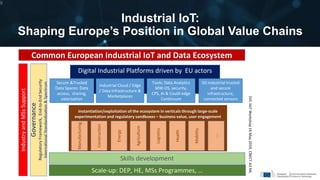
Industrial IoT:
Shaping Europe’s Position in Global Value Chains
9
Common European Industrial IoT and Data Ecosystem
IndustryandMSsSupport
Governance
RegulatoryFramework,End-to-EndSecurity
InternationalStandardisation&Spectrum
Digital Industrial Platforms driven by EU actors
Secure &Trusted
Data Spaces: Data
access, sharing,
valorisation
Tools: Data Analytics
MW-OS, security,
CPS, AI & Could-edge
Continuum
Industrial Cloud / Edge
/ Data Infrastructure &
Marketplaces
5G industrial trusted
and secure
infrastructure,
connected sensors
Instantiation/exploitation of the ecosystem in verticals through large-scale
experimentation and regulatory sandboxes – business value, user engagement
Manufacturing
Construction
Energy
Agriculture
Logistics
Health
Mobility
….
Skills development
Scale-up: DEP, HE, MSs Programmes, …
SVC-IIoTWorkshop16May2019,CNECT-A2ML
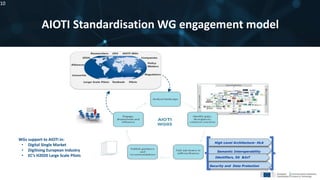
AIOTI Standardisation WG engagement model
10
Security and Data Protection
Semantic Interoperability
High Level Architecture- HLA
Identifiers, 5G &IoT
WGs support to AIOTI in:
• Digital Single Market
• Digitising European Industry
• EC’s H2020 Large Scale Pilots
11
12
• IoT Landscape georgios.karagiannis@huawei.com
• IoT Landscape maintenance is key to keep the liaisons alive and maintain dialogue on how to foster collaboration to improve i nteroperability & security, v09 to be published
in Q3 2019
• Gap Analysis and recommendations michelle.wetterwald@netellany.fr ; emmanuel.darmois@commledge.com, 1st release published May 2018, 2nd ongoing (2019)
• Cooperation with SDOs/Alliances to foster co-creation and interworking georgios.karagiannis@huawei.com, Patrick.Guillemin@etsi.org (e.g., Liaisons: 3GPP, ITU-T, ISO,
OSGi Alliance, BBF, 3GPP; MoUs – signed: AII, OSGi Alliance, BDVA, under discussion OPC Foundation, SCI4.0, ISO/IEC JTC1 SC41)
• IoT relation and impact on 5G thomas.klein@de.ibm.com ; georgios.karagiannis@huawei.com 1st release published in June 2018, 2nd in March 2019
• HLA / High Level Architecture marco.carugi@gmail.com ; omar.elloumi@nokia.com R4, published in June 2018, R5 ongoing (2019)
• IoT Reference Architecture and its mapping with existing IoT Reference Architectures
• IoT identifiers juergen.heiles@siemens.com ; henri.barthel@gs1.org 1st release published February 2018
• SemIoP IoT Semantic Interoperability Martin.Bauer@neclab.eu; Laura.Daniele@tno.nl new JWP under construction
• IoT Privacy (with WG04) vanderwees@arthurslegal.com Nuance of Trust event, Series of GDPR-Centric AIOTI webinars
• IoT Platform, experimentation, LSPs need concrete standard framework & references to enable ”IoT Trust” and IoT “Privacy by d esign” + STF 547
• IoT Security (with WG04) vanderwees@arthurslegal.com; jacques.kruse-brandao@sgs.com; harm.arendshorst@ilabs.ai
• IoT Security Architecture for Trusted IoT Devices; Baseline Requirements for Security & Privacy up to segment requirements; e xperimentation, LSPs need concrete
standard framework & references to enable ”IoT Trust” based on IoT “Security by design” + STF 547
• Series of new IoT Webinars on Application-Centric (IoT Verticals meet IoT Horizontals). The central themes of the webinars are: Personal Wearables (H2x): Health, Living,
Consumer, Public Space, and other verticals, Moving Sensors (M2x): Farm2Fork, Mobility, Consumer, Cities, and other verticals + Long Term Fixed IoT Applications (F2x):
Industry 4.0, Cities, Consumer, Water Management, Energy, Construction, Living, and other verticals.
• Joint MSP/DEI WG on Standardisation participation / November 2018 report + new plans in 2019
WG03 Highlights (ref. https://aioti.eu/aioti-wg03-reports-on-iot-standards/)
13
What is Semantic Interoperability?
 Semantics is the study of meaning – in our context the meaning of the data being exchanged
 Traditionally, the semantics of data being exchanged is encoded in the producers and consumers of the data, i.e.
it is implicitly given as part of the implementation of producers and consumers
 Situation in IoT
 IoT systems can be huge and dynamic, i.e. there is a large number of changing producers and consumers
 Producers and consumers do not a-priori know each other
 Increased value in IoT in case information can be (re-)used for completely new purposes
 Implicit encoding of semantics not flexible enough + discovery has to be enabled
 Make semantics explicit, i.e. attach the meaning to the data
 It is about the agreement on uniquely identified concepts
 The communicated data are instantiations of the concepts
 Concepts, properties and relationships can be formalized as ontologies
 Semantic Interoperability is about exchanging information on the basis of agreed, formalized and explicit
semantics
13
14
What is Semantic Interoperability?
 Semantics is the study of meaning – in our context the meaning of the data being exchanged
 Traditionally, the semantics of data being exchanged is encoded in the producers and consumers of the data, i.e.
it is implicitly given as part of the implementation of producers and consumers
 Situation in IoT
 IoT systems can be huge and dynamic, i.e. there is a large number of changing producers and consumers
 Producers and consumers do not a-priori know each other
 Increased value in IoT in case information can be (re-)used for completely new purposes
 Implicit encoding of semantics not flexible enough + discovery has to be enabled
 Make semantics explicit, i.e. attach the meaning to the data
 It is about the agreement on uniquely identified concepts
 The communicated data are instantiations of the concepts
 Concepts, properties and relationships can be formalized as ontologies
 Semantic Interoperability is about exchanging information on the basis of agreed, formalized and explicit
semantics
14
15
Initial Joint Whitepaper 2016:
Semantic Interoperability for the Web of Things
• Idea in AIOTI
• Get together experts
• Improve convergence
• High visibility
• Work under Creative
Commons License
• SDOs: oneM2M, W3C Web of Things,
IEEE P2413
• DOI: 10.13140/RG.2.2.25758.13122
16
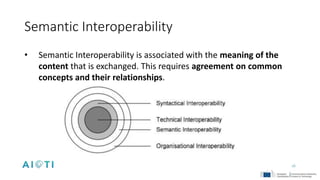
Semantic Interoperability
• Semantic Interoperability is associated with the meaning of the
content that is exchanged. This requires agreement on common
concepts and their relationships.
17
AIOTIWG03 SemIoP LeadershipTeam
Martin Bauer (NEC) Laura Daniel (TNO).
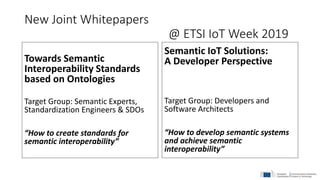
New Joint Whitepapers
@ ETSI IoT Week 2019
Towards Semantic
Interoperability Standards
based on Ontologies
Target Group: Semantic Experts,
Standardization Engineers & SDOs
“How to create standards for
semantic interoperability”
Semantic IoT Solutions:
A Developer Perspective
Target Group: Developers and
Software Architects
“How to develop semantic systems
and achieve semantic
interoperability”
More AIOTI cooperation
19
• CEN/CENELEC/ETSI Smart Meter CG, Smart Energy Grid CG, Smart Cities CG (SF-SSCC),
CG-Smart Manufacturing, …
• ISO, IEC (TC57, TC65), JTC1 SC41 SC42 SC 27 AG8, OMA, GSMA, BBF, TM Forum, OGC,
NIST, NGMN, OASIS, OCF, AIM, ZigBee, Bluetooth, ULE Alliance, IPSO Alliance, IPv6
Forum, LoRa Alliance..
• Based on exisiting AIOTI participation and contribution levels
1. Light = IoT Landscape input & update, email exchanged
2. Participation = conf calls, meetings, surveys, reporting, inputs
3. Cooperation = liaison, work program sharing, join paper/release
4. Commitment = task/group/deliverbale leader or co-author
• Reaching consensus on recommendations, facilitating exchanges
• FoF/EFFRA, 5GIA, BDVA, ECSO, EIP-SCC (Urban Patforms), Eurocities, IoT
Forum, BSI, Hyper/CAT…
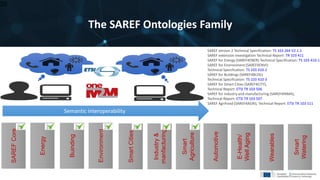
The SAREF Ontologies Family
20
Semantic interoperability
SAREFCore
Energy
Buinding
Environment
SmartCities
Industry&
manfacturing
Smart
Agriculture
Automotive
E-Health/
WellAging
Wearables
Smart
Watering
SAREF version 2 Technical Specification: TS 103 264 V2.1.1
SAREF extension investigation Technical Report: TR 103 411
SAREF for Energy (SAREF4ENER) Technical Specification: TS 103 410‐1
SAREF for Environment (SAREF4ENVI)
Technical Specification: TS 103 410‐2
SAREF for Buildings (SAREF4BLDG)
Technical Specification: TS 103 410‐3
SAREF for Smart Cities (SAREF4CITY),
Technical Report: ETSI TR 103 506
SAREF for industry and manufacturing (SAREF4INMA),
Technical Report: ETSI TR 103 507
SAREF AgriFood (SAREF4AGRI), Technical Report: ETSI TR 103 511
Background & Useful links:
• Digitising European Industry Strategy (DEI):
https://ec.europa.eu/digital-single-market/en/digitising-european-industry  FUTURIUM
• Supporting and Building Platforms under DEI
- https://ec.europa.eu/digital-single-market/en/industrial-platforms-and-large-scale-pilots
• European Commission’s Strategy on Key Strategic Value Chains, Apr. 2019
• Conclusions on a EU Industrial Policy Strategy, A vision for 2030
• Stakeholder Forum 2019 on 13-15th Nov. 2019 in Madrid
• “Artificial Intelligence and Digital Innovation Hubs for the European industry”
21
So Where’s the Meat Bread&Butter?
As Always: It’s in the Backup Slides ;-)
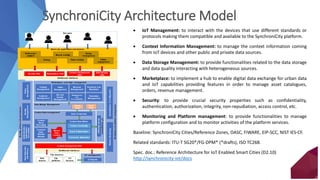
SynchroniCity Architecture Model
 IoT Management: to interact with the devices that use different standards or
protocols making them compatible and available to the SynchroniCity platform.
 Context Information Management: to manage the context information coming
from IoT devices and other public and private data sources.
 Data Storage Management: to provide functionalities related to the data storage
and data quality interacting with heterogeneous sources.
 Marketplace: to implement a hub to enable digital data exchange for urban data
and IoT capabilities providing features in order to manage asset catalogues,
orders, revenue management.
 Security: to provide crucial security properties such as confidentiality,
authentication, authorization, integrity, non-repudiation, access control, etc.
 Monitoring and Platform management: to provide functionalities to manage
platform configuration and to monitor activities of the platform services.
Baseline: SynchroniCity Cities/Reference Zones, OASC, FIWARE, EIP-SCC, NIST IES-CF.
Related standards: ITU-T SG20*/FG-DPM* (*drafts), ISO TC268.
Spec. doc.: Reference Architecture for IoT Enabled Smart Cities (D2.10)
http://synchronicity-iot/docs
IoTmanagement
Southbound interfaces
Data Storage Management
Context Data management
Security,privacyandgovernance
Northbound interfaces
Marketplace and asset management
IoT management
Open
Data
Monitoringandplatformmanagement
Smart city applications and services
Context
Event
Processing
DeviceManager
Data Connectors
IoTAgents
PlatformMonitoringAdministration&Configuration
Common
Data
Models
Adapter
Context management APIs
Context Data Broker
Query & Subscription
Context Availability
Command dispatcher
City resources
Data
sources
IoT
Devices
Private
Data
Authentication
Authorization
Accounting
DataProtection
andPrivacy
Context management
APIs
Security APIs Marketplace APIs
Data Storage
APIs
Policy
Management
Identity
Management
Multi-modal
assistant
Parking
Bicycle mobility
Policy making
Energy
management
Citizen
engagement …
…
End-users
Shared
Data
models
City
platforms
Catalog
Management
Revenue
Management
Feedback and
Reputation
Customer
Management
SLA and
License
Management
Transparency
and
Accountability
Federation
Management
Order
Management
23
IoTmanagement
Southbound interfaces
Data Storage Management
Context Data management
Security,privacyandgovernance
Northbound interfaces
Marketplace and asset management
IoT management
Open
Data
Monitoringandplatformmanagement
Smart city applications and services
Context
Event
Processing
DeviceManager
Data Connectors
IoTAgents
PlatformMonitoringAdministration&Configuration
Common
Data
Models
Adapter
Context management APIs
Context Data Broker
Query & Subscription
Context Availability
Command dispatcher
City resources
Data
sources
IoT
Devices
Private
Data
Authentication
Authorization
Accounting
DataProtection
andPrivacy
Context management
APIs
Security APIs Marketplace APIs
Data Storage
APIs
Policy
Management
Identity
Management
Multi-modal
assistant
Parking
Bicycle mobility
Policy making
Energy
management
Citizen
engagement …
…
End-users
Shared
Data
models
City
platforms
Catalog
Management
Revenue
Management
Feedback and
Reputation
Customer
Management
SLA and
License
Management
Transparency
and
Accountability
Federation
Management
Order
Management
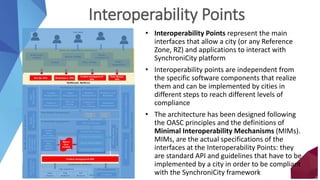
Interoperability Points
• Interoperability Points represent the main
interfaces that allow a city (or any Reference
Zone, RZ) and applications to interact with
SynchroniCity platform
• Interoperability points are independent from
the specific software components that realize
them and can be implemented by cities in
different steps to reach different levels of
compliance
• The architecture has been designed following
the OASC principles and the definitions of
Minimal Interoperability Mechanisms (MIMs).
MIMs, are the actual specifications of the
interfaces at the Interoperability Points: they
are standard API and guidelines that have to be
implemented by a city in order to be compliant
with the SynchroniCity framework
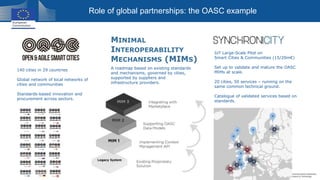
Role of global partnerships: the OASC example
140 cities in 29 countries
Global network of local networks of
cities and communities
Standards-based innovation and
procurement across sectors.
IoT Large-Scale Pilot on
Smart Cities & Communities (15/20m€)
Set up to validate and mature the OASC
MIMs at scale.
20 cities, 50 services – running on the
same common technical ground.
Catalogue of validated services based on
standards.
MINIMAL
INTEROPERABILITY
MECHANISMS (MIMS)
A roadmap based on existing standards
and mechanisms, governed by cities,
supported by suppliers and
infrastructure providers.
MIM Value proposition
Supply-side:
• Scale, agile development/deployment
Demand-side:
• Choice, flexibility, efficiency, value-for-money,
independence, economic development
All:
• Reduced risk, increased investments, innovation
www.synchronicity-iot.eu
Interoperability and AIOTI

Interoperability and AIOTI

  • 1.
    Franck Boissière European Commission- DG CONNECT IoT Standardisation and Interoperability The H2020 and AIOTI approach from sensors to AI through data lakes EBDVF 2019 - Helsinki
  • 2.
  • 3.
    INTERNET OF THINGS Researchand Innovation • Around €350 million investments  12 large scale pilots (€ 210 million)  coordinated across different EC policy streams with DG AGRI, ENER, GROW • nurturing an ecosystems of SMEs, start-ups • Leading Global IoT Standards setting Policy and Stakeholder Engagement • Key element of Digitizing European Industry strategy, e.g. through AIOTI • Regulatory framework for IoT • Addressing security and privacy, e.g. GDPR compliance, IoT cybersecurity Certification • New liability regimes for innovative products based on IoT (with DG GROW, JUST)
  • 4.
  • 5.
    Policy Dimensions &Interaction Source: DEI-MSP Final Report Task 3
  • 6.
    2016-2020 Large ScalePilots IoT Focus Area SYNCHRONICITY - Delivering an IoT enabled Digital Single Market for Europe and Beyond: Single digital city market for Europe (EU contr: 15M€, 33 partners in 9 countries) MONICA - Management Of Networked IoT Wearables – Very Large Scale Demonstration of Cultural Societal: Wearable devices containing sensors and actuators for massive scale applications. Europe (EU contr: 15M€, 28 partners in 9 countries) ACTIVAGE - ACTivating InnoVative IoT smart living environments for AGEing well: Active and healthy ageing. Europe (EU contr: 20M€, 48 partners in 9 countries) IoF2020 - Internet of Food and Farm 2020: Strengthen competiveness of farming and food chains in Europe. Europe (EU contr: 30M€, 70 partners in 16 countries) european-iot-pilots.eu AUTOPILOT - AUTOmated driving Progressed by Internet Of Things: Automated driving and infrastructure. Europe (EU contr: 20M€, 43 partners in 14 countries) Cross Fertilisation through Alignment, Synchronisation and Exchanges for IoT:Cross fertilisation of the various IoT Large Scale Pilots (LSPs) alignment with AIOTI . Mapping architecture approaches, interoperability and standards at technical and semantic levels .
  • 7.
    2019-2023 Large ScalePilots DEI Focus Area Aligning Reference Architectures, Open Platforms and Large-Scale Pilots in Digitising European Industry: Creation of common data platforms based on a unified architecture and an established standard. As part of the Horizon 2020 programme, the OPEN DEI project focuses on “Platforms and Pilots” to support the implementation of next generation digital platforms in four basic industrial domains: Manufacturing Agriculture Energy Healthcare Standardisation Conducting cross-domain surveys, performing promotion and implementation Platform building Comparing reference architectures and open source reference implementations, enabling a unified industrial data platform. Large scale piloting Contributing to a digital maturity model, creating a set of assessment methods and a migration journey benchmarking tool Data ecosystem building Enabling an innovation and collaboration platform, forging a European network of DIHs, contributing to industrial skills catalogue and observatory
  • 8.
    AI CSA? Oct 20–Dec23 Automotive Auto-pilot (26m€) Jan 17–Dec 19 Assisted Living Activage (25m€) Jan 17–Jun 20 Wearables Monica (17 m€) Jan 17–Dec 19 Agri IoF2020 (34m€) Jan 17–Dec 20 Smart Cities Synchronicity (20m€) Jan 17–Dec 19 CSA Create-IoT Jan 17–Dec 19 CSA U4IoT Jan 17–Dec 19 Agri Atlas (15m€) Oct 19–Sept 22 Energy Interconnect (35m€) Oct 19–Sept 23 Agri Demeter (17m€) Sept 19–Feb 23 2017 2018 2019 2020 2021 2022 2023 CSA Digiplace Sept 19–Feb 21 CSA OpenDei Jun 19–May 22 IoT/DEI Large Scale Pilots IoT FA LSP wave 1 DEI FA LSP wave 2&3 CSA NGIot Nov 18–Oct 21 Manufacturing? Jan 19–Dec 22Manufacturing? Jan 19–Dec 22Manufacturing? Jan 19–Dec 22Manufacturing? Sep-20-Dec 23 eHealth GateKeeper (23m€) Oct 19–March 23 eHealth PHArA-ON (22m€) Dec 19–Nov 23 Manufacturing Jan 19–Dec 22Manufacturing Jan 19–Dec 22Manufacturing Jan 19–Dec 22Manufacturing Jan 19–Dec 22
  • 9.
    Industrial IoT: Shaping Europe’sPosition in Global Value Chains 9 Common European Industrial IoT and Data Ecosystem IndustryandMSsSupport Governance RegulatoryFramework,End-to-EndSecurity InternationalStandardisation&Spectrum Digital Industrial Platforms driven by EU actors Secure &Trusted Data Spaces: Data access, sharing, valorisation Tools: Data Analytics MW-OS, security, CPS, AI & Could-edge Continuum Industrial Cloud / Edge / Data Infrastructure & Marketplaces 5G industrial trusted and secure infrastructure, connected sensors Instantiation/exploitation of the ecosystem in verticals through large-scale experimentation and regulatory sandboxes – business value, user engagement Manufacturing Construction Energy Agriculture Logistics Health Mobility …. Skills development Scale-up: DEP, HE, MSs Programmes, … SVC-IIoTWorkshop16May2019,CNECT-A2ML
  • 10.
    AIOTI Standardisation WGengagement model 10 Security and Data Protection Semantic Interoperability High Level Architecture- HLA Identifiers, 5G &IoT WGs support to AIOTI in: • Digital Single Market • Digitising European Industry • EC’s H2020 Large Scale Pilots
  • 11.
  • 12.
    12 • IoT Landscapegeorgios.karagiannis@huawei.com • IoT Landscape maintenance is key to keep the liaisons alive and maintain dialogue on how to foster collaboration to improve i nteroperability & security, v09 to be published in Q3 2019 • Gap Analysis and recommendations michelle.wetterwald@netellany.fr ; emmanuel.darmois@commledge.com, 1st release published May 2018, 2nd ongoing (2019) • Cooperation with SDOs/Alliances to foster co-creation and interworking georgios.karagiannis@huawei.com, Patrick.Guillemin@etsi.org (e.g., Liaisons: 3GPP, ITU-T, ISO, OSGi Alliance, BBF, 3GPP; MoUs – signed: AII, OSGi Alliance, BDVA, under discussion OPC Foundation, SCI4.0, ISO/IEC JTC1 SC41) • IoT relation and impact on 5G thomas.klein@de.ibm.com ; georgios.karagiannis@huawei.com 1st release published in June 2018, 2nd in March 2019 • HLA / High Level Architecture marco.carugi@gmail.com ; omar.elloumi@nokia.com R4, published in June 2018, R5 ongoing (2019) • IoT Reference Architecture and its mapping with existing IoT Reference Architectures • IoT identifiers juergen.heiles@siemens.com ; henri.barthel@gs1.org 1st release published February 2018 • SemIoP IoT Semantic Interoperability Martin.Bauer@neclab.eu; Laura.Daniele@tno.nl new JWP under construction • IoT Privacy (with WG04) vanderwees@arthurslegal.com Nuance of Trust event, Series of GDPR-Centric AIOTI webinars • IoT Platform, experimentation, LSPs need concrete standard framework & references to enable ”IoT Trust” and IoT “Privacy by d esign” + STF 547 • IoT Security (with WG04) vanderwees@arthurslegal.com; jacques.kruse-brandao@sgs.com; harm.arendshorst@ilabs.ai • IoT Security Architecture for Trusted IoT Devices; Baseline Requirements for Security & Privacy up to segment requirements; e xperimentation, LSPs need concrete standard framework & references to enable ”IoT Trust” based on IoT “Security by design” + STF 547 • Series of new IoT Webinars on Application-Centric (IoT Verticals meet IoT Horizontals). The central themes of the webinars are: Personal Wearables (H2x): Health, Living, Consumer, Public Space, and other verticals, Moving Sensors (M2x): Farm2Fork, Mobility, Consumer, Cities, and other verticals + Long Term Fixed IoT Applications (F2x): Industry 4.0, Cities, Consumer, Water Management, Energy, Construction, Living, and other verticals. • Joint MSP/DEI WG on Standardisation participation / November 2018 report + new plans in 2019 WG03 Highlights (ref. https://aioti.eu/aioti-wg03-reports-on-iot-standards/)
  • 13.
    13 What is SemanticInteroperability?  Semantics is the study of meaning – in our context the meaning of the data being exchanged  Traditionally, the semantics of data being exchanged is encoded in the producers and consumers of the data, i.e. it is implicitly given as part of the implementation of producers and consumers  Situation in IoT  IoT systems can be huge and dynamic, i.e. there is a large number of changing producers and consumers  Producers and consumers do not a-priori know each other  Increased value in IoT in case information can be (re-)used for completely new purposes  Implicit encoding of semantics not flexible enough + discovery has to be enabled  Make semantics explicit, i.e. attach the meaning to the data  It is about the agreement on uniquely identified concepts  The communicated data are instantiations of the concepts  Concepts, properties and relationships can be formalized as ontologies  Semantic Interoperability is about exchanging information on the basis of agreed, formalized and explicit semantics 13
  • 14.
    14 What is SemanticInteroperability?  Semantics is the study of meaning – in our context the meaning of the data being exchanged  Traditionally, the semantics of data being exchanged is encoded in the producers and consumers of the data, i.e. it is implicitly given as part of the implementation of producers and consumers  Situation in IoT  IoT systems can be huge and dynamic, i.e. there is a large number of changing producers and consumers  Producers and consumers do not a-priori know each other  Increased value in IoT in case information can be (re-)used for completely new purposes  Implicit encoding of semantics not flexible enough + discovery has to be enabled  Make semantics explicit, i.e. attach the meaning to the data  It is about the agreement on uniquely identified concepts  The communicated data are instantiations of the concepts  Concepts, properties and relationships can be formalized as ontologies  Semantic Interoperability is about exchanging information on the basis of agreed, formalized and explicit semantics 14
  • 15.
    15 Initial Joint Whitepaper2016: Semantic Interoperability for the Web of Things • Idea in AIOTI • Get together experts • Improve convergence • High visibility • Work under Creative Commons License • SDOs: oneM2M, W3C Web of Things, IEEE P2413 • DOI: 10.13140/RG.2.2.25758.13122
  • 16.
    16 Semantic Interoperability • SemanticInteroperability is associated with the meaning of the content that is exchanged. This requires agreement on common concepts and their relationships.
  • 17.
    17 AIOTIWG03 SemIoP LeadershipTeam MartinBauer (NEC) Laura Daniel (TNO).
  • 18.
    New Joint Whitepapers @ETSI IoT Week 2019 Towards Semantic Interoperability Standards based on Ontologies Target Group: Semantic Experts, Standardization Engineers & SDOs “How to create standards for semantic interoperability” Semantic IoT Solutions: A Developer Perspective Target Group: Developers and Software Architects “How to develop semantic systems and achieve semantic interoperability”
  • 19.
    More AIOTI cooperation 19 •CEN/CENELEC/ETSI Smart Meter CG, Smart Energy Grid CG, Smart Cities CG (SF-SSCC), CG-Smart Manufacturing, … • ISO, IEC (TC57, TC65), JTC1 SC41 SC42 SC 27 AG8, OMA, GSMA, BBF, TM Forum, OGC, NIST, NGMN, OASIS, OCF, AIM, ZigBee, Bluetooth, ULE Alliance, IPSO Alliance, IPv6 Forum, LoRa Alliance.. • Based on exisiting AIOTI participation and contribution levels 1. Light = IoT Landscape input & update, email exchanged 2. Participation = conf calls, meetings, surveys, reporting, inputs 3. Cooperation = liaison, work program sharing, join paper/release 4. Commitment = task/group/deliverbale leader or co-author • Reaching consensus on recommendations, facilitating exchanges • FoF/EFFRA, 5GIA, BDVA, ECSO, EIP-SCC (Urban Patforms), Eurocities, IoT Forum, BSI, Hyper/CAT…
  • 20.
    The SAREF OntologiesFamily 20 Semantic interoperability SAREFCore Energy Buinding Environment SmartCities Industry& manfacturing Smart Agriculture Automotive E-Health/ WellAging Wearables Smart Watering SAREF version 2 Technical Specification: TS 103 264 V2.1.1 SAREF extension investigation Technical Report: TR 103 411 SAREF for Energy (SAREF4ENER) Technical Specification: TS 103 410‐1 SAREF for Environment (SAREF4ENVI) Technical Specification: TS 103 410‐2 SAREF for Buildings (SAREF4BLDG) Technical Specification: TS 103 410‐3 SAREF for Smart Cities (SAREF4CITY), Technical Report: ETSI TR 103 506 SAREF for industry and manufacturing (SAREF4INMA), Technical Report: ETSI TR 103 507 SAREF AgriFood (SAREF4AGRI), Technical Report: ETSI TR 103 511
  • 21.
    Background & Usefullinks: • Digitising European Industry Strategy (DEI): https://ec.europa.eu/digital-single-market/en/digitising-european-industry  FUTURIUM • Supporting and Building Platforms under DEI - https://ec.europa.eu/digital-single-market/en/industrial-platforms-and-large-scale-pilots • European Commission’s Strategy on Key Strategic Value Chains, Apr. 2019 • Conclusions on a EU Industrial Policy Strategy, A vision for 2030 • Stakeholder Forum 2019 on 13-15th Nov. 2019 in Madrid • “Artificial Intelligence and Digital Innovation Hubs for the European industry” 21
  • 22.
    So Where’s theMeat Bread&Butter? As Always: It’s in the Backup Slides ;-)
  • 23.
    SynchroniCity Architecture Model IoT Management: to interact with the devices that use different standards or protocols making them compatible and available to the SynchroniCity platform.  Context Information Management: to manage the context information coming from IoT devices and other public and private data sources.  Data Storage Management: to provide functionalities related to the data storage and data quality interacting with heterogeneous sources.  Marketplace: to implement a hub to enable digital data exchange for urban data and IoT capabilities providing features in order to manage asset catalogues, orders, revenue management.  Security: to provide crucial security properties such as confidentiality, authentication, authorization, integrity, non-repudiation, access control, etc.  Monitoring and Platform management: to provide functionalities to manage platform configuration and to monitor activities of the platform services. Baseline: SynchroniCity Cities/Reference Zones, OASC, FIWARE, EIP-SCC, NIST IES-CF. Related standards: ITU-T SG20*/FG-DPM* (*drafts), ISO TC268. Spec. doc.: Reference Architecture for IoT Enabled Smart Cities (D2.10) http://synchronicity-iot/docs IoTmanagement Southbound interfaces Data Storage Management Context Data management Security,privacyandgovernance Northbound interfaces Marketplace and asset management IoT management Open Data Monitoringandplatformmanagement Smart city applications and services Context Event Processing DeviceManager Data Connectors IoTAgents PlatformMonitoringAdministration&Configuration Common Data Models Adapter Context management APIs Context Data Broker Query & Subscription Context Availability Command dispatcher City resources Data sources IoT Devices Private Data Authentication Authorization Accounting DataProtection andPrivacy Context management APIs Security APIs Marketplace APIs Data Storage APIs Policy Management Identity Management Multi-modal assistant Parking Bicycle mobility Policy making Energy management Citizen engagement … … End-users Shared Data models City platforms Catalog Management Revenue Management Feedback and Reputation Customer Management SLA and License Management Transparency and Accountability Federation Management Order Management 23
  • 24.
    IoTmanagement Southbound interfaces Data StorageManagement Context Data management Security,privacyandgovernance Northbound interfaces Marketplace and asset management IoT management Open Data Monitoringandplatformmanagement Smart city applications and services Context Event Processing DeviceManager Data Connectors IoTAgents PlatformMonitoringAdministration&Configuration Common Data Models Adapter Context management APIs Context Data Broker Query & Subscription Context Availability Command dispatcher City resources Data sources IoT Devices Private Data Authentication Authorization Accounting DataProtection andPrivacy Context management APIs Security APIs Marketplace APIs Data Storage APIs Policy Management Identity Management Multi-modal assistant Parking Bicycle mobility Policy making Energy management Citizen engagement … … End-users Shared Data models City platforms Catalog Management Revenue Management Feedback and Reputation Customer Management SLA and License Management Transparency and Accountability Federation Management Order Management Interoperability Points • Interoperability Points represent the main interfaces that allow a city (or any Reference Zone, RZ) and applications to interact with SynchroniCity platform • Interoperability points are independent from the specific software components that realize them and can be implemented by cities in different steps to reach different levels of compliance • The architecture has been designed following the OASC principles and the definitions of Minimal Interoperability Mechanisms (MIMs). MIMs, are the actual specifications of the interfaces at the Interoperability Points: they are standard API and guidelines that have to be implemented by a city in order to be compliant with the SynchroniCity framework
  • 25.
    Role of globalpartnerships: the OASC example 140 cities in 29 countries Global network of local networks of cities and communities Standards-based innovation and procurement across sectors. IoT Large-Scale Pilot on Smart Cities & Communities (15/20m€) Set up to validate and mature the OASC MIMs at scale. 20 cities, 50 services – running on the same common technical ground. Catalogue of validated services based on standards. MINIMAL INTEROPERABILITY MECHANISMS (MIMS) A roadmap based on existing standards and mechanisms, governed by cities, supported by suppliers and infrastructure providers.
  • 26.
    MIM Value proposition Supply-side: •Scale, agile development/deployment Demand-side: • Choice, flexibility, efficiency, value-for-money, independence, economic development All: • Reduced risk, increased investments, innovation
  • 27.

Editor's Notes

  • #11  AIOTI WG03 Reports v2: we do not develop standards AIOTI WG03 has developed a very effective scheme for liaising with other standardisation bodies/alliances, with the aim to reaching consensus on recommendations and facilitating exchanges. A key feature is its gradual engagement levels ranging from Light = IoT Landscape input & update, email exchanged Participation = conf calls, meetings, surveys, reporting, inputs Cooperation = liaison, work program sharing, join paper/release Commitment = task/group/deliverbale leader or co-author The most active liaisons are with: oneM2M, Omar Elloumi Nokia, oneM2M TP Chairman ITU-T SG20, Marco Carugi, NEC Corporation, ITU-T SG20 Rapporteur and Mentor IEEE P2413, Paul Murdock Landis+Gyr ISO/IEC JTC1 WG10 (IoT) now JTC 1/SC 41 since May’17, Henri Barthel GS1 CEN/CENELEC Bernhard Thies, CENELEC President IIC Jean-Pierre Desbenoit, Schneider-Electric OPC and Platform I4.0, Thomas Hahn, Siemens (Juergen Heiles) IETF Georgios Karagiannis, Huawei Technologies (Patrick Wetterwald) W3C (Dave Raggett)
  • #26 The demand side is an essential element of any market, and