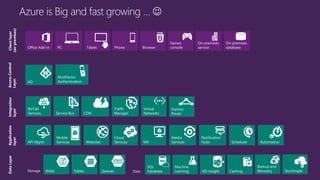
Azure is Big and fast growing … Clientlayer
(on-premises)
Tablet Phone
Games
consolePC
On-premises
databaseBrowserOffice Add-in
On-premises
service
AD
Multifactor
Authentication
AccessControl
Layer
Integration
layer
Service Bus CDN
BizTalk
Services
Traffic
Manager
Virtual
Networks
Express
Route
Application
layer
API Mgmt Websites
Cloud
Services VM
Mobile
Services
Media
Services
Notification
Hubs Scheduler Automation
DataLayer
Storage Blobs Tables Queues Data
Machine
Learning HD Insight
Backup and
Recovery
SQL
Database Caching StorSimple
♥
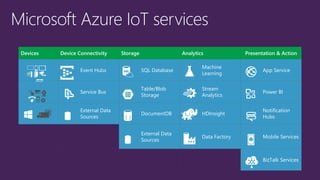
Devices Device Connectivity Storage Analytics Presentation & Action
Event Hubs SQL Database
Machine
Learning
App Service
Service Bus
Table/Blob
Storage
Stream
Analytics
Power BI
External Data
Sources
DocumentDB HDInsight
Notification
Hubs
External Data
Sources
Data Factory Mobile Services
BizTalk Services
{ }
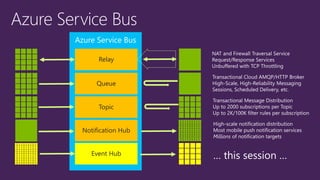
Relay
Queue
Topic
Notification Hub
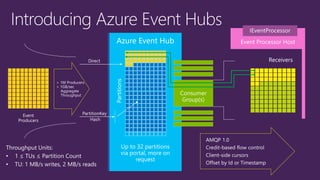
Event Hub
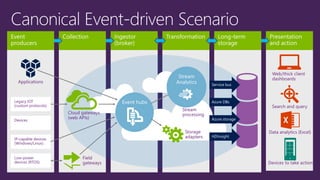
Event
Producers
Event
Producers
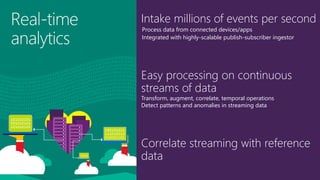
Intake millions of events per second
Process data from connected devices/apps
Integrated with highly-scalable publish-subscriber ingestor
Easy processing on continuous
streams of data
Transform, augment, correlate, temporal operations
Detect patterns and anomalies in streaming data
Correlate streaming with reference
data
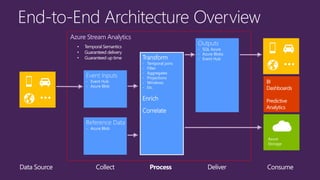
End-to-End Architecture Overview
Data Source Collect Process ConsumeDeliver
Event Inputs
- Event Hub
- Azure Blob
Transform
- Temporal joins
- Filter
- Aggregates
- Projections
- Windows
- Etc.
Enrich
Correlate
Outputs
- SQL Azure
- Azure Blobs
- Event Hub
Azure
Storage
• Temporal Semantics
• Guaranteed delivery
• Guaranteed up time
Azure Stream Analytics
Reference Data
- Azure Blob
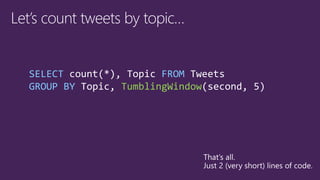
SELECT count(*), Topic FROM Tweets
GROUP BY Topic, TumblingWindow(second, 5)
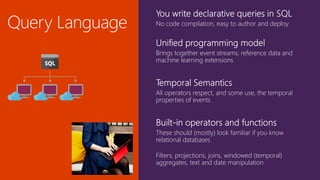
No code compilation, easy to author and deploy
Brings together event streams, reference data and
machine learning extensions
All operators respect, and some use, the temporal
properties of events
These should (mostly) look familiar if you know
relational databases
Filters, projections, joins, windowed (temporal)
aggregates, text and date manipulation
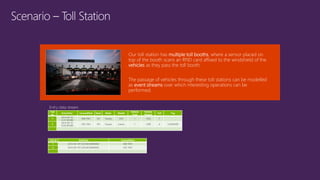
Our toll station has multiple toll booths, where a sensor placed on
top of the booth scans an RFID card affixed to the windshield of the
vehicles as they pass the toll booth.
The passage of vehicles through these toll stations can be modelled
as event streams over which interesting operations can be
performed.
Toll
Id
EntryTime LicensePlate State Make Model
Vehicle
Type
Vehicle
Weight
Toll Tag
1
2014-09-10
12:01:00.000
JNB 7001 NY Honda CRV 1 1535 7
2
2014-09-10
12:02:00.000
YXZ 1001 NY Toyota Camry 1 1399 4 123456789
…
Toll Id ExitTime LicensePlate
1 2014-09-10T12:03:00.0000000Z JNB 7001
2 2014-09-10T12:03:00.0000000Z YXZ 1001
…
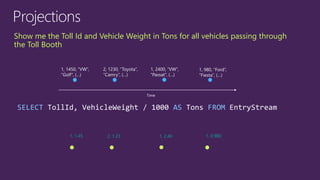
Projections
1, 1450, “VW”,
“Golf”, (…)
2, 1230, “Toyota”,
“Camry”, (…)
1, 2400, “VW”,
“Passat”, (…)
1, 980, “Ford”,
“Fiesta”, (…)
SELECT TollId, VehicleWeight / 1000 AS Tons FROM EntryStream
1, 1.45 2, 1.23 1, 2.40 1, 0.980
Show me the Toll Id and Vehicle Weight in Tons for all vehicles passing through
the Toll Booth
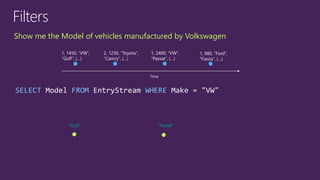
Filters
SELECT Model FROM EntryStream WHERE Make = "VW"
1, 1450, “VW”,
“Golf”, (…)
2, 1230, “Toyota”,
“Camry”, (…)
1, 2400, “VW”,
“Passat”, (…)
1, 980, “Ford”,
“Fiesta”, (…)
“Golf” “Passat”
Show me the Model of vehicles manufactured by Volkswagen
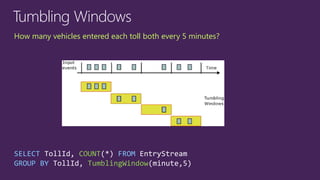
Tumbling Windows
SELECT TollId, COUNT(*) FROM EntryStream
GROUP BY TollId, TumblingWindow(minute,5)
How many vehicles entered each toll both every 5 minutes?
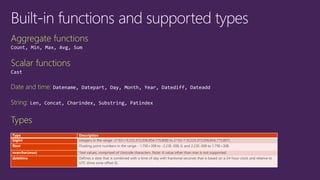
Aggregate functions
Scalar functions
Date and time:
String:
Types
Type Description
bigint Integers in the range -2^63 (-9,223,372,036,854,775,808) to 2^63-1 (9,223,372,036,854,775,807).
float Floating point numbers in the range - 1.79E+308 to -2.23E-308, 0, and 2.23E-308 to 1.79E+308.
nvarchar(max) Text values, comprised of Unicode characters. Note: A value other than max is not supported.
datetime Defines a date that is combined with a time of day with fractional seconds that is based on a 24-hour clock and relative to
UTC (time zone offset 0).
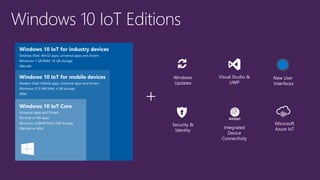
Windows 10 IoT Editions
+
Microsoft
Azure IoT
Security &
Identity
Windows
Updates
Visual Studio &
UWP
Windows 10 IoT for industry devices
Desktop Shell, Win32 apps, Universal apps and drivers
Minimum: 1 GB RAM, 16 GB storage
X86/x64
Windows 10 IoT for mobile devices
Modern Shell, Mobile apps, Universal apps and drivers
Minimum: 512 MB RAM, 4 GB storage
ARM
Windows 10 IoT Core
Universal Apps and Drivers
No shell or MS apps
Minimum: 256MB RAM, 2GB storage
X86/x64 or ARM Integrated
Device
Connectivity
New User
Interfaces
Microsoft Azure and IoT – how to use

Microsoft Azure and IoT – how to use

  • 2.
    Azure is Bigand fast growing … Clientlayer (on-premises) Tablet Phone Games consolePC On-premises databaseBrowserOffice Add-in On-premises service AD Multifactor Authentication AccessControl Layer Integration layer Service Bus CDN BizTalk Services Traffic Manager Virtual Networks Express Route Application layer API Mgmt Websites Cloud Services VM Mobile Services Media Services Notification Hubs Scheduler Automation DataLayer Storage Blobs Tables Queues Data Machine Learning HD Insight Backup and Recovery SQL Database Caching StorSimple
  • 4.
  • 6.
    Devices Device ConnectivityStorage Analytics Presentation & Action Event Hubs SQL Database Machine Learning App Service Service Bus Table/Blob Storage Stream Analytics Power BI External Data Sources DocumentDB HDInsight Notification Hubs External Data Sources Data Factory Mobile Services BizTalk Services { }
  • 9.
  • 11.
  • 16.
  • 23.
    Intake millions ofevents per second Process data from connected devices/apps Integrated with highly-scalable publish-subscriber ingestor Easy processing on continuous streams of data Transform, augment, correlate, temporal operations Detect patterns and anomalies in streaming data Correlate streaming with reference data
  • 24.
    End-to-End Architecture Overview DataSource Collect Process ConsumeDeliver Event Inputs - Event Hub - Azure Blob Transform - Temporal joins - Filter - Aggregates - Projections - Windows - Etc. Enrich Correlate Outputs - SQL Azure - Azure Blobs - Event Hub Azure Storage • Temporal Semantics • Guaranteed delivery • Guaranteed up time Azure Stream Analytics Reference Data - Azure Blob
  • 25.
    SELECT count(*), TopicFROM Tweets GROUP BY Topic, TumblingWindow(second, 5)
  • 26.
    No code compilation,easy to author and deploy Brings together event streams, reference data and machine learning extensions All operators respect, and some use, the temporal properties of events These should (mostly) look familiar if you know relational databases Filters, projections, joins, windowed (temporal) aggregates, text and date manipulation
  • 27.
    Our toll stationhas multiple toll booths, where a sensor placed on top of the booth scans an RFID card affixed to the windshield of the vehicles as they pass the toll booth. The passage of vehicles through these toll stations can be modelled as event streams over which interesting operations can be performed. Toll Id EntryTime LicensePlate State Make Model Vehicle Type Vehicle Weight Toll Tag 1 2014-09-10 12:01:00.000 JNB 7001 NY Honda CRV 1 1535 7 2 2014-09-10 12:02:00.000 YXZ 1001 NY Toyota Camry 1 1399 4 123456789 … Toll Id ExitTime LicensePlate 1 2014-09-10T12:03:00.0000000Z JNB 7001 2 2014-09-10T12:03:00.0000000Z YXZ 1001 …
  • 28.
    Projections 1, 1450, “VW”, “Golf”,(…) 2, 1230, “Toyota”, “Camry”, (…) 1, 2400, “VW”, “Passat”, (…) 1, 980, “Ford”, “Fiesta”, (…) SELECT TollId, VehicleWeight / 1000 AS Tons FROM EntryStream 1, 1.45 2, 1.23 1, 2.40 1, 0.980 Show me the Toll Id and Vehicle Weight in Tons for all vehicles passing through the Toll Booth
  • 29.
    Filters SELECT Model FROMEntryStream WHERE Make = "VW" 1, 1450, “VW”, “Golf”, (…) 2, 1230, “Toyota”, “Camry”, (…) 1, 2400, “VW”, “Passat”, (…) 1, 980, “Ford”, “Fiesta”, (…) “Golf” “Passat” Show me the Model of vehicles manufactured by Volkswagen
  • 30.
    Tumbling Windows SELECT TollId,COUNT(*) FROM EntryStream GROUP BY TollId, TumblingWindow(minute,5) How many vehicles entered each toll both every 5 minutes?
  • 31.
    Aggregate functions Scalar functions Dateand time: String: Types Type Description bigint Integers in the range -2^63 (-9,223,372,036,854,775,808) to 2^63-1 (9,223,372,036,854,775,807). float Floating point numbers in the range - 1.79E+308 to -2.23E-308, 0, and 2.23E-308 to 1.79E+308. nvarchar(max) Text values, comprised of Unicode characters. Note: A value other than max is not supported. datetime Defines a date that is combined with a time of day with fractional seconds that is based on a 24-hour clock and relative to UTC (time zone offset 0).
  • 33.
    Windows 10 IoTEditions + Microsoft Azure IoT Security & Identity Windows Updates Visual Studio & UWP Windows 10 IoT for industry devices Desktop Shell, Win32 apps, Universal apps and drivers Minimum: 1 GB RAM, 16 GB storage X86/x64 Windows 10 IoT for mobile devices Modern Shell, Mobile apps, Universal apps and drivers Minimum: 512 MB RAM, 4 GB storage ARM Windows 10 IoT Core Universal Apps and Drivers No shell or MS apps Minimum: 256MB RAM, 2GB storage X86/x64 or ARM Integrated Device Connectivity New User Interfaces