Minimax and Alpha-Beta Reduction
Group Members
Md. Musabbir Hussain 141-15-3077
Faiaz Ahamed Raihan 141-15-3260
Md. Mahfuzul Yamin 141-15-3429
Ms. Habiba Sultana 141-15-3435
Content
• Minimax Decision
• Required Pieces for Minimax
• Properties of Minimax
• Deeper game trees
• Alpha-Beta Properties
• Alpha-Beta Pruning example
• Conclusion
Minimax Decision
• Assign a utility value to each possible ending
• Assures best possible ending, assuming opponent also plays
perfectly
• opponent tries to give you worst possible ending
• Depth-first search tree traversal that updates utility values as it
recourses back up the tree
Required Pieces for Minimax
• An initial state
• The positions of all the pieces
• Whose turn it is
• Operators
• Legal moves the player can make
• Terminal Test
• Determines if a state is a final state
• Utility Function
Properties of Minimax
• Complete? Yes (if tree is finite)
• Optimal? Yes (against an optimal opponent)
• Time complexity? O(bm)
• Space complexity? O(bm) (depth-first exploration
7
ED
0B C
R
0
N
4 O P
9
Q
-6
S
3
T
5
U
-7
V
-9
K MF G
-5
H
3
I
8 J L
2
W
-3
X
-5
A
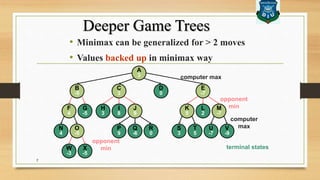
Deeper Game Trees
• Minimax can be generalized for > 2 moves
• Values backed up in minimax way
terminal states
O
-5
K
5
M
-7
F
4
J
9
E
-7
B
-5
C
3
A
3
opponent
min
computer
max
opponent
min
computer max
Alpha-Beta Pruning
• Main idea: Avoid processing subtrees that have no effect on the result
• Two new parameters
• α: The best value for MAX seen so far
• β: The best value for MIN seen so far
• α is used in MIN nodes, and is assigned in MAX nodes
• β is used in MAX nodes, and is assigned in MIN nodes
Alpha-Beta Pruning
• Alpha = the value of the best choice we’ve found so far for
MAX (highest)
• Beta = the value of the best choice we’ve found so far for MIN
(lowest)
• When maximizing, cut off values lower than Alpha
• When minimizing, cut off values greater than Beta
When to Prune
• Prune whenever  ≥ .
• Prune below a Max node whose alpha value becomes greater than or
equal to the beta value of its ancestors.
• Max nodes update alpha based on children’s returned values.
• Prune below a Min node whose beta value becomes less than or
equal to the alpha value of its ancestors.
• Min nodes update beta based on children’s returned values.
Properties of α-β
• Pruning preserves completeness and optimality of original
minimax algorithm
• Good move ordering improves effectiveness of pruning
• With "perfect ordering," time complexity = O(bm/2)
Therefore, doubles depth of search
Alpha-Beta Example Revisited
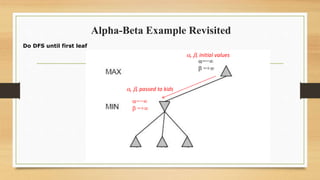
, , initial values
Do DFS until first leaf
=−
 =+
=−
 =+
, , passed to kids
Alpha-Beta Example (continued)
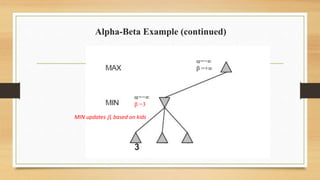
MIN updates , based on kids
=−
 =+
=−
 =3
Alpha-Beta Example (continued)
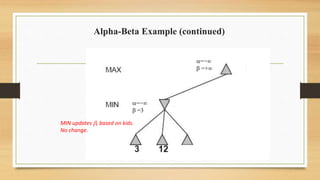
=−
 =3
MIN updates , based on kids.
No change.
=−
 =+
Alpha-Beta Example (continued)
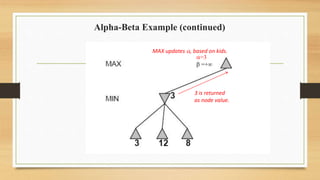
MAX updates , based on kids.
=3
 =+
3 is returned
as node value.
Alpha-Beta Example (continued)
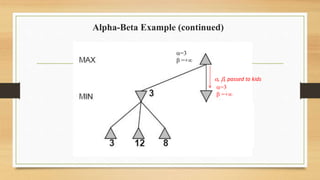
=3
 =+
=3
 =+
, , passed to kids
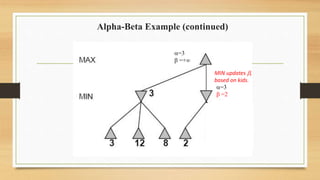
Alpha-Beta Example (continued)
=3
 =+
=3
 =2
MIN updates ,
based on kids.
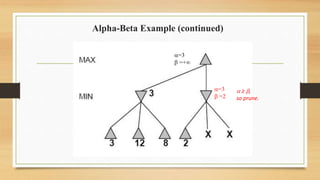
Alpha-Beta Example (continued)
=3
 =2
 ≥ ,
so prune.
=3
 =+
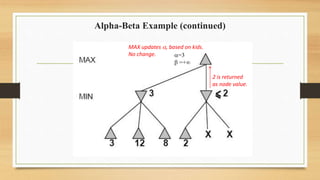
Alpha-Beta Example (continued)
2 is returned
as node value.
MAX updates , based on kids.
No change. =3
 =+
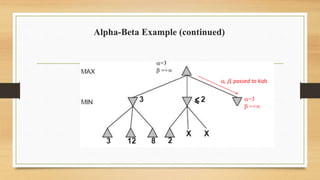
Alpha-Beta Example (continued)
,
=3
 =+
=3
 =+
, , passed to kids
Alpha-Beta Example (continued)
,
=3
 =14
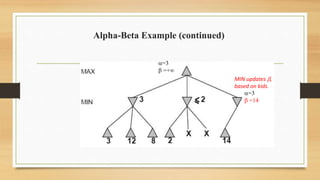
=3
 =+
MIN updates ,
based on kids.
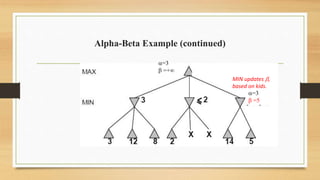
Alpha-Beta Example (continued)
,
=3
 =5
=3
 =+
MIN updates ,
based on kids.
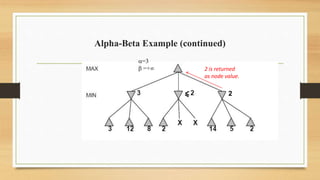
Alpha-Beta Example (continued)
=3
 =+ 2 is returned
as node value.
2
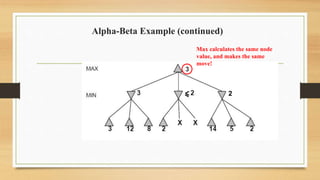
Alpha-Beta Example (continued)
Max calculates the same node
value, and makes the same
move!
2
Conclusion
• Minimax finds optimal play for deterministic, fully
observable, two-player games
• Alpha-Beta reduction makes it faster
THANK YOU

AI-MiniMax Algorithm and Alpha Beta Reduction

  • 1.
  • 2.
    Group Members Md. MusabbirHussain 141-15-3077 Faiaz Ahamed Raihan 141-15-3260 Md. Mahfuzul Yamin 141-15-3429 Ms. Habiba Sultana 141-15-3435
  • 3.
    Content • Minimax Decision •Required Pieces for Minimax • Properties of Minimax • Deeper game trees • Alpha-Beta Properties • Alpha-Beta Pruning example • Conclusion
  • 4.
    Minimax Decision • Assigna utility value to each possible ending • Assures best possible ending, assuming opponent also plays perfectly • opponent tries to give you worst possible ending • Depth-first search tree traversal that updates utility values as it recourses back up the tree
  • 5.
    Required Pieces forMinimax • An initial state • The positions of all the pieces • Whose turn it is • Operators • Legal moves the player can make • Terminal Test • Determines if a state is a final state • Utility Function
  • 6.
    Properties of Minimax •Complete? Yes (if tree is finite) • Optimal? Yes (against an optimal opponent) • Time complexity? O(bm) • Space complexity? O(bm) (depth-first exploration
  • 7.
    7 ED 0B C R 0 N 4 OP 9 Q -6 S 3 T 5 U -7 V -9 K MF G -5 H 3 I 8 J L 2 W -3 X -5 A Deeper Game Trees • Minimax can be generalized for > 2 moves • Values backed up in minimax way terminal states O -5 K 5 M -7 F 4 J 9 E -7 B -5 C 3 A 3 opponent min computer max opponent min computer max
  • 8.
    Alpha-Beta Pruning • Mainidea: Avoid processing subtrees that have no effect on the result • Two new parameters • α: The best value for MAX seen so far • β: The best value for MIN seen so far • α is used in MIN nodes, and is assigned in MAX nodes • β is used in MAX nodes, and is assigned in MIN nodes
  • 9.
    Alpha-Beta Pruning • Alpha= the value of the best choice we’ve found so far for MAX (highest) • Beta = the value of the best choice we’ve found so far for MIN (lowest) • When maximizing, cut off values lower than Alpha • When minimizing, cut off values greater than Beta
  • 10.
    When to Prune •Prune whenever  ≥ . • Prune below a Max node whose alpha value becomes greater than or equal to the beta value of its ancestors. • Max nodes update alpha based on children’s returned values. • Prune below a Min node whose beta value becomes less than or equal to the alpha value of its ancestors. • Min nodes update beta based on children’s returned values.
  • 11.
    Properties of α-β •Pruning preserves completeness and optimality of original minimax algorithm • Good move ordering improves effectiveness of pruning • With "perfect ordering," time complexity = O(bm/2) Therefore, doubles depth of search
  • 12.
    Alpha-Beta Example Revisited ,, initial values Do DFS until first leaf =−  =+ =−  =+ , , passed to kids
  • 13.
    Alpha-Beta Example (continued) MINupdates , based on kids =−  =+ =−  =3
  • 14.
    Alpha-Beta Example (continued) =− =3 MIN updates , based on kids. No change. =−  =+
  • 15.
    Alpha-Beta Example (continued) MAXupdates , based on kids. =3  =+ 3 is returned as node value.
  • 16.
    Alpha-Beta Example (continued) =3 =+ =3  =+ , , passed to kids
  • 17.
    Alpha-Beta Example (continued) =3 =+ =3  =2 MIN updates , based on kids.
  • 18.
    Alpha-Beta Example (continued) =3 =2  ≥ , so prune. =3  =+
  • 19.
    Alpha-Beta Example (continued) 2is returned as node value. MAX updates , based on kids. No change. =3  =+
  • 20.
    Alpha-Beta Example (continued) , =3 =+ =3  =+ , , passed to kids
  • 21.
    Alpha-Beta Example (continued) , =3 =14 =3  =+ MIN updates , based on kids.
  • 22.
    Alpha-Beta Example (continued) , =3 =5 =3  =+ MIN updates , based on kids.
  • 23.
    Alpha-Beta Example (continued) =3 =+ 2 is returned as node value. 2
  • 24.
    Alpha-Beta Example (continued) Maxcalculates the same node value, and makes the same move! 2
  • 25.
    Conclusion • Minimax findsoptimal play for deterministic, fully observable, two-player games • Alpha-Beta reduction makes it faster
  • 26.