Students doing popular science: Visual communication in a hybrid academic genreChristophHafner, City University of Hong Konghttp://www1.english.cityu.edu.hk/acadlitCERLIS conference, University of Bergamo, June 2011
Background, methods
Context for this studyCity University of HK, English for Science and Technology course for students of:Applied BiologyApplied ChemistryEnvironmental Science and ManagementMathematics
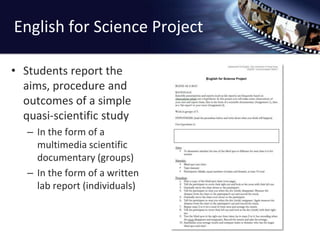
English for Science ProjectStudents report the aims, procedure and outcomes of a simple quasi-scientific studyIn the form of a multimedia scientific documentary (groups)In the form of a written lab report (individuals)
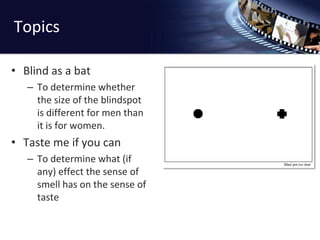
TopicsBlind as a batTo determine whether the size of the blindspot is different for men than it is for women.Taste me if you canTo determine what (if any) effect the sense of smell has on the sense of taste
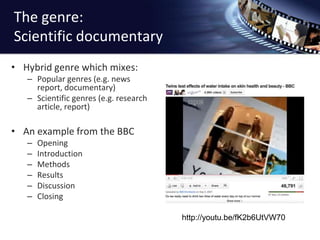
The genre: Scientific documentaryHybrid genre which mixes:Popular genres (e.g. news report, documentary)Scientific genres (e.g. research article, report)An example from the BBCOpeningIntroductionMethodsResultsDiscussionClosinghttp://youtu.be/fK2b6UtVW70
Data sourcesStudent scientific documentaries
Analysis draws on Baldry and Thibault, 2006:
Move, Shot, visual frame
Speech
Soundtrack
Setting/participants
Action/gaze gesture
Camera position/perspective
Student focus group interviews
Student comments to course blogFocus questionsWhat multimodal rhetorical strategies do students draw on when they create a multimedia scientific documentary?How can this activity benefit their development of academic literacies in the science domain?
Student perspectives on the task
The challenge of attentionThe first impression of audience is the critical point to determine the success of a good documentary since if the audience’s attention cannot be attracted at the beginning, they will have no interest to continue to watch the video even the information is rich and constructive. I agree with t01_john. He said that visual stimulation would be the easiest way to make them remember the video. [Student blog post, October 7th, 2009 at 11:22 pm]
The challenge of multimodalityI think the most challenging thing is how to give an attractive and interesting present[ation] because we use lots of method involved in our video. For example, use pictures, use a narrator, stand in front of the camera for speaking and use music or many, many elements we involved in order to give a whole product to make it more interesting. [Student focus group interview] 
Thinking about multimodalityMoving images and animationCharts and tables for scientific dataSubtitlesDifferent camera angles and lighting,Background musicSound effectsInteresting locationsInteresting participantsFacial expression
3 Cases and rhetorical devicesInvestigation of a startling factDid you realize there is a blind spot in your eye?Investigation of a social issueWhy does the cafeteria food taste so bad? Is it only the taste, or is it the smell as well?Investigation of a personal issueWhy can’t I taste this orange juice? Is there something wrong with me?
Case #1Investigation of a startling fact
Student identityStudent as ‘scientist’Narrator role is backgrounded, increased social distance between the producers and their audience
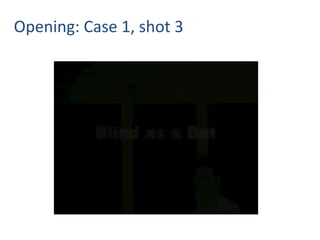
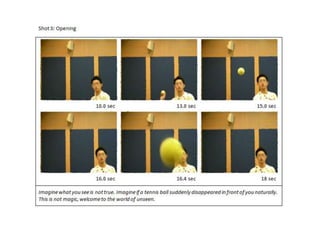
Opening: Case 1, shot 3
Background and theory: Case 1, shot 10
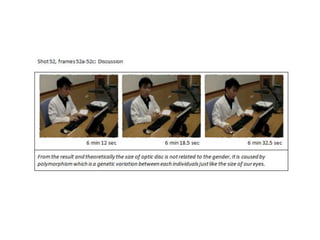
Discussion: Case 1, shots 51-52
Case #2Investigation of a social issue
Student identityStudent as ‘reporter’Narrator role is more prominent, with an on-screen narrator (the reporter), who appears at various points throughout the documentaryWatch for intertextual references and use of sound
Opening: Case 2, shots 1-8

CERLIS 2011: Students doing popular science: Visual communication in an emerging genre

  • 1.
    Students doing popularscience: Visual communication in a hybrid academic genreChristophHafner, City University of Hong Konghttp://www1.english.cityu.edu.hk/acadlitCERLIS conference, University of Bergamo, June 2011
  • 2.
  • 3.
    Context for thisstudyCity University of HK, English for Science and Technology course for students of:Applied BiologyApplied ChemistryEnvironmental Science and ManagementMathematics
  • 4.
    English for ScienceProjectStudents report the aims, procedure and outcomes of a simple quasi-scientific studyIn the form of a multimedia scientific documentary (groups)In the form of a written lab report (individuals)
  • 5.
    TopicsBlind as abatTo determine whether the size of the blindspot is different for men than it is for women.Taste me if you canTo determine what (if any) effect the sense of smell has on the sense of taste
  • 6.
    The genre: ScientificdocumentaryHybrid genre which mixes:Popular genres (e.g. news report, documentary)Scientific genres (e.g. research article, report)An example from the BBCOpeningIntroductionMethodsResultsDiscussionClosinghttp://youtu.be/fK2b6UtVW70
  • 7.
  • 8.
    Analysis draws onBaldry and Thibault, 2006:
  • 9.
  • 10.
  • 11.
  • 12.
  • 13.
  • 14.
  • 15.
  • 16.
    Student comments tocourse blogFocus questionsWhat multimodal rhetorical strategies do students draw on when they create a multimedia scientific documentary?How can this activity benefit their development of academic literacies in the science domain?
  • 17.
  • 18.
    The challenge ofattentionThe first impression of audience is the critical point to determine the success of a good documentary since if the audience’s attention cannot be attracted at the beginning, they will have no interest to continue to watch the video even the information is rich and constructive. I agree with t01_john. He said that visual stimulation would be the easiest way to make them remember the video. [Student blog post, October 7th, 2009 at 11:22 pm]
  • 19.
    The challenge ofmultimodalityI think the most challenging thing is how to give an attractive and interesting present[ation] because we use lots of method involved in our video. For example, use pictures, use a narrator, stand in front of the camera for speaking and use music or many, many elements we involved in order to give a whole product to make it more interesting. [Student focus group interview] 
  • 20.
    Thinking about multimodalityMovingimages and animationCharts and tables for scientific dataSubtitlesDifferent camera angles and lighting,Background musicSound effectsInteresting locationsInteresting participantsFacial expression
  • 21.
    3 Cases andrhetorical devicesInvestigation of a startling factDid you realize there is a blind spot in your eye?Investigation of a social issueWhy does the cafeteria food taste so bad? Is it only the taste, or is it the smell as well?Investigation of a personal issueWhy can’t I taste this orange juice? Is there something wrong with me?
  • 22.
    Case #1Investigation ofa startling fact
  • 23.
    Student identityStudent as‘scientist’Narrator role is backgrounded, increased social distance between the producers and their audience
  • 24.
  • 26.
    Background and theory:Case 1, shot 10
  • 28.
  • 30.
  • 31.
    Student identityStudent as‘reporter’Narrator role is more prominent, with an on-screen narrator (the reporter), who appears at various points throughout the documentaryWatch for intertextual references and use of sound
  • 32.

Editor's Notes

  • #11 Students were concerned to meet the challenge of creating an interesting documentary capable of attracting the attention of viewers – many students felt that this was the most challenging aspect of the video overall. In their comments some students discuss how multimodal presentation techniques can be strategically used to creatively get attention, e.g. by providing an attention-getting opening to their documentary or a memorable closing.
  • #12 The combination of modes is identified as a challenge by this student. In this extract the student articulates an awareness of the need to combine multiple modes simultaneously in order to communicate their message effectively.
  • #13 Similarly, in their comments on the course weblog (made in the course of the semester) students demonstrate an appreciation of the range of multimodal semiotic resources available. In week 2, students were asked to evaluate sample documentaries and answer the question: “What do you think worked well in the documentaries that we viewed?” In their responses students commented on the way that different modalities complement one another. In the online discussion, students referred to a wide range of semiotic resources: moving images and animation, charts and tables for scientific data, subtitles, different camera angles and lighting, background music, sound effects, interesting locations, interesting participants, facial expression. Taking into account these observations, many students suggested possible strategies to use in their own documentaries.
  • #14 Out of the 18 videos that students made, we identified 3 that we thought were particularly interesting, and which use slightly different rhetorical devices in order to respond to the challenge of getting attention. The first presents itself in a scientific fashion, and in order to get the attention of the audience the students present their topic as an investigation of a startling fact, pointing out that while we might feel that our vision is 100% complete, in actual fact each eye has a blind spot and objects that fall into this blind spot cannot be perceived. The students here are like scientists explaining concepts to a lay and uninformed audience. The second presents itself in a more journalistic fashion as a TV show on the CityU scientific channel and in order to get the attention of the audience the students present their topic as an investigation of a social issue, the complaints about food at the cafeteria. The students here are like investigative reporters. The third presents itself in a dramatic way as a kind of story, and in order to get the audience’s attention the students present their topic as an investigation of a personal issue, the problem that one student has tasting his orange juice. The students here are like adventurers who go on a quest to discover the truth.
  • #15 In the first case, on the ‘Blind as a Bat’ topic, the students created a serious production with an objective tone that evoked a scientific or technical presentation. In order to catch the attention of the audience they present their topic as an investigation of a startling fact, pointing out that while we might feel that our vision is 100% complete, in actual fact each eye has a blind spot and objects that fall into this blind spot cannot be perceived. In the documentary they firmly adopt the identity of a scientist explaining a study to a lay, uninformed audience.
  • #16 The narrator role is backgrounded as the students mainly use voiceover to narrate their documentary. As a result, there are fewer opportunities for interaction than there might otherwise be, and an increased social distance between the producers and their audience is achieved. The documentary is less personal and this contributes to a sense of objectivity that fits in with the role that students have adopted.
  • #17 This is the opening ‘hook’ which presents the rhetorical device: ‘investigation of a startling fact’
  • #18 The opening presents the startling idea that what we see may not be true, and that a tennis ball could suddenly disappear in front of us ‘naturally’. This is reinforced by the visual image, which shows a man throwing a ball toward the camera, and we see the ball disappear and reappear as it comes hurtling towards us. The visual image has strong elements of interpersonal interaction. Although the shot is medium long, with corresponding far social distance, the image is a nevertheless a demand (Kress and van Leeuwen, 2006) with the man looking directly at us and the ball hurtling towards us. This composition strongly engages the viewer, and the action of the ball disappearing confronts the viewer with a vision that they now cannot be true.
  • #20 The students create an animation which draws on analytical images in order to show how the eye works. There is clear concurrence between the image and the text here: in the first frame, the image depicts light moving from the picture to the eye, refracting through the lens of the eye ending up on the retina. The animation zooms in on the eye to portray nerves, which flash as if stimulated. The animation then zooms out and the image shows how the information moves to the brain, with arrows appearing at the eye and forming a path to the brain.
  • #22 In this shot, the students draw on a range of multimodal resources in order to assume the identity of the scientist explaining the results. First, they have chosen a setting and various props, equipment and tools that are associated with the university scientist. The student, portrayed at medium close distance from an oblique angle, is wearing a white laboratory coat, and is seated at the front of a university classroom in front of a computer. The student uses gaze in order to cue the involvement of the audience. At the beginning of the shot, his gaze is fixed on the screen, reflecting his involvement in his ‘work’ on the computer. Then his gaze shifts to us and the visual image shifts to a demand and we are invited to listen to what he has to say. Finally, his gaze shifts away again, as he continues his ‘work’.
  • #23 In this case, on the taste me if you can topic, the students have created a video that evokes the experience of watching a lighthearted news programme on TV. In order to catch the attention of the audience they present their video as an investigation of a social issue. In their opening they point out that students have recently been complaining about the food in the university cafeteria, and set out to investigate why the food is so bad by doing an investigation of smell and taste.
  • #24 With a more prominent narrator role, this documentary comes across as more personal than the previous one. As a consequence of closer social distance, the tone is more personal and there is a greater sense of involvement on the part of the audience as we are invited to identify with the narrator when he talks to us throughout the documentary.
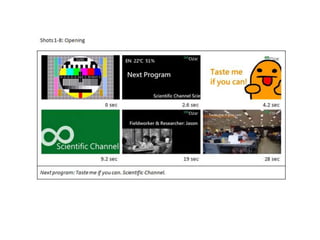
  • #25 This sequence precedes the opening hook and is interesting for the intertextual references that the students draw upon.
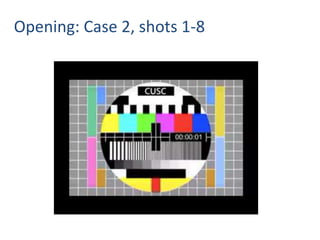
  • #26 In this opening, the students draw heavily on multimodal intertextual resources – text, visuals and sound are all reminiscent of a TV channel and TV show, so that we have the distinct impression that we are watching the beginning of a TV show on the ‘CityU Scientific Channel’. We first see a television test screen, then we see a title page which incorporates information about language and weather (top left cluster), TV channel (top right cluster, CUSC stands for CityU Scientific Channel, as well as scrolling along the bottom cluster: ‘Scientific channel’) and the Next program announcement (middle cluster), then we see the advertisement for the upcoming programme, then the scientific channel logo, then the programme intro including some credits, finally we see the reporter at the scene, eating food in the cafeteria.
  • #27 In this case, also on the taste me if you can topic, the students have created a video which evokes a drama and tells a story. In order to catch the attention of the audience, the students have presented their topic as an investigation of a personal issue. Near the beginning of the video there is a role play between two students, one of whom has a bad cold and can’t taste his orange juice. He is about to rush to the clinic to see what is wrong when the other stops him, and they decide to investigate the issue on their own.
  • #28 In this case the narrator role is still prominent but the narrator is more closely involved in the action because of the way that the video follows the two friends and tells the story of their ‘journey of experiment’. This is more in the style of a participatory documentary and there is quite a lot of interpersonal engagement as we are invited to identify with the protagonists and be involved in their story.
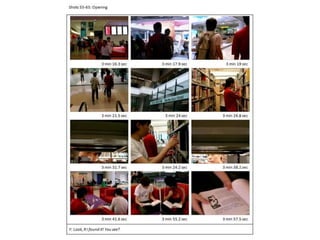
  • #30 At this point the story is told entirely visually, with a very impressive range of visuals (different kinds of shots, camera angles and distances) and effective use of the soundtrack to liven up the subject. The upbeat funky music played here contrasts with the activity itself, which is doing research in the library. With effective use of multimodal resources the students are able to portray this activity in a much more positive way.
  • #32 The basic idea is that the documentary task presents students with a medium that they are very familiar with, and challenges them to create something that will attract the attention of the audience. In doing so, they have to think about issues of audience, purpose and rhetorical structure in a process that is broadly similar to writing in any context. When subsequently they recontextualize their documentaries and re-present them as written lab reports, they are faced with a different kind of challenge, namely of repurposing the content for a specialist audience, whose expectations they may be less familiar with. This opens up a space to reflect on which aspects of the presentation that they did are transferrable to the new context and which ones are not. In particular, on our course, it stimulated discussion about using visuals in scientific discourse and about register in scientific discourse. It could equally well stimulate a discussion about the discursive strategies that scientists use in order to get the attention of their audience.