AIDA Model
Sukun & Divyae
History & Approach
• Coined by the American sales and advertisement legend Elias St. Elmo
Lewis in the late 1880s.
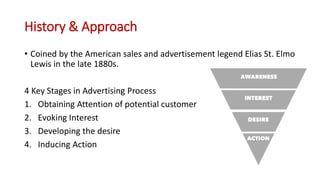
4 Key Stages in Advertising Process
1. Obtaining Attention of potential customer
2. Evoking Interest
3. Developing the desire
4. Inducing Action
Attention
• An advertisement must grab the attention of a potential customer.
• Coca-Cola Zero original campaign consisted of posters on bus stations
and billboards with no notion that it was an advertisement
• The posters were black and had peculiar red questions written on
them.
• The campaign successfully attracted attention of massive amounts of
people before they even knew what it was about.
Interest
• It is essential to keep the potential customers interested in the
advertisement.
• The above stated campaign formed the questions always
incorporating the symbol or the word ‘zero’.
• When people started noticing that this was the only consistent thing
(in addition to appearance) in the posters, they became interested to
know what it represented.
Desire
• Building up the desire to have or use a product/service in potential
customers consist mostly of accumulation of positive arguments.
• The Coca Cola Zero campaign introduced the beverage and focused
on advertising the fact that although it does not contain sugars.
• It tastes the same as the original beverage. This stimulated
customers to give it a try!
Action
• A percentage of customers has fallen off as each stage progressed.
• Who acquired a positive impression of the product/service which was
advertised and the only thing which can now be done is offering them
a sale.
• This is a stage where you win some and you lose some.
• However, if the work in the previous stages was done well, a solid
ground is made for potential future transactions.
Cheers!
Divyae & Sukun

AIDA Model (Coke Zero)

  • 1.
  • 2.
    History & Approach •Coined by the American sales and advertisement legend Elias St. Elmo Lewis in the late 1880s. 4 Key Stages in Advertising Process 1. Obtaining Attention of potential customer 2. Evoking Interest 3. Developing the desire 4. Inducing Action
  • 3.
    Attention • An advertisementmust grab the attention of a potential customer. • Coca-Cola Zero original campaign consisted of posters on bus stations and billboards with no notion that it was an advertisement • The posters were black and had peculiar red questions written on them. • The campaign successfully attracted attention of massive amounts of people before they even knew what it was about.
  • 4.
    Interest • It isessential to keep the potential customers interested in the advertisement. • The above stated campaign formed the questions always incorporating the symbol or the word ‘zero’. • When people started noticing that this was the only consistent thing (in addition to appearance) in the posters, they became interested to know what it represented.
  • 6.
    Desire • Building upthe desire to have or use a product/service in potential customers consist mostly of accumulation of positive arguments. • The Coca Cola Zero campaign introduced the beverage and focused on advertising the fact that although it does not contain sugars. • It tastes the same as the original beverage. This stimulated customers to give it a try!
  • 8.
    Action • A percentageof customers has fallen off as each stage progressed. • Who acquired a positive impression of the product/service which was advertised and the only thing which can now be done is offering them a sale. • This is a stage where you win some and you lose some. • However, if the work in the previous stages was done well, a solid ground is made for potential future transactions.
  • 11.