
The process of planning and executing the pricing promotion and distribution of products and services and ideas in order to create exchanges that satisfy both the firm and  its customers.
The activities that direct the flow of goods and services  from production to consumption. It starts  with the customer -- what he wants to have it ends with the customer --- giving him what he wants. Meeting needs profitably, art of selling products, to sell superfluous.
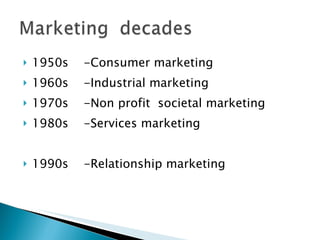
1950s  -Consumer marketing 1960s  -Industrial marketing 1970s  -Non profit  societal marketing 1980s  -Services marketing 1990s  -Relationship marketing
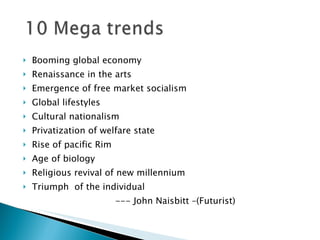
Booming global economy Renaissance in the arts Emergence of free market socialism Global lifestyles  Cultural nationalism Privatization of welfare state Rise of pacific Rim Age of biology Religious revival of new millennium Triumph  of the individual  --- John Naisbitt –(Futurist)
“  Deliver  a  higher standard of living”
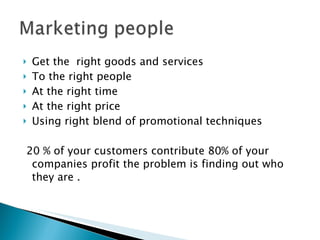
Get the  right goods and services To the right people At the right time At the right price Using right blend of promotional techniques 20 % of your customers contribute 80% of your companies profit the problem is finding out who they are .
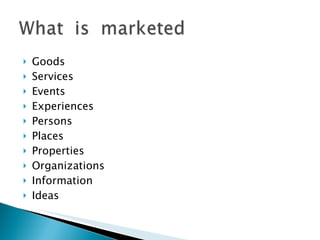
Goods Services Events Experiences Persons Places Properties Organizations Information Ideas
Stated need -  Inexpensive car Real need –  operating cost low Unstated need – Good service Delight need –  Onboard navigation  system Secret need –  Seen by friends as a  savvy customer
 
1. The Law of Leadership It’s better to be first than it is to be better.  The basic issue in marketing is creating a category you can be first in.  E.g., most people know who climbed Mount Everest first, but not second. 2. The Law of Category If you can’t be first in a category, set up a new category you can be first in.  E.g., most people don’t know who  landed on the moon fourth but they know who the first  man to do that was.
3.  The Law of the Mind It’s better to be first in the mind than to be first in the marketplace.  E.g., Altair 8800 was the first PC, but Apple got first in the mind. 4. The Law of Perception Marketing is not a battle of products; it is a battle of perceptions. 5. The Law of Focus The most powerful concept in marketing is owning a word in the prospect’s mind.  E.g., Xerox this or FedEx that.
6.  The Law of Exclusivity Two companies cannot own the same word in the prospect’s mind. 7. The Law of the Ladder What strategy to use depends on which rung you occupy on the ladder.  E.g., Avis is 2 nd  – we try harder. 8. The Law of Duality In the long run, every market becomes a two horse race.  E.g., Coke v Pepsi, Kodak v Fuji, McDonalds and Burger King.
9.  The Law of the Opposite If you’re shooting for second place, your strategy is determined by the leader.  E.g., Coke is an old soft drink, so Pepsi went  for the choice of a new generation. 10. The Law of Division Over time, a category will divide and become two or more categories, e.g., computers.   11. The Law of Perspective  Marketing Effects take place over an extended period of time.
12. The Law of Line  Extension There is an irresistible pressure to extend the equity of the brand. 13. The Law of Sacrifice You have to give up something  to get something. FedEx sacrificed other air freight options for small packages overnight, and owned the word “overnight”. 1 4. The Law of Attributes  For every attribute, there is an opposite, effective attribute.  E.g., Crest toothpaste fights cavities, but Close Up freshens breath.
15. The Law of Candour When you admit a negative, the prospect will give you a positive.  E.g., the 1970 VW will stay ugly longer – implies reliability not good looks. 16. The Law of Singularity In each situation, only one move will produce substantial results.  In a military sense, this is called the line of least expectation, e.g., the Allied invasion of Normandy. 17. The Law of Unpredictability Unless you write your competitors’ plans,   you can’t predict the future.
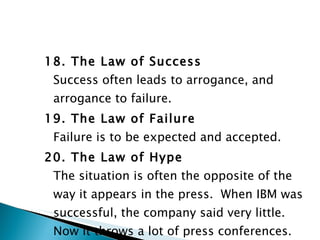
18. The Law of Success Success often leads to arrogance, and arrogance to failure. 19. The Law of Failure Failure is to be expected and accepted. 20. The Law of Hype The situation is often the opposite of the way it appears in the press.  When IBM was successful, the company said very little.  Now it throws a lot of press conferences.
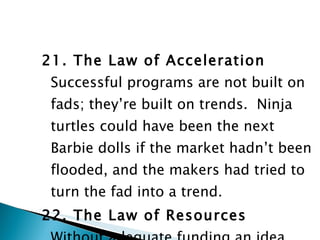
21. The Law of Acceleration Successful programs are not built on fads; they’re built on trends.  Ninja turtles could have been the next Barbie dolls if the market hadn’t been flooded, and the makers had tried to turn the fad into a trend. 22. The Law of Resources Without adequate funding an idea won’t get off the ground.
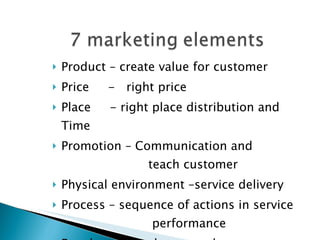
Product – create value for customer Price  -  right price Place  - right place distribution and Time Promotion – Communication and   teach customer Physical environment –service delivery Process – sequence of actions in service    performance People  --  Employees and customers
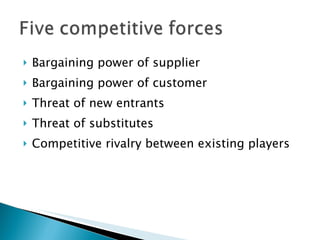
Bargaining power of supplier Bargaining power of customer Threat of new entrants Threat of substitutes Competitive rivalry between existing players
Generate an inner glow Radiate an outer glow SMILE  with your eyes
Famous  Chevrolet salesman 12 years he  is  number one Salary  2,000,000 $ per year He sends  “ I like You” cards  to his 13000 customers Customers  say “YES”
One kind  to advertise One kind to sell One kind to make  money
Foot in the door Low ball Door in the  face Reciprocity
First make a small request then follow it up with a  larger  request Start  small and  build
First make an attractive  deal People say  YES Fill all the forms  They think as  a good deal Hook is  set  Then change the deal Done by  used car  salesperson
A large  request followed by a small request When large  is  rejected  follow it with a  small reasonable request sales person offering one year plan Reducing the  availability increases  the desirability
Sales person  leaves a  bag containing Furniture polish Window cleaner Detergent Toothpaste Shampoo  says  try for free You end up buying one  or  two (AMWAY)
CONSUMERS  WILL NOT ACCEPT HOT FOOD THAT IS SERVED COLD AND COLD FOOD SERVED HOT
Givers Give friendship and service Give promise Contribute to the lives of customers Trading  is  not giving Everyone lives by selling something Making a sale is motivating a salesman
Joining  together is the beginning Keeping together is  progress Working together is success work together and  market products and  services
Thank You

Marketing basics

  • 2.
    The process ofplanning and executing the pricing promotion and distribution of products and services and ideas in order to create exchanges that satisfy both the firm and its customers.
  • 3.
    The activities thatdirect the flow of goods and services from production to consumption. It starts with the customer -- what he wants to have it ends with the customer --- giving him what he wants. Meeting needs profitably, art of selling products, to sell superfluous.
  • 4.
    1950s -Consumermarketing 1960s -Industrial marketing 1970s -Non profit societal marketing 1980s -Services marketing 1990s -Relationship marketing
  • 5.
    Booming global economyRenaissance in the arts Emergence of free market socialism Global lifestyles Cultural nationalism Privatization of welfare state Rise of pacific Rim Age of biology Religious revival of new millennium Triumph of the individual --- John Naisbitt –(Futurist)
  • 6.
    “ Deliver a higher standard of living”
  • 7.
    Get the right goods and services To the right people At the right time At the right price Using right blend of promotional techniques 20 % of your customers contribute 80% of your companies profit the problem is finding out who they are .
  • 8.
    Goods Services EventsExperiences Persons Places Properties Organizations Information Ideas
  • 9.
    Stated need - Inexpensive car Real need – operating cost low Unstated need – Good service Delight need – Onboard navigation system Secret need – Seen by friends as a savvy customer
  • 10.
  • 11.
    1. The Lawof Leadership It’s better to be first than it is to be better. The basic issue in marketing is creating a category you can be first in. E.g., most people know who climbed Mount Everest first, but not second. 2. The Law of Category If you can’t be first in a category, set up a new category you can be first in. E.g., most people don’t know who landed on the moon fourth but they know who the first man to do that was.
  • 12.
    3. TheLaw of the Mind It’s better to be first in the mind than to be first in the marketplace. E.g., Altair 8800 was the first PC, but Apple got first in the mind. 4. The Law of Perception Marketing is not a battle of products; it is a battle of perceptions. 5. The Law of Focus The most powerful concept in marketing is owning a word in the prospect’s mind. E.g., Xerox this or FedEx that.
  • 13.
    6. TheLaw of Exclusivity Two companies cannot own the same word in the prospect’s mind. 7. The Law of the Ladder What strategy to use depends on which rung you occupy on the ladder. E.g., Avis is 2 nd – we try harder. 8. The Law of Duality In the long run, every market becomes a two horse race. E.g., Coke v Pepsi, Kodak v Fuji, McDonalds and Burger King.
  • 14.
    9. TheLaw of the Opposite If you’re shooting for second place, your strategy is determined by the leader. E.g., Coke is an old soft drink, so Pepsi went for the choice of a new generation. 10. The Law of Division Over time, a category will divide and become two or more categories, e.g., computers. 11. The Law of Perspective Marketing Effects take place over an extended period of time.
  • 15.
    12. The Lawof Line Extension There is an irresistible pressure to extend the equity of the brand. 13. The Law of Sacrifice You have to give up something to get something. FedEx sacrificed other air freight options for small packages overnight, and owned the word “overnight”. 1 4. The Law of Attributes For every attribute, there is an opposite, effective attribute. E.g., Crest toothpaste fights cavities, but Close Up freshens breath.
  • 16.
    15. The Lawof Candour When you admit a negative, the prospect will give you a positive. E.g., the 1970 VW will stay ugly longer – implies reliability not good looks. 16. The Law of Singularity In each situation, only one move will produce substantial results. In a military sense, this is called the line of least expectation, e.g., the Allied invasion of Normandy. 17. The Law of Unpredictability Unless you write your competitors’ plans, you can’t predict the future.
  • 17.
    18. The Lawof Success Success often leads to arrogance, and arrogance to failure. 19. The Law of Failure Failure is to be expected and accepted. 20. The Law of Hype The situation is often the opposite of the way it appears in the press. When IBM was successful, the company said very little. Now it throws a lot of press conferences.
  • 18.
    21. The Lawof Acceleration Successful programs are not built on fads; they’re built on trends. Ninja turtles could have been the next Barbie dolls if the market hadn’t been flooded, and the makers had tried to turn the fad into a trend. 22. The Law of Resources Without adequate funding an idea won’t get off the ground.
  • 19.
    Product – createvalue for customer Price - right price Place - right place distribution and Time Promotion – Communication and teach customer Physical environment –service delivery Process – sequence of actions in service performance People -- Employees and customers
  • 20.
    Bargaining power ofsupplier Bargaining power of customer Threat of new entrants Threat of substitutes Competitive rivalry between existing players
  • 21.
    Generate an innerglow Radiate an outer glow SMILE with your eyes
  • 22.
    Famous Chevroletsalesman 12 years he is number one Salary 2,000,000 $ per year He sends “ I like You” cards to his 13000 customers Customers say “YES”
  • 23.
    One kind to advertise One kind to sell One kind to make money
  • 24.
    Foot in thedoor Low ball Door in the face Reciprocity
  • 25.
    First make asmall request then follow it up with a larger request Start small and build
  • 26.
    First make anattractive deal People say YES Fill all the forms They think as a good deal Hook is set Then change the deal Done by used car salesperson
  • 27.
    A large request followed by a small request When large is rejected follow it with a small reasonable request sales person offering one year plan Reducing the availability increases the desirability
  • 28.
    Sales person leaves a bag containing Furniture polish Window cleaner Detergent Toothpaste Shampoo says try for free You end up buying one or two (AMWAY)
  • 29.
    CONSUMERS WILLNOT ACCEPT HOT FOOD THAT IS SERVED COLD AND COLD FOOD SERVED HOT
  • 30.
    Givers Give friendshipand service Give promise Contribute to the lives of customers Trading is not giving Everyone lives by selling something Making a sale is motivating a salesman
  • 31.
    Joining togetheris the beginning Keeping together is progress Working together is success work together and market products and services
  • 32.