Work like a Brain
with... AI and
Copilot
Nicolas Georgeault
MVP et MCT – MuBrain & AFI
Expertise
Introduction
What is a human brain?
• 86 billions of neurons connected by synapses
• We are losing every day around 85.000 neurons
• 10.000 billions of synapses per cm3 (1.400 cm3)
• 120 m/s, soit 430 km/h is the speed of
information
Working like a Brain
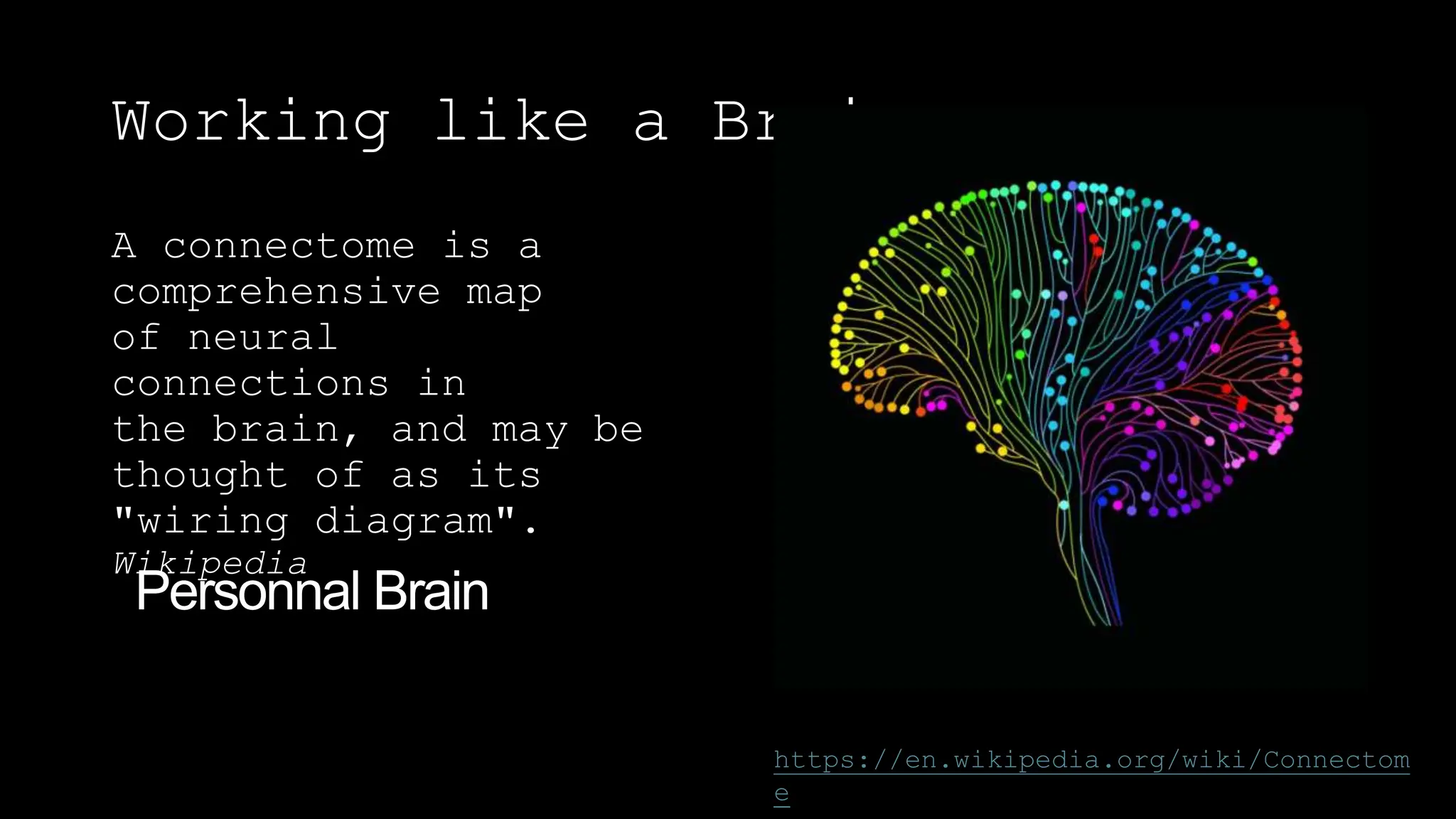
A connectome is a
comprehensive map
of neural
connections in
the brain, and may be
thought of as its
"wiring diagram".
Wikipedia
https://en.wikipedia.org/wiki/Connectom
e
Working like a Brain
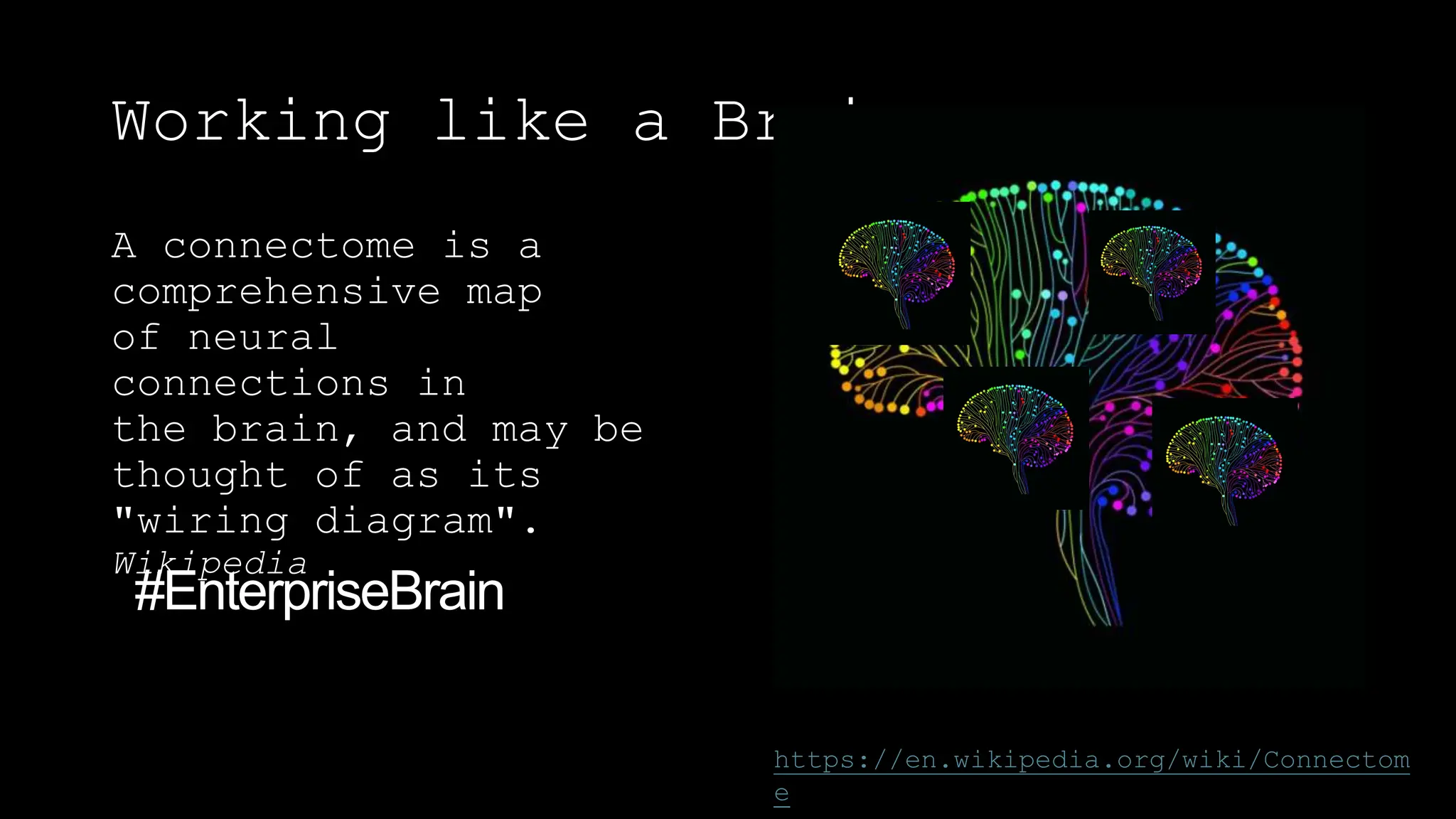
A connectome is a
comprehensive map
of neural
connections in
the brain, and may be
thought of as its
"wiring diagram".
Wikipedia
https://en.wikipedia.org/wiki/Connectom
e
What we mean by « Working like
a Brain »?
• Our brain is working by association, comparison
• Let’s consider each employee as a neurone
• Build the corporate Knowledge Network
• Connect the dots
• Organize the micro-knowledge
What « knowledge » means
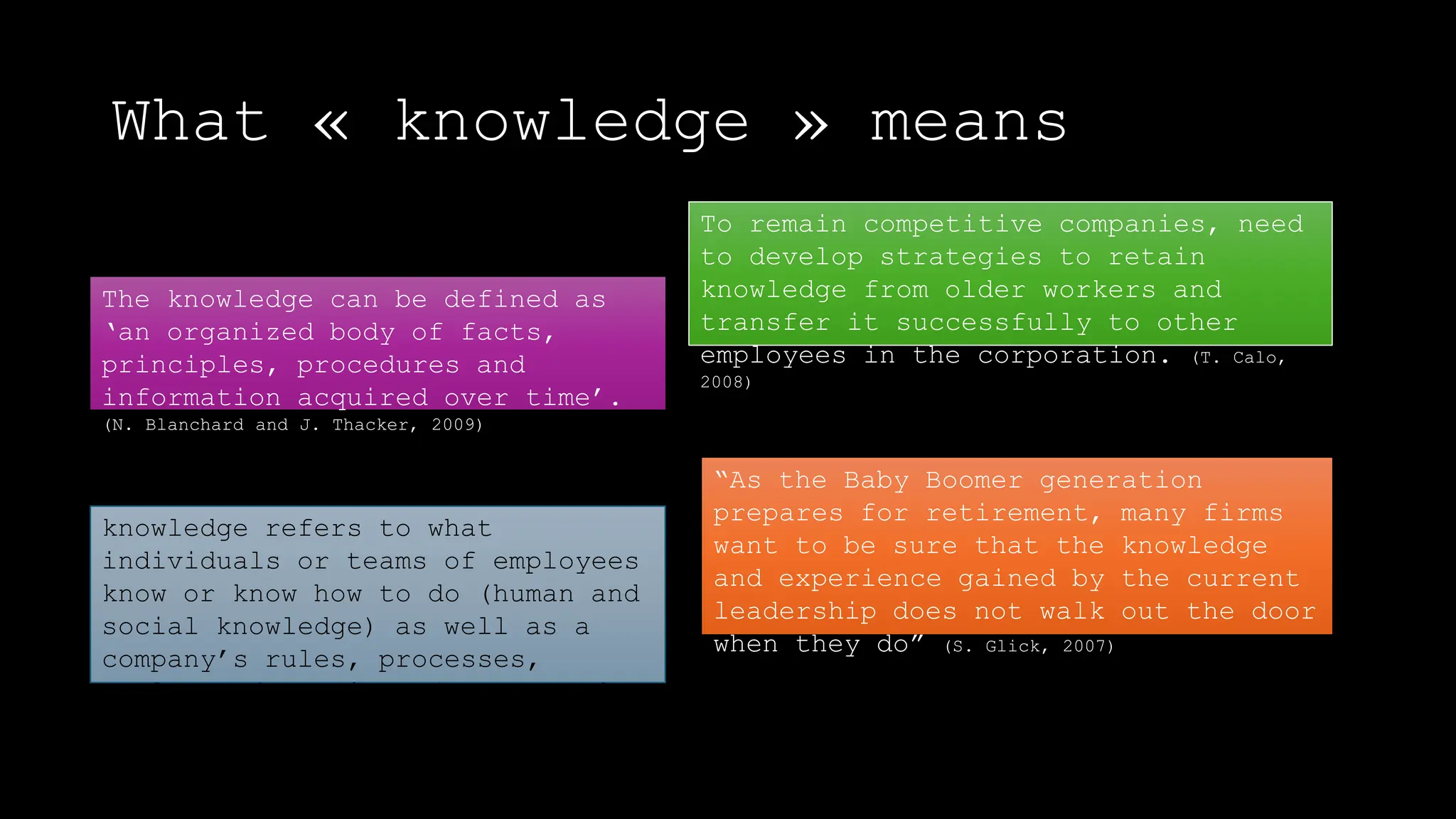
The knowledge can be defined as
‘an organized body of facts,
principles, procedures and
information acquired over time’.
(N. Blanchard and J. Thacker, 2009)
knowledge refers to what
individuals or teams of employees
know or know how to do (human and
social knowledge) as well as a
company’s rules, processes,
tools, and routines (structured
knowledge). (R. Noe, 2008)
To remain competitive companies, need
to develop strategies to retain
knowledge from older workers and
transfer it successfully to other
employees in the corporation. (T. Calo,
2008)
“As the Baby Boomer generation
prepares for retirement, many firms
want to be sure that the knowledge
and experience gained by the current
leadership does not walk out the door
when they do” (S. Glick, 2007)
What problems are we
trying to solve?
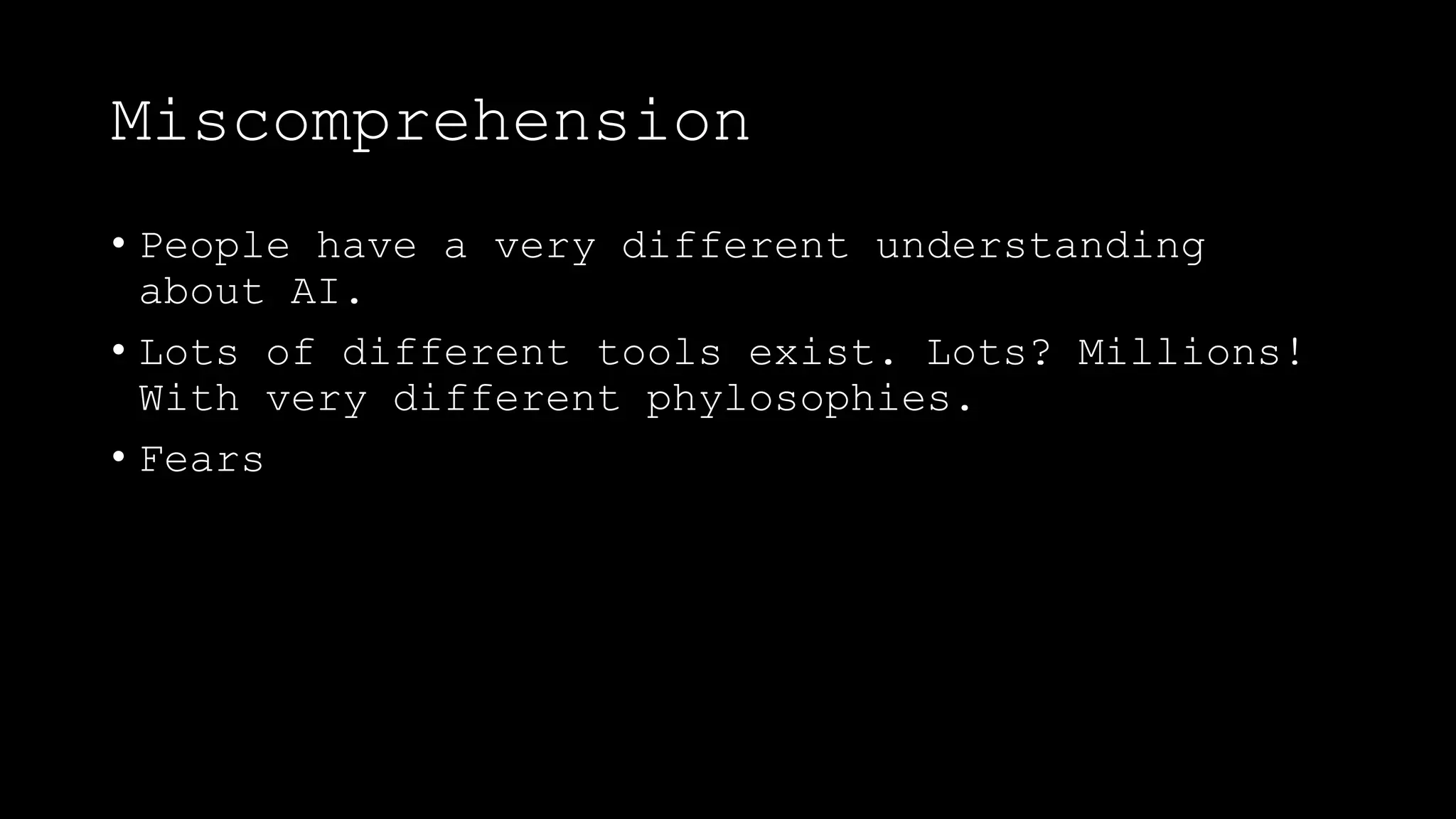
Miscomprehension
• People have a very different understanding
about AI.
• Lots of different tools exist. Lots? Millions!
With very different phylosophies.
• Fears
Magic does not exist
Siegfried https://youtu.be/q7sxNfGkU2k?si=be6EFz_wr
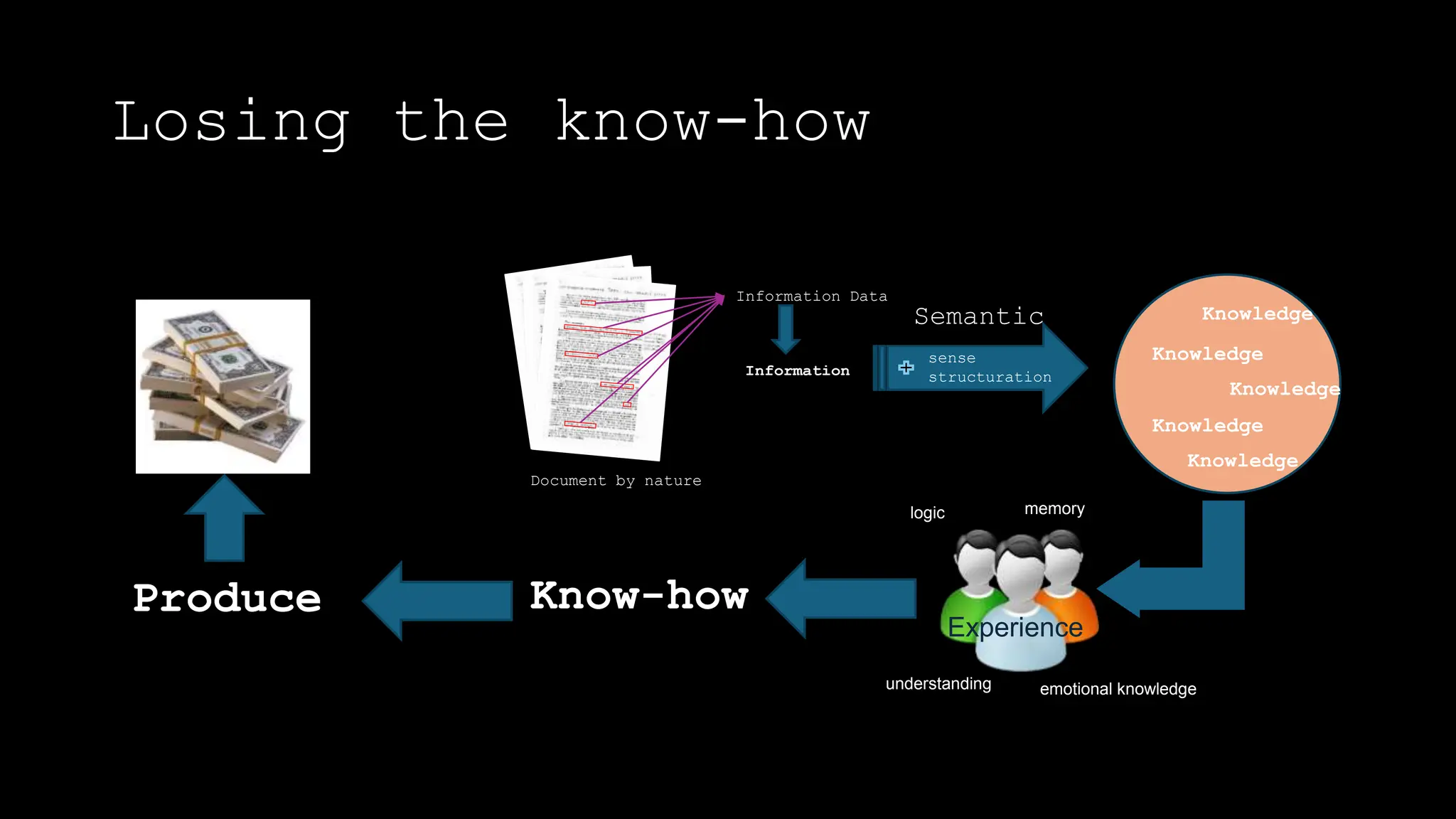
Losing the know-how
Document by nature
Information Data
Information
Knowledge
sense
structuration
Knowledge
Knowledge
Knowledge
Knowledge
Know-how
logic
understanding emotional knowledge
memory
Experience
Produce
Semantic
How to do it?
Make it yours!
• Built a strategy based on YOUR mission not the
Microsoft one.
• Focus on what is the value for your mission.
• But… What is your Mission?
• Always remember your values.
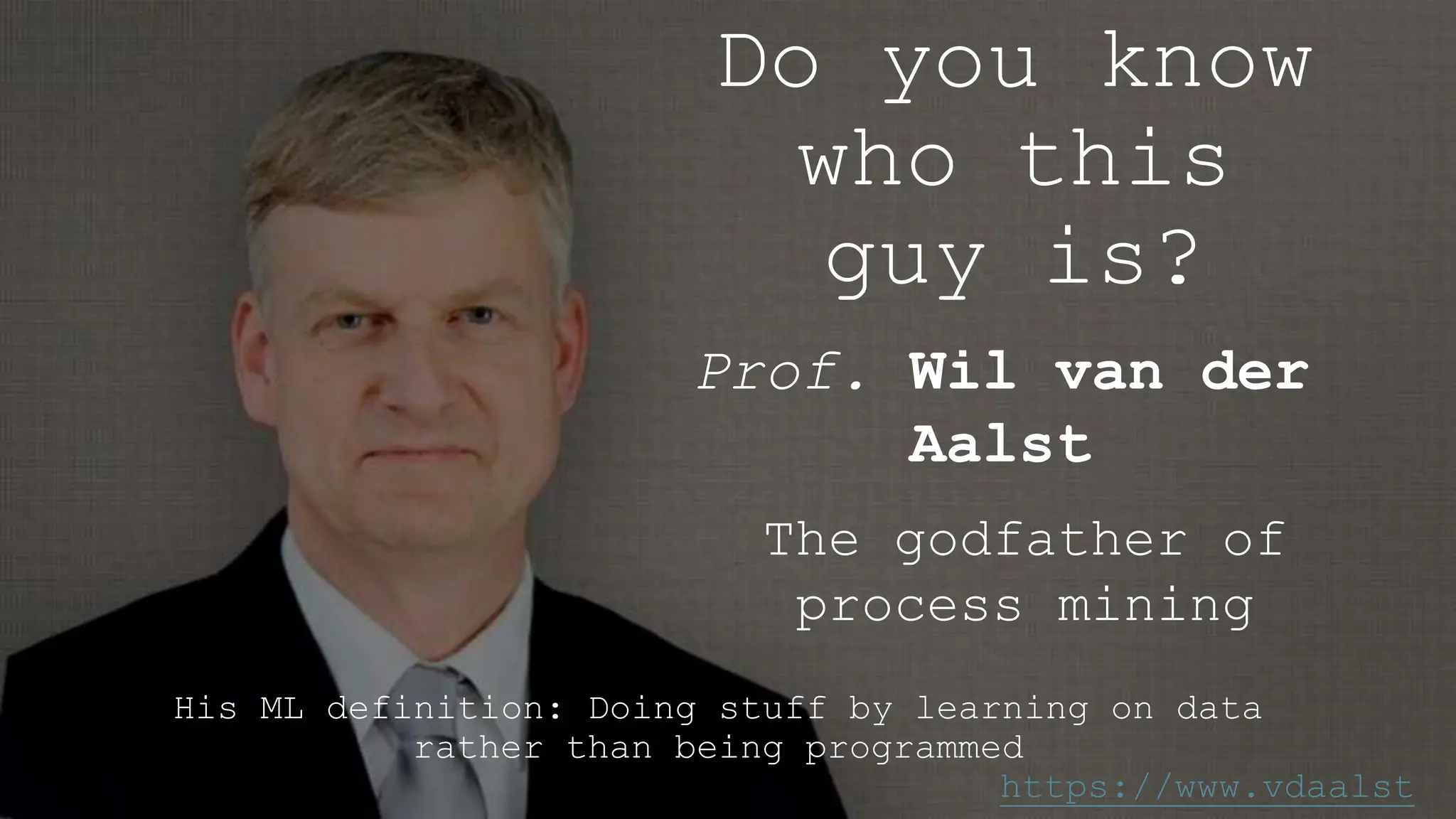
Do you know
who this
guy is?
His ML definition: Doing stuff by learning on data
rather than being programmed
Prof. Wil van der
Aalst
The godfather of
process mining
https://www.vdaalst
Understand your « real »
processes
• Use Process Mining to analyze your processes.
• Start by focussing on small processes with
highest value.
• Never try to automate something, you are not
able to do manually.
• You can’t
Formal Meetings
• Use AI to help your mission first but help AI
to be more efficient.
• Organize the Agenda, introduce patterns and
provide guidance
• Reduce time to 30mn.
• Keep topics separates.
• Name the topic first with related keywords.
• Name the person in charge of it.
• Close by adding a conclusion.
• Close by summarizing tasks.
Adhoc Meetings
• Formal meeting are like documents where Adhoc
meeting are like conversations.
• Teams mobile app can start a meeting on
movement.
• Provide guidance about how to record adhoc
meetings from Teams mobile App.
• Follow the same pattern you defined for formal
meetings.
Documents
• Normalize titles
• Normalize keywords
• Provide guidance about how to use Copilot to
insert a summary
• Identify content generated using AI
• Keep the AI generated content out of your
knowledge network
Thoughts
• Enterprise Social Network is the only place to
store micro-knowledge.
• Start using Viva Engage to structure the know-
how.
• Use Viva Engage to connect the knowledge.
• Teams conversations are not adapted to this
content.
• People typically have more than 6,000 thoughts
per day (https://www.nature.com/articles/s41467-020-17255-9)
• Provide guidance about how to structure posts
and how to use Tags
Serendipity
• AI NOT creative
• AI lacks true curiosity
• AI cannot replicate human serendipity
• But serendipity is strategic for your activity
Conclusion
Dos and don'ts
• Don’t limit AI to a passive assistant.
• Don’t try to explain prompt engineering.
• Don’t try to explain what are Copilots but
where to use it.
• Start building your Knowledge Network.
• Don’t limit knowledge to only documents.
Questions?
Thank you

AI Community Conference - Toronto 2024: Work like a Brain with... AI and Copilot

  • 1.
    Work like aBrain with... AI and Copilot Nicolas Georgeault MVP et MCT – MuBrain & AFI Expertise
  • 2.
  • 3.
    What is ahuman brain? • 86 billions of neurons connected by synapses • We are losing every day around 85.000 neurons • 10.000 billions of synapses per cm3 (1.400 cm3) • 120 m/s, soit 430 km/h is the speed of information
  • 4.
    Working like aBrain A connectome is a comprehensive map of neural connections in the brain, and may be thought of as its "wiring diagram". Wikipedia https://en.wikipedia.org/wiki/Connectom e
  • 5.
    Working like aBrain A connectome is a comprehensive map of neural connections in the brain, and may be thought of as its "wiring diagram". Wikipedia https://en.wikipedia.org/wiki/Connectom e
  • 6.
    What we meanby « Working like a Brain »? • Our brain is working by association, comparison • Let’s consider each employee as a neurone • Build the corporate Knowledge Network • Connect the dots • Organize the micro-knowledge
  • 7.
    What « knowledge» means The knowledge can be defined as ‘an organized body of facts, principles, procedures and information acquired over time’. (N. Blanchard and J. Thacker, 2009) knowledge refers to what individuals or teams of employees know or know how to do (human and social knowledge) as well as a company’s rules, processes, tools, and routines (structured knowledge). (R. Noe, 2008) To remain competitive companies, need to develop strategies to retain knowledge from older workers and transfer it successfully to other employees in the corporation. (T. Calo, 2008) “As the Baby Boomer generation prepares for retirement, many firms want to be sure that the knowledge and experience gained by the current leadership does not walk out the door when they do” (S. Glick, 2007)
  • 8.
    What problems arewe trying to solve?
  • 9.
    Miscomprehension • People havea very different understanding about AI. • Lots of different tools exist. Lots? Millions! With very different phylosophies. • Fears
  • 10.
    Magic does notexist Siegfried https://youtu.be/q7sxNfGkU2k?si=be6EFz_wr
  • 11.
    Losing the know-how Documentby nature Information Data Information Knowledge sense structuration Knowledge Knowledge Knowledge Knowledge Know-how logic understanding emotional knowledge memory Experience Produce Semantic
  • 12.
  • 13.
    Make it yours! •Built a strategy based on YOUR mission not the Microsoft one. • Focus on what is the value for your mission. • But… What is your Mission? • Always remember your values.
  • 14.
    Do you know whothis guy is? His ML definition: Doing stuff by learning on data rather than being programmed Prof. Wil van der Aalst The godfather of process mining https://www.vdaalst
  • 15.
    Understand your «real » processes • Use Process Mining to analyze your processes. • Start by focussing on small processes with highest value. • Never try to automate something, you are not able to do manually. • You can’t
  • 17.
    Formal Meetings • UseAI to help your mission first but help AI to be more efficient. • Organize the Agenda, introduce patterns and provide guidance • Reduce time to 30mn. • Keep topics separates. • Name the topic first with related keywords. • Name the person in charge of it. • Close by adding a conclusion. • Close by summarizing tasks.
  • 18.
    Adhoc Meetings • Formalmeeting are like documents where Adhoc meeting are like conversations. • Teams mobile app can start a meeting on movement. • Provide guidance about how to record adhoc meetings from Teams mobile App. • Follow the same pattern you defined for formal meetings.
  • 19.
    Documents • Normalize titles •Normalize keywords • Provide guidance about how to use Copilot to insert a summary • Identify content generated using AI • Keep the AI generated content out of your knowledge network
  • 20.
    Thoughts • Enterprise SocialNetwork is the only place to store micro-knowledge. • Start using Viva Engage to structure the know- how. • Use Viva Engage to connect the knowledge. • Teams conversations are not adapted to this content. • People typically have more than 6,000 thoughts per day (https://www.nature.com/articles/s41467-020-17255-9) • Provide guidance about how to structure posts and how to use Tags
  • 21.
    Serendipity • AI NOTcreative • AI lacks true curiosity • AI cannot replicate human serendipity • But serendipity is strategic for your activity
  • 22.
  • 23.
    Dos and don'ts •Don’t limit AI to a passive assistant. • Don’t try to explain prompt engineering. • Don’t try to explain what are Copilots but where to use it. • Start building your Knowledge Network. • Don’t limit knowledge to only documents.
  • 24.
  • 25.

Editor's Notes

  • #10 That means if you are not personnalizing AI, people will maybe not exactly understand AI the way you want to use it. Tools are legions! Even if they are all using the same model, they are all doing different things differently. Governance fear… No, Model is not trained based on your queries. And never ever Copilot will send any of your data out of your tenant without your conscent. No YOUR personal data will not be stealed and use without YOUR conscent. Don’t Fear Of Missing Out, Stay focus on your mission.
  • #12 Being able to produce with quality standards
  • #14 1. Built a deployment plan based on YOUR mission not the Microsoft one. 2. Focus on what is the value for your mission 3. Did you mission change? Is your mission clear for all your employees? 4. What are your key values? Does AI go against your values in any ways?
  • #15 Professor Wil van der Aalst has published in total more than 400 books, journal papers, book chapters, conference papers, and reports. He refers to process mining as “the bridge between data science [which includes algorithms, machine learning, data mining, and predictive analytics] and process science [which covers operations management and research, business process improvement and management, process automation, workflow management, and optimization].”
  • #16 Many businesses don’t realize how variable their processes are, and the impact that variability has on, well, everything. You can’t fix what you can’t see, and most businesses aren’t seeing the full picture of how everything’s actually getting done across programs, systems, and departments.
  • #18 Do not spend too much time on anything that does not serve your mission first.
  • #20 According to my internal project called "Better meetings" what could be the best title for this document? What are the 3 main keywords for this document content? Add a short summary to introduce this document. Add the 3 keywords at the end of the summary.
  • #22 1. The debate on whether AI is creative and can innovate is ongoing in academic and business circles. The implications of the answer are significant for the future of business, work, and the essence of humanity. The answer is both "Yes" and "No." Large Language Models (LLMs), at the forefront of the AI revolution, have a remarkable ability to detect hidden patterns in human knowledge, which some, like Ray Kurzweil and Geoffrey Hinton, consider to be a form of creativity. 2. The article suggests that while AI can exhibit "task-specific curiosity" within certain limits, it may not be able to fully replicate the open-ended and spontaneous curiosity that is uniquely human. This is because AI is goal-oriented and operates within the confines of its training data. Experts are skeptical that AI's "artificial curiosity" can match the depth and spontaneity of human curiosity anytime soon. Human curiosity stems from innate qualities like self-awareness, emotional depth, and the search for deeper meaning, which current AI systems lack. LLMs like GPT mimic human-like outputs based on statistical patterns without a deeper contextual understanding and cannot replicate key drivers of human curiosity such as noticing unexpected observations, creatively connecting different ideas, and self-directed learning. 3. The diversity of human experiences, shaped by personal contexts and sensory encounters, provides a rich source for creative ideas and unexpected connections, which AI systems cannot access due to their data limitations. While AI may advance in perceiving and interacting with the world, replicating the depth of human experiences remains a challenge. Human cognition is deeply embodied, with emotions and experiences fueling curiosity and serendipity, aspects that AI currently lacks