1
RCS702/Unit-2
Subject Name:-Artificial Intelligence
Subject Code:- RCS702
Unit No.:- 2
Lecture No.:- 6
Topic Name :- Alpha-Beta Algorithm
Er. Hiresh Kumar Gupta
Department of CSE
Content
1. Alpha-Beta Pruning
2. Condition for alpha-beta pruning
3. Pseudo-code for Alpha-beta Pruning
4. Working of Alpha-Beta Pruning
5. Example
6. Important Questions
RCS702/Unit-2 2
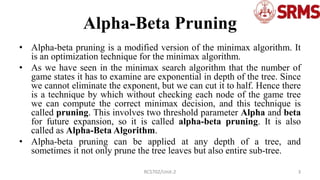
Alpha-Beta Pruning
• Alpha-beta pruning is a modified version of the minimax algorithm. It
is an optimization technique for the minimax algorithm.
• As we have seen in the minimax search algorithm that the number of
game states it has to examine are exponential in depth of the tree. Since
we cannot eliminate the exponent, but we can cut it to half. Hence there
is a technique by which without checking each node of the game tree
we can compute the correct minimax decision, and this technique is
called pruning. This involves two threshold parameter Alpha and beta
for future expansion, so it is called alpha-beta pruning. It is also
called as Alpha-Beta Algorithm.
• Alpha-beta pruning can be applied at any depth of a tree, and
sometimes it not only prune the tree leaves but also entire sub-tree.
3
RCS702/Unit-2
• The two-parameter can be defined as:
– Alpha: The best (highest-value) choice we have found so far at
any point along the path of Maximizer. The initial value of alpha
is -∞.
– Beta: The best (lowest-value) choice we have found so far at any
point along the path of Minimizer. The initial value of beta
is +∞.
• The Alpha-beta pruning to a standard minimax algorithm
returns the same move as the standard algorithm does, but it
removes all the nodes which are not really affecting the
final decision but making algorithm slow. Hence by pruning
these nodes, it makes the algorithm fast.
4
RCS702/Unit-2
Condition for Alpha-beta pruning
• The main condition which required for alpha-beta pruning
is:
α>=β
• The Max player will only update the value of alpha.
• The Min player will only update the value of beta.
• While backtracking the tree, the node values will be passed
to upper nodes instead of values of alpha and beta.
• We will only pass the alpha, beta values to the child nodes.
5
RCS702/Unit-2
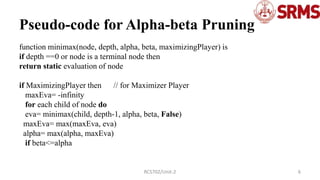
Pseudo-code for Alpha-beta Pruning
function minimax(node, depth, alpha, beta, maximizingPlayer) is
if depth ==0 or node is a terminal node then
return static evaluation of node
if MaximizingPlayer then // for Maximizer Player
maxEva= -infinity
for each child of node do
eva= minimax(child, depth-1, alpha, beta, False)
maxEva= max(maxEva, eva)
alpha= max(alpha, maxEva)
if beta<=alpha
6
RCS702/Unit-2
break
return maxEva
else // for Minimizer player
minEva= +infinity
for each child of node do
eva= minimax(child, depth-1, alpha, beta, true)
minEva= min(minEva, eva)
beta= min(beta, eva)
if beta<=alpha
break
return minEva
7
RCS702/Unit-2
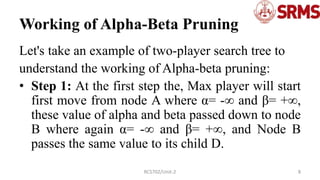
Working of Alpha-Beta Pruning
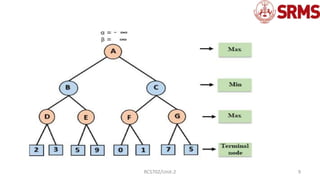
Let's take an example of two-player search tree to
understand the working of Alpha-beta pruning:
• Step 1: At the first step the, Max player will start
first move from node A where α= -∞ and β= +∞,
these value of alpha and beta passed down to node
B where again α= -∞ and β= +∞, and Node B
passes the same value to its child D.
8
RCS702/Unit-2
9
RCS702/Unit-2
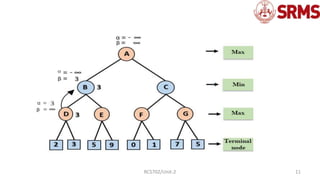
• Step 2: At Node D, the value of α will be
calculated as its turn for Max. The value of α is
compared with firstly 2 and then 3, and the max
(2, 3) = 3 will be the value of α at node D and
node value will also 3.
• Step 3: Now algorithm backtrack to node B,
where the value of β will change as this is a turn
of Min, Now β= +∞, will compare with the
available subsequent nodes value, i.e. min (∞, 3)
= 3, hence at node B now α= -∞, and β= 3.
10
RCS702/Unit-2
11
RCS702/Unit-2
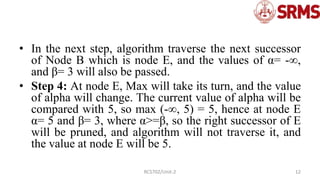
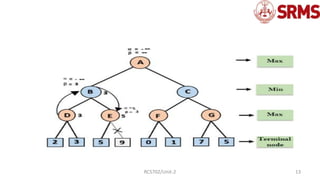
• In the next step, algorithm traverse the next successor
of Node B which is node E, and the values of α= -∞,
and β= 3 will also be passed.
• Step 4: At node E, Max will take its turn, and the value
of alpha will change. The current value of alpha will be
compared with 5, so max (-∞, 5) = 5, hence at node E
α= 5 and β= 3, where α>=β, so the right successor of E
will be pruned, and algorithm will not traverse it, and
the value at node E will be 5.
12
RCS702/Unit-2
13
RCS702/Unit-2
• Step 5: At next step, algorithm again backtrack the tree,
from node B to node A. At node A, the value of alpha will
be changed the maximum available value is 3 as max (-∞,
3)= 3, and β= +∞, these two values now passes to right
successor of A which is Node C.
• At node C, α=3 and β= +∞, and the same values will be
passed on to node F.
• Step 6: At node F, again the value of α will be compared
with left child which is 0, and max(3,0)= 3, and then
compared with right child which is 1, and max(3,1)= 3 still
α remains 3, but the node value of F will become 1.
14
RCS702/Unit-2
15
RCS702/Unit-2
• Step 7: Node F returns the node value 1 to
node C, at C α= 3 and β= +∞, here the value of
beta will be changed, it will compare with 1 so
min (∞, 1) = 1. Now at C, α=3 and β= 1, and
again it satisfies the condition α>=β, so the
next child of C which is G will be pruned, and
the algorithm will not compute the entire sub-
tree G.
16
RCS702/Unit-2
17
RCS702/Unit-2
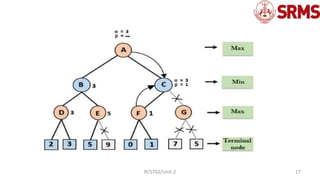
• Step 8: C now returns the value of 1 to A here
the best value for A is max (3, 1) = 3.
Following is the final game tree which is the
showing the nodes which are computed and
nodes which has never computed. Hence the
optimal value for the maximizer is 3 for this
example.
18
RCS702/Unit-2
19
RCS702/Unit-2
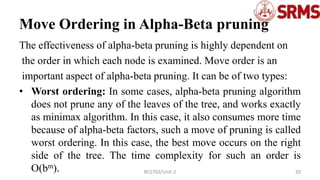
Move Ordering in Alpha-Beta pruning
The effectiveness of alpha-beta pruning is highly dependent on
the order in which each node is examined. Move order is an
important aspect of alpha-beta pruning. It can be of two types:
• Worst ordering: In some cases, alpha-beta pruning algorithm
does not prune any of the leaves of the tree, and works exactly
as minimax algorithm. In this case, it also consumes more time
because of alpha-beta factors, such a move of pruning is called
worst ordering. In this case, the best move occurs on the right
side of the tree. The time complexity for such an order is
O(bm). 20
RCS702/Unit-2
• Ideal ordering: The ideal ordering for alpha-
beta pruning occurs when lots of pruning
happens in the tree, and best moves occur at
the left side of the tree. We apply DFS hence it
first search left of the tree and go deep twice as
minimax algorithm in the same amount of
time. Complexity in ideal ordering is O(bm/2).
21
RCS702/Unit-2
Example
RCS702/Unit-2 22
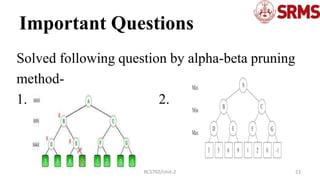
Important Questions
Solved following question by alpha-beta pruning
method-
1. 2.
RCS702/Unit-2 23
3.
RCS702/Unit-2 24
References
Text Book:
Stuart Russell, Peter Norvig, “Artificial Intelligence – A Modern Approach”,
Pearson Education
Reference Book:
Elaine Rich and Kevin Knight, “Artificial Intelligence”, McGraw-Hill
Other:
https://www.javatpoint.com/ai-alpha-beta-pruning
https://www.mygreatlearning.com/blog/alpha-beta-pruning-in-ai/
https://www.geeksforgeeks.org/minimax-algorithm-in-game-theory-set-4-alpha-beta- pruning/
25
RCS702/Unit-2
Thank You
26
RCS702/Unit-2

AI algorithms with alpha beta stratagy 1

  • 1.
    1 RCS702/Unit-2 Subject Name:-Artificial Intelligence SubjectCode:- RCS702 Unit No.:- 2 Lecture No.:- 6 Topic Name :- Alpha-Beta Algorithm Er. Hiresh Kumar Gupta Department of CSE
  • 2.
    Content 1. Alpha-Beta Pruning 2.Condition for alpha-beta pruning 3. Pseudo-code for Alpha-beta Pruning 4. Working of Alpha-Beta Pruning 5. Example 6. Important Questions RCS702/Unit-2 2
  • 3.
    Alpha-Beta Pruning • Alpha-betapruning is a modified version of the minimax algorithm. It is an optimization technique for the minimax algorithm. • As we have seen in the minimax search algorithm that the number of game states it has to examine are exponential in depth of the tree. Since we cannot eliminate the exponent, but we can cut it to half. Hence there is a technique by which without checking each node of the game tree we can compute the correct minimax decision, and this technique is called pruning. This involves two threshold parameter Alpha and beta for future expansion, so it is called alpha-beta pruning. It is also called as Alpha-Beta Algorithm. • Alpha-beta pruning can be applied at any depth of a tree, and sometimes it not only prune the tree leaves but also entire sub-tree. 3 RCS702/Unit-2
  • 4.
    • The two-parametercan be defined as: – Alpha: The best (highest-value) choice we have found so far at any point along the path of Maximizer. The initial value of alpha is -∞. – Beta: The best (lowest-value) choice we have found so far at any point along the path of Minimizer. The initial value of beta is +∞. • The Alpha-beta pruning to a standard minimax algorithm returns the same move as the standard algorithm does, but it removes all the nodes which are not really affecting the final decision but making algorithm slow. Hence by pruning these nodes, it makes the algorithm fast. 4 RCS702/Unit-2
  • 5.
    Condition for Alpha-betapruning • The main condition which required for alpha-beta pruning is: α>=β • The Max player will only update the value of alpha. • The Min player will only update the value of beta. • While backtracking the tree, the node values will be passed to upper nodes instead of values of alpha and beta. • We will only pass the alpha, beta values to the child nodes. 5 RCS702/Unit-2
  • 6.
    Pseudo-code for Alpha-betaPruning function minimax(node, depth, alpha, beta, maximizingPlayer) is if depth ==0 or node is a terminal node then return static evaluation of node if MaximizingPlayer then // for Maximizer Player maxEva= -infinity for each child of node do eva= minimax(child, depth-1, alpha, beta, False) maxEva= max(maxEva, eva) alpha= max(alpha, maxEva) if beta<=alpha 6 RCS702/Unit-2
  • 7.
    break return maxEva else //for Minimizer player minEva= +infinity for each child of node do eva= minimax(child, depth-1, alpha, beta, true) minEva= min(minEva, eva) beta= min(beta, eva) if beta<=alpha break return minEva 7 RCS702/Unit-2
  • 8.
    Working of Alpha-BetaPruning Let's take an example of two-player search tree to understand the working of Alpha-beta pruning: • Step 1: At the first step the, Max player will start first move from node A where α= -∞ and β= +∞, these value of alpha and beta passed down to node B where again α= -∞ and β= +∞, and Node B passes the same value to its child D. 8 RCS702/Unit-2
  • 9.
  • 10.
    • Step 2:At Node D, the value of α will be calculated as its turn for Max. The value of α is compared with firstly 2 and then 3, and the max (2, 3) = 3 will be the value of α at node D and node value will also 3. • Step 3: Now algorithm backtrack to node B, where the value of β will change as this is a turn of Min, Now β= +∞, will compare with the available subsequent nodes value, i.e. min (∞, 3) = 3, hence at node B now α= -∞, and β= 3. 10 RCS702/Unit-2
  • 11.
  • 12.
    • In thenext step, algorithm traverse the next successor of Node B which is node E, and the values of α= -∞, and β= 3 will also be passed. • Step 4: At node E, Max will take its turn, and the value of alpha will change. The current value of alpha will be compared with 5, so max (-∞, 5) = 5, hence at node E α= 5 and β= 3, where α>=β, so the right successor of E will be pruned, and algorithm will not traverse it, and the value at node E will be 5. 12 RCS702/Unit-2
  • 13.
  • 14.
    • Step 5:At next step, algorithm again backtrack the tree, from node B to node A. At node A, the value of alpha will be changed the maximum available value is 3 as max (-∞, 3)= 3, and β= +∞, these two values now passes to right successor of A which is Node C. • At node C, α=3 and β= +∞, and the same values will be passed on to node F. • Step 6: At node F, again the value of α will be compared with left child which is 0, and max(3,0)= 3, and then compared with right child which is 1, and max(3,1)= 3 still α remains 3, but the node value of F will become 1. 14 RCS702/Unit-2
  • 15.
  • 16.
    • Step 7:Node F returns the node value 1 to node C, at C α= 3 and β= +∞, here the value of beta will be changed, it will compare with 1 so min (∞, 1) = 1. Now at C, α=3 and β= 1, and again it satisfies the condition α>=β, so the next child of C which is G will be pruned, and the algorithm will not compute the entire sub- tree G. 16 RCS702/Unit-2
  • 17.
  • 18.
    • Step 8:C now returns the value of 1 to A here the best value for A is max (3, 1) = 3. Following is the final game tree which is the showing the nodes which are computed and nodes which has never computed. Hence the optimal value for the maximizer is 3 for this example. 18 RCS702/Unit-2
  • 19.
  • 20.
    Move Ordering inAlpha-Beta pruning The effectiveness of alpha-beta pruning is highly dependent on the order in which each node is examined. Move order is an important aspect of alpha-beta pruning. It can be of two types: • Worst ordering: In some cases, alpha-beta pruning algorithm does not prune any of the leaves of the tree, and works exactly as minimax algorithm. In this case, it also consumes more time because of alpha-beta factors, such a move of pruning is called worst ordering. In this case, the best move occurs on the right side of the tree. The time complexity for such an order is O(bm). 20 RCS702/Unit-2
  • 21.
    • Ideal ordering:The ideal ordering for alpha- beta pruning occurs when lots of pruning happens in the tree, and best moves occur at the left side of the tree. We apply DFS hence it first search left of the tree and go deep twice as minimax algorithm in the same amount of time. Complexity in ideal ordering is O(bm/2). 21 RCS702/Unit-2
  • 22.
  • 23.
    Important Questions Solved followingquestion by alpha-beta pruning method- 1. 2. RCS702/Unit-2 23
  • 24.
  • 25.
    References Text Book: Stuart Russell,Peter Norvig, “Artificial Intelligence – A Modern Approach”, Pearson Education Reference Book: Elaine Rich and Kevin Knight, “Artificial Intelligence”, McGraw-Hill Other: https://www.javatpoint.com/ai-alpha-beta-pruning https://www.mygreatlearning.com/blog/alpha-beta-pruning-in-ai/ https://www.geeksforgeeks.org/minimax-algorithm-in-game-theory-set-4-alpha-beta- pruning/ 25 RCS702/Unit-2
  • 26.