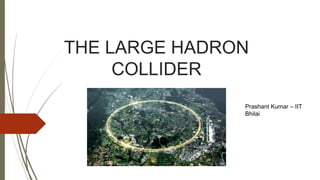
THE LARGE HADRON
COLLIDER
Prashant Kumar – IIT
Bhilai
INTRODUCTION
• World’s largest and most powerful.
• Situated near Geneva ,Switzerland.
• Built by CERN; in collaboration with over 10,000 scientists and hundreds of
universities and laboratories, as well as more than 100 countries.
• Massive power of 13 TeV total, the present world record.
Physical Specifications :
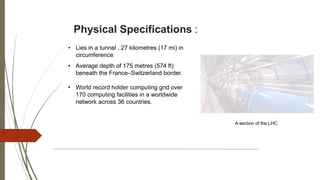
A section of the LHC
• Lies in a tunnel , 27 kilometres (17 mi) in
circumference.
• Average depth of 175 metres (574 ft)
beneath the France–Switzerland border.
• World record holder computing grid over
170 computing facilities in a worldwide
network across 36 countries.
Working principle
• The collider tunnel contains two adjacent parallel beamlines each containing a beam, which
travel in opposite directions around the ring.
• They are using super-conducting electromagnets to align the beams, dipole magnets to guide
keep beams on circular path and Quadrupole magnets to keep beam focused.
• Approximately 96 tonnes of superfluid helium-4 is needed to keep the magnets, made of
copper-clad niobium-titanium, at their operating temperature of 1.9 , making the LHC the
largest cryogenic facility in the world at liquid helium temperature .
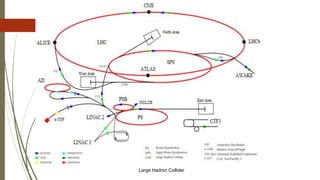
• The collider has four crossing points, around which are positioned seven detectors, each
designed for certain kinds of research
Large Hadron Collider
Detectors:
Seven detectors have been constructed at LHC at various intersection points.Two of them,
the ATLAS experiment and the Compact Muon Solenoid(CMS), are large general-purpose particle
detectors. ALICE and LHCb have more specific roles and the last
three, TOTEM, MoEDAL and LHCf, are very much smaller and are for very specialized research.
The ATLAS and CMS experiments discovered the Higgs boson.
Computing Grid:
Data produced by LHC, as well as LHC-related simulation, were estimated at approximately
15 petabytes per year (max throughput while running not stated) .
It is an international collaborative project that consists of a grid-based computer
network infrastructure initially connecting 140 computing centers in 35 countries (over 170 in 36
countries as of 2012).
It uses both private fiber optic cable links and existing high-speed portions of the public Internet to
enable data transfer from CERN to academic institutions around the world.
Discoveries
• Discovery of Higgs boson :
In 2013, physicists confirmed that they'd found a Higgs boson with
a mass of roughly 126 GeV -- the total mass of about 126 protons.
It proves the existence of Higgs field : an unusual field that
conveyed mass based on how strongly particles interacted with it.
If this Higgs field existed .
• Discovery of tetraquarks :
In 2003, researchers in Japan found a strange particle, X(3872),
that appeared to be made of a charm quark, an anticharm and at
least two other quarks.
While exploring the particle's possible existence, researchers
found Z(4430), an apparent four-quark particle.
• Missing Supersymmetry (SUSY) :
SUSY would mean that the two elemental particle types
(fermions and bosons) are merely two sides of the same
coin -- a glaring omission in the standard model --
because fermion-boson and boson-fermion conversions
might involve gravitons (the long-theorized gravity force-
carriers).
• Coordinated Motion:
When scientists at LHC opted to ram protons into lead
nuclei, they noted a surprising phenomenon: The
random paths that the resulting subatomic shrapnel
usually took had been replaced by an apparent
coordination.
One theory advanced to explain the phenomenon says
that the impact created an exotic state of matter
called quark-gluon plasma (QGP), which flowed like
liquid and produced coordinated particles as it cooled.
Many physicists hoped that the LHC would poke a few holes in the
standard model.
Though, the LHC has dealt repeated blows to exotic physics while
reconfirming the standard model at every turn. Granted, the results are
not all in (there's an awful lot of data to analyze), and the LHC has yet to
hit its full energy of 14 tera-electron volts (TeV).
Signs of New Physics After All ... or Not
THANK YOU

Large Hadron Collider

  • 1.
  • 2.
    INTRODUCTION • World’s largestand most powerful. • Situated near Geneva ,Switzerland. • Built by CERN; in collaboration with over 10,000 scientists and hundreds of universities and laboratories, as well as more than 100 countries. • Massive power of 13 TeV total, the present world record.
  • 3.
    Physical Specifications : Asection of the LHC • Lies in a tunnel , 27 kilometres (17 mi) in circumference. • Average depth of 175 metres (574 ft) beneath the France–Switzerland border. • World record holder computing grid over 170 computing facilities in a worldwide network across 36 countries.
  • 4.
    Working principle • Thecollider tunnel contains two adjacent parallel beamlines each containing a beam, which travel in opposite directions around the ring. • They are using super-conducting electromagnets to align the beams, dipole magnets to guide keep beams on circular path and Quadrupole magnets to keep beam focused. • Approximately 96 tonnes of superfluid helium-4 is needed to keep the magnets, made of copper-clad niobium-titanium, at their operating temperature of 1.9 , making the LHC the largest cryogenic facility in the world at liquid helium temperature . • The collider has four crossing points, around which are positioned seven detectors, each designed for certain kinds of research
  • 5.
  • 6.
    Detectors: Seven detectors havebeen constructed at LHC at various intersection points.Two of them, the ATLAS experiment and the Compact Muon Solenoid(CMS), are large general-purpose particle detectors. ALICE and LHCb have more specific roles and the last three, TOTEM, MoEDAL and LHCf, are very much smaller and are for very specialized research. The ATLAS and CMS experiments discovered the Higgs boson. Computing Grid: Data produced by LHC, as well as LHC-related simulation, were estimated at approximately 15 petabytes per year (max throughput while running not stated) . It is an international collaborative project that consists of a grid-based computer network infrastructure initially connecting 140 computing centers in 35 countries (over 170 in 36 countries as of 2012). It uses both private fiber optic cable links and existing high-speed portions of the public Internet to enable data transfer from CERN to academic institutions around the world.
  • 7.
    Discoveries • Discovery ofHiggs boson : In 2013, physicists confirmed that they'd found a Higgs boson with a mass of roughly 126 GeV -- the total mass of about 126 protons. It proves the existence of Higgs field : an unusual field that conveyed mass based on how strongly particles interacted with it. If this Higgs field existed . • Discovery of tetraquarks : In 2003, researchers in Japan found a strange particle, X(3872), that appeared to be made of a charm quark, an anticharm and at least two other quarks. While exploring the particle's possible existence, researchers found Z(4430), an apparent four-quark particle.
  • 8.
    • Missing Supersymmetry(SUSY) : SUSY would mean that the two elemental particle types (fermions and bosons) are merely two sides of the same coin -- a glaring omission in the standard model -- because fermion-boson and boson-fermion conversions might involve gravitons (the long-theorized gravity force- carriers). • Coordinated Motion: When scientists at LHC opted to ram protons into lead nuclei, they noted a surprising phenomenon: The random paths that the resulting subatomic shrapnel usually took had been replaced by an apparent coordination. One theory advanced to explain the phenomenon says that the impact created an exotic state of matter called quark-gluon plasma (QGP), which flowed like liquid and produced coordinated particles as it cooled.
  • 9.
    Many physicists hopedthat the LHC would poke a few holes in the standard model. Though, the LHC has dealt repeated blows to exotic physics while reconfirming the standard model at every turn. Granted, the results are not all in (there's an awful lot of data to analyze), and the LHC has yet to hit its full energy of 14 tera-electron volts (TeV). Signs of New Physics After All ... or Not THANK YOU