Nursing Shortage & Quality of Care in the Elderly Aging, Law, and Public Policy
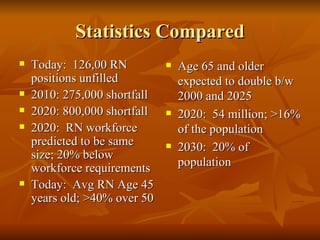
Statistics Compared Today:  126,00 RN positions unfilled 2010: 275,000 shortfall 2020: 800,000 shortfall 2020:  RN workforce predicted to be same size; 20% below workforce requirements Today:  Avg RN Age 45 years old; >40% over 50  Age 65 and older expected to double b/w 2000 and 2025 2020:  54 million; >16% of the population 2030:  20% of population
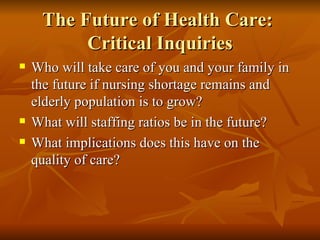
The Future of Health Care:  Critical Inquiries Who will take care of you and your family in the future if nursing shortage remains and elderly population is to grow?  What will staffing ratios be in the future? What implications does this have on the quality of care?
THE NURSING SHORTAGE:  WHY NURSING ISN’T ON THE TOP TEN LIST OF GREATEST JOBS
BURNOUT! Long hours High stress Heavy responsibilities Physical and Emotional exhaustion
 
Other Factors Associated with Nursing Shortage Low Incentives/Low Job Satisfaction Low Salary relative to Job Requirements Lack of Respect and Autonomy Caregiver Work-Related Injuries Nursing Faculty Shortage
How does the Nursing Shortage Affect Care in the Elderly? Studies demonstrate that the higher the nurse to patient ratio the greater risk to the patient Typical Ratio:  Med-Surg unit is 5-6 patients per 1 RN.  Secretary of Health and Human Services Survey:  Strong relationship between nurse staffing and five outcomes:  UTI’s, PNA, length of stay, upper GI bleeding, and shock.  Quality of Care diminished, negative outcomes more likely to occur
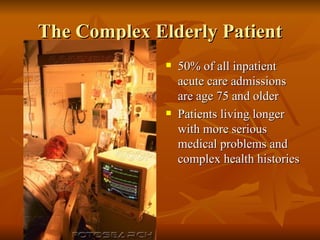
The Complex Elderly Patient 50% of all inpatient acute care admissions are age 75 and older Patients living longer with more serious medical problems and complex health histories
Quality of Care Diminished Pain Management Timely, effective pain management a problem with high ratios Medication Errors Patients are on an obscene amount of medications now Not surprising more errors are occurring with less staff and more meds Typical medication list is 2 pages long (multiply this by 5 or 6) and all meds generally due at the same time.  Passing medications becomes a race against the clock instead of educated decision making process.
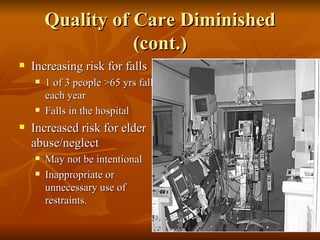
Quality of Care Diminished (cont.) Increasing risk for falls 1 of 3 people >65 yrs fall each year Falls in the hospital Increased risk for elder abuse/neglect May not be intentional Inappropriate or unnecessary use of restraints.
Solutions 1999:  California Assembly Bill 394 First state to enact mandated staffing ratios Since then other states have followed 2005: Registered Nurse Safe Staffing Act S.71 Requires all Medicare-participating hospitals to base staffing on acuity and RN input.  Kaiser Model/Approach Overlapping shifts, lower ratios.
Happy Thanksgiving! Questions, Comments

Aging Presentation

  • 1.
    Nursing Shortage &Quality of Care in the Elderly Aging, Law, and Public Policy
  • 2.
    Statistics Compared Today: 126,00 RN positions unfilled 2010: 275,000 shortfall 2020: 800,000 shortfall 2020: RN workforce predicted to be same size; 20% below workforce requirements Today: Avg RN Age 45 years old; >40% over 50 Age 65 and older expected to double b/w 2000 and 2025 2020: 54 million; >16% of the population 2030: 20% of population
  • 3.
    The Future ofHealth Care: Critical Inquiries Who will take care of you and your family in the future if nursing shortage remains and elderly population is to grow? What will staffing ratios be in the future? What implications does this have on the quality of care?
  • 4.
    THE NURSING SHORTAGE: WHY NURSING ISN’T ON THE TOP TEN LIST OF GREATEST JOBS
  • 5.
    BURNOUT! Long hoursHigh stress Heavy responsibilities Physical and Emotional exhaustion
  • 6.
  • 7.
    Other Factors Associatedwith Nursing Shortage Low Incentives/Low Job Satisfaction Low Salary relative to Job Requirements Lack of Respect and Autonomy Caregiver Work-Related Injuries Nursing Faculty Shortage
  • 8.
    How does theNursing Shortage Affect Care in the Elderly? Studies demonstrate that the higher the nurse to patient ratio the greater risk to the patient Typical Ratio: Med-Surg unit is 5-6 patients per 1 RN. Secretary of Health and Human Services Survey: Strong relationship between nurse staffing and five outcomes: UTI’s, PNA, length of stay, upper GI bleeding, and shock. Quality of Care diminished, negative outcomes more likely to occur
  • 9.
    The Complex ElderlyPatient 50% of all inpatient acute care admissions are age 75 and older Patients living longer with more serious medical problems and complex health histories
  • 10.
    Quality of CareDiminished Pain Management Timely, effective pain management a problem with high ratios Medication Errors Patients are on an obscene amount of medications now Not surprising more errors are occurring with less staff and more meds Typical medication list is 2 pages long (multiply this by 5 or 6) and all meds generally due at the same time. Passing medications becomes a race against the clock instead of educated decision making process.
  • 11.
    Quality of CareDiminished (cont.) Increasing risk for falls 1 of 3 people >65 yrs fall each year Falls in the hospital Increased risk for elder abuse/neglect May not be intentional Inappropriate or unnecessary use of restraints.
  • 12.
    Solutions 1999: California Assembly Bill 394 First state to enact mandated staffing ratios Since then other states have followed 2005: Registered Nurse Safe Staffing Act S.71 Requires all Medicare-participating hospitals to base staffing on acuity and RN input. Kaiser Model/Approach Overlapping shifts, lower ratios.
  • 13.