
General practice:  clinical governance &  patient management software Harry Pert
Effecting Change for Better Outcomes
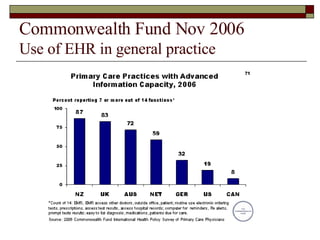
Commonwealth Fund Nov 2006 Use of EHR in general practice
Why has NZ been successful? Good software, and connectivity  (PMS & Healthlink) Culture ‘early adopters’ Business model New support for general practice from the early 90s
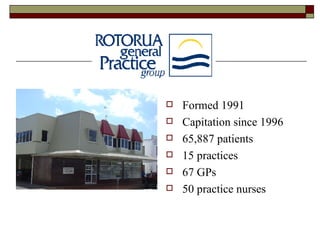
Formed 1991 Capitation since 1996 65,887 patients 15 practices 67 GPs 50 practice nurses
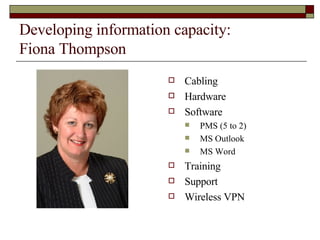
Developing information capacity:  Fiona Thompson Cabling Hardware Software PMS (5 to 2) MS Outlook MS Word Training  Support Wireless VPN
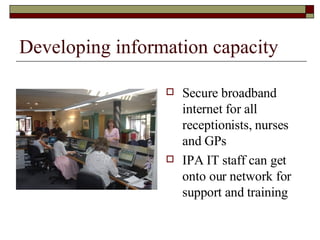
Developing information capacity Secure broadband internet for all receptionists, nurses and GPs IPA IT staff can get onto our network for support and training
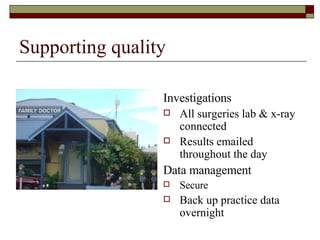
Supporting quality Investigations  All surgeries lab & x-ray connected Results emailed throughout the day Data management Secure Back up practice data overnight
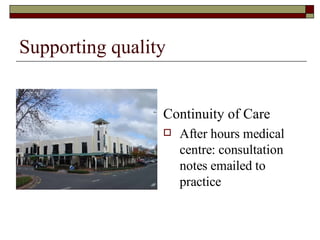
Supporting quality Continuity of Care After hours medical centre: consultation notes emailed to practice
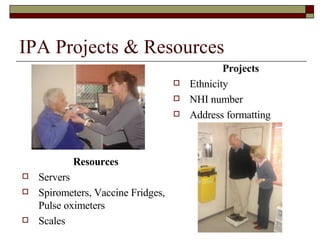
IPA Projects & Resources Projects Ethnicity NHI number Address formatting Resources Servers Spirometers, Vaccine Fridges, Pulse oximeters Scales
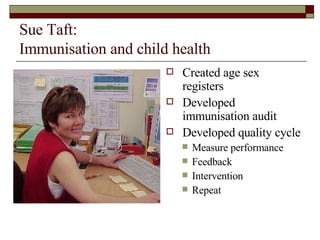
Sue Taft:  Immunisation and child health Created age sex registers Developed immunisation audit Developed quality cycle Measure performance Feedback Intervention Repeat
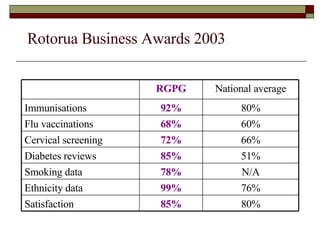
Rotorua Business Awards 2003 RGPG National average Immunisations 92% 80% Flu vaccinations 68% 60% Cervical screening 72% 66% Diabetes reviews 85% 51% Smoking data 78% N/A Ethnicity data 99% 76% Satisfaction 85% 80%
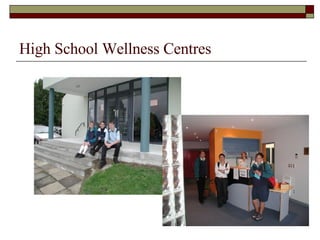
High School Wellness Centres
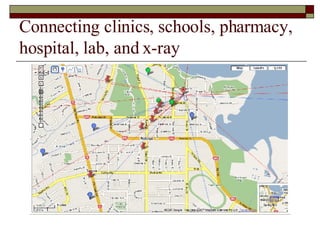
Connecting clinics, schools, pharmacy, hospital, lab, and x-ray
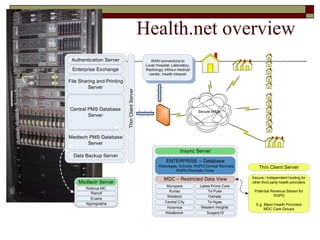
Health.net overview
What have we learnt?  Clinical governance The nature of general practice The role of management support The new requirements of our PMS
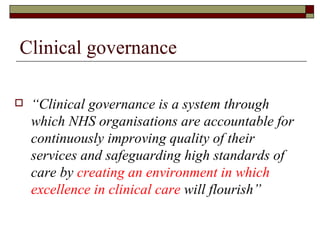
Clinical governance  “ Clinical governance is a system through which NHS organisations are accountable for continuously improving quality of their services and safeguarding high standards of care by  creating an environment in which excellence in clinical care  will flourish”
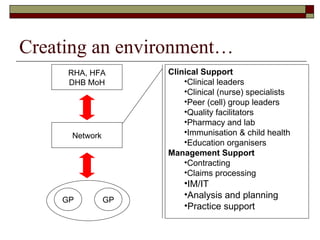
Creating an environment… Network RHA, HFA DHB MoH Clinical Support Clinical leaders Clinical (nurse) specialists Peer (cell) group leaders Quality facilitators Pharmacy and lab Immunisation & child health  Education organisers   Management Support Contracting Claims processing IM/IT Analysis and planning  Practice support GP GP
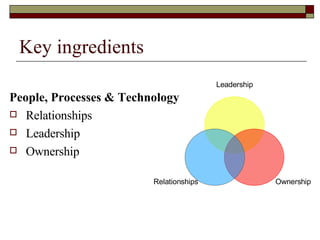
Key ingredients People, Processes & Technology Relationships Leadership Ownership Leadership Ownership Relationships
Creating an environment… Permissive:  High trust, low bureaucracy Innovation flourishes, achievement & morale high Prescriptive: Low trust, high bureaucracy  Innovation stifled, achievement & morale low
UK NHS: NPfIT “ Some of the key enablers of service transformation, such as the delivery of Information Technology will … increasingly  need to be driven and owned out in the service rather than from the centre,   so that patients can get the full benefits as quickly as possible ”.   David Nicholson, NHS Chief Executive Dec 2006  The NHS operating framework for 2007/08
Dennis Protti  BJ Healthcare Computing and Information Management Dec 2003 Over 150 factors… identified, but only  two – top management support and clinician involvement… consistently associated with successful implementation” “Lack of clinician involvement has been a consistent theme in past failures”
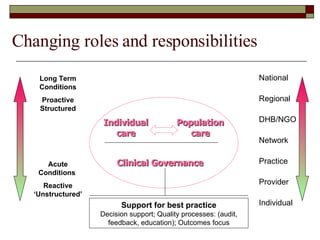
Changing roles and responsibilities Individual care Population care Clinical Governance National Regional DHB/NGO Network Practice Provider Individual Support for best practice Decision support; Quality processes: (audit, feedback, education);  Outcomes focus Long Term Conditions Proactive Structured Acute Conditions  Reactive ‘Unstructured’
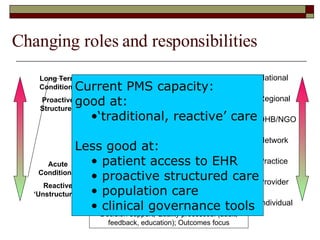
Changing roles and responsibilities Individual care Population care Clinical Governance National Regional DHB/NGO Network Practice Provider Individual Support for best practice Decision support; Quality processes: (audit, feedback, education);  Outcomes focus Long Term Conditions Proactive Structured Acute Conditions  Reactive ‘Unstructured’ Current PMS capacity:  good at:  ‘ traditional, reactive’ care Less good at: patient access to EHR proactive structured care population care clinical governance tools
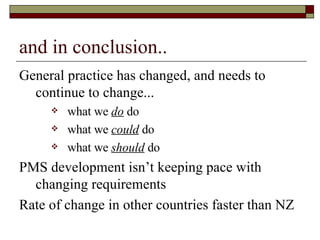
and in conclusion.. General practice has changed, and needs to continue to change... what we  do  do what we  could  do what we  should  do PMS development isn’t keeping pace with changing requirements Rate of change in other countries faster than NZ
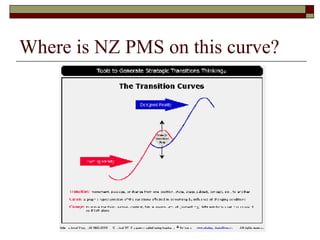
Where is NZ PMS on this curve?
Thank you

General practice: clinical governance & patient management software

  • 1.
    General practice: clinical governance & patient management software Harry Pert
  • 2.
    Effecting Change forBetter Outcomes
  • 3.
    Commonwealth Fund Nov2006 Use of EHR in general practice
  • 4.
    Why has NZbeen successful? Good software, and connectivity (PMS & Healthlink) Culture ‘early adopters’ Business model New support for general practice from the early 90s
  • 5.
    Formed 1991 Capitationsince 1996 65,887 patients 15 practices 67 GPs 50 practice nurses
  • 6.
    Developing information capacity: Fiona Thompson Cabling Hardware Software PMS (5 to 2) MS Outlook MS Word Training Support Wireless VPN
  • 7.
    Developing information capacitySecure broadband internet for all receptionists, nurses and GPs IPA IT staff can get onto our network for support and training
  • 8.
    Supporting quality Investigations All surgeries lab & x-ray connected Results emailed throughout the day Data management Secure Back up practice data overnight
  • 9.
    Supporting quality Continuityof Care After hours medical centre: consultation notes emailed to practice
  • 10.
    IPA Projects &Resources Projects Ethnicity NHI number Address formatting Resources Servers Spirometers, Vaccine Fridges, Pulse oximeters Scales
  • 11.
    Sue Taft: Immunisation and child health Created age sex registers Developed immunisation audit Developed quality cycle Measure performance Feedback Intervention Repeat
  • 12.
    Rotorua Business Awards2003 RGPG National average Immunisations 92% 80% Flu vaccinations 68% 60% Cervical screening 72% 66% Diabetes reviews 85% 51% Smoking data 78% N/A Ethnicity data 99% 76% Satisfaction 85% 80%
  • 13.
  • 14.
    Connecting clinics, schools,pharmacy, hospital, lab, and x-ray
  • 15.
  • 16.
    What have welearnt? Clinical governance The nature of general practice The role of management support The new requirements of our PMS
  • 17.
    Clinical governance “ Clinical governance is a system through which NHS organisations are accountable for continuously improving quality of their services and safeguarding high standards of care by creating an environment in which excellence in clinical care will flourish”
  • 18.
    Creating an environment…Network RHA, HFA DHB MoH Clinical Support Clinical leaders Clinical (nurse) specialists Peer (cell) group leaders Quality facilitators Pharmacy and lab Immunisation & child health Education organisers Management Support Contracting Claims processing IM/IT Analysis and planning Practice support GP GP
  • 19.
    Key ingredients People,Processes & Technology Relationships Leadership Ownership Leadership Ownership Relationships
  • 20.
    Creating an environment…Permissive: High trust, low bureaucracy Innovation flourishes, achievement & morale high Prescriptive: Low trust, high bureaucracy Innovation stifled, achievement & morale low
  • 21.
    UK NHS: NPfIT“ Some of the key enablers of service transformation, such as the delivery of Information Technology will … increasingly need to be driven and owned out in the service rather than from the centre, so that patients can get the full benefits as quickly as possible ”. David Nicholson, NHS Chief Executive Dec 2006 The NHS operating framework for 2007/08
  • 22.
    Dennis Protti BJ Healthcare Computing and Information Management Dec 2003 Over 150 factors… identified, but only two – top management support and clinician involvement… consistently associated with successful implementation” “Lack of clinician involvement has been a consistent theme in past failures”
  • 23.
    Changing roles andresponsibilities Individual care Population care Clinical Governance National Regional DHB/NGO Network Practice Provider Individual Support for best practice Decision support; Quality processes: (audit, feedback, education); Outcomes focus Long Term Conditions Proactive Structured Acute Conditions Reactive ‘Unstructured’
  • 24.
    Changing roles andresponsibilities Individual care Population care Clinical Governance National Regional DHB/NGO Network Practice Provider Individual Support for best practice Decision support; Quality processes: (audit, feedback, education); Outcomes focus Long Term Conditions Proactive Structured Acute Conditions Reactive ‘Unstructured’ Current PMS capacity: good at: ‘ traditional, reactive’ care Less good at: patient access to EHR proactive structured care population care clinical governance tools
  • 25.
    and in conclusion..General practice has changed, and needs to continue to change... what we do do what we could do what we should do PMS development isn’t keeping pace with changing requirements Rate of change in other countries faster than NZ
  • 26.
    Where is NZPMS on this curve?
  • 27.