Agile Organisational Change
Join the conversation 7-9pm 6th October 2022
Presented by Alex Boulting
The aim of these monthly talks is to
crowd-source a body of knowledge from
people who have experience in
Organisational Change.
2
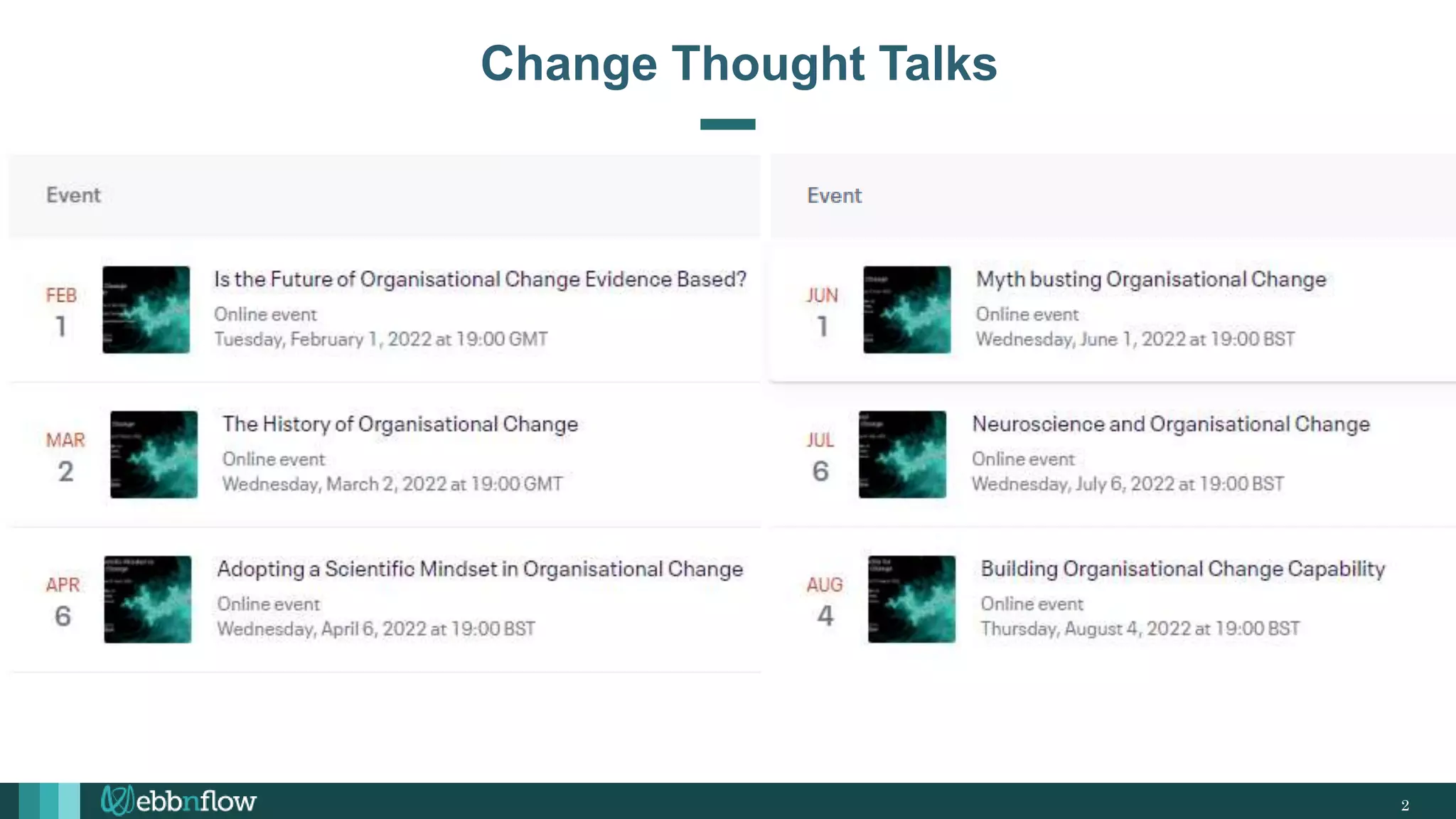
Change Thought Talks
3
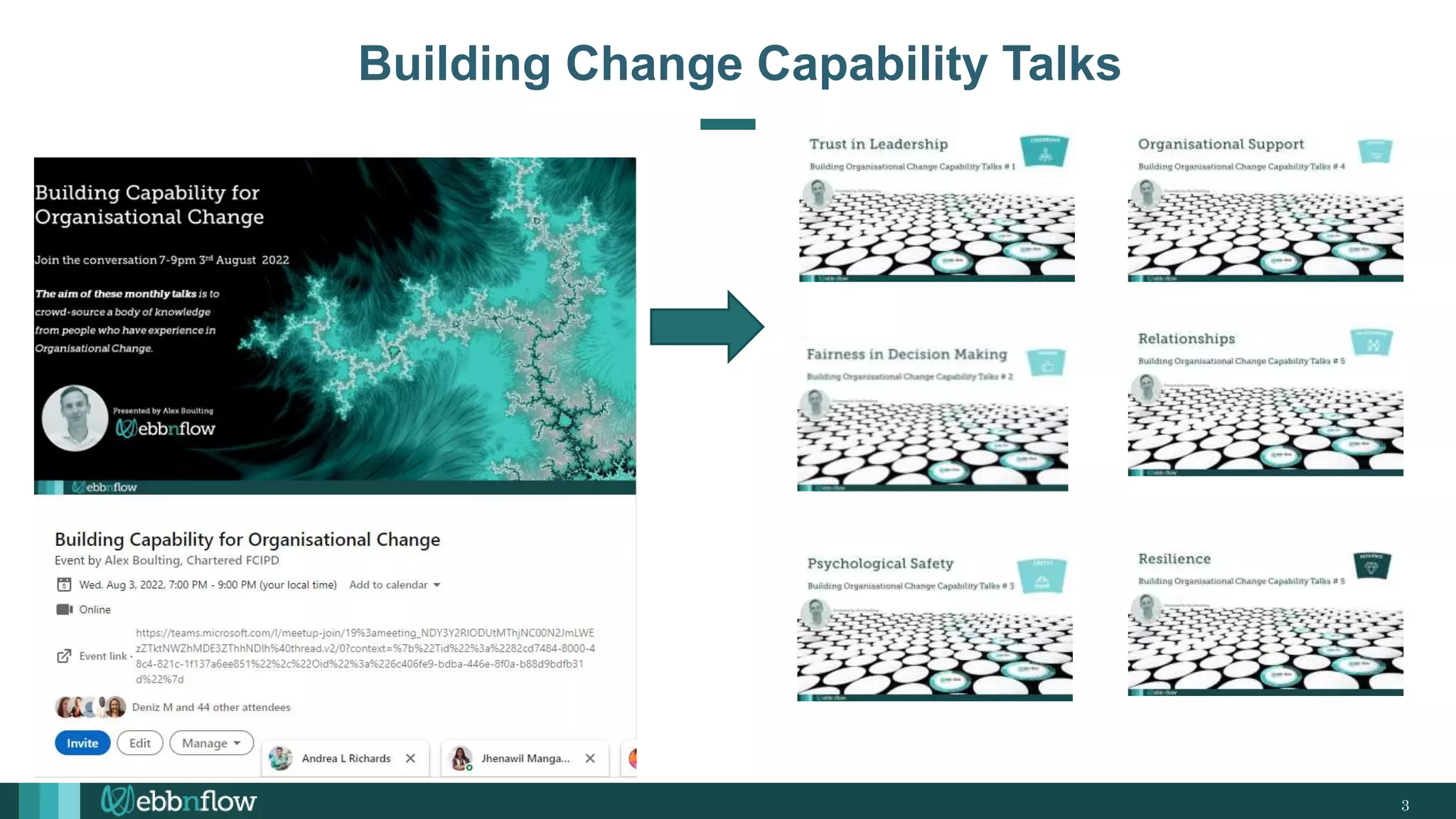
Building Change Capability Talks
4
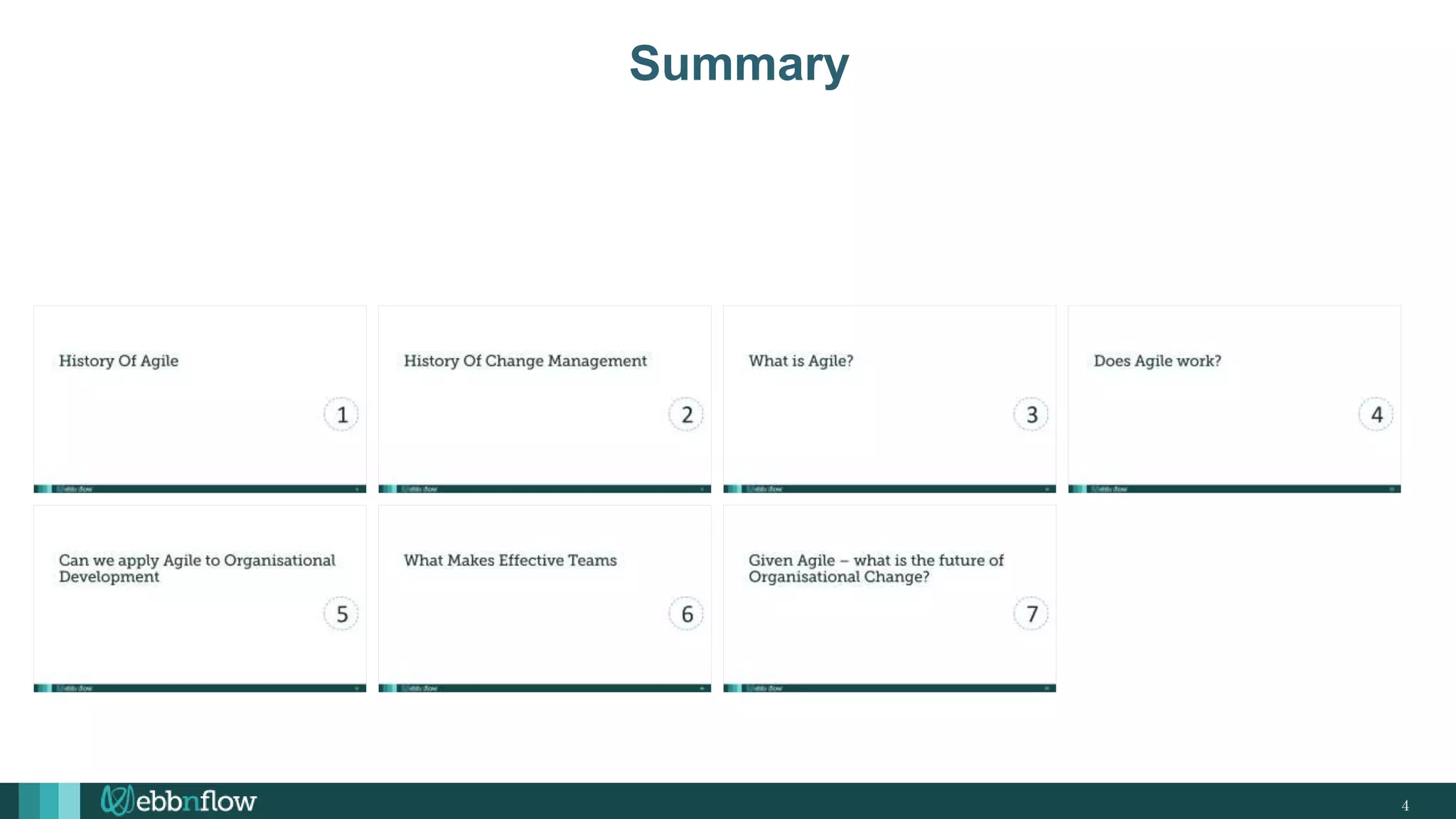
Summary
6
History Of Agile
1
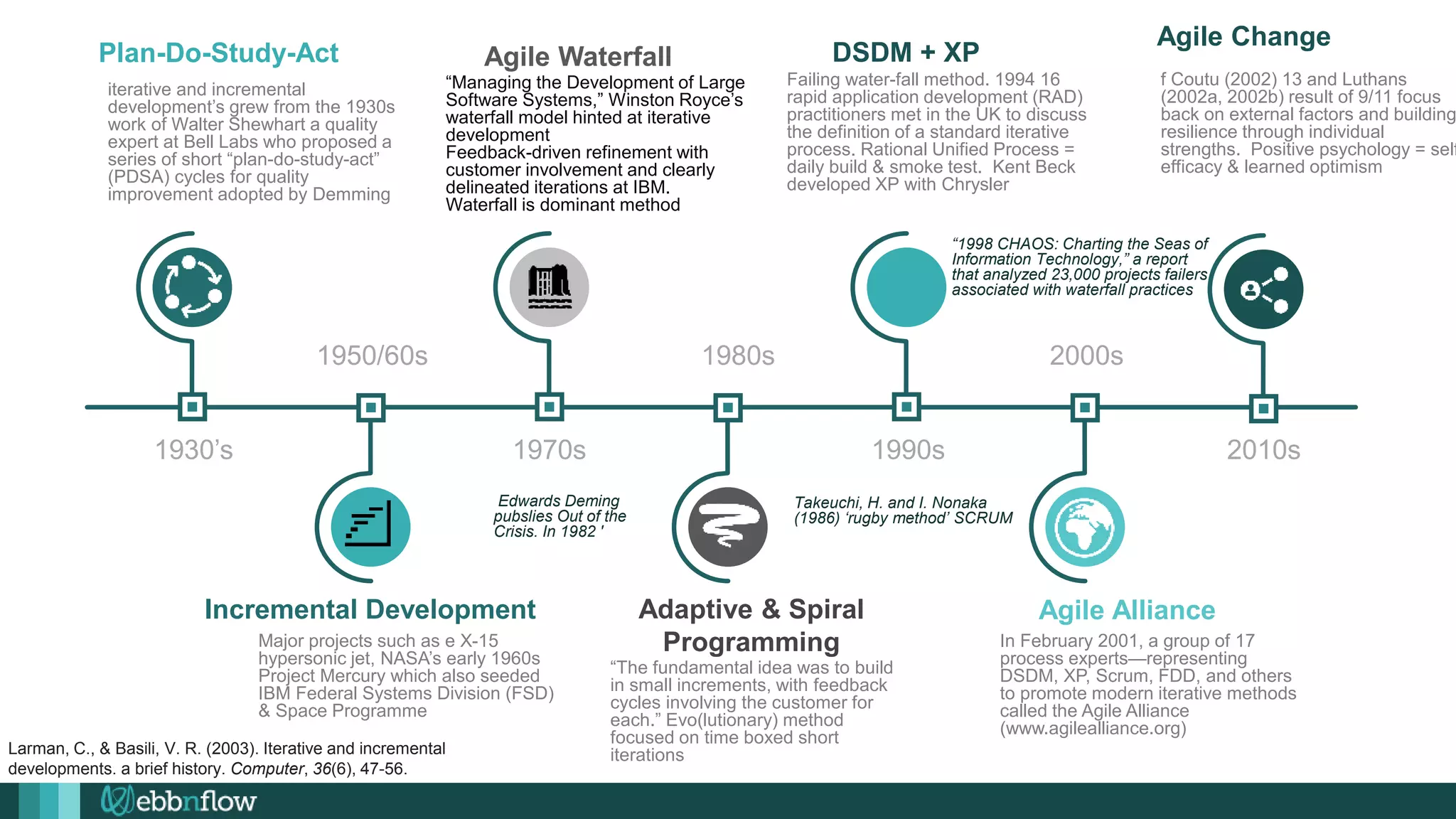
1930’s 1970s 1990s 2010s
1950/60s 1980s 2000s
iterative and incremental
development’s grew from the 1930s
work of Walter Shewhart a quality
expert at Bell Labs who proposed a
series of short “plan-do-study-act”
(PDSA) cycles for quality
improvement adopted by Demming
“The fundamental idea was to build
in small increments, with feedback
cycles involving the customer for
each.” Evo(lutionary) method
focused on time boxed short
iterations
Plan-Do-Study-Act
Adaptive & Spiral
Programming
DSDM + XP
Agile Alliance
Agile Change
In February 2001, a group of 17
process experts—representing
DSDM, XP, Scrum, FDD, and others
to promote modern iterative methods
called the Agile Alliance
(www.agilealliance.org)
f Coutu (2002) 13 and Luthans
(2002a, 2002b) result of 9/11 focus
back on external factors and building
resilience through individual
strengths. Positive psychology = self
efficacy & learned optimism
Failing water-fall method. 1994 16
rapid application development (RAD)
practitioners met in the UK to discuss
the definition of a standard iterative
process. Rational Unified Process =
daily build & smoke test. Kent Beck
developed XP with Chrysler
“Managing the Development of Large
Software Systems,” Winston Royce’s
waterfall model hinted at iterative
development
Feedback-driven refinement with
customer involvement and clearly
delineated iterations at IBM.
Waterfall is dominant method
Agile Waterfall
Incremental Development
Major projects such as e X-15
hypersonic jet, NASA’s early 1960s
Project Mercury which also seeded
IBM Federal Systems Division (FSD)
& Space Programme
Edwards Deming
pubslies Out of the
Crisis. In 1982 '
Takeuchi, H. and I. Nonaka
(1986) ‘rugby method’ SCRUM
“1998 CHAOS: Charting the Seas of
Information Technology,” a report
that analyzed 23,000 projects failers
associated with waterfall practices
Larman, C., & Basili, V. R. (2003). Iterative and incremental
developments. a brief history. Computer, 36(6), 47-56.
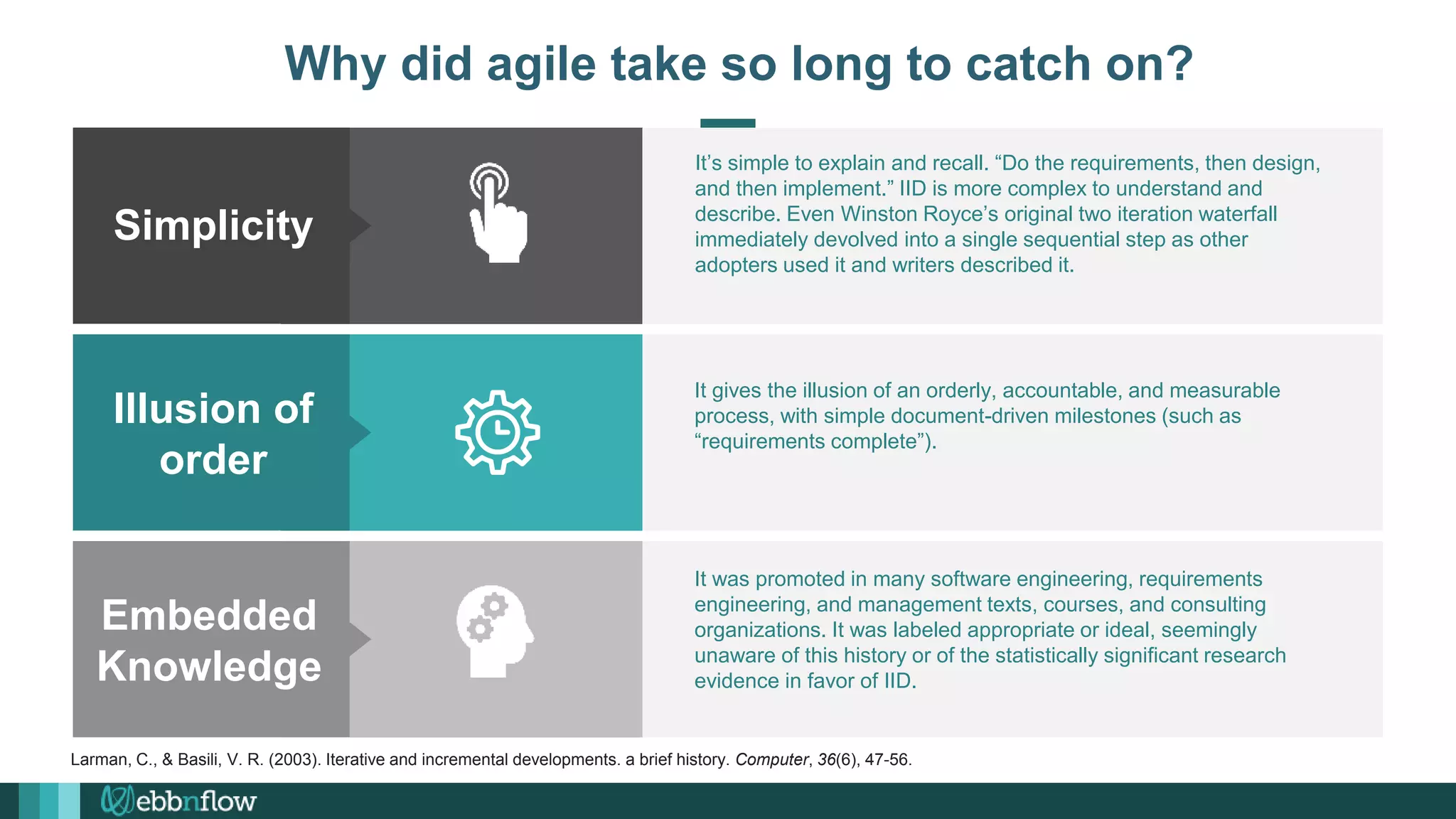
It’s simple to explain and recall. “Do the requirements, then design,
and then implement.” IID is more complex to understand and
describe. Even Winston Royce’s original two iteration waterfall
immediately devolved into a single sequential step as other
adopters used it and writers described it.
It gives the illusion of an orderly, accountable, and measurable
process, with simple document-driven milestones (such as
“requirements complete”).
Simplicity
Illusion of
order
Embedded
Knowledge
Why did agile take so long to catch on?
It was promoted in many software engineering, requirements
engineering, and management texts, courses, and consulting
organizations. It was labeled appropriate or ideal, seemingly
unaware of this history or of the statistically significant research
evidence in favor of IID.
Larman, C., & Basili, V. R. (2003). Iterative and incremental developments. a brief history. Computer, 36(6), 47-56.
9
History Of Change Management
2
10
1950s 1960s 1980s
1970s 1990s 2000s 2010s 2020s
1940s
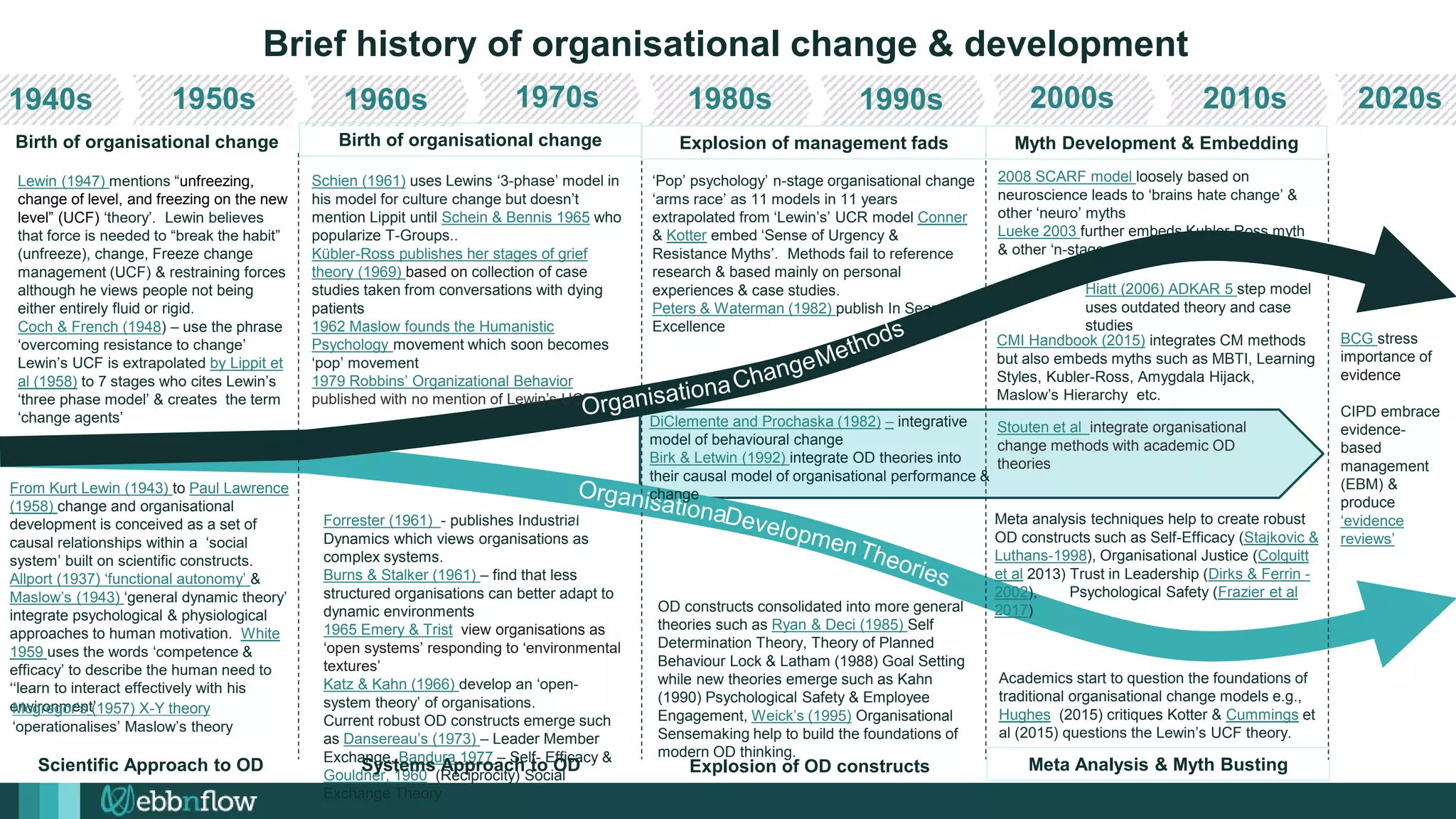
From Kurt Lewin (1943) to Paul Lawrence
(1958) change and organisational
development is conceived as a set of
causal relationships within a ‘social
system’ built on scientific constructs.
Allport (1937) ‘functional autonomy’ &
Maslow’s (1943) ‘general dynamic theory’
integrate psychological & physiological
approaches to human motivation. White
1959 uses the words ‘competence &
efficacy’ to describe the human need to
‘‘learn to interact effectively with his
environment’
Lewin (1947) mentions “unfreezing,
change of level, and freezing on the new
level” (UCF) ‘theory’. Lewin believes
that force is needed to “break the habit”
(unfreeze), change, Freeze change
management (UCF) & restraining forces
although he views people not being
either entirely fluid or rigid.
Coch & French (1948) – use the phrase
‘overcoming resistance to change’
Lewin’s UCF is extrapolated by Lippit et
al (1958) to 7 stages who cites Lewin’s
‘three phase model’ & creates the term
‘change agents’
Schien (1961) uses Lewins ‘3-phase’ model in
his model for culture change but doesn’t
mention Lippit until Schein & Bennis 1965 who
popularize T-Groups..
Kübler-Ross publishes her stages of grief
theory (1969) based on collection of case
studies taken from conversations with dying
patients
1962 Maslow founds the Humanistic
Psychology movement which soon becomes
‘pop’ movement
1979 Robbins’ Organizational Behavior
published with no mention of Lewin’s UCF
Forrester (1961) - publishes Industrial
Dynamics which views organisations as
complex systems.
Burns & Stalker (1961) – find that less
structured organisations can better adapt to
dynamic environments
1965 Emery & Trist view organisations as
‘open systems’ responding to ‘environmental
textures’
Katz & Kahn (1966) develop an ‘open-
system theory’ of organisations.
Current robust OD constructs emerge such
as Dansereau’s (1973) – Leader Member
Exchange, Bandura 1977 – Self- Efficacy &
Gouldner, 1960 (Reciprocity) Social
Exchange Theory
‘Pop’ psychology’ n-stage organisational change
‘arms race’ as 11 models in 11 years
extrapolated from ‘Lewin’s’ UCR model Conner
& Kotter embed ‘Sense of Urgency &
Resistance Myths’. Methods fail to reference
research & based mainly on personal
experiences & case studies.
Peters & Waterman (1982) publish In Search of
Excellence
Brief history of organisational change & development
Birth of organisational change Birth of organisational change Explosion of management fads
Meta Analysis & Myth Busting
Scientific Approach to OD Systems Approach to OD Explosion of OD constructs
Myth Development & Embedding
OD constructs consolidated into more general
theories such as Ryan & Deci (1985) Self
Determination Theory, Theory of Planned
Behaviour Lock & Latham (1988) Goal Setting
while new theories emerge such as Kahn
(1990) Psychological Safety & Employee
Engagement, Weick’s (1995) Organisational
Sensemaking help to build the foundations of
modern OD thinking.
Meta analysis techniques help to create robust
OD constructs such as Self-Efficacy (Stajkovic &
Luthans-1998), Organisational Justice (Colquitt
et al 2013) Trust in Leadership (Dirks & Ferrin -
2002), Psychological Safety (Frazier et al
2017)
Academics start to question the foundations of
traditional organisational change models e.g.,
Hughes (2015) critiques Kotter & Cummings et
al (2015) questions the Lewin’s UCF theory.
BCG stress
importance of
evidence
CIPD embrace
evidence-
based
management
(EBM) &
produce
‘evidence
reviews’
2008 SCARF model loosely based on
neuroscience leads to ‘brains hate change’ &
other ‘neuro’ myths
Lueke 2003 further embeds Kubler Ross myth
& other ‘n-stage methods.
Mcgregor’s (1957) X-Y theory
‘operationalises’ Maslow’s theory
DiClemente and Prochaska (1982) – integrative
model of behavioural change
Birk & Letwin (1992) integrate OD theories into
their causal model of organisational performance &
change
Hiatt (2006) ADKAR 5 step model
uses outdated theory and case
studies
Stouten et al integrate organisational
change methods with academic OD
theories
CMI Handbook (2015) integrates CM methods
but also embeds myths such as MBTI, Learning
Styles, Kubler-Ross, Amygdala Hijack,
Maslow’s Hierarchy etc.
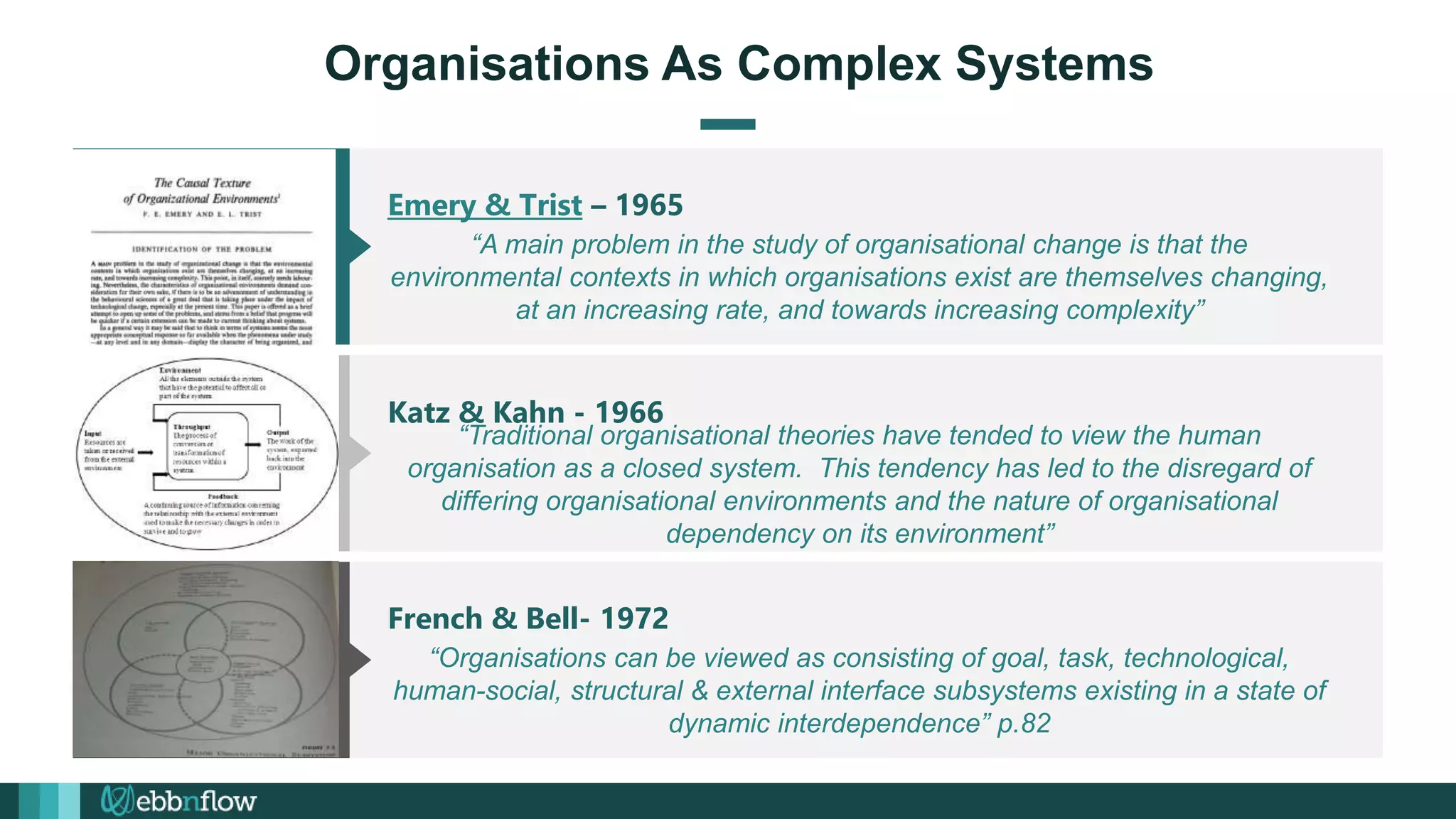
Organisations As Complex Systems
“Traditional organisational theories have tended to view the human
organisation as a closed system. This tendency has led to the disregard of
differing organisational environments and the nature of organisational
dependency on its environment”
Katz & Kahn - 1966
01
02
03
“A main problem in the study of organisational change is that the
environmental contexts in which organisations exist are themselves changing,
at an increasing rate, and towards increasing complexity”
Emery & Trist – 1965
“Organisations can be viewed as consisting of goal, task, technological,
human-social, structural & external interface subsystems existing in a state of
dynamic interdependence” p.82
French & Bell- 1972
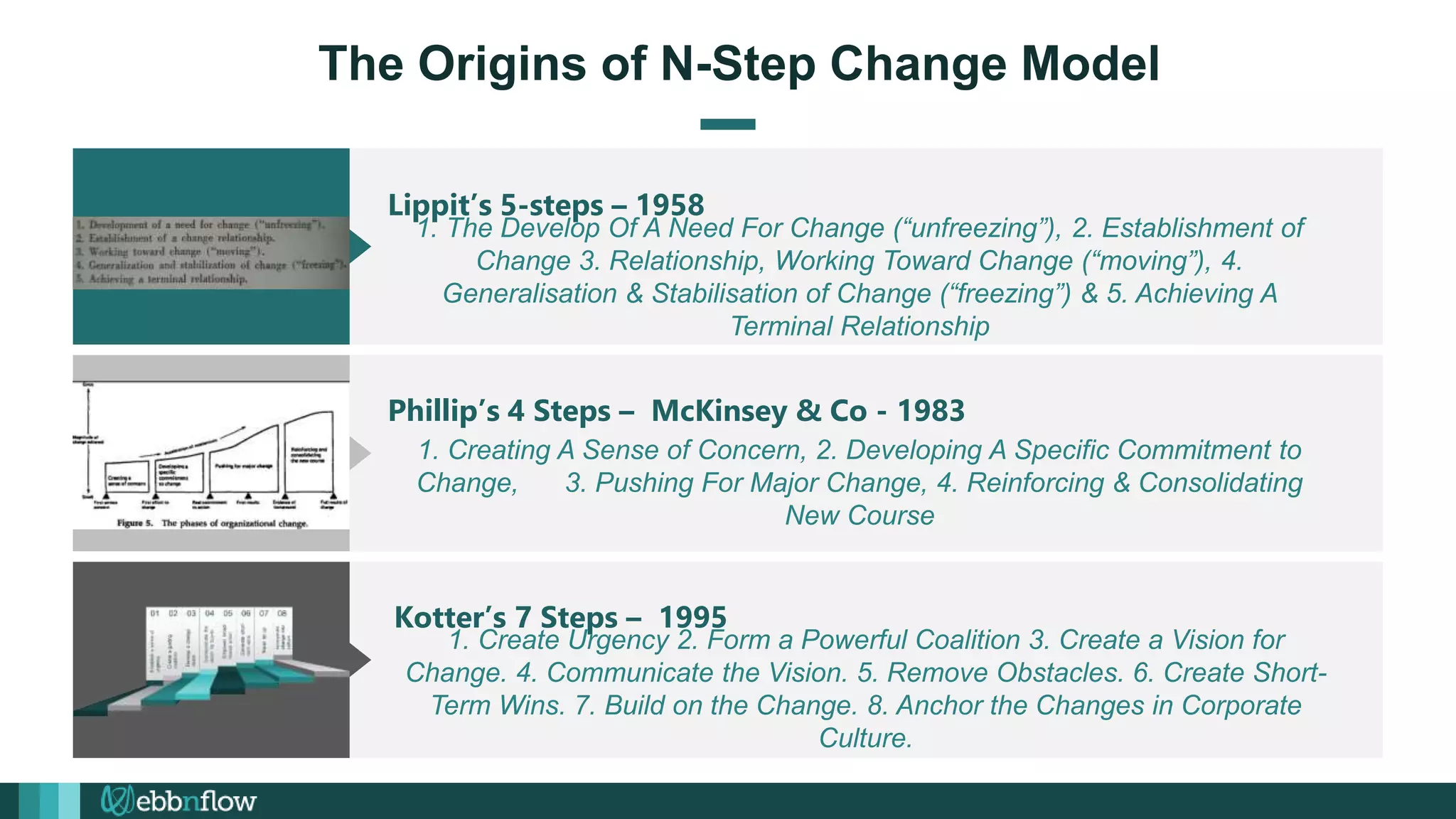
The Origins of N-Step Change Model
01
02
1. The Develop Of A Need For Change (“unfreezing”), 2. Establishment of
Change 3. Relationship, Working Toward Change (“moving”), 4.
Generalisation & Stabilisation of Change (“freezing”) & 5. Achieving A
Terminal Relationship
Lippit’s 5-steps – 1958
1. Creating A Sense of Concern, 2. Developing A Specific Commitment to
Change, 3. Pushing For Major Change, 4. Reinforcing & Consolidating
New Course
Phillip’s 4 Steps – McKinsey & Co - 1983
1. Create Urgency 2. Form a Powerful Coalition 3. Create a Vision for
Change. 4. Communicate the Vision. 5. Remove Obstacles. 6. Create Short-
Term Wins. 7. Build on the Change. 8. Anchor the Changes in Corporate
Culture.
Kotter’s 7 Steps – 1995
13
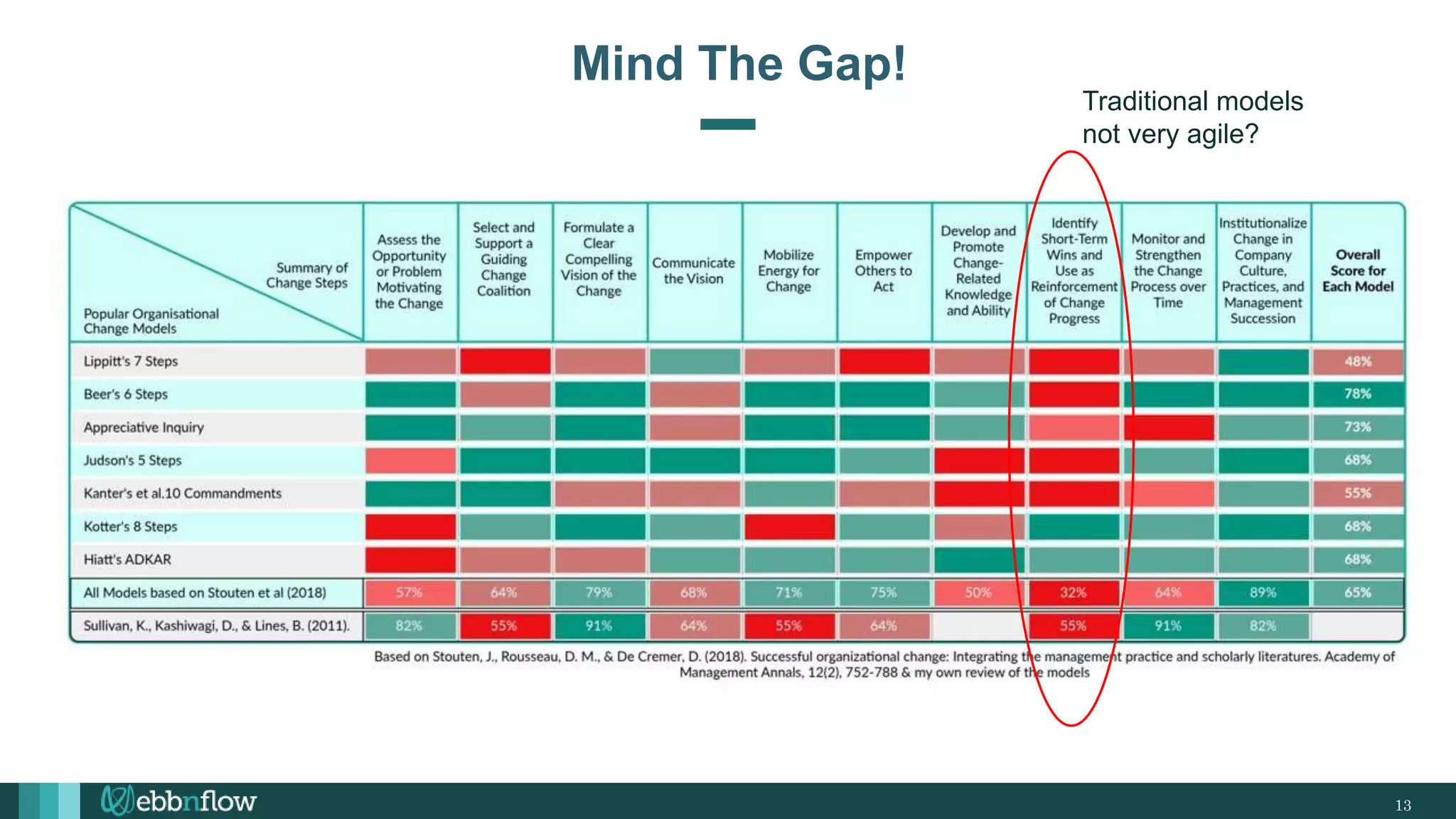
Mind The Gap!
Traditional models
not very agile?
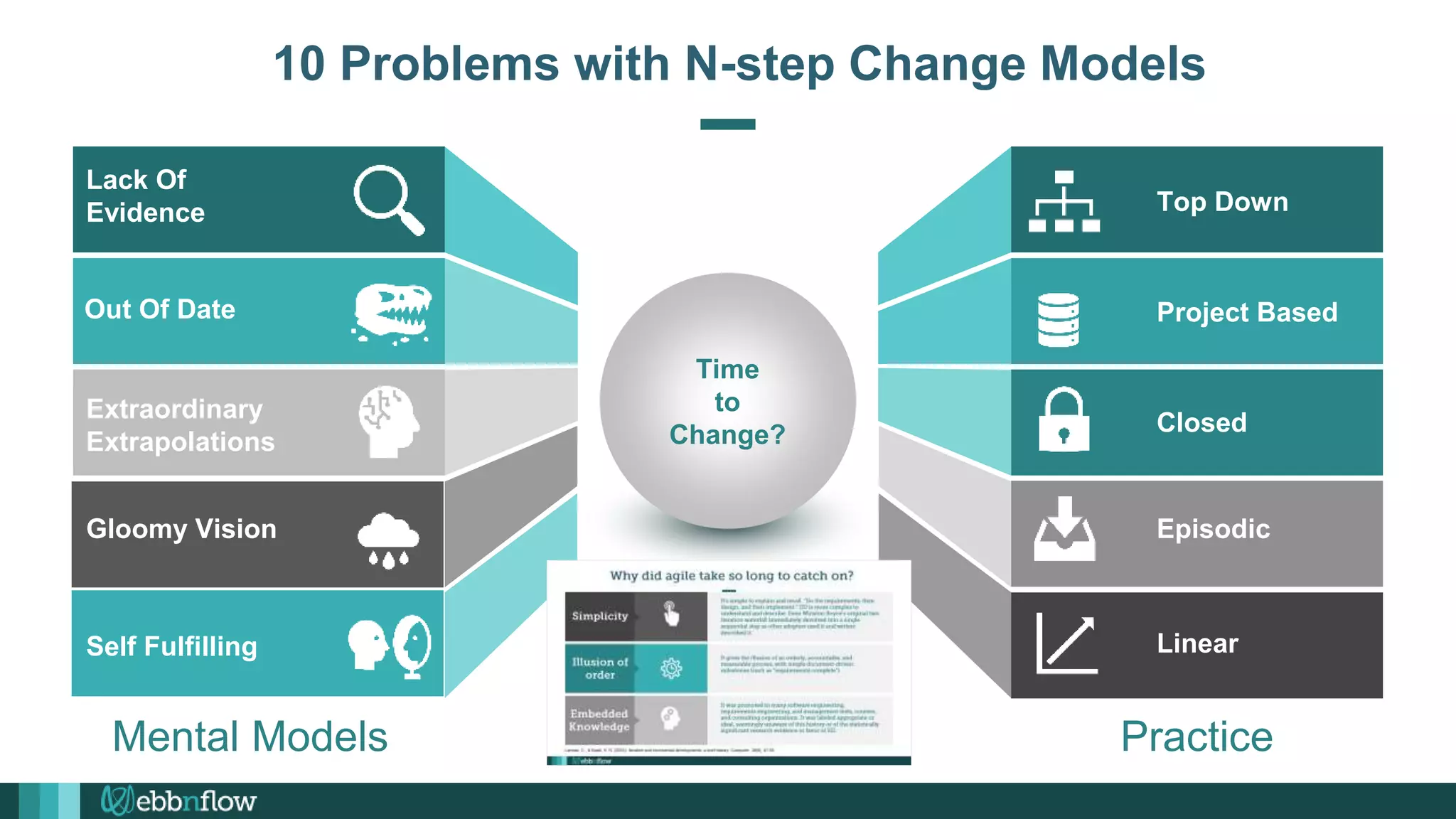
10 Problems with N-step Change Models
Mental Models
Time
to
Change?
Practice
Lack Of
Evidence
Out Of Date
Extraordinary
Extrapolations
Gloomy Vision
Self Fulfilling
Top Down
Project Based
Closed
Episodic
Linear
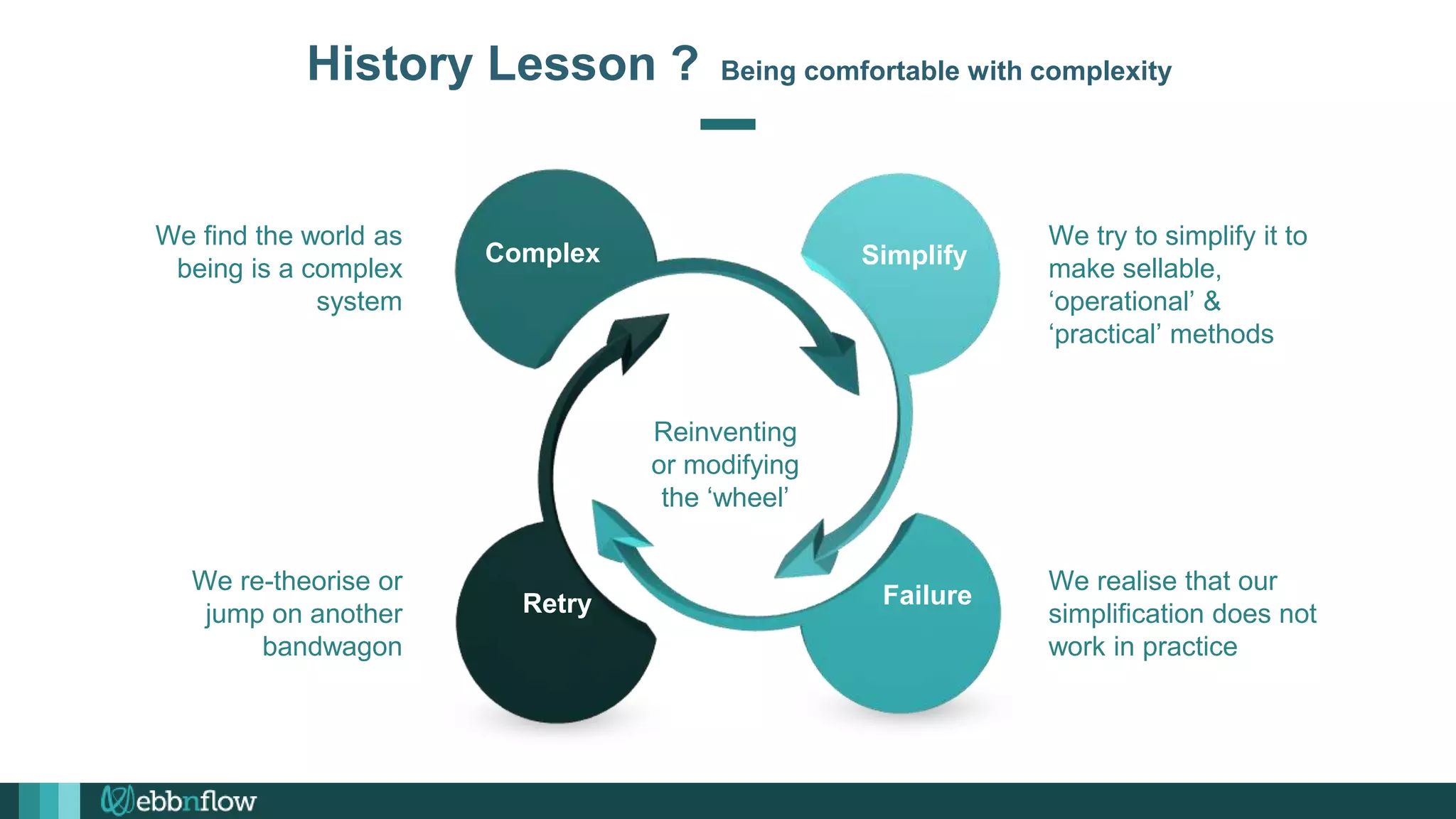
History Lesson ? Being comfortable with complexity
We try to simplify it to
make sellable,
‘operational’ &
‘practical’ methods
We realise that our
simplification does not
work in practice
We find the world as
being is a complex
system
We re-theorise or
jump on another
bandwagon
Reinventing
or modifying
the ‘wheel’
Complex
Retry Failure
Simplify
16
What is Agile?
3
17
What is ‘Agile’?
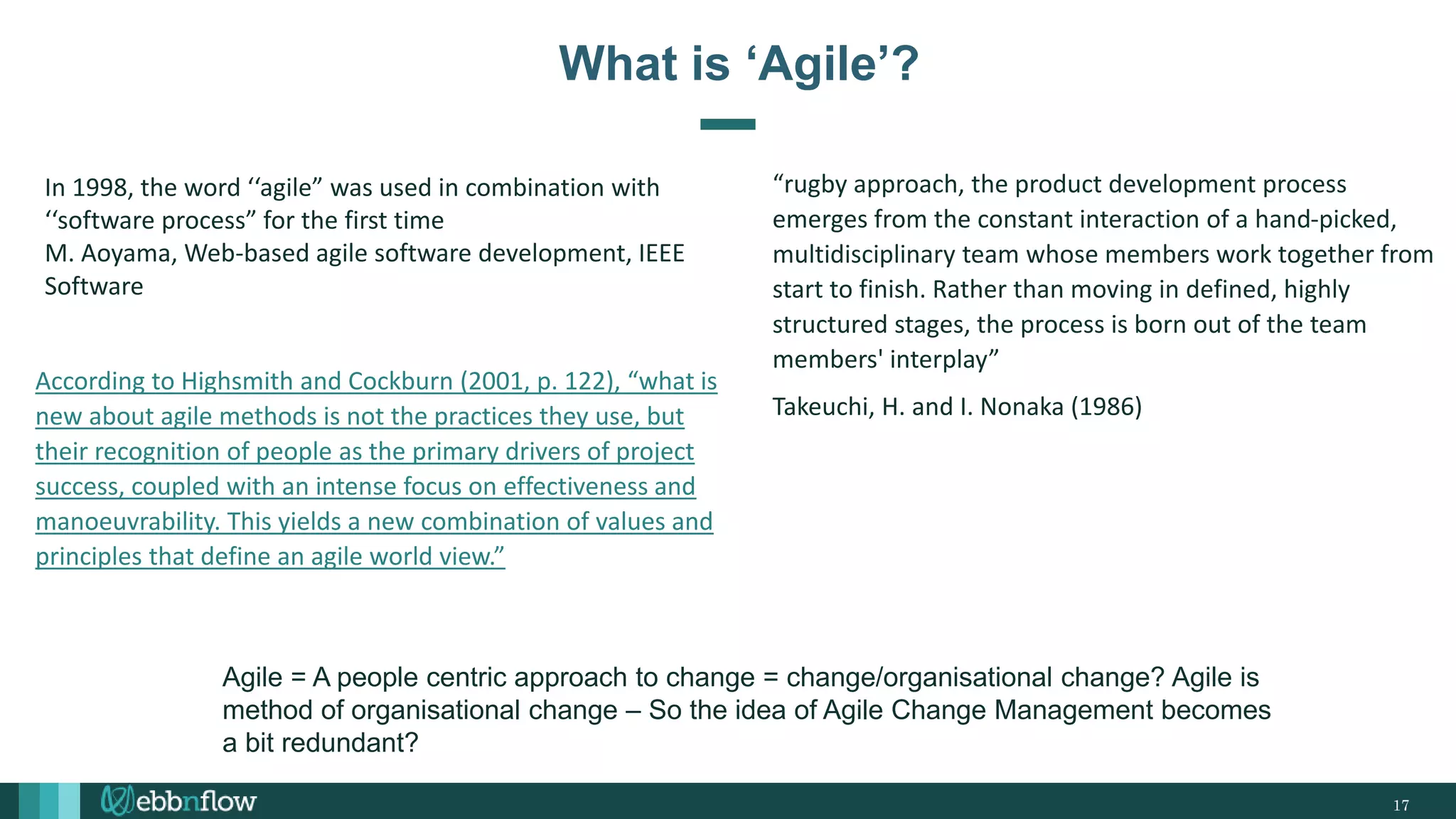
In 1998, the word ‘‘agile” was used in combination with
‘‘software process” for the first time
M. Aoyama, Web-based agile software development, IEEE
Software
According to Highsmith and Cockburn (2001, p. 122), “what is
new about agile methods is not the practices they use, but
their recognition of people as the primary drivers of project
success, coupled with an intense focus on effectiveness and
manoeuvrability. This yields a new combination of values and
principles that define an agile world view.”
“rugby approach, the product development process
emerges from the constant interaction of a hand-picked,
multidisciplinary team whose members work together from
start to finish. Rather than moving in defined, highly
structured stages, the process is born out of the team
members' interplay”
Takeuchi, H. and I. Nonaka (1986)
Agile = A people centric approach to change = change/organisational change? Agile is
method of organisational change – So the idea of Agile Change Management becomes
a bit redundant?
18
Agile Manifesto
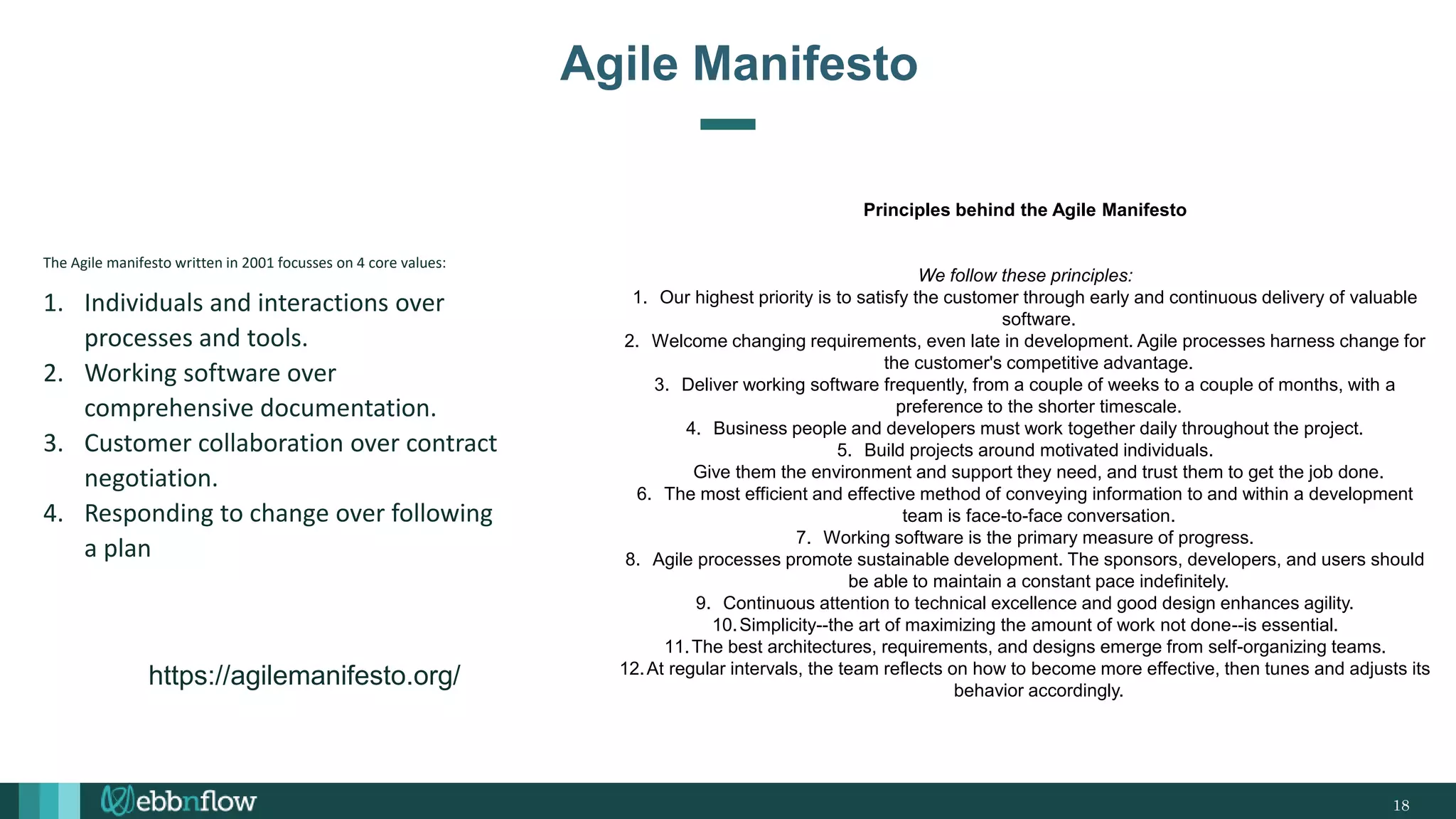
The Agile manifesto written in 2001 focusses on 4 core values:
1. Individuals and interactions over
processes and tools.
2. Working software over
comprehensive documentation.
3. Customer collaboration over contract
negotiation.
4. Responding to change over following
a plan
Principles behind the Agile Manifesto
We follow these principles:
1. Our highest priority is to satisfy the customer through early and continuous delivery of valuable
software.
2. Welcome changing requirements, even late in development. Agile processes harness change for
the customer's competitive advantage.
3. Deliver working software frequently, from a couple of weeks to a couple of months, with a
preference to the shorter timescale.
4. Business people and developers must work together daily throughout the project.
5. Build projects around motivated individuals.
Give them the environment and support they need, and trust them to get the job done.
6. The most efficient and effective method of conveying information to and within a development
team is face-to-face conversation.
7. Working software is the primary measure of progress.
8. Agile processes promote sustainable development. The sponsors, developers, and users should
be able to maintain a constant pace indefinitely.
9. Continuous attention to technical excellence and good design enhances agility.
10.Simplicity--the art of maximizing the amount of work not done--is essential.
11.The best architectures, requirements, and designs emerge from self-organizing teams.
12.At regular intervals, the team reflects on how to become more effective, then tunes and adjusts its
behavior accordingly.
https://agilemanifesto.org/
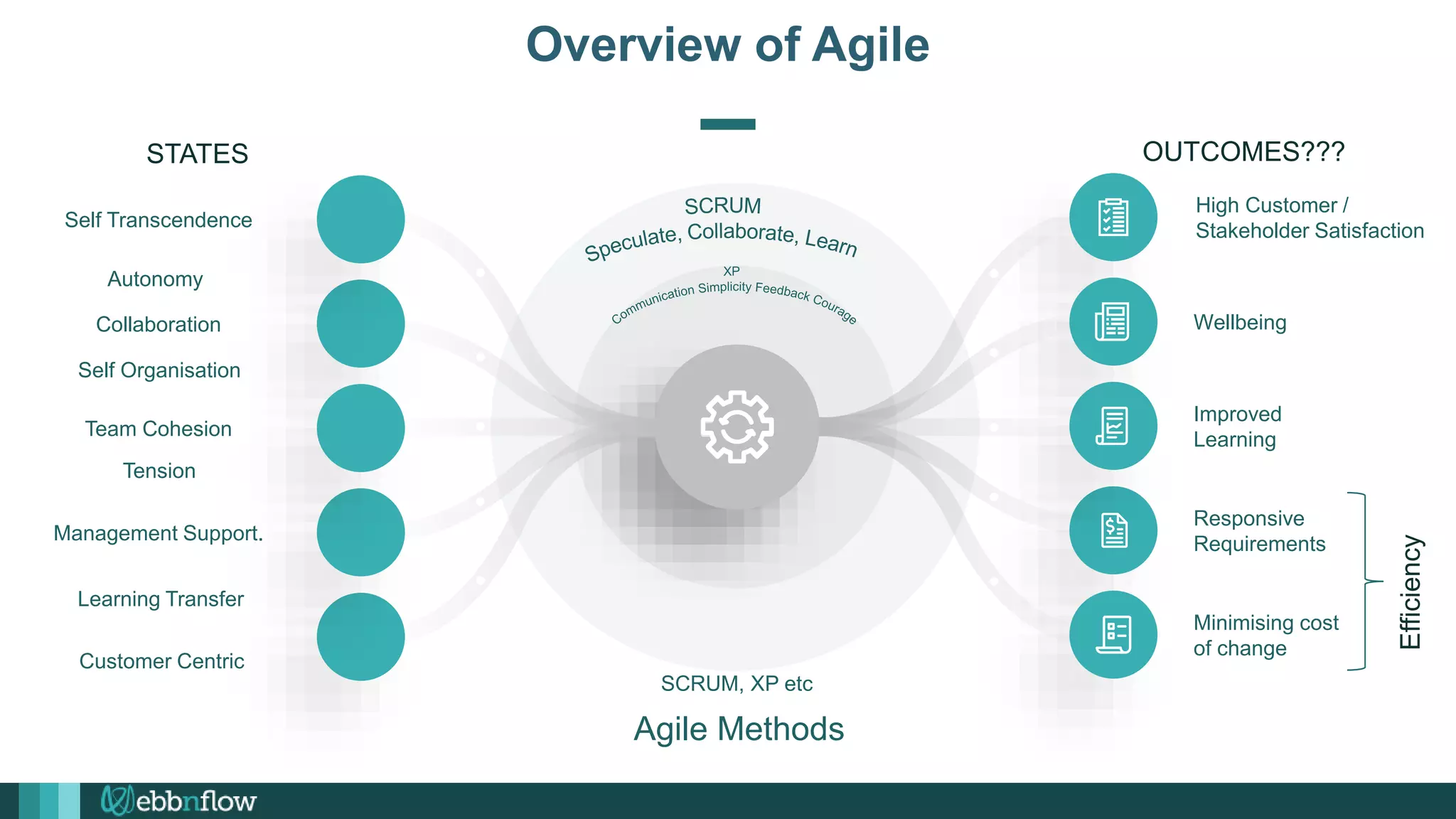
Wellbeing
Improved
Learning
Responsive
Requirements
Minimising cost
of change
SCRUM, XP etc
Agile Methods
Learning Transfer
Management Support.
Team Cohesion
Collaboration
Self Transcendence
OUTCOMES???
Overview of Agile
Autonomy
Tension
Self Organisation
High Customer /
Stakeholder Satisfaction
STATES
Customer Centric
Efficiency
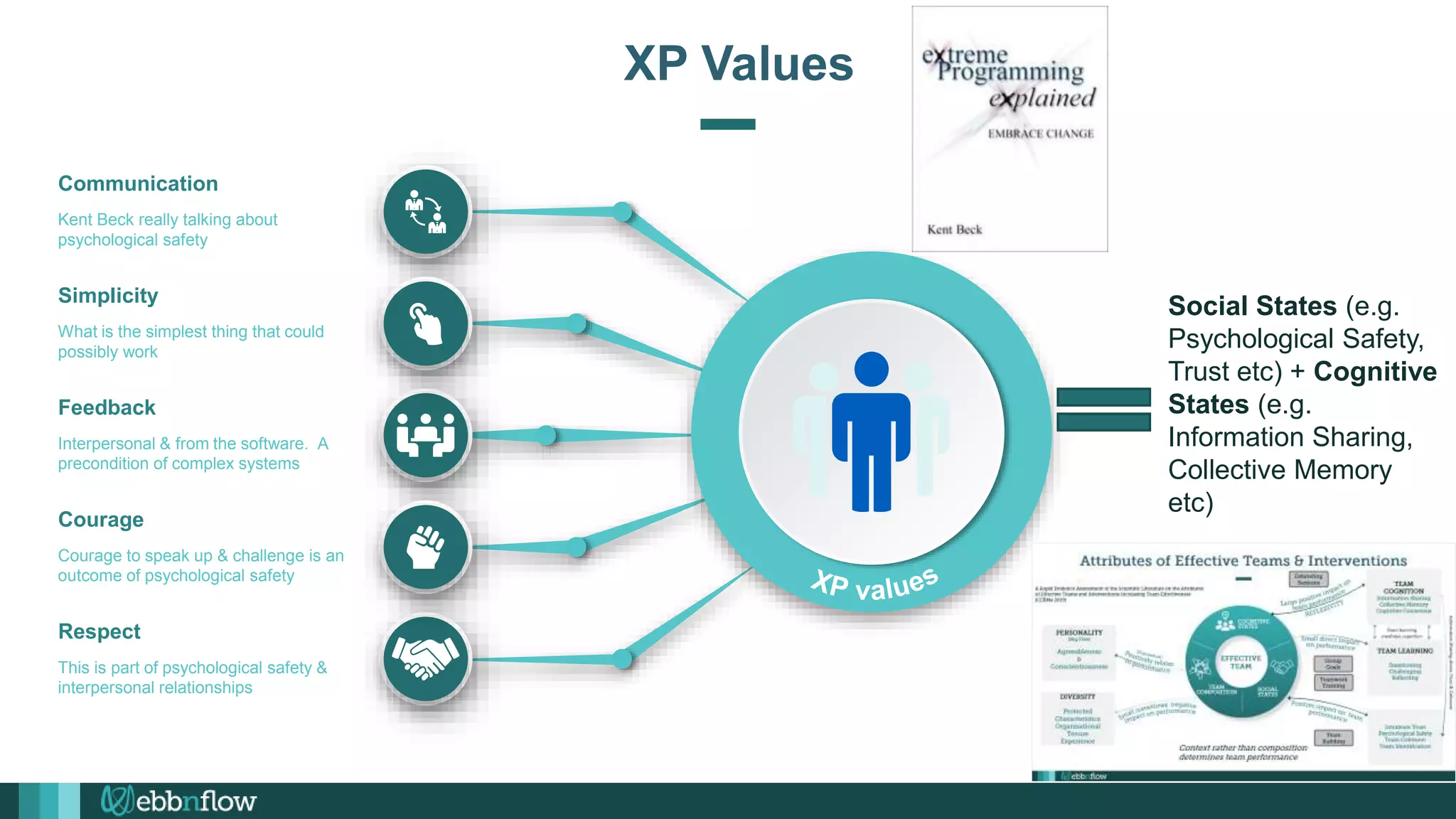
Kent Beck really talking about
psychological safety
Communication
What is the simplest thing that could
possibly work
Simplicity
Interpersonal & from the software. A
precondition of complex systems
Feedback
Courage to speak up & challenge is an
outcome of psychological safety
Courage
This is part of psychological safety &
interpersonal relationships
Respect
XP Values
Social States (e.g.
Psychological Safety,
Trust etc) + Cognitive
States (e.g.
Information Sharing,
Collective Memory
etc)
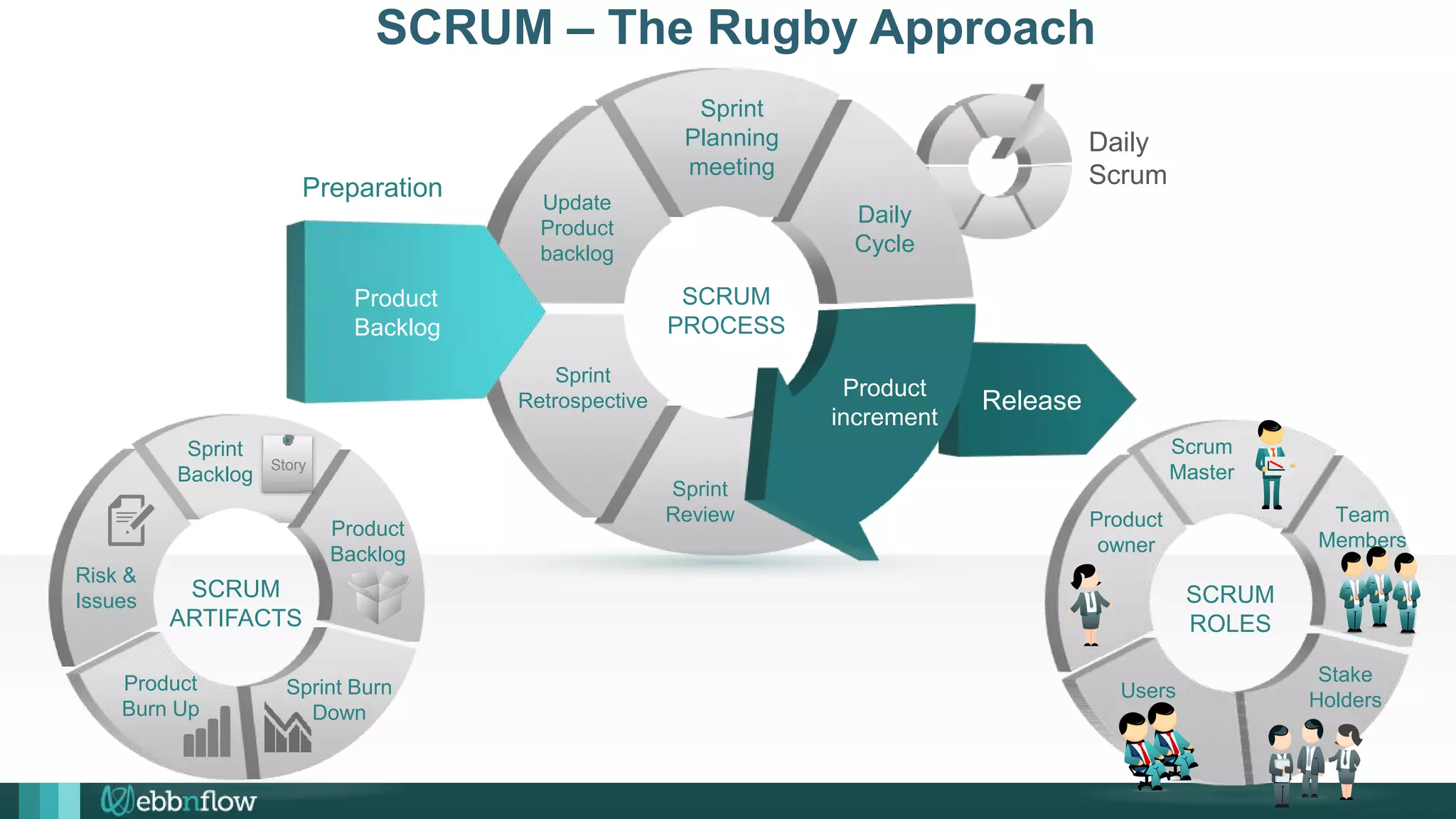
Release
Daily
Scrum
Daily
Cycle
Preparation
Sprint
Review
Sprint
Retrospective
Update
Product
backlog
SCRUM
PROCESS
Product
Backlog
Sprint
Planning
meeting
Daily
Cycle
Product
increment
SCRUM
ARTIFACTS
Risk &
Issues
Sprint
Backlog
Product
Backlog
Sprint Burn
Down
Product
Burn Up
Story
SCRUM
ROLES
Product
owner
Scrum
Master
Stake
Holders
Users
Team
Members
SCRUM – The Rugby Approach
22
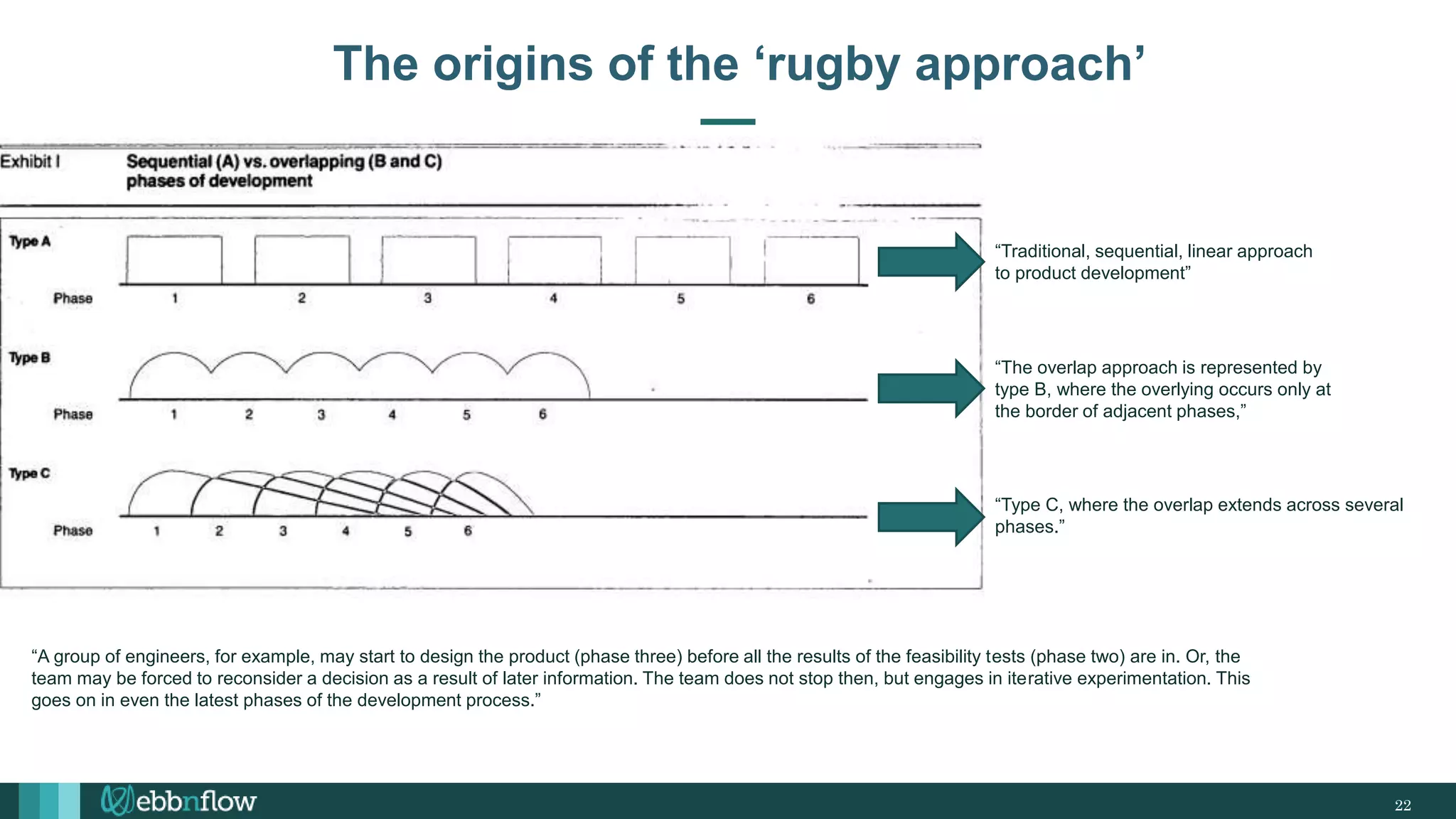
The origins of the ‘rugby approach’
“A group of engineers, for example, may start to design the product (phase three) before all the results of the feasibility tests (phase two) are in. Or, the
team may be forced to reconsider a decision as a result of later information. The team does not stop then, but engages in iterative experimentation. This
goes on in even the latest phases of the development process.”
“Traditional, sequential, linear approach
to product development”
“The overlap approach is represented by
type B, where the overlying occurs only at
the border of adjacent phases,”
“Type C, where the overlap extends across several
phases.”
23
Does Agile work?
4
24
2008 Systematic Review of Agile
Dybå, T., & Dingsøyr, T. (2008). Empirical studies of agile software development: A systematic review. Information and software technology, 50(9-10), 833-859.
Identified 36 studies on Agile Software
development
76% on XP, 15% General Agility, 3%
SCRUM & 3% Lean
Rigour. Has a thorough and appropriate
approach been applied to key research
methods in the study?
Credibility. Are the findings well-
presented and meaningful?
Relevance. How useful are the findings
to the software industry and the research
community?
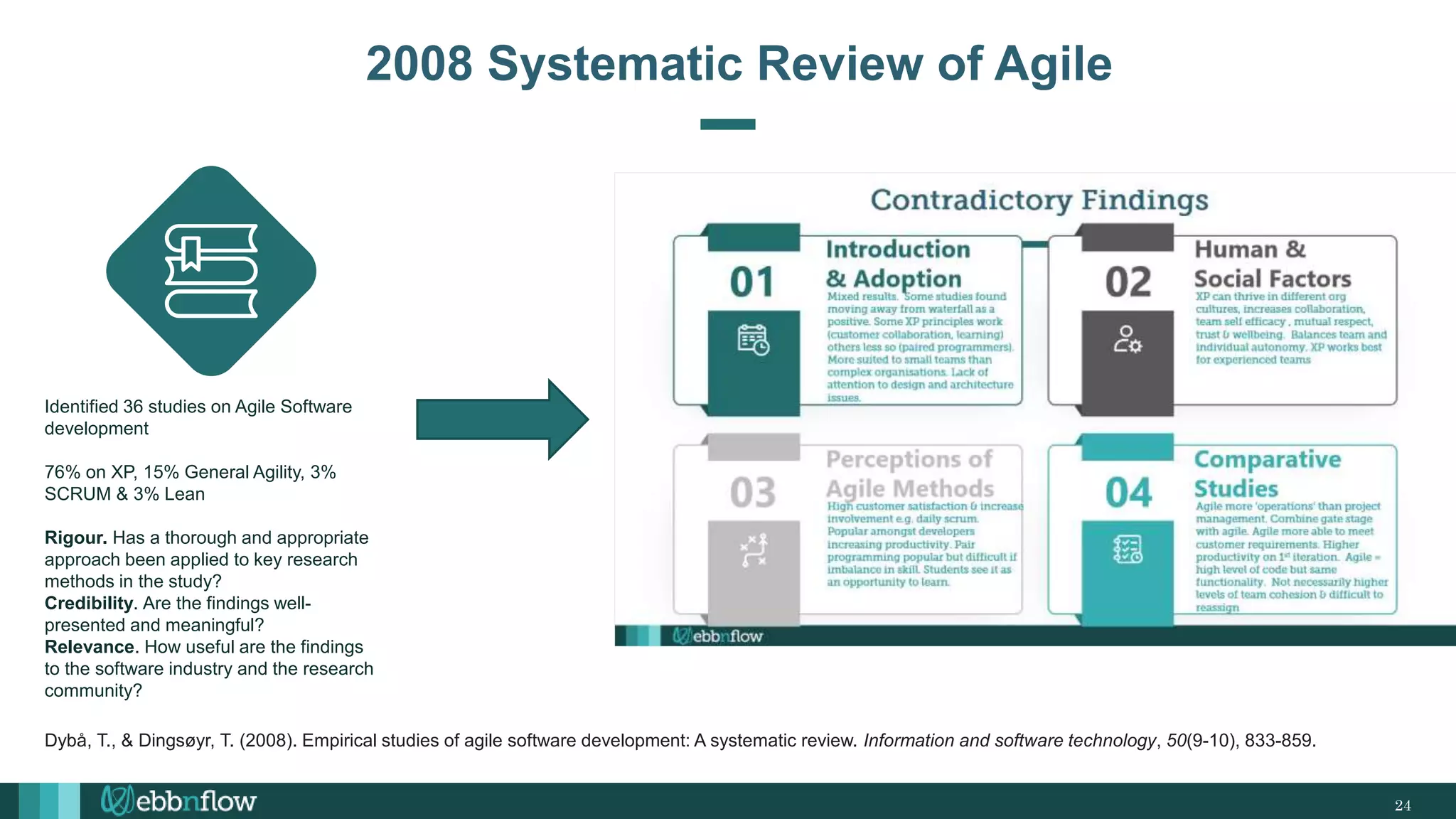
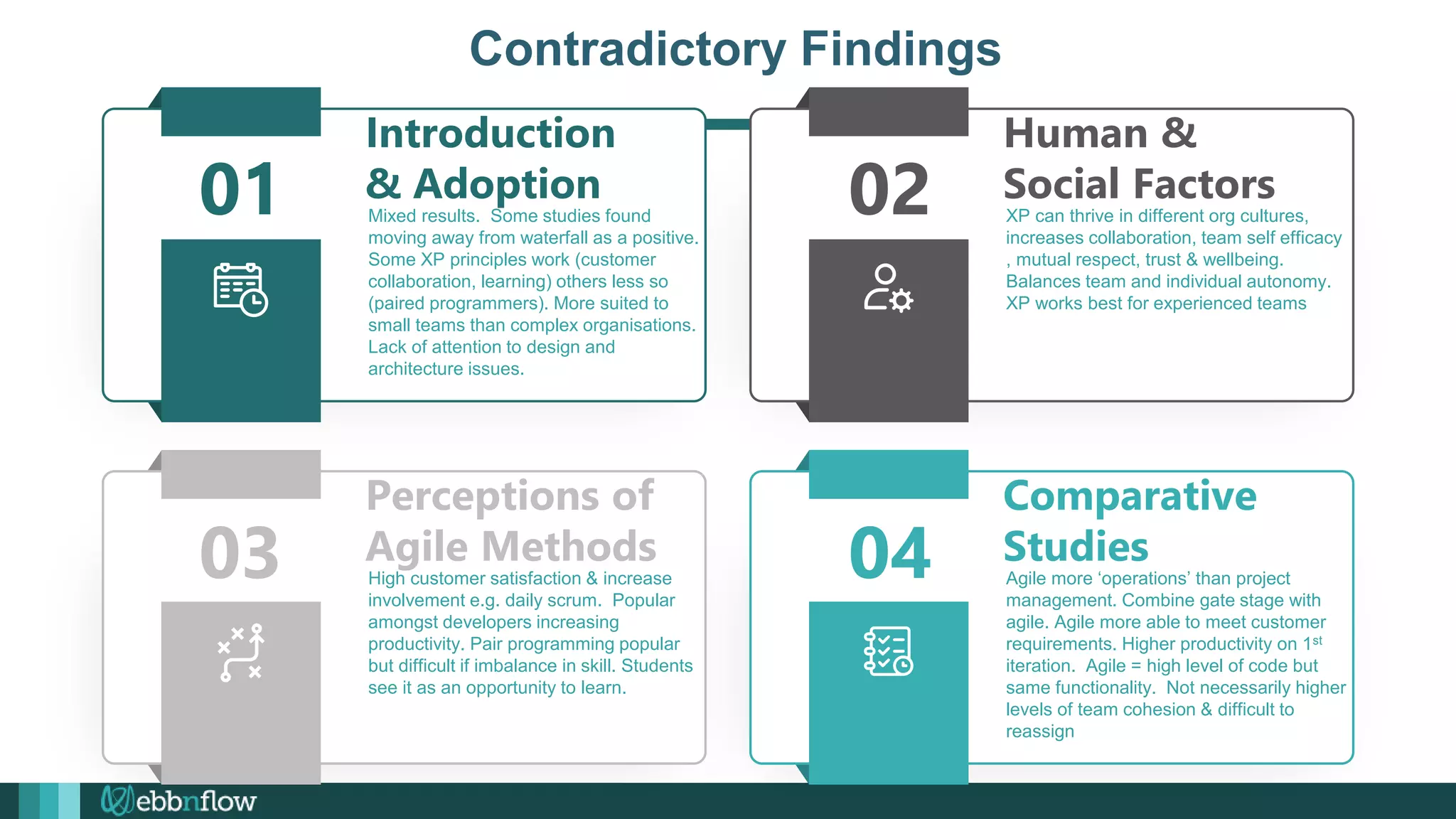
Mixed results. Some studies found
moving away from waterfall as a positive.
Some XP principles work (customer
collaboration, learning) others less so
(paired programmers). More suited to
small teams than complex organisations.
Lack of attention to design and
architecture issues.
Introduction
& Adoption
01 02 XP can thrive in different org cultures,
increases collaboration, team self efficacy
, mutual respect, trust & wellbeing.
Balances team and individual autonomy.
XP works best for experienced teams
Human &
Social Factors
High customer satisfaction & increase
involvement e.g. daily scrum. Popular
amongst developers increasing
productivity. Pair programming popular
but difficult if imbalance in skill. Students
see it as an opportunity to learn.
Perceptions of
Agile Methods
Agile more ‘operations’ than project
management. Combine gate stage with
agile. Agile more able to meet customer
requirements. Higher productivity on 1st
iteration. Agile = high level of code but
same functionality. Not necessarily higher
levels of team cohesion & difficult to
reassign
Comparative
Studies
03 04
Contradictory Findings
26
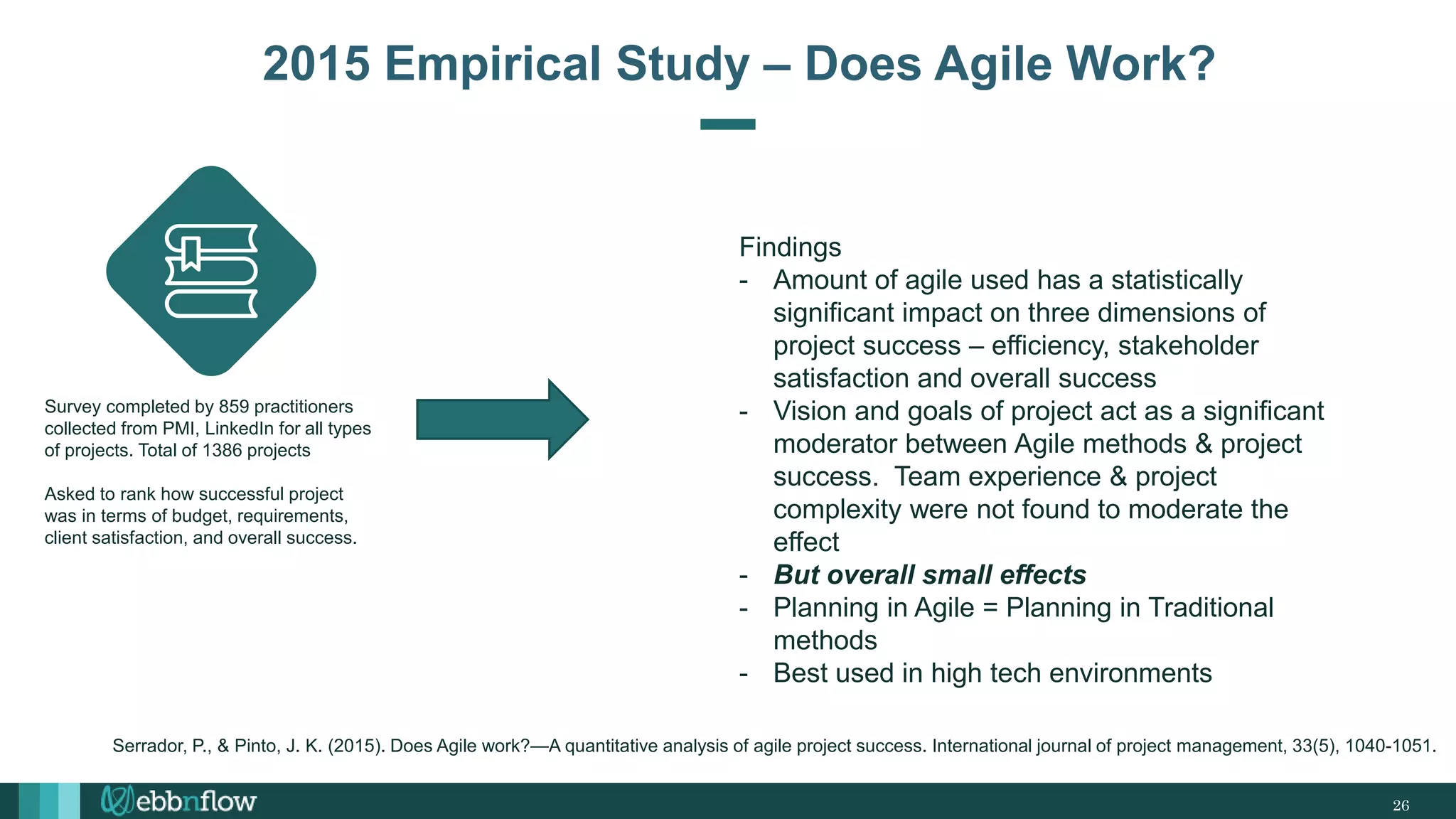
2015 Empirical Study – Does Agile Work?
Serrador, P., & Pinto, J. K. (2015). Does Agile work?—A quantitative analysis of agile project success. International journal of project management, 33(5), 1040-1051.
Survey completed by 859 practitioners
collected from PMI, LinkedIn for all types
of projects. Total of 1386 projects
Asked to rank how successful project
was in terms of budget, requirements,
client satisfaction, and overall success.
Findings
- Amount of agile used has a statistically
significant impact on three dimensions of
project success – efficiency, stakeholder
satisfaction and overall success
- Vision and goals of project act as a significant
moderator between Agile methods & project
success. Team experience & project
complexity were not found to moderate the
effect
- But overall small effects
- Planning in Agile = Planning in Traditional
methods
- Best used in high tech environments
27
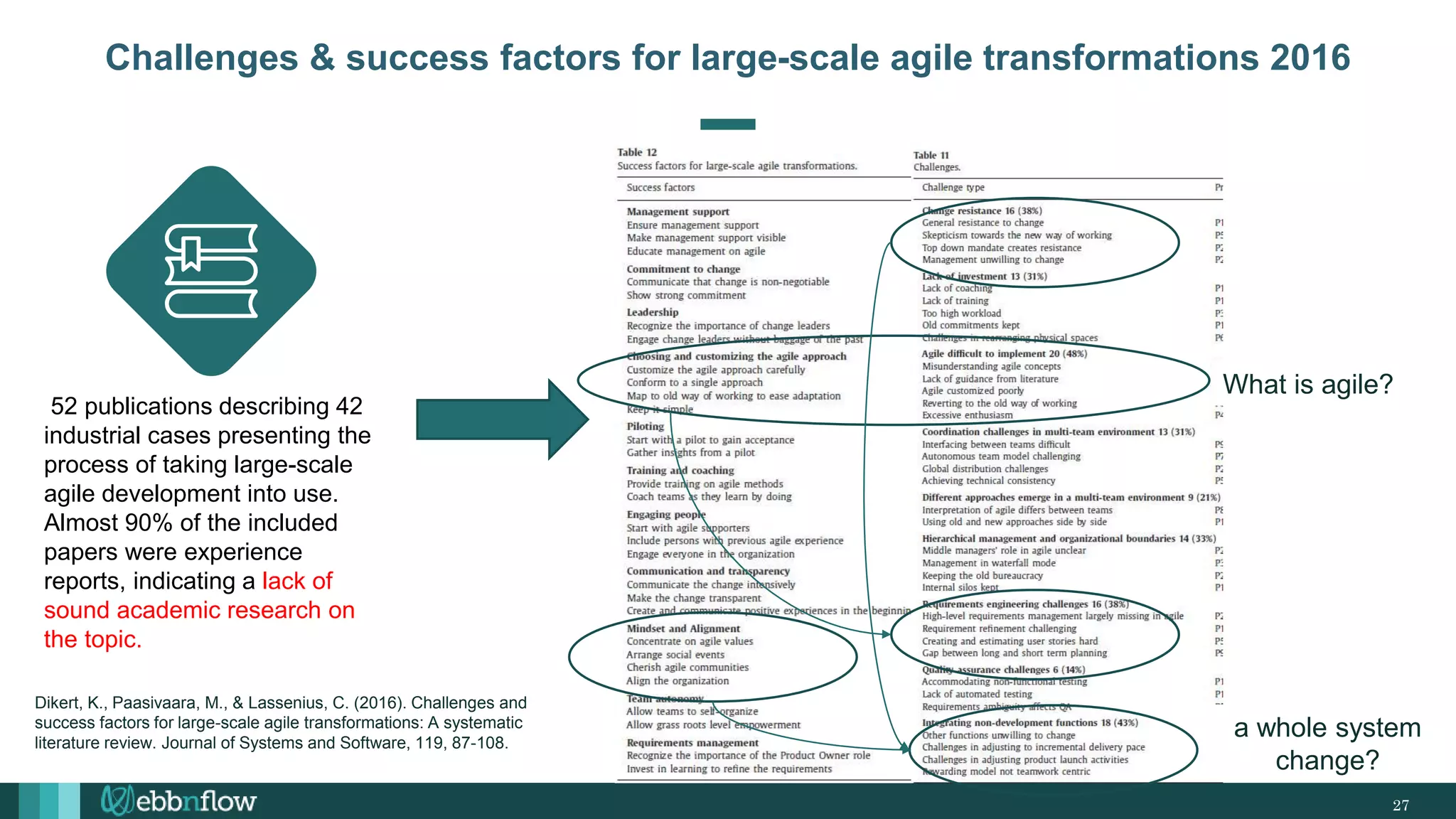
Challenges & success factors for large-scale agile transformations 2016
52 publications describing 42
industrial cases presenting the
process of taking large-scale
agile development into use.
Almost 90% of the included
papers were experience
reports, indicating a lack of
sound academic research on
the topic.
What is agile?
a whole system
change?
Dikert, K., Paasivaara, M., & Lassenius, C. (2016). Challenges and
success factors for large-scale agile transformations: A systematic
literature review. Journal of Systems and Software, 119, 87-108.
28
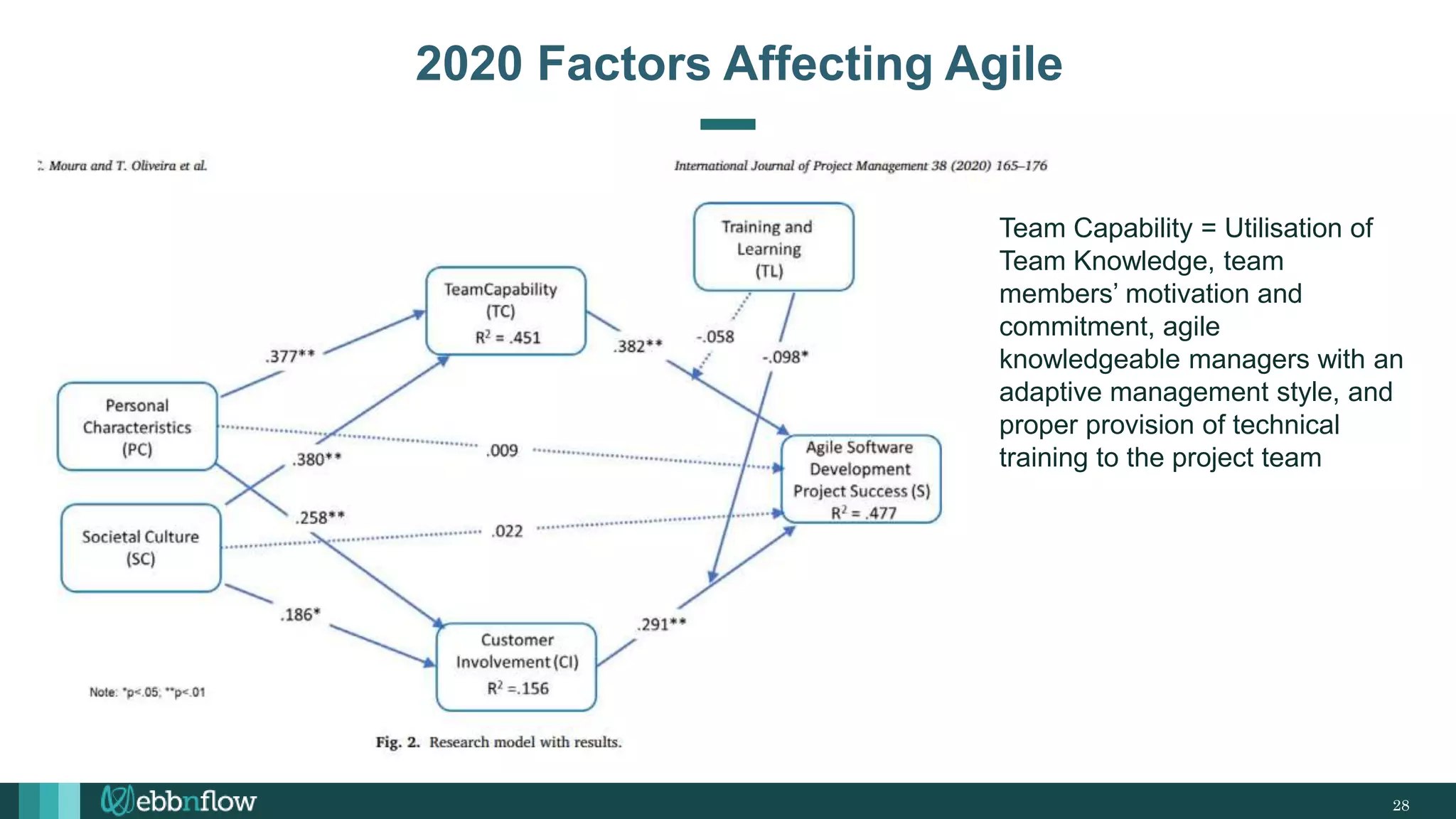
2020 Factors Affecting Agile
Team Capability = Utilisation of
Team Knowledge, team
members’ motivation and
commitment, agile
knowledgeable managers with an
adaptive management style, and
proper provision of technical
training to the project team
29
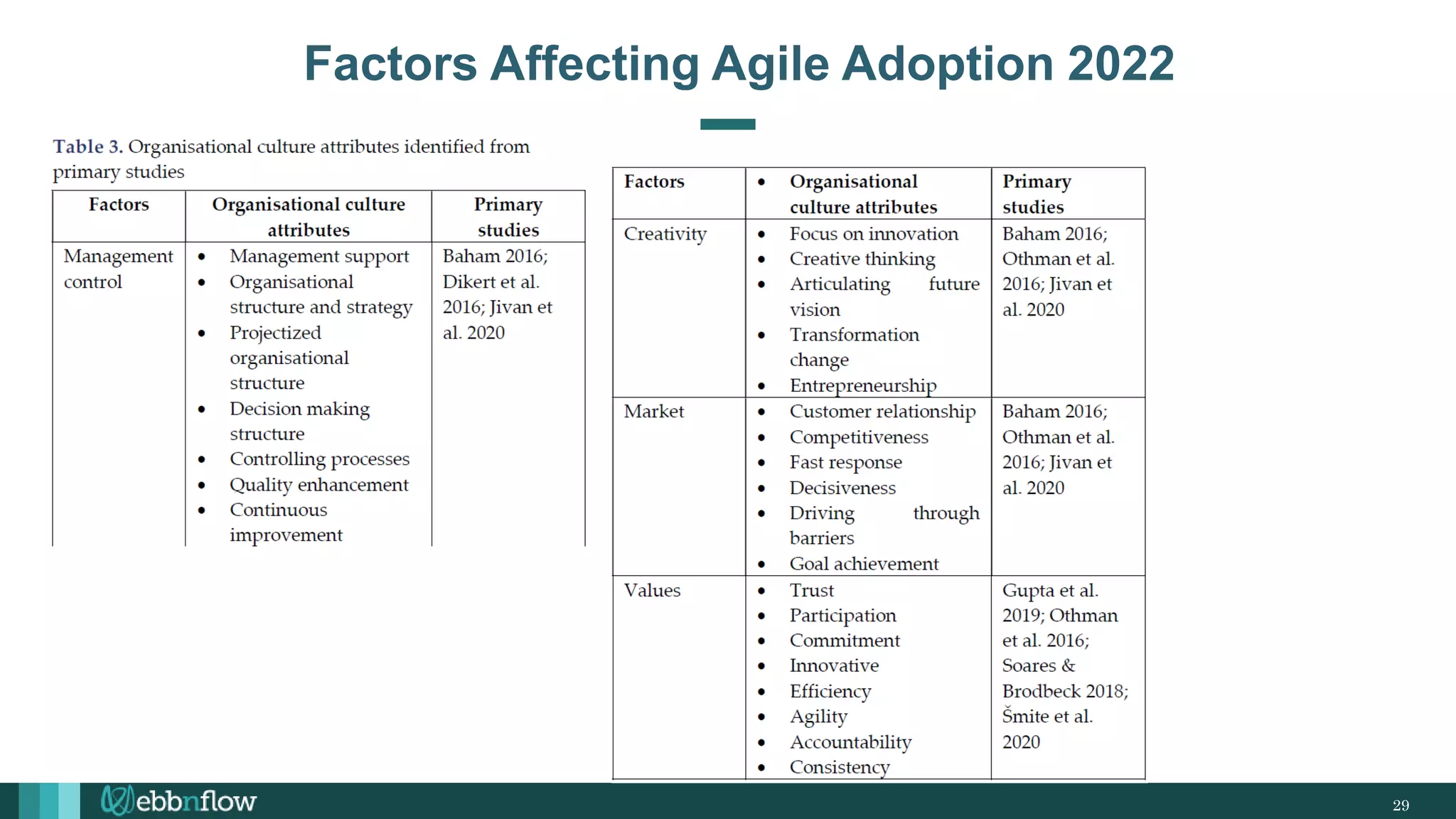
Factors Affecting Agile Adoption 2022
30
A decade of agile methodologies 2012
Most importantly, a majority of agile studies do not seem to be
concerned about any theoretical underpinnings for their research
exploration, which reinforces the general popular perception that
agile research tends to be a-theoretical.
Such theory-driven research enables us to separate true
innovations among agile practices from the reinventions and
remixes of old approaches, thereby helping us adopt such
innovations at a faster rate in the future.
Therefore, we urge agile researchers to embrace a more
theory-based approach in the future when inquiring into these
promising research areas of agile development.
it is important to remember that the field can mature and progress as a
scientific discipline only if efforts are made to provide a robust
theoretical scaffold for the conduct of research on agile
development.
“
“
Dingsøyr, T., Nerur, S., Balijepally, V., & Moe, N. B. (2012). A decade of agile methodologies:
Towards explaining agile software development. Journal of systems and software, 85(6), 1213-
1221.
31
Can we apply Agile to Organisational
Development
5
32
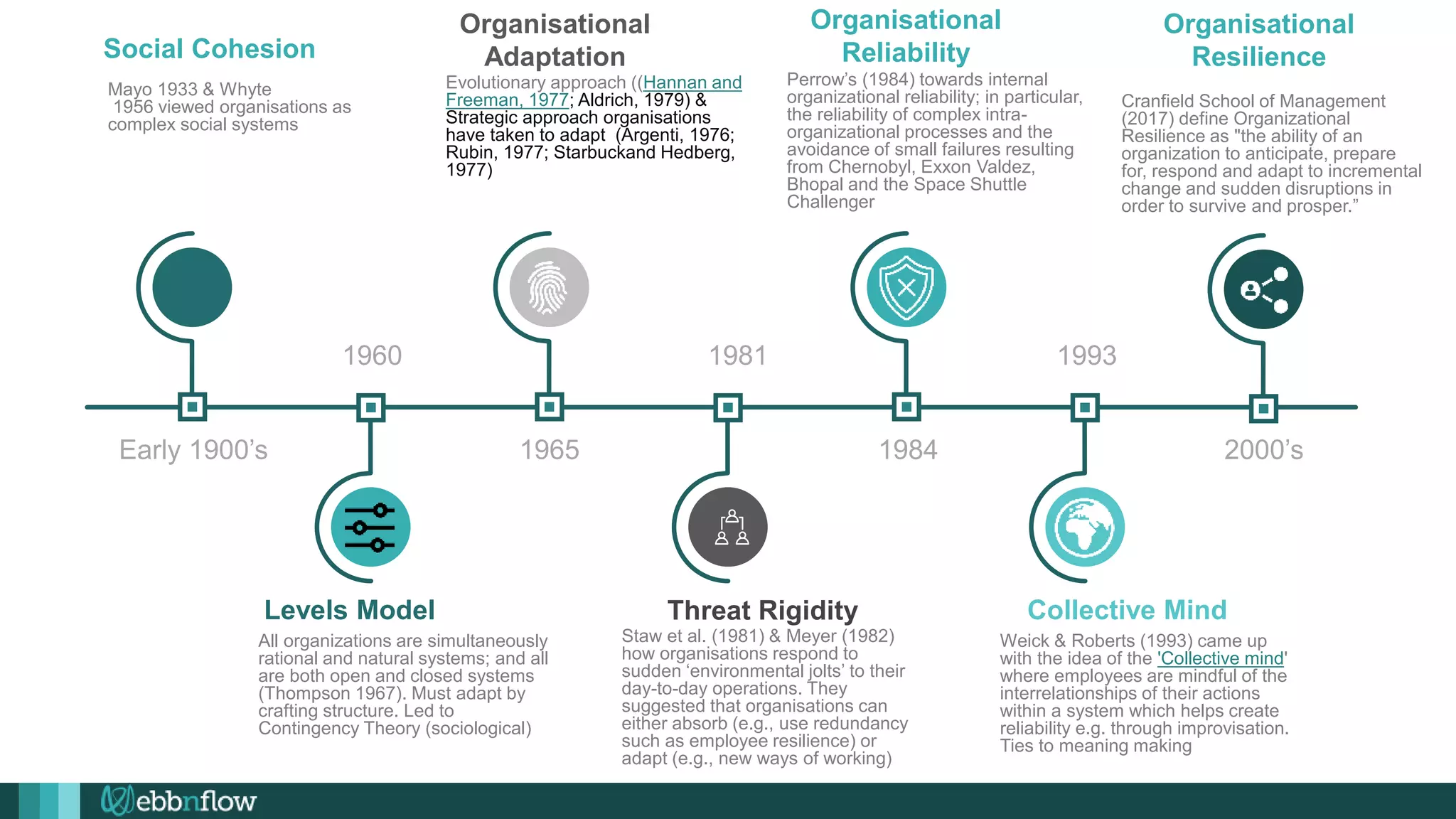
Agile – Old wine new bottles?
Early 1900’s 1965 1984 2000’s
1960 1981 1993
Mayo 1933 & Whyte
1956 viewed organisations as
complex social systems
Staw et al. (1981) & Meyer (1982)
how organisations respond to
sudden ‘environmental jolts’ to their
day-to-day operations. They
suggested that organisations can
either absorb (e.g., use redundancy
such as employee resilience) or
adapt (e.g., new ways of working)
Social Cohesion
Threat Rigidity
Organisational
Reliability
Collective Mind
Weick & Roberts (1993) came up
with the idea of the 'Collective mind'
where employees are mindful of the
interrelationships of their actions
within a system which helps create
reliability e.g. through improvisation.
Ties to meaning making
Perrow’s (1984) towards internal
organizational reliability; in particular,
the reliability of complex intra-
organizational processes and the
avoidance of small failures resulting
from Chernobyl, Exxon Valdez,
Bhopal and the Space Shuttle
Challenger
Evolutionary approach ((Hannan and
Freeman, 1977; Aldrich, 1979) &
Strategic approach organisations
have taken to adapt (Argenti, 1976;
Rubin, 1977; Starbuckand Hedberg,
1977)
Organisational
Adaptation
Levels Model
All organizations are simultaneously
rational and natural systems; and all
are both open and closed systems
(Thompson 1967). Must adapt by
crafting structure. Led to
Contingency Theory (sociological)
Cranfield School of Management
(2017) define Organizational
Resilience as "the ability of an
organization to anticipate, prepare
for, respond and adapt to incremental
change and sudden disruptions in
order to survive and prosper.”
Organisational
Resilience
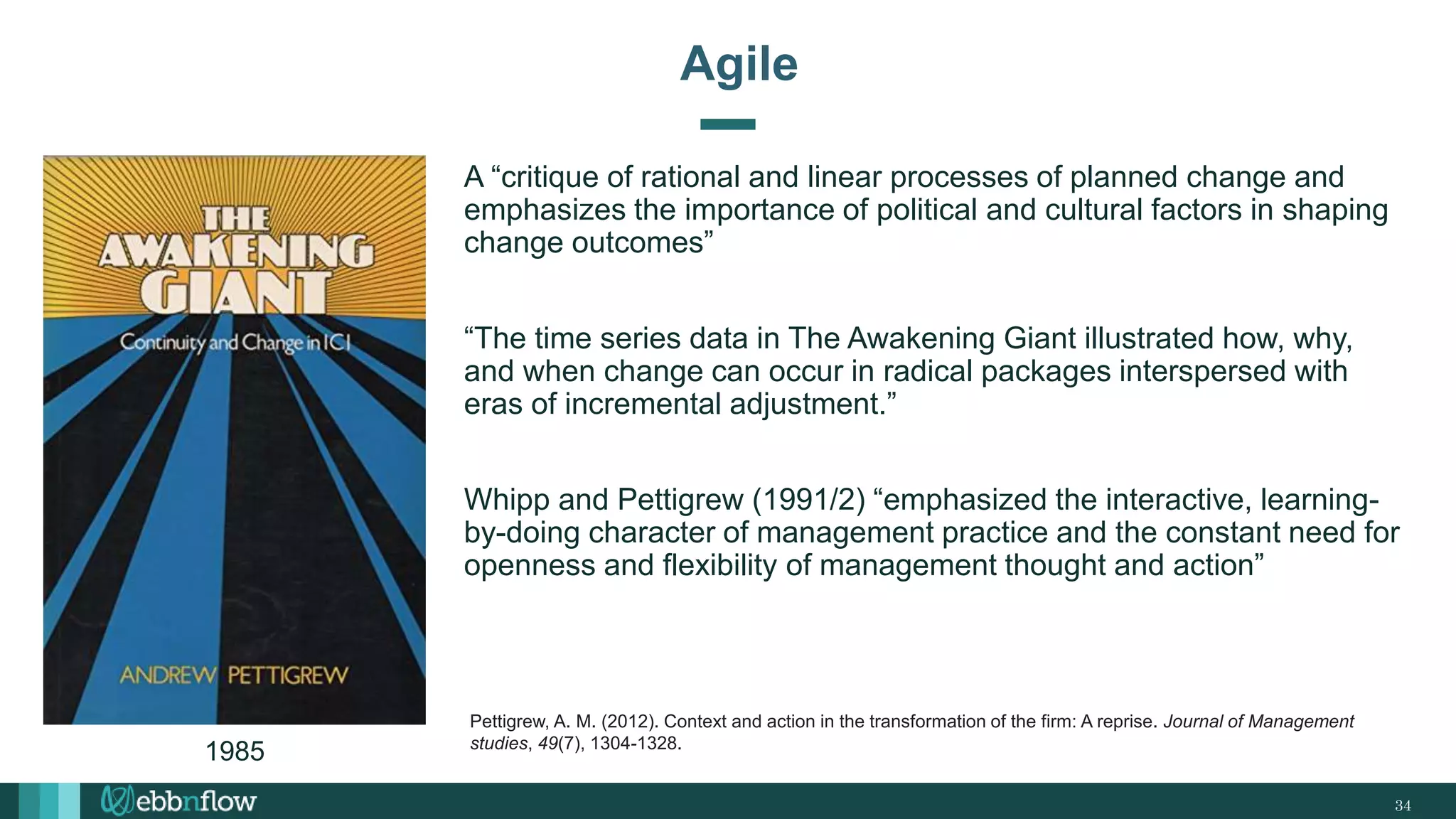
A “critique of rational and linear processes of planned change and
emphasizes the importance of political and cultural factors in shaping
change outcomes”
“The time series data in The Awakening Giant illustrated how, why,
and when change can occur in radical packages interspersed with
eras of incremental adjustment.”
Whipp and Pettigrew (1991/2) “emphasized the interactive, learning-
by-doing character of management practice and the constant need for
openness and flexibility of management thought and action”
34
Agile
Pettigrew, A. M. (2012). Context and action in the transformation of the firm: A reprise. Journal of Management
studies, 49(7), 1304-1328.
1985
35
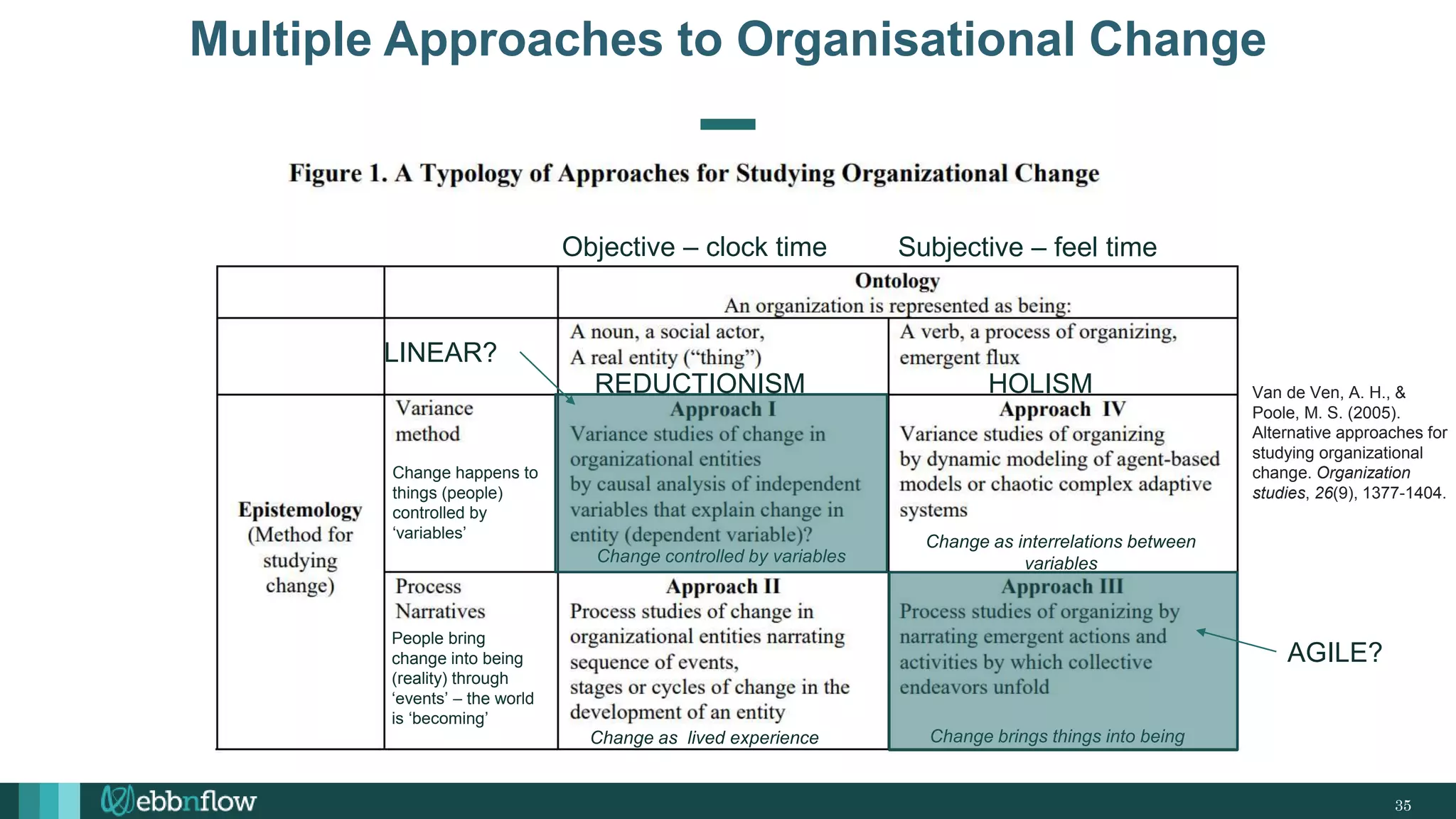
Multiple Approaches to Organisational Change
Subjective – feel time
Objective – clock time
Change happens to
things (people)
controlled by
‘variables’
People bring
change into being
(reality) through
‘events’ – the world
is ‘becoming’
Van de Ven, A. H., &
Poole, M. S. (2005).
Alternative approaches for
studying organizational
change. Organization
studies, 26(9), 1377-1404.
HOLISM
REDUCTIONISM
Change as interrelations between
variables
Change controlled by variables
Change as lived experience Change brings things into being
AGILE?
LINEAR?
36
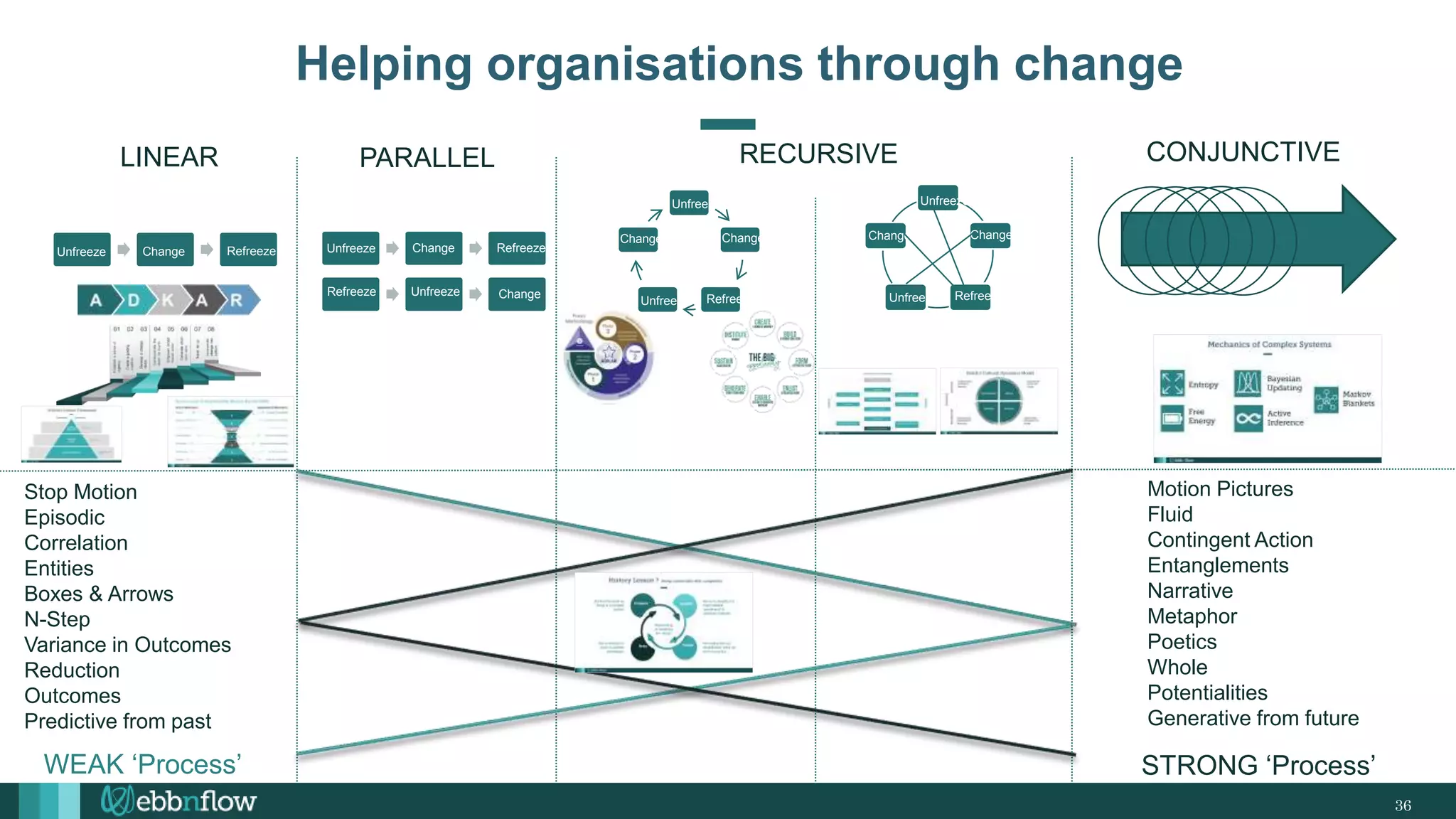
Helping organisations through change
Unfreeze
Unfreeze
Refreeze
Change Unfreeze Refreeze
Change
Change
Refreeze
Unfreeze
Refreeze
Change
Change
Unfreeze
Unfreeze
Refreeze
Change
Change
Unfreeze
Stop Motion
Episodic
Correlation
Entities
Boxes & Arrows
N-Step
Variance in Outcomes
Reduction
Outcomes
Predictive from past
LINEAR PARALLEL RECURSIVE CONJUNCTIVE
Motion Pictures
Fluid
Contingent Action
Entanglements
Narrative
Metaphor
Poetics
Whole
Potentialities
Generative from future
WEAK ‘Process’ STRONG ‘Process’
37
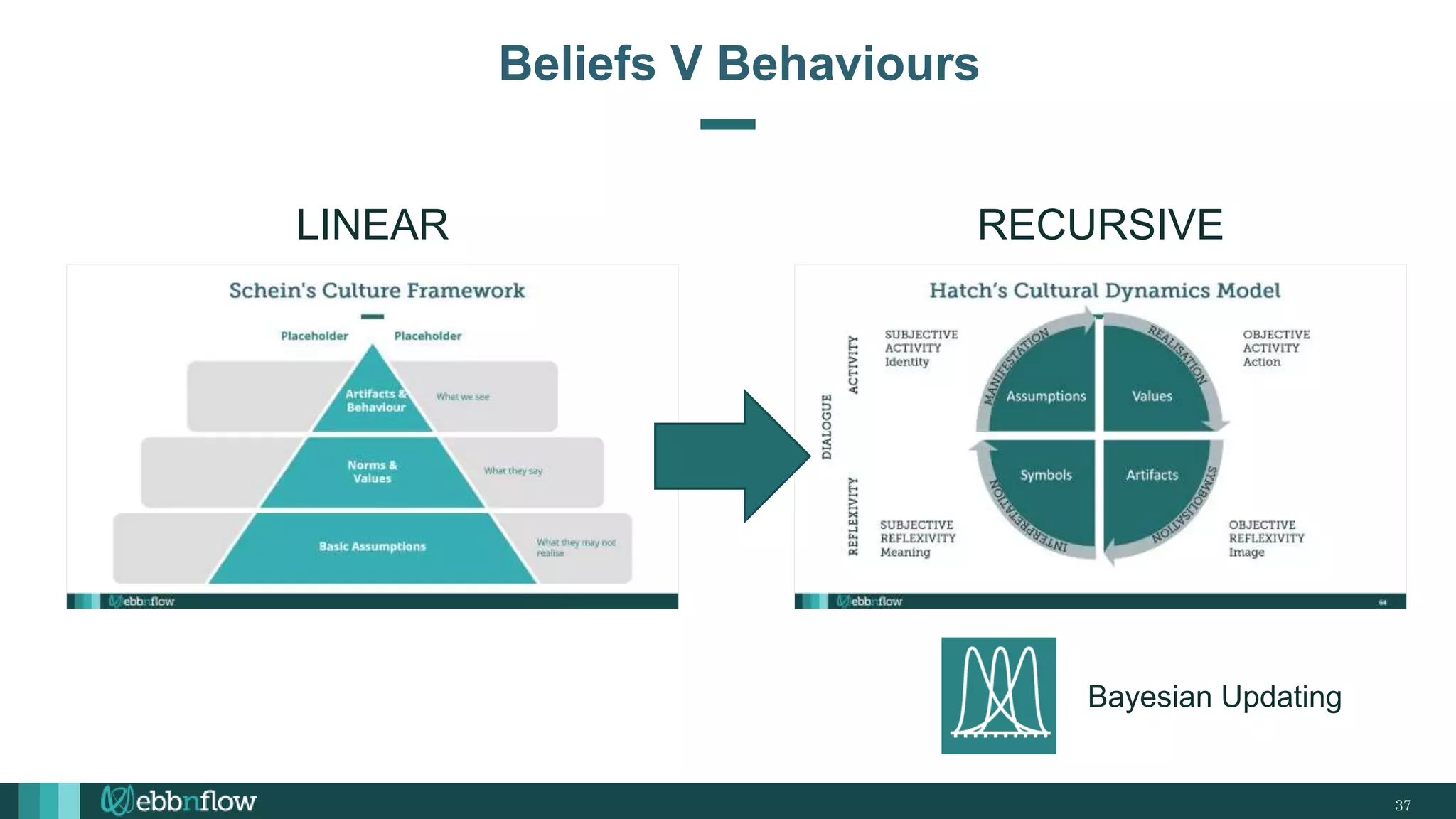
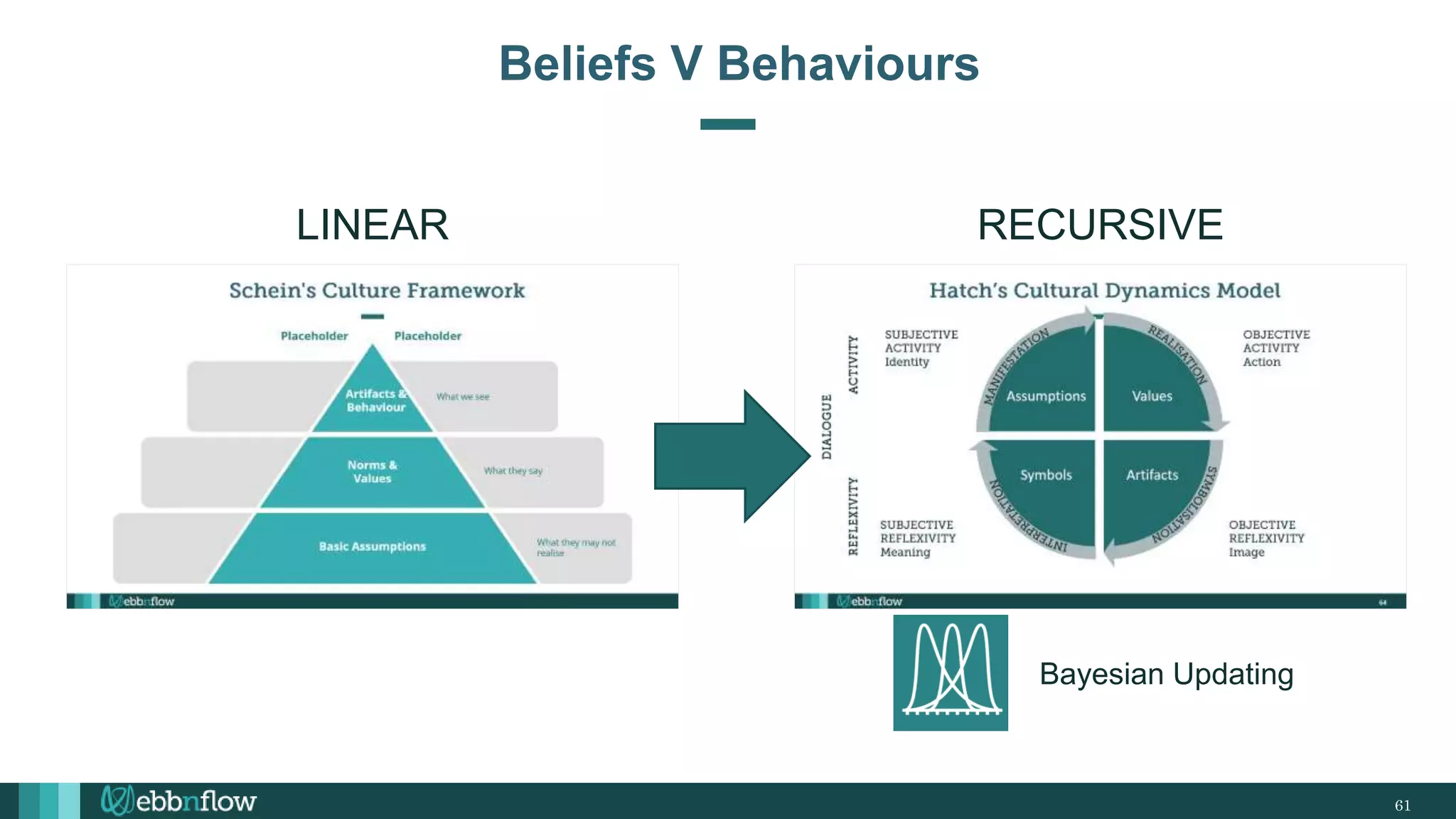
Beliefs V Behaviours
LINEAR RECURSIVE
Bayesian Updating
38
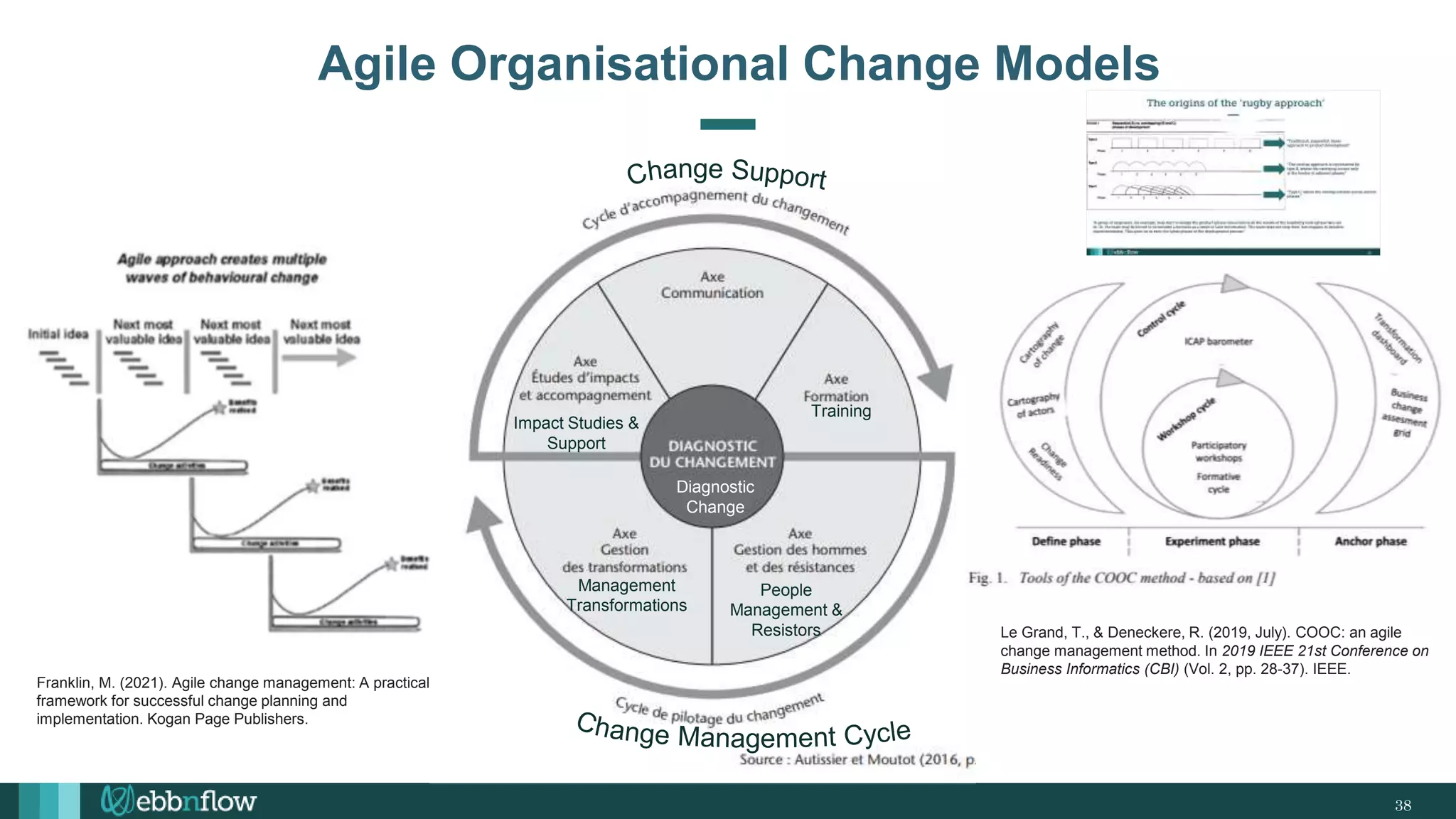
Agile Organisational Change Models
Training
Management
Transformations
People
Management &
Resistors
Impact Studies &
Support
Diagnostic
Change
Le Grand, T., & Deneckere, R. (2019, July). COOC: an agile
change management method. In 2019 IEEE 21st Conference on
Business Informatics (CBI) (Vol. 2, pp. 28-37). IEEE.
Franklin, M. (2021). Agile change management: A practical
framework for successful change planning and
implementation. Kogan Page Publishers.
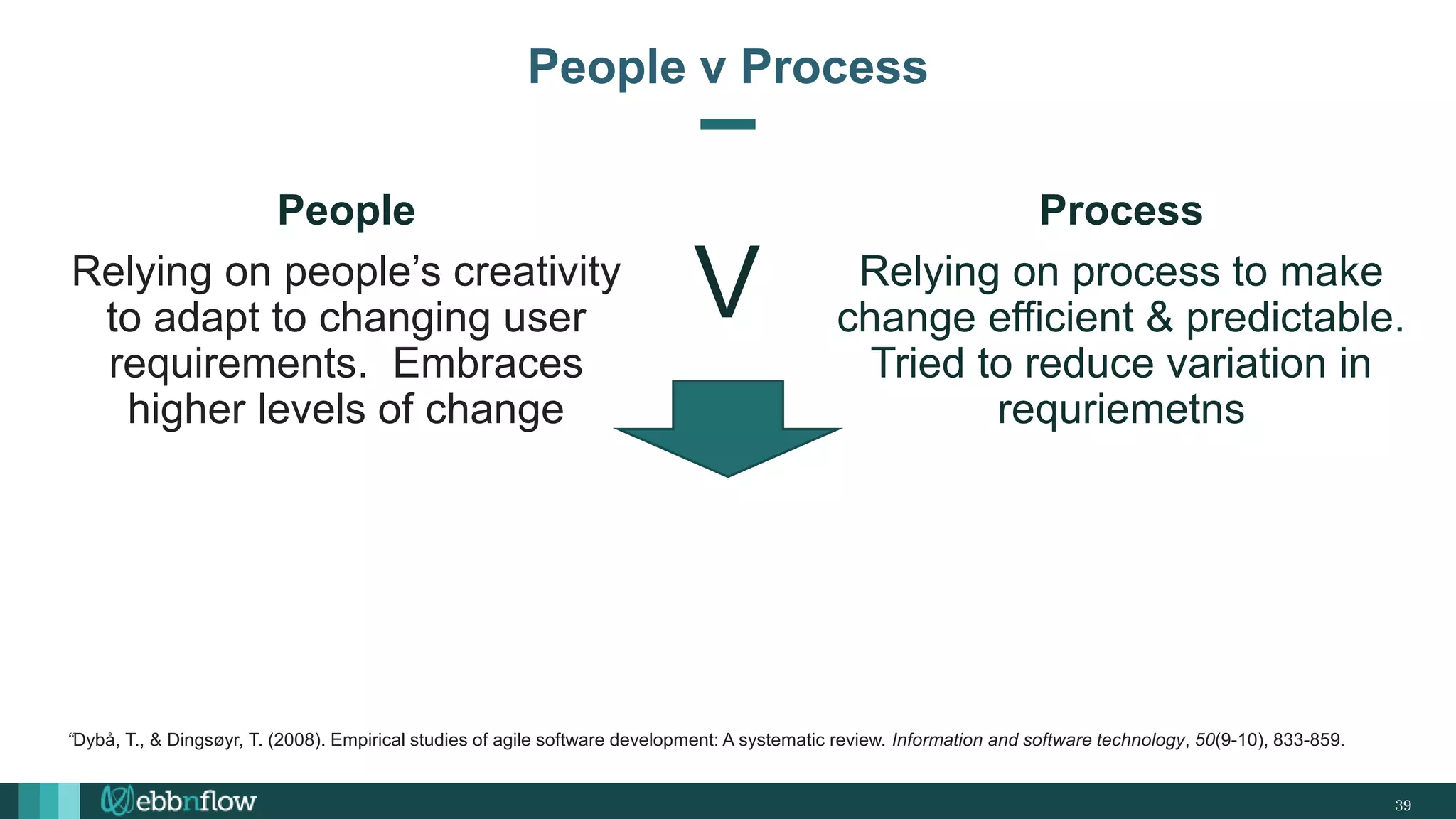
People
Relying on people’s creativity
to adapt to changing user
requirements. Embraces
higher levels of change
39
People v Process
Process
Relying on process to make
change efficient & predictable.
Tried to reduce variation in
requriemetns
V
“Dybå, T., & Dingsøyr, T. (2008). Empirical studies of agile software development: A systematic review. Information and software technology, 50(9-10), 833-859.
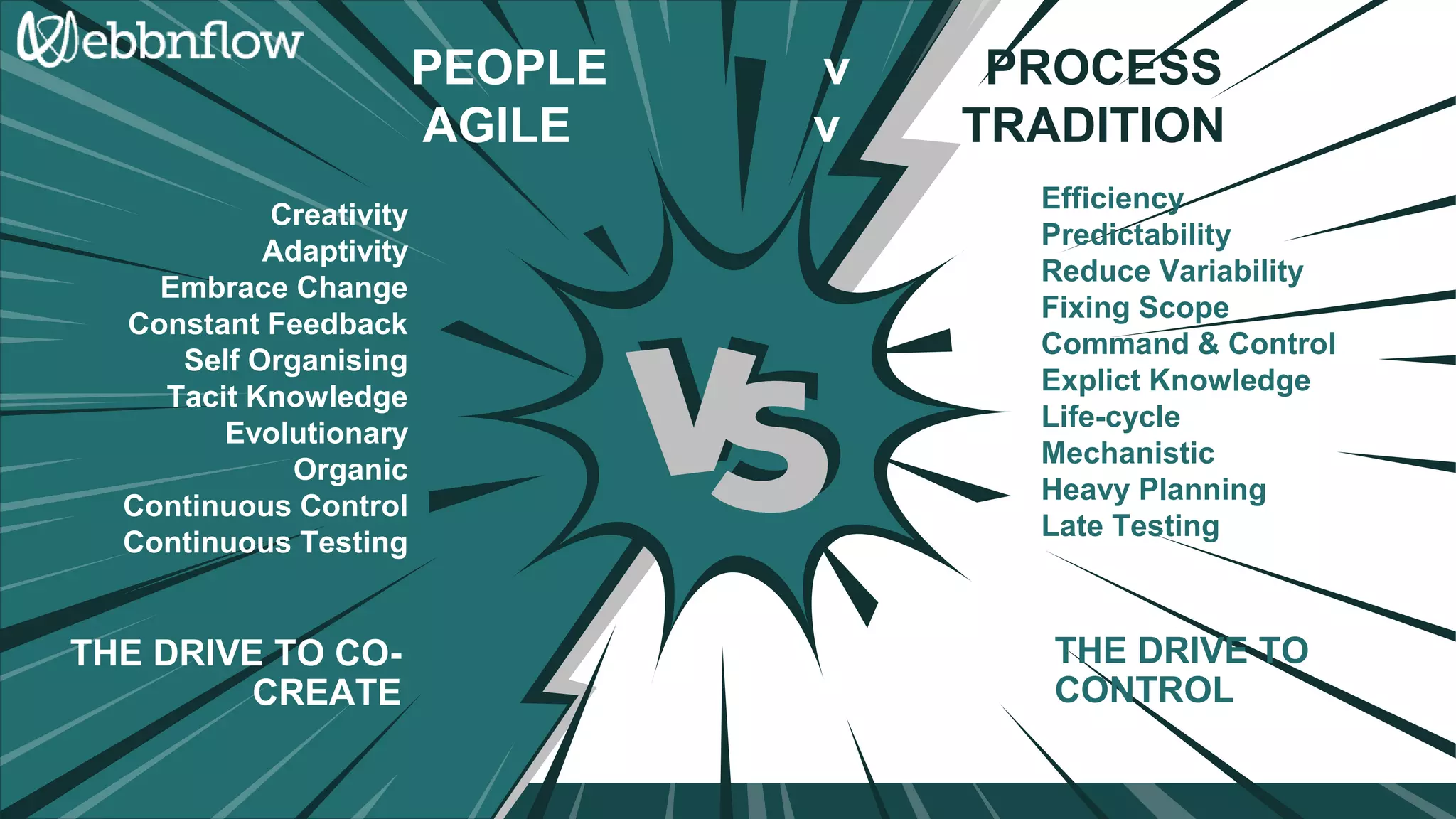
THE DRIVE TO
CONTROL
Efficiency
Predictability
Reduce Variability
Fixing Scope
Command & Control
Explict Knowledge
Life-cycle
Mechanistic
Heavy Planning
Late Testing
THE DRIVE TO CO-
CREATE
Creativity
Adaptivity
Embrace Change
Constant Feedback
Self Organising
Tacit Knowledge
Evolutionary
Organic
Continuous Control
Continuous Testing
PEOPLE v PROCESS
AGILE v TRADITIONAL
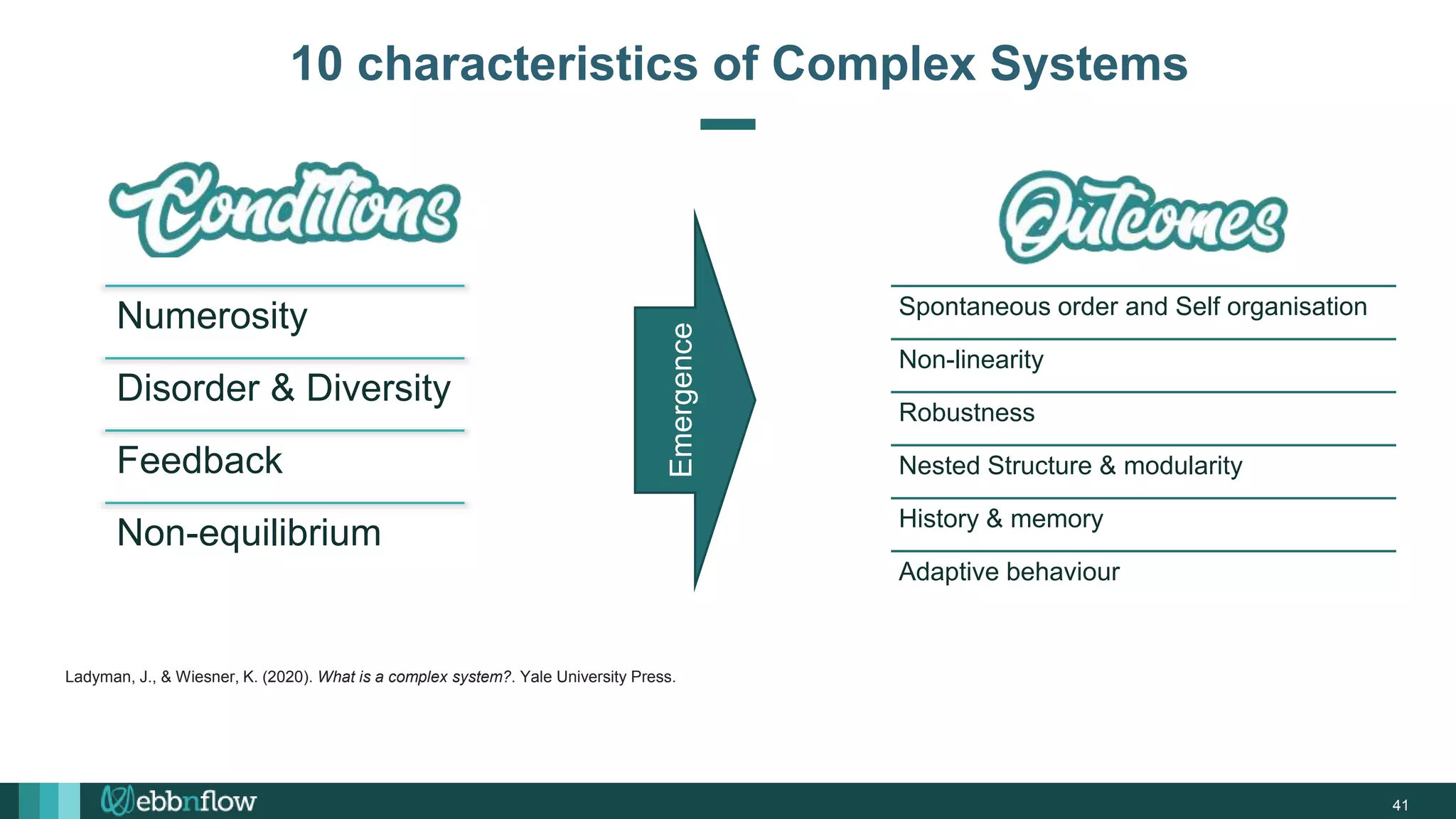
Numerosity
Disorder & Diversity
Feedback
Non-equilibrium
41
10 characteristics of Complex Systems
Spontaneous order and Self organisation
Non-linearity
Robustness
Nested Structure & modularity
History & memory
Adaptive behaviour
Emergence
Ladyman, J., & Wiesner, K. (2020). What is a complex system?. Yale University Press.
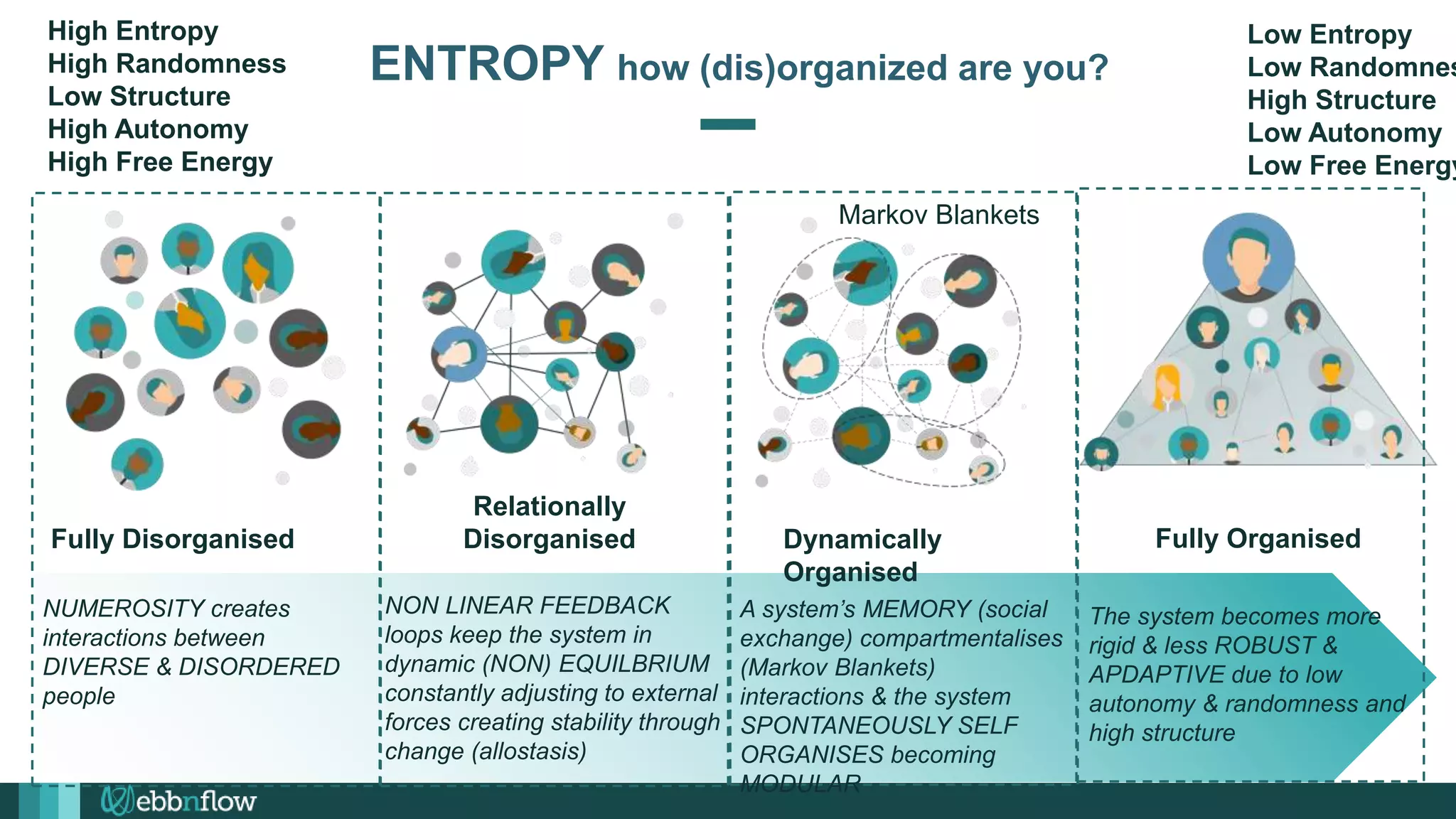
ENTROPY how (dis)organized are you?
Relationally
Disorganised
Fully Disorganised Dynamically
Organised
Fully Organised
High Entropy
High Randomness
Low Structure
High Autonomy
High Free Energy
Low Entropy
Low Randomnes
High Structure
Low Autonomy
Low Free Energy
A system’s MEMORY (social
exchange) compartmentalises
(Markov Blankets)
interactions & the system
SPONTANEOUSLY SELF
ORGANISES becoming
MODULAR
NUMEROSITY creates
interactions between
DIVERSE & DISORDERED
people
NON LINEAR FEEDBACK
loops keep the system in
dynamic (NON) EQUILBRIUM
constantly adjusting to external
forces creating stability through
change (allostasis)
The system becomes more
rigid & less ROBUST &
APDAPTIVE due to low
autonomy & randomness and
high structure
Markov Blankets
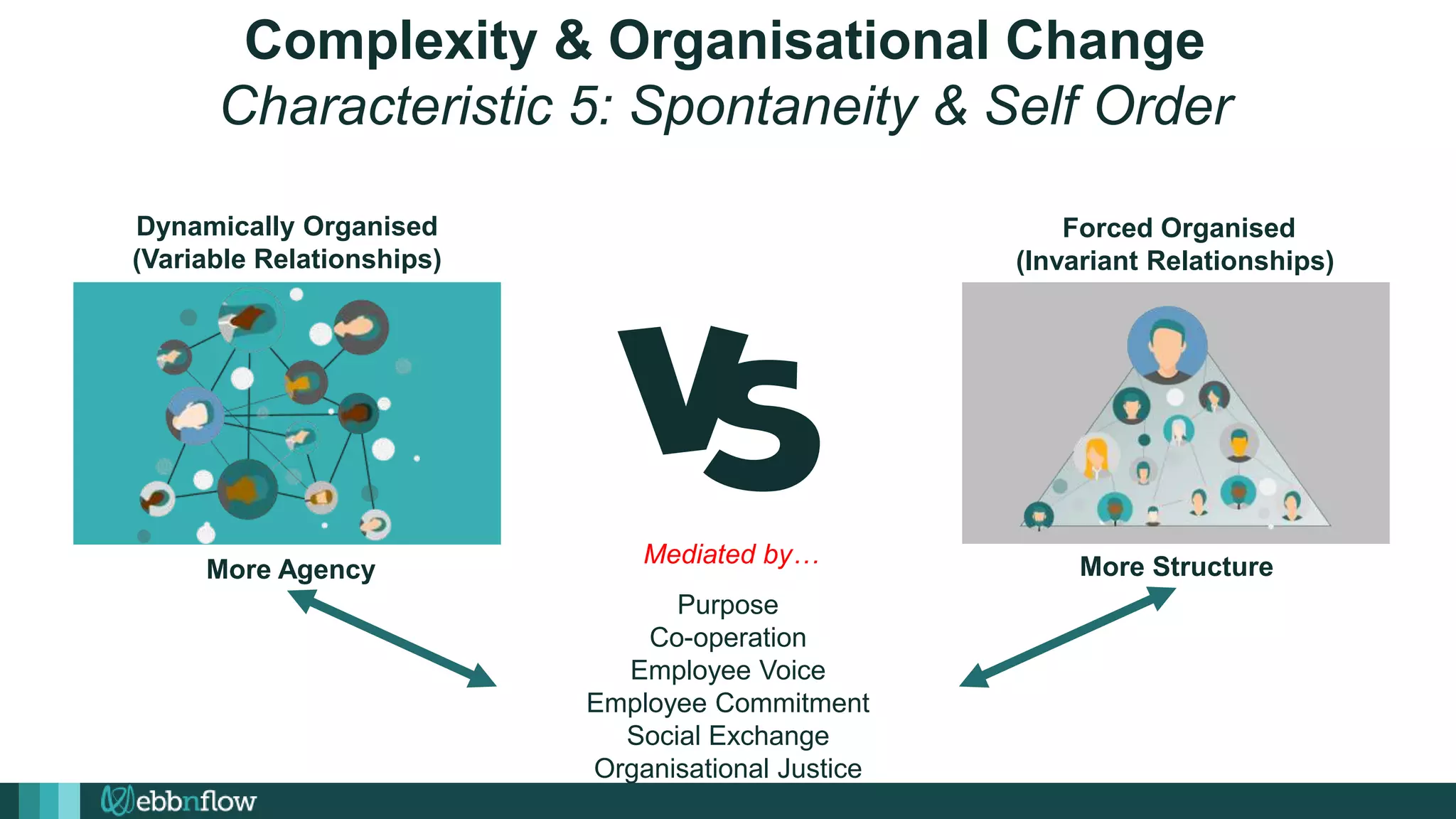
Complexity & Organisational Change
Characteristic 5: Spontaneity & Self Order
Dynamically Organised
(Variable Relationships)
Forced Organised
(Invariant Relationships)
More Structure
More Agency
Purpose
Co-operation
Employee Voice
Employee Commitment
Social Exchange
Organisational Justice
Mediated by…
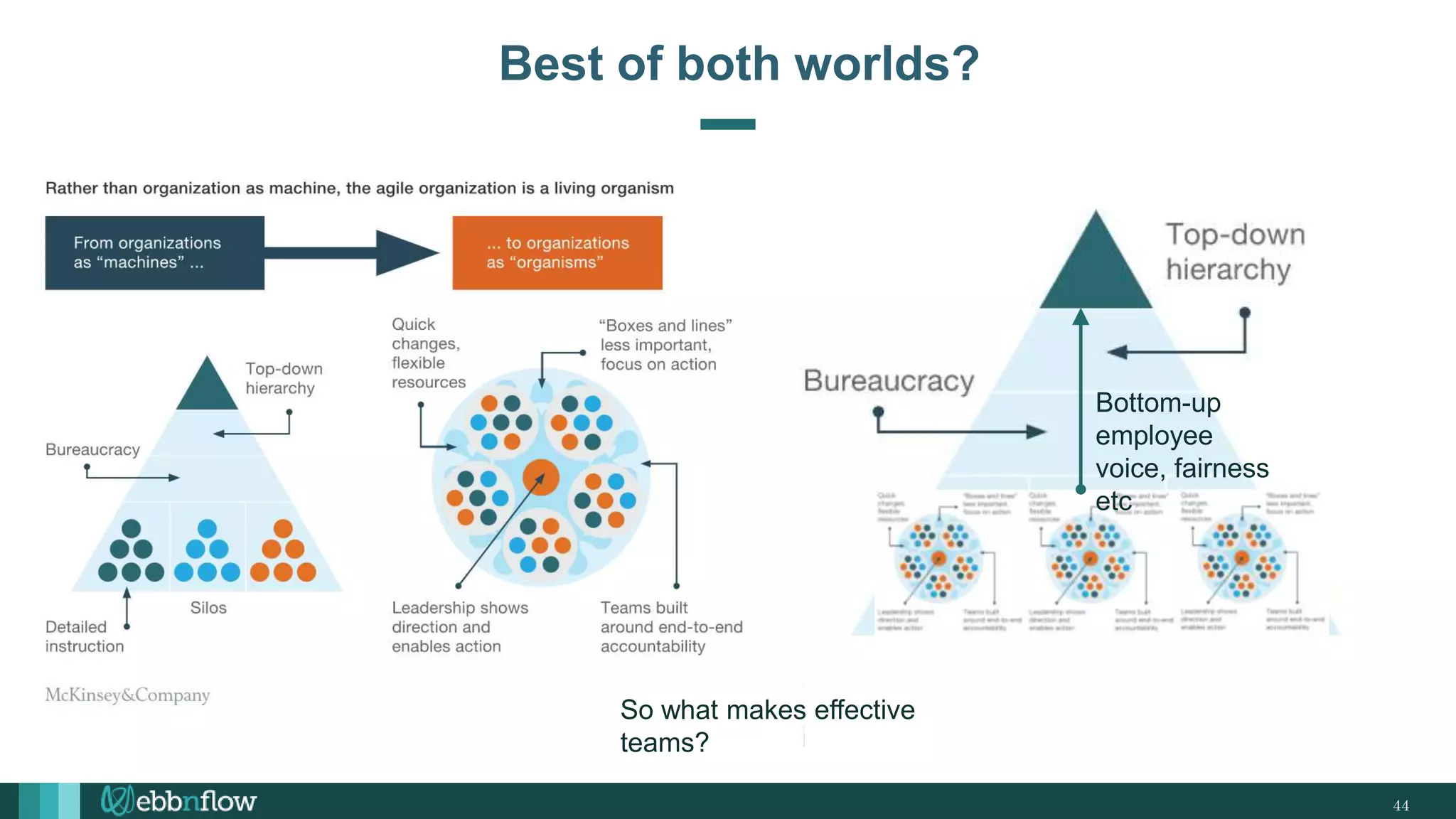
44
Best of both worlds?
Bottom-up
employee
voice, fairness
etc
So what makes effective
teams?
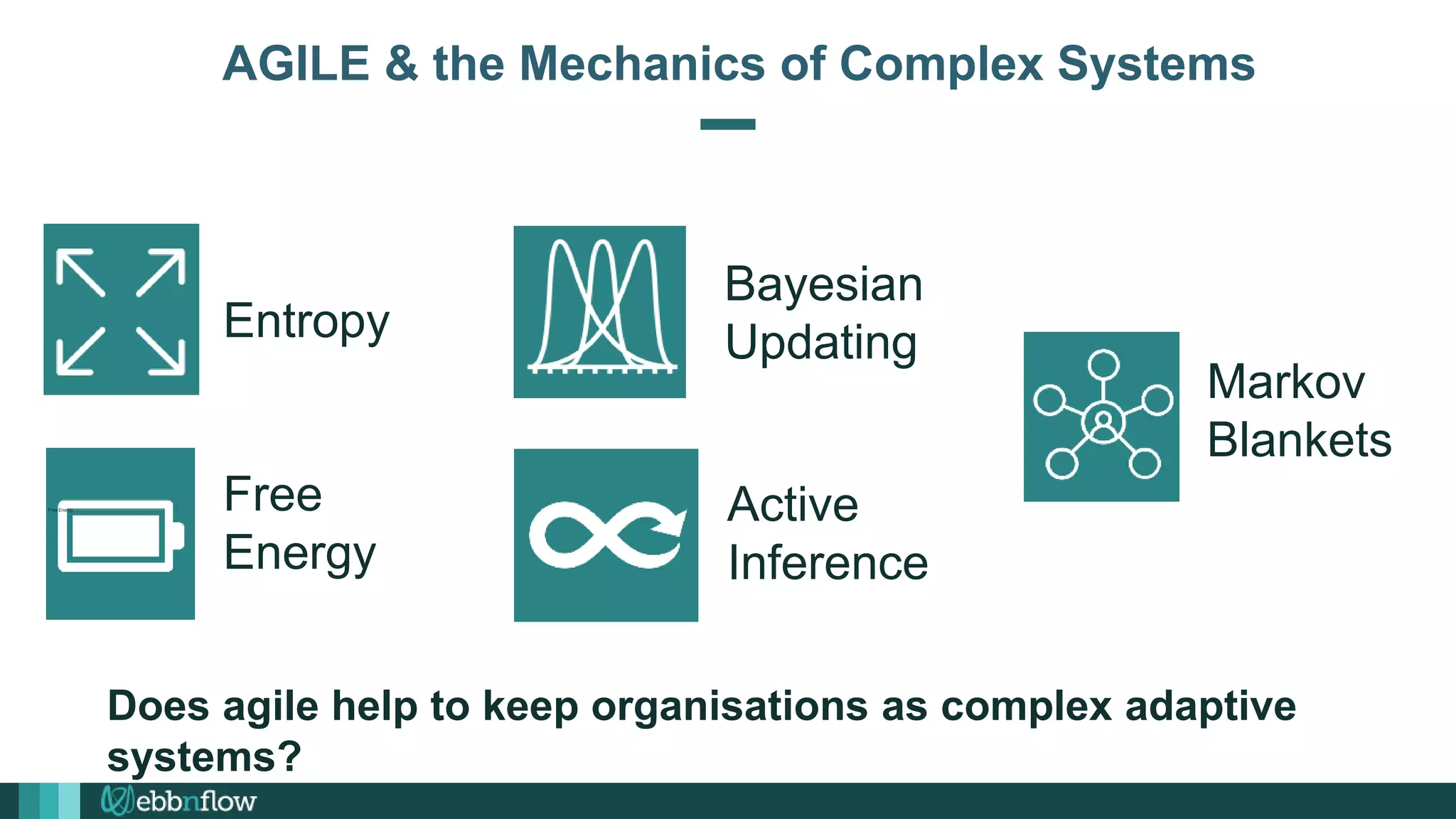
AGILE & the Mechanics of Complex Systems
Free Energy
Entropy
Free
Energy
Bayesian
Updating
Active
Inference
Markov
Blankets
Does agile help to keep organisations as complex adaptive
systems?
46
What Makes Effective Teams
6
47
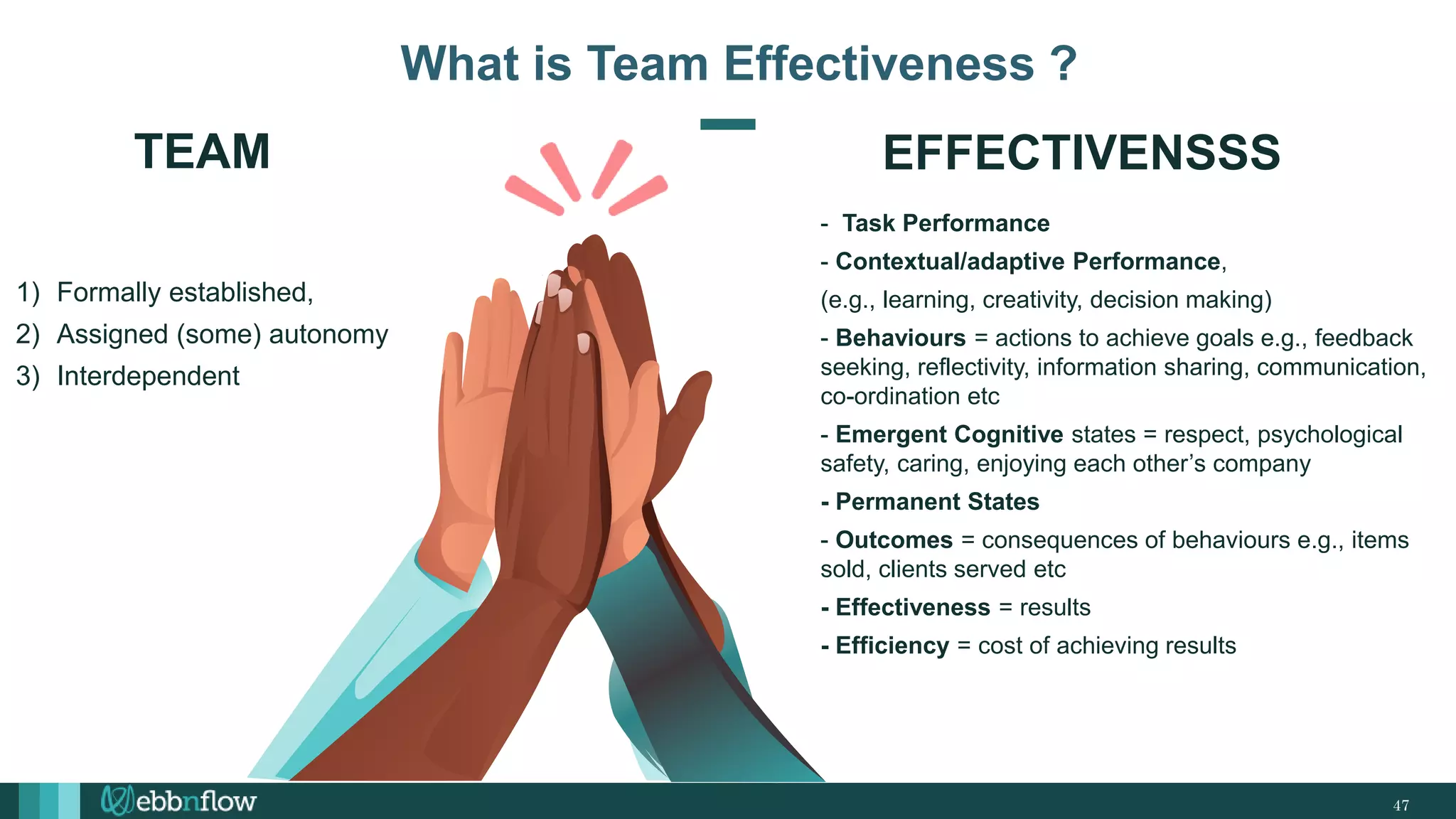
What is Team Effectiveness ?
1) Formally established,
2) Assigned (some) autonomy
3) Interdependent
- Task Performance
- Contextual/adaptive Performance,
(e.g., learning, creativity, decision making)
- Behaviours = actions to achieve goals e.g., feedback
seeking, reflectivity, information sharing, communication,
co-ordination etc
- Emergent Cognitive states = respect, psychological
safety, caring, enjoying each other’s company
- Permanent States
- Outcomes = consequences of behaviours e.g., items
sold, clients served etc
- Effectiveness = results
- Efficiency = cost of achieving results
TEAM EFFECTIVENSSS
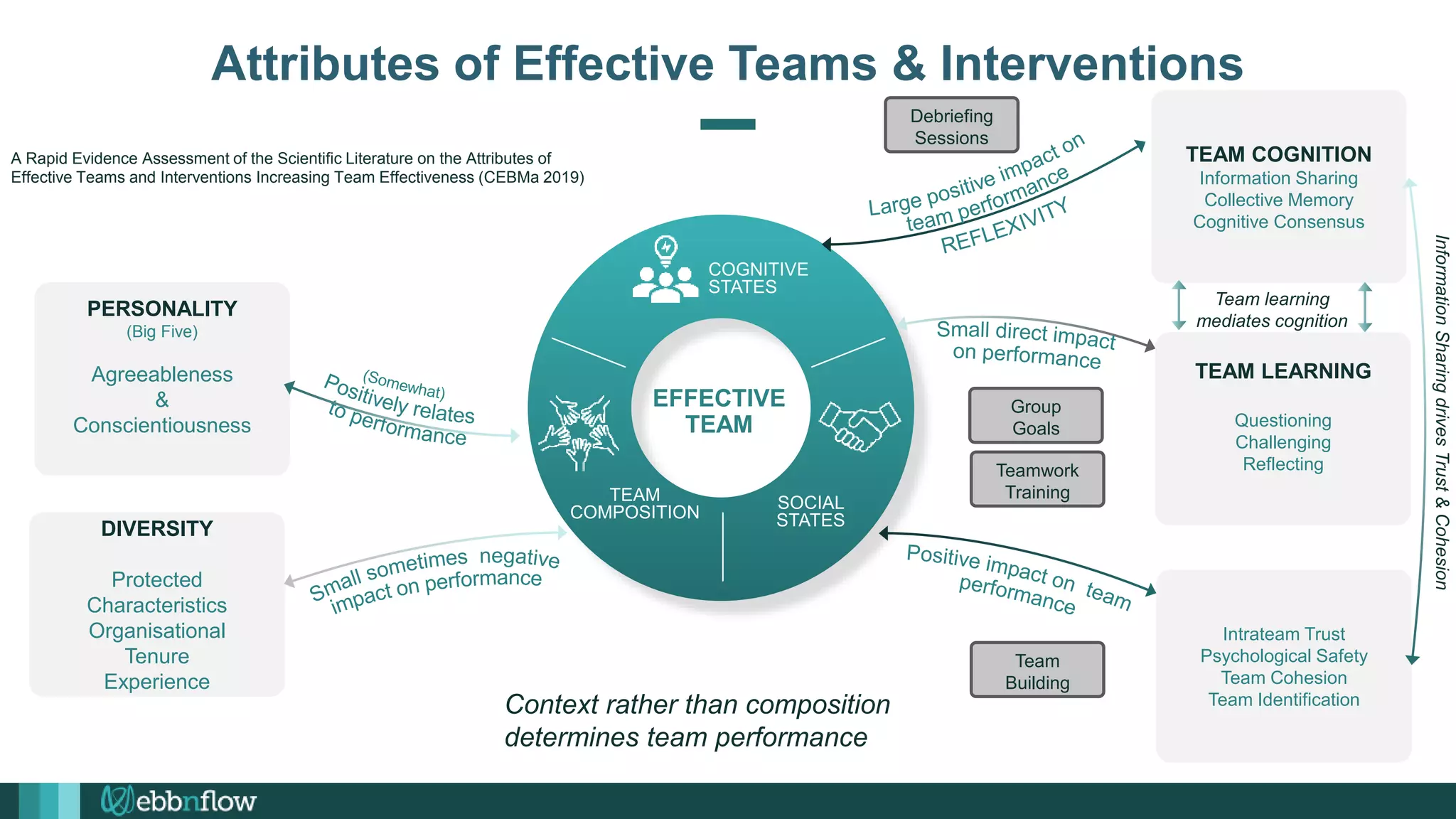
TEAM COGNITION
Information Sharing
Collective Memory
Cognitive Consensus
Intrateam Trust
Psychological Safety
Team Cohesion
Team Identification
DIVERSITY
Protected
Characteristics
Organisational
Tenure
Experience
EFFECTIVE
TEAM
COGNITIVE
STATES
TEAM
COMPOSITION
SOCIAL
STATES
Debriefing
Sessions
PERSONALITY
(Big Five)
Agreeableness
&
Conscientiousness
TEAM LEARNING
Questioning
Challenging
Reflecting
Team learning
mediates cognition
Teamwork
Training
Team
Building
Group
Goals
Attributes of Effective Teams & Interventions
A Rapid Evidence Assessment of the Scientific Literature on the Attributes of
Effective Teams and Interventions Increasing Team Effectiveness (CEBMa 2019)
Context rather than composition
determines team performance
Information
Sharing
drives
Trust
&
Cohesion
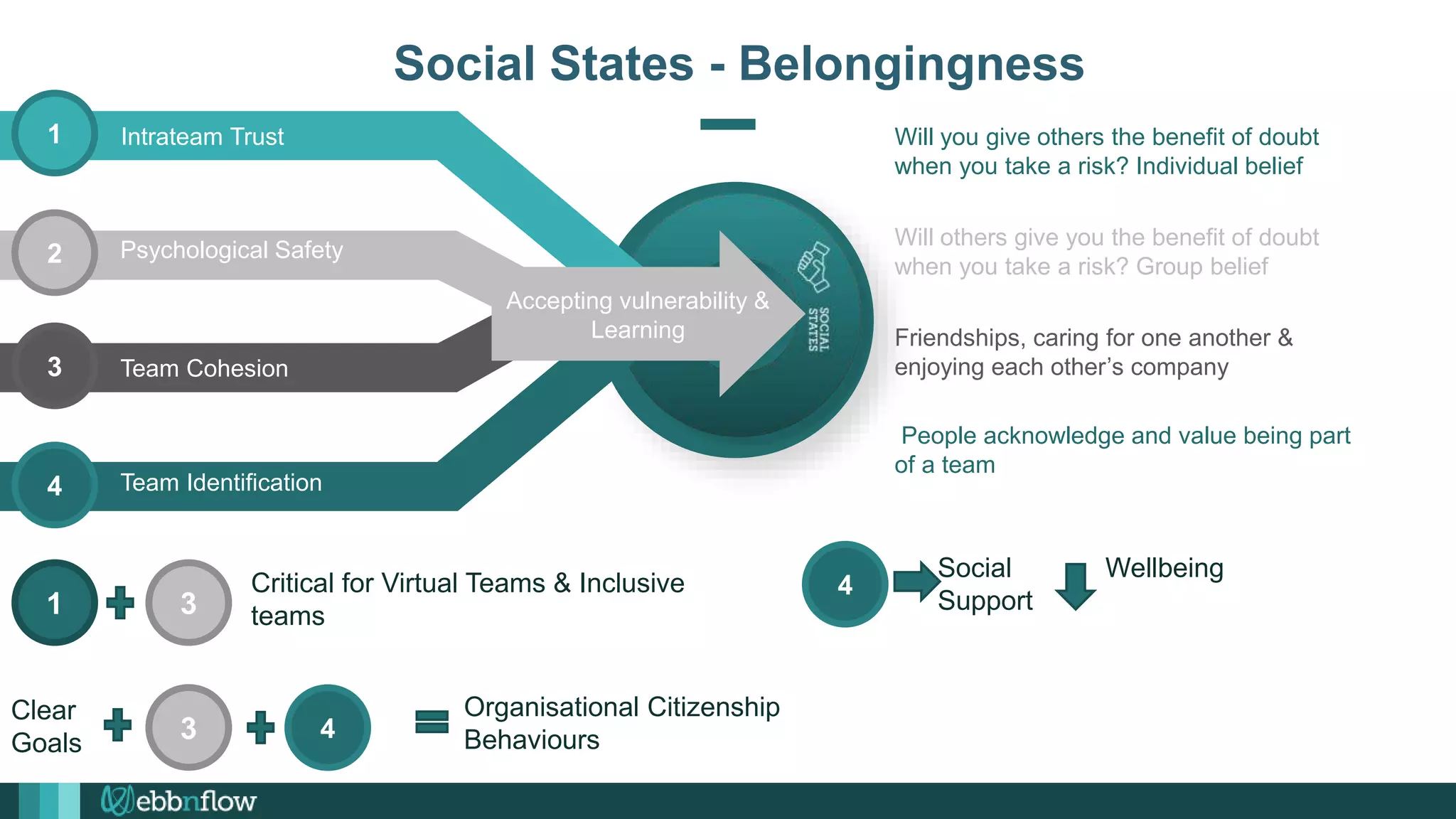
1
2
3
4
Will others give you the benefit of doubt
when you take a risk? Group belief
People acknowledge and value being part
of a team
Friendships, caring for one another &
enjoying each other’s company
Will you give others the benefit of doubt
when you take a risk? Individual belief
Social States - Belongingness
Intrateam Trust
Psychological Safety
Team Cohesion
Team Identification
Group Learning
Accepting vulnerability &
Learning
1 3
Critical for Virtual Teams & Inclusive
teams
3
Organisational Citizenship
Behaviours
Clear
Goals
4
4
Social
Support
Wellbeing
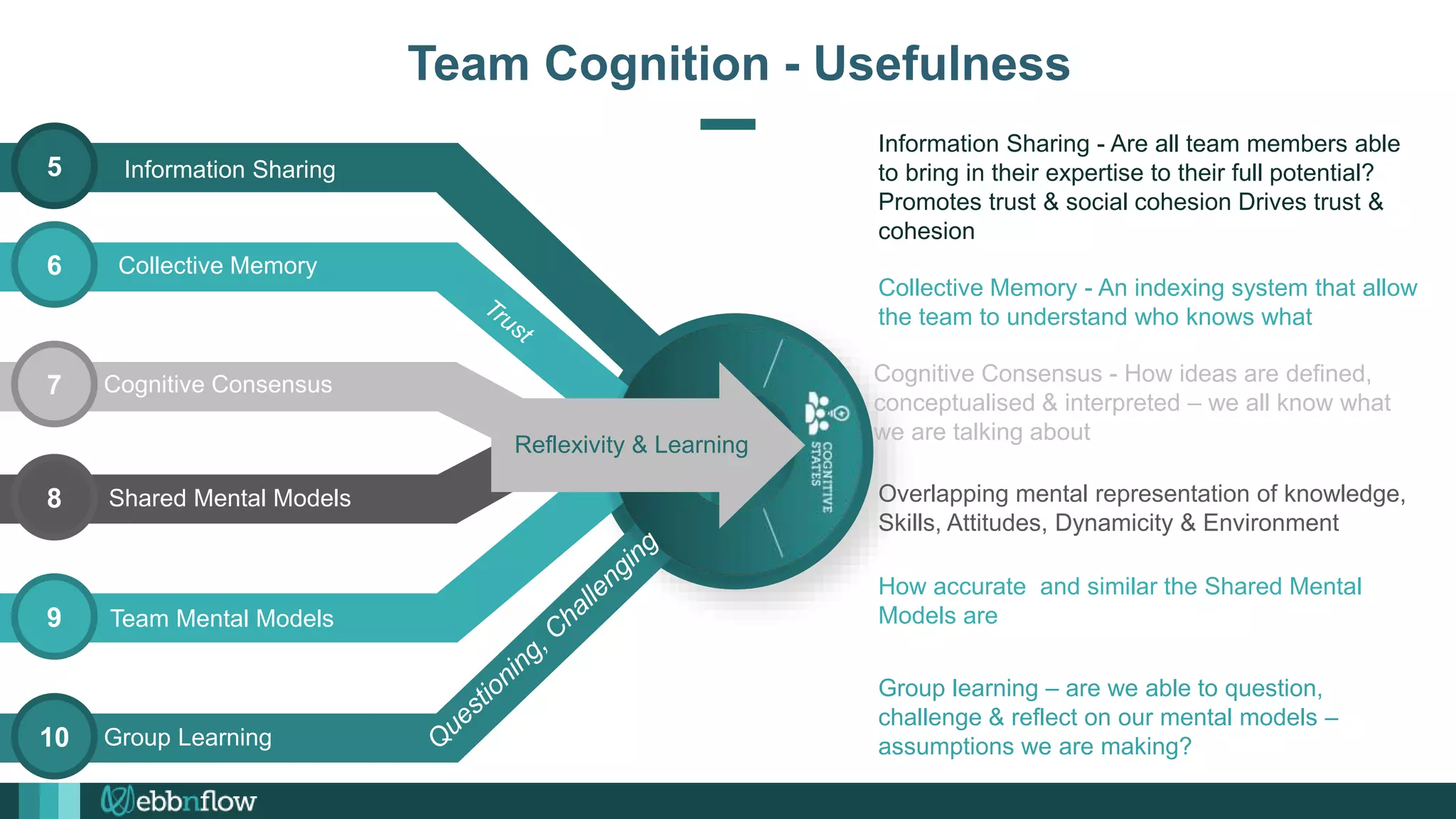
5
6
7
8
9
10
Collective Memory - An indexing system that allow
the team to understand who knows what
Overlapping mental representation of knowledge,
Skills, Attitudes, Dynamicity & Environment
Cognitive Consensus - How ideas are defined,
conceptualised & interpreted – we all know what
we are talking about
Information Sharing - Are all team members able
to bring in their expertise to their full potential?
Promotes trust & social cohesion Drives trust &
cohesion
How accurate and similar the Shared Mental
Models are
Group learning – are we able to question,
challenge & reflect on our mental models –
assumptions we are making?
Team Cognition - Usefulness
Information Sharing
Collective Memory
Cognitive Consensus
Reflexivity & Learning
Shared Mental Models
Group Learning
Team Mental Models
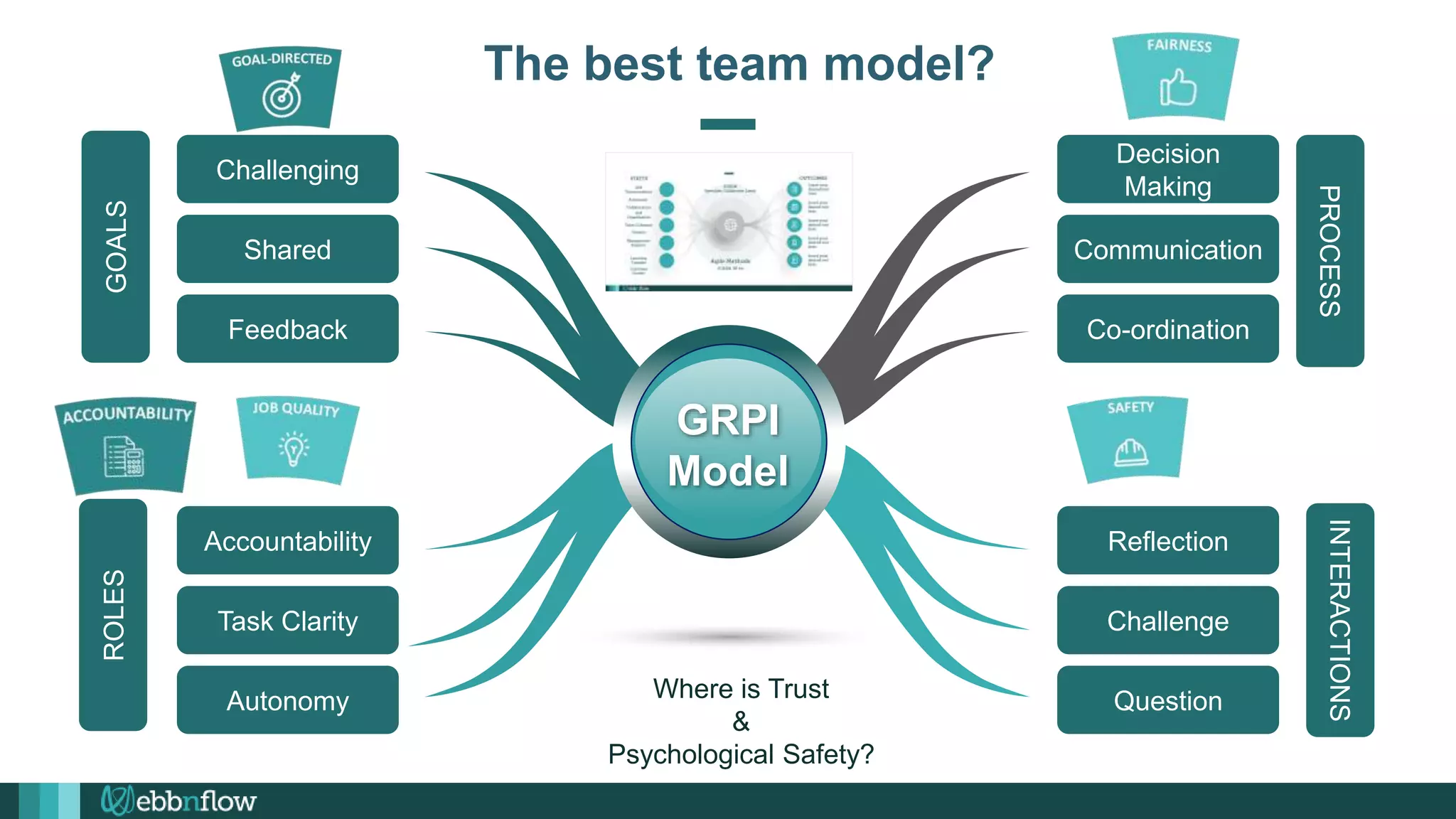
Challenging
Shared
Feedback
Accountability
Task Clarity
Autonomy
Decision
Making
Communication
Co-ordination
Reflection
Challenge
Question
GRPI
Model
GOALS
ROLES
PROCESS
INTERACTIONS
The best team model?
Where is Trust
&
Psychological Safety?
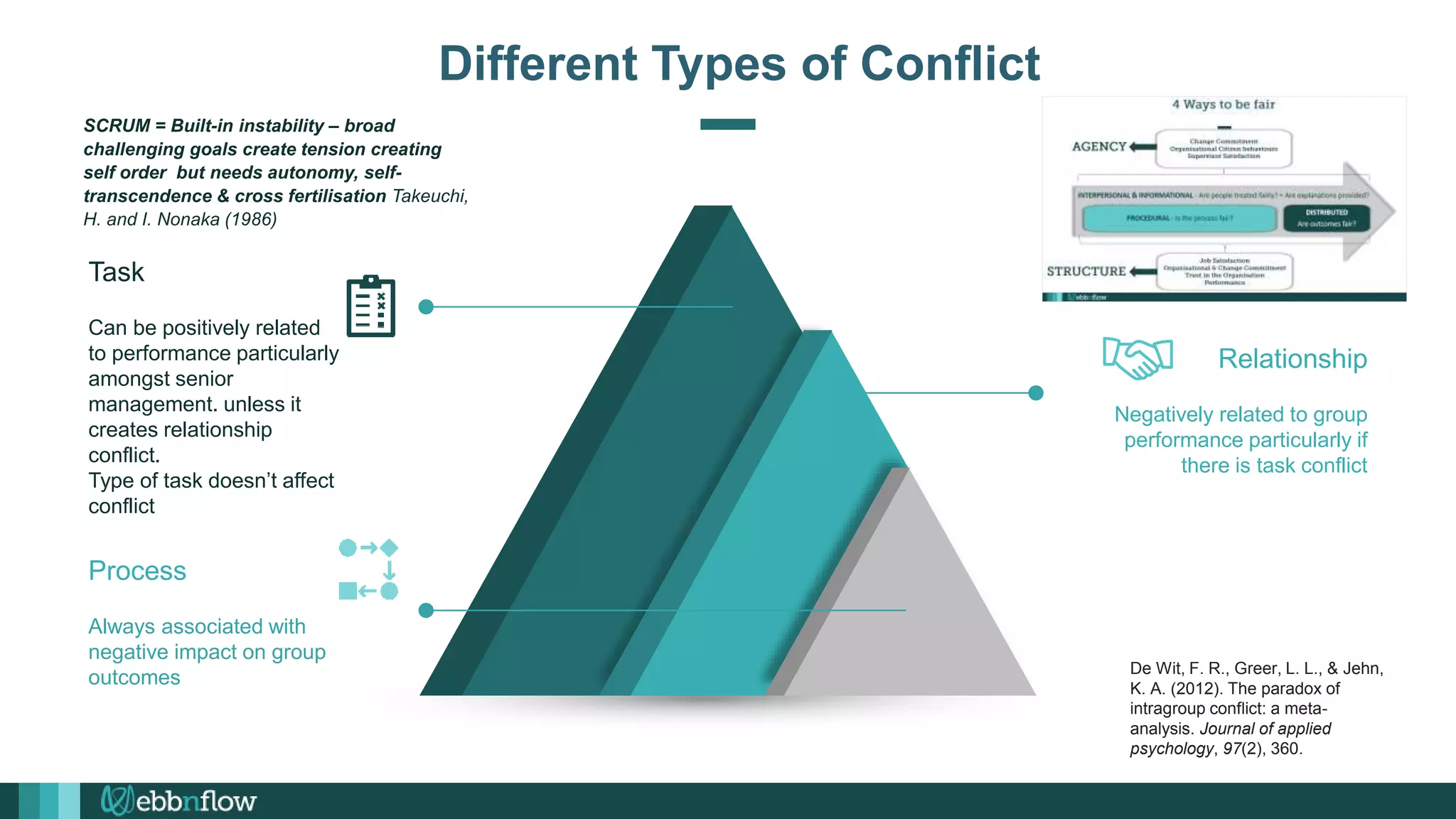
Different Types of Conflict
Can be positively related
to performance particularly
amongst senior
management. unless it
creates relationship
conflict.
Type of task doesn’t affect
conflict
Task
Always associated with
negative impact on group
outcomes
Process
Negatively related to group
performance particularly if
there is task conflict
Relationship
De Wit, F. R., Greer, L. L., & Jehn,
K. A. (2012). The paradox of
intragroup conflict: a meta-
analysis. Journal of applied
psychology, 97(2), 360.
SCRUM = Built-in instability – broad
challenging goals create tension creating
self order but needs autonomy, self-
transcendence & cross fertilisation Takeuchi,
H. and I. Nonaka (1986)
53
Given Agile – what is the future of
Organisational Change?
7
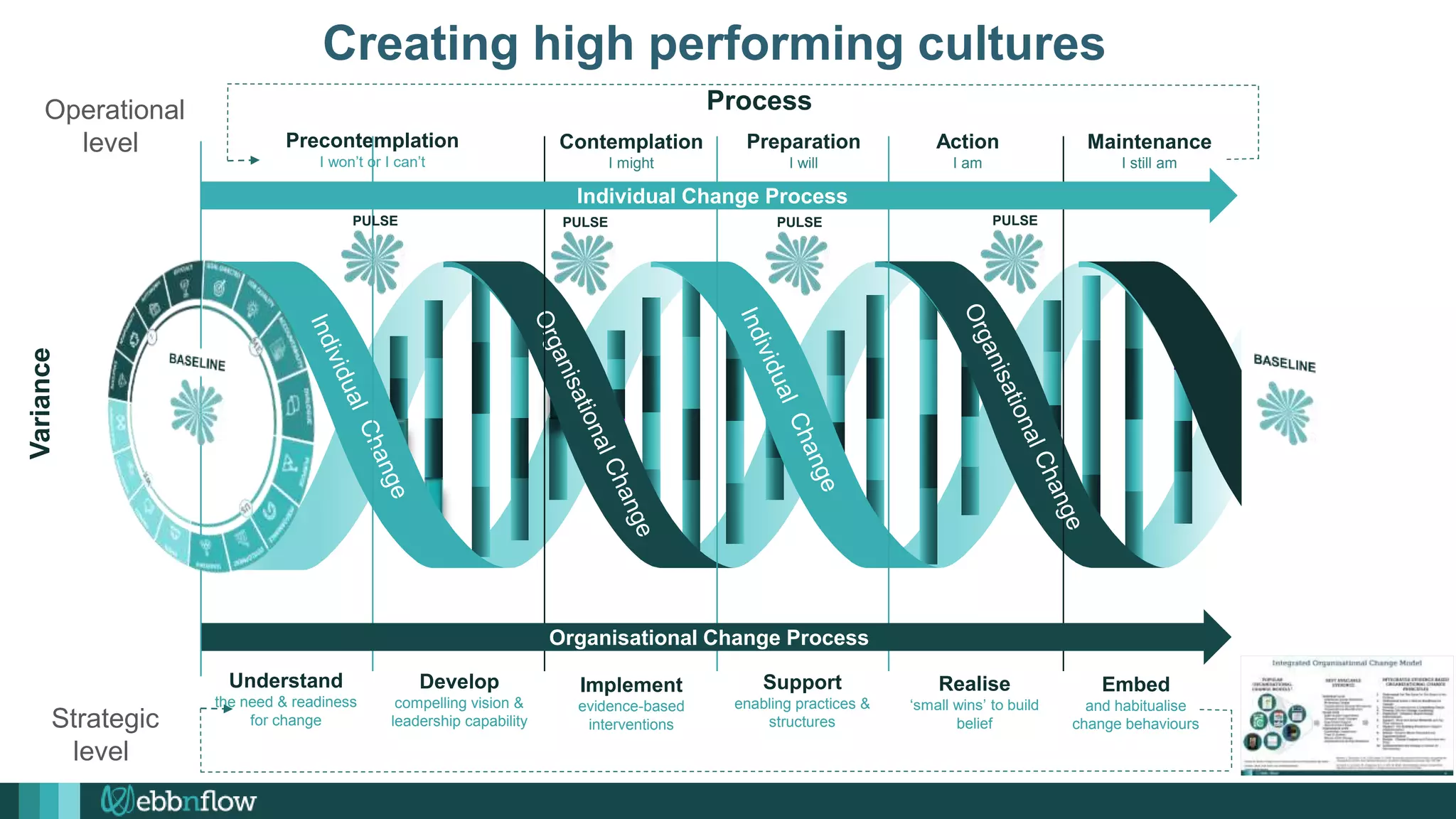
Precontemplation
I won’t or I can’t
Contemplation
I might
Preparation
I will
Action
I am
Realise
‘small wins’ to build
belief
Embed
and habitualise
change behaviours
Understand
the need & readiness
for change
Develop
compelling vision &
leadership capability
Implement
evidence-based
interventions
Support
enabling practices &
structures
Maintenance
I still am
Individual Change Process
Organisational Change Process
PULSE PULSE
PULSE PULSE
Creating high performing cultures
Operational
level
Strategic
level
Process
Variance
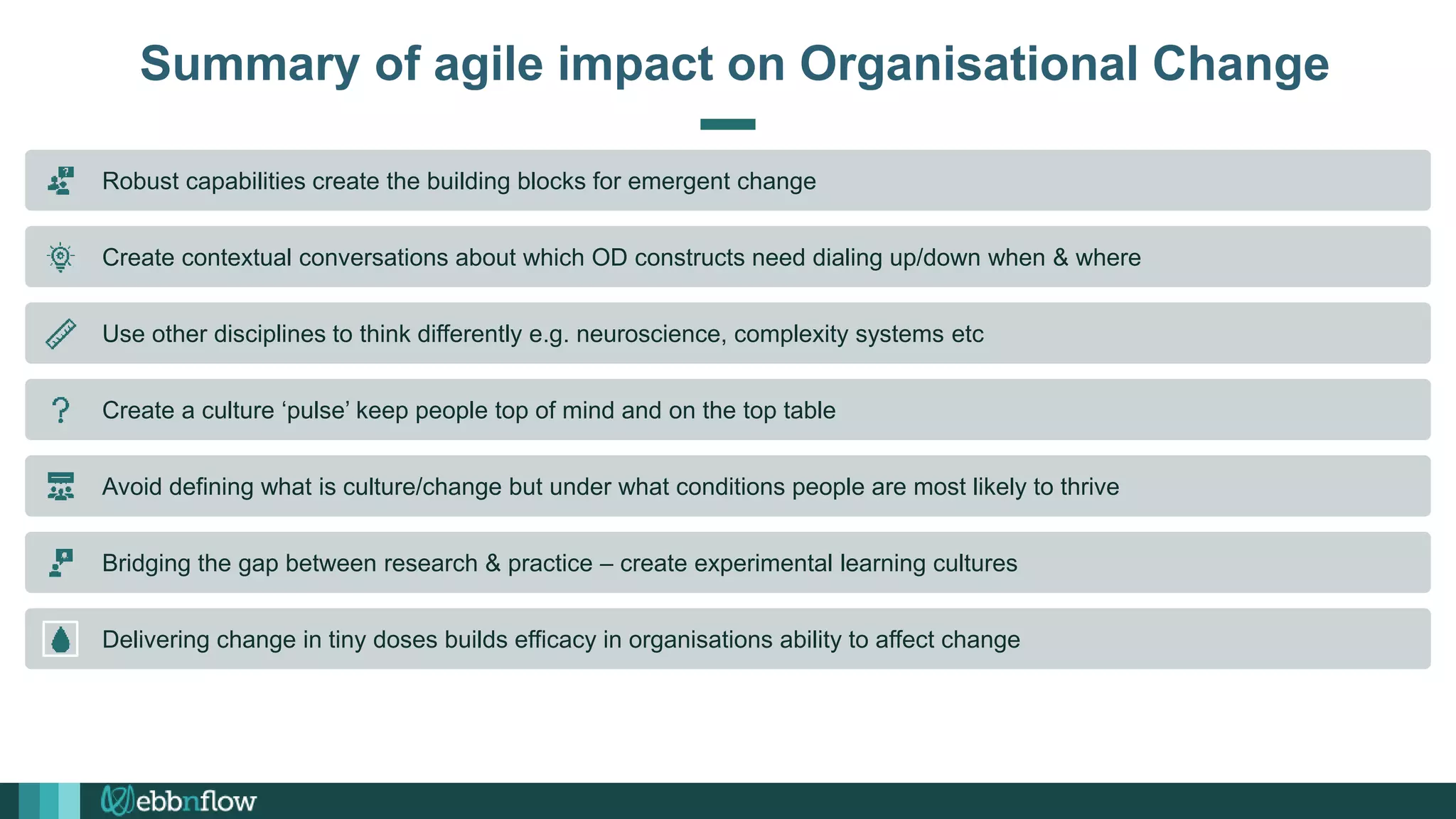
Summary of agile impact on Organisational Change
Robust capabilities create the building blocks for emergent change
Create contextual conversations about which OD constructs need dialing up/down when & where
Use other disciplines to think differently e.g. neuroscience, complexity systems etc
Create a culture ‘pulse’ keep people top of mind and on the top table
Avoid defining what is culture/change but under what conditions people are most likely to thrive
Bridging the gap between research & practice – create experimental learning cultures
Delivering change in tiny doses builds efficacy in organisations ability to affect change
AND ...
Thank you!
from Alex
Boulting
Owner | ebbnflow
+44 7562570000
alex@ebbnflow.co.u
k
www.ebbnflow.co.u
k
Stay tuned and check our newest videos on YouTube:
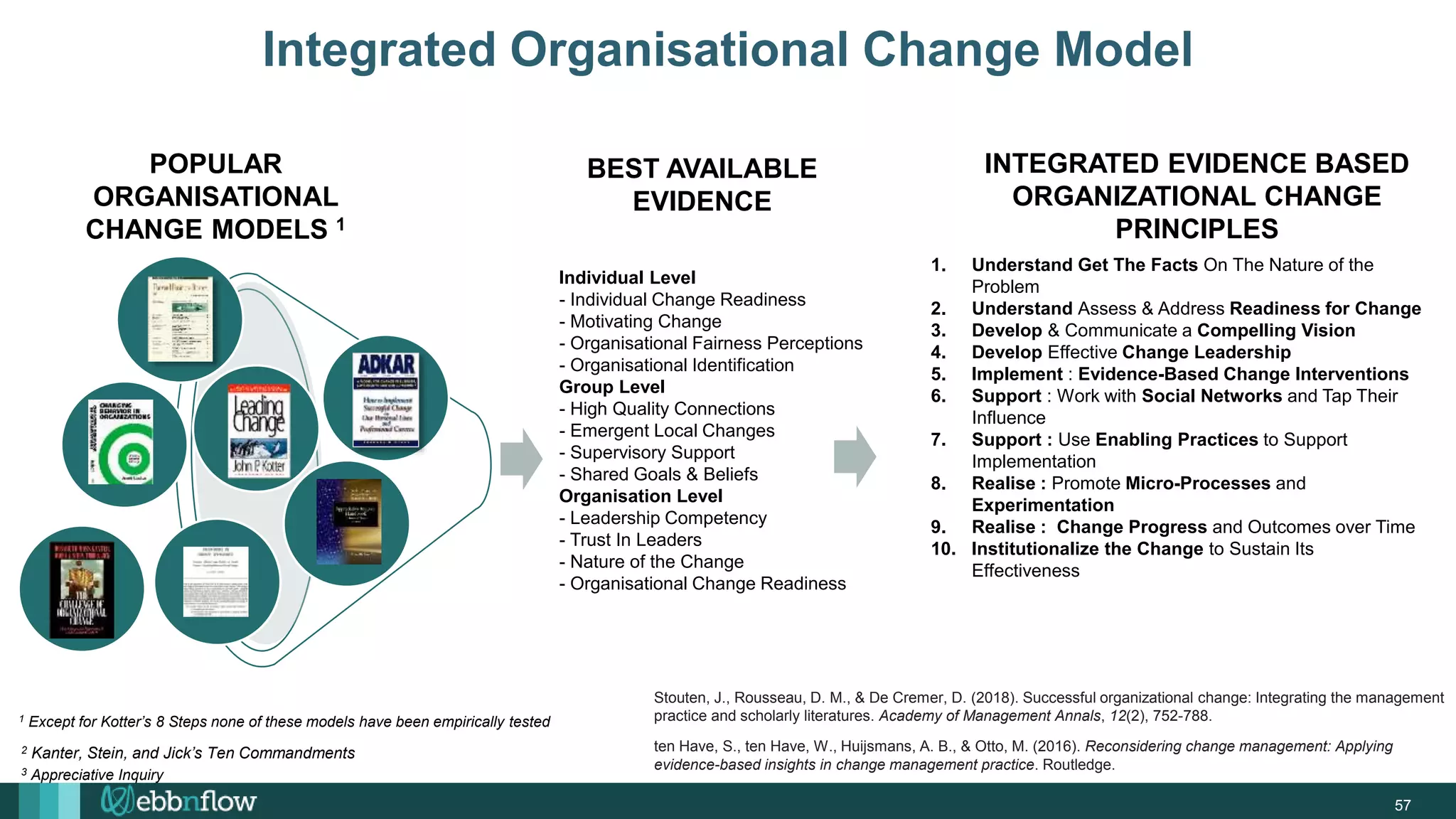
Individual Level
- Individual Change Readiness
- Motivating Change
- Organisational Fairness Perceptions
- Organisational Identification
Group Level
- High Quality Connections
- Emergent Local Changes
- Supervisory Support
- Shared Goals & Beliefs
Organisation Level
- Leadership Competency
- Trust In Leaders
- Nature of the Change
- Organisational Change Readiness
BEST AVAILABLE
EVIDENCE
1. Understand Get The Facts On The Nature of the
Problem
2. Understand Assess & Address Readiness for Change
3. Develop & Communicate a Compelling Vision
4. Develop Effective Change Leadership
5. Implement : Evidence-Based Change Interventions
6. Support : Work with Social Networks and Tap Their
Influence
7. Support : Use Enabling Practices to Support
Implementation
8. Realise : Promote Micro-Processes and
Experimentation
9. Realise : Change Progress and Outcomes over Time
10. Institutionalize the Change to Sustain Its
Effectiveness
INTEGRATED EVIDENCE BASED
ORGANIZATIONAL CHANGE
PRINCIPLES
Stouten, J., Rousseau, D. M., & De Cremer, D. (2018). Successful organizational change: Integrating the management
practice and scholarly literatures. Academy of Management Annals, 12(2), 752-788.
ten Have, S., ten Have, W., Huijsmans, A. B., & Otto, M. (2016). Reconsidering change management: Applying
evidence-based insights in change management practice. Routledge.
Integrated Organisational Change Model
57
2 Kanter, Stein, and Jick’s Ten Commandments
POPULAR
ORGANISATIONAL
CHANGE MODELS 1
1 Except for Kotter’s 8 Steps none of these models have been empirically tested
3 Appreciative Inquiry
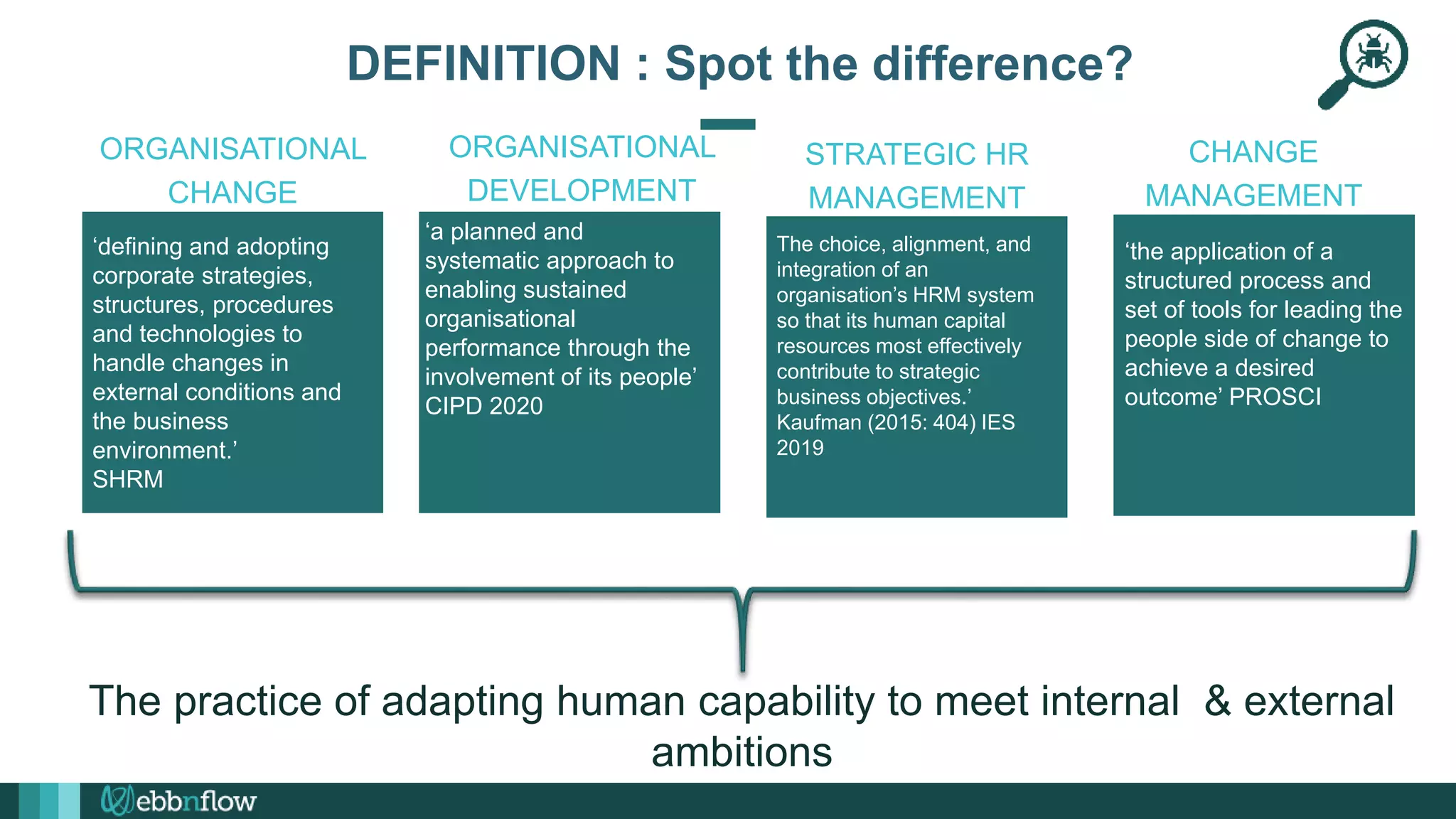
ORGANISATIONAL
CHANGE
‘defining and adopting
corporate strategies,
structures, procedures
and technologies to
handle changes in
external conditions and
the business
environment.’
SHRM
“ ‘the application of a
structured process and
set of tools for leading the
people side of change to
achieve a desired
outcome’ PROSCI
CHANGE
MANAGEMENT
ORGANISATIONAL
DEVELOPMENT
‘a planned and
systematic approach to
enabling sustained
organisational
performance through the
involvement of its people’
CIPD 2020
The practice of adapting human capability to meet internal & external
ambitions
STRATEGIC HR
MANAGEMENT
The choice, alignment, and
integration of an
organisation’s HRM system
so that its human capital
resources most effectively
contribute to strategic
business objectives.’
Kaufman (2015: 404) IES
2019
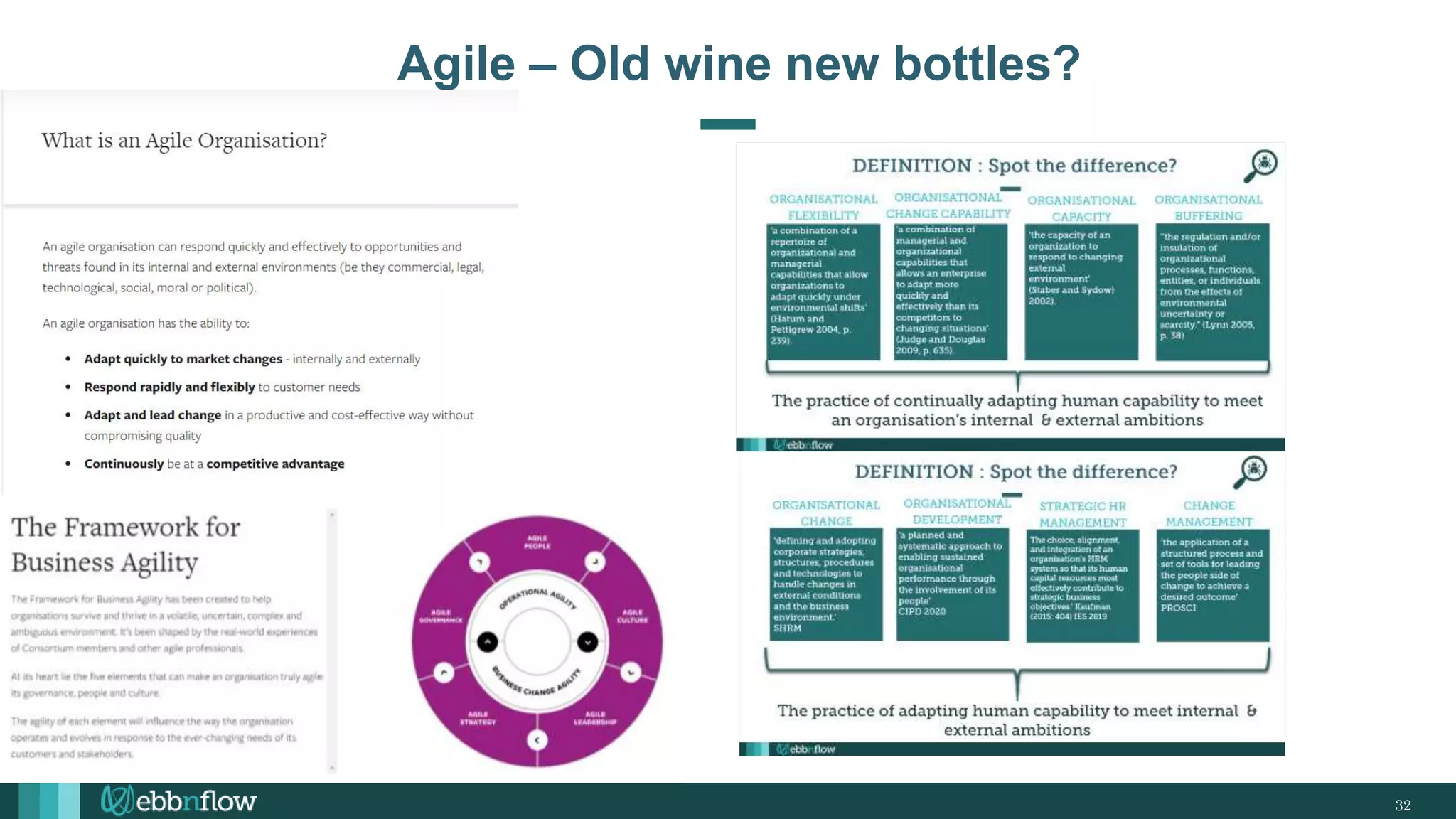
DEFINITION : Spot the difference?
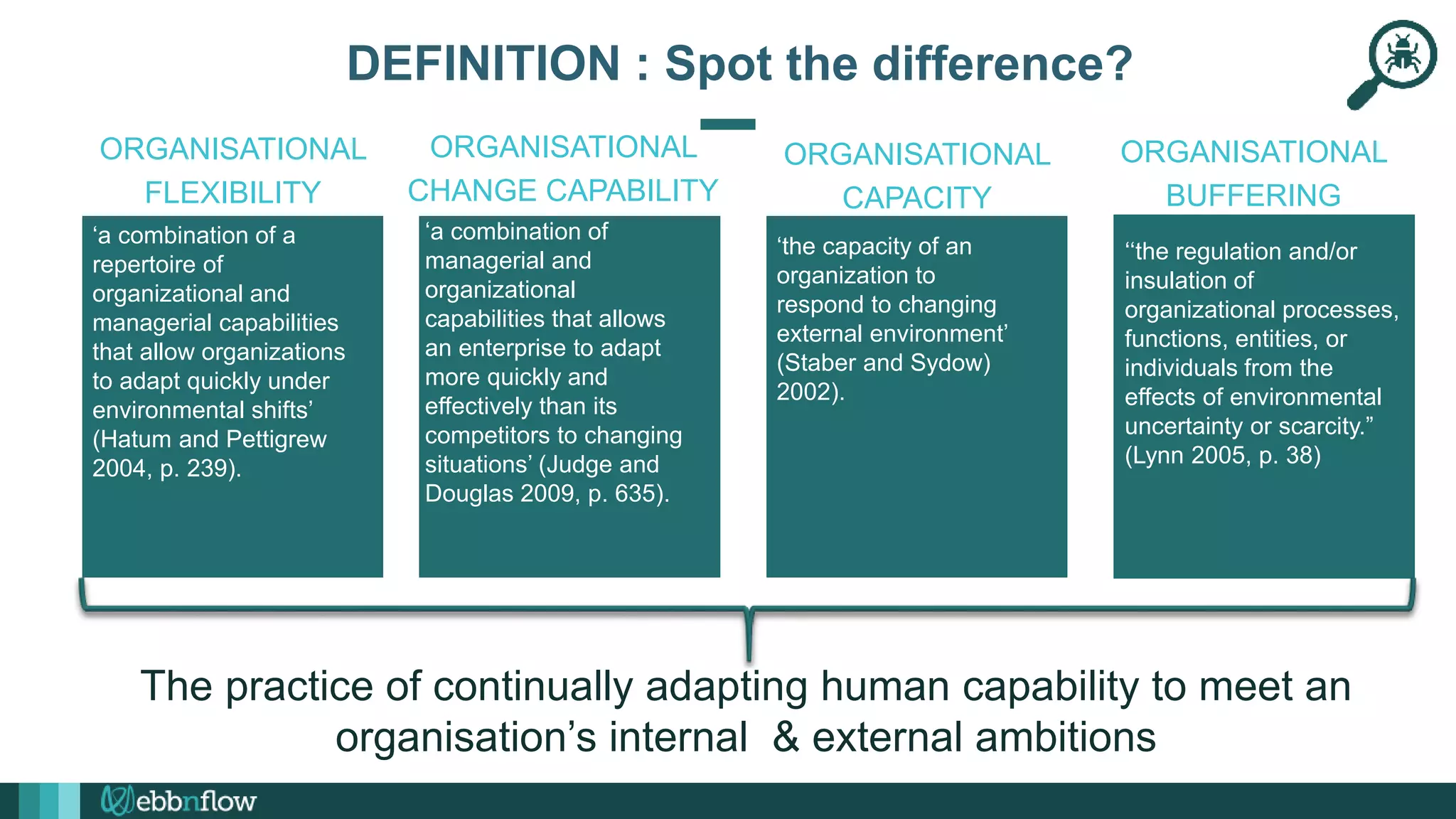
ORGANISATIONAL
FLEXIBILITY
‘a combination of a
repertoire of
organizational and
managerial capabilities
that allow organizations
to adapt quickly under
environmental shifts’
(Hatum and Pettigrew
2004, p. 239).
“ ‘‘the regulation and/or
insulation of
organizational processes,
functions, entities, or
individuals from the
effects of environmental
uncertainty or scarcity.”
(Lynn 2005, p. 38)
ORGANISATIONAL
BUFFERING
ORGANISATIONAL
CHANGE CAPABILITY
‘a combination of
managerial and
organizational
capabilities that allows
an enterprise to adapt
more quickly and
effectively than its
competitors to changing
situations’ (Judge and
Douglas 2009, p. 635).
The practice of continually adapting human capability to meet an
organisation’s internal & external ambitions
ORGANISATIONAL
CAPACITY
‘the capacity of an
organization to
respond to changing
external environment’
(Staber and Sydow)
2002).
DEFINITION : Spot the difference?
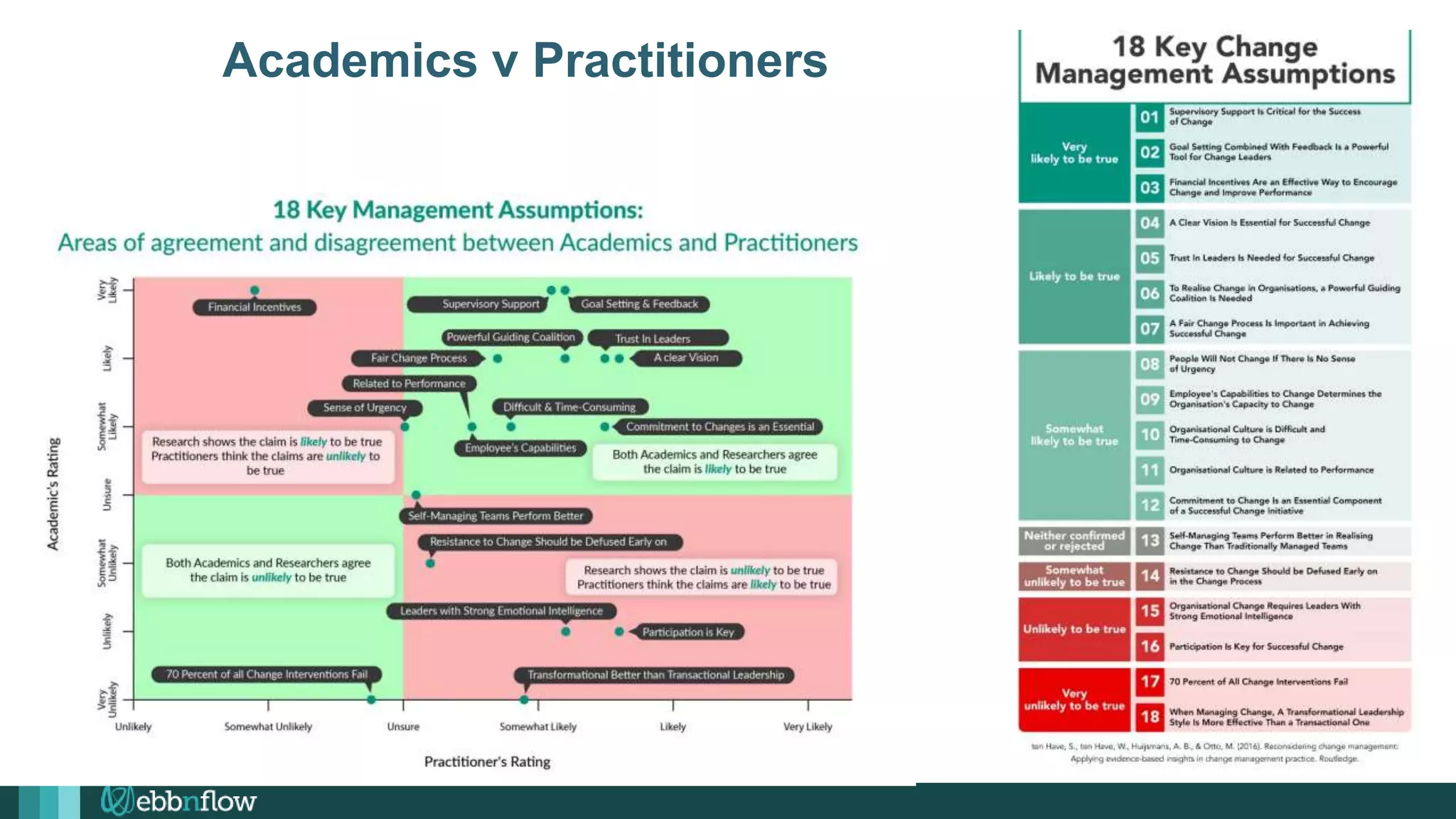
Academics v Practitioners
61
Beliefs V Behaviours
LINEAR RECURSIVE
Bayesian Updating
62
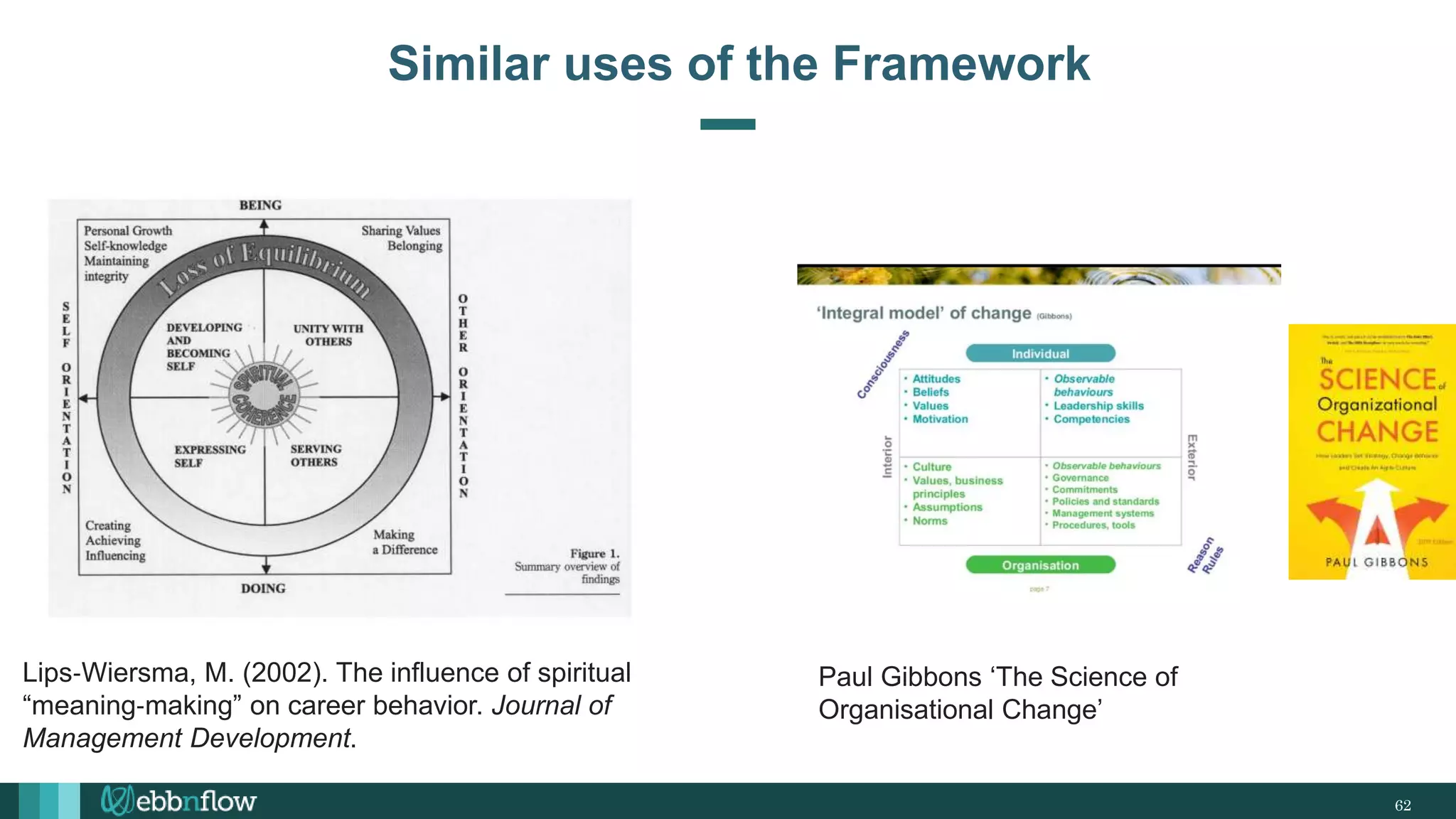
Similar uses of the Framework
Lips‐Wiersma, M. (2002). The influence of spiritual
“meaning‐making” on career behavior. Journal of
Management Development.
Paul Gibbons ‘The Science of
Organisational Change’
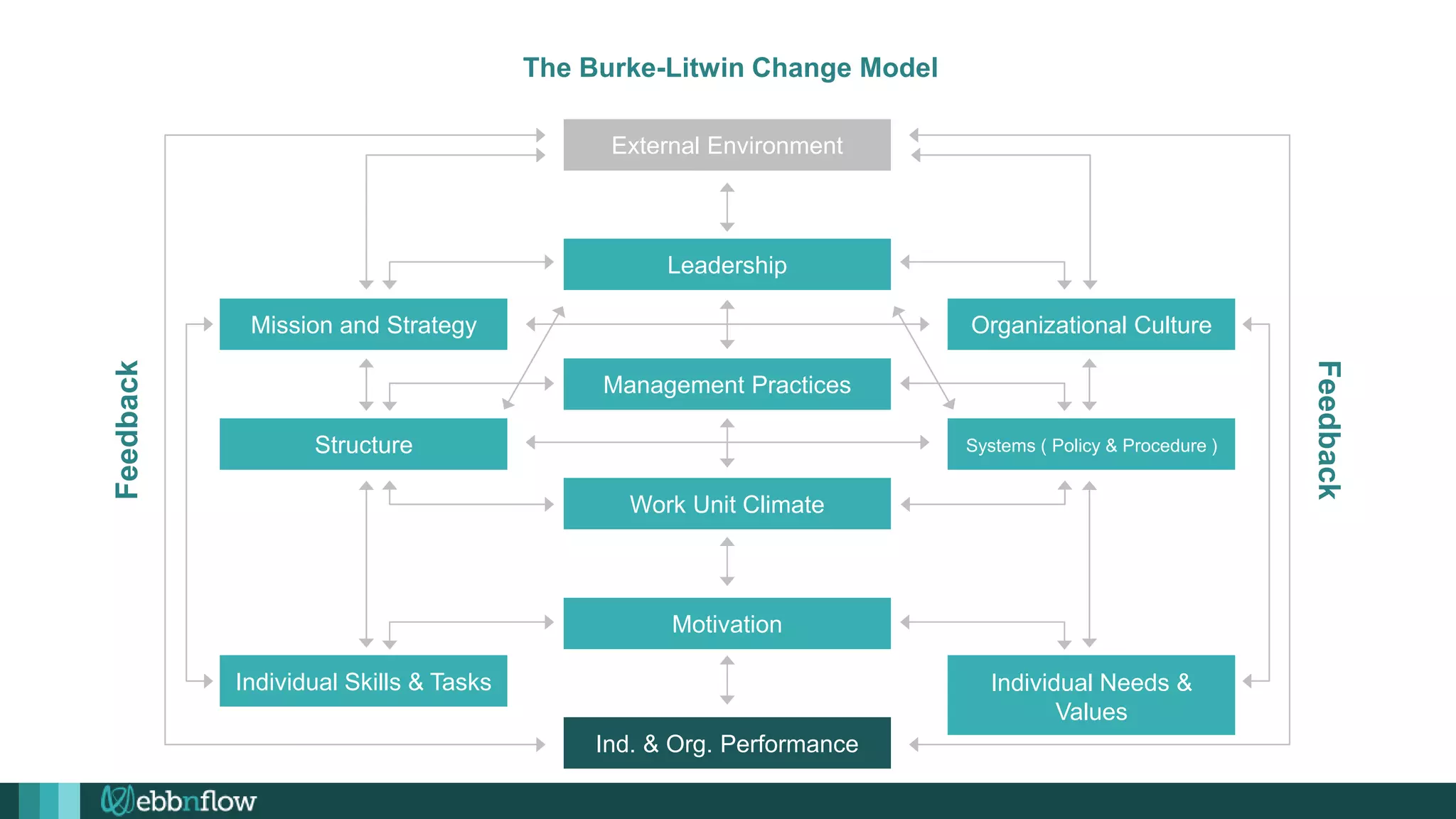
The Burke-Litwin Change Model
Feedback
Feedback
External Environment
Leadership
Management Practices
Work Unit Climate
Motivation
Ind. & Org. Performance
Mission and Strategy Organizational Culture
Structure Systems ( Policy & Procedure )
Individual Skills & Tasks Individual Needs &
Values
Subjective
Intersubjective
Interobjective
Objective
Internal Cohesion
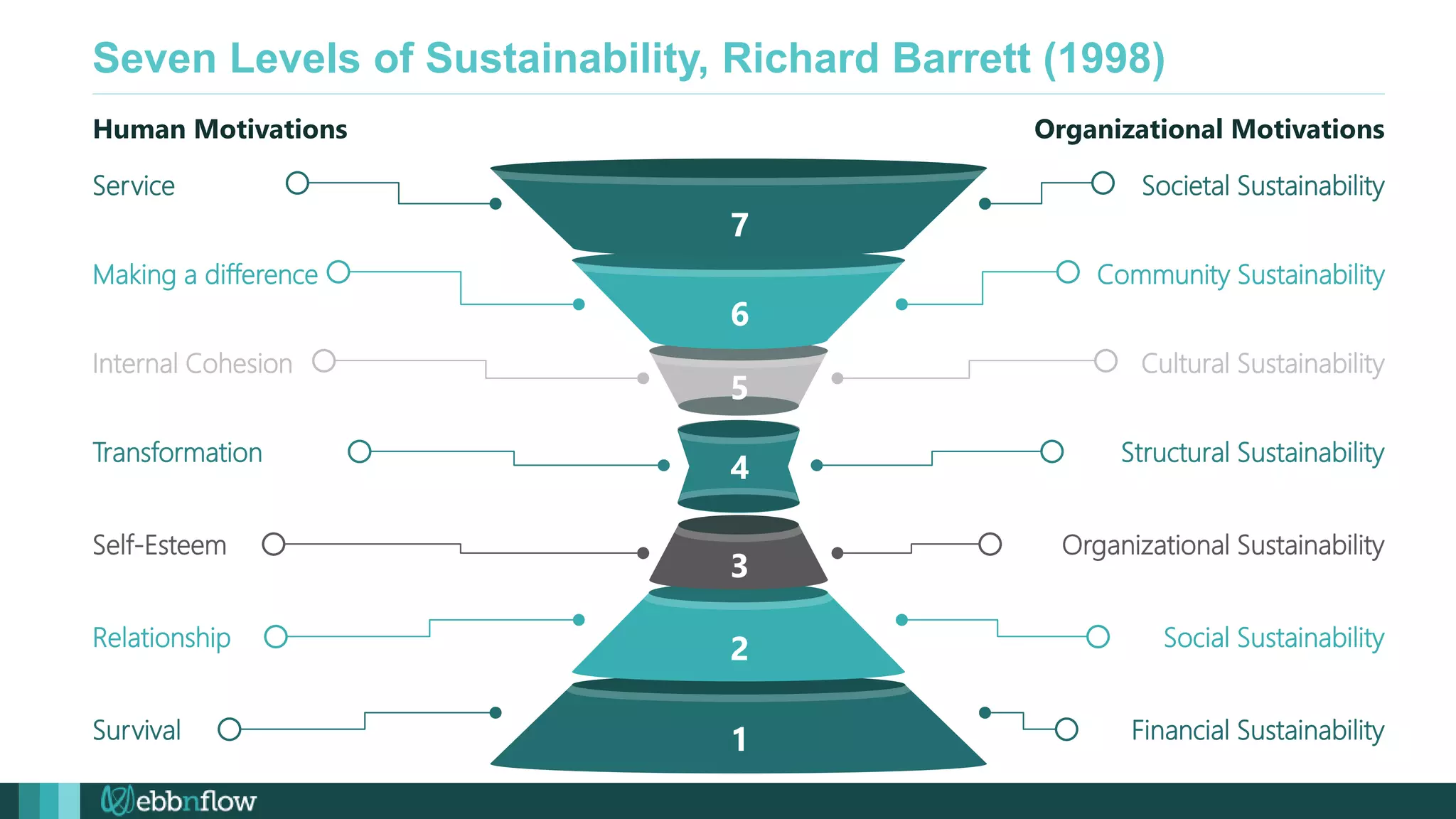
Seven Levels of Sustainability, Richard Barrett (1998)
7
6
5
4
3
2
1
Organizational Motivations
Human Motivations
Service
Making a difference
Self-Esteem
Relationship
Survival
Transformation
Societal Sustainability
Community Sustainability
Cultural Sustainability
Organizational Sustainability
Social Sustainability
Financial Sustainability
Structural Sustainability
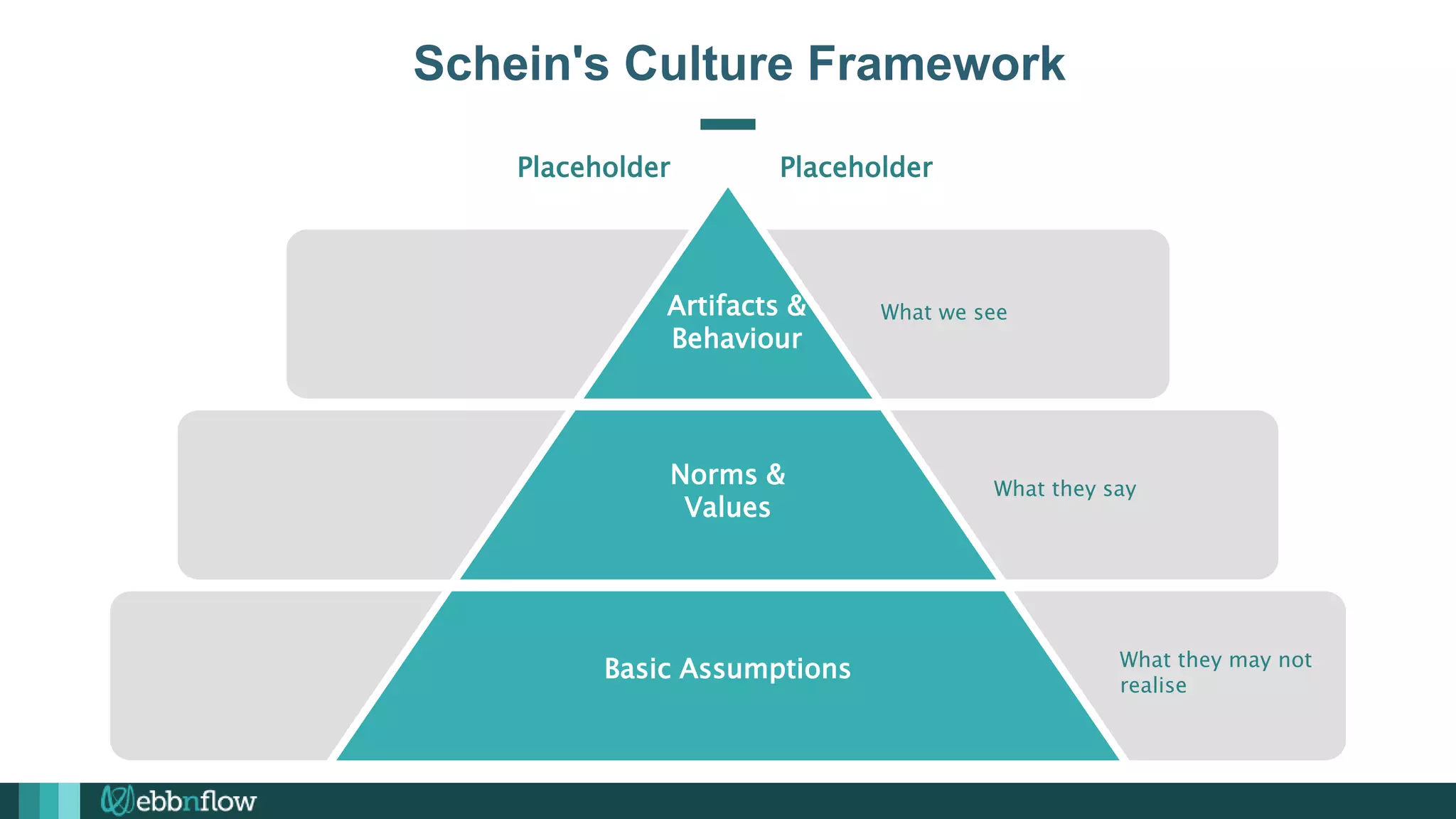
Schein's Culture Framework
Placeholder Placeholder
Artifacts &
Behaviour
Norms &
Values
Basic Assumptions
What we see
What they say
What they may not
realise
The Burke-Litwin Change Model
Feedback
Feedback
External Environment
Leadership
Management Practices
Work Unit Climate
Motivation
Ind. & Org. Performance
Mission and Strategy Organizational Culture
Structure Systems ( Policy & Procedure )
Individual Skills & Tasks Individual Needs &
Values
67
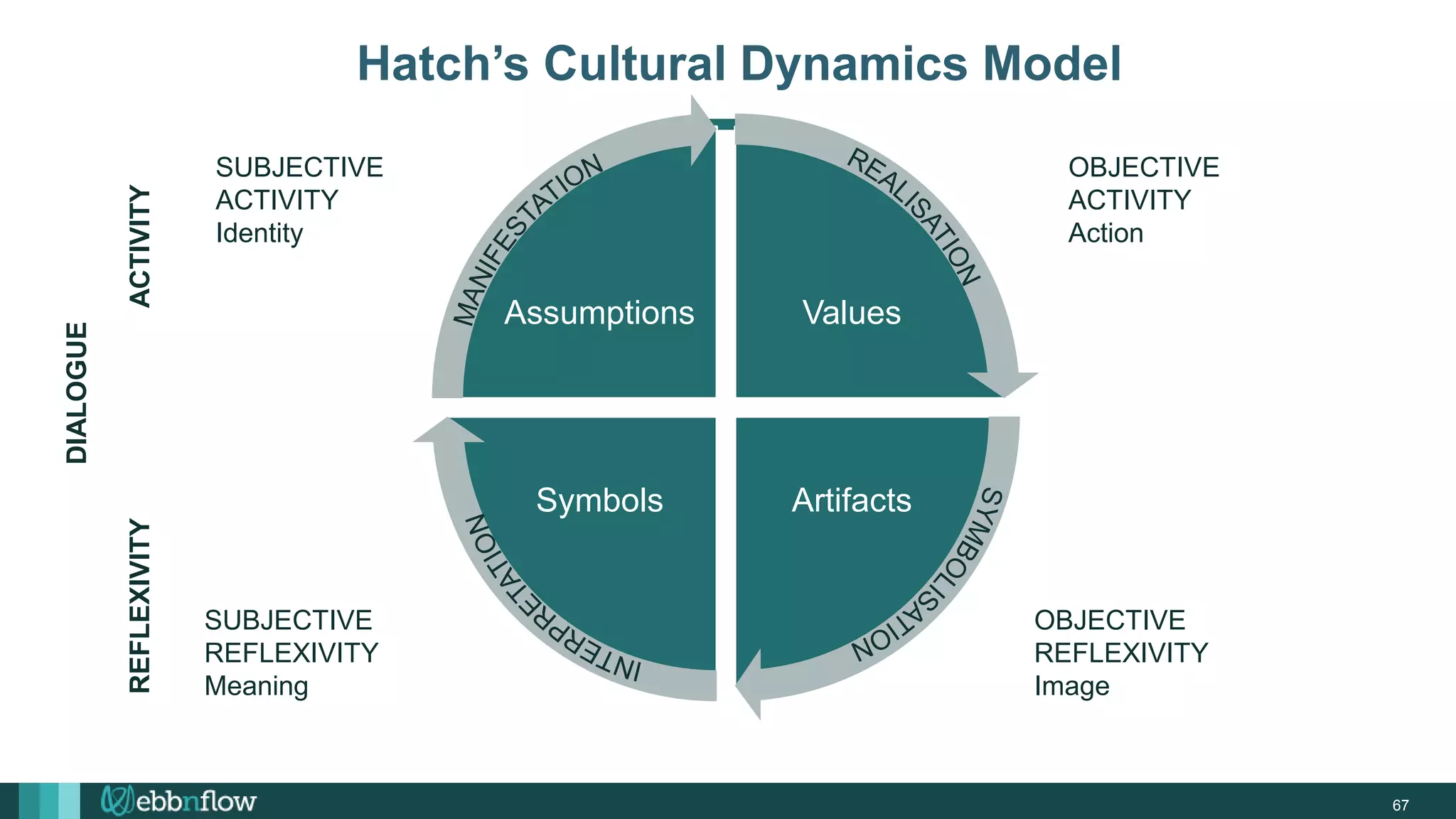
Hatch’s Cultural Dynamics Model
Values
Artifacts
Symbols
Assumptions
SUBJECTIVE
ACTIVITY
Identity
OBJECTIVE
ACTIVITY
Action
OBJECTIVE
REFLEXIVITY
Image
SUBJECTIVE
REFLEXIVITY
Meaning
REFLEXIVITY
ACTIVITY
DIALOGUE
68
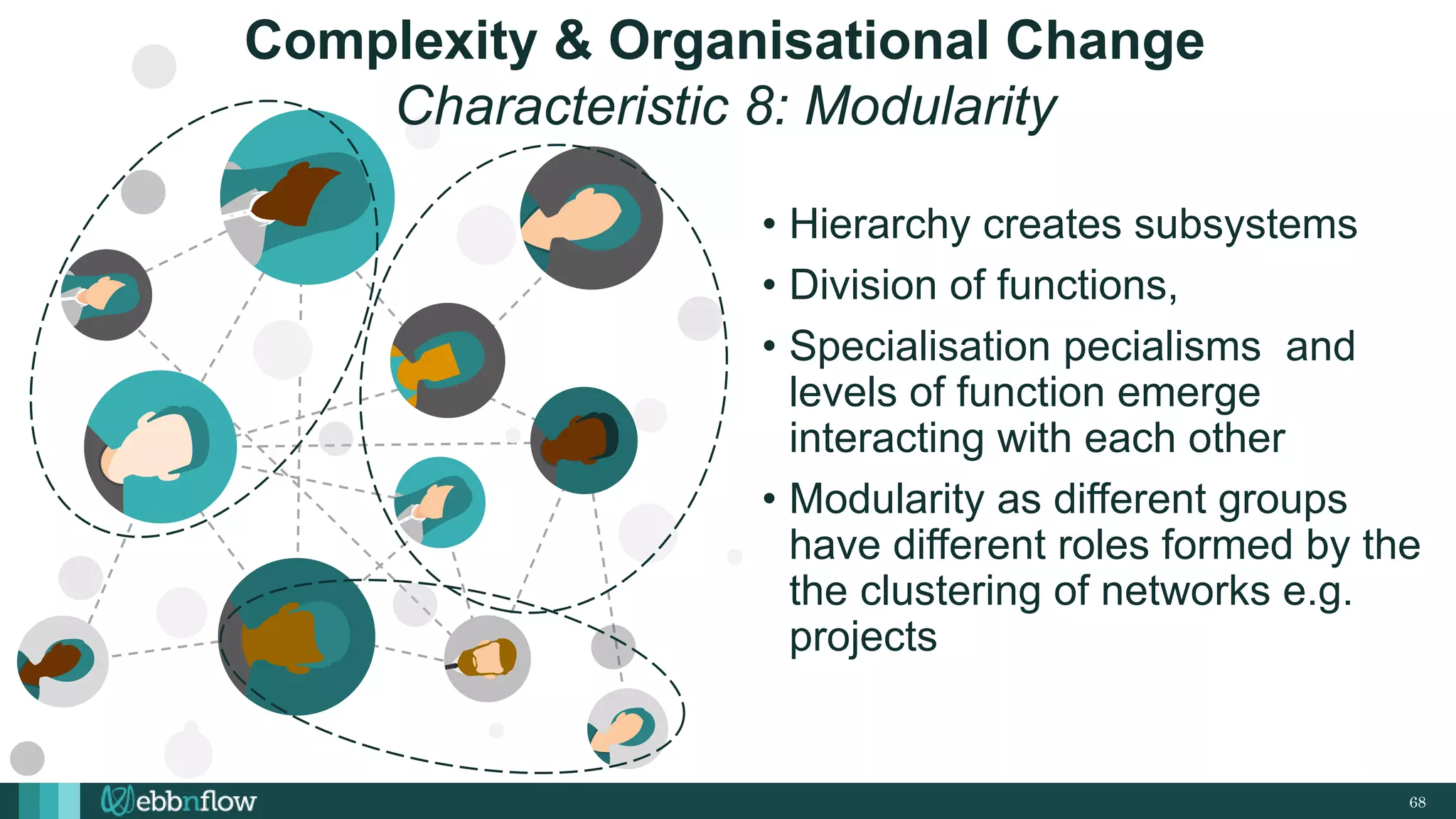
• Hierarchy creates subsystems
• Division of functions,
• Specialisation pecialisms and
levels of function emerge
interacting with each other
• Modularity as different groups
have different roles formed by the
the clustering of networks e.g.
projects
Complexity & Organisational Change
Characteristic 8: Modularity
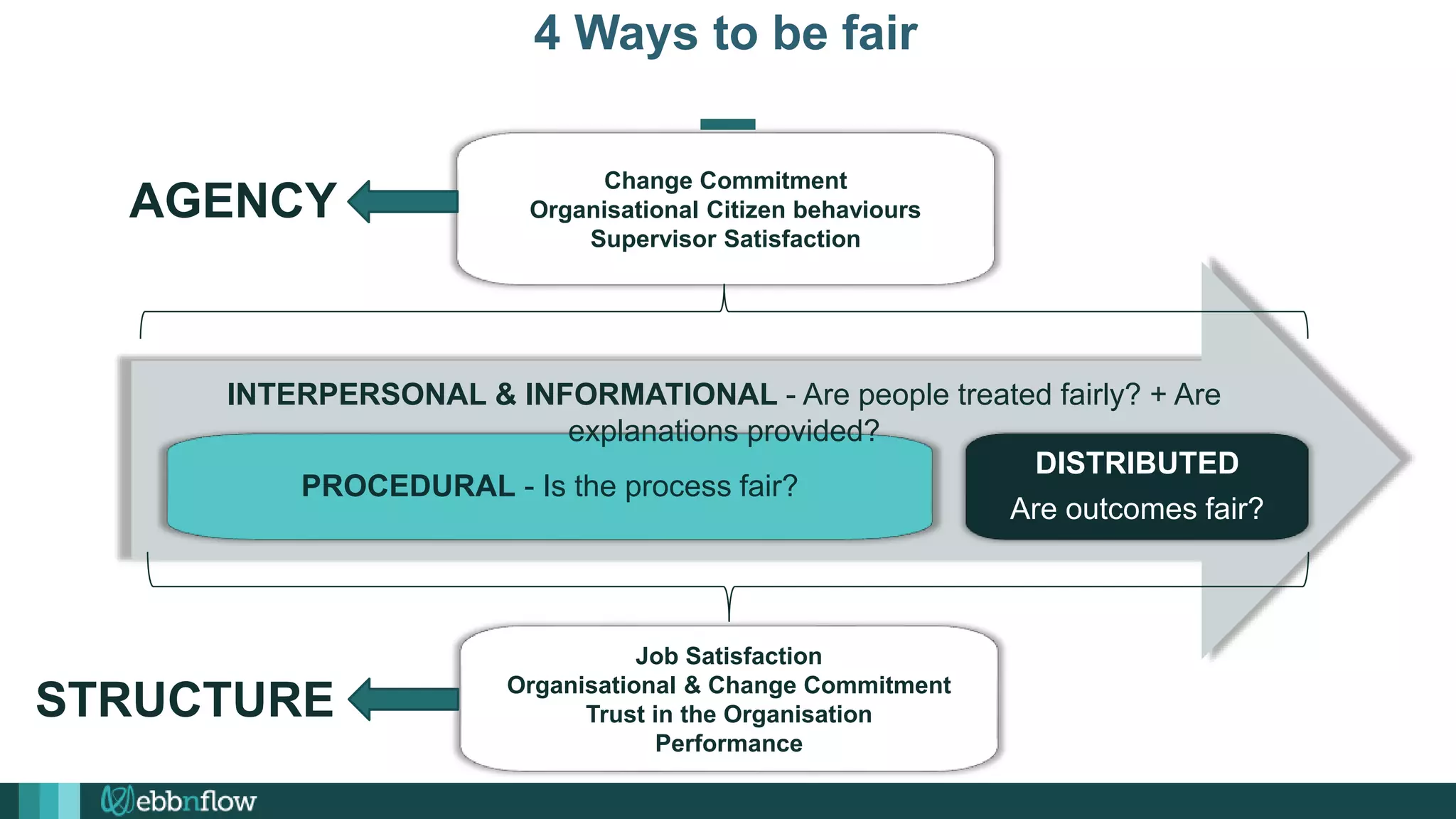
Change Commitment
Organisational Citizen behaviours
Supervisor Satisfaction
4 Ways to be fair
PROCEDURAL - Is the process fair?
DISTRIBUTED
Are outcomes fair?
INTERPERSONAL & INFORMATIONAL - Are people treated fairly? + Are
explanations provided?
Job Satisfaction
Organisational & Change Commitment
Trust in the Organisation
Performance
AGENCY
STRUCTURE
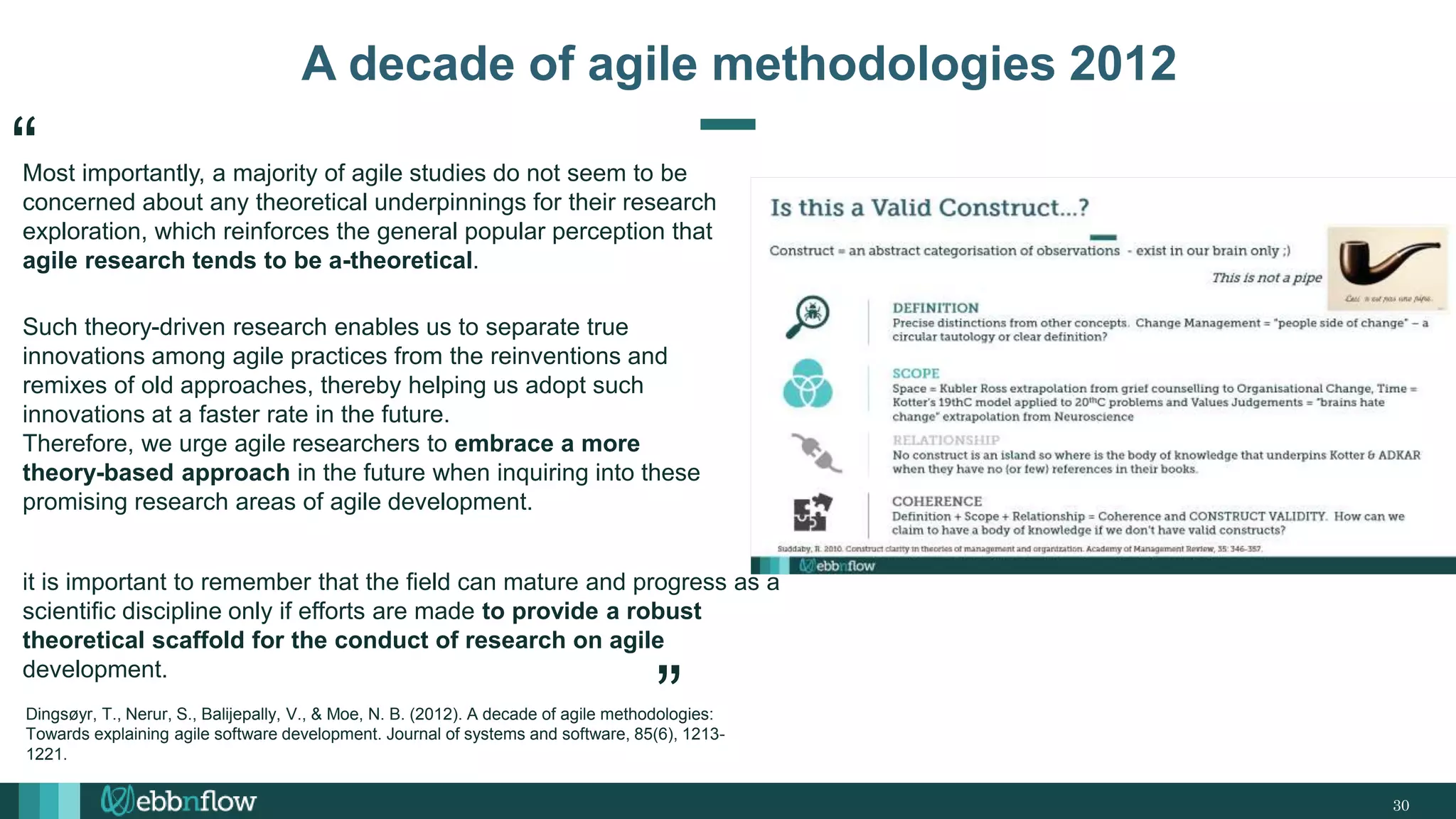
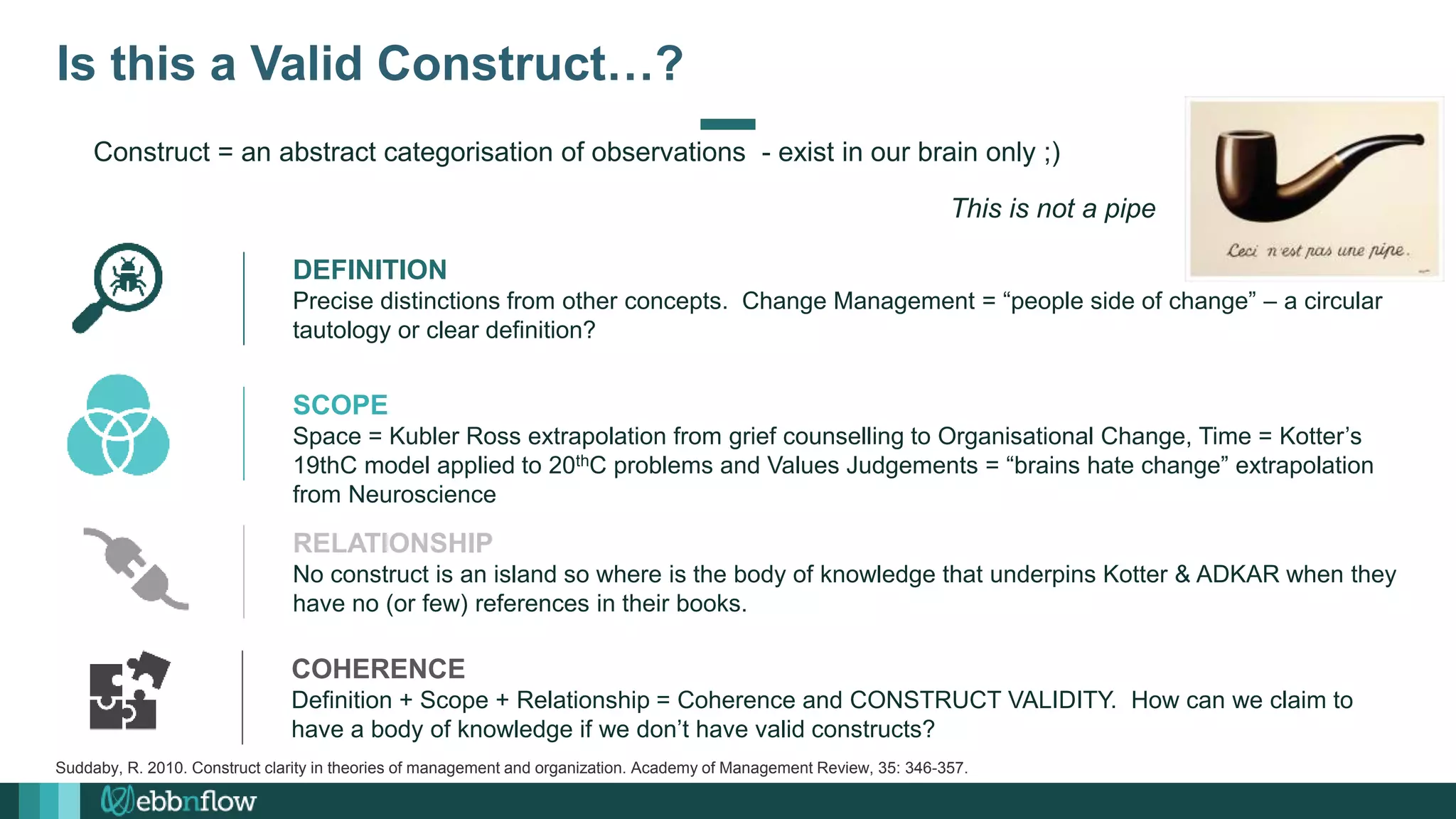
Is this a Valid Construct…?
COHERENCE
Definition + Scope + Relationship = Coherence and CONSTRUCT VALIDITY. How can we claim to
have a body of knowledge if we don’t have valid constructs?
RELATIONSHIP
No construct is an island so where is the body of knowledge that underpins Kotter & ADKAR when they
have no (or few) references in their books.
SCOPE
Space = Kubler Ross extrapolation from grief counselling to Organisational Change, Time = Kotter’s
19thC model applied to 20thC problems and Values Judgements = “brains hate change” extrapolation
from Neuroscience
DEFINITION
Precise distinctions from other concepts. Change Management = “people side of change” – a circular
tautology or clear definition?
Suddaby, R. 2010. Construct clarity in theories of management and organization. Academy of Management Review, 35: 346-357.
Construct = an abstract categorisation of observations - exist in our brain only ;)
This is not a pipe
Change & Performance

Agile Organisational Change

  • 1.
    Agile Organisational Change Jointhe conversation 7-9pm 6th October 2022 Presented by Alex Boulting The aim of these monthly talks is to crowd-source a body of knowledge from people who have experience in Organisational Change.
  • 2.
  • 3.
  • 4.
  • 6.
  • 7.
    1930’s 1970s 1990s2010s 1950/60s 1980s 2000s iterative and incremental development’s grew from the 1930s work of Walter Shewhart a quality expert at Bell Labs who proposed a series of short “plan-do-study-act” (PDSA) cycles for quality improvement adopted by Demming “The fundamental idea was to build in small increments, with feedback cycles involving the customer for each.” Evo(lutionary) method focused on time boxed short iterations Plan-Do-Study-Act Adaptive & Spiral Programming DSDM + XP Agile Alliance Agile Change In February 2001, a group of 17 process experts—representing DSDM, XP, Scrum, FDD, and others to promote modern iterative methods called the Agile Alliance (www.agilealliance.org) f Coutu (2002) 13 and Luthans (2002a, 2002b) result of 9/11 focus back on external factors and building resilience through individual strengths. Positive psychology = self efficacy & learned optimism Failing water-fall method. 1994 16 rapid application development (RAD) practitioners met in the UK to discuss the definition of a standard iterative process. Rational Unified Process = daily build & smoke test. Kent Beck developed XP with Chrysler “Managing the Development of Large Software Systems,” Winston Royce’s waterfall model hinted at iterative development Feedback-driven refinement with customer involvement and clearly delineated iterations at IBM. Waterfall is dominant method Agile Waterfall Incremental Development Major projects such as e X-15 hypersonic jet, NASA’s early 1960s Project Mercury which also seeded IBM Federal Systems Division (FSD) & Space Programme Edwards Deming pubslies Out of the Crisis. In 1982 ' Takeuchi, H. and I. Nonaka (1986) ‘rugby method’ SCRUM “1998 CHAOS: Charting the Seas of Information Technology,” a report that analyzed 23,000 projects failers associated with waterfall practices Larman, C., & Basili, V. R. (2003). Iterative and incremental developments. a brief history. Computer, 36(6), 47-56.
  • 8.
    It’s simple toexplain and recall. “Do the requirements, then design, and then implement.” IID is more complex to understand and describe. Even Winston Royce’s original two iteration waterfall immediately devolved into a single sequential step as other adopters used it and writers described it. It gives the illusion of an orderly, accountable, and measurable process, with simple document-driven milestones (such as “requirements complete”). Simplicity Illusion of order Embedded Knowledge Why did agile take so long to catch on? It was promoted in many software engineering, requirements engineering, and management texts, courses, and consulting organizations. It was labeled appropriate or ideal, seemingly unaware of this history or of the statistically significant research evidence in favor of IID. Larman, C., & Basili, V. R. (2003). Iterative and incremental developments. a brief history. Computer, 36(6), 47-56.
  • 9.
    9 History Of ChangeManagement 2
  • 10.
    10 1950s 1960s 1980s 1970s1990s 2000s 2010s 2020s 1940s From Kurt Lewin (1943) to Paul Lawrence (1958) change and organisational development is conceived as a set of causal relationships within a ‘social system’ built on scientific constructs. Allport (1937) ‘functional autonomy’ & Maslow’s (1943) ‘general dynamic theory’ integrate psychological & physiological approaches to human motivation. White 1959 uses the words ‘competence & efficacy’ to describe the human need to ‘‘learn to interact effectively with his environment’ Lewin (1947) mentions “unfreezing, change of level, and freezing on the new level” (UCF) ‘theory’. Lewin believes that force is needed to “break the habit” (unfreeze), change, Freeze change management (UCF) & restraining forces although he views people not being either entirely fluid or rigid. Coch & French (1948) – use the phrase ‘overcoming resistance to change’ Lewin’s UCF is extrapolated by Lippit et al (1958) to 7 stages who cites Lewin’s ‘three phase model’ & creates the term ‘change agents’ Schien (1961) uses Lewins ‘3-phase’ model in his model for culture change but doesn’t mention Lippit until Schein & Bennis 1965 who popularize T-Groups.. Kübler-Ross publishes her stages of grief theory (1969) based on collection of case studies taken from conversations with dying patients 1962 Maslow founds the Humanistic Psychology movement which soon becomes ‘pop’ movement 1979 Robbins’ Organizational Behavior published with no mention of Lewin’s UCF Forrester (1961) - publishes Industrial Dynamics which views organisations as complex systems. Burns & Stalker (1961) – find that less structured organisations can better adapt to dynamic environments 1965 Emery & Trist view organisations as ‘open systems’ responding to ‘environmental textures’ Katz & Kahn (1966) develop an ‘open- system theory’ of organisations. Current robust OD constructs emerge such as Dansereau’s (1973) – Leader Member Exchange, Bandura 1977 – Self- Efficacy & Gouldner, 1960 (Reciprocity) Social Exchange Theory ‘Pop’ psychology’ n-stage organisational change ‘arms race’ as 11 models in 11 years extrapolated from ‘Lewin’s’ UCR model Conner & Kotter embed ‘Sense of Urgency & Resistance Myths’. Methods fail to reference research & based mainly on personal experiences & case studies. Peters & Waterman (1982) publish In Search of Excellence Brief history of organisational change & development Birth of organisational change Birth of organisational change Explosion of management fads Meta Analysis & Myth Busting Scientific Approach to OD Systems Approach to OD Explosion of OD constructs Myth Development & Embedding OD constructs consolidated into more general theories such as Ryan & Deci (1985) Self Determination Theory, Theory of Planned Behaviour Lock & Latham (1988) Goal Setting while new theories emerge such as Kahn (1990) Psychological Safety & Employee Engagement, Weick’s (1995) Organisational Sensemaking help to build the foundations of modern OD thinking. Meta analysis techniques help to create robust OD constructs such as Self-Efficacy (Stajkovic & Luthans-1998), Organisational Justice (Colquitt et al 2013) Trust in Leadership (Dirks & Ferrin - 2002), Psychological Safety (Frazier et al 2017) Academics start to question the foundations of traditional organisational change models e.g., Hughes (2015) critiques Kotter & Cummings et al (2015) questions the Lewin’s UCF theory. BCG stress importance of evidence CIPD embrace evidence- based management (EBM) & produce ‘evidence reviews’ 2008 SCARF model loosely based on neuroscience leads to ‘brains hate change’ & other ‘neuro’ myths Lueke 2003 further embeds Kubler Ross myth & other ‘n-stage methods. Mcgregor’s (1957) X-Y theory ‘operationalises’ Maslow’s theory DiClemente and Prochaska (1982) – integrative model of behavioural change Birk & Letwin (1992) integrate OD theories into their causal model of organisational performance & change Hiatt (2006) ADKAR 5 step model uses outdated theory and case studies Stouten et al integrate organisational change methods with academic OD theories CMI Handbook (2015) integrates CM methods but also embeds myths such as MBTI, Learning Styles, Kubler-Ross, Amygdala Hijack, Maslow’s Hierarchy etc.
  • 11.
    Organisations As ComplexSystems “Traditional organisational theories have tended to view the human organisation as a closed system. This tendency has led to the disregard of differing organisational environments and the nature of organisational dependency on its environment” Katz & Kahn - 1966 01 02 03 “A main problem in the study of organisational change is that the environmental contexts in which organisations exist are themselves changing, at an increasing rate, and towards increasing complexity” Emery & Trist – 1965 “Organisations can be viewed as consisting of goal, task, technological, human-social, structural & external interface subsystems existing in a state of dynamic interdependence” p.82 French & Bell- 1972
  • 12.
    The Origins ofN-Step Change Model 01 02 1. The Develop Of A Need For Change (“unfreezing”), 2. Establishment of Change 3. Relationship, Working Toward Change (“moving”), 4. Generalisation & Stabilisation of Change (“freezing”) & 5. Achieving A Terminal Relationship Lippit’s 5-steps – 1958 1. Creating A Sense of Concern, 2. Developing A Specific Commitment to Change, 3. Pushing For Major Change, 4. Reinforcing & Consolidating New Course Phillip’s 4 Steps – McKinsey & Co - 1983 1. Create Urgency 2. Form a Powerful Coalition 3. Create a Vision for Change. 4. Communicate the Vision. 5. Remove Obstacles. 6. Create Short- Term Wins. 7. Build on the Change. 8. Anchor the Changes in Corporate Culture. Kotter’s 7 Steps – 1995
  • 13.
    13 Mind The Gap! Traditionalmodels not very agile?
  • 14.
    10 Problems withN-step Change Models Mental Models Time to Change? Practice Lack Of Evidence Out Of Date Extraordinary Extrapolations Gloomy Vision Self Fulfilling Top Down Project Based Closed Episodic Linear
  • 15.
    History Lesson ?Being comfortable with complexity We try to simplify it to make sellable, ‘operational’ & ‘practical’ methods We realise that our simplification does not work in practice We find the world as being is a complex system We re-theorise or jump on another bandwagon Reinventing or modifying the ‘wheel’ Complex Retry Failure Simplify
  • 16.
  • 17.
    17 What is ‘Agile’? In1998, the word ‘‘agile” was used in combination with ‘‘software process” for the first time M. Aoyama, Web-based agile software development, IEEE Software According to Highsmith and Cockburn (2001, p. 122), “what is new about agile methods is not the practices they use, but their recognition of people as the primary drivers of project success, coupled with an intense focus on effectiveness and manoeuvrability. This yields a new combination of values and principles that define an agile world view.” “rugby approach, the product development process emerges from the constant interaction of a hand-picked, multidisciplinary team whose members work together from start to finish. Rather than moving in defined, highly structured stages, the process is born out of the team members' interplay” Takeuchi, H. and I. Nonaka (1986) Agile = A people centric approach to change = change/organisational change? Agile is method of organisational change – So the idea of Agile Change Management becomes a bit redundant?
  • 18.
    18 Agile Manifesto The Agilemanifesto written in 2001 focusses on 4 core values: 1. Individuals and interactions over processes and tools. 2. Working software over comprehensive documentation. 3. Customer collaboration over contract negotiation. 4. Responding to change over following a plan Principles behind the Agile Manifesto We follow these principles: 1. Our highest priority is to satisfy the customer through early and continuous delivery of valuable software. 2. Welcome changing requirements, even late in development. Agile processes harness change for the customer's competitive advantage. 3. Deliver working software frequently, from a couple of weeks to a couple of months, with a preference to the shorter timescale. 4. Business people and developers must work together daily throughout the project. 5. Build projects around motivated individuals. Give them the environment and support they need, and trust them to get the job done. 6. The most efficient and effective method of conveying information to and within a development team is face-to-face conversation. 7. Working software is the primary measure of progress. 8. Agile processes promote sustainable development. The sponsors, developers, and users should be able to maintain a constant pace indefinitely. 9. Continuous attention to technical excellence and good design enhances agility. 10.Simplicity--the art of maximizing the amount of work not done--is essential. 11.The best architectures, requirements, and designs emerge from self-organizing teams. 12.At regular intervals, the team reflects on how to become more effective, then tunes and adjusts its behavior accordingly. https://agilemanifesto.org/
  • 19.
    Wellbeing Improved Learning Responsive Requirements Minimising cost of change SCRUM,XP etc Agile Methods Learning Transfer Management Support. Team Cohesion Collaboration Self Transcendence OUTCOMES??? Overview of Agile Autonomy Tension Self Organisation High Customer / Stakeholder Satisfaction STATES Customer Centric Efficiency
  • 20.
    Kent Beck reallytalking about psychological safety Communication What is the simplest thing that could possibly work Simplicity Interpersonal & from the software. A precondition of complex systems Feedback Courage to speak up & challenge is an outcome of psychological safety Courage This is part of psychological safety & interpersonal relationships Respect XP Values Social States (e.g. Psychological Safety, Trust etc) + Cognitive States (e.g. Information Sharing, Collective Memory etc)
  • 21.
  • 22.
    22 The origins ofthe ‘rugby approach’ “A group of engineers, for example, may start to design the product (phase three) before all the results of the feasibility tests (phase two) are in. Or, the team may be forced to reconsider a decision as a result of later information. The team does not stop then, but engages in iterative experimentation. This goes on in even the latest phases of the development process.” “Traditional, sequential, linear approach to product development” “The overlap approach is represented by type B, where the overlying occurs only at the border of adjacent phases,” “Type C, where the overlap extends across several phases.”
  • 23.
  • 24.
    24 2008 Systematic Reviewof Agile Dybå, T., & Dingsøyr, T. (2008). Empirical studies of agile software development: A systematic review. Information and software technology, 50(9-10), 833-859. Identified 36 studies on Agile Software development 76% on XP, 15% General Agility, 3% SCRUM & 3% Lean Rigour. Has a thorough and appropriate approach been applied to key research methods in the study? Credibility. Are the findings well- presented and meaningful? Relevance. How useful are the findings to the software industry and the research community?
  • 25.
    Mixed results. Somestudies found moving away from waterfall as a positive. Some XP principles work (customer collaboration, learning) others less so (paired programmers). More suited to small teams than complex organisations. Lack of attention to design and architecture issues. Introduction & Adoption 01 02 XP can thrive in different org cultures, increases collaboration, team self efficacy , mutual respect, trust & wellbeing. Balances team and individual autonomy. XP works best for experienced teams Human & Social Factors High customer satisfaction & increase involvement e.g. daily scrum. Popular amongst developers increasing productivity. Pair programming popular but difficult if imbalance in skill. Students see it as an opportunity to learn. Perceptions of Agile Methods Agile more ‘operations’ than project management. Combine gate stage with agile. Agile more able to meet customer requirements. Higher productivity on 1st iteration. Agile = high level of code but same functionality. Not necessarily higher levels of team cohesion & difficult to reassign Comparative Studies 03 04 Contradictory Findings
  • 26.
    26 2015 Empirical Study– Does Agile Work? Serrador, P., & Pinto, J. K. (2015). Does Agile work?—A quantitative analysis of agile project success. International journal of project management, 33(5), 1040-1051. Survey completed by 859 practitioners collected from PMI, LinkedIn for all types of projects. Total of 1386 projects Asked to rank how successful project was in terms of budget, requirements, client satisfaction, and overall success. Findings - Amount of agile used has a statistically significant impact on three dimensions of project success – efficiency, stakeholder satisfaction and overall success - Vision and goals of project act as a significant moderator between Agile methods & project success. Team experience & project complexity were not found to moderate the effect - But overall small effects - Planning in Agile = Planning in Traditional methods - Best used in high tech environments
  • 27.
    27 Challenges & successfactors for large-scale agile transformations 2016 52 publications describing 42 industrial cases presenting the process of taking large-scale agile development into use. Almost 90% of the included papers were experience reports, indicating a lack of sound academic research on the topic. What is agile? a whole system change? Dikert, K., Paasivaara, M., & Lassenius, C. (2016). Challenges and success factors for large-scale agile transformations: A systematic literature review. Journal of Systems and Software, 119, 87-108.
  • 28.
    28 2020 Factors AffectingAgile Team Capability = Utilisation of Team Knowledge, team members’ motivation and commitment, agile knowledgeable managers with an adaptive management style, and proper provision of technical training to the project team
  • 29.
  • 30.
    30 A decade ofagile methodologies 2012 Most importantly, a majority of agile studies do not seem to be concerned about any theoretical underpinnings for their research exploration, which reinforces the general popular perception that agile research tends to be a-theoretical. Such theory-driven research enables us to separate true innovations among agile practices from the reinventions and remixes of old approaches, thereby helping us adopt such innovations at a faster rate in the future. Therefore, we urge agile researchers to embrace a more theory-based approach in the future when inquiring into these promising research areas of agile development. it is important to remember that the field can mature and progress as a scientific discipline only if efforts are made to provide a robust theoretical scaffold for the conduct of research on agile development. “ “ Dingsøyr, T., Nerur, S., Balijepally, V., & Moe, N. B. (2012). A decade of agile methodologies: Towards explaining agile software development. Journal of systems and software, 85(6), 1213- 1221.
  • 31.
    31 Can we applyAgile to Organisational Development 5
  • 32.
    32 Agile – Oldwine new bottles?
  • 33.
    Early 1900’s 19651984 2000’s 1960 1981 1993 Mayo 1933 & Whyte 1956 viewed organisations as complex social systems Staw et al. (1981) & Meyer (1982) how organisations respond to sudden ‘environmental jolts’ to their day-to-day operations. They suggested that organisations can either absorb (e.g., use redundancy such as employee resilience) or adapt (e.g., new ways of working) Social Cohesion Threat Rigidity Organisational Reliability Collective Mind Weick & Roberts (1993) came up with the idea of the 'Collective mind' where employees are mindful of the interrelationships of their actions within a system which helps create reliability e.g. through improvisation. Ties to meaning making Perrow’s (1984) towards internal organizational reliability; in particular, the reliability of complex intra- organizational processes and the avoidance of small failures resulting from Chernobyl, Exxon Valdez, Bhopal and the Space Shuttle Challenger Evolutionary approach ((Hannan and Freeman, 1977; Aldrich, 1979) & Strategic approach organisations have taken to adapt (Argenti, 1976; Rubin, 1977; Starbuckand Hedberg, 1977) Organisational Adaptation Levels Model All organizations are simultaneously rational and natural systems; and all are both open and closed systems (Thompson 1967). Must adapt by crafting structure. Led to Contingency Theory (sociological) Cranfield School of Management (2017) define Organizational Resilience as "the ability of an organization to anticipate, prepare for, respond and adapt to incremental change and sudden disruptions in order to survive and prosper.” Organisational Resilience
  • 34.
    A “critique ofrational and linear processes of planned change and emphasizes the importance of political and cultural factors in shaping change outcomes” “The time series data in The Awakening Giant illustrated how, why, and when change can occur in radical packages interspersed with eras of incremental adjustment.” Whipp and Pettigrew (1991/2) “emphasized the interactive, learning- by-doing character of management practice and the constant need for openness and flexibility of management thought and action” 34 Agile Pettigrew, A. M. (2012). Context and action in the transformation of the firm: A reprise. Journal of Management studies, 49(7), 1304-1328. 1985
  • 35.
    35 Multiple Approaches toOrganisational Change Subjective – feel time Objective – clock time Change happens to things (people) controlled by ‘variables’ People bring change into being (reality) through ‘events’ – the world is ‘becoming’ Van de Ven, A. H., & Poole, M. S. (2005). Alternative approaches for studying organizational change. Organization studies, 26(9), 1377-1404. HOLISM REDUCTIONISM Change as interrelations between variables Change controlled by variables Change as lived experience Change brings things into being AGILE? LINEAR?
  • 36.
    36 Helping organisations throughchange Unfreeze Unfreeze Refreeze Change Unfreeze Refreeze Change Change Refreeze Unfreeze Refreeze Change Change Unfreeze Unfreeze Refreeze Change Change Unfreeze Stop Motion Episodic Correlation Entities Boxes & Arrows N-Step Variance in Outcomes Reduction Outcomes Predictive from past LINEAR PARALLEL RECURSIVE CONJUNCTIVE Motion Pictures Fluid Contingent Action Entanglements Narrative Metaphor Poetics Whole Potentialities Generative from future WEAK ‘Process’ STRONG ‘Process’
  • 37.
    37 Beliefs V Behaviours LINEARRECURSIVE Bayesian Updating
  • 38.
    38 Agile Organisational ChangeModels Training Management Transformations People Management & Resistors Impact Studies & Support Diagnostic Change Le Grand, T., & Deneckere, R. (2019, July). COOC: an agile change management method. In 2019 IEEE 21st Conference on Business Informatics (CBI) (Vol. 2, pp. 28-37). IEEE. Franklin, M. (2021). Agile change management: A practical framework for successful change planning and implementation. Kogan Page Publishers.
  • 39.
    People Relying on people’screativity to adapt to changing user requirements. Embraces higher levels of change 39 People v Process Process Relying on process to make change efficient & predictable. Tried to reduce variation in requriemetns V “Dybå, T., & Dingsøyr, T. (2008). Empirical studies of agile software development: A systematic review. Information and software technology, 50(9-10), 833-859.
  • 40.
    THE DRIVE TO CONTROL Efficiency Predictability ReduceVariability Fixing Scope Command & Control Explict Knowledge Life-cycle Mechanistic Heavy Planning Late Testing THE DRIVE TO CO- CREATE Creativity Adaptivity Embrace Change Constant Feedback Self Organising Tacit Knowledge Evolutionary Organic Continuous Control Continuous Testing PEOPLE v PROCESS AGILE v TRADITIONAL
  • 41.
    Numerosity Disorder & Diversity Feedback Non-equilibrium 41 10characteristics of Complex Systems Spontaneous order and Self organisation Non-linearity Robustness Nested Structure & modularity History & memory Adaptive behaviour Emergence Ladyman, J., & Wiesner, K. (2020). What is a complex system?. Yale University Press.
  • 42.
    ENTROPY how (dis)organizedare you? Relationally Disorganised Fully Disorganised Dynamically Organised Fully Organised High Entropy High Randomness Low Structure High Autonomy High Free Energy Low Entropy Low Randomnes High Structure Low Autonomy Low Free Energy A system’s MEMORY (social exchange) compartmentalises (Markov Blankets) interactions & the system SPONTANEOUSLY SELF ORGANISES becoming MODULAR NUMEROSITY creates interactions between DIVERSE & DISORDERED people NON LINEAR FEEDBACK loops keep the system in dynamic (NON) EQUILBRIUM constantly adjusting to external forces creating stability through change (allostasis) The system becomes more rigid & less ROBUST & APDAPTIVE due to low autonomy & randomness and high structure Markov Blankets
  • 43.
    Complexity & OrganisationalChange Characteristic 5: Spontaneity & Self Order Dynamically Organised (Variable Relationships) Forced Organised (Invariant Relationships) More Structure More Agency Purpose Co-operation Employee Voice Employee Commitment Social Exchange Organisational Justice Mediated by…
  • 44.
    44 Best of bothworlds? Bottom-up employee voice, fairness etc So what makes effective teams?
  • 45.
    AGILE & theMechanics of Complex Systems Free Energy Entropy Free Energy Bayesian Updating Active Inference Markov Blankets Does agile help to keep organisations as complex adaptive systems?
  • 46.
  • 47.
    47 What is TeamEffectiveness ? 1) Formally established, 2) Assigned (some) autonomy 3) Interdependent - Task Performance - Contextual/adaptive Performance, (e.g., learning, creativity, decision making) - Behaviours = actions to achieve goals e.g., feedback seeking, reflectivity, information sharing, communication, co-ordination etc - Emergent Cognitive states = respect, psychological safety, caring, enjoying each other’s company - Permanent States - Outcomes = consequences of behaviours e.g., items sold, clients served etc - Effectiveness = results - Efficiency = cost of achieving results TEAM EFFECTIVENSSS
  • 48.
    TEAM COGNITION Information Sharing CollectiveMemory Cognitive Consensus Intrateam Trust Psychological Safety Team Cohesion Team Identification DIVERSITY Protected Characteristics Organisational Tenure Experience EFFECTIVE TEAM COGNITIVE STATES TEAM COMPOSITION SOCIAL STATES Debriefing Sessions PERSONALITY (Big Five) Agreeableness & Conscientiousness TEAM LEARNING Questioning Challenging Reflecting Team learning mediates cognition Teamwork Training Team Building Group Goals Attributes of Effective Teams & Interventions A Rapid Evidence Assessment of the Scientific Literature on the Attributes of Effective Teams and Interventions Increasing Team Effectiveness (CEBMa 2019) Context rather than composition determines team performance Information Sharing drives Trust & Cohesion
  • 49.
    1 2 3 4 Will others giveyou the benefit of doubt when you take a risk? Group belief People acknowledge and value being part of a team Friendships, caring for one another & enjoying each other’s company Will you give others the benefit of doubt when you take a risk? Individual belief Social States - Belongingness Intrateam Trust Psychological Safety Team Cohesion Team Identification Group Learning Accepting vulnerability & Learning 1 3 Critical for Virtual Teams & Inclusive teams 3 Organisational Citizenship Behaviours Clear Goals 4 4 Social Support Wellbeing
  • 50.
    5 6 7 8 9 10 Collective Memory -An indexing system that allow the team to understand who knows what Overlapping mental representation of knowledge, Skills, Attitudes, Dynamicity & Environment Cognitive Consensus - How ideas are defined, conceptualised & interpreted – we all know what we are talking about Information Sharing - Are all team members able to bring in their expertise to their full potential? Promotes trust & social cohesion Drives trust & cohesion How accurate and similar the Shared Mental Models are Group learning – are we able to question, challenge & reflect on our mental models – assumptions we are making? Team Cognition - Usefulness Information Sharing Collective Memory Cognitive Consensus Reflexivity & Learning Shared Mental Models Group Learning Team Mental Models
  • 51.
  • 52.
    Different Types ofConflict Can be positively related to performance particularly amongst senior management. unless it creates relationship conflict. Type of task doesn’t affect conflict Task Always associated with negative impact on group outcomes Process Negatively related to group performance particularly if there is task conflict Relationship De Wit, F. R., Greer, L. L., & Jehn, K. A. (2012). The paradox of intragroup conflict: a meta- analysis. Journal of applied psychology, 97(2), 360. SCRUM = Built-in instability – broad challenging goals create tension creating self order but needs autonomy, self- transcendence & cross fertilisation Takeuchi, H. and I. Nonaka (1986)
  • 53.
    53 Given Agile –what is the future of Organisational Change? 7
  • 54.
    Precontemplation I won’t orI can’t Contemplation I might Preparation I will Action I am Realise ‘small wins’ to build belief Embed and habitualise change behaviours Understand the need & readiness for change Develop compelling vision & leadership capability Implement evidence-based interventions Support enabling practices & structures Maintenance I still am Individual Change Process Organisational Change Process PULSE PULSE PULSE PULSE Creating high performing cultures Operational level Strategic level Process Variance
  • 55.
    Summary of agileimpact on Organisational Change Robust capabilities create the building blocks for emergent change Create contextual conversations about which OD constructs need dialing up/down when & where Use other disciplines to think differently e.g. neuroscience, complexity systems etc Create a culture ‘pulse’ keep people top of mind and on the top table Avoid defining what is culture/change but under what conditions people are most likely to thrive Bridging the gap between research & practice – create experimental learning cultures Delivering change in tiny doses builds efficacy in organisations ability to affect change
  • 56.
    AND ... Thank you! fromAlex Boulting Owner | ebbnflow +44 7562570000 alex@ebbnflow.co.u k www.ebbnflow.co.u k Stay tuned and check our newest videos on YouTube:
  • 57.
    Individual Level - IndividualChange Readiness - Motivating Change - Organisational Fairness Perceptions - Organisational Identification Group Level - High Quality Connections - Emergent Local Changes - Supervisory Support - Shared Goals & Beliefs Organisation Level - Leadership Competency - Trust In Leaders - Nature of the Change - Organisational Change Readiness BEST AVAILABLE EVIDENCE 1. Understand Get The Facts On The Nature of the Problem 2. Understand Assess & Address Readiness for Change 3. Develop & Communicate a Compelling Vision 4. Develop Effective Change Leadership 5. Implement : Evidence-Based Change Interventions 6. Support : Work with Social Networks and Tap Their Influence 7. Support : Use Enabling Practices to Support Implementation 8. Realise : Promote Micro-Processes and Experimentation 9. Realise : Change Progress and Outcomes over Time 10. Institutionalize the Change to Sustain Its Effectiveness INTEGRATED EVIDENCE BASED ORGANIZATIONAL CHANGE PRINCIPLES Stouten, J., Rousseau, D. M., & De Cremer, D. (2018). Successful organizational change: Integrating the management practice and scholarly literatures. Academy of Management Annals, 12(2), 752-788. ten Have, S., ten Have, W., Huijsmans, A. B., & Otto, M. (2016). Reconsidering change management: Applying evidence-based insights in change management practice. Routledge. Integrated Organisational Change Model 57 2 Kanter, Stein, and Jick’s Ten Commandments POPULAR ORGANISATIONAL CHANGE MODELS 1 1 Except for Kotter’s 8 Steps none of these models have been empirically tested 3 Appreciative Inquiry
  • 58.
    ORGANISATIONAL CHANGE ‘defining and adopting corporatestrategies, structures, procedures and technologies to handle changes in external conditions and the business environment.’ SHRM “ ‘the application of a structured process and set of tools for leading the people side of change to achieve a desired outcome’ PROSCI CHANGE MANAGEMENT ORGANISATIONAL DEVELOPMENT ‘a planned and systematic approach to enabling sustained organisational performance through the involvement of its people’ CIPD 2020 The practice of adapting human capability to meet internal & external ambitions STRATEGIC HR MANAGEMENT The choice, alignment, and integration of an organisation’s HRM system so that its human capital resources most effectively contribute to strategic business objectives.’ Kaufman (2015: 404) IES 2019 DEFINITION : Spot the difference?
  • 59.
    ORGANISATIONAL FLEXIBILITY ‘a combination ofa repertoire of organizational and managerial capabilities that allow organizations to adapt quickly under environmental shifts’ (Hatum and Pettigrew 2004, p. 239). “ ‘‘the regulation and/or insulation of organizational processes, functions, entities, or individuals from the effects of environmental uncertainty or scarcity.” (Lynn 2005, p. 38) ORGANISATIONAL BUFFERING ORGANISATIONAL CHANGE CAPABILITY ‘a combination of managerial and organizational capabilities that allows an enterprise to adapt more quickly and effectively than its competitors to changing situations’ (Judge and Douglas 2009, p. 635). The practice of continually adapting human capability to meet an organisation’s internal & external ambitions ORGANISATIONAL CAPACITY ‘the capacity of an organization to respond to changing external environment’ (Staber and Sydow) 2002). DEFINITION : Spot the difference?
  • 60.
  • 61.
    61 Beliefs V Behaviours LINEARRECURSIVE Bayesian Updating
  • 62.
    62 Similar uses ofthe Framework Lips‐Wiersma, M. (2002). The influence of spiritual “meaning‐making” on career behavior. Journal of Management Development. Paul Gibbons ‘The Science of Organisational Change’
  • 63.
    The Burke-Litwin ChangeModel Feedback Feedback External Environment Leadership Management Practices Work Unit Climate Motivation Ind. & Org. Performance Mission and Strategy Organizational Culture Structure Systems ( Policy & Procedure ) Individual Skills & Tasks Individual Needs & Values Subjective Intersubjective Interobjective Objective
  • 64.
    Internal Cohesion Seven Levelsof Sustainability, Richard Barrett (1998) 7 6 5 4 3 2 1 Organizational Motivations Human Motivations Service Making a difference Self-Esteem Relationship Survival Transformation Societal Sustainability Community Sustainability Cultural Sustainability Organizational Sustainability Social Sustainability Financial Sustainability Structural Sustainability
  • 65.
    Schein's Culture Framework PlaceholderPlaceholder Artifacts & Behaviour Norms & Values Basic Assumptions What we see What they say What they may not realise
  • 66.
    The Burke-Litwin ChangeModel Feedback Feedback External Environment Leadership Management Practices Work Unit Climate Motivation Ind. & Org. Performance Mission and Strategy Organizational Culture Structure Systems ( Policy & Procedure ) Individual Skills & Tasks Individual Needs & Values
  • 67.
    67 Hatch’s Cultural DynamicsModel Values Artifacts Symbols Assumptions SUBJECTIVE ACTIVITY Identity OBJECTIVE ACTIVITY Action OBJECTIVE REFLEXIVITY Image SUBJECTIVE REFLEXIVITY Meaning REFLEXIVITY ACTIVITY DIALOGUE
  • 68.
    68 • Hierarchy createssubsystems • Division of functions, • Specialisation pecialisms and levels of function emerge interacting with each other • Modularity as different groups have different roles formed by the the clustering of networks e.g. projects Complexity & Organisational Change Characteristic 8: Modularity
  • 69.
    Change Commitment Organisational Citizenbehaviours Supervisor Satisfaction 4 Ways to be fair PROCEDURAL - Is the process fair? DISTRIBUTED Are outcomes fair? INTERPERSONAL & INFORMATIONAL - Are people treated fairly? + Are explanations provided? Job Satisfaction Organisational & Change Commitment Trust in the Organisation Performance AGENCY STRUCTURE
  • 70.
    Is this aValid Construct…? COHERENCE Definition + Scope + Relationship = Coherence and CONSTRUCT VALIDITY. How can we claim to have a body of knowledge if we don’t have valid constructs? RELATIONSHIP No construct is an island so where is the body of knowledge that underpins Kotter & ADKAR when they have no (or few) references in their books. SCOPE Space = Kubler Ross extrapolation from grief counselling to Organisational Change, Time = Kotter’s 19thC model applied to 20thC problems and Values Judgements = “brains hate change” extrapolation from Neuroscience DEFINITION Precise distinctions from other concepts. Change Management = “people side of change” – a circular tautology or clear definition? Suddaby, R. 2010. Construct clarity in theories of management and organization. Academy of Management Review, 35: 346-357. Construct = an abstract categorisation of observations - exist in our brain only ;) This is not a pipe Change & Performance