What is Scrum?
And Why?
Keisuke Daimon
(10 min)
What is Scrum?
Our tech team is trying to follow a software development framework, Scrum.
But.. What is Scrum?
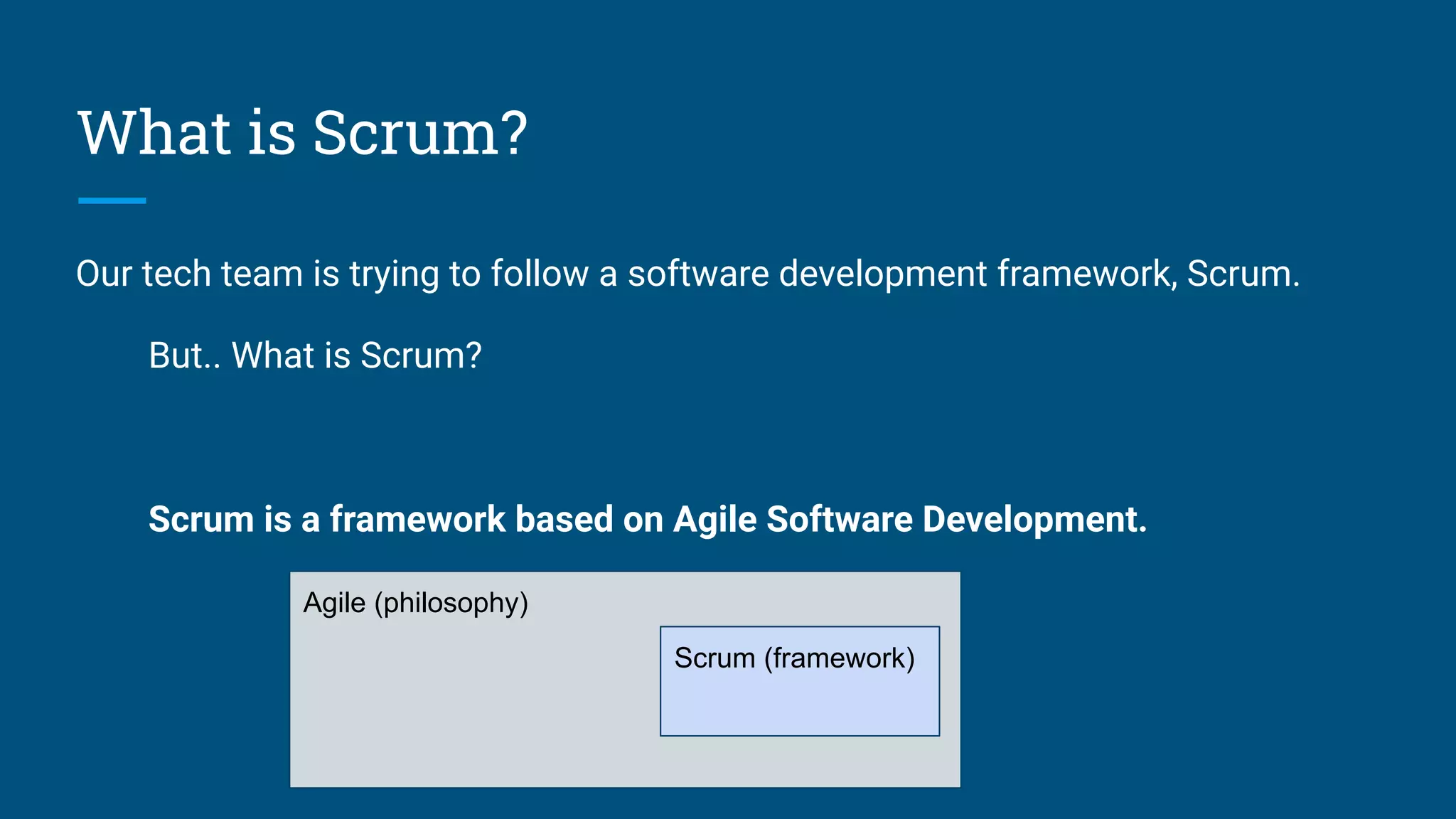
Scrum is a framework based on Agile Software Development.
Agile (philosophy)
Scrum (framework)
Then what is Agile? Why do we need it?
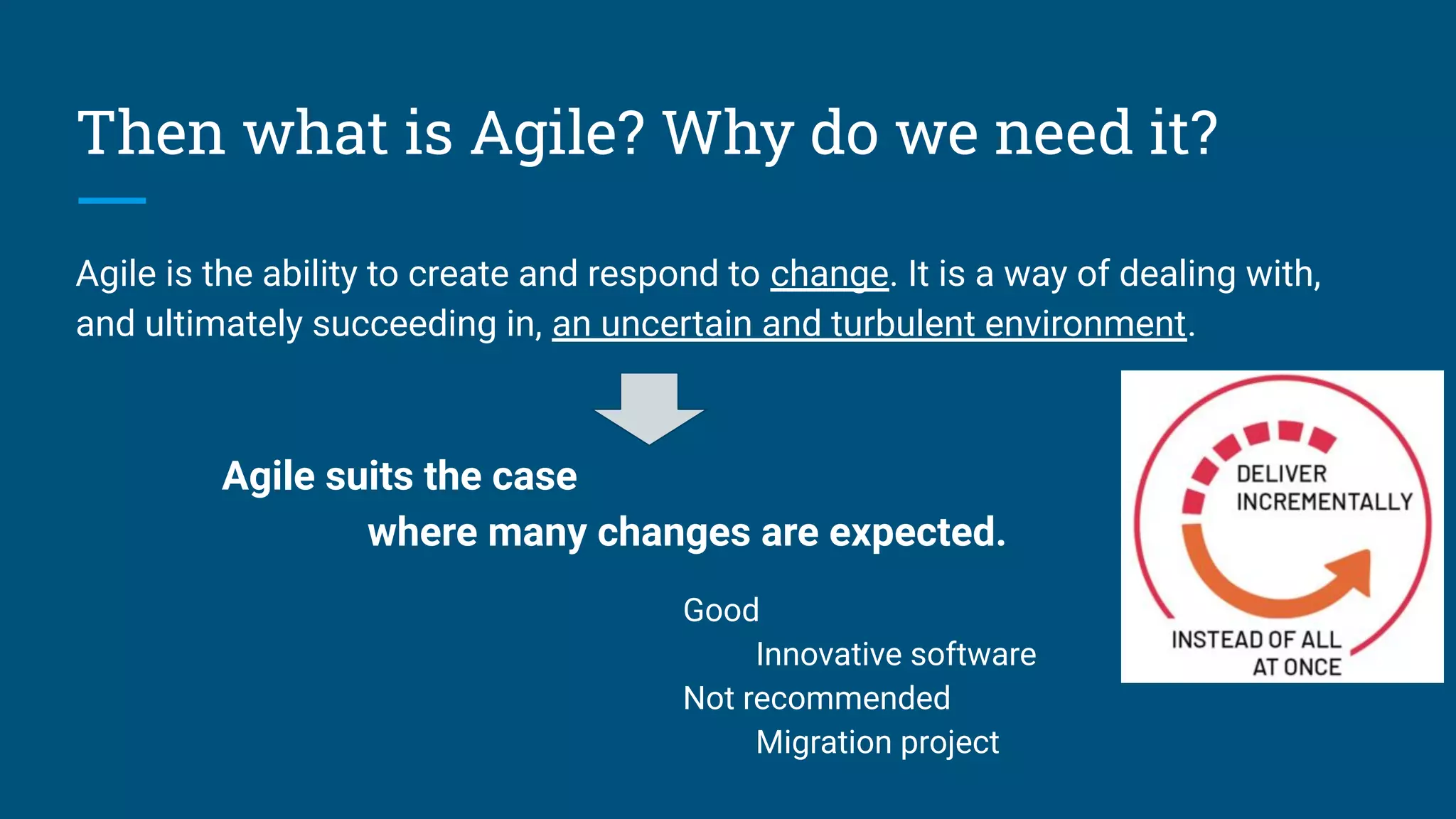
Agile is the ability to create and respond to change. It is a way of dealing with,
and ultimately succeeding in, an uncertain and turbulent environment.
Agile suits the case
where many changes are expected.
Good
Innovative software
Not recommended
Migration project
Manifesto for Agile Software Development
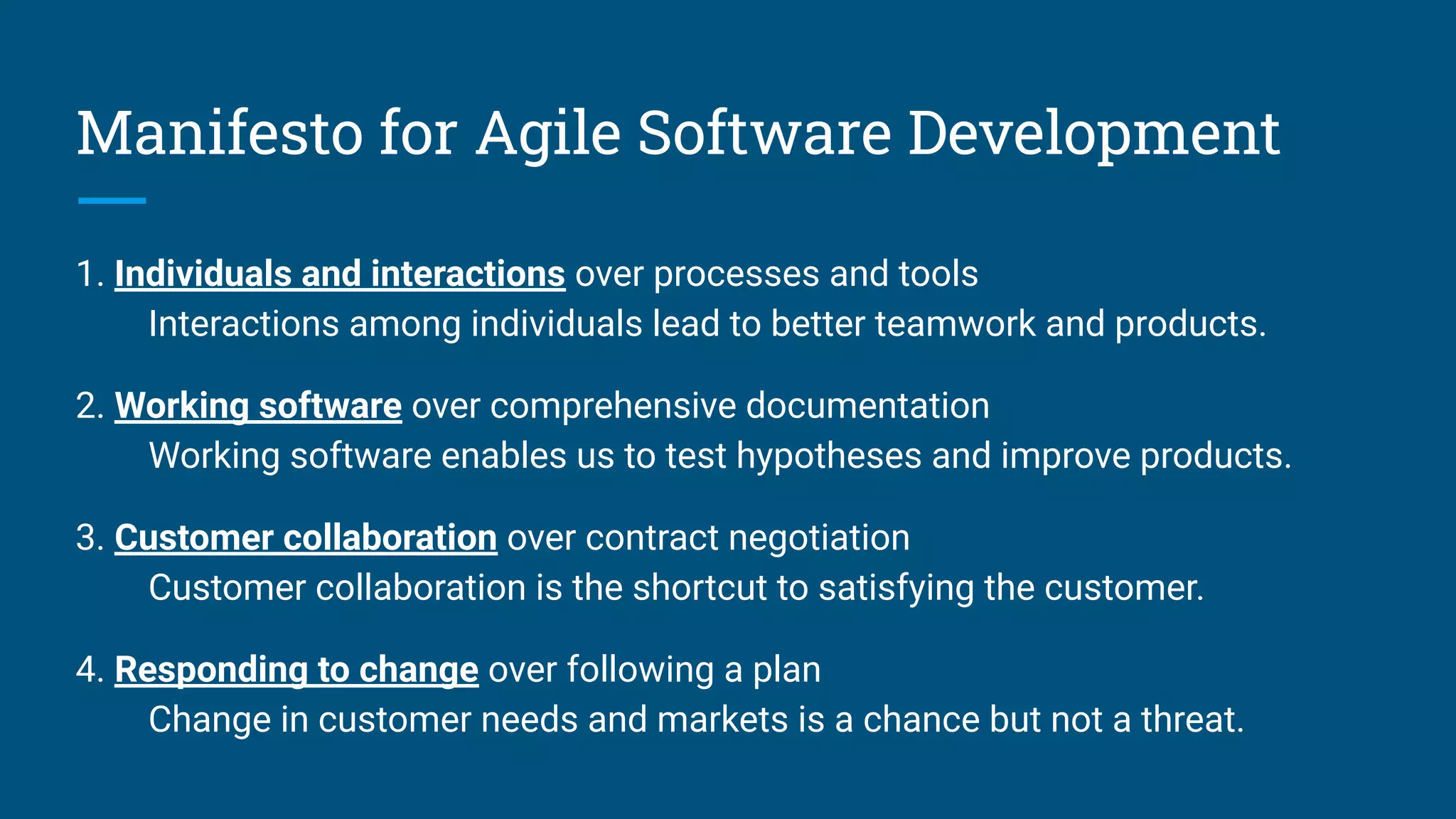
1. Individuals and interactions over processes and tools
Interactions among individuals lead to better teamwork and products.
2. Working software over comprehensive documentation
Working software enables us to test hypotheses and improve products.
3. Customer collaboration over contract negotiation
Customer collaboration is the shortcut to satisfying the customer.
4. Responding to change over following a plan
Change in customer needs and markets is a chance but not a threat.
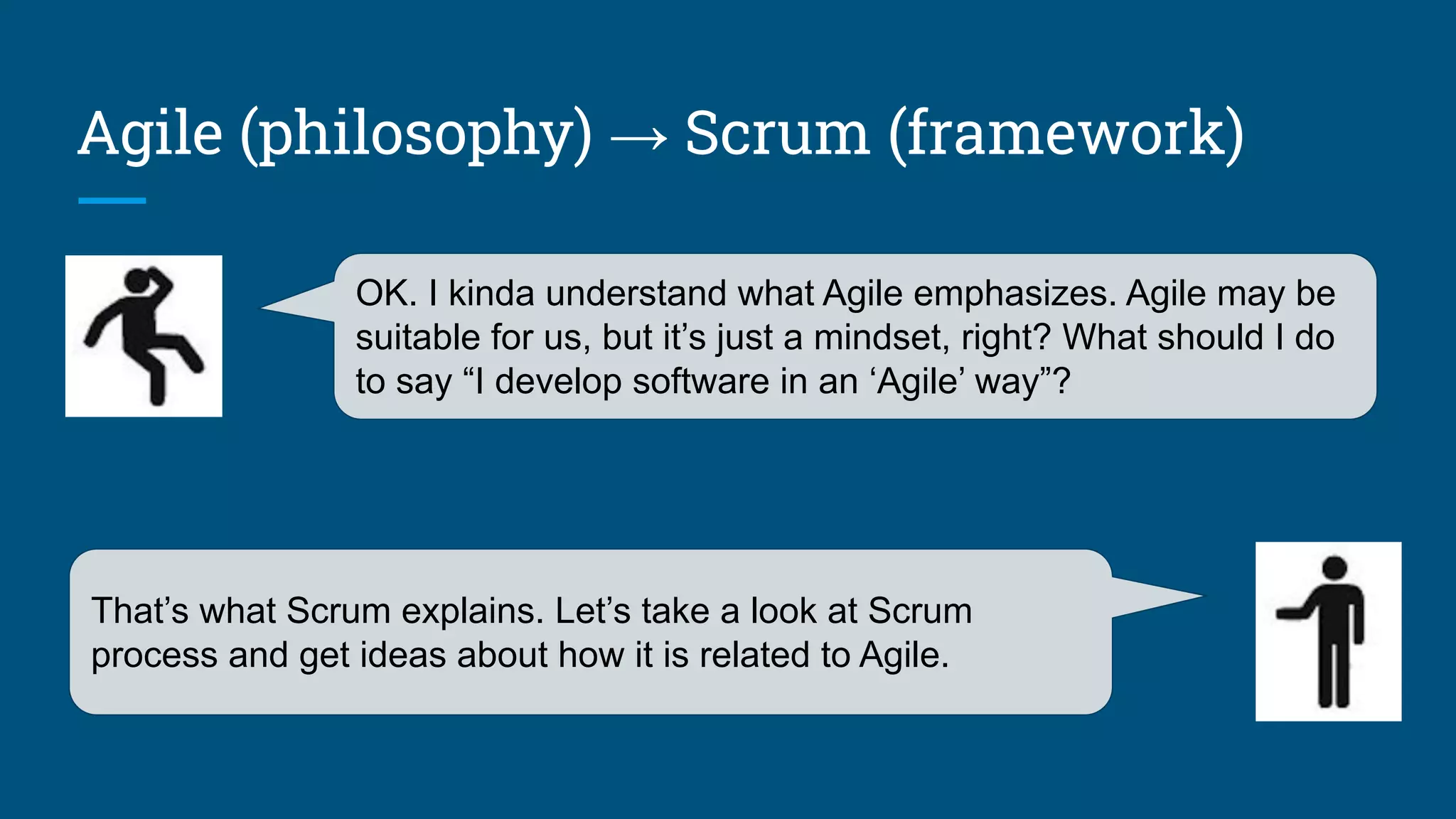
Agile (philosophy) → Scrum (framework)
OK. I kinda understand what Agile emphasizes. Agile may be
suitable for us, but it’s just a mindset, right? What should I do
to say “I develop software in an ‘Agile’ way”?
That’s what Scrum explains. Let’s take a look at Scrum
process and get ideas about how it is related to Agile.
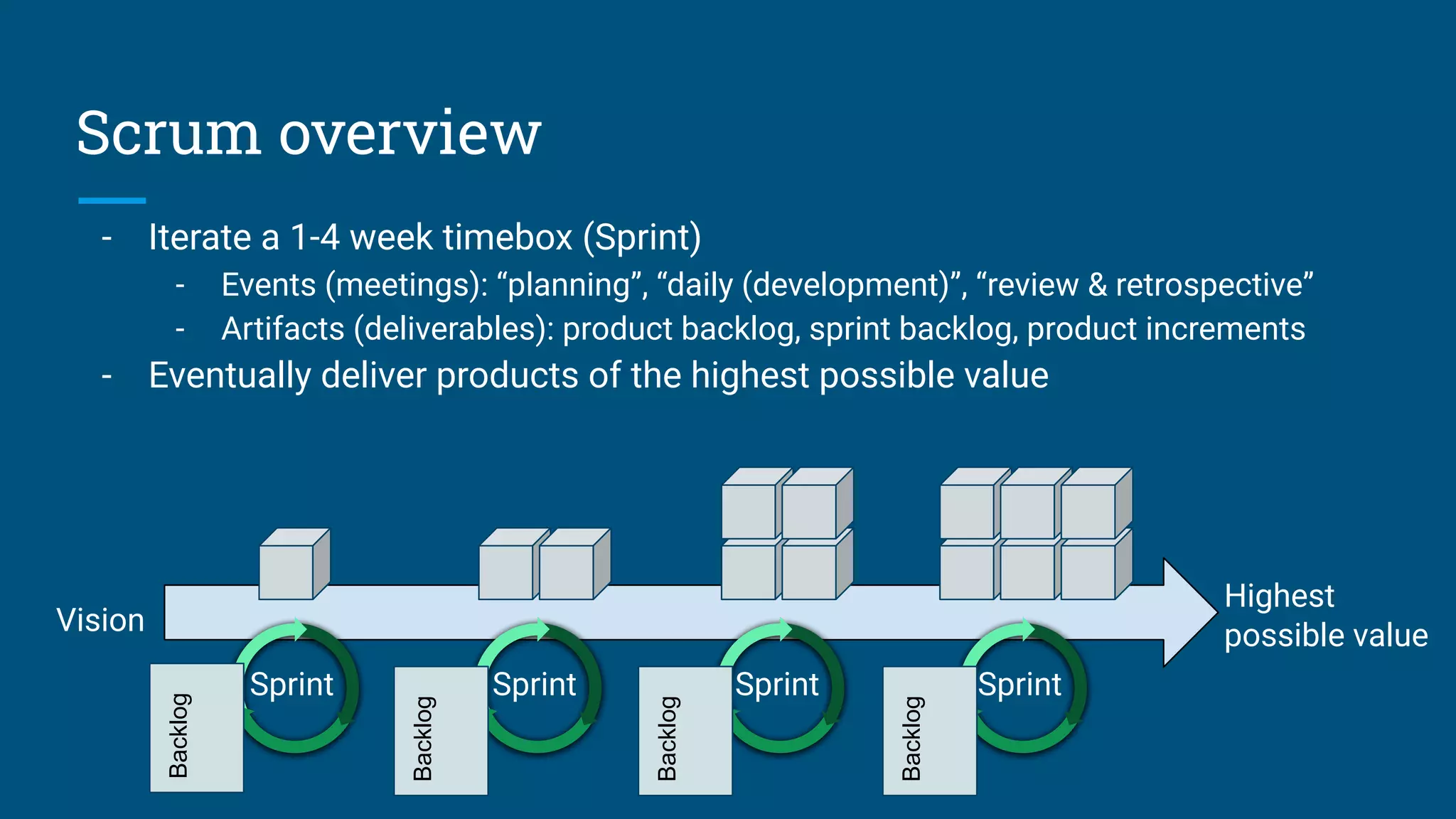
Scrum overview
- Iterate a 1-4 week timebox (Sprint)
- Events (meetings): “planning”, “daily (development)”, “review & retrospective”
- Artifacts (deliverables): product backlog, sprint backlog, product increments
- Eventually deliver products of the highest possible value
Sprint Sprint Sprint Sprint
Highest
possible value
Backlog
Backlog
Backlog
Backlog
Vision
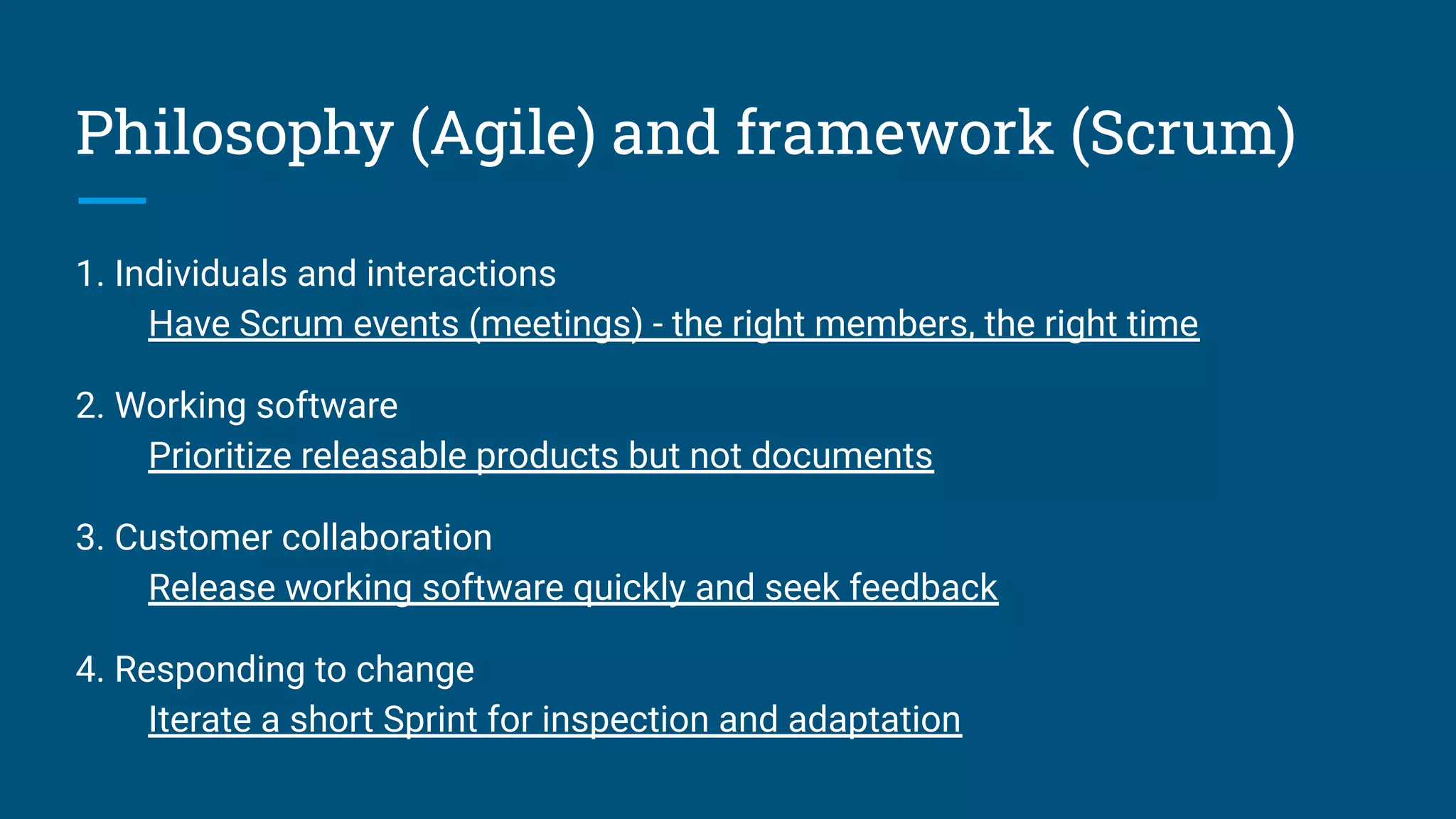
Philosophy (Agile) and framework (Scrum)
1. Individuals and interactions
Have Scrum events (meetings) - the right members, the right time
2. Working software
Prioritize releasable products but not documents
3. Customer collaboration
Release working software quickly and seek feedback
4. Responding to change
Iterate a short Sprint for inspection and adaptation
Product backlog
Scrum Sprint
Sprint
(1-4 weeks)
1. Planning
[Planning] Decide Sprint
Goal for next Sprint
3. Review & Retrospective
[Review] Check if the product increment creates value
[Retrospective] Improve people, process and tools
Feature 1
Feature 2
Sprint backlog
Feature 1
Feature 2
Vision
Biz value
Once
per Sprint
2. Development
[Daily] Create a potentially
releasable increment
[ ]: Name of meeting
Update any time
Daily
Takeaways
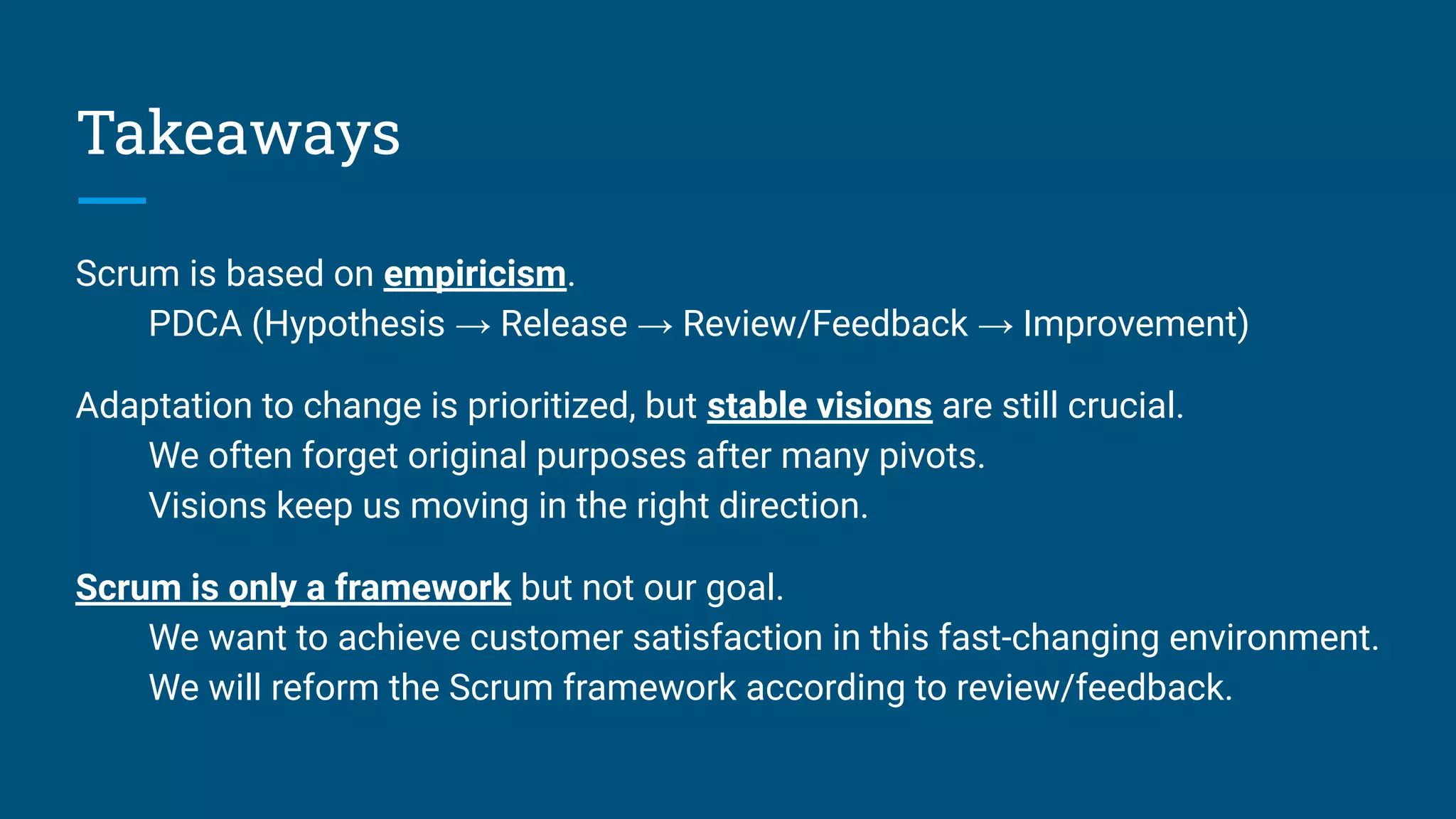
Scrum is based on empiricism.
PDCA (Hypothesis → Release → Review/Feedback → Improvement)
Adaptation to change is prioritized, but stable visions are still crucial.
We often forget original purposes after many pivots.
Visions keep us moving in the right direction.
Scrum is only a framework but not our goal.
We want to achieve customer satisfaction in this fast-changing environment.
We will reform the Scrum framework according to review/feedback.
Thank you
References
Official
Manifesto for Agile Software Development
Principles behind the Agile Manifesto
The Scrum Guide
Links (English)
[Agile Alliance] Agile 101
[cprime] What is Agile? What is Scrum?
Links (Japanese)
[IPA] アジャイルソフトウェア開発宣言の読みとき方
[三菱電気 細谷泰夫] スクラムと品質
[RAKUTEN Mitsuyuki Shiiba] 結果的にスクラムになってる!なのがいいと思う!

What is Scrum? And Why? (For Stakeholders)

  • 1.
    What is Scrum? AndWhy? Keisuke Daimon (10 min)
  • 2.
    What is Scrum? Ourtech team is trying to follow a software development framework, Scrum. But.. What is Scrum? Scrum is a framework based on Agile Software Development. Agile (philosophy) Scrum (framework)
  • 3.
    Then what isAgile? Why do we need it? Agile is the ability to create and respond to change. It is a way of dealing with, and ultimately succeeding in, an uncertain and turbulent environment. Agile suits the case where many changes are expected. Good Innovative software Not recommended Migration project
  • 4.
    Manifesto for AgileSoftware Development 1. Individuals and interactions over processes and tools Interactions among individuals lead to better teamwork and products. 2. Working software over comprehensive documentation Working software enables us to test hypotheses and improve products. 3. Customer collaboration over contract negotiation Customer collaboration is the shortcut to satisfying the customer. 4. Responding to change over following a plan Change in customer needs and markets is a chance but not a threat.
  • 5.
    Agile (philosophy) →Scrum (framework) OK. I kinda understand what Agile emphasizes. Agile may be suitable for us, but it’s just a mindset, right? What should I do to say “I develop software in an ‘Agile’ way”? That’s what Scrum explains. Let’s take a look at Scrum process and get ideas about how it is related to Agile.
  • 6.
    Scrum overview - Iteratea 1-4 week timebox (Sprint) - Events (meetings): “planning”, “daily (development)”, “review & retrospective” - Artifacts (deliverables): product backlog, sprint backlog, product increments - Eventually deliver products of the highest possible value Sprint Sprint Sprint Sprint Highest possible value Backlog Backlog Backlog Backlog Vision
  • 7.
    Philosophy (Agile) andframework (Scrum) 1. Individuals and interactions Have Scrum events (meetings) - the right members, the right time 2. Working software Prioritize releasable products but not documents 3. Customer collaboration Release working software quickly and seek feedback 4. Responding to change Iterate a short Sprint for inspection and adaptation
  • 8.
    Product backlog Scrum Sprint Sprint (1-4weeks) 1. Planning [Planning] Decide Sprint Goal for next Sprint 3. Review & Retrospective [Review] Check if the product increment creates value [Retrospective] Improve people, process and tools Feature 1 Feature 2 Sprint backlog Feature 1 Feature 2 Vision Biz value Once per Sprint 2. Development [Daily] Create a potentially releasable increment [ ]: Name of meeting Update any time Daily
  • 9.
    Takeaways Scrum is basedon empiricism. PDCA (Hypothesis → Release → Review/Feedback → Improvement) Adaptation to change is prioritized, but stable visions are still crucial. We often forget original purposes after many pivots. Visions keep us moving in the right direction. Scrum is only a framework but not our goal. We want to achieve customer satisfaction in this fast-changing environment. We will reform the Scrum framework according to review/feedback.
  • 10.
  • 11.
    References Official Manifesto for AgileSoftware Development Principles behind the Agile Manifesto The Scrum Guide Links (English) [Agile Alliance] Agile 101 [cprime] What is Agile? What is Scrum? Links (Japanese) [IPA] アジャイルソフトウェア開発宣言の読みとき方 [三菱電気 細谷泰夫] スクラムと品質 [RAKUTEN Mitsuyuki Shiiba] 結果的にスクラムになってる!なのがいいと思う!