AGEING IN INDIA :
Some Issues and Challenges
Purnima R
(Dept of Economics)
AGEING : Meaning and Implication
 Ageing is the process becoming older
 Population ageing is the increase in the median age of a
population or an alteration in the age structure of a
population so that elderly persons are increasingly
represented within a country’s overall age structure.
 It challenges the society to adapt, in order to maximise the
health and functional capacity of older people as well as their
social participation and security.
Causes of Ageing
 Population ageing has three possible reasons : Migration,
longer life expectancy and decreased birth rate
 It has occurred due to development which has enabled better
nutrition, sanitation, health care, education and economic well
being
 Fertility rates have declined and life expectancy has risen
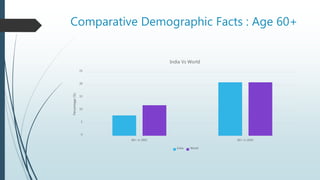
 The global share of old people i.e. 60 years and above
increased from 9.2% in 1990 to 11.7% in 2013 and is
estimated to reach 21.1% by 2050. (UN 2013)
 India and China are the two largest ageing nations in Asia
accounting for a significant share in the world’s aged.
(Prakash 1994, UN 2013)
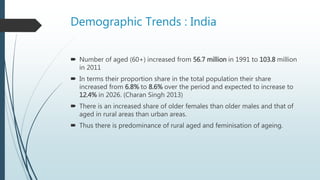
Demographic Trends : India
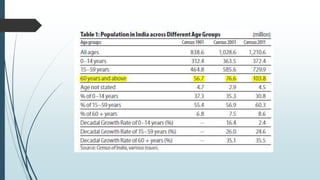
 Number of aged (60+) increased from 56.7 million in 1991 to 103.8 million
in 2011
 In terms their proportion share in the total population their share
increased from 6.8% to 8.6% over the period and expected to increase to
12.4% in 2026. (Charan Singh 2013)
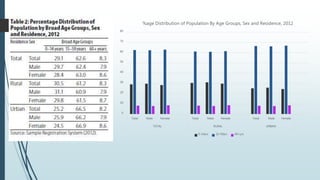
 There is an increased share of older females than older males and that of
aged in rural areas than urban areas.
 Thus there is predominance of rural aged and feminisation of ageing.
0
10
20
30
40
50
60
70
80
Total Male Female Total Male Female Total Male Female
TOTAL RURAL URBAN
%age Distribution of Population By Age Groups, Sex and Residence, 2012
0-14yrs 15-59yrs 60+yrs
Comparative Demographic Facts : Age 60+
0
5
10
15
20
25
60+ in 2002 60+ in 2050
Percentage(%)
India Vs World
India World
0
2
4
6
8
10
12
14
16
18
20
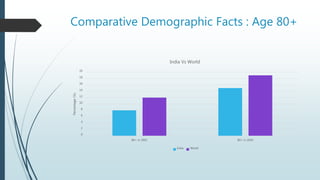
80+ in 2002 80+ in 2050
Percentage(%)
India Vs World
India World
Comparative Demographic Facts : Age 80+
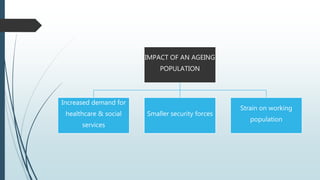
IMPACT OF AN AGEING
POPULATION
Increased demand for
healthcare & social
services
Smaller security forces
Strain on working
population
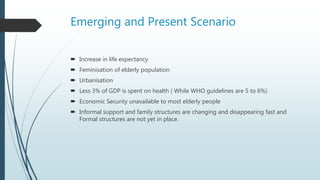
Emerging and Present Scenario
 Increase in life expectancy
 Feminisation of elderly population
 Urbanisation
 Less 3% of GDP is spent on health ( While WHO guidelines are 5 to 6%)
 Economic Security unavailable to most elderly people
 Informal support and family structures are changing and disappearing fast and
Formal structures are not yet in place.
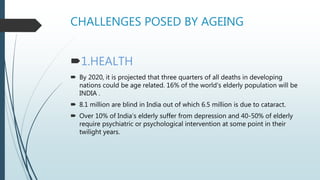
CHALLENGES POSED BY AGEING
1.HEALTH
 By 2020, it is projected that three quarters of all deaths in developing
nations could be age related. 16% of the world's elderly population will be
INDIA .
 8.1 million are blind in India out of which 6.5 million is due to cataract.
 Over 10% of India’s elderly suffer from depression and 40-50% of elderly
require psychiatric or psychological intervention at some point in their
twilight years.
2. Financial Security
 70% of aged depend for their day to day maintenance. The situation is worse for
elderly females where 85% to 87% are economically dependent partially or fully.
 Among aged who were once employed (as salaried employ or causal labour) about
79% in rural and 35% in urban areas have not received any benefits on retirement.
Priority Issues
1. Economic Security
 Introduction of pension schemes
 Income generation opportunities for able and willing older people
 Imaginative schemes for contributory pensions for those older people who can
afford to save in prime years
 Special schemes for women, Dalits and rural poor, disabled older people and
widows.
2. Health Security
 Accessible, available and affordable Geriatric Health Facilities to all older persons
 Provision of infrastructure and trained personnel
 Development of facilities in public health arena for the poor
 Exploration of Public Private Partnership in development of infrastructure and
financing of health care sector
 Special attention to Women, poor, disabled, rural, Dalits and destitute
National Policies For The Elderly
 Article 41 of the Indian Constitution provides that the State shall, within the limits
of its economic development, make effective provision for securing the right to
work, to education and to public assistance in cases of unemployment, old age,
sickness and disablement.
 The Maintenance and Welfare of Parents and Senior Citizen Act, 2007 was enacted
in December 2007 to ensure need-based, maintenance of parents and senior
citizens and their welfare.
 An Integrated Program for Older Person (IPOP) is being implemented since 1992
with the sole objective of improving the quality of life of senior citizens by
providing basic amenities like shelter, food, medical care and entertainment
opportunities.
National Policies For The Elderly (cont.)
 The National Policy on Older Persons (NPOP) was announced in January 1999 to
reaffirm the commitment to ensure well-being of elderly.
 The Maintenance and Welfare of Parents and Senior citizens Act, 2007, assigns
responsibility and obligation on the heirs to provide care and support to the
elderly.
 Various ministries like the Railways, Rural Development and Finance also offer
special concessions to the elderly
Pension Schemes : At a Glance
 Pension Fund Regulatory and Development Authority was established in 2003 and
has been making efforts to improve social security in India.
 The fiscal impact of raising pensions is basically in terms of medical expenditure for
the older population.
*In the context of India, this burden would be high because of lack of public
sector medical services, lack of medical personnel, malnutrition, poor sanitation,
and infrastructure to deal with the ageing problem. ( Charan Singh)
 One of the most important pension scheme is the Indira Gandhi National Old Age
Pension Scheme (IGNOAPS).
The government also introduced the Annapurna Scheme to ensure food security for
those elderly who are eligible for IGNOAPS, but are presently not receiving it.
 In order to widen the coverage of pension two more schemes were added :
National Pension System (NPS)—Lite, and NPS—Swavalamban.
 The target of Swavalamban is to encourage people from the unorganised sectors
to save for the future.
 Despite these efforts, the coverage of the Indian pension system has remained low.
~Until 2013, only 1.2% of the working population had subscribed to the NPS, of
which more than 50% were civil servants for whom the scheme was
mandatory.(EPFO Annual Report 2012-13)
~ An approximately 70% of the total 60+ population receives no pension at all.
Schemes for Unorganised Sector Workers
 National Family Benefit Scheme
 Janani Suraksha Yojana
 Janshree Bima Yojana
 Aam Admi Bima Yojana
 Rashtriya Swastha Yojana
Atal Pension Yojana (2015)
 It was launched in continuation to the Jan Dhan Yojana Scheme to bring those
employed in rural and unorganized sector under the ambit of Pension Schemes. The
idea of the scheme is to provide a definite pension to all Indians.
 In Atal Pension Yojana, for every contribution made to the pension fund, the
government will contribute an equal amount to his/her fund. Depending on the
contribution made between the age 18yr and 40yr, at the age of 60 a sum
of ₹1000, ₹2000 ₹3000, ₹4000 , or ₹5000 will be paid monthly.
 EXAMPLE :If a subscriber Joins APY and opts for a 5000 pension plan and pays his
premium as per norms then he will start getting Rs 5000 pension till he is alive after
attaining 60 years of age. After subscriber is dead then his/her spouse will get the
pension amount that subscriber was getting. After both are gone then Nominee will
get the corpus amount of Rs 8.5 lakhs.
What Can be Done? (Recommendations)
 Improve present allocations of Social Pensions .
 Encourage Private Sector pension ( example: UTI Bank –Sewa Bank pension
scheme)
 Insurance Regulation and Development Authority (IRDA) may be asked to
enforce a uniform policy on all Insurance Companies, particularly
Government owned companies, to continue medical insurance for whole
life at a commensurate premium.
 Facilities to be provided in the hospitals/ nursing homes/ pay and stay
homes or any special centres for rehabilitation especially after the older
persons has suffered from a debilitating disease. Increase in centres that
provide support like physio-therapy, psychological counselling etc.
 The design of hospitals and all public building and places
should be conducive to the use of disabled elderly.
 Promoting awareness about the concept of healthy ageing
and the health problems and to involve the community in the
process of their mitigation.
 Provisions on National Rural Health Mission should also be
weaved with this programme to make it more effective.
NRHM ignores elderly
References and Sources
 EPW Vol L No. 18 –Ageing in India (Charan Singh, Kanchan Bharati, Ayanendu
Sanyal)
 Ageing Population in India: Select Economic Issues-IIMB working paper (Charan
Singh)
 Studies on Ageing in India (S. Siva Raj)
 EPW Vol L No.44 -India’s Population Programme Obstacles and Opportunities
(Betsy Hartmann, Mohan Rao)
 http://pmjandhanyojana.co.in/atal-pension-yojana/
THANK YOU

Ageing in india

  • 1.
    AGEING IN INDIA: Some Issues and Challenges Purnima R (Dept of Economics)
  • 2.
    AGEING : Meaningand Implication  Ageing is the process becoming older  Population ageing is the increase in the median age of a population or an alteration in the age structure of a population so that elderly persons are increasingly represented within a country’s overall age structure.  It challenges the society to adapt, in order to maximise the health and functional capacity of older people as well as their social participation and security.
  • 3.
    Causes of Ageing Population ageing has three possible reasons : Migration, longer life expectancy and decreased birth rate  It has occurred due to development which has enabled better nutrition, sanitation, health care, education and economic well being  Fertility rates have declined and life expectancy has risen
  • 4.
     The globalshare of old people i.e. 60 years and above increased from 9.2% in 1990 to 11.7% in 2013 and is estimated to reach 21.1% by 2050. (UN 2013)  India and China are the two largest ageing nations in Asia accounting for a significant share in the world’s aged. (Prakash 1994, UN 2013)
  • 5.
    Demographic Trends :India  Number of aged (60+) increased from 56.7 million in 1991 to 103.8 million in 2011  In terms their proportion share in the total population their share increased from 6.8% to 8.6% over the period and expected to increase to 12.4% in 2026. (Charan Singh 2013)  There is an increased share of older females than older males and that of aged in rural areas than urban areas.  Thus there is predominance of rural aged and feminisation of ageing.
  • 7.
    0 10 20 30 40 50 60 70 80 Total Male FemaleTotal Male Female Total Male Female TOTAL RURAL URBAN %age Distribution of Population By Age Groups, Sex and Residence, 2012 0-14yrs 15-59yrs 60+yrs
  • 8.
    Comparative Demographic Facts: Age 60+ 0 5 10 15 20 25 60+ in 2002 60+ in 2050 Percentage(%) India Vs World India World
  • 9.
    0 2 4 6 8 10 12 14 16 18 20 80+ in 200280+ in 2050 Percentage(%) India Vs World India World Comparative Demographic Facts : Age 80+
  • 10.
    IMPACT OF ANAGEING POPULATION Increased demand for healthcare & social services Smaller security forces Strain on working population
  • 11.
    Emerging and PresentScenario  Increase in life expectancy  Feminisation of elderly population  Urbanisation  Less 3% of GDP is spent on health ( While WHO guidelines are 5 to 6%)  Economic Security unavailable to most elderly people  Informal support and family structures are changing and disappearing fast and Formal structures are not yet in place.
  • 12.
    CHALLENGES POSED BYAGEING 1.HEALTH  By 2020, it is projected that three quarters of all deaths in developing nations could be age related. 16% of the world's elderly population will be INDIA .  8.1 million are blind in India out of which 6.5 million is due to cataract.  Over 10% of India’s elderly suffer from depression and 40-50% of elderly require psychiatric or psychological intervention at some point in their twilight years.
  • 13.
    2. Financial Security 70% of aged depend for their day to day maintenance. The situation is worse for elderly females where 85% to 87% are economically dependent partially or fully.  Among aged who were once employed (as salaried employ or causal labour) about 79% in rural and 35% in urban areas have not received any benefits on retirement.
  • 14.
    Priority Issues 1. EconomicSecurity  Introduction of pension schemes  Income generation opportunities for able and willing older people  Imaginative schemes for contributory pensions for those older people who can afford to save in prime years  Special schemes for women, Dalits and rural poor, disabled older people and widows.
  • 15.
    2. Health Security Accessible, available and affordable Geriatric Health Facilities to all older persons  Provision of infrastructure and trained personnel  Development of facilities in public health arena for the poor  Exploration of Public Private Partnership in development of infrastructure and financing of health care sector  Special attention to Women, poor, disabled, rural, Dalits and destitute
  • 16.
    National Policies ForThe Elderly  Article 41 of the Indian Constitution provides that the State shall, within the limits of its economic development, make effective provision for securing the right to work, to education and to public assistance in cases of unemployment, old age, sickness and disablement.  The Maintenance and Welfare of Parents and Senior Citizen Act, 2007 was enacted in December 2007 to ensure need-based, maintenance of parents and senior citizens and their welfare.  An Integrated Program for Older Person (IPOP) is being implemented since 1992 with the sole objective of improving the quality of life of senior citizens by providing basic amenities like shelter, food, medical care and entertainment opportunities.
  • 17.
    National Policies ForThe Elderly (cont.)  The National Policy on Older Persons (NPOP) was announced in January 1999 to reaffirm the commitment to ensure well-being of elderly.  The Maintenance and Welfare of Parents and Senior citizens Act, 2007, assigns responsibility and obligation on the heirs to provide care and support to the elderly.  Various ministries like the Railways, Rural Development and Finance also offer special concessions to the elderly
  • 18.
    Pension Schemes :At a Glance  Pension Fund Regulatory and Development Authority was established in 2003 and has been making efforts to improve social security in India.  The fiscal impact of raising pensions is basically in terms of medical expenditure for the older population. *In the context of India, this burden would be high because of lack of public sector medical services, lack of medical personnel, malnutrition, poor sanitation, and infrastructure to deal with the ageing problem. ( Charan Singh)  One of the most important pension scheme is the Indira Gandhi National Old Age Pension Scheme (IGNOAPS). The government also introduced the Annapurna Scheme to ensure food security for those elderly who are eligible for IGNOAPS, but are presently not receiving it.
  • 19.
     In orderto widen the coverage of pension two more schemes were added : National Pension System (NPS)—Lite, and NPS—Swavalamban.  The target of Swavalamban is to encourage people from the unorganised sectors to save for the future.  Despite these efforts, the coverage of the Indian pension system has remained low. ~Until 2013, only 1.2% of the working population had subscribed to the NPS, of which more than 50% were civil servants for whom the scheme was mandatory.(EPFO Annual Report 2012-13) ~ An approximately 70% of the total 60+ population receives no pension at all.
  • 20.
    Schemes for UnorganisedSector Workers  National Family Benefit Scheme  Janani Suraksha Yojana  Janshree Bima Yojana  Aam Admi Bima Yojana  Rashtriya Swastha Yojana
  • 21.
    Atal Pension Yojana(2015)  It was launched in continuation to the Jan Dhan Yojana Scheme to bring those employed in rural and unorganized sector under the ambit of Pension Schemes. The idea of the scheme is to provide a definite pension to all Indians.  In Atal Pension Yojana, for every contribution made to the pension fund, the government will contribute an equal amount to his/her fund. Depending on the contribution made between the age 18yr and 40yr, at the age of 60 a sum of ₹1000, ₹2000 ₹3000, ₹4000 , or ₹5000 will be paid monthly.  EXAMPLE :If a subscriber Joins APY and opts for a 5000 pension plan and pays his premium as per norms then he will start getting Rs 5000 pension till he is alive after attaining 60 years of age. After subscriber is dead then his/her spouse will get the pension amount that subscriber was getting. After both are gone then Nominee will get the corpus amount of Rs 8.5 lakhs.
  • 22.
    What Can beDone? (Recommendations)  Improve present allocations of Social Pensions .  Encourage Private Sector pension ( example: UTI Bank –Sewa Bank pension scheme)  Insurance Regulation and Development Authority (IRDA) may be asked to enforce a uniform policy on all Insurance Companies, particularly Government owned companies, to continue medical insurance for whole life at a commensurate premium.  Facilities to be provided in the hospitals/ nursing homes/ pay and stay homes or any special centres for rehabilitation especially after the older persons has suffered from a debilitating disease. Increase in centres that provide support like physio-therapy, psychological counselling etc.
  • 23.
     The designof hospitals and all public building and places should be conducive to the use of disabled elderly.  Promoting awareness about the concept of healthy ageing and the health problems and to involve the community in the process of their mitigation.  Provisions on National Rural Health Mission should also be weaved with this programme to make it more effective. NRHM ignores elderly
  • 24.
    References and Sources EPW Vol L No. 18 –Ageing in India (Charan Singh, Kanchan Bharati, Ayanendu Sanyal)  Ageing Population in India: Select Economic Issues-IIMB working paper (Charan Singh)  Studies on Ageing in India (S. Siva Raj)  EPW Vol L No.44 -India’s Population Programme Obstacles and Opportunities (Betsy Hartmann, Mohan Rao)  http://pmjandhanyojana.co.in/atal-pension-yojana/
  • 25.