AGRIBUSINESS
CONCEPT
DIANA O. LIM, M.Sc.
Instructor
Lecture Objective:
At the end of this lecture, you should be able to:
1. Discuss the concept of agribusiness;
2. Explain the key functions of management in agribusiness; and
3. Describe the agribusiness as an allied field of agriculture;
Lecture Outline:
1. Agribusiness management: scope, functions, and tasks
2. Agribusiness management: organization and context
3. Marketing management for agribusiness
4. Financial management for agribusiness
5. Operations management for agribusiness
6. Human resource management for agribusiness
THE
CONTINUATION…..
Financial Management for
Agribusiness
Financial management for agribusiness
Understanding financial statements
Managers often use the word “profit” or “the bottom line”
Profit is the amount remaining from a sale after cost of the product
and operating expenses have been paid
Financial data are necessary to evaluate the firm’s performance
a successful agribusiness manager understands the financial
operations of the firm well enough to use this information as a tool in
improving firm performance
Understanding the interrelationships of other accounts on the balance
sheet and the income statement as well as the cash flow statement is
essential to properly manage the agribusiness
Financial management for agribusiness
Understanding financial statements
Importance of Financial Statements
1. Financial data can be used by managers internally in their decision-
making;
2. Financial data are used for financial reporting to
stockholders/partners, lenders, and others who have interests in
the firm; and
3. Financial data can be used to achieve and assess the goals and
objectives of the firm;
Financial management for agribusiness
Understanding financial statements
Managerial accounting vs. financial accounting
Managerial accounting is the collection and use of financial
information to make good management decisions that are consistent
with the needs, objectives, and goals of the company.
Financial accounting is the collection and use of financial information
for the purpose of reporting to governmental units, lending
institutions, investors, and suppliers to the business.
Financial management for agribusiness
Understanding financial statements
Feature of a good record system:
1. It should be simple and easy to understand;
2. It should be reliable, accurate, consistent, and timely;
3. It should be based on the uniqueness of the particular business;
4. It should be cost effective to implement and maintain.
Financial management for agribusiness
Understanding financial statements
A good financial records should provide for the basis for:
1. Determining the success of the business in terms of profitability
during specific time period or cycles;
2. Determining the general financial condition or health of the
business at a given moment;
3. Predicting the future of the business to meet the demands of
creditors, of change, and of expansion;
4. Analyzing the trends in performance as they relate to
management’s abilities and to the success or failure of the past
decisions and achievements; and
5. Choosing among the various possible alternatives for future use of
resources within the firm.
Financial management for agribusiness
Understanding financial statements
The accounting process:
1. Journalizing (day-to-day recording of transactions,
chronologically);
2. Prepare the ledger;
3. Prepare the financial statements; and
4. Analyze the financial statements.
Financial management for agribusiness
Understanding financial statements
The Three Basic Financial Statements:
1. Balance Sheet – a financial statement that shows the current
financial position of the business; it shows what the business
owns (assets), owes (liabilities) and the total owner’s investment
in the business.
2. Income Statement – a financial statement that shows the financial
performance of the business within a specific period of time; it
summarizes the revenue and expenses incurred as well as the net
profit.
3. Cash Flow Statement - a financial statement that shows the total
amount of cash inflows, outflows, and net cash within a specific
period of time.
Financial management for agribusiness
Analyzing financial statements
Analysis of financial statements is often comparative: over time,
against budget, or relative to similar firms.
Ratios generally measure the important criteria of profitability,
liquidity, solvency, and efficiency.
If ratios are used properly, they are indicators of strengths and
weaknesses in the business.
Return on the owner’s investment (return on equity or ROE) is the
most fundamental measure of profitability.
Financial analysis gives the manager an insights for improved
decision-making.
Financial management for agribusiness
Financing the agribusiness
Cash is king!
Proper cash management is the lifeblood of any agribusiness.
Cash is needed for financing assets and transactions
Agribusiness managers are expected to be experts in cash
management
Whenever and wherever financial resources are secured, money is
used in the enterprise with the full expectation that it will be returned
with a profit.
Profit making ability of an agribusiness manager is essential for the
viability of the firm
Financial management for agribusiness
Financing the agribusiness
There are three sources from which the manager may raise funds:
1) Investment by owners;
2) Borrowing; and
3) Funds generated by profits and retained in the business.
*whatever the kind and size of a business, its ability to generate
profits will ultimately determine the amount of funds that are
available for its use.
Financial management for agribusiness
Financing the agribusiness
Factors that influences the increase in financial resources:
1) Why are additional funds needed?
2) How does the use of additional funds fit with the overall mission
of the business?
3) What increases in revenue, profit, and/or net cash flow will be
generated by the additional funds?
4) What sources are available to provide additional funds?
5) How much will these additional funds cost the agribusiness?
6) How much is needed in the way of additional financial resources?
Financial management for agribusiness
Financing the agribusiness
Factors that influences the increase in financial resources:
7) When is this increase in revenue flow expected?
8) When will these additional funds needed?
9) For what time periods will these additional funds be needed?
10) If the funds are borrowed, how will the indebtedness be repaid?
11) How will this indebtedness affect profit?
12) How will this indebtedness affect liquidity and solvency?
13) What risk is involved that may delay the time period when funds
may be repaid?
Financial management for agribusiness
Financing the agribusiness
Debt or equity financing?
There are four types of capital:
1) Short-term loans: one year or less; used whenever the
requirement for additional funds is temporary.
2) Intermediate-term loans: one to five years; provides a source of
capital that will allow growth or modernization without forcing
the owners to surrender control over the business.
3) Long-term loans: more than five years; often for real estate like
land and buildings.
4) Equity capital: no due date; not have to be repaid, becomes
permanent part of the business.
Financial management for agribusiness
Financing the agribusiness
The Cost of Capital
When a business borrows money, it incurs special costs that are paid
to the lender. One of these is interest, but interest is not the only
cost of borrowing money. Several other factors affect the net cost of
borrowed capital:
1) Repayment terms and conditions
2) Compensatory balances, points, and stock investments
3) The income tax bracket of the firm
Financial management for agribusiness
Tools for evaluating operating decisions
Effective decision-making is a critical talent of the successful food and
agribusiness manager
Professional managers approach this decision-making activity
systematically
Decision-making is the process of choosing between alternatives for
the purpose of achieving desired goals.
Financial management for agribusiness
Tools for evaluating operating decisions
Three things associated with the Decision-making Process
1) Process
2) Choosing
3) Goals
Financial management for agribusiness
Tools for evaluating operating decisions
Steps involved in the Decision-making Process
1) Problem Identification
2) Summary of facts
3) Identifying alternatives
4) Analysis
5) Action
6) Evaluation
Financial management for agribusiness
Tools for evaluating operating decisions
Volume-cost analysis or breakeven analysis as decision tool
 A tool for examining the relationship between costs and the volume of
business generated by the firm.
 Analyzes differences in the kinds of costs (fixed costs, variable costs, semi-
variable costs) encountered by agribusiness and how the volume of
business affects them.
Financial management for agribusiness
Tools for evaluating operating decisions
Volume-cost analysis or breakeven analysis procedure
Step 1: classify fixed and variable costs
Step 2: summarize fixed and variable costs
Step 3: calculate the contribution to overhead
Step 4: calculate the breakeven point
Financial management for agribusiness
Tools for evaluating operating decisions
Uses of Volume-cost analysis or breakeven analysis
Profit planning
Changes in costs
Changes in price
Financial management for agribusiness
Tools for evaluating capital investment decisions
Major consequence for agribusiness managers is making capital
investment decisions
Capital investment refers to the addition of durable assets to an
agribusiness, which usually require relatively large financial outlays
and will last over a long period of time.
Capital investment can be financed through cash purchase,
borrowing, or leasing.
Financial management for agribusiness
Tools for evaluating capital investment decisions
Capital Budgeting or Investment Analysis is the procedure for
evaluating the effects of an agribusiness manager’s investment
choices on the profitability, risk, and liquidity of a business.
Investment decisions concerns the following:
1. Expansion projects
2. Replacement projects
3. Alternative investment projects
Financial management for agribusiness
Tools for evaluating capital investment decisions
 Five Steps in Capital Budgeting
1. Identification of investment alternatives
2. Selection of an appropriate capital budgeting evaluation method
◦ Payback period – the length of time it will take an investment to generate
sufficient additional cash flows to pay for it.
◦ Simple rate of return – refers to the profit generated by the investment as a
percentage of the investment.
◦ Net present value – the current, net value of an investment, taking the time
value of money into consideration when evaluating costs and returns.
◦ Internal rate of return – also called discounted rate of return, marginal
efficiency of capital, yield, etc.; the discount rate that equates the net present
value of the projected net cash flows to zero.
3. Collection of relevant data
4. Analysis of data
5. Interpretation of the results
Operations Management for
Agribusiness
Operations management for agribusiness
Operations management refers to the direction and control of the
processes used by food and agribusiness firms to produce goods and
services.
OM can be broken into two distinct areas:
1) Production planning
2) Supply chain management
 Modern operations management begins with the work of Frederick
W. Taylor, who introduced the concept of scientific management. He
studied and observed production focusing on workers, the methods
of work, and the wages paid for increased output.
Operations management for agribusiness
PRODUCTION PLANNING
Devising a quality program
Locating a plant
Choosing the appropriate level of capacity
Designing the layout of the operation
Deciding on the process design
Specifying job tasks and responsibilities
SUPPLY CHAIN MANAGEMENT
Aggregate production planning
Production scheduling
Purchasing of materials for production
Management of the various types of
inventories
Transportation management
Distributing the finished goods or services
Operations management for agribusiness
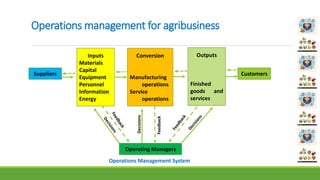
Operations Management involves a system of interrelated activities and players.
Suppliers provide the inputs to the system. Timely delivery of high-quality
inputs influences al activities in the system. Inputs consist of the human
resources (skilled workers and managers), capital (equipment), materials,
information, and energy required to produce the desired outputs. The
conversion or transformation of inputs into outputs involves the system of
facilities, processes, and procedures by which goods and services are produced.
Customers purchase the outputs from the system, and their feedback to the
rest of the system is essential in generating and designing new products and
services. Finally, managers make decisions and obtain feedback on those
decisions to make the total production system flow smoothly.
Operations management for agribusiness
Suppliers Customers
Decisions
Feedback
Operating Managers
Inputs
Materials
Capital
Equipment
Personnel
Information
Energy
Conversion
Manufacturing
operations
Service
operations
Outputs
Finished
goods and
services
Operations Management System
Operations management for agribusiness
Issues in operations management
1) The growing service sector
2) Time-based competition
3) Productivity improvement
4) Global competition
5) Quality
Operations management for agribusiness
Generalization in OM:
Production planning decisions entail quality management, location, capacity, layout,
and process design of the plant or facility, and job design.
Supply chain management decisions include purchasing, production scheduling,
inventory control and distribution.
Many factors affect each of these sets of decisions, and food and agribusiness
managers must consider all factors and their effect on the total system before making
a decision.
Human Resource Management for
Agribusiness
Human resource management for agribusiness
Managing organizational structure
 management must develop an organizational structure where the
responsibilities, authority, and accountability of individuals are
clearly defined.
Organizational structure denotes the formal way that employee
responsibilities are assigned in a firm—who reports tow whom, who
has responsibility for what, etc.
Human resource management for agribusiness
Managing organizational structure
 The Formal Organization
The management develops an organizational structure specifying the various
responsibilities, authority, and accountability of employees.
The larger the business, the more formalized and structured is its organization
Responsibility, Authority, and Accountability
Responsibility is the obligation to see a task through to completion; can be
contractual or voluntary; cannot be given away; can be shared by another
person or group; cannot be passed downward; undiluted with its originator.
Authority is the right to command or force an action by another; allows
instruction to be given to another individual; derivative or responsibility since
it comes from the ultimate source of responsibility.
Accountability involves being answerable to another person for performance.
Human resource management for agribusiness
Managing organizational structure
 The Formal Organization
Principles of Organization
1. Span-of-control principle – the number of people who can be supervised
effectively by one individual is limited.
2. Minimal layer principle – the number of levels of management should be
kept as low as possible, which is consistent with the goal of maintaining an
effective span of control.
3. Delegation downward principle – authority should be delegated downward
to the lowest level at which the decision can be made competently.
4. Parity of responsibility and authority principle – a person should have
enough authority to carry our assigned responsibilities.
5. Flexibility principle – an organization should maintain its structural flexibility
so that it can adjust to its changing internal and external environments.
Human resource management for agribusiness
Managing organizational structure
 The Formal Organization
Types of Organizational Structure
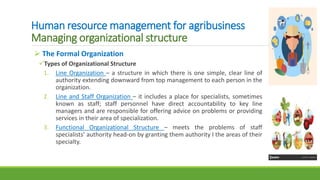
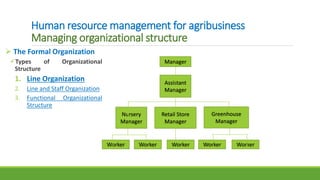
1. Line Organization – a structure in which there is one simple, clear line of
authority extending downward from top management to each person in the
organization.
2. Line and Staff Organization – it includes a place for specialists, sometimes
known as staff; staff personnel have direct accountability to key line
managers and are responsible for offering advice on problems or providing
services in their area of specialization.
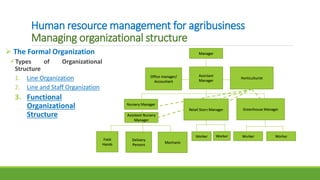
3. Functional Organizational Structure – meets the problems of staff
specialists’ authority head-on by granting them authority I the areas of their
specialty.
Human resource management for agribusiness
Managing organizational structure
 The Formal Organization
Types of Organizational
Structure
1. Line Organization
2. Line and Staff Organization
3. Functional Organizational
Structure
Worker
Manager
Assistant
Manager
Nursery
Manager
Retail Store
Manager
Greenhouse
Manager
Worker Worker Worker Worker
Human resource management for agribusiness
Managing organizational structure
 The Formal Organization
Types of Organizational
Structure
1. Line Organization
2. Line and Staff
Organization
3. Functional Organizational
Structure
Mechanic
Manager
Assistant
Manager
Nursery Manager
Retail Store Manager Greenhouse Manager
Field
Hands
Worker Worker Worker
Office manager/
Accountant
Horticulturist
Delivery
Persons
Worker
Assistant Nursery
Manager
Human resource management for agribusiness
Managing organizational structure
 The Formal Organization
Types of Organizational
Structure
1. Line Organization
2. Line and Staff Organization
3. Functional
Organizational
Structure
Mechanic
Manager
Assistant
Manager
Nursery Manager
Retail Store Manager Greenhouse Manager
Field
Hands
Worker Worker Worker
Office manager/
Accountant
Horticulturist
Delivery
Persons
Worker
Assistant Nursery
Manager
Human resource management for agribusiness
Managing organizational structure
 The Informal Organization
Primarily concerned with interpersonal relationships among people; emotions,
feelings, communications, and values.
Relationships develop as the result of status, power, and politics.
Status – the social rank or position of a person in a group.
Symbols – include title, age, experience, physical characteristics, knowledge,
physical possessions, authority, location, privileges, acquaintances, and a host
of other factors, depending on the situation.
Power – the ability to control another person’s behavior.
Politics – the manner in which power and status are used.
Human resource management for agribusiness
Managing organizational structure
 Leadership
The ability to combine personal style and organizational goals in correct
proportions.
Styles of Leadership
1) Authoritarian – also called autocratic; a leader-centered style, in which the
thoughts, ideas, and wishes of the leader are expected to be obeyed
completely, without question; can be benevolent autocrats (gives so much
praise that employees are shamed into obedience) or manipulative
autocrat (creates illusion that employees are participating in the decision-
making process).
2) Democratic – also called participative leadership style favors a shared
decision-making process, with the leader maintaining the ultimate
responsibility for decisions while actively seeking significant input from
followers.
Human resource management for agribusiness
Managing organizational structure
 Leadership
The ability to combine personal style and organizational goals in correct
proportions.
Styles of Leadership
3) Free Reign – also called laissez-faire; literally relinquishes all decision-
making to followers; leaders essentially abdicates his or her responsibility to
the group and simply joins the group as an equal, thus, the group decides
what to do.
4) Transformational – motivates followers to work for transcendental goals
and for aroused higher-level needs of self-actualization rather than for
immediate self-interest.
Human resource management for agribusiness
Managing human resources in agribusiness
Human resource management can be divided into two separate but
closely related areas:
1. Managing human resource functions
2. Managing employee motivation
Human resource management for agribusiness
Managing human resources in agribusiness
The steps (or functions of a HR department) include:
1. Determine the firm’s human resource needs (job specifications {spell
out the qualifications needed to perform a job satisfactorily} and job
description {stresses a job’s activities and duties})
2. Find and recruit people
3. Select and hire employees
4. Orient new employees to their jobs
5. Set terms of compensation and benefits
6. Evaluate performance
7. Oversee training and development
8. Provide for promotions and advancement
9. Manage terminations or transfers
ENDOFUNIT1
THANKYOU!!!

AgEcon13_agribusiness management.pptx

  • 1.
  • 2.
    Lecture Objective: At theend of this lecture, you should be able to: 1. Discuss the concept of agribusiness; 2. Explain the key functions of management in agribusiness; and 3. Describe the agribusiness as an allied field of agriculture;
  • 3.
    Lecture Outline: 1. Agribusinessmanagement: scope, functions, and tasks 2. Agribusiness management: organization and context 3. Marketing management for agribusiness 4. Financial management for agribusiness 5. Operations management for agribusiness 6. Human resource management for agribusiness
  • 4.
  • 5.
  • 6.
    Financial management foragribusiness Understanding financial statements Managers often use the word “profit” or “the bottom line” Profit is the amount remaining from a sale after cost of the product and operating expenses have been paid Financial data are necessary to evaluate the firm’s performance a successful agribusiness manager understands the financial operations of the firm well enough to use this information as a tool in improving firm performance Understanding the interrelationships of other accounts on the balance sheet and the income statement as well as the cash flow statement is essential to properly manage the agribusiness
  • 7.
    Financial management foragribusiness Understanding financial statements Importance of Financial Statements 1. Financial data can be used by managers internally in their decision- making; 2. Financial data are used for financial reporting to stockholders/partners, lenders, and others who have interests in the firm; and 3. Financial data can be used to achieve and assess the goals and objectives of the firm;
  • 8.
    Financial management foragribusiness Understanding financial statements Managerial accounting vs. financial accounting Managerial accounting is the collection and use of financial information to make good management decisions that are consistent with the needs, objectives, and goals of the company. Financial accounting is the collection and use of financial information for the purpose of reporting to governmental units, lending institutions, investors, and suppliers to the business.
  • 9.
    Financial management foragribusiness Understanding financial statements Feature of a good record system: 1. It should be simple and easy to understand; 2. It should be reliable, accurate, consistent, and timely; 3. It should be based on the uniqueness of the particular business; 4. It should be cost effective to implement and maintain.
  • 10.
    Financial management foragribusiness Understanding financial statements A good financial records should provide for the basis for: 1. Determining the success of the business in terms of profitability during specific time period or cycles; 2. Determining the general financial condition or health of the business at a given moment; 3. Predicting the future of the business to meet the demands of creditors, of change, and of expansion; 4. Analyzing the trends in performance as they relate to management’s abilities and to the success or failure of the past decisions and achievements; and 5. Choosing among the various possible alternatives for future use of resources within the firm.
  • 11.
    Financial management foragribusiness Understanding financial statements The accounting process: 1. Journalizing (day-to-day recording of transactions, chronologically); 2. Prepare the ledger; 3. Prepare the financial statements; and 4. Analyze the financial statements.
  • 12.
    Financial management foragribusiness Understanding financial statements The Three Basic Financial Statements: 1. Balance Sheet – a financial statement that shows the current financial position of the business; it shows what the business owns (assets), owes (liabilities) and the total owner’s investment in the business. 2. Income Statement – a financial statement that shows the financial performance of the business within a specific period of time; it summarizes the revenue and expenses incurred as well as the net profit. 3. Cash Flow Statement - a financial statement that shows the total amount of cash inflows, outflows, and net cash within a specific period of time.
  • 13.
    Financial management foragribusiness Analyzing financial statements Analysis of financial statements is often comparative: over time, against budget, or relative to similar firms. Ratios generally measure the important criteria of profitability, liquidity, solvency, and efficiency. If ratios are used properly, they are indicators of strengths and weaknesses in the business. Return on the owner’s investment (return on equity or ROE) is the most fundamental measure of profitability. Financial analysis gives the manager an insights for improved decision-making.
  • 14.
    Financial management foragribusiness Financing the agribusiness Cash is king! Proper cash management is the lifeblood of any agribusiness. Cash is needed for financing assets and transactions Agribusiness managers are expected to be experts in cash management Whenever and wherever financial resources are secured, money is used in the enterprise with the full expectation that it will be returned with a profit. Profit making ability of an agribusiness manager is essential for the viability of the firm
  • 15.
    Financial management foragribusiness Financing the agribusiness There are three sources from which the manager may raise funds: 1) Investment by owners; 2) Borrowing; and 3) Funds generated by profits and retained in the business. *whatever the kind and size of a business, its ability to generate profits will ultimately determine the amount of funds that are available for its use.
  • 16.
    Financial management foragribusiness Financing the agribusiness Factors that influences the increase in financial resources: 1) Why are additional funds needed? 2) How does the use of additional funds fit with the overall mission of the business? 3) What increases in revenue, profit, and/or net cash flow will be generated by the additional funds? 4) What sources are available to provide additional funds? 5) How much will these additional funds cost the agribusiness? 6) How much is needed in the way of additional financial resources?
  • 17.
    Financial management foragribusiness Financing the agribusiness Factors that influences the increase in financial resources: 7) When is this increase in revenue flow expected? 8) When will these additional funds needed? 9) For what time periods will these additional funds be needed? 10) If the funds are borrowed, how will the indebtedness be repaid? 11) How will this indebtedness affect profit? 12) How will this indebtedness affect liquidity and solvency? 13) What risk is involved that may delay the time period when funds may be repaid?
  • 18.
    Financial management foragribusiness Financing the agribusiness Debt or equity financing? There are four types of capital: 1) Short-term loans: one year or less; used whenever the requirement for additional funds is temporary. 2) Intermediate-term loans: one to five years; provides a source of capital that will allow growth or modernization without forcing the owners to surrender control over the business. 3) Long-term loans: more than five years; often for real estate like land and buildings. 4) Equity capital: no due date; not have to be repaid, becomes permanent part of the business.
  • 19.
    Financial management foragribusiness Financing the agribusiness The Cost of Capital When a business borrows money, it incurs special costs that are paid to the lender. One of these is interest, but interest is not the only cost of borrowing money. Several other factors affect the net cost of borrowed capital: 1) Repayment terms and conditions 2) Compensatory balances, points, and stock investments 3) The income tax bracket of the firm
  • 20.
    Financial management foragribusiness Tools for evaluating operating decisions Effective decision-making is a critical talent of the successful food and agribusiness manager Professional managers approach this decision-making activity systematically Decision-making is the process of choosing between alternatives for the purpose of achieving desired goals.
  • 21.
    Financial management foragribusiness Tools for evaluating operating decisions Three things associated with the Decision-making Process 1) Process 2) Choosing 3) Goals
  • 22.
    Financial management foragribusiness Tools for evaluating operating decisions Steps involved in the Decision-making Process 1) Problem Identification 2) Summary of facts 3) Identifying alternatives 4) Analysis 5) Action 6) Evaluation
  • 23.
    Financial management foragribusiness Tools for evaluating operating decisions Volume-cost analysis or breakeven analysis as decision tool  A tool for examining the relationship between costs and the volume of business generated by the firm.  Analyzes differences in the kinds of costs (fixed costs, variable costs, semi- variable costs) encountered by agribusiness and how the volume of business affects them.
  • 24.
    Financial management foragribusiness Tools for evaluating operating decisions Volume-cost analysis or breakeven analysis procedure Step 1: classify fixed and variable costs Step 2: summarize fixed and variable costs Step 3: calculate the contribution to overhead Step 4: calculate the breakeven point
  • 25.
    Financial management foragribusiness Tools for evaluating operating decisions Uses of Volume-cost analysis or breakeven analysis Profit planning Changes in costs Changes in price
  • 26.
    Financial management foragribusiness Tools for evaluating capital investment decisions Major consequence for agribusiness managers is making capital investment decisions Capital investment refers to the addition of durable assets to an agribusiness, which usually require relatively large financial outlays and will last over a long period of time. Capital investment can be financed through cash purchase, borrowing, or leasing.
  • 27.
    Financial management foragribusiness Tools for evaluating capital investment decisions Capital Budgeting or Investment Analysis is the procedure for evaluating the effects of an agribusiness manager’s investment choices on the profitability, risk, and liquidity of a business. Investment decisions concerns the following: 1. Expansion projects 2. Replacement projects 3. Alternative investment projects
  • 28.
    Financial management foragribusiness Tools for evaluating capital investment decisions  Five Steps in Capital Budgeting 1. Identification of investment alternatives 2. Selection of an appropriate capital budgeting evaluation method ◦ Payback period – the length of time it will take an investment to generate sufficient additional cash flows to pay for it. ◦ Simple rate of return – refers to the profit generated by the investment as a percentage of the investment. ◦ Net present value – the current, net value of an investment, taking the time value of money into consideration when evaluating costs and returns. ◦ Internal rate of return – also called discounted rate of return, marginal efficiency of capital, yield, etc.; the discount rate that equates the net present value of the projected net cash flows to zero. 3. Collection of relevant data 4. Analysis of data 5. Interpretation of the results
  • 29.
  • 30.
    Operations management foragribusiness Operations management refers to the direction and control of the processes used by food and agribusiness firms to produce goods and services. OM can be broken into two distinct areas: 1) Production planning 2) Supply chain management  Modern operations management begins with the work of Frederick W. Taylor, who introduced the concept of scientific management. He studied and observed production focusing on workers, the methods of work, and the wages paid for increased output.
  • 31.
    Operations management foragribusiness PRODUCTION PLANNING Devising a quality program Locating a plant Choosing the appropriate level of capacity Designing the layout of the operation Deciding on the process design Specifying job tasks and responsibilities SUPPLY CHAIN MANAGEMENT Aggregate production planning Production scheduling Purchasing of materials for production Management of the various types of inventories Transportation management Distributing the finished goods or services
  • 32.
    Operations management foragribusiness Operations Management involves a system of interrelated activities and players. Suppliers provide the inputs to the system. Timely delivery of high-quality inputs influences al activities in the system. Inputs consist of the human resources (skilled workers and managers), capital (equipment), materials, information, and energy required to produce the desired outputs. The conversion or transformation of inputs into outputs involves the system of facilities, processes, and procedures by which goods and services are produced. Customers purchase the outputs from the system, and their feedback to the rest of the system is essential in generating and designing new products and services. Finally, managers make decisions and obtain feedback on those decisions to make the total production system flow smoothly.
  • 33.
    Operations management foragribusiness Suppliers Customers Decisions Feedback Operating Managers Inputs Materials Capital Equipment Personnel Information Energy Conversion Manufacturing operations Service operations Outputs Finished goods and services Operations Management System
  • 34.
    Operations management foragribusiness Issues in operations management 1) The growing service sector 2) Time-based competition 3) Productivity improvement 4) Global competition 5) Quality
  • 35.
    Operations management foragribusiness Generalization in OM: Production planning decisions entail quality management, location, capacity, layout, and process design of the plant or facility, and job design. Supply chain management decisions include purchasing, production scheduling, inventory control and distribution. Many factors affect each of these sets of decisions, and food and agribusiness managers must consider all factors and their effect on the total system before making a decision.
  • 36.
    Human Resource Managementfor Agribusiness
  • 37.
    Human resource managementfor agribusiness Managing organizational structure  management must develop an organizational structure where the responsibilities, authority, and accountability of individuals are clearly defined. Organizational structure denotes the formal way that employee responsibilities are assigned in a firm—who reports tow whom, who has responsibility for what, etc.
  • 38.
    Human resource managementfor agribusiness Managing organizational structure  The Formal Organization The management develops an organizational structure specifying the various responsibilities, authority, and accountability of employees. The larger the business, the more formalized and structured is its organization Responsibility, Authority, and Accountability Responsibility is the obligation to see a task through to completion; can be contractual or voluntary; cannot be given away; can be shared by another person or group; cannot be passed downward; undiluted with its originator. Authority is the right to command or force an action by another; allows instruction to be given to another individual; derivative or responsibility since it comes from the ultimate source of responsibility. Accountability involves being answerable to another person for performance.
  • 39.
    Human resource managementfor agribusiness Managing organizational structure  The Formal Organization Principles of Organization 1. Span-of-control principle – the number of people who can be supervised effectively by one individual is limited. 2. Minimal layer principle – the number of levels of management should be kept as low as possible, which is consistent with the goal of maintaining an effective span of control. 3. Delegation downward principle – authority should be delegated downward to the lowest level at which the decision can be made competently. 4. Parity of responsibility and authority principle – a person should have enough authority to carry our assigned responsibilities. 5. Flexibility principle – an organization should maintain its structural flexibility so that it can adjust to its changing internal and external environments.
  • 40.
    Human resource managementfor agribusiness Managing organizational structure  The Formal Organization Types of Organizational Structure 1. Line Organization – a structure in which there is one simple, clear line of authority extending downward from top management to each person in the organization. 2. Line and Staff Organization – it includes a place for specialists, sometimes known as staff; staff personnel have direct accountability to key line managers and are responsible for offering advice on problems or providing services in their area of specialization. 3. Functional Organizational Structure – meets the problems of staff specialists’ authority head-on by granting them authority I the areas of their specialty.
  • 41.
    Human resource managementfor agribusiness Managing organizational structure  The Formal Organization Types of Organizational Structure 1. Line Organization 2. Line and Staff Organization 3. Functional Organizational Structure Worker Manager Assistant Manager Nursery Manager Retail Store Manager Greenhouse Manager Worker Worker Worker Worker
  • 42.
    Human resource managementfor agribusiness Managing organizational structure  The Formal Organization Types of Organizational Structure 1. Line Organization 2. Line and Staff Organization 3. Functional Organizational Structure Mechanic Manager Assistant Manager Nursery Manager Retail Store Manager Greenhouse Manager Field Hands Worker Worker Worker Office manager/ Accountant Horticulturist Delivery Persons Worker Assistant Nursery Manager
  • 43.
    Human resource managementfor agribusiness Managing organizational structure  The Formal Organization Types of Organizational Structure 1. Line Organization 2. Line and Staff Organization 3. Functional Organizational Structure Mechanic Manager Assistant Manager Nursery Manager Retail Store Manager Greenhouse Manager Field Hands Worker Worker Worker Office manager/ Accountant Horticulturist Delivery Persons Worker Assistant Nursery Manager
  • 44.
    Human resource managementfor agribusiness Managing organizational structure  The Informal Organization Primarily concerned with interpersonal relationships among people; emotions, feelings, communications, and values. Relationships develop as the result of status, power, and politics. Status – the social rank or position of a person in a group. Symbols – include title, age, experience, physical characteristics, knowledge, physical possessions, authority, location, privileges, acquaintances, and a host of other factors, depending on the situation. Power – the ability to control another person’s behavior. Politics – the manner in which power and status are used.
  • 45.
    Human resource managementfor agribusiness Managing organizational structure  Leadership The ability to combine personal style and organizational goals in correct proportions. Styles of Leadership 1) Authoritarian – also called autocratic; a leader-centered style, in which the thoughts, ideas, and wishes of the leader are expected to be obeyed completely, without question; can be benevolent autocrats (gives so much praise that employees are shamed into obedience) or manipulative autocrat (creates illusion that employees are participating in the decision- making process). 2) Democratic – also called participative leadership style favors a shared decision-making process, with the leader maintaining the ultimate responsibility for decisions while actively seeking significant input from followers.
  • 46.
    Human resource managementfor agribusiness Managing organizational structure  Leadership The ability to combine personal style and organizational goals in correct proportions. Styles of Leadership 3) Free Reign – also called laissez-faire; literally relinquishes all decision- making to followers; leaders essentially abdicates his or her responsibility to the group and simply joins the group as an equal, thus, the group decides what to do. 4) Transformational – motivates followers to work for transcendental goals and for aroused higher-level needs of self-actualization rather than for immediate self-interest.
  • 47.
    Human resource managementfor agribusiness Managing human resources in agribusiness Human resource management can be divided into two separate but closely related areas: 1. Managing human resource functions 2. Managing employee motivation
  • 48.
    Human resource managementfor agribusiness Managing human resources in agribusiness The steps (or functions of a HR department) include: 1. Determine the firm’s human resource needs (job specifications {spell out the qualifications needed to perform a job satisfactorily} and job description {stresses a job’s activities and duties}) 2. Find and recruit people 3. Select and hire employees 4. Orient new employees to their jobs 5. Set terms of compensation and benefits 6. Evaluate performance 7. Oversee training and development 8. Provide for promotions and advancement 9. Manage terminations or transfers
  • 49.