Central Adoption Resource
Authority
Ministry of Women & Child
Development
Government of India
BACKGROUND
• Central Adoption Resource Authority:
• Central Adoption Resource Authority (CARA) is a
statutory body of Ministry of Women & Child Development,
Government of India. It functions as the nodal body for
adoption of Indian children and is mandated to monitor
and regulate in-country and inter-country adoptions. CARA
is designated as the Central Authority to deal with inter-
country adoptions in accordance with the provisions of the
Hague Convention on Inter-country Adoption, 1993, ratified
by Government of India in 2003.
CARA primarily deals with adoption of orphan, abandoned
and surrendered children through its associated
/recognised adoption agencies.
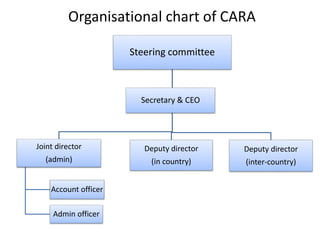
Secretary & CEO
Steering committee
Joint director
(admin)
Admin officer
Account officer
Deputy director
(in country)
Deputy director
(inter-country)
Organisational chart of CARA
CARA Schemes and guidelines
• Revised ICPS
• Sponceship guidelines
• Model guidelines for Foster Care, 2016
The law governing Adoption
• Adoption of a child in India is governed by the
following acts:
• THE HINDU ADOPTION AND MAINTENANCE ACT,
1956 which deals with adoption by individuals
belonging to Hindu, Sikhs, Jains, Buddists.
• Guardian and Wards Act, 1890, which deals with
adoption by Foreign Citizens, Indian Nationals,
NRI who are Muslims, Christians or Jews.
• Juvenile Justice Act , 2000 which deals in part
with adoption of children by non- Hindu parents.
Adoption
• Adoption is a legal process by which a child is
placed with a married couple or a single
female who agree to raise him as their own
and assume all responsibilities for him.
Adoption is the creation of a new, permanent
relationship between an adoptive parent and
child and the child takes the place of a
biological child to all intents and purpose.
CONTD....
• WHO CAN ADOPT? - Single woman (unmarried, widow,
divorcee) or married couple.
– An Indian
– non-Resident Indian
– Foreign citizen
• WHO CAN GIVE CHILD IN ADOPTION? - Parents / Guardian of
child
• – both parents together
• – one of them if the other has renounced world or ceased
to be Hindu or has become mentally unstable.
• – If both parents are dead or not competent in law or child’s
parentage unknown then guardian can give child in adoption
with permission of court.
Criteria for eligible child
• The child must be legally free for adoption.
• Clearance from ACA/State Government is mandatory
for all children except wherever exempted under the
Guidelines.
• Siblings/twins/triplets cannot be separated except in
exceptional cases.
• Two unrelated children cannot be proposed to a
foreign family at a time.
• A child may as far as possible be placed in adoption
before it reaches the age of 12.
• The consent of the child has to be obtained wherever
applicable.
Eligibility criteria for PAP’s (prospective
adoptive parents)
• The prospective adoptive parents shall be physically, mentally and
emotionally stable, financially capable and shall not have any life
threatening medical condition.
• Any prospective adoptive parents, irrespective of his marital status and
whether or not he has biological son or daughter, can adopt a child subject
to following, namely:-
(a) the consent of both the spouses for the adoption shall be required, in
case of a married couple;
(b) a single female can adopt a child of any gender;
(c) a single male shall not be eligible to adopt a girl child;
• No child shall be given in adoption to a couple unless they have at least
two years of stable marital relationship.
• The age of prospective adoptive parents, as on the date of registration,
shall be counted for deciding the eligibility and the eligibility of
prospective adoptive parents to apply for children of different age groups
shall be as under:-
Contd....
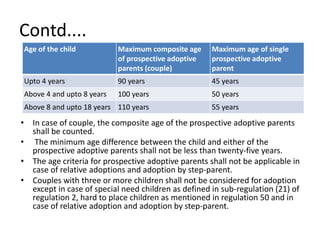
Age of the child Maximum composite age
of prospective adoptive
parents (couple)
Maximum age of single
prospective adoptive
parent
Upto 4 years 90 years 45 years
Above 4 and upto 8 years 100 years 50 years
Above 8 and upto 18 years 110 years 55 years
• In case of couple, the composite age of the prospective adoptive parents
shall be counted.
• The minimum age difference between the child and either of the
prospective adoptive parents shall not be less than twenty-five years.
• The age criteria for prospective adoptive parents shall not be applicable in
case of relative adoptions and adoption by step-parent.
• Couples with three or more children shall not be considered for adoption
except in case of special need children as defined in sub-regulation (21) of
regulation 2, hard to place children as mentioned in regulation 50 and in
case of relative adoption and adoption by step-parent.
Registration procedure for in-country
adoption
• REGISTRAION Registration to be done with a recognized adoption
coordinating agency and preparation of the documents to be submitted
with the agency to get registered.
• HOME STUDY AND COUNSELING Home Study at the parent/s residence to
assess the couple’s parenting abilities, preparations, on the issue of
Adoption. This is made into a report and is submitted to the honorable
court.
• REFERRAL OF THE CHILD The agency will disclose medical file, Physical
Examination Report and such information of the child. On the parent/s
acceptance of the same, the agency will show the child physically. The
prospective parent have option to accept child or ask for another child.
• FILING OF PETITION Documentations made by the parent/s to the agency
and the child’s documents are sent for preparation of the petition. Once
the petition is ready the parent/s will be called at the court and sign the
same in presence of the court officer.
Contd...
• HEARING The parent/s should attend the court hearing in
camera along with the child. If satisfied judicial officer will
pass the order and mention the amount to be invested in
the child’s name.
• COURT ORDER Once the amount is invested and the receipt
is shown to the Judge the order will be issued. If under
HAMA then a Deed of Adoption is prepared and the same
needs to be registered with the local registrar’s office. This
is not required in adoptions done under Guardian and
Wards Act of 1890 & Juvenile Justice Act of 2000 Acts.
• FOLLOW UP After the adoption the agency needs to submit
follow up reports to the court about the child’s welfare up
to 2 years or more.
Adoption procedure for inter-country
adoption
• Step I: To register with Enlisted Foreign Adoption Agency
(EFAA)
• Step II: Role of Recognised Indian Placement Agency (RIPA)
• Step III: Child being declared free for inter-country adoption -
Clearance by ACA
• Step IV: Matching of the Child Study Report with Home Study
Report of FPAP by RIPA
• Step V: Issue of No Objection Certificate (NOC) by CARA
• Step VI: Filing of Petition in the Court
• Step VII: Passport and Visa
• Step VIII: Child travels to adoptive country
Loopholes

Cara (central adoption resource authority)

  • 1.
    Central Adoption Resource Authority Ministryof Women & Child Development Government of India
  • 2.
    BACKGROUND • Central AdoptionResource Authority: • Central Adoption Resource Authority (CARA) is a statutory body of Ministry of Women & Child Development, Government of India. It functions as the nodal body for adoption of Indian children and is mandated to monitor and regulate in-country and inter-country adoptions. CARA is designated as the Central Authority to deal with inter- country adoptions in accordance with the provisions of the Hague Convention on Inter-country Adoption, 1993, ratified by Government of India in 2003. CARA primarily deals with adoption of orphan, abandoned and surrendered children through its associated /recognised adoption agencies.
  • 3.
    Secretary & CEO Steeringcommittee Joint director (admin) Admin officer Account officer Deputy director (in country) Deputy director (inter-country) Organisational chart of CARA
  • 4.
    CARA Schemes andguidelines • Revised ICPS • Sponceship guidelines • Model guidelines for Foster Care, 2016
  • 5.
    The law governingAdoption • Adoption of a child in India is governed by the following acts: • THE HINDU ADOPTION AND MAINTENANCE ACT, 1956 which deals with adoption by individuals belonging to Hindu, Sikhs, Jains, Buddists. • Guardian and Wards Act, 1890, which deals with adoption by Foreign Citizens, Indian Nationals, NRI who are Muslims, Christians or Jews. • Juvenile Justice Act , 2000 which deals in part with adoption of children by non- Hindu parents.
  • 6.
    Adoption • Adoption isa legal process by which a child is placed with a married couple or a single female who agree to raise him as their own and assume all responsibilities for him. Adoption is the creation of a new, permanent relationship between an adoptive parent and child and the child takes the place of a biological child to all intents and purpose.
  • 7.
    CONTD.... • WHO CANADOPT? - Single woman (unmarried, widow, divorcee) or married couple. – An Indian – non-Resident Indian – Foreign citizen • WHO CAN GIVE CHILD IN ADOPTION? - Parents / Guardian of child • – both parents together • – one of them if the other has renounced world or ceased to be Hindu or has become mentally unstable. • – If both parents are dead or not competent in law or child’s parentage unknown then guardian can give child in adoption with permission of court.
  • 8.
    Criteria for eligiblechild • The child must be legally free for adoption. • Clearance from ACA/State Government is mandatory for all children except wherever exempted under the Guidelines. • Siblings/twins/triplets cannot be separated except in exceptional cases. • Two unrelated children cannot be proposed to a foreign family at a time. • A child may as far as possible be placed in adoption before it reaches the age of 12. • The consent of the child has to be obtained wherever applicable.
  • 9.
    Eligibility criteria forPAP’s (prospective adoptive parents) • The prospective adoptive parents shall be physically, mentally and emotionally stable, financially capable and shall not have any life threatening medical condition. • Any prospective adoptive parents, irrespective of his marital status and whether or not he has biological son or daughter, can adopt a child subject to following, namely:- (a) the consent of both the spouses for the adoption shall be required, in case of a married couple; (b) a single female can adopt a child of any gender; (c) a single male shall not be eligible to adopt a girl child; • No child shall be given in adoption to a couple unless they have at least two years of stable marital relationship. • The age of prospective adoptive parents, as on the date of registration, shall be counted for deciding the eligibility and the eligibility of prospective adoptive parents to apply for children of different age groups shall be as under:-
  • 10.
    Contd.... Age of thechild Maximum composite age of prospective adoptive parents (couple) Maximum age of single prospective adoptive parent Upto 4 years 90 years 45 years Above 4 and upto 8 years 100 years 50 years Above 8 and upto 18 years 110 years 55 years • In case of couple, the composite age of the prospective adoptive parents shall be counted. • The minimum age difference between the child and either of the prospective adoptive parents shall not be less than twenty-five years. • The age criteria for prospective adoptive parents shall not be applicable in case of relative adoptions and adoption by step-parent. • Couples with three or more children shall not be considered for adoption except in case of special need children as defined in sub-regulation (21) of regulation 2, hard to place children as mentioned in regulation 50 and in case of relative adoption and adoption by step-parent.
  • 11.
    Registration procedure forin-country adoption • REGISTRAION Registration to be done with a recognized adoption coordinating agency and preparation of the documents to be submitted with the agency to get registered. • HOME STUDY AND COUNSELING Home Study at the parent/s residence to assess the couple’s parenting abilities, preparations, on the issue of Adoption. This is made into a report and is submitted to the honorable court. • REFERRAL OF THE CHILD The agency will disclose medical file, Physical Examination Report and such information of the child. On the parent/s acceptance of the same, the agency will show the child physically. The prospective parent have option to accept child or ask for another child. • FILING OF PETITION Documentations made by the parent/s to the agency and the child’s documents are sent for preparation of the petition. Once the petition is ready the parent/s will be called at the court and sign the same in presence of the court officer.
  • 12.
    Contd... • HEARING Theparent/s should attend the court hearing in camera along with the child. If satisfied judicial officer will pass the order and mention the amount to be invested in the child’s name. • COURT ORDER Once the amount is invested and the receipt is shown to the Judge the order will be issued. If under HAMA then a Deed of Adoption is prepared and the same needs to be registered with the local registrar’s office. This is not required in adoptions done under Guardian and Wards Act of 1890 & Juvenile Justice Act of 2000 Acts. • FOLLOW UP After the adoption the agency needs to submit follow up reports to the court about the child’s welfare up to 2 years or more.
  • 13.
    Adoption procedure forinter-country adoption • Step I: To register with Enlisted Foreign Adoption Agency (EFAA) • Step II: Role of Recognised Indian Placement Agency (RIPA) • Step III: Child being declared free for inter-country adoption - Clearance by ACA • Step IV: Matching of the Child Study Report with Home Study Report of FPAP by RIPA • Step V: Issue of No Objection Certificate (NOC) by CARA • Step VI: Filing of Petition in the Court • Step VII: Passport and Visa • Step VIII: Child travels to adoptive country
  • 14.