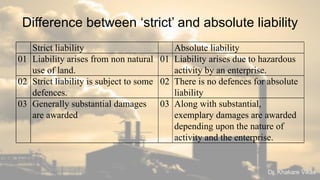
1. The document discusses the rules of strict liability established in Rylands v. Fletcher, where a defendant can be held liable for damages caused by an escape from his land of something dangerous, even without negligence.
2. It then explains the evolution of the rule of absolute liability in India established in M.C. Mehta v. Union of India, where industries engaged in hazardous or inherently dangerous activities can be held absolutely liable for any resulting harms with no defenses.
3. Examples of the Bhopal gas tragedy case and M.C. Mehta case are provided where the rule of absolute liability was applied.