
The Aging of Cellulose Insulation
in Transformers
WHITE PAPER
© 2017 AGC Refining & Filtration LLC
AGC REFINING & FILTRATION
THE AGING OF CELLULOSE INSULATION IN TRANSFORMERS 2
Contents
General 3
Cellulose Decomposition 3
Degree of Polymerization 3
Furan Analysis 4
The Significance of Furan Analysis 5
Preserving Cellulose Insulation 5
AGC REFINING & FILTRATION
THE AGING OF CELLULOSE INSULATION IN TRANSFORMERS 3
General
The insulation system in a transformer consists of both insulating oil and paper (cellulose). As the
transformer ages, the dielectric properties deteriorate. A transformer is considered to have reached the
end of its useful life when the paper insulation has lost its dielectric strength.
As the aging process proceeds, oxidation causes acid and sludge to form in the transformer oil. Moisture
enters the transformer and solid particles accumulate in the oil. Despite this degradation of the insulating
fluid, it is possible to slow down the aging process by oil purification.
As the paper ages, its tensile strength decreases making the transformer susceptible to winding failures
during mechanical stresses such as vibration, short-circuits, arcing, etc.
While transformer oil aging can be reversed, paper aging is irreversible. Thus, the useful life of a
transformer is defined by the useful life of the paper insulation. But while the aging of paper is irreversible,
the rate at which the aging occurs can be influenced by operation, maintenance, and condition monitoring
of the transformer.
With condition monitoring it is possible to:
 Estimate the remaining life of the transformer
 Assess whether the remaining useful life can be extended through modification of the operation
and/or maintenance of the transformer
Cellulose Decomposition
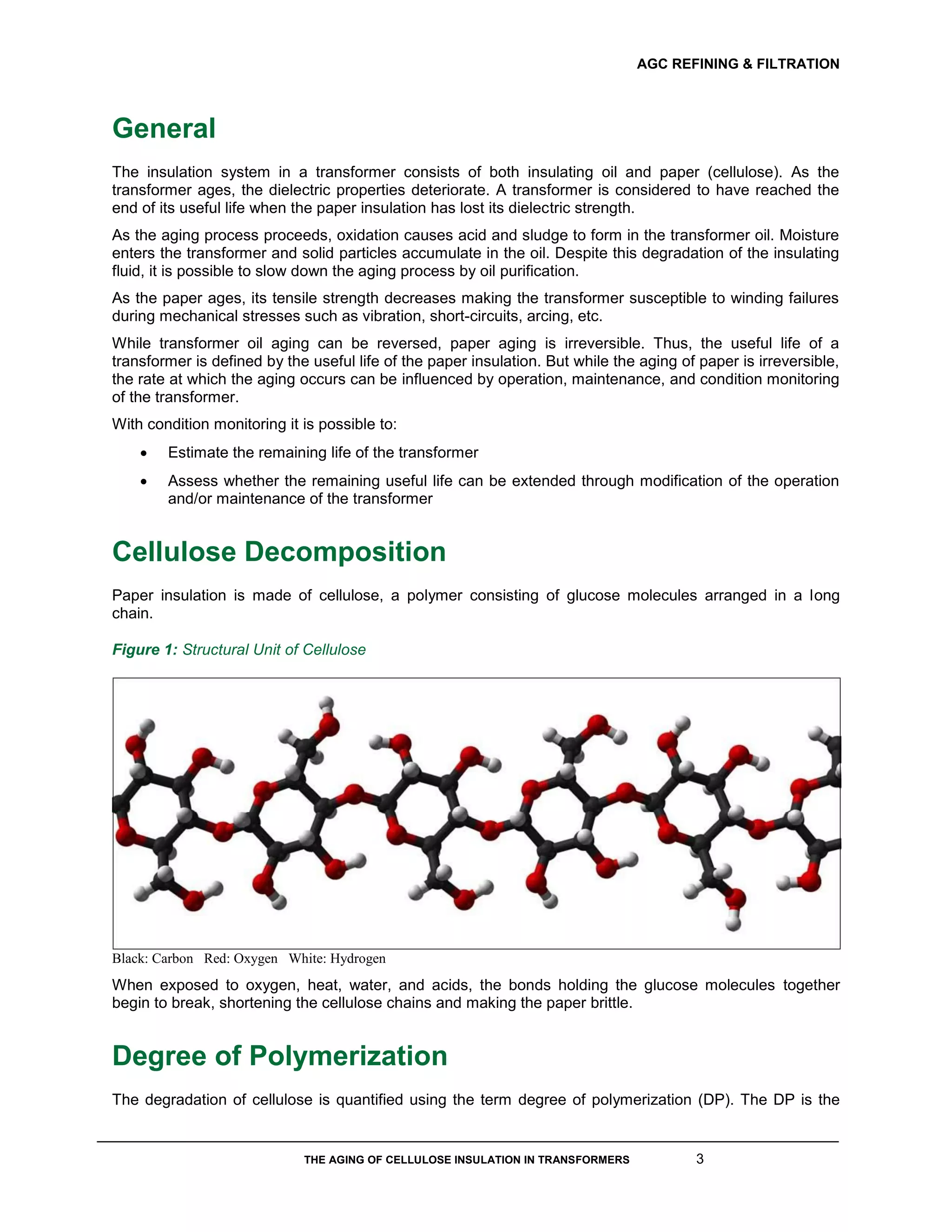
Paper insulation is made of cellulose, a polymer consisting of glucose molecules arranged in a long
chain.
Figure 1: Structural Unit of Cellulose
Black: Carbon Red: Oxygen White: Hydrogen
When exposed to oxygen, heat, water, and acids, the bonds holding the glucose molecules together
begin to break, shortening the cellulose chains and making the paper brittle.
Degree of Polymerization
The degradation of cellulose is quantified using the term degree of polymerization (DP). The DP is the
AGC REFINING & FILTRATION
THE AGING OF CELLULOSE INSULATION IN TRANSFORMERS 4
average length of the cellulose chains in glucose units that make up the paper insulation. As the chains
get shorter due to degrading processes, such as oxidation, pyrolysis (thermal degradation), and
hydrolysis, the DP value decreases. New insulation typically has a DP value of 1,500–1,800. When the
transformer undergoes factory testing and dry-out, this value drops to about 800–1,200.
Because this value has a wide range, it is important to determine the initial DPO on newly installed
transformers in order to have a baseline value to compare future DP results. The comparison allows
trending of the aging process of the paper insulation and, in many cases, early identification of any
accelerated aging that can be controlled by modifying operation and/or maintenance of the transformer.
DP analysis is also an important test for older transformers that may be approaching the end-of-life. As
the cellulose chains get shorter, they lose tensile strength, which reduces the ability of the paper to
withstand short-circuits, arcing, and other mechanical stresses. At a DP of 450–500 the paper insulation
has lost approximately 50% of its tensile strength and the probability of failure in the windings during a
short-circuit is fairly high. At a DP of 200 the paper has lost all its mechanical strength and is considered
to be at the end of its life.
It has been suggested that, due to the high probability of failure during short-circuit events, 450 is a better
indicator of the end of a transformer’s life than the absolute end-of-life indicated by a DP value of 200.
There are several ways to determine the DP of paper insulation. The most direct method is to take a
sample of the paper and have it analyzed. This method is the most accurate way to determine the DP, but
it has several weak points. First, it is impractical in many cases because it is an intrusive test and the
transformer must be shut down. Also, removing a sample of paper may negatively affect the transformer.
Finally, conditions are not the same at all locations inside the transformer, so in order to get a
representative result, several samples need to be taken from different locations.
Furan Analysis
When cellulose degrades, the glycosidic bonds that hold the molecule together break apart. This
shortened the cellulose chains and releases glucose into the oil. Glucose is an unstable molecule that is
quickly converted into furan. Measuring furan concentration in the insulating oil thus yields information
about the condition of the paper insulation.
Taking a sample for furan analysis requires only small samples. To run a furan analysis, the oil is
prepared and analyzed with high-pressure liquid chromatography (HPLC). The concentrations of five
main derivatives of furan are measured.
The furan derivatives are:
 2-furaldehydeyy
 Furfuryl alcohol
 2-acetyl furan
 5-methyl-2-furaldehyde
 5-hydroxymethyl-2-furaldehyde
Of these, 2-furaldehyde is by far the most abundant of the furan derivatives, but the other four are
occasionally found in large enough concentrations to indicate significant paper degradation and should
not be ignored.
The concentrations of each of the five furan derivatives are reported as an estimated DP for the sample,
which is calculated using these furan concentrations. Studies that correlate actual values with those
calculated from analyses indicate good correlation between the two.
Oil filtration, particularly with fuller’s earth, removes furans from the oil. For this reason it is best not to
sample for furan analysis soon after filtering or purifying the oil. Like moisture, furans exist in a dynamic
state of equilibrium between oil and paper. Consequently, after furans are removed from the oil during
AGC REFINING & FILTRATION
THE AGING OF CELLULOSE INSULATION IN TRANSFORMERS 5
filtration, the equilibrium re-establishes itself by moving from the paper into the oil. After about six months,
the furans will have reached equilibrium and a sample can be taken again.
The Significance of Furan Analysis
A degree of polymerization value, whether calculated based on a paper sample or estimated based on
furan analysis, gives a good indication of the paper insulation. By comparing two or more DP values
taken at different times, the rate of paper degradation can be determined. This is important because:
Knowing the rate of cellulose decomposition will allow for an estimate of when the transformer will reach
the end of its useful life
Trending the rate of cellulose decomposition will allow identification and control of accelerated aging
before the transformer loses a significant amount of its remaining life
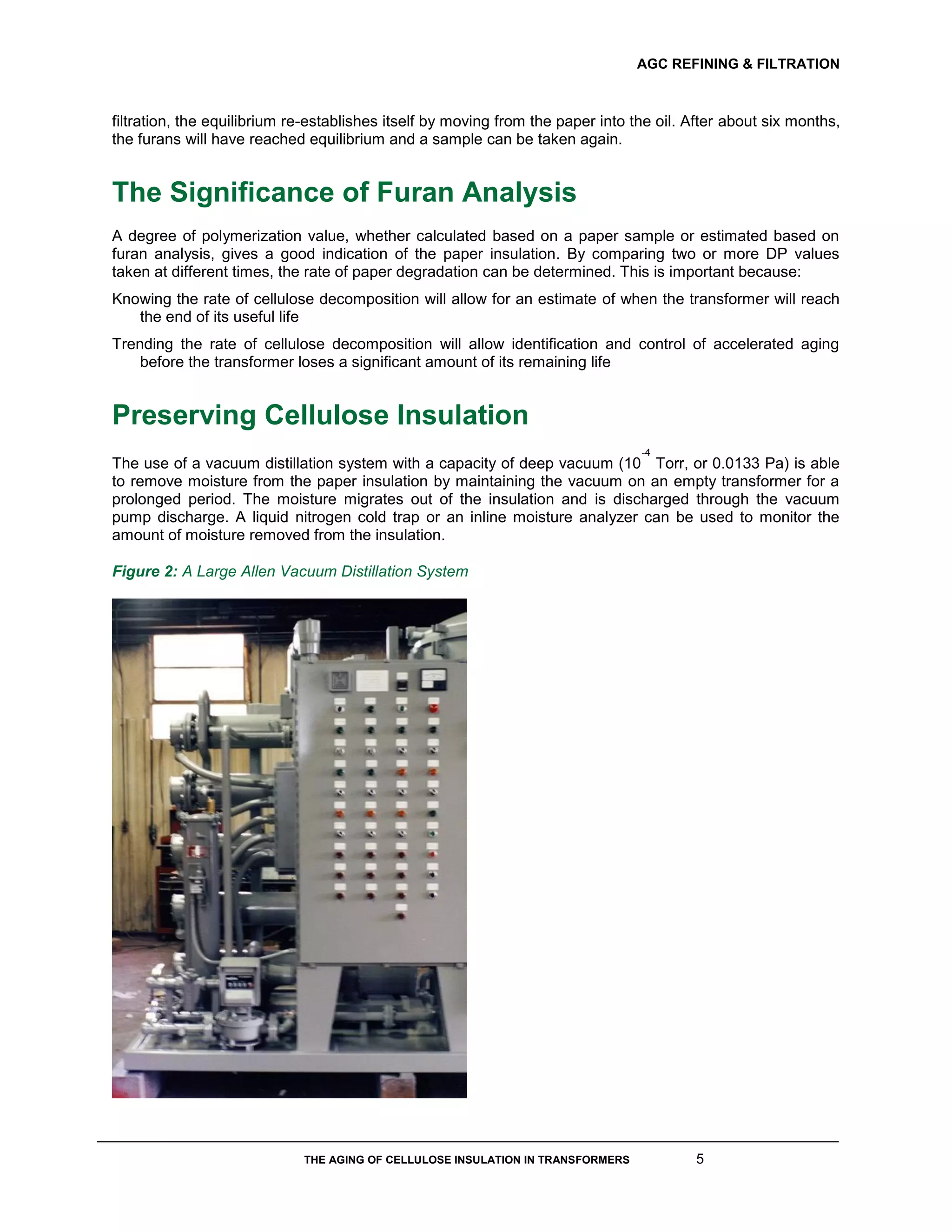
Preserving Cellulose Insulation
The use of a vacuum distillation system with a capacity of deep vacuum (10
-4
Torr, or 0.0133 Pa) is able
to remove moisture from the paper insulation by maintaining the vacuum on an empty transformer for a
prolonged period. The moisture migrates out of the insulation and is discharged through the vacuum
pump discharge. A liquid nitrogen cold trap or an inline moisture analyzer can be used to monitor the
amount of moisture removed from the insulation.
Figure 2: A Large Allen Vacuum Distillation System
AGC REFINING & FILTRATION
THE AGING OF CELLULOSE INSULATION IN TRANSFORMERS 6
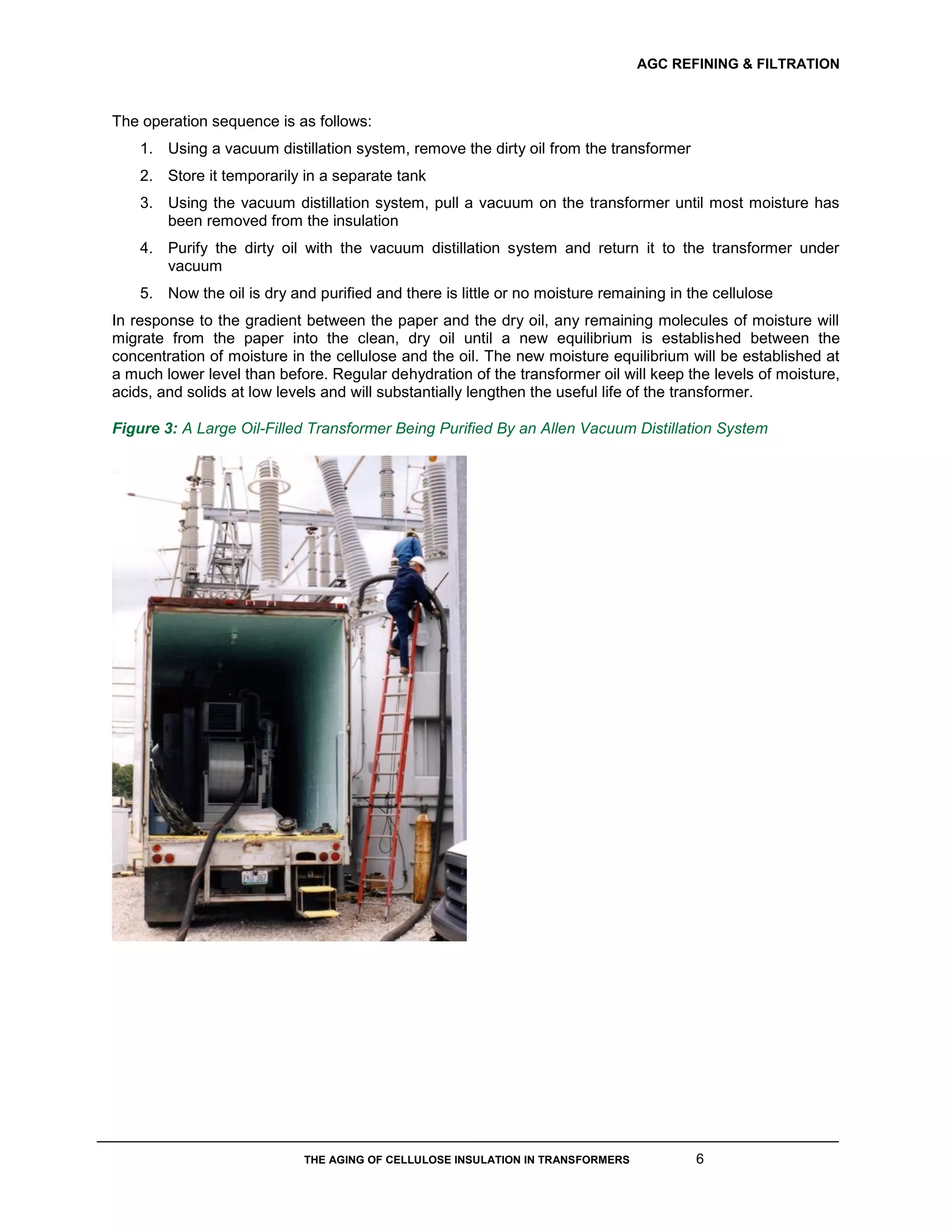
The operation sequence is as follows:
1. Using a vacuum distillation system, remove the dirty oil from the transformer
2. Store it temporarily in a separate tank
3. Using the vacuum distillation system, pull a vacuum on the transformer until most moisture has
been removed from the insulation
4. Purify the dirty oil with the vacuum distillation system and return it to the transformer under
vacuum
5. Now the oil is dry and purified and there is little or no moisture remaining in the cellulose
In response to the gradient between the paper and the dry oil, any remaining molecules of moisture will
migrate from the paper into the clean, dry oil until a new equilibrium is established between the
concentration of moisture in the cellulose and the oil. The new moisture equilibrium will be established at
a much lower level than before. Regular dehydration of the transformer oil will keep the levels of moisture,
acids, and solids at low levels and will substantially lengthen the useful life of the transformer.
Figure 3: A Large Oil-Filled Transformer Being Purified By an Allen Vacuum Distillation System
www.AGCInternational.com
3045 East Elm Street
Springfield, Missouri 65802, USA
Toll Free: +1 800 865 3208
Phone: +1 417 865 2844

Agc wp-aging of cellulose insulation in transformers

  • 1.
    The Aging ofCellulose Insulation in Transformers WHITE PAPER © 2017 AGC Refining & Filtration LLC
  • 2.
    AGC REFINING &FILTRATION THE AGING OF CELLULOSE INSULATION IN TRANSFORMERS 2 Contents General 3 Cellulose Decomposition 3 Degree of Polymerization 3 Furan Analysis 4 The Significance of Furan Analysis 5 Preserving Cellulose Insulation 5
  • 3.
    AGC REFINING &FILTRATION THE AGING OF CELLULOSE INSULATION IN TRANSFORMERS 3 General The insulation system in a transformer consists of both insulating oil and paper (cellulose). As the transformer ages, the dielectric properties deteriorate. A transformer is considered to have reached the end of its useful life when the paper insulation has lost its dielectric strength. As the aging process proceeds, oxidation causes acid and sludge to form in the transformer oil. Moisture enters the transformer and solid particles accumulate in the oil. Despite this degradation of the insulating fluid, it is possible to slow down the aging process by oil purification. As the paper ages, its tensile strength decreases making the transformer susceptible to winding failures during mechanical stresses such as vibration, short-circuits, arcing, etc. While transformer oil aging can be reversed, paper aging is irreversible. Thus, the useful life of a transformer is defined by the useful life of the paper insulation. But while the aging of paper is irreversible, the rate at which the aging occurs can be influenced by operation, maintenance, and condition monitoring of the transformer. With condition monitoring it is possible to:  Estimate the remaining life of the transformer  Assess whether the remaining useful life can be extended through modification of the operation and/or maintenance of the transformer Cellulose Decomposition Paper insulation is made of cellulose, a polymer consisting of glucose molecules arranged in a long chain. Figure 1: Structural Unit of Cellulose Black: Carbon Red: Oxygen White: Hydrogen When exposed to oxygen, heat, water, and acids, the bonds holding the glucose molecules together begin to break, shortening the cellulose chains and making the paper brittle. Degree of Polymerization The degradation of cellulose is quantified using the term degree of polymerization (DP). The DP is the
  • 4.
    AGC REFINING &FILTRATION THE AGING OF CELLULOSE INSULATION IN TRANSFORMERS 4 average length of the cellulose chains in glucose units that make up the paper insulation. As the chains get shorter due to degrading processes, such as oxidation, pyrolysis (thermal degradation), and hydrolysis, the DP value decreases. New insulation typically has a DP value of 1,500–1,800. When the transformer undergoes factory testing and dry-out, this value drops to about 800–1,200. Because this value has a wide range, it is important to determine the initial DPO on newly installed transformers in order to have a baseline value to compare future DP results. The comparison allows trending of the aging process of the paper insulation and, in many cases, early identification of any accelerated aging that can be controlled by modifying operation and/or maintenance of the transformer. DP analysis is also an important test for older transformers that may be approaching the end-of-life. As the cellulose chains get shorter, they lose tensile strength, which reduces the ability of the paper to withstand short-circuits, arcing, and other mechanical stresses. At a DP of 450–500 the paper insulation has lost approximately 50% of its tensile strength and the probability of failure in the windings during a short-circuit is fairly high. At a DP of 200 the paper has lost all its mechanical strength and is considered to be at the end of its life. It has been suggested that, due to the high probability of failure during short-circuit events, 450 is a better indicator of the end of a transformer’s life than the absolute end-of-life indicated by a DP value of 200. There are several ways to determine the DP of paper insulation. The most direct method is to take a sample of the paper and have it analyzed. This method is the most accurate way to determine the DP, but it has several weak points. First, it is impractical in many cases because it is an intrusive test and the transformer must be shut down. Also, removing a sample of paper may negatively affect the transformer. Finally, conditions are not the same at all locations inside the transformer, so in order to get a representative result, several samples need to be taken from different locations. Furan Analysis When cellulose degrades, the glycosidic bonds that hold the molecule together break apart. This shortened the cellulose chains and releases glucose into the oil. Glucose is an unstable molecule that is quickly converted into furan. Measuring furan concentration in the insulating oil thus yields information about the condition of the paper insulation. Taking a sample for furan analysis requires only small samples. To run a furan analysis, the oil is prepared and analyzed with high-pressure liquid chromatography (HPLC). The concentrations of five main derivatives of furan are measured. The furan derivatives are:  2-furaldehydeyy  Furfuryl alcohol  2-acetyl furan  5-methyl-2-furaldehyde  5-hydroxymethyl-2-furaldehyde Of these, 2-furaldehyde is by far the most abundant of the furan derivatives, but the other four are occasionally found in large enough concentrations to indicate significant paper degradation and should not be ignored. The concentrations of each of the five furan derivatives are reported as an estimated DP for the sample, which is calculated using these furan concentrations. Studies that correlate actual values with those calculated from analyses indicate good correlation between the two. Oil filtration, particularly with fuller’s earth, removes furans from the oil. For this reason it is best not to sample for furan analysis soon after filtering or purifying the oil. Like moisture, furans exist in a dynamic state of equilibrium between oil and paper. Consequently, after furans are removed from the oil during
  • 5.
    AGC REFINING &FILTRATION THE AGING OF CELLULOSE INSULATION IN TRANSFORMERS 5 filtration, the equilibrium re-establishes itself by moving from the paper into the oil. After about six months, the furans will have reached equilibrium and a sample can be taken again. The Significance of Furan Analysis A degree of polymerization value, whether calculated based on a paper sample or estimated based on furan analysis, gives a good indication of the paper insulation. By comparing two or more DP values taken at different times, the rate of paper degradation can be determined. This is important because: Knowing the rate of cellulose decomposition will allow for an estimate of when the transformer will reach the end of its useful life Trending the rate of cellulose decomposition will allow identification and control of accelerated aging before the transformer loses a significant amount of its remaining life Preserving Cellulose Insulation The use of a vacuum distillation system with a capacity of deep vacuum (10 -4 Torr, or 0.0133 Pa) is able to remove moisture from the paper insulation by maintaining the vacuum on an empty transformer for a prolonged period. The moisture migrates out of the insulation and is discharged through the vacuum pump discharge. A liquid nitrogen cold trap or an inline moisture analyzer can be used to monitor the amount of moisture removed from the insulation. Figure 2: A Large Allen Vacuum Distillation System
  • 6.
    AGC REFINING &FILTRATION THE AGING OF CELLULOSE INSULATION IN TRANSFORMERS 6 The operation sequence is as follows: 1. Using a vacuum distillation system, remove the dirty oil from the transformer 2. Store it temporarily in a separate tank 3. Using the vacuum distillation system, pull a vacuum on the transformer until most moisture has been removed from the insulation 4. Purify the dirty oil with the vacuum distillation system and return it to the transformer under vacuum 5. Now the oil is dry and purified and there is little or no moisture remaining in the cellulose In response to the gradient between the paper and the dry oil, any remaining molecules of moisture will migrate from the paper into the clean, dry oil until a new equilibrium is established between the concentration of moisture in the cellulose and the oil. The new moisture equilibrium will be established at a much lower level than before. Regular dehydration of the transformer oil will keep the levels of moisture, acids, and solids at low levels and will substantially lengthen the useful life of the transformer. Figure 3: A Large Oil-Filled Transformer Being Purified By an Allen Vacuum Distillation System
  • 7.
    www.AGCInternational.com 3045 East ElmStreet Springfield, Missouri 65802, USA Toll Free: +1 800 865 3208 Phone: +1 417 865 2844