Accounting Standard (AS) 19
Lease
By Manjunath NS
1
Index
Objective
Scope
Definitions
Types of Leases
Accounting treatments of lease transactions
Sale & Lease back
Disclosures
Difference between AS 19 & IND AS 17
3
4
5-7
8-10
11
12-14
15-17
18
2
Objective
 The objective of this standard is to prescribe accounting
treatment for Leases
&
disclosures in relation to Financial and Operating
Leases.
3
Scope
 This standard applies to all leases except:-
a) Lease rights to explore for or use of natural resources,
such as oil, gas and other mineral rights,
b) Leases of motion pictures and
c) Lease agreement to use land.
4
Definitions
 Lease:- Agreement between two parties where one party
obtains right to use asset against consideration or series of
consideration for an agreed period of time.
Lessee Lessor
Consideration for using asset
Right to use asset
Lease
5
Cont.
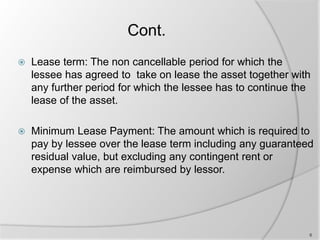
 Lease term: The non cancellable period for which the
lessee has agreed to take on lease the asset together with
any further period for which the lessee has to continue the
lease of the asset.
 Minimum Lease Payment: The amount which is required to
pay by lessee over the lease term including any guaranteed
residual value, but excluding any contingent rent or
expense which are reimbursed by lessor.
6
Cont.
 Fair Value: The amount for which an asset can be
exchanged or a liability settled between knowledgeable,
willing parties in an arm’s length transaction.
 Contingent rent: A portion of lease payment which is based
on a factor such as percentage of sales etc.
7
Types of Leases
 There are two types of leases:
a) Operating lease,
b) Finance lease.
a) Operating Lease: Leases other than finance lease are
operating lease.
8
Cont.
b) Finance lease : A lease which transfers all risk and rewards
incidental to ownership of asset.
Generally, these types of leases are considered as finance
leases:
i) Transfer of ownership of leased asset at the end of lease
period for nil consideration.
ii) Lease period is almost equal to life of asset.
iii) Option to buy leased asset at the end of lease period at a
very low price.
9
Cont.
d) Asset is of specified nature and cannot be used by other
person without major modifications are made.
e) Present value of lease rental with residual life is approx.
equal to cost of asset.
10
Accounting Treatment of Lease
 Accounting treatment of Finance Lease:
 Accounting treatment of Operating Lease:
11
Sales & lease Back resulting in
Financial lease
 Excess or deficiency of sale proceeds over carrying amount
should be deferred and amortised over lease term, in
proportion of Depreciation of leased asset.
Sales and lease back is finance lease
Sales and lease back
Sale Price-WDV=
Excess/Profit
Deferred & amortised
over lease term
Sale Price-
WDV=Deficiency/loss
Deferred & amortised
over lease term
12
Sale and lease back resulting in
operating lease
Sales and lease back
Case 1
SP<FV,
SP-WDV=GAIN/(LOSS)
Recognise immediately
in P&L
Note 1
Case 2
SP>FV,
SP-WDV= GAIN
Recognise immediately
in P&L & SP-FV will be
deferred.
Note 2
Case 3
FV<WDV,
SP/FV-WDV= Loss
Recognise immediately
in P&L
Note 3
13
Cont.
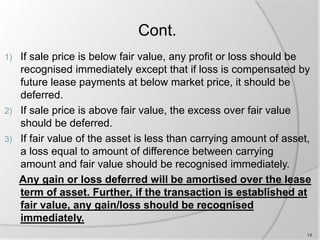
1) If sale price is below fair value, any profit or loss should be
recognised immediately except that if loss is compensated by
future lease payments at below market price, it should be
deferred.
2) If sale price is above fair value, the excess over fair value
should be deferred.
3) If fair value of the asset is less than carrying amount of asset,
a loss equal to amount of difference between carrying
amount and fair value should be recognised immediately.
Any gain or loss deferred will be amortised over the lease
term of asset. Further, if the transaction is established at
fair value, any gain/loss should be recognised
immediately.
14
Disclosures
Books of Lessee Books of Lessor
Asset on lease should be specifically
specified as no lease.
Unearned finance income.
Contingent rent recognised as
expense in P&L for the period.
Unguaranteed residual value.
General leasing policies. Contingent rent recognised in P&L.
The total of sub-lease rentals
expected to realise in future, if any.
General leasing policies.
A reconciliation statement as given in
slide no.16
A reconciliation statement as given in
slide no.17.
Provisions for doubtful debts on lease
rents.
15
Cont.
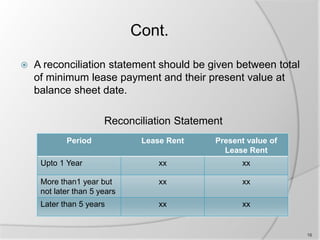
 A reconciliation statement should be given between total
of minimum lease payment and their present value at
balance sheet date.
Reconciliation Statement
Period Lease Rent Present value of
Lease Rent
Upto 1 Year xx xx
More than1 year but
not later than 5 years
xx xx
Later than 5 years xx xx
16
Cont.
 A reconciliation statement should be given between total
gross investments and present value of lease rent at
balance sheet date.
Reconciliation Statement
Period Lease Rent Present value of
Lease Rent
Upto 1 Year xx xx
More than1 year but
not later than 5 years
xx xx
Later than 5 years xx xx
17
Differences between AS 19 & IND AS 17
Particulars AS 19 IND AS 17
Applicability on Land It does not applies to lease of
land.
It applies to lease of
land.
Gain or loss on sale and
leaseback transaction
Gain or loss should be amortised
in ration of Depreciation and over
the life of leased asset in case of
operating lease.
IND AS 17 is Silent.
Classification of current
/non current lease
liability
AS 19 is silent. It requires
classifications.
Inflation based operating
lease
AS 19 is silent Payments should not be
recognised on SLM
basis.
Distinction between
inception of lease and
commencement of lease
AS 19 is silent. IND AS 17 Provides
distinction between
these terms.
18
Thank You
19

AFSR SAMS.pptx

  • 1.
    Accounting Standard (AS)19 Lease By Manjunath NS 1
  • 2.
    Index Objective Scope Definitions Types of Leases Accountingtreatments of lease transactions Sale & Lease back Disclosures Difference between AS 19 & IND AS 17 3 4 5-7 8-10 11 12-14 15-17 18 2
  • 3.
    Objective  The objectiveof this standard is to prescribe accounting treatment for Leases & disclosures in relation to Financial and Operating Leases. 3
  • 4.
    Scope  This standardapplies to all leases except:- a) Lease rights to explore for or use of natural resources, such as oil, gas and other mineral rights, b) Leases of motion pictures and c) Lease agreement to use land. 4
  • 5.
    Definitions  Lease:- Agreementbetween two parties where one party obtains right to use asset against consideration or series of consideration for an agreed period of time. Lessee Lessor Consideration for using asset Right to use asset Lease 5
  • 6.
    Cont.  Lease term:The non cancellable period for which the lessee has agreed to take on lease the asset together with any further period for which the lessee has to continue the lease of the asset.  Minimum Lease Payment: The amount which is required to pay by lessee over the lease term including any guaranteed residual value, but excluding any contingent rent or expense which are reimbursed by lessor. 6
  • 7.
    Cont.  Fair Value:The amount for which an asset can be exchanged or a liability settled between knowledgeable, willing parties in an arm’s length transaction.  Contingent rent: A portion of lease payment which is based on a factor such as percentage of sales etc. 7
  • 8.
    Types of Leases There are two types of leases: a) Operating lease, b) Finance lease. a) Operating Lease: Leases other than finance lease are operating lease. 8
  • 9.
    Cont. b) Finance lease: A lease which transfers all risk and rewards incidental to ownership of asset. Generally, these types of leases are considered as finance leases: i) Transfer of ownership of leased asset at the end of lease period for nil consideration. ii) Lease period is almost equal to life of asset. iii) Option to buy leased asset at the end of lease period at a very low price. 9
  • 10.
    Cont. d) Asset isof specified nature and cannot be used by other person without major modifications are made. e) Present value of lease rental with residual life is approx. equal to cost of asset. 10
  • 11.
    Accounting Treatment ofLease  Accounting treatment of Finance Lease:  Accounting treatment of Operating Lease: 11
  • 12.
    Sales & leaseBack resulting in Financial lease  Excess or deficiency of sale proceeds over carrying amount should be deferred and amortised over lease term, in proportion of Depreciation of leased asset. Sales and lease back is finance lease Sales and lease back Sale Price-WDV= Excess/Profit Deferred & amortised over lease term Sale Price- WDV=Deficiency/loss Deferred & amortised over lease term 12
  • 13.
    Sale and leaseback resulting in operating lease Sales and lease back Case 1 SP<FV, SP-WDV=GAIN/(LOSS) Recognise immediately in P&L Note 1 Case 2 SP>FV, SP-WDV= GAIN Recognise immediately in P&L & SP-FV will be deferred. Note 2 Case 3 FV<WDV, SP/FV-WDV= Loss Recognise immediately in P&L Note 3 13
  • 14.
    Cont. 1) If saleprice is below fair value, any profit or loss should be recognised immediately except that if loss is compensated by future lease payments at below market price, it should be deferred. 2) If sale price is above fair value, the excess over fair value should be deferred. 3) If fair value of the asset is less than carrying amount of asset, a loss equal to amount of difference between carrying amount and fair value should be recognised immediately. Any gain or loss deferred will be amortised over the lease term of asset. Further, if the transaction is established at fair value, any gain/loss should be recognised immediately. 14
  • 15.
    Disclosures Books of LesseeBooks of Lessor Asset on lease should be specifically specified as no lease. Unearned finance income. Contingent rent recognised as expense in P&L for the period. Unguaranteed residual value. General leasing policies. Contingent rent recognised in P&L. The total of sub-lease rentals expected to realise in future, if any. General leasing policies. A reconciliation statement as given in slide no.16 A reconciliation statement as given in slide no.17. Provisions for doubtful debts on lease rents. 15
  • 16.
    Cont.  A reconciliationstatement should be given between total of minimum lease payment and their present value at balance sheet date. Reconciliation Statement Period Lease Rent Present value of Lease Rent Upto 1 Year xx xx More than1 year but not later than 5 years xx xx Later than 5 years xx xx 16
  • 17.
    Cont.  A reconciliationstatement should be given between total gross investments and present value of lease rent at balance sheet date. Reconciliation Statement Period Lease Rent Present value of Lease Rent Upto 1 Year xx xx More than1 year but not later than 5 years xx xx Later than 5 years xx xx 17
  • 18.
    Differences between AS19 & IND AS 17 Particulars AS 19 IND AS 17 Applicability on Land It does not applies to lease of land. It applies to lease of land. Gain or loss on sale and leaseback transaction Gain or loss should be amortised in ration of Depreciation and over the life of leased asset in case of operating lease. IND AS 17 is Silent. Classification of current /non current lease liability AS 19 is silent. It requires classifications. Inflation based operating lease AS 19 is silent Payments should not be recognised on SLM basis. Distinction between inception of lease and commencement of lease AS 19 is silent. IND AS 17 Provides distinction between these terms. 18
  • 19.