August 2021
COMPLIANCE, INTEGRITY & CORROSION
Design & Construction of New Pipelines
SAFETY STATISTICS
2017 2018 2019 2020
Recordable Incidents 0 0 0 0
Lost Workday Case Rate 0.0 0.0 0.0 0.0
Lost Time Rate 0.0 0.0 0.0 0.0
EMR 0.75 0.7 0.72 0.7
Total Man-hours Worked 951,357 1,300,032 2,206,852 1,629,894
Preventative and Active Case Management
 Lost Workday Case Rate of Zero
 DART Rate of Zero
 Lost Time Rate (LTR) of Zero
Zero OSHA: Recordable Incidents
Agenda
FIRST THINGS FIRST
 Jurisdictional analysis
 High consequence area (HCA) analysis
 Emergency flow restriction device (EFRD) analysis
 Geohazard analysis
 Leak detection capability analysis
 AC interference modeling & mitigation design
 Cathodic protection (CP) design
 Risk analysis
 Cathodic protection & AC mitigation system installation
 Cathodic protection & AC mitigation system commissioning
What’s in and What’s Out – 49 CFR Part 192, Gas
JURISDICTIONAL ANALYSIS
Transmission pipeline – B31.8 & 192
Gathering pipeline – it depends
 Class location unit
• 660’ buffer either side of center
• Continuous sliding mile
 Class 1 – B31.8
• Contains ≤ 10 habitable buildings
 Class 2, 3, 4 – B31.8 & 192
What’s in and What’s Out – PHMSA “Mega Rule”
JURISDICTIONAL ANALYSIS
Mega rule part 1 – effective july 1, 2020
 New requirements for gas & liquid transmission
 Class 1 design safety factor increased from 1.1 to 1.25
• Applies to type A and type B gas gathering
 Proscribes TVC record requirements to support MAOP / MOP
• Construction inspection and turn-over packages are critical
Mega rule parts 2 & 3 – effective 2020 / 2021?
 Eliminates class 1 gathering “loop hole”
 In/out function of pressure and diameter
• ≥ 30% smys? And
• ≥ 10”, 12”, 16”?
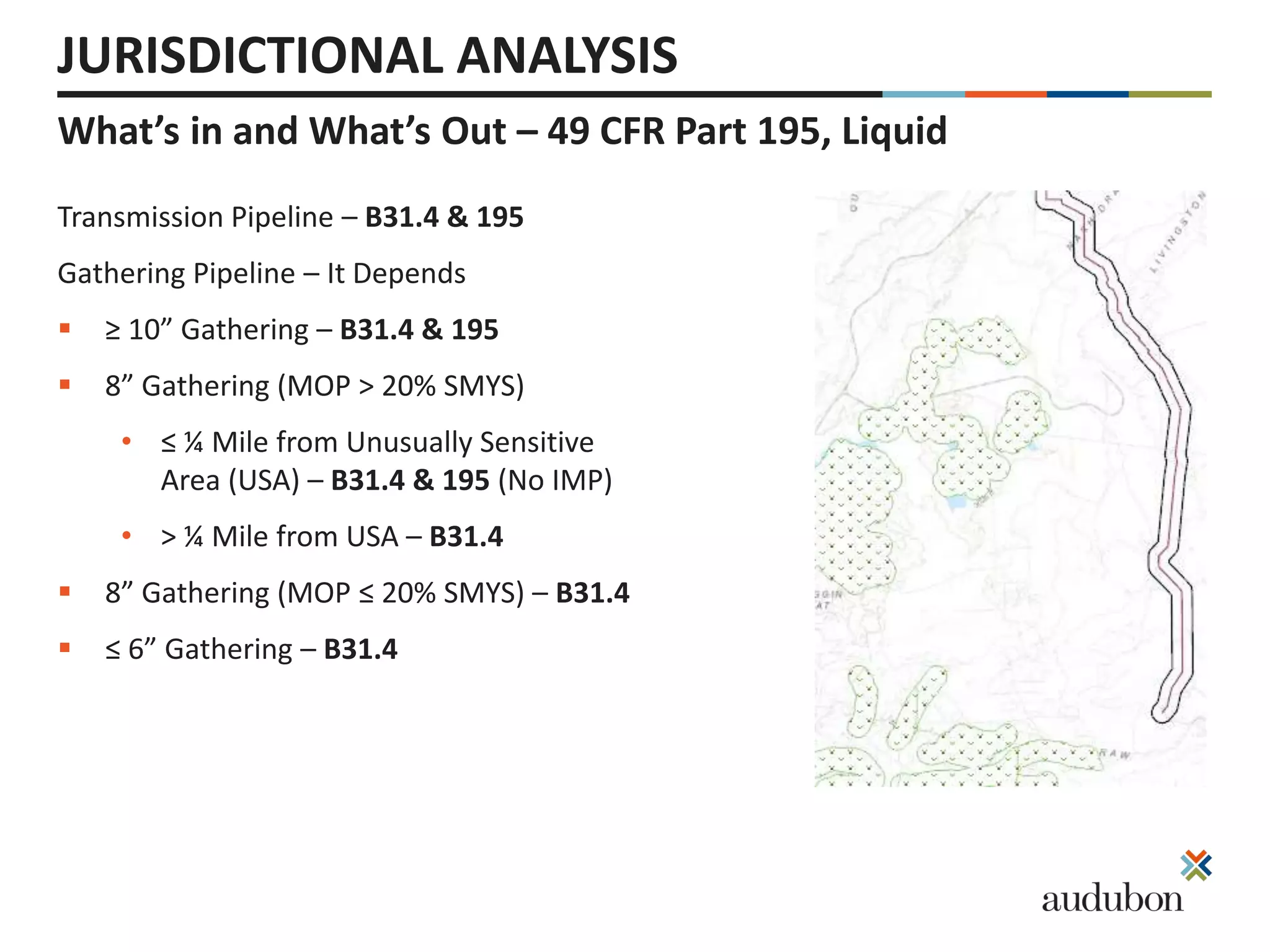
What’s in and What’s Out – 49 CFR Part 195, Liquid
JURISDICTIONAL ANALYSIS
Transmission Pipeline – B31.4 & 195
Gathering Pipeline – It Depends
 ≥ 10” Gathering – B31.4 & 195
 8” Gathering (MOP > 20% SMYS)
• ≤ ¼ Mile from Unusually Sensitive
Area (USA) – B31.4 & 195 (No IMP)
• > ¼ Mile from USA – B31.4
 8” Gathering (MOP ≤ 20% SMYS) – B31.4
 ≤ 6” Gathering – B31.4
49 CFR Part 192, Gas
HCA ANALYSIS – IM RULE
Design & Construction Impact
 Pressure Safety Factor Class
Location Dependent
 Need Class Location
to Calculate MAOP
49 CFR Part 195, Liquid
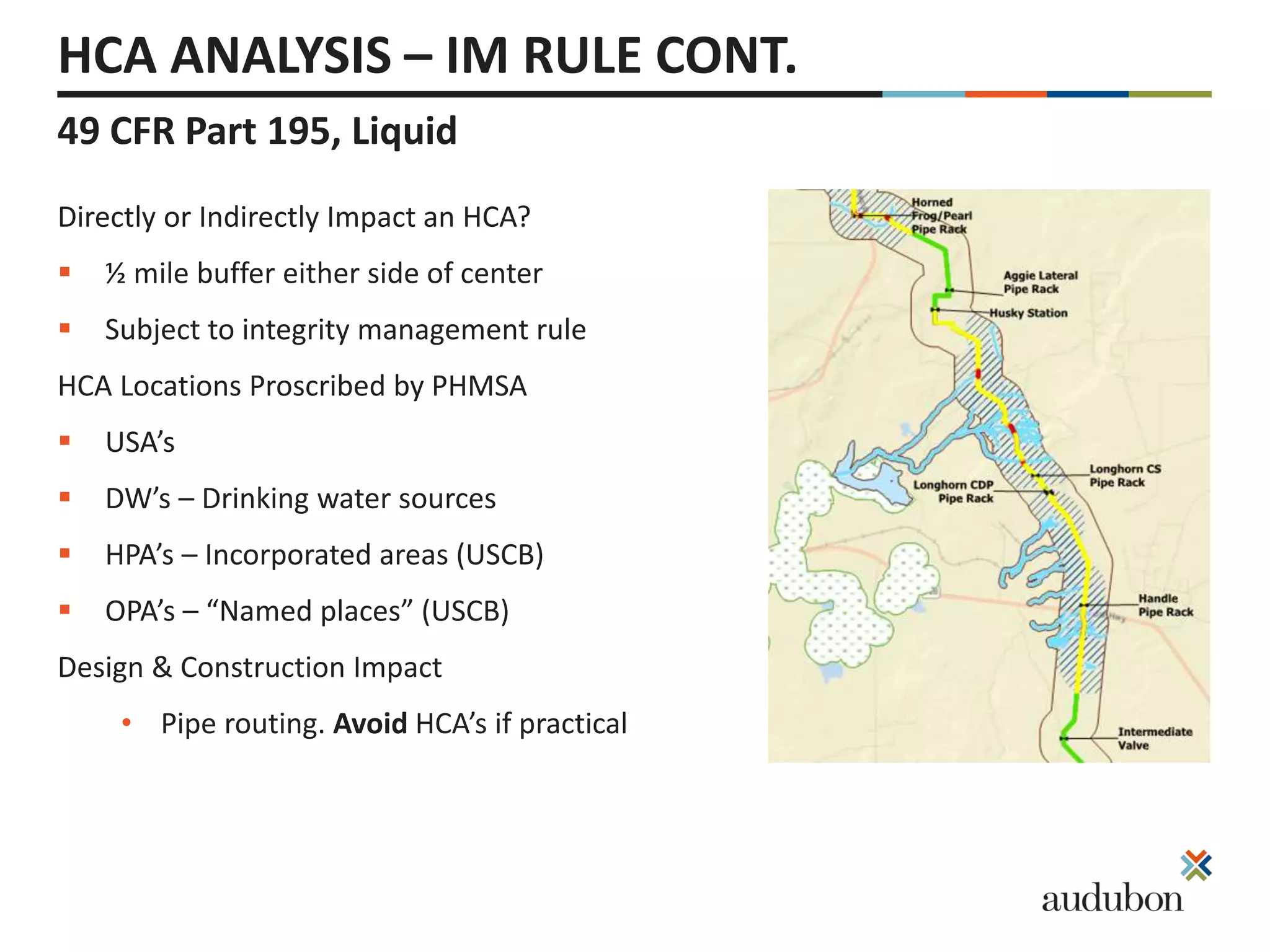
HCA ANALYSIS – IM RULE CONT.
Directly or Indirectly Impact an HCA?
 ½ mile buffer either side of center
 Subject to integrity management rule
HCA Locations Proscribed by PHMSA
 USA’s
 DW’s – Drinking water sources
 HPA’s – Incorporated areas (USCB)
 OPA’s – “Named places” (USCB)
Design & Construction Impact
• Pipe routing. Avoid HCA’s if practical
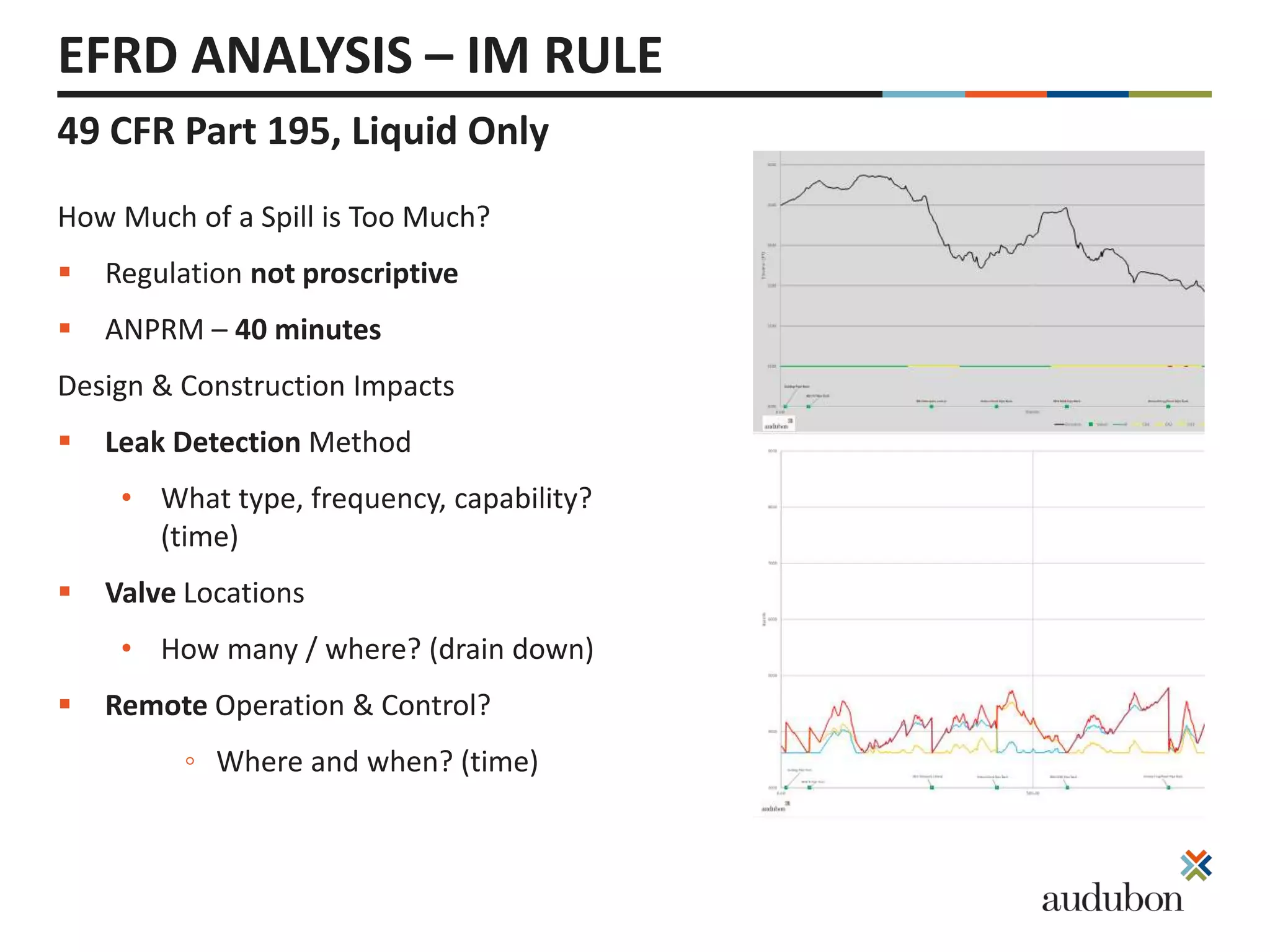
49 CFR Part 195, Liquid Only
EFRD ANALYSIS – IM RULE
How Much of a Spill is Too Much?
 Regulation not proscriptive
 ANPRM – 40 minutes
Design & Construction Impacts
 Leak Detection Method
• What type, frequency, capability?
(time)
 Valve Locations
• How many / where? (drain down)
 Remote Operation & Control?
◦ Where and when? (time)
49 CFR Part 195
GEOHAZARD
 Topography and Geology
 Geological Hazards
• Earthquake Induced Hazards
• Mass Wasting
• Flooding and High Groundwater
• Stream Channel Migration and Avulsion
Hazards
• Surface Erosion
• Karst Topography
49 CFR Part 195, Liquid Only
LDCA ANALYSIS – IM RULE
How Quickly Can a Leak Be Identified?
 Leak Detection Techniques?
• Credit for Multiples
 Pipeline and Product Type?
 Proximity to HCA’s?
Design & Construction Impacts
 Swiftness of LDS
 Response Personnel Locations
 Risk Assessment Results
Pipeline Threat & Personnel Safety Hazard
AC INTERFERENCE
High Voltage (≥ 69 kV) Power Lines That
Cross or Parallel Pipelines
 Digital Simulation of Induced AC Voltage
and Current on Pipeline
 Design Mitigation to Eliminate Corrosion
& Safety Hazard
 Design & Construction Impacts
• Get started early
◦ Months to obtain power line
data
• Minimize crossings & parallelism
• Cross @ 90o angle
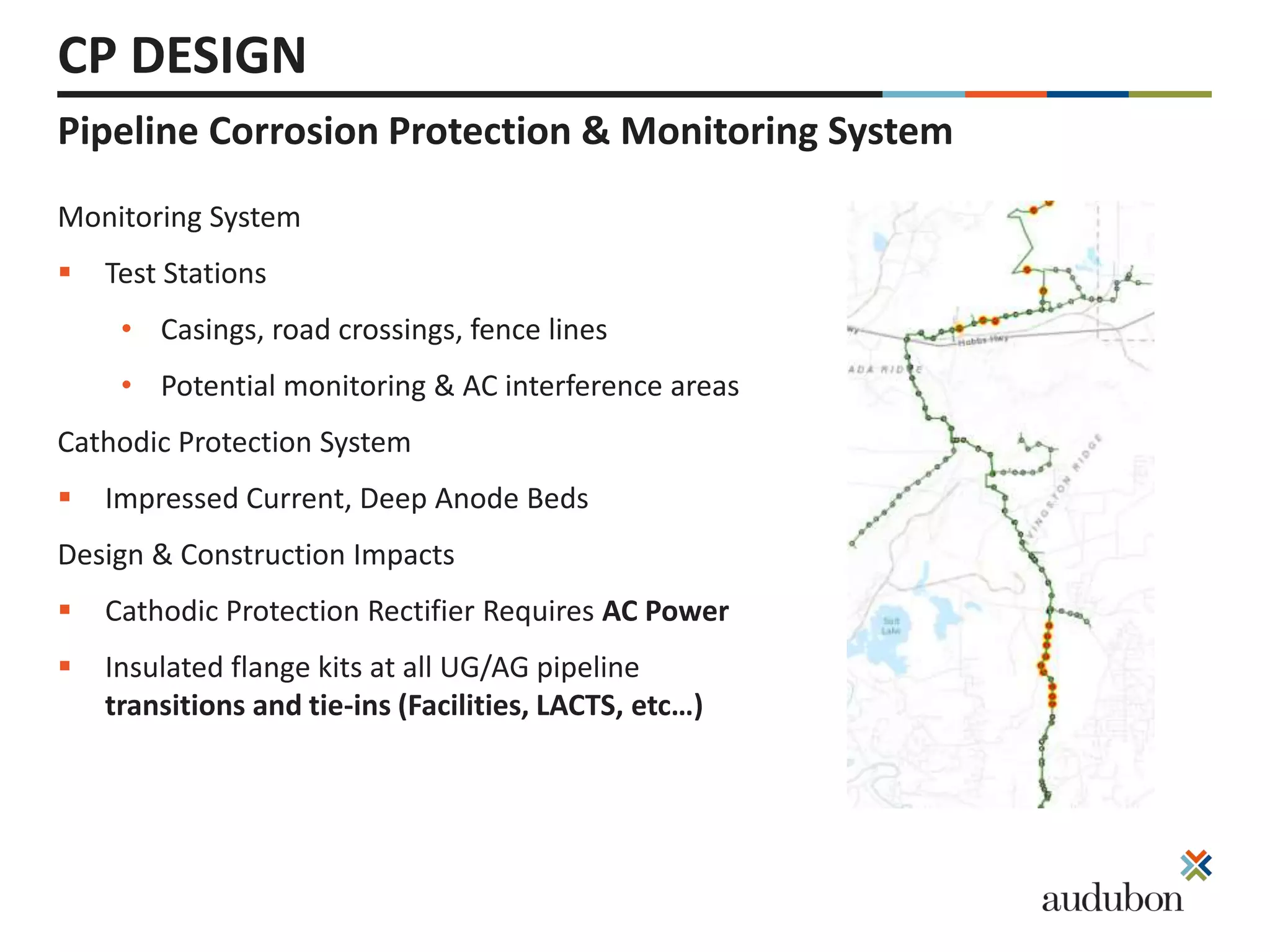
Pipeline Corrosion Protection & Monitoring System
CP DESIGN
Monitoring System
 Test Stations
• Casings, road crossings, fence lines
• Potential monitoring & AC interference areas
Cathodic Protection System
 Impressed Current, Deep Anode Beds
Design & Construction Impacts
 Cathodic Protection Rectifier Requires AC Power
 Insulated flange kits at all UG/AG pipeline
transitions and tie-ins (Facilities, LACTS, etc…)
Parking Lot
CP DESIGN
Design & Construction Impacts
 Electrical isolation at all power system
grounds (Remote control valves, pumps,
meters, instrumentation, pipe supports)
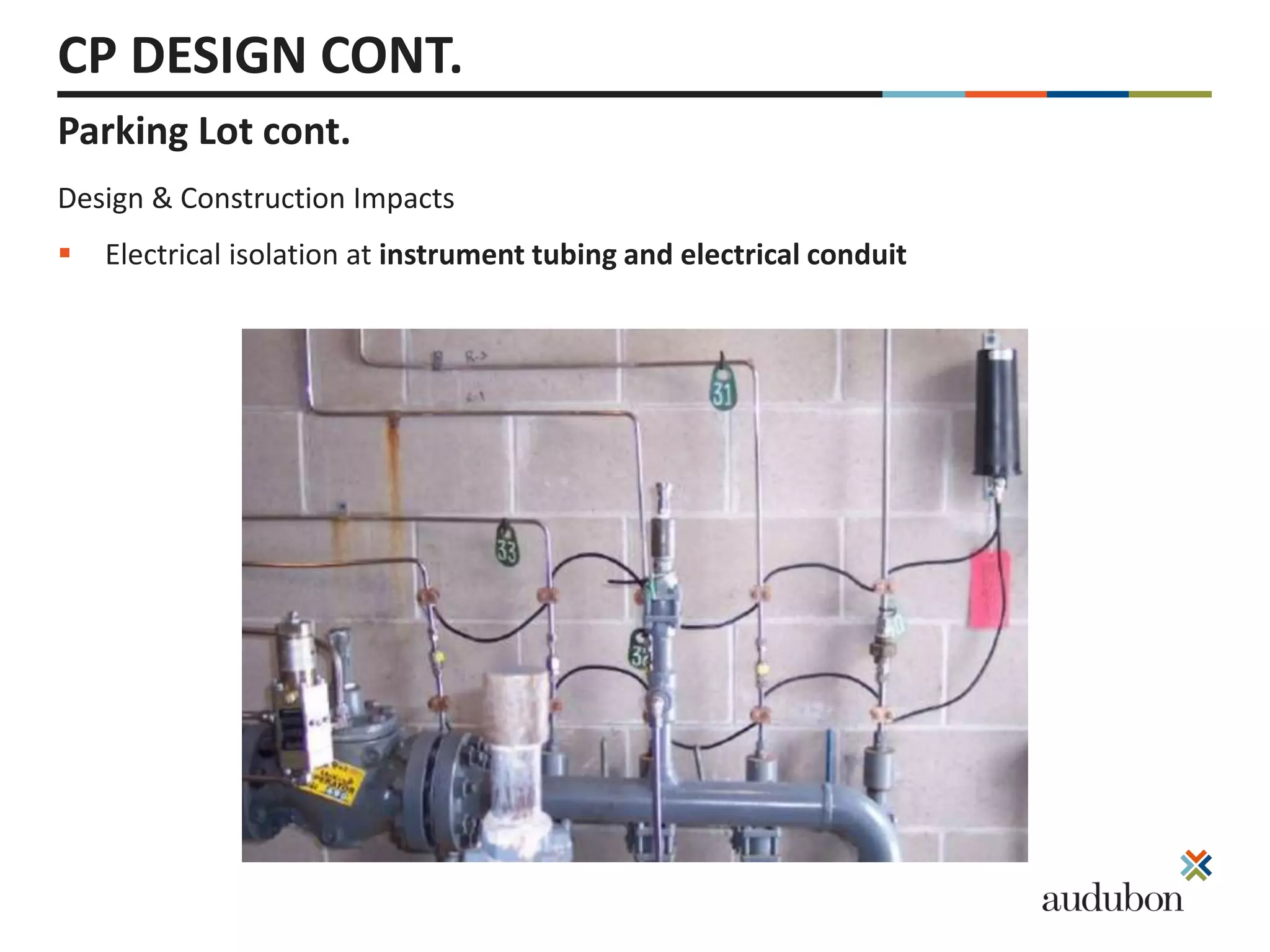
Parking Lot cont.
CP DESIGN CONT.
Design & Construction Impacts
 Electrical isolation at instrument tubing and electrical conduit
How Much is Too Much? – Integrity Management Program
RISK ANALYSIS – IM RULE
Design & Construction Impacts
 Design Drives Risk
• Pipe wall (Barrier)
• Routing (Mitigator)
◦ Receptors
◦ Third party damage
◦ Geohazards
• Corrosion Protection
(Mitigator)
• Security (Mitigator)
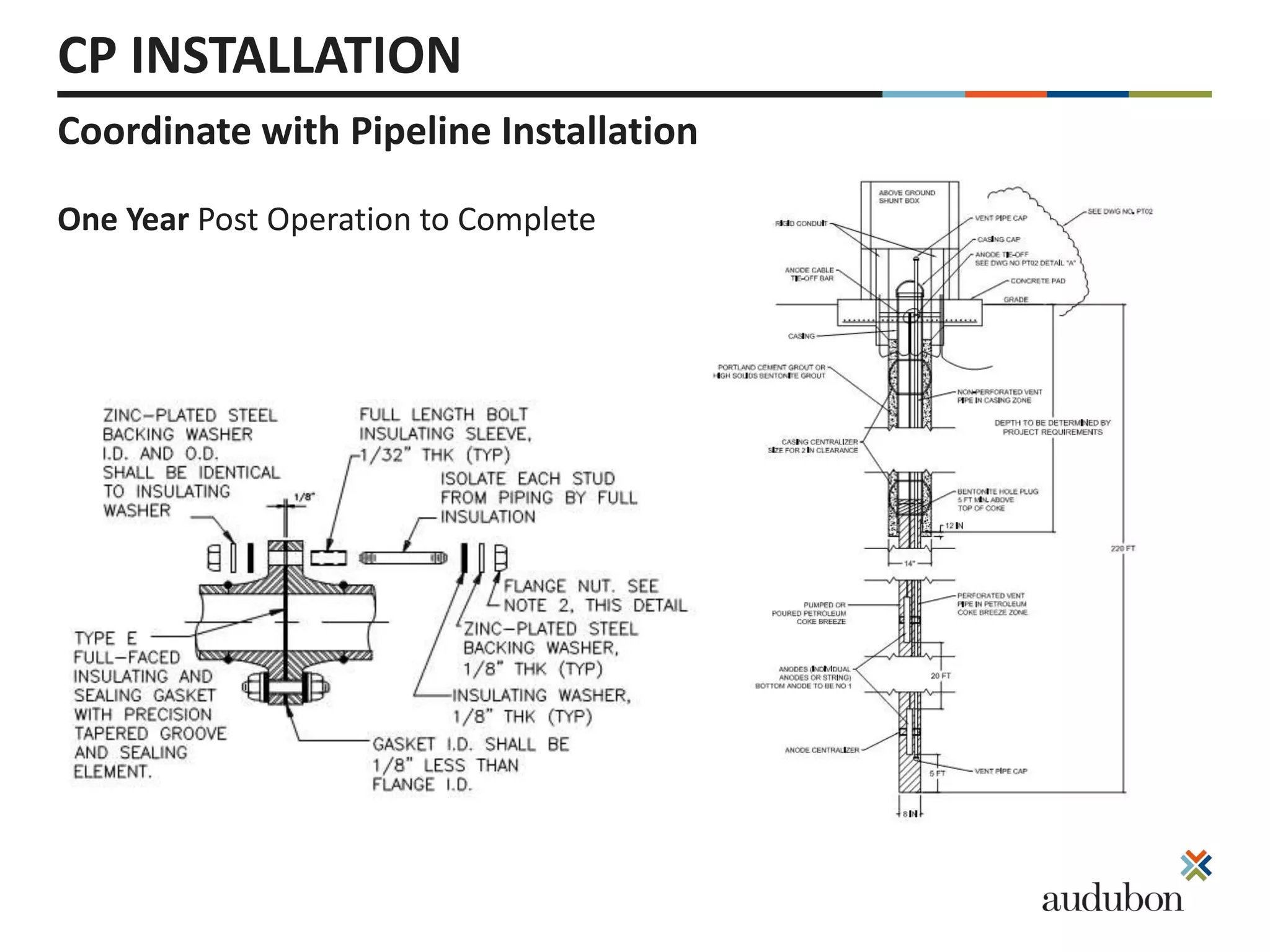
Coordinate with Pipeline Installation
CP INSTALLATION
One Year Post Operation to Complete
Coordinate with Pipeline Installation cont.
CP INSTALLATION CONT.
One Year Post Operation to Complete
Coordinate with Pipeline Installation
AC MITIGATION INSTALLATION
Temporary Mitigation System During
Construction?
 Personnel Shock Protection During
Stringing and Lowering In
Install mitigation system simultaneously with pipeline
Baseline Survey
CP COMMISSIONING
 Prior to the Application of
Cathodic Protection
 Permanent Record of
Pipeline Native Potentials
 Identify Areas of Stray
Current Interference
(Corrosion)
On/Off Survey
CP COMMISSIONING CONT.
 Demonstrates Compliance
with Cathodic Protection
Criterion
 Identifies Any Areas
of Inadequate Protection
/Non-Compliance
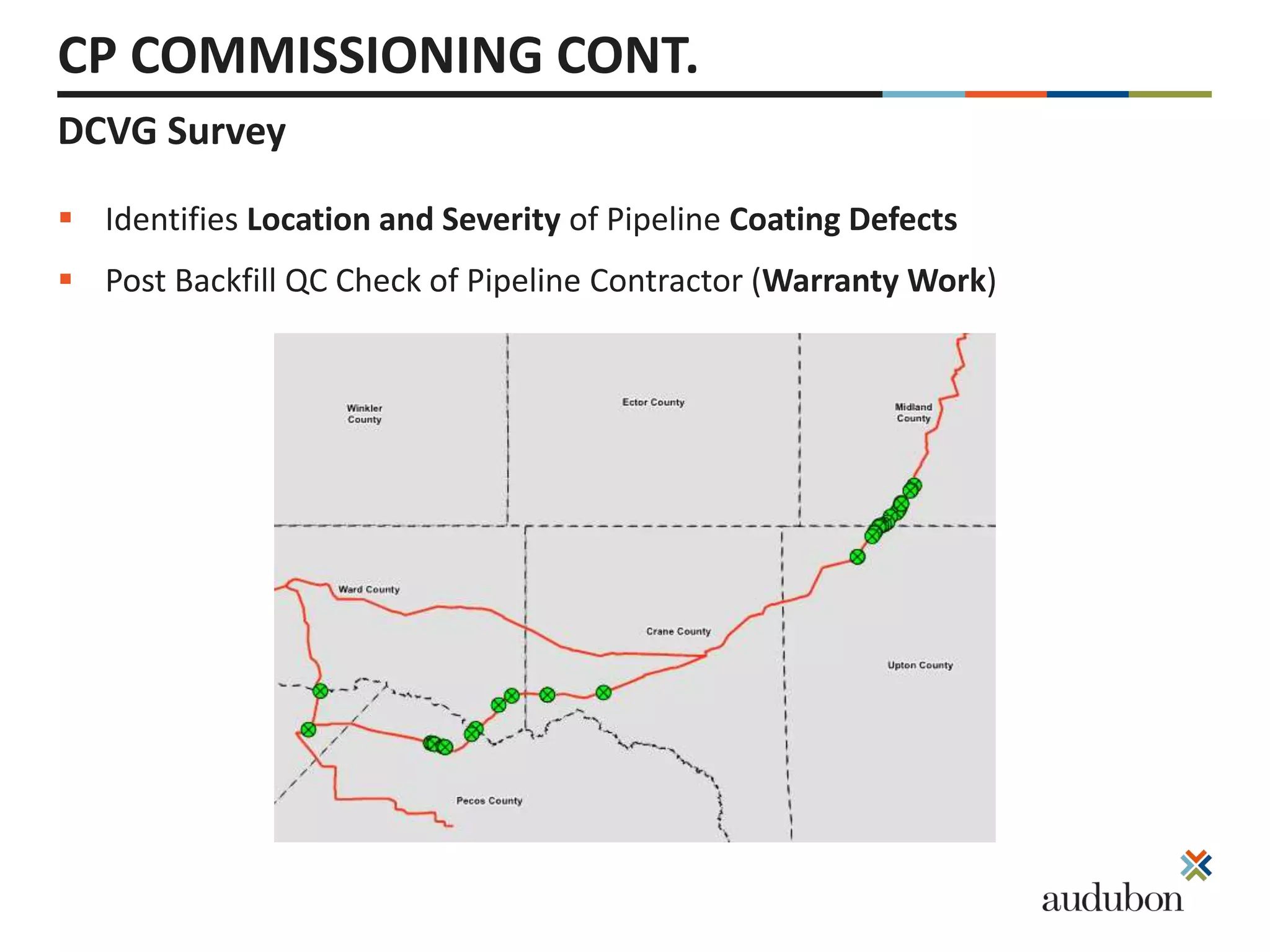
DCVG Survey
CP COMMISSIONING CONT.
 Identifies Location and Severity of Pipeline Coating Defects
 Post Backfill QC Check of Pipeline Contractor (Warranty Work)
D: C:
Vice President, Asset Integrity & Corrosion
Audubon Companies
blouque@auduboncompanies.com
918.514.5879
BRYAN LOUQUE
913.221.3446
auduboncompanies.com

AFS Pipeline Compliance, Integrity & Corrosion

  • 1.
    August 2021 COMPLIANCE, INTEGRITY& CORROSION Design & Construction of New Pipelines
  • 2.
    SAFETY STATISTICS 2017 20182019 2020 Recordable Incidents 0 0 0 0 Lost Workday Case Rate 0.0 0.0 0.0 0.0 Lost Time Rate 0.0 0.0 0.0 0.0 EMR 0.75 0.7 0.72 0.7 Total Man-hours Worked 951,357 1,300,032 2,206,852 1,629,894 Preventative and Active Case Management  Lost Workday Case Rate of Zero  DART Rate of Zero  Lost Time Rate (LTR) of Zero Zero OSHA: Recordable Incidents
  • 3.
    Agenda FIRST THINGS FIRST Jurisdictional analysis  High consequence area (HCA) analysis  Emergency flow restriction device (EFRD) analysis  Geohazard analysis  Leak detection capability analysis  AC interference modeling & mitigation design  Cathodic protection (CP) design  Risk analysis  Cathodic protection & AC mitigation system installation  Cathodic protection & AC mitigation system commissioning
  • 4.
    What’s in andWhat’s Out – 49 CFR Part 192, Gas JURISDICTIONAL ANALYSIS Transmission pipeline – B31.8 & 192 Gathering pipeline – it depends  Class location unit • 660’ buffer either side of center • Continuous sliding mile  Class 1 – B31.8 • Contains ≤ 10 habitable buildings  Class 2, 3, 4 – B31.8 & 192
  • 5.
    What’s in andWhat’s Out – PHMSA “Mega Rule” JURISDICTIONAL ANALYSIS Mega rule part 1 – effective july 1, 2020  New requirements for gas & liquid transmission  Class 1 design safety factor increased from 1.1 to 1.25 • Applies to type A and type B gas gathering  Proscribes TVC record requirements to support MAOP / MOP • Construction inspection and turn-over packages are critical Mega rule parts 2 & 3 – effective 2020 / 2021?  Eliminates class 1 gathering “loop hole”  In/out function of pressure and diameter • ≥ 30% smys? And • ≥ 10”, 12”, 16”?
  • 6.
    What’s in andWhat’s Out – 49 CFR Part 195, Liquid JURISDICTIONAL ANALYSIS Transmission Pipeline – B31.4 & 195 Gathering Pipeline – It Depends  ≥ 10” Gathering – B31.4 & 195  8” Gathering (MOP > 20% SMYS) • ≤ ¼ Mile from Unusually Sensitive Area (USA) – B31.4 & 195 (No IMP) • > ¼ Mile from USA – B31.4  8” Gathering (MOP ≤ 20% SMYS) – B31.4  ≤ 6” Gathering – B31.4
  • 7.
    49 CFR Part192, Gas HCA ANALYSIS – IM RULE Design & Construction Impact  Pressure Safety Factor Class Location Dependent  Need Class Location to Calculate MAOP
  • 8.
    49 CFR Part195, Liquid HCA ANALYSIS – IM RULE CONT. Directly or Indirectly Impact an HCA?  ½ mile buffer either side of center  Subject to integrity management rule HCA Locations Proscribed by PHMSA  USA’s  DW’s – Drinking water sources  HPA’s – Incorporated areas (USCB)  OPA’s – “Named places” (USCB) Design & Construction Impact • Pipe routing. Avoid HCA’s if practical
  • 9.
    49 CFR Part195, Liquid Only EFRD ANALYSIS – IM RULE How Much of a Spill is Too Much?  Regulation not proscriptive  ANPRM – 40 minutes Design & Construction Impacts  Leak Detection Method • What type, frequency, capability? (time)  Valve Locations • How many / where? (drain down)  Remote Operation & Control? ◦ Where and when? (time)
  • 10.
    49 CFR Part195 GEOHAZARD  Topography and Geology  Geological Hazards • Earthquake Induced Hazards • Mass Wasting • Flooding and High Groundwater • Stream Channel Migration and Avulsion Hazards • Surface Erosion • Karst Topography
  • 11.
    49 CFR Part195, Liquid Only LDCA ANALYSIS – IM RULE How Quickly Can a Leak Be Identified?  Leak Detection Techniques? • Credit for Multiples  Pipeline and Product Type?  Proximity to HCA’s? Design & Construction Impacts  Swiftness of LDS  Response Personnel Locations  Risk Assessment Results
  • 12.
    Pipeline Threat &Personnel Safety Hazard AC INTERFERENCE High Voltage (≥ 69 kV) Power Lines That Cross or Parallel Pipelines  Digital Simulation of Induced AC Voltage and Current on Pipeline  Design Mitigation to Eliminate Corrosion & Safety Hazard  Design & Construction Impacts • Get started early ◦ Months to obtain power line data • Minimize crossings & parallelism • Cross @ 90o angle
  • 13.
    Pipeline Corrosion Protection& Monitoring System CP DESIGN Monitoring System  Test Stations • Casings, road crossings, fence lines • Potential monitoring & AC interference areas Cathodic Protection System  Impressed Current, Deep Anode Beds Design & Construction Impacts  Cathodic Protection Rectifier Requires AC Power  Insulated flange kits at all UG/AG pipeline transitions and tie-ins (Facilities, LACTS, etc…)
  • 14.
    Parking Lot CP DESIGN Design& Construction Impacts  Electrical isolation at all power system grounds (Remote control valves, pumps, meters, instrumentation, pipe supports)
  • 15.
    Parking Lot cont. CPDESIGN CONT. Design & Construction Impacts  Electrical isolation at instrument tubing and electrical conduit
  • 16.
    How Much isToo Much? – Integrity Management Program RISK ANALYSIS – IM RULE Design & Construction Impacts  Design Drives Risk • Pipe wall (Barrier) • Routing (Mitigator) ◦ Receptors ◦ Third party damage ◦ Geohazards • Corrosion Protection (Mitigator) • Security (Mitigator)
  • 17.
    Coordinate with PipelineInstallation CP INSTALLATION One Year Post Operation to Complete
  • 18.
    Coordinate with PipelineInstallation cont. CP INSTALLATION CONT. One Year Post Operation to Complete
  • 19.
    Coordinate with PipelineInstallation AC MITIGATION INSTALLATION Temporary Mitigation System During Construction?  Personnel Shock Protection During Stringing and Lowering In Install mitigation system simultaneously with pipeline
  • 20.
    Baseline Survey CP COMMISSIONING Prior to the Application of Cathodic Protection  Permanent Record of Pipeline Native Potentials  Identify Areas of Stray Current Interference (Corrosion)
  • 21.
    On/Off Survey CP COMMISSIONINGCONT.  Demonstrates Compliance with Cathodic Protection Criterion  Identifies Any Areas of Inadequate Protection /Non-Compliance
  • 22.
    DCVG Survey CP COMMISSIONINGCONT.  Identifies Location and Severity of Pipeline Coating Defects  Post Backfill QC Check of Pipeline Contractor (Warranty Work)
  • 23.
    D: C: Vice President,Asset Integrity & Corrosion Audubon Companies blouque@auduboncompanies.com 918.514.5879 BRYAN LOUQUE 913.221.3446 auduboncompanies.com