May 2021
EXTERNAL CORROSION DIRECT ASSESSMENT
(ECDA)
Matthew Myers, Manager of Integrity & Corrosion
TODAY’S SPEAKER
Matt Myers is the Manager of Asset Integrity & Corrosion
at Audubon Field Solutions. He has over 8 years of
experience in engineering, design, construction,
operation and maintenance of pipeline systems for
natural gas (192), LNG (193), and hazardous liquids (195)
systems. NACE certified, Matt is a technical and
operational expert in pipeline and asset integrity, external
corrosion, internal corrosion, and cathodic protection. He
holds a BS degree in Electrical Engineering from the Texas
A&M University and is currently pursuing an MBA from
Oklahoma State University.
AGENDA
Slide 4 What Is External Corrosion Direct Assessment?
Slide 5 Why Use External Corrosion Direct Assessment?
Slide 6-7 PHMSA Requirements
Slide 8-31
Slide 8
Slide 13
Slide 18
Slide 28
Phases (I – IV)
Phase I – Pre-Assessment
Phase II – Indirect Inspection
Phase III – Direct Examination
Phase IV – Post Assessment
External Corrosion Direct Assessment
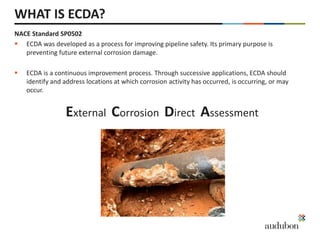
WHAT IS ECDA?
NACE Standard SP0502
 ECDA was developed as a process for improving pipeline safety. Its primary purpose is
preventing future external corrosion damage.
 ECDA is a continuous improvement process. Through successive applications, ECDA should
identify and address locations at which corrosion activity has occurred, is occurring, or may
occur.
 ECDA is primarily applied when the pipeline:
• Hydro and/or ILI integrity assessment methods are not feasible
◦ This is discussed in:
▫ Appendix E to Part 192—Guidance on Determining High Consequence Areas
and on Carrying out Requirements in the Integrity Management Rule
▫ §195.452 Pipeline integrity management in high consequence areas
 ECDA may be applied to identify integrity threats such as Stress Corrosion Cracking (SCC),
Microbiologically Influenced Corrosion (MIC), and other external integrity issues
 ECDA is required to be included in Operator’s Integrity Management by PHMSA’s:
• The Gas Pipeline Integrity Management Rule (192)
• The Hazardous Liquid IM Rule (195)
WHY USE ECDA?
192 & 195 Integrity Management Assessment Method
PART 192—Transportation of Natural and Other Gas by Pipeline: Minimum Federal Safety
Standards
 §192.911 What are the elements of an integrity management program?
• (d) A direct assessment plan, if applicable, meeting the requirements of §192.923, and
depending on the threat assessed, of §192.925, 192.927, or 192.929
 §192.939 What are the required reassessment intervals?
• (a) – Assessment Intervals – 7 years
• (a) & (b) – ECDA approved method
 §192.925 What are the requirements for using External Corrosion Direct Assessment (ECDA)?
• ECDA Methodology; References directly NACE SP0502
PART 195—Transportation of Hazardous Liquids by Pipeline
 §195.452 Pipeline integrity management in high consequence areas.
• (j)(3) – Assessment Intervals – 5 years
• (j)(5)(iii) – ECDA approved method
 §195.588 What standards apply to direct assessment?
• ECDA Methodology; References directly NACE SP0502
PHMSA REQUIREMENTS
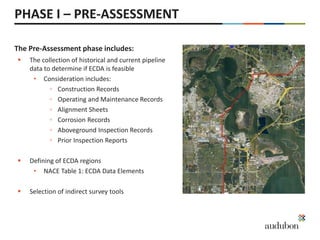
The Pre-Assessment phase includes:
PHASE I – PRE-ASSESSMENT
 The collection of historical and current pipeline
data to determine if ECDA is feasible
• Consideration includes:
◦ Construction Records
◦ Operating and Maintenance Records
◦ Alignment Sheets
◦ Corrosion Records
◦ Aboveground Inspection Records
◦ Prior Inspection Reports
 Defining of ECDA regions
• NACE Table 1: ECDA Data Elements
 Selection of indirect survey tools
PHASE I – PRE-ASSESSMENT CONT.
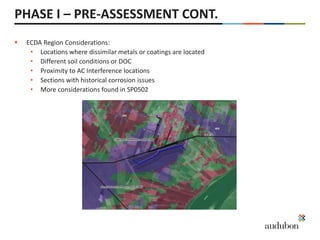
 ECDA Region Considerations:
• Locations where dissimilar metals or coatings are located
• Different soil conditions or DOC
• Proximity to AC Interference locations
• Sections with historical corrosion issues
• More considerations found in SP0502
PHASE I – PRE-ASSESSMENT CONT.
 Feasibility assessment provides the opportunity
to review the different attributes of the pipeline
and ROW to determine if an ECDA is possible
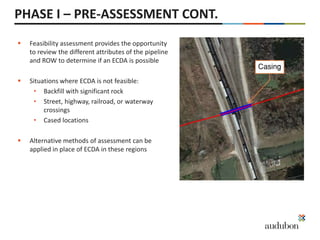
 Situations where ECDA is not feasible:
• Backfill with significant rock
• Street, highway, railroad, or waterway
crossings
• Cased locations
 Alternative methods of assessment can be
applied in place of ECDA in these regions
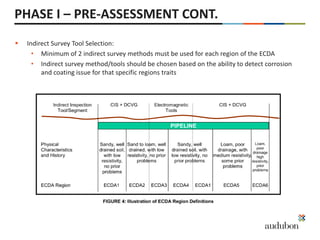
 Indirect Survey Tool Selection:
• Minimum of 2 indirect survey methods must be used for each region of the ECDA
• Indirect survey method/tools should be chosen based on the ability to detect corrosion
and coating issue for that specific regions traits
PHASE I – PRE-ASSESSMENT CONT.
TABLE 2: ECDA TOOL SELECTION MATRIX
1= Applicable: Small coating holidays (isolated and typically <600 mm2 [1 in.2]) and conditions that do not cause
fluctuations in CP potentials under normal operating conditions.
2= Applicable: Large coating holidays (isolated and continuous) or conditions that cause fluctuations in CP
potentials under normal operating conditions.
3= Not Applicable: Not applicate to this tool or not applicable to this tool without additional considerations.
NACE SP0502 Table 2: ECDA Tool Selection Matrix
PHASE II – INDIRECT SURVEY
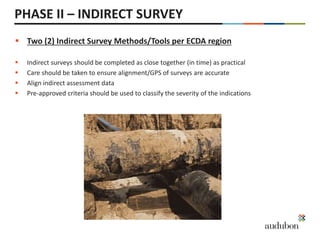
 Two (2) Indirect Survey Methods/Tools per ECDA region
 Indirect surveys should be completed as close together (in time) as practical
 Care should be taken to ensure alignment/GPS of surveys are accurate
 Align indirect assessment data
 Pre-approved criteria should be used to classify the severity of the indications
PHASE II – INDIRECT SURVEY CONT.
Common Types of Indirect Survey
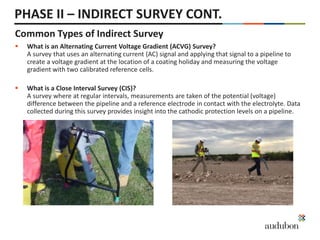
 What is an Alternating Current Voltage Gradient (ACVG) Survey?
A survey that uses an alternating current (AC) signal and applying that signal to a pipeline to
create a voltage gradient at the location of a coating holiday and measuring the voltage
gradient with two calibrated reference cells.
 What is a Close Interval Survey (CIS)?
A survey where at regular intervals, measurements are taken of the potential (voltage)
difference between the pipeline and a reference electrode in contact with the electrolyte. Data
collected during this survey provides insight into the cathodic protection levels on a pipeline.
PHASE II – INDIRECT SURVEY CONT.
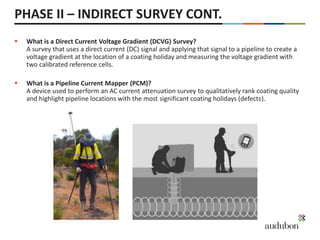
 What is a Direct Current Voltage Gradient (DCVG) Survey?
A survey that uses a direct current (DC) signal and applying that signal to a pipeline to create a
voltage gradient at the location of a coating holiday and measuring the voltage gradient with
two calibrated reference cells.
 What is a Pipeline Current Mapper (PCM)?
A device used to perform an AC current attenuation survey to qualitatively rank coating quality
and highlight pipeline locations with the most significant coating holidays (defects).
PHASE II – INDIRECT SURVEY CONT.
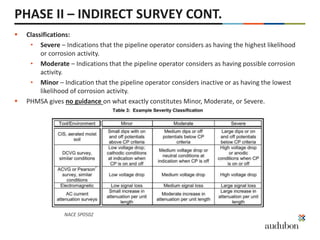
 Classifications:
• Severe – Indications that the pipeline operator considers as having the highest likelihood
or corrosion activity.
• Moderate – Indications that the pipeline operator considers as having possible corrosion
activity.
• Minor – Indication that the pipeline operator considers inactive or as having the lowest
likelihood of corrosion activity.
 PHMSA gives no guidance on what exactly constitutes Minor, Moderate, or Severe.
NACE SP0502
PHASE II – INDIRECT SURVEY CONT.
Audubon Classifications
PHASE III – DIRECT EXAMINATION
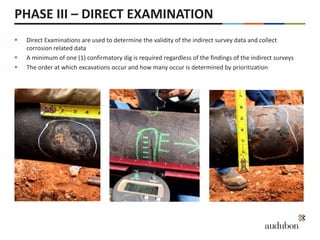
 Direct Examinations are used to determine the validity of the indirect survey data and collect
corrosion related data
 A minimum of one (1) confirmatory dig is required regardless of the findings of the indirect surveys
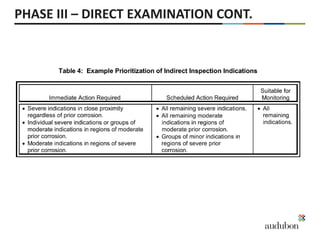
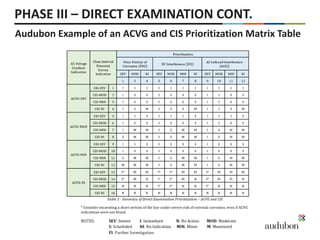
 The order at which excavations occur and how many occur is determined by prioritization
PHASE III – DIRECT EXAMINATION CONT.
Audubon Example of an ACVG and CIS Prioritization Matrix Table
PHASE III – DIRECT EXAMINATION CONT.
ECDA Effectiveness?
ECDA effectiveness is part of the Phase IV Post-Assessment but is used in the Direct Examinations
NACE STANDARDS SP0502
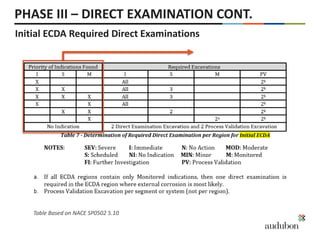
 6.4.2.1 - For initial ECDA applications, at least two additional direct examinations are required
for process validation. The direct examinations shall be conducted at randomly selected
locations, one of which is categorized as scheduled (or monitored if no scheduled indications
exist) and one in an area where no indication was detected.
 6.4.2.1 – If conditions that are more severe than determined during the ECDA process (i.e., that
result in a reassessment interval less than determined during the ECDA process) are detected,
the process shall be reevaluated and repeated or an alternative integrity assessment method
used.
PHASE III – DIRECT EXAMINATION CONT.
Initial ECDA Required Direct Examinations
Table Based on NACE SP0502 5.10
PHASE III – DIRECT EXAMINATION CONT.
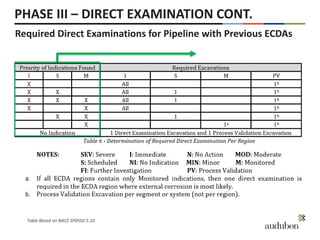
Required Direct Examinations for Pipeline with Previous ECDAs
Table Based on NACE SP0502 5.10
PHASE III – DIRECT EXAMINATION CONT.
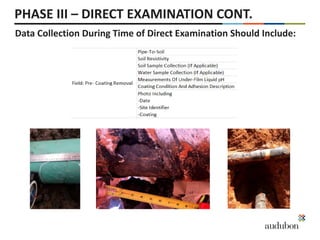
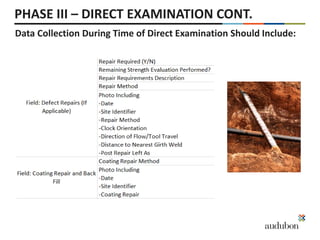
Data Collection During Time of Direct Examination Should Include:
PHASE III – DIRECT EXAMINATION CONT.
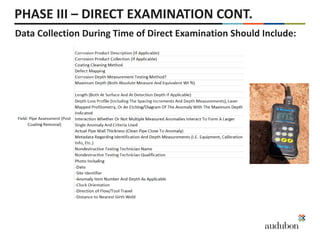
Data Collection During Time of Direct Examination Should Include:
PHASE III – DIRECT EXAMINATION CONT.
Data Collection During Time of Direct Examination Should Include:
PHASE III – DIRECT EXAMINATION CONT.
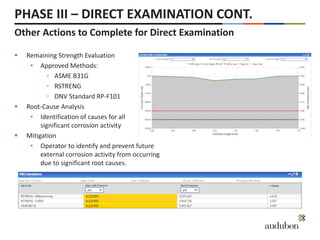
 Remaining Strength Evaluation
• Approved Methods:
▫ ASME B31G
▫ RSTRENG
▫ DNV Standard RP-F101
 Root-Cause Analysis
• Identification of causes for all
significant corrosion activity
 Mitigation
• Operator to identify and prevent future
external corrosion activity from occurring
due to significant root causes.
Other Actions to Complete for Direct Examination
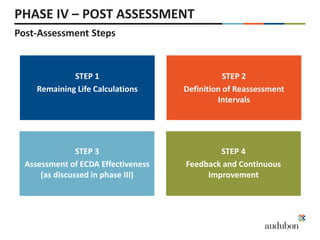
Post-Assessment Steps
PHASE IV – POST ASSESSMENT
STEP 1
Remaining Life Calculations
STEP 4
Feedback and Continuous
Improvement
STEP 3
Assessment of ECDA Effectiveness
(as discussed in phase III)
STEP 2
Definition of Reassessment
Intervals
PHASE IV – POST ASSESSMENT CONT.
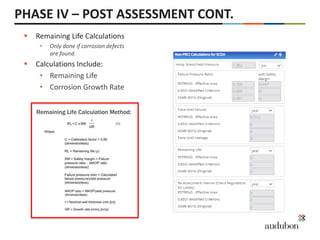
 Remaining Life Calculations
• Only done if corrosion defects
are found.
 Calculations Include:
• Remaining Life
• Corrosion Growth Rate
Remaining Life Calculation Method:
PHASE IV – POST ASSESSMENT CONT.
 NACE STANDARD SP0502 Reassessment Intervals
6.3.1 – When corrosion defects are found during the direct examinations, the maximum
reassessment interval for each ECDA region shall be taken as one-half the calculated
remaining life. The maximum reassessment interval may be further limited by documents
such as ASME B31.4 and ASME B31.8.
 PART 192—Transportation Of Natural And Other Gas By Pipeline: Minimum Federal Safety
Standards
• §192.939 What are the required reassessment intervals?
◦ (a) – Assessment Intervals – 7 years
 PART 195—Transportation Of Hazardous Liquids By Pipeline
• §195.452 Pipeline integrity management in high consequence areas.
◦ (j)(3) – Assessment Intervals – 5 years
Reassessment Intervals
PHASE IV – POST ASSESSMENT CONT.
 Identification and Classification of Indirect Survey Results
 Direct Examination Data
 Remaining Strength Analysis
 Root-Cause Analysis
 Remediation
 In-Process Evaluations
 Direct Examinations Used for Process Validations (PV)
 Criteria for Monitoring
 Reassessment Intervals
Feedback and Continuous Improvement should be considered
for the following:
D: C:
Manager of Integrity and Corrosion
mmyers@auduboncompanies.com
918-514-5846
Matthew Myers
918-986-6139
auduboncompanies.com

External Corrosion Direct Assessment (ECDA)

  • 1.
    May 2021 EXTERNAL CORROSIONDIRECT ASSESSMENT (ECDA)
  • 2.
    Matthew Myers, Managerof Integrity & Corrosion TODAY’S SPEAKER Matt Myers is the Manager of Asset Integrity & Corrosion at Audubon Field Solutions. He has over 8 years of experience in engineering, design, construction, operation and maintenance of pipeline systems for natural gas (192), LNG (193), and hazardous liquids (195) systems. NACE certified, Matt is a technical and operational expert in pipeline and asset integrity, external corrosion, internal corrosion, and cathodic protection. He holds a BS degree in Electrical Engineering from the Texas A&M University and is currently pursuing an MBA from Oklahoma State University.
  • 3.
    AGENDA Slide 4 WhatIs External Corrosion Direct Assessment? Slide 5 Why Use External Corrosion Direct Assessment? Slide 6-7 PHMSA Requirements Slide 8-31 Slide 8 Slide 13 Slide 18 Slide 28 Phases (I – IV) Phase I – Pre-Assessment Phase II – Indirect Inspection Phase III – Direct Examination Phase IV – Post Assessment
  • 4.
    External Corrosion DirectAssessment WHAT IS ECDA? NACE Standard SP0502  ECDA was developed as a process for improving pipeline safety. Its primary purpose is preventing future external corrosion damage.  ECDA is a continuous improvement process. Through successive applications, ECDA should identify and address locations at which corrosion activity has occurred, is occurring, or may occur.
  • 5.
     ECDA isprimarily applied when the pipeline: • Hydro and/or ILI integrity assessment methods are not feasible ◦ This is discussed in: ▫ Appendix E to Part 192—Guidance on Determining High Consequence Areas and on Carrying out Requirements in the Integrity Management Rule ▫ §195.452 Pipeline integrity management in high consequence areas  ECDA may be applied to identify integrity threats such as Stress Corrosion Cracking (SCC), Microbiologically Influenced Corrosion (MIC), and other external integrity issues  ECDA is required to be included in Operator’s Integrity Management by PHMSA’s: • The Gas Pipeline Integrity Management Rule (192) • The Hazardous Liquid IM Rule (195) WHY USE ECDA? 192 & 195 Integrity Management Assessment Method
  • 6.
    PART 192—Transportation ofNatural and Other Gas by Pipeline: Minimum Federal Safety Standards  §192.911 What are the elements of an integrity management program? • (d) A direct assessment plan, if applicable, meeting the requirements of §192.923, and depending on the threat assessed, of §192.925, 192.927, or 192.929  §192.939 What are the required reassessment intervals? • (a) – Assessment Intervals – 7 years • (a) & (b) – ECDA approved method  §192.925 What are the requirements for using External Corrosion Direct Assessment (ECDA)? • ECDA Methodology; References directly NACE SP0502 PART 195—Transportation of Hazardous Liquids by Pipeline  §195.452 Pipeline integrity management in high consequence areas. • (j)(3) – Assessment Intervals – 5 years • (j)(5)(iii) – ECDA approved method  §195.588 What standards apply to direct assessment? • ECDA Methodology; References directly NACE SP0502 PHMSA REQUIREMENTS
  • 7.
    The Pre-Assessment phaseincludes: PHASE I – PRE-ASSESSMENT  The collection of historical and current pipeline data to determine if ECDA is feasible • Consideration includes: ◦ Construction Records ◦ Operating and Maintenance Records ◦ Alignment Sheets ◦ Corrosion Records ◦ Aboveground Inspection Records ◦ Prior Inspection Reports  Defining of ECDA regions • NACE Table 1: ECDA Data Elements  Selection of indirect survey tools
  • 8.
    PHASE I –PRE-ASSESSMENT CONT.  ECDA Region Considerations: • Locations where dissimilar metals or coatings are located • Different soil conditions or DOC • Proximity to AC Interference locations • Sections with historical corrosion issues • More considerations found in SP0502
  • 9.
    PHASE I –PRE-ASSESSMENT CONT.  Feasibility assessment provides the opportunity to review the different attributes of the pipeline and ROW to determine if an ECDA is possible  Situations where ECDA is not feasible: • Backfill with significant rock • Street, highway, railroad, or waterway crossings • Cased locations  Alternative methods of assessment can be applied in place of ECDA in these regions
  • 10.
     Indirect SurveyTool Selection: • Minimum of 2 indirect survey methods must be used for each region of the ECDA • Indirect survey method/tools should be chosen based on the ability to detect corrosion and coating issue for that specific regions traits PHASE I – PRE-ASSESSMENT CONT.
  • 11.
    TABLE 2: ECDATOOL SELECTION MATRIX 1= Applicable: Small coating holidays (isolated and typically <600 mm2 [1 in.2]) and conditions that do not cause fluctuations in CP potentials under normal operating conditions. 2= Applicable: Large coating holidays (isolated and continuous) or conditions that cause fluctuations in CP potentials under normal operating conditions. 3= Not Applicable: Not applicate to this tool or not applicable to this tool without additional considerations. NACE SP0502 Table 2: ECDA Tool Selection Matrix
  • 12.
    PHASE II –INDIRECT SURVEY  Two (2) Indirect Survey Methods/Tools per ECDA region  Indirect surveys should be completed as close together (in time) as practical  Care should be taken to ensure alignment/GPS of surveys are accurate  Align indirect assessment data  Pre-approved criteria should be used to classify the severity of the indications
  • 13.
    PHASE II –INDIRECT SURVEY CONT. Common Types of Indirect Survey  What is an Alternating Current Voltage Gradient (ACVG) Survey? A survey that uses an alternating current (AC) signal and applying that signal to a pipeline to create a voltage gradient at the location of a coating holiday and measuring the voltage gradient with two calibrated reference cells.  What is a Close Interval Survey (CIS)? A survey where at regular intervals, measurements are taken of the potential (voltage) difference between the pipeline and a reference electrode in contact with the electrolyte. Data collected during this survey provides insight into the cathodic protection levels on a pipeline.
  • 14.
    PHASE II –INDIRECT SURVEY CONT.  What is a Direct Current Voltage Gradient (DCVG) Survey? A survey that uses a direct current (DC) signal and applying that signal to a pipeline to create a voltage gradient at the location of a coating holiday and measuring the voltage gradient with two calibrated reference cells.  What is a Pipeline Current Mapper (PCM)? A device used to perform an AC current attenuation survey to qualitatively rank coating quality and highlight pipeline locations with the most significant coating holidays (defects).
  • 15.
    PHASE II –INDIRECT SURVEY CONT.  Classifications: • Severe – Indications that the pipeline operator considers as having the highest likelihood or corrosion activity. • Moderate – Indications that the pipeline operator considers as having possible corrosion activity. • Minor – Indication that the pipeline operator considers inactive or as having the lowest likelihood of corrosion activity.  PHMSA gives no guidance on what exactly constitutes Minor, Moderate, or Severe. NACE SP0502
  • 16.
    PHASE II –INDIRECT SURVEY CONT. Audubon Classifications
  • 17.
    PHASE III –DIRECT EXAMINATION  Direct Examinations are used to determine the validity of the indirect survey data and collect corrosion related data  A minimum of one (1) confirmatory dig is required regardless of the findings of the indirect surveys  The order at which excavations occur and how many occur is determined by prioritization
  • 18.
    PHASE III –DIRECT EXAMINATION CONT.
  • 19.
    PHASE III –DIRECT EXAMINATION CONT. Audubon Example of an ACVG and CIS Prioritization Matrix Table
  • 20.
    PHASE III –DIRECT EXAMINATION CONT. ECDA Effectiveness? ECDA effectiveness is part of the Phase IV Post-Assessment but is used in the Direct Examinations NACE STANDARDS SP0502  6.4.2.1 - For initial ECDA applications, at least two additional direct examinations are required for process validation. The direct examinations shall be conducted at randomly selected locations, one of which is categorized as scheduled (or monitored if no scheduled indications exist) and one in an area where no indication was detected.  6.4.2.1 – If conditions that are more severe than determined during the ECDA process (i.e., that result in a reassessment interval less than determined during the ECDA process) are detected, the process shall be reevaluated and repeated or an alternative integrity assessment method used.
  • 21.
    PHASE III –DIRECT EXAMINATION CONT. Initial ECDA Required Direct Examinations Table Based on NACE SP0502 5.10
  • 22.
    PHASE III –DIRECT EXAMINATION CONT. Required Direct Examinations for Pipeline with Previous ECDAs Table Based on NACE SP0502 5.10
  • 23.
    PHASE III –DIRECT EXAMINATION CONT. Data Collection During Time of Direct Examination Should Include:
  • 24.
    PHASE III –DIRECT EXAMINATION CONT. Data Collection During Time of Direct Examination Should Include:
  • 25.
    PHASE III –DIRECT EXAMINATION CONT. Data Collection During Time of Direct Examination Should Include:
  • 26.
    PHASE III –DIRECT EXAMINATION CONT.  Remaining Strength Evaluation • Approved Methods: ▫ ASME B31G ▫ RSTRENG ▫ DNV Standard RP-F101  Root-Cause Analysis • Identification of causes for all significant corrosion activity  Mitigation • Operator to identify and prevent future external corrosion activity from occurring due to significant root causes. Other Actions to Complete for Direct Examination
  • 27.
    Post-Assessment Steps PHASE IV– POST ASSESSMENT STEP 1 Remaining Life Calculations STEP 4 Feedback and Continuous Improvement STEP 3 Assessment of ECDA Effectiveness (as discussed in phase III) STEP 2 Definition of Reassessment Intervals
  • 28.
    PHASE IV –POST ASSESSMENT CONT.  Remaining Life Calculations • Only done if corrosion defects are found.  Calculations Include: • Remaining Life • Corrosion Growth Rate Remaining Life Calculation Method:
  • 29.
    PHASE IV –POST ASSESSMENT CONT.  NACE STANDARD SP0502 Reassessment Intervals 6.3.1 – When corrosion defects are found during the direct examinations, the maximum reassessment interval for each ECDA region shall be taken as one-half the calculated remaining life. The maximum reassessment interval may be further limited by documents such as ASME B31.4 and ASME B31.8.  PART 192—Transportation Of Natural And Other Gas By Pipeline: Minimum Federal Safety Standards • §192.939 What are the required reassessment intervals? ◦ (a) – Assessment Intervals – 7 years  PART 195—Transportation Of Hazardous Liquids By Pipeline • §195.452 Pipeline integrity management in high consequence areas. ◦ (j)(3) – Assessment Intervals – 5 years Reassessment Intervals
  • 30.
    PHASE IV –POST ASSESSMENT CONT.  Identification and Classification of Indirect Survey Results  Direct Examination Data  Remaining Strength Analysis  Root-Cause Analysis  Remediation  In-Process Evaluations  Direct Examinations Used for Process Validations (PV)  Criteria for Monitoring  Reassessment Intervals Feedback and Continuous Improvement should be considered for the following:
  • 31.
    D: C: Manager ofIntegrity and Corrosion mmyers@auduboncompanies.com 918-514-5846 Matthew Myers 918-986-6139 auduboncompanies.com

Editor's Notes

  • #6 https://primis.phmsa.dot.gov/comm/FactSheets/FSdirectAssessmentGas.htm https://primis.phmsa.dot.gov/comm/FactSheets/FSdirectAssessmentLiquid.htm?nocache=662
  • #7 192 GAS It is directly reference in the 192 Integrity Management requirements Assessment Intervals – Maximum 7 years without prior approval by PHMSA ECDA is an approved method for direct assessment by PHMSA 195 LIQUIDS It is directly reference in the 195 Integrity Management requirements Assessment Intervals – Maximum 5 years without prior approval by PHMSA ECDA is an approved method for direct assessment by PHMSA
  • #8 “NACE Table 1: ECDA Data Elements” Lists different pipeline elements how that element might affect an ECDA region and/or how you could possibly create a region from that element.
  • #9 FBE vs FBE/ARO vs Coal Tar vs Shrink Sleeves…..etc Normal DOC vs a bore or river crossing AC Interference ROW Historical leak areas or areas where direct assessment or cut outs have occurred.
  • #10 Alternative Methods might include “Other Technologies”. Guided Wave UT (GWUT) is a possible method but requires approval from PHMSA. Guidelines for Integrity Assessment of Cased Pipe for Gas Transmission Pipelines in HCAs https://www.phmsa.dot.gov/pipeline/gas-transmission-integrity-management/guidelines-integrity-assessment-cased-pipe-gas-transmission-pipelines-in-hcas
  • #16 NACA SP0502 previously gave guidance but that guidance was removed.
  • #18 SP0502 5.1.3 Minimum 1 Dig
  • #19 Example given by SP0502
  • #24 Audubon collects data based on API 1163 and SP0502 Insures thoroughness
  • #27 Technical Toolbox RSTRENG Outputs
  • #29 SP0502 6.2.4.1 Technical Tool Box RSTRENG