The music traditions and culture of Africa is wide and varied.
African music varies by region and by tribe, yet they have some
common characteristics. These include the following:
1. Part of every activities – everyone joins in clapping, singing,
and dancing to the music.
2. Hold communities together and sometimes even defines a
person’s place in society.
3. Used for recreation and important life events like marriage,
childbirth, battles, and coming of age.
4. Not normally written down but passed on through oral tradition.
5. Relies heavily on percussions instruments, rhythm, repetition,
and call-response patterns.
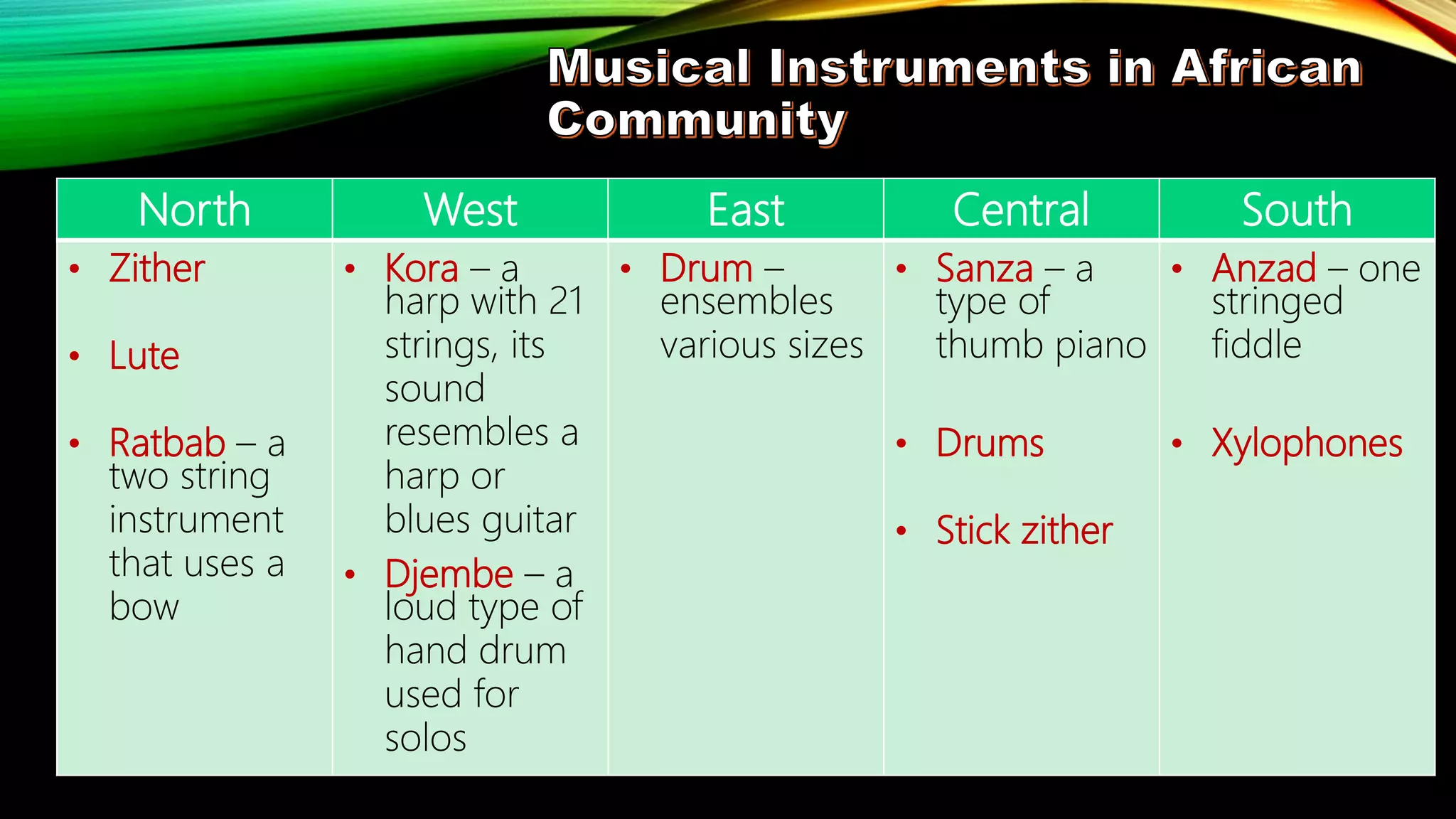
North West East Central South
• Zither
• Lute
• Ratbab – a
two string
instrument
that uses a
bow
• Kora – a
harp with 21
strings, its
sound
resembles a
harp or
blues guitar
• Djembe – a
loud type of
hand drum
used for
solos
• Drum –
ensembles
various sizes
• Sanza – a
type of
thumb piano
• Drums
• Stick zither
• Anzad – one
stringed
fiddle
• Xylophones
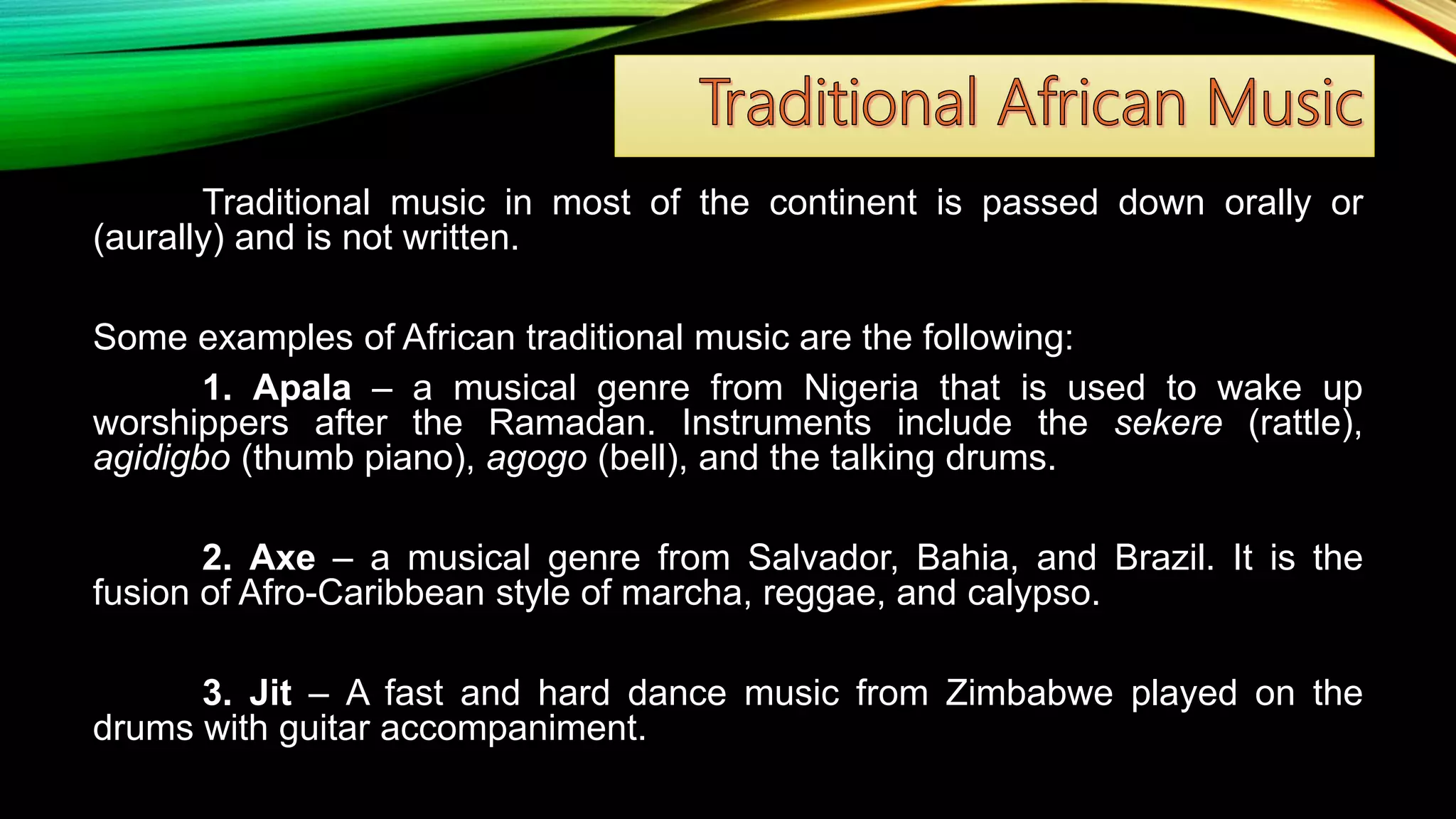
Traditional music in most of the continent is passed down orally or
(aurally) and is not written.
Some examples of African traditional music are the following:
1. Apala – a musical genre from Nigeria that is used to wake up
worshippers after the Ramadan. Instruments include the sekere (rattle),
agidigbo (thumb piano), agogo (bell), and the talking drums.
2. Axe – a musical genre from Salvador, Bahia, and Brazil. It is the
fusion of Afro-Caribbean style of marcha, reggae, and calypso.
3. Jit – A fast and hard dance music from Zimbabwe played on the
drums with guitar accompaniment.
4. Jive – a lively variation of a jitterburg
5. Juju – A popular style from Nigeria relying on traditional Yoruba rhythms
6. Kwassa-kwassa – A booty dance style from Zaire
7. Marabi – an extended dance in vamping patterns and repeated harmony
8. Reggae - A Jamaican sound dominated by bass and guitar
9. Salsa – Afro-Cuban music
10. Samba – Brazillian Music
11. Soca – A fusion of soul and calypso music
12. Were – A muslim music used as a wakeup call for early breakfast and
prayers during Ramadan
13. Zouk – A fast carnival type of music
A. Maracatu – The origin of Maracatu can be traced back the Coronation
of the Black King’s Ceremony. When Brazil was still a Portuguese
colony, the enslaved Africans would consecrate a black leader, the King
of Congo, who would speak for the slaves in the presence of their
masters.
B. Blues – Is a musical form of genre that originated in African-American
communities in the “deep south” of the united States. Slaves used to
sing while working in the cotton and vegetable field.
C. Spiritual – Is a form of religious song with its roots in the camp meetings
of the Great Awakening of the early 19th century. Spirituals were a passionate
song form, like the blues.
D. Soul – Is a music genre that combines rhythm and blues, gospel music,
and jazz that originated in the United States. The genre occationally uses
improvisations, twirls, and auxiliary sounds. It has a catchy rhythm stressed
through handclapping and extemporaneous body movements. Another
characteristics of soul music is the use of tense vocal sound through call-
and response between the soloist and the chorus.
Chordophones Aerophones
Kora Nyanga
Idiophones Membranophones
Balafon Djembe
Adungu Kudu horn
Talking Drum Kalimba
Uhadi Rasps
Shekere Slit
Agogo
African music

African music

  • 2.
    The music traditionsand culture of Africa is wide and varied. African music varies by region and by tribe, yet they have some common characteristics. These include the following: 1. Part of every activities – everyone joins in clapping, singing, and dancing to the music. 2. Hold communities together and sometimes even defines a person’s place in society.
  • 3.
    3. Used forrecreation and important life events like marriage, childbirth, battles, and coming of age. 4. Not normally written down but passed on through oral tradition. 5. Relies heavily on percussions instruments, rhythm, repetition, and call-response patterns.
  • 4.
    North West EastCentral South • Zither • Lute • Ratbab – a two string instrument that uses a bow • Kora – a harp with 21 strings, its sound resembles a harp or blues guitar • Djembe – a loud type of hand drum used for solos • Drum – ensembles various sizes • Sanza – a type of thumb piano • Drums • Stick zither • Anzad – one stringed fiddle • Xylophones
  • 5.
    Traditional music inmost of the continent is passed down orally or (aurally) and is not written. Some examples of African traditional music are the following: 1. Apala – a musical genre from Nigeria that is used to wake up worshippers after the Ramadan. Instruments include the sekere (rattle), agidigbo (thumb piano), agogo (bell), and the talking drums. 2. Axe – a musical genre from Salvador, Bahia, and Brazil. It is the fusion of Afro-Caribbean style of marcha, reggae, and calypso. 3. Jit – A fast and hard dance music from Zimbabwe played on the drums with guitar accompaniment.
  • 6.
    4. Jive –a lively variation of a jitterburg 5. Juju – A popular style from Nigeria relying on traditional Yoruba rhythms 6. Kwassa-kwassa – A booty dance style from Zaire 7. Marabi – an extended dance in vamping patterns and repeated harmony 8. Reggae - A Jamaican sound dominated by bass and guitar 9. Salsa – Afro-Cuban music 10. Samba – Brazillian Music 11. Soca – A fusion of soul and calypso music 12. Were – A muslim music used as a wakeup call for early breakfast and prayers during Ramadan 13. Zouk – A fast carnival type of music
  • 7.
    A. Maracatu –The origin of Maracatu can be traced back the Coronation of the Black King’s Ceremony. When Brazil was still a Portuguese colony, the enslaved Africans would consecrate a black leader, the King of Congo, who would speak for the slaves in the presence of their masters. B. Blues – Is a musical form of genre that originated in African-American communities in the “deep south” of the united States. Slaves used to sing while working in the cotton and vegetable field.
  • 8.
    C. Spiritual –Is a form of religious song with its roots in the camp meetings of the Great Awakening of the early 19th century. Spirituals were a passionate song form, like the blues. D. Soul – Is a music genre that combines rhythm and blues, gospel music, and jazz that originated in the United States. The genre occationally uses improvisations, twirls, and auxiliary sounds. It has a catchy rhythm stressed through handclapping and extemporaneous body movements. Another characteristics of soul music is the use of tense vocal sound through call- and response between the soloist and the chorus.
  • 9.
  • 10.
  • 11.
  • 12.
  • 13.
  • 14.
  • 15.