Signature Assignment:
Records Management Training Activity
C. Johnson
CUR 570
Dr. Gregory Dlabach
September 18, 2017
Training Activity
Discuss and List How to Maintain Paper Records According to Regulations.
Conducting An Effective Training Session
It is important for the trainers to develop a training activity that will be effective. There are
specific tips and techniques that they should keep in mind to ensure the training activity is
not only effective but also engaging for the trainees and that focuses on accomplishing the
program’s goals (Training Today, 2016). Some of the tips and techniques include
(Training Today, 2016):
•Informing trainees what topics will be covered in the activity.
•Informing trainees on important topics such as polices procedures, and other related
information.
•Using as much hands-on training as possible.
•Involving trainees in their own learning process (discussion questions, group work, etc.).
•Analyzing the activity as it goes on; look at what parts of the activity is working and parts
of the activity that is not working.
•Soliciting feedback on the activity; find out how students feel about it; was the activity
helpful; what can be improved.
The 507th Wing is currently organizing the curriculum for our Records Management
Training (RMT). The 507th Wing has three geographically separated units and is
adopting distance learning RMT program for those organizations. The training will be
conducted over a three-day period for initial trainees and refresher trainees. It will
create a positive impact on the organization because it will teach personnel how to
responsibly create, maintain, and dispose records for their offices in accordance with
government directives and regulations. Creating a records management training
program that has activities of this nature helps the trainees understand the process of
(Iron Mountain, 2015):
• Record organization and retrieval
• Keeping the organization in legal compliance
• Improving storage space on the network systems
• Standardization
Why is this Training Activity Necessary?
Part of the training includes trainers teaching trainees how to setup records in their own
office. Records include “all books, papers, maps, photographs, machine-readable materials,
or other documentary materials, regardless of physical form or characteristics, made or
received by an agency of the United States Government under Federal law or in connection
with the transaction of public business and preserved or appropriate for preservation by that
agency or its legitimate successor as evidence of the organization, functions, policies,
decisions, procedures, operations, or other activities of the Government or because of the
informational value of the data in them.” (National Archives, n.d.).
The government directives and regulations that defines this training are as follows:
•The Federal Records Act of 1950 – requires government agencies to manage records with
the participation of all personnel such as military members, civilians, and contractors (U.S.
Department of Education, 2016).
•The E-Government Act – it ensures the use of electronic government services and
improves the use of information technology in government operations (Justice Information
Sharing, 2013).
•The Paperwork Reduction Act – its intent is to reduce the amount of paperwork that could
potentially burden citizens and private businesses (Justice Information Sharing, 2013).
Important Government Directives
• The Data Quality Act – main purpose is to provide policy and procedural guidance
to government agencies to ensure and maximize the quality, objectivity,
utility, and integrity of information disseminated by government agencies
(Center for Effective Government, 2015).
• Presidential Memorandum M-12-8 – In 2011, President Obama signed this
memorandum starting an Executive Branch-wide effort to reform records
management policies and practices in efforts to develop a 21st-century framework
for the management of Government records (Genis, 2011).
Important Government Directives continues…
• Students will be able to identify what constitutes an official
record and vital records.
• Students will be able to establish and maintain paper and
electronic records according to regulations.
• Students will be able to demonstrate how to create file plans
using the Air Force Records Information Management
System.
• Students will be able to explain the basic principles of the
Privacy Act and Freedom of Information Act.
Records Management Training Program Goals
*Although all of the course objectives are listed above, the green highlighted objective will
be the focus for this activity.
The program objectives will primarily use collaborative learning and encourage critical thinking
skills. Collaborative learning is based on the view that knowledge is a social construct (Cornell
University, 2016).Trainees can work together and share ideas on how to create a dynamic records
management procedures for their office. Working together is important to ensuring that trainees
have the same understanding and are on the same page in creating an effective management
program. This will also prevent different offices from having different records structures that are
not setup in accordance to regulations.
Records Management Training Program Objective
Objective 1:
•Audience: Records Management students
•Behavior: Discuss and list how to maintain paper and electronic records according
to regulations.
•Condition: In a breakdown of multiple teams.
•Degree: With a correct response 90% of the time.
In a breakdown of multiple teams (condition), Records Management students
(audience) will discuss and list how to maintain paper and electronic records
according to regulations (behavior) with a correct response 90% of the time
(degree).
This presentation will focus on an activity that displays one of the main objectives for the
program:
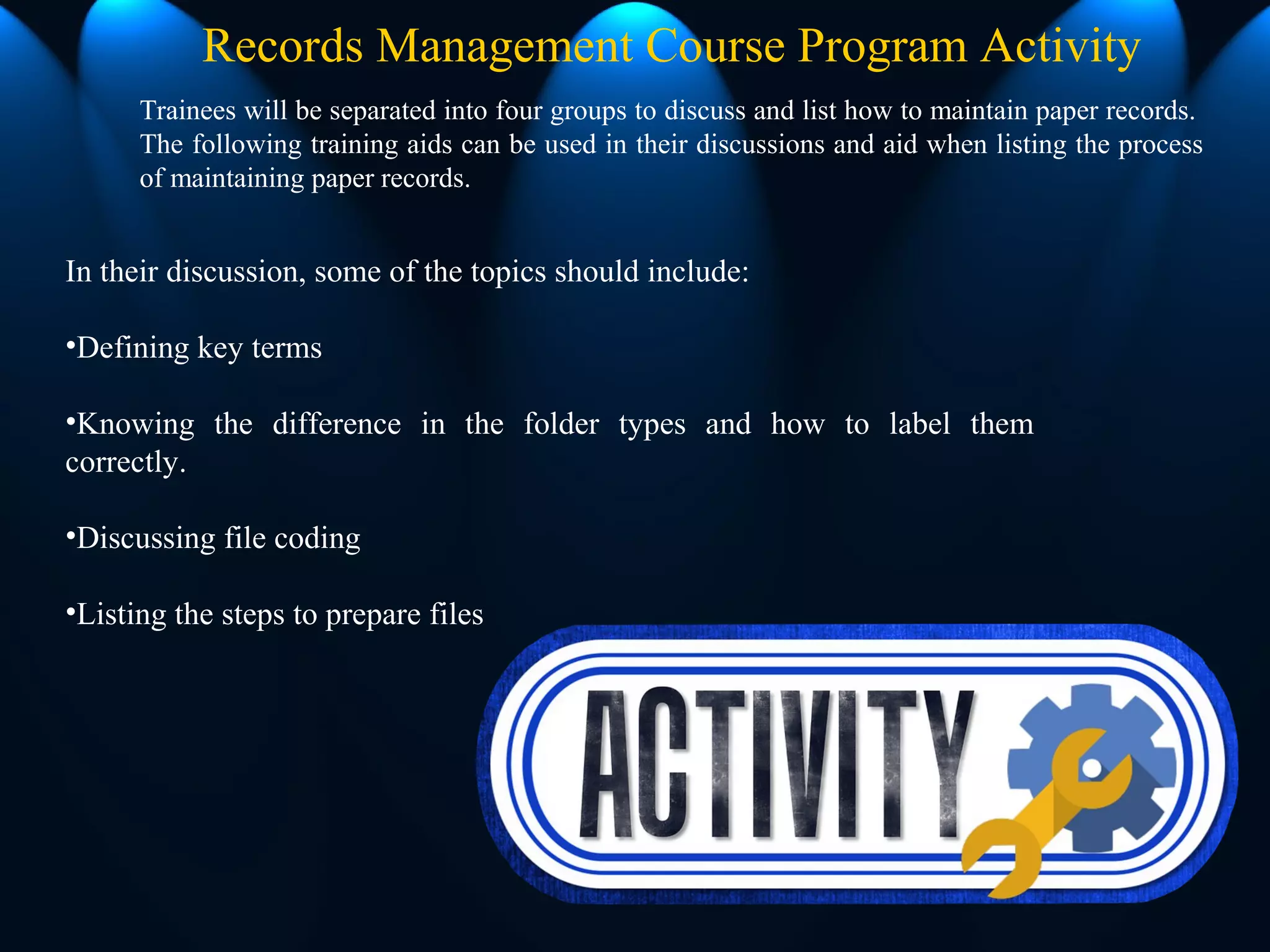
In their discussion, some of the topics should include:
•Defining key terms
•Knowing the difference in the folder types and how to label them
correctly.
•Discussing file coding
•Listing the steps to prepare files
Records Management Course Program Activity
Trainees will be separated into four groups to discuss and list how to maintain paper records.
The following training aids can be used in their discussions and aid when listing the process
of maintaining paper records.
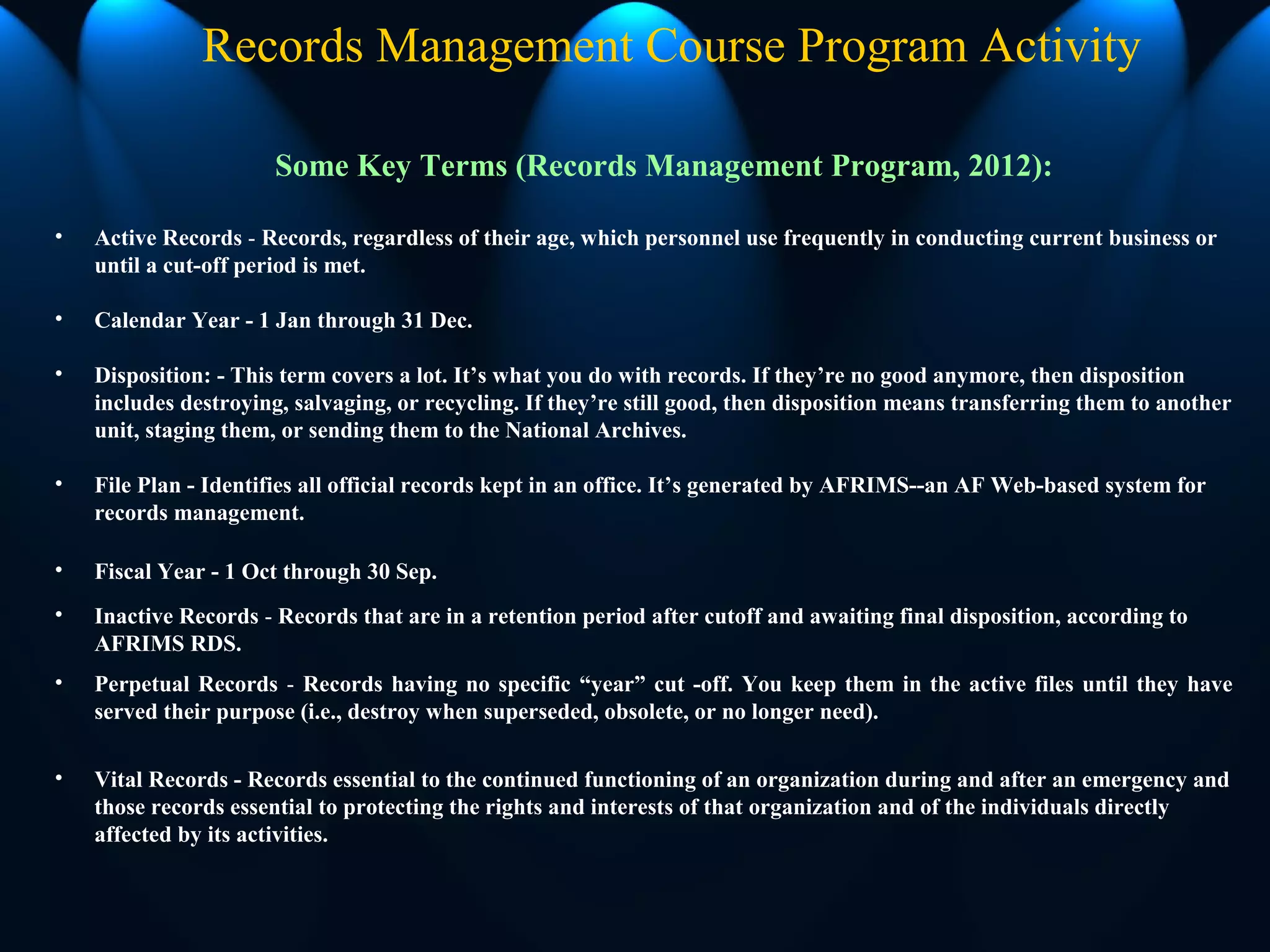
Records Management Course Program Activity
Some Key Terms (Records Management Program, 2012):
• Active Records - Records, regardless of their age, which personnel use frequently in conducting current business or
until a cut-off period is met.
• Calendar Year - 1 Jan through 31 Dec.
• Disposition: - This term covers a lot. It’s what you do with records. If they’re no good anymore, then disposition
includes destroying, salvaging, or recycling. If they’re still good, then disposition means transferring them to another
unit, staging them, or sending them to the National Archives.
• File Plan - Identifies all official records kept in an office. It’s generated by AFRIMS--an AF Web-based system for
records management.
• Fiscal Year - 1 Oct through 30 Sep.
• Inactive Records - Records that are in a retention period after cutoff and awaiting final disposition, according to
AFRIMS RDS.
• Perpetual Records - Records having no specific “year” cut -off. You keep them in the active files until they have
served their purpose (i.e., destroy when superseded, obsolete, or no longer need).
• Vital Records - Records essential to the continued functioning of an organization during and after an emergency and
those records essential to protecting the rights and interests of that organization and of the individuals directly
affected by its activities.
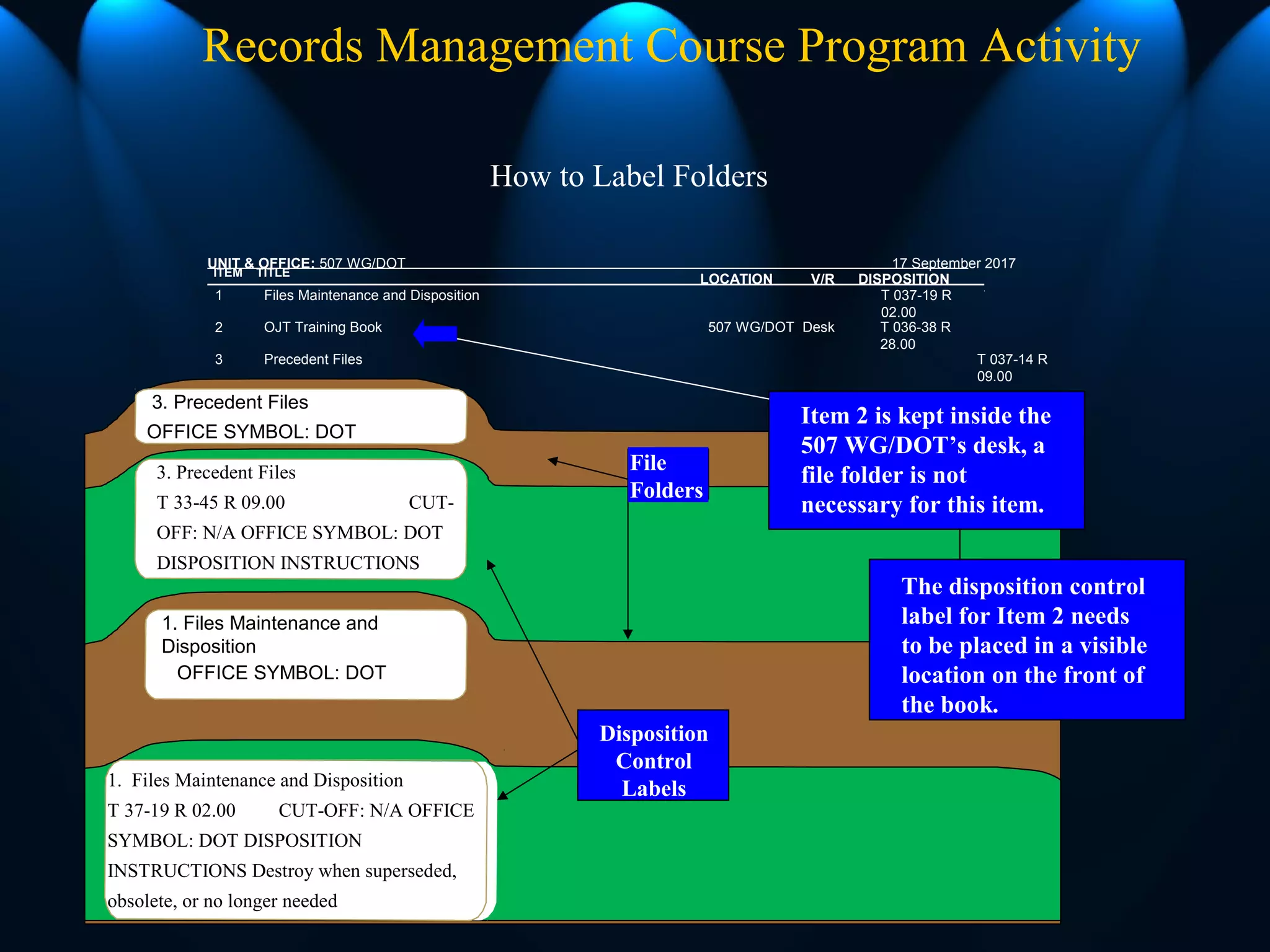
Records Management Course Program Activity
UNIT & OFFICE: 507 WG/DOT 17 September 2017
ITEM TITLE
LOCATION V/R DISPOSITION
1 Files Maintenance and Disposition T 037-19 R
02.00
2 OJT Training Book 507 WG/DOT Desk T 036-38 R
28.00
3 Precedent Files T 037-14 R
09.00
1. Files Maintenance and
Disposition
OFFICE SYMBOL: DOT
3. Precedent Files
OFFICE SYMBOL: DOT
Item 2 is kept inside the
507 WG/DOT’s desk, a
file folder is not
necessary for this item.
The disposition control
label for Item 2 needs
to be placed in a visible
location on the front of
the book.
File
Folders
Disposition
Control
Labels
3. Precedent Files
T 33-45 R 09.00 CUT-
OFF: N/A OFFICE SYMBOL: DOT
DISPOSITION INSTRUCTIONS
1. Files Maintenance and Disposition
T 37-19 R 02.00 CUT-OFF: N/A OFFICE
SYMBOL: DOT DISPOSITION
INSTRUCTIONS Destroy when superseded,
obsolete, or no longer needed
How to Label Folders
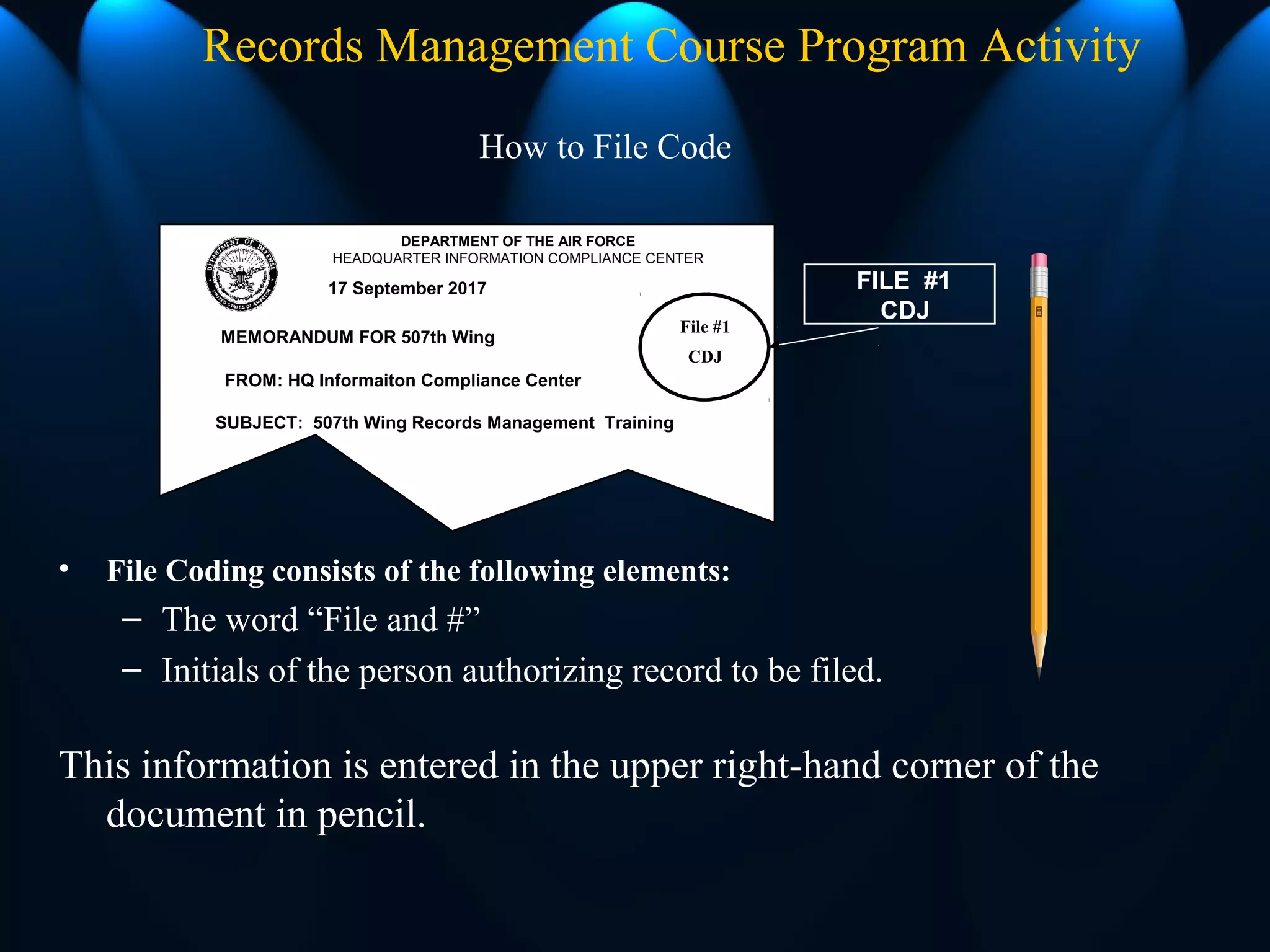
FILE #1
CDJ
• File Coding consists of the following elements:
– The word “File and #”
– Initials of the person authorizing record to be filed.
This information is entered in the upper right-hand corner of the
document in pencil.
DEPARTMENT OF THE AIR FORCE
HEADQUARTER INFORMATION COMPLIANCE CENTER
17 September 2017
MEMORANDUM FOR 507th Wing
FROM: HQ Informaiton Compliance Center
SUBJECT: 507th Wing Records Management Training
File #1
CDJ
How to File Code
Records Management Course Program Activity
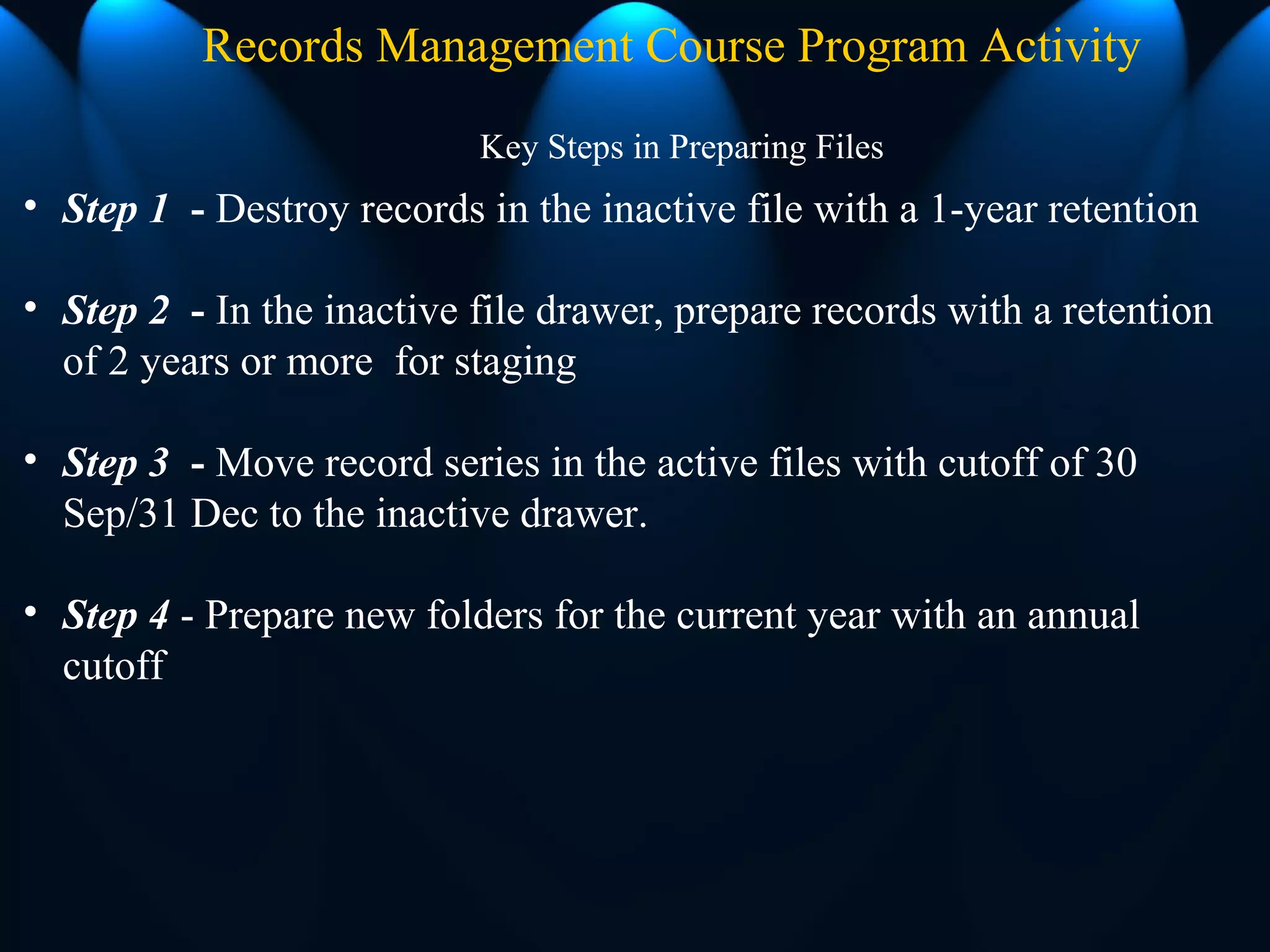
Key Steps in Preparing Files
Records Management Course Program Activity
• Step 1 - Destroy records in the inactive file with a 1-year retention
• Step 2 - In the inactive file drawer, prepare records with a retention
of 2 years or more for staging
• Step 3 - Move record series in the active files with cutoff of 30
Sep/31 Dec to the inactive drawer.
• Step 4 - Prepare new folders for the current year with an annual
cutoff
References
Air Force Instruction 33-322, Records Management Program. (2012). Retrieved from http://
static.e-publishing.af.mil/production/1/saf_cio_a6/publication/afi33-322/
afi33-322.pdf
Disposal of Records (44 U.S.C. Chapter 33). (n.d.) Retrieved from https://www.archives.gov/about/
laws/disposal-of-records.html
E-Government Act of 2002. (2013). Retrieved form https://www.it.ojp.gov/PrivacyLiberty/
authorities/statutes/1287
Federal Records Act. (2016). Retrieved from http://www2.ed.gov/policy/gen/leg/fra.html
Genis, C. (2011). Federal Mandate: Presidential Memorandum – Managing Government Records.
Retrieved from http://blogs.ironmountain.com/2011/service-lines/records-management-
and-
storage/federal-mandate-presidential-memorandum-–-managing-government-records/
How to Conduct an Effective Training Session. (2016). Retrieved from http://

AET 570 Signature Assignment Activity Part VII - Cor'Lencia Johnson

  • 1.
    Signature Assignment: Records ManagementTraining Activity C. Johnson CUR 570 Dr. Gregory Dlabach September 18, 2017
  • 2.
    Training Activity Discuss andList How to Maintain Paper Records According to Regulations.
  • 3.
    Conducting An EffectiveTraining Session It is important for the trainers to develop a training activity that will be effective. There are specific tips and techniques that they should keep in mind to ensure the training activity is not only effective but also engaging for the trainees and that focuses on accomplishing the program’s goals (Training Today, 2016). Some of the tips and techniques include (Training Today, 2016): •Informing trainees what topics will be covered in the activity. •Informing trainees on important topics such as polices procedures, and other related information. •Using as much hands-on training as possible. •Involving trainees in their own learning process (discussion questions, group work, etc.). •Analyzing the activity as it goes on; look at what parts of the activity is working and parts of the activity that is not working. •Soliciting feedback on the activity; find out how students feel about it; was the activity helpful; what can be improved.
  • 4.
    The 507th Wingis currently organizing the curriculum for our Records Management Training (RMT). The 507th Wing has three geographically separated units and is adopting distance learning RMT program for those organizations. The training will be conducted over a three-day period for initial trainees and refresher trainees. It will create a positive impact on the organization because it will teach personnel how to responsibly create, maintain, and dispose records for their offices in accordance with government directives and regulations. Creating a records management training program that has activities of this nature helps the trainees understand the process of (Iron Mountain, 2015): • Record organization and retrieval • Keeping the organization in legal compliance • Improving storage space on the network systems • Standardization Why is this Training Activity Necessary?
  • 5.
    Part of thetraining includes trainers teaching trainees how to setup records in their own office. Records include “all books, papers, maps, photographs, machine-readable materials, or other documentary materials, regardless of physical form or characteristics, made or received by an agency of the United States Government under Federal law or in connection with the transaction of public business and preserved or appropriate for preservation by that agency or its legitimate successor as evidence of the organization, functions, policies, decisions, procedures, operations, or other activities of the Government or because of the informational value of the data in them.” (National Archives, n.d.). The government directives and regulations that defines this training are as follows: •The Federal Records Act of 1950 – requires government agencies to manage records with the participation of all personnel such as military members, civilians, and contractors (U.S. Department of Education, 2016). •The E-Government Act – it ensures the use of electronic government services and improves the use of information technology in government operations (Justice Information Sharing, 2013). •The Paperwork Reduction Act – its intent is to reduce the amount of paperwork that could potentially burden citizens and private businesses (Justice Information Sharing, 2013). Important Government Directives
  • 6.
    • The DataQuality Act – main purpose is to provide policy and procedural guidance to government agencies to ensure and maximize the quality, objectivity, utility, and integrity of information disseminated by government agencies (Center for Effective Government, 2015). • Presidential Memorandum M-12-8 – In 2011, President Obama signed this memorandum starting an Executive Branch-wide effort to reform records management policies and practices in efforts to develop a 21st-century framework for the management of Government records (Genis, 2011). Important Government Directives continues…
  • 7.
    • Students willbe able to identify what constitutes an official record and vital records. • Students will be able to establish and maintain paper and electronic records according to regulations. • Students will be able to demonstrate how to create file plans using the Air Force Records Information Management System. • Students will be able to explain the basic principles of the Privacy Act and Freedom of Information Act. Records Management Training Program Goals *Although all of the course objectives are listed above, the green highlighted objective will be the focus for this activity.
  • 8.
    The program objectiveswill primarily use collaborative learning and encourage critical thinking skills. Collaborative learning is based on the view that knowledge is a social construct (Cornell University, 2016).Trainees can work together and share ideas on how to create a dynamic records management procedures for their office. Working together is important to ensuring that trainees have the same understanding and are on the same page in creating an effective management program. This will also prevent different offices from having different records structures that are not setup in accordance to regulations. Records Management Training Program Objective Objective 1: •Audience: Records Management students •Behavior: Discuss and list how to maintain paper and electronic records according to regulations. •Condition: In a breakdown of multiple teams. •Degree: With a correct response 90% of the time. In a breakdown of multiple teams (condition), Records Management students (audience) will discuss and list how to maintain paper and electronic records according to regulations (behavior) with a correct response 90% of the time (degree). This presentation will focus on an activity that displays one of the main objectives for the program:
  • 9.
    In their discussion,some of the topics should include: •Defining key terms •Knowing the difference in the folder types and how to label them correctly. •Discussing file coding •Listing the steps to prepare files Records Management Course Program Activity Trainees will be separated into four groups to discuss and list how to maintain paper records. The following training aids can be used in their discussions and aid when listing the process of maintaining paper records.
  • 10.
    Records Management CourseProgram Activity Some Key Terms (Records Management Program, 2012): • Active Records - Records, regardless of their age, which personnel use frequently in conducting current business or until a cut-off period is met. • Calendar Year - 1 Jan through 31 Dec. • Disposition: - This term covers a lot. It’s what you do with records. If they’re no good anymore, then disposition includes destroying, salvaging, or recycling. If they’re still good, then disposition means transferring them to another unit, staging them, or sending them to the National Archives. • File Plan - Identifies all official records kept in an office. It’s generated by AFRIMS--an AF Web-based system for records management. • Fiscal Year - 1 Oct through 30 Sep. • Inactive Records - Records that are in a retention period after cutoff and awaiting final disposition, according to AFRIMS RDS. • Perpetual Records - Records having no specific “year” cut -off. You keep them in the active files until they have served their purpose (i.e., destroy when superseded, obsolete, or no longer need). • Vital Records - Records essential to the continued functioning of an organization during and after an emergency and those records essential to protecting the rights and interests of that organization and of the individuals directly affected by its activities.
  • 11.
    Records Management CourseProgram Activity UNIT & OFFICE: 507 WG/DOT 17 September 2017 ITEM TITLE LOCATION V/R DISPOSITION 1 Files Maintenance and Disposition T 037-19 R 02.00 2 OJT Training Book 507 WG/DOT Desk T 036-38 R 28.00 3 Precedent Files T 037-14 R 09.00 1. Files Maintenance and Disposition OFFICE SYMBOL: DOT 3. Precedent Files OFFICE SYMBOL: DOT Item 2 is kept inside the 507 WG/DOT’s desk, a file folder is not necessary for this item. The disposition control label for Item 2 needs to be placed in a visible location on the front of the book. File Folders Disposition Control Labels 3. Precedent Files T 33-45 R 09.00 CUT- OFF: N/A OFFICE SYMBOL: DOT DISPOSITION INSTRUCTIONS 1. Files Maintenance and Disposition T 37-19 R 02.00 CUT-OFF: N/A OFFICE SYMBOL: DOT DISPOSITION INSTRUCTIONS Destroy when superseded, obsolete, or no longer needed How to Label Folders
  • 12.
    FILE #1 CDJ • FileCoding consists of the following elements: – The word “File and #” – Initials of the person authorizing record to be filed. This information is entered in the upper right-hand corner of the document in pencil. DEPARTMENT OF THE AIR FORCE HEADQUARTER INFORMATION COMPLIANCE CENTER 17 September 2017 MEMORANDUM FOR 507th Wing FROM: HQ Informaiton Compliance Center SUBJECT: 507th Wing Records Management Training File #1 CDJ How to File Code Records Management Course Program Activity
  • 13.
    Key Steps inPreparing Files Records Management Course Program Activity • Step 1 - Destroy records in the inactive file with a 1-year retention • Step 2 - In the inactive file drawer, prepare records with a retention of 2 years or more for staging • Step 3 - Move record series in the active files with cutoff of 30 Sep/31 Dec to the inactive drawer. • Step 4 - Prepare new folders for the current year with an annual cutoff
  • 14.
    References Air Force Instruction33-322, Records Management Program. (2012). Retrieved from http:// static.e-publishing.af.mil/production/1/saf_cio_a6/publication/afi33-322/ afi33-322.pdf Disposal of Records (44 U.S.C. Chapter 33). (n.d.) Retrieved from https://www.archives.gov/about/ laws/disposal-of-records.html E-Government Act of 2002. (2013). Retrieved form https://www.it.ojp.gov/PrivacyLiberty/ authorities/statutes/1287 Federal Records Act. (2016). Retrieved from http://www2.ed.gov/policy/gen/leg/fra.html Genis, C. (2011). Federal Mandate: Presidential Memorandum – Managing Government Records. Retrieved from http://blogs.ironmountain.com/2011/service-lines/records-management- and- storage/federal-mandate-presidential-memorandum-–-managing-government-records/ How to Conduct an Effective Training Session. (2016). Retrieved from http://