Student Achievement Assistant/Deputy Superintendent SVUSD Fall, 1990-1997
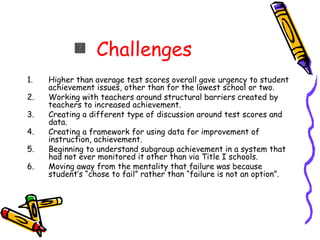
Challenges Higher than average test scores overall gave urgency to student achievement issues, other than for the lowest school or two. Working with teachers around structural barriers created by teachers to increased achievement. Creating a different type of discussion around test scores and data. Creating a framework for using data for improvement of instruction, achievement. Beginning to understand subgroup achievement in a system that had not ever monitored it other than via Title I schools. Moving away from the mentality that failure was because student’s “chose to fail” rather than “failure is not an option”.
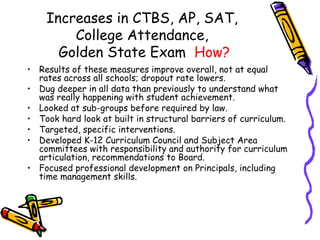
Increases in CTBS, AP, SAT,  College Attendance,  Golden State Exam  How? Results of these measures improve overall, not at equal rates across all schools; dropout rate lowers. Dug deeper in all data than previously to understand what was really happening with student achievement. Looked at sub-groups before required by law. Took hard look at built in structural barriers of curriculum. Targeted, specific interventions. Developed K-12 Curriculum Council and Subject Area committees with responsibility and authority for curriculum articulation, recommendations to Board. Focused professional development on Principals, including time management skills.
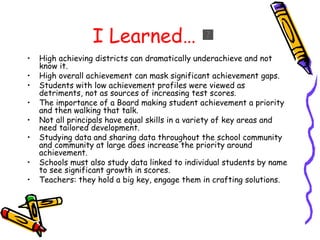
I Learned… High achieving districts can dramatically underachieve and not know it. High overall achievement can mask significant achievement gaps. Students with low achievement profiles were viewed as detriments, not as sources of increasing test scores. The importance of a Board making student achievement a priority and then walking that talk. Not all principals have equal skills in a variety of key areas and need tailored development. Studying data and sharing data throughout the school community and community at large does increase the priority around achievement. Schools must also study data linked to individual students by name to see significant growth in scores. Teachers: they hold a big key, engage them in crafting solutions.

5. Student Achievement Assistant Supt

  • 1.
    Student Achievement Assistant/DeputySuperintendent SVUSD Fall, 1990-1997
  • 2.
    Challenges Higher thanaverage test scores overall gave urgency to student achievement issues, other than for the lowest school or two. Working with teachers around structural barriers created by teachers to increased achievement. Creating a different type of discussion around test scores and data. Creating a framework for using data for improvement of instruction, achievement. Beginning to understand subgroup achievement in a system that had not ever monitored it other than via Title I schools. Moving away from the mentality that failure was because student’s “chose to fail” rather than “failure is not an option”.
  • 3.
    Increases in CTBS,AP, SAT, College Attendance, Golden State Exam How? Results of these measures improve overall, not at equal rates across all schools; dropout rate lowers. Dug deeper in all data than previously to understand what was really happening with student achievement. Looked at sub-groups before required by law. Took hard look at built in structural barriers of curriculum. Targeted, specific interventions. Developed K-12 Curriculum Council and Subject Area committees with responsibility and authority for curriculum articulation, recommendations to Board. Focused professional development on Principals, including time management skills.
  • 4.
    I Learned… Highachieving districts can dramatically underachieve and not know it. High overall achievement can mask significant achievement gaps. Students with low achievement profiles were viewed as detriments, not as sources of increasing test scores. The importance of a Board making student achievement a priority and then walking that talk. Not all principals have equal skills in a variety of key areas and need tailored development. Studying data and sharing data throughout the school community and community at large does increase the priority around achievement. Schools must also study data linked to individual students by name to see significant growth in scores. Teachers: they hold a big key, engage them in crafting solutions.