20092626
Lee HyunAh
   Product placement is a form of ad
    vertisement, where branded goods
    or services are placed in a conte
    xt usually devoid of ads, such as
    movies, music videos, the story l
    ine of television shows, or news
    programs.

   The product placement is often no
    t disclosed at the time that the
    good or service is featured.

   Product placement became common i
    n the 1990s, until the ramificati
    ons of product placement were cle
    arly understood.
   Product placement is an investment for b
    rands trying to reach a niche audience,
    and there are strong reasons for investo
    rs to expect that film product placement
    will increase consumer awareness of a pa
    rticular brand. A big-budget feature fil
    m that has expectations of grossing mill
    ions may attract many commercial interes
    ts

   For example
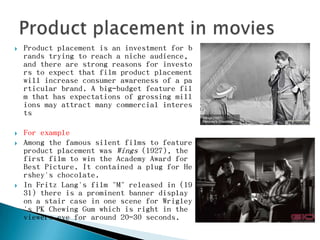
   Among the famous silent films to feature
    product placement was Wings (1927), the
    first film to win the Academy Award for
    Best Picture. It contained a plug for He
    rshey's chocolate.
   In Fritz Lang's film "M" released in (19
    31) there is a prominent banner display
    on a stair case in one scene for Wrigley
    's PK Chewing Gum which is right in the
    viewers eye for around 20-30 seconds.
   radio in the 1930s and 1940s and early t
    elevision in the 1950s, television progr
    ams were often underwritten by companies
    . "Soap operas" are called such because
    they were initially underwritten by cons
    umer, packaged-goods companies such as P
    rocter & Gamble or Unilever.

   When television began to displace radio,
    DuMont's Cavalcade of Stars television s   Korea Drama PPL
    how was, in its era, notable for not rel
    ying on a sole Sponsor (commercial) in t
    he tradition of NBC's Texaco Star Theate
    r and similar productions. Sponsorship e
    xists today with programs being sponsore
    d by major vendors such as
    Hallmark Cards.
   Product placement has long been
    prevalent in sports as well, fro
    m professional sports to college
    sports, and even on the local le
    vel with high school sports. Thi
    s can be attributed to sports be
    ing prevalent on television, whi
    ch increases exposure to these p
    roducts.

   The National Hockey League began
    allowing sponsors to line along
    the interior walls of the ice ri
    nks in the early 1980s. This, co
    mbined with new rules mandating
    players to wear helmets (though
    some were grandfathered), arguab
    ly gave the NHL a different look
    in the 1980s than compared with
    the 1970s.
   Coca-Cola could pay a given fee
    to have the title character drin
    king a Coke, instead of a Pepsi
    beverage.

    Toyota might pay to have one of
    the characters drive their newes
    t automobile.

   Through product placement, compa
    nies hope that moviegoers will t
    ake note of the products used by
    the characters, and therefore th
    ink more strongly about using th
    e products themselves. Some peop
    le consider product placement to
    be deceptive and unethical.

Advertizing

  • 1.
  • 2.
    Product placement is a form of ad vertisement, where branded goods or services are placed in a conte xt usually devoid of ads, such as movies, music videos, the story l ine of television shows, or news programs.  The product placement is often no t disclosed at the time that the good or service is featured.  Product placement became common i n the 1990s, until the ramificati ons of product placement were cle arly understood.
  • 3.
    Product placement is an investment for b rands trying to reach a niche audience, and there are strong reasons for investo rs to expect that film product placement will increase consumer awareness of a pa rticular brand. A big-budget feature fil m that has expectations of grossing mill ions may attract many commercial interes ts  For example  Among the famous silent films to feature product placement was Wings (1927), the first film to win the Academy Award for Best Picture. It contained a plug for He rshey's chocolate.  In Fritz Lang's film "M" released in (19 31) there is a prominent banner display on a stair case in one scene for Wrigley 's PK Chewing Gum which is right in the viewers eye for around 20-30 seconds.
  • 4.
    radio in the 1930s and 1940s and early t elevision in the 1950s, television progr ams were often underwritten by companies . "Soap operas" are called such because they were initially underwritten by cons umer, packaged-goods companies such as P rocter & Gamble or Unilever.  When television began to displace radio, DuMont's Cavalcade of Stars television s Korea Drama PPL how was, in its era, notable for not rel ying on a sole Sponsor (commercial) in t he tradition of NBC's Texaco Star Theate r and similar productions. Sponsorship e xists today with programs being sponsore d by major vendors such as Hallmark Cards.
  • 5.
    Product placement has long been prevalent in sports as well, fro m professional sports to college sports, and even on the local le vel with high school sports. Thi s can be attributed to sports be ing prevalent on television, whi ch increases exposure to these p roducts.  The National Hockey League began allowing sponsors to line along the interior walls of the ice ri nks in the early 1980s. This, co mbined with new rules mandating players to wear helmets (though some were grandfathered), arguab ly gave the NHL a different look in the 1980s than compared with the 1970s.
  • 6.
    Coca-Cola could pay a given fee to have the title character drin king a Coke, instead of a Pepsi beverage. Toyota might pay to have one of the characters drive their newes t automobile.  Through product placement, compa nies hope that moviegoers will t ake note of the products used by the characters, and therefore th ink more strongly about using th e products themselves. Some peop le consider product placement to be deceptive and unethical.