DR. YAGNESH POPAT OM BABYCARE HOSPITAL RAJKOT Prepadness for AEFV  &  Medicolegal aspects
AEFV: Adverse Events   Following Vaccination It is an untoward, temporally associated event following immunization that might or might not be caused by the vaccine or the immunization process.
Introduction These events may be recognized during  clinical trials or during post marketing surveillance – eg. Intussusception following Rotashield vaccine, febrile seizures following Proquad vaccine and GBS following meningococcal conjugate vaccines.
Importance: Tolerance to vaccine associated adverse events is generally lower as these are administered to healthy children.  Vaccine associated adverse events are more likely to be noticed and  communicated  and can often significantly impact immunization programs as noticed with measles, MMR and pertussis vaccines. Unpredictable Always observe for 15 min after vaccination
CLASSIFICATION: Adverse vaccine reaction (vaccine induced ) Trigger reaction (vaccine potentiated)  Programmatic errors  Injection reaction
Adverse vaccine reaction (vaccine induced ):   Here the vaccine is causally related to the  reaction- eg. VAPP due to oral polio  vaccine, anaphylaxis.
Trigger reaction (vaccine potentiated): Here the reaction is triggered by the  vaccine. eg. Febrile seizure following vaccination in a predisposed child.
Programmatic errors:  These are most common cause for serious adverse events and death following vaccination. Deaths following measles vaccination due to toxic shock syndrome resulting from improper reconstitution and storage of measles vaccine is the most recent example of this phenomenon.
Injection reaction:   Examples include syncope due to pain of vaccination, injection site abscesses, sciatic nerve damage due to gluteal  injection and transmission of blood  borne pathogens such as  HIV/HBV/HCV.
AEFV Serious adverse events (SAE): - fatal or life threatening  - persistent or significant disability - prolong hospitalisation - leads to birth defects/congenital  anomalies Non serious events:
Adverse vaccine reaction Local reaction Systemic  reaction Allergic reaction
Local Reactions: Common  Pain, erythema and induration. More with whole cell pertusis vaccines and aluminiun adjuvanted (DTPw, DTaP, DT, Td, TDap, TT Hep B, Hep A, inactivated combination vaccines, HPV and PCV7) vaccines.  Frequency of local reactions increase with subsequent doses and frequently administered doses (TT). Local reactions may be partly ameliorated by ice application and paracetamol.
  Systemic   Reactions: Fever is the most common systemic reaction and like local reactions, fever is more common with whole cell pertussis vaccines and aluminium adjuvanted vaccines.  However unlike local reactions it usually declines with increasing age and increasing number of doses.  Administration  of paracetamol at the time of vaccinaton and later on a regular basis is helpful and indicated especially in children predispoded to febrile seizures.  Fever due to vaccination does not usually last for more than 48  hours and any  fever persisting beyond  this time should be evaluated for  other causes.
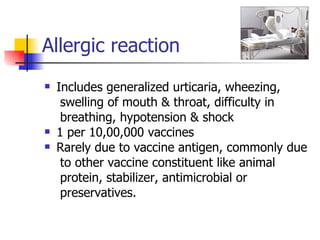
Allergic reaction Includes generalized urticaria, wheezing,  swelling of mouth & throat, difficulty in  breathing, hypotension & shock 1 per 10,00,000 vaccines Rarely due to vaccine antigen, commonly due to other vaccine constituent like animal  protein, stabilizer, antimicrobial or preservatives.
Information Provide relatives with sufficient information about side effects / adverse events that may arise. verbal, brochure, video, resource kits Internet or hotline resource
Consent
Consent Only verbal consent is sufficient
Preparation
Resuscitation Equipment Oxygen Ambu bag & mask Endotracheal tubes Laryngoscope Iv assess devices & Iv fluids Drugs: Adrenaline, Hydrocortisone, Antihistime, Inotropes etc
Emergency management of  anaphylaxis: Administer epinephrine (1:1000 solution) 0.01 ml/kg/dose (max 0.5ml) intramuscular in anterolateral thigh. set up IV access. lay patient flat and elevate legs if tolerated. Give high flow oxygen and airway/ventilation if needed. if hypotensive also, set up additional wide bore access and give IV normal saline 20 ml/kg under pressure over 1-2 minutes.
Emergency management of  anaphylaxis:  continued …. IM adrenaline may be repeated after 3-5 minutes if required. oral antihistaminics may be given to ameliorate skin symptoms but IV  antihistaminics are not recommended. Oral or injectable corticosteroids equivalent to prednisone 1-2 mg/kg may be given but benefit is yet unproven.
CONTROVERSIES IN VACCINE SAFETY Vaccines and Autism Safety of Thiomersol (50 % Ethyl mercury)
Medico legal issues  Indian law is silent. - Introduction of new vaccine. - National regulatory authority. - waste management. - advertisement. -  Liability/ negligence   - Magic remedial act
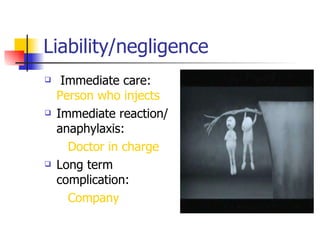
Liability/negligence Immediate care:  Person who injects Immediate reaction/ anaphylaxis:  Doctor in charge Long term complication:  Company
VACCINE ASSOCIATED ADVERSE  EVENT REPORTING SYSTEM (VAERS) Required for generation further data Exists in most developed countries  Practically non existant in India Report on  www.iapcoi.com All SAE irrespective of causal association, non serious adverse events that are unexpected in nature, severity, frequency or outcome, vaccine failures, and all usage in pregnancy.
CONCLUSION
CONCLUSION Vaccines are largely safe. Serious outcomes are usually programmatic/ human errors. It is therefore extremely important to use vaccines strictly  as per recommendation and be prepared to handle any eventuality.
Don’t feel lonely
Call for assistance
GURU
THANK YOU
 
THANK YOU
DR. YAGNESH POPAT OM BABYCARE HOSPITAL RAJKOT
Conclusion
DR. YAGNESH POPAT   om babycare hospital   Rajkot OM BABYCARE HOSPITAL RAJKOT DR. YAGNESH POPAT

Adverse events following immunization

  • 1.
    DR. YAGNESH POPATOM BABYCARE HOSPITAL RAJKOT Prepadness for AEFV & Medicolegal aspects
  • 2.
    AEFV: Adverse Events Following Vaccination It is an untoward, temporally associated event following immunization that might or might not be caused by the vaccine or the immunization process.
  • 3.
    Introduction These eventsmay be recognized during clinical trials or during post marketing surveillance – eg. Intussusception following Rotashield vaccine, febrile seizures following Proquad vaccine and GBS following meningococcal conjugate vaccines.
  • 4.
    Importance: Tolerance tovaccine associated adverse events is generally lower as these are administered to healthy children. Vaccine associated adverse events are more likely to be noticed and communicated and can often significantly impact immunization programs as noticed with measles, MMR and pertussis vaccines. Unpredictable Always observe for 15 min after vaccination
  • 5.
    CLASSIFICATION: Adverse vaccinereaction (vaccine induced ) Trigger reaction (vaccine potentiated) Programmatic errors Injection reaction
  • 6.
    Adverse vaccine reaction(vaccine induced ): Here the vaccine is causally related to the reaction- eg. VAPP due to oral polio vaccine, anaphylaxis.
  • 7.
    Trigger reaction (vaccinepotentiated): Here the reaction is triggered by the vaccine. eg. Febrile seizure following vaccination in a predisposed child.
  • 8.
    Programmatic errors: These are most common cause for serious adverse events and death following vaccination. Deaths following measles vaccination due to toxic shock syndrome resulting from improper reconstitution and storage of measles vaccine is the most recent example of this phenomenon.
  • 9.
    Injection reaction: Examples include syncope due to pain of vaccination, injection site abscesses, sciatic nerve damage due to gluteal injection and transmission of blood borne pathogens such as HIV/HBV/HCV.
  • 10.
    AEFV Serious adverseevents (SAE): - fatal or life threatening - persistent or significant disability - prolong hospitalisation - leads to birth defects/congenital anomalies Non serious events:
  • 11.
    Adverse vaccine reactionLocal reaction Systemic reaction Allergic reaction
  • 12.
    Local Reactions: Common Pain, erythema and induration. More with whole cell pertusis vaccines and aluminiun adjuvanted (DTPw, DTaP, DT, Td, TDap, TT Hep B, Hep A, inactivated combination vaccines, HPV and PCV7) vaccines. Frequency of local reactions increase with subsequent doses and frequently administered doses (TT). Local reactions may be partly ameliorated by ice application and paracetamol.
  • 13.
    Systemic Reactions: Fever is the most common systemic reaction and like local reactions, fever is more common with whole cell pertussis vaccines and aluminium adjuvanted vaccines. However unlike local reactions it usually declines with increasing age and increasing number of doses. Administration of paracetamol at the time of vaccinaton and later on a regular basis is helpful and indicated especially in children predispoded to febrile seizures. Fever due to vaccination does not usually last for more than 48 hours and any fever persisting beyond this time should be evaluated for other causes.
  • 14.
    Allergic reaction Includesgeneralized urticaria, wheezing, swelling of mouth & throat, difficulty in breathing, hypotension & shock 1 per 10,00,000 vaccines Rarely due to vaccine antigen, commonly due to other vaccine constituent like animal protein, stabilizer, antimicrobial or preservatives.
  • 15.
    Information Provide relativeswith sufficient information about side effects / adverse events that may arise. verbal, brochure, video, resource kits Internet or hotline resource
  • 16.
  • 17.
    Consent Only verbalconsent is sufficient
  • 18.
  • 19.
    Resuscitation Equipment OxygenAmbu bag & mask Endotracheal tubes Laryngoscope Iv assess devices & Iv fluids Drugs: Adrenaline, Hydrocortisone, Antihistime, Inotropes etc
  • 20.
    Emergency management of anaphylaxis: Administer epinephrine (1:1000 solution) 0.01 ml/kg/dose (max 0.5ml) intramuscular in anterolateral thigh. set up IV access. lay patient flat and elevate legs if tolerated. Give high flow oxygen and airway/ventilation if needed. if hypotensive also, set up additional wide bore access and give IV normal saline 20 ml/kg under pressure over 1-2 minutes.
  • 21.
    Emergency management of anaphylaxis: continued …. IM adrenaline may be repeated after 3-5 minutes if required. oral antihistaminics may be given to ameliorate skin symptoms but IV antihistaminics are not recommended. Oral or injectable corticosteroids equivalent to prednisone 1-2 mg/kg may be given but benefit is yet unproven.
  • 22.
    CONTROVERSIES IN VACCINESAFETY Vaccines and Autism Safety of Thiomersol (50 % Ethyl mercury)
  • 23.
    Medico legal issues Indian law is silent. - Introduction of new vaccine. - National regulatory authority. - waste management. - advertisement. - Liability/ negligence - Magic remedial act
  • 24.
    Liability/negligence Immediate care: Person who injects Immediate reaction/ anaphylaxis: Doctor in charge Long term complication: Company
  • 25.
    VACCINE ASSOCIATED ADVERSE EVENT REPORTING SYSTEM (VAERS) Required for generation further data Exists in most developed countries Practically non existant in India Report on www.iapcoi.com All SAE irrespective of causal association, non serious adverse events that are unexpected in nature, severity, frequency or outcome, vaccine failures, and all usage in pregnancy.
  • 26.
  • 27.
    CONCLUSION Vaccines arelargely safe. Serious outcomes are usually programmatic/ human errors. It is therefore extremely important to use vaccines strictly as per recommendation and be prepared to handle any eventuality.
  • 28.
  • 29.
  • 30.
  • 31.
  • 32.
  • 33.
  • 34.
    DR. YAGNESH POPATOM BABYCARE HOSPITAL RAJKOT
  • 35.
  • 36.
    DR. YAGNESH POPAT om babycare hospital Rajkot OM BABYCARE HOSPITAL RAJKOT DR. YAGNESH POPAT