MOHIT PANDEY
TEERTHANKER MAHAVEER COLLEGE OF PHARMACY
TMU, MORADABAD
ADVERSE DRUG REACTION
A
PRESENTATION
CLINICAL RESEARCH AND PHARMACOVIGILANCE
COURSE CODE :- MPL204T
FOR PARTIAL
FULLFILMENT OF
MASTER OF PHARMACY
(PHARMACOLOGY)
PRESENTED BY:-
MOHIT PANDEY
M.PHARM 2 SEM
(PHARMACOLOGY)
PRESENTED TO:-
Dr. MAYUR PORWAL
ASSOCIATE PROFESSOR
PHARMACOLOGY
According to WHO “A response to a drug that is
noxious and unintended and occurs at doses normally
used in man for the prophylaxis, diagnosis or therapy
of disease, or for modification of physiological
function”.
Noxious means :- injurious or harmful
2
MOHIT PANDEY 3
MOHIT PANDEY
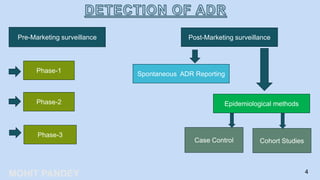
Pre-Marketing surveillance Post-Marketing surveillance
Phase-1
Phase-2
Phase-3
Spontaneous ADR Reporting
Epidemiological methods
Case Control Cohort Studies
4
MOHIT PANDEY
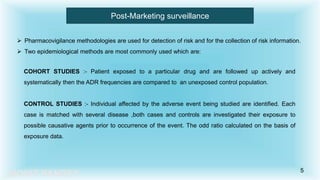
Post-Marketing surveillance
 Pharmacovigilance methodologies are used for detection of risk and for the collection of risk information.
 Two epidemiological methods are most commonly used which are:
COHORT STUDIES :- Patient exposed to a particular drug and are followed up actively and
systematically then the ADR frequencies are compared to an unexposed control population.
CONTROL STUDIES :- Individual affected by the adverse event being studied are identified. Each
case is matched with several disease ,both cases and controls are investigated their exposure to
possible causative agents prior to occurrence of the event. The odd ratio calculated on the basis of
exposure data.
5
6
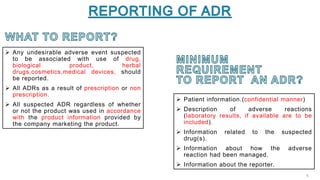
 Any undesirable adverse event suspected
to be associated with use of drug,
biological product, herbal
drugs,cosmetics,medical devices, should
be reported.
 All ADRs as a result of prescription or non
prescription.
 All suspected ADR regardless of whether
or not the product was used in accordance
with the product information provided by
the company marketing the product.
 Patient information.(confidential manner)
 Description of adverse reactions
(laboratory results, if available are to be
included).
 Information related to the suspected
drug(s).
 Information about how the adverse
reaction had been managed.
 Information about the reporter.
MOHIT PANDEY
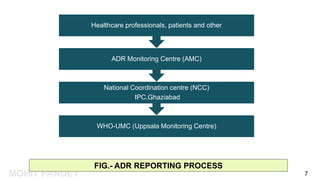
WHO-UMC (Uppsala Monitoring Centre)
National Coordination centre (NCC)
IPC,Ghaziabad
ADR Monitoring Centre (AMC)
Healthcare professionals, patients and other
FIG.- ADR REPORTING PROCESS
7
MOHIT PANDEY 8
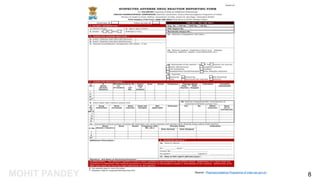
Source:- Pharmacovigilance Programme of India (ipc.gov.in)
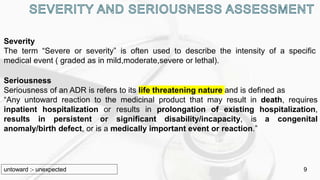
Seriousness
Seriousness of an ADR is refers to its life threatening nature and is defined as
“Any untoward reaction to the medicinal product that may result in death, requires
inpatient hospitalization or results in prolongation of existing hospitalization,
results in persistent or significant disability/incapacity, is a congenital
anomaly/birth defect, or is a medically important event or reaction.”
untoward :- unexpected
Severity
The term “Severe or severity” is often used to describe the intensity of a specific
medical event ( graded as in mild,moderate,severe or lethal).
9
10
MOHIT PANDEY
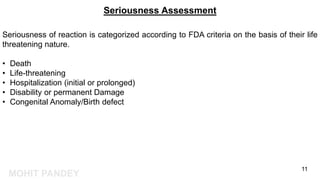
Seriousness Assessment
Seriousness of reaction is categorized according to FDA criteria on the basis of their life
threatening nature.
• Death
• Life-threatening
• Hospitalization (initial or prolonged)
• Disability or permanent Damage
• Congenital Anomaly/Birth defect
11
MOHIT PANDEY
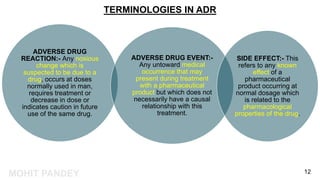
TERMINOLOGIES IN ADR
ADVERSE DRUG
REACTION:- Any noxious
change which is
suspected to be due to a
drug, occurs at doses
normally used in man,
requires treatment or
decrease in dose or
indicates caution in future
use of the same drug.
ADVERSE DRUG EVENT:-
Any untoward medical
occurrence that may
present during treatment
with a pharmaceutical
product but which does not
necessarily have a causal
relationship with this
treatment.
SIDE EFFECT:- This
refers to any known
effect of a
pharmaceutical
product occurring at
normal dosage which
is related to the
pharmacological
properties of the drug.
12
MOHIT PANDEY 13
1. Petrova G, Stoimenova A, Dimitrova M, Kamusheva M, Petrova D, Georgiev O.
Assessment of the expectancy, seriousness and severity of adverse drug reactions reported
for chronic obstructive pulmonary disease therapy. SAGE open medicine. 2017 Jan
31;5:2050312117690404.
2. Pharmacovigilance Programme of India (ipc.gov.in)
MOHIT PANDEY 14

ADVERSE DRUG REACTION, types and reporting

  • 1.
    MOHIT PANDEY TEERTHANKER MAHAVEERCOLLEGE OF PHARMACY TMU, MORADABAD ADVERSE DRUG REACTION A PRESENTATION CLINICAL RESEARCH AND PHARMACOVIGILANCE COURSE CODE :- MPL204T FOR PARTIAL FULLFILMENT OF MASTER OF PHARMACY (PHARMACOLOGY) PRESENTED BY:- MOHIT PANDEY M.PHARM 2 SEM (PHARMACOLOGY) PRESENTED TO:- Dr. MAYUR PORWAL ASSOCIATE PROFESSOR PHARMACOLOGY
  • 2.
    According to WHO“A response to a drug that is noxious and unintended and occurs at doses normally used in man for the prophylaxis, diagnosis or therapy of disease, or for modification of physiological function”. Noxious means :- injurious or harmful 2
  • 3.
  • 4.
    MOHIT PANDEY Pre-Marketing surveillancePost-Marketing surveillance Phase-1 Phase-2 Phase-3 Spontaneous ADR Reporting Epidemiological methods Case Control Cohort Studies 4
  • 5.
    MOHIT PANDEY Post-Marketing surveillance Pharmacovigilance methodologies are used for detection of risk and for the collection of risk information.  Two epidemiological methods are most commonly used which are: COHORT STUDIES :- Patient exposed to a particular drug and are followed up actively and systematically then the ADR frequencies are compared to an unexposed control population. CONTROL STUDIES :- Individual affected by the adverse event being studied are identified. Each case is matched with several disease ,both cases and controls are investigated their exposure to possible causative agents prior to occurrence of the event. The odd ratio calculated on the basis of exposure data. 5
  • 6.
    6  Any undesirableadverse event suspected to be associated with use of drug, biological product, herbal drugs,cosmetics,medical devices, should be reported.  All ADRs as a result of prescription or non prescription.  All suspected ADR regardless of whether or not the product was used in accordance with the product information provided by the company marketing the product.  Patient information.(confidential manner)  Description of adverse reactions (laboratory results, if available are to be included).  Information related to the suspected drug(s).  Information about how the adverse reaction had been managed.  Information about the reporter.
  • 7.
    MOHIT PANDEY WHO-UMC (UppsalaMonitoring Centre) National Coordination centre (NCC) IPC,Ghaziabad ADR Monitoring Centre (AMC) Healthcare professionals, patients and other FIG.- ADR REPORTING PROCESS 7
  • 8.
    MOHIT PANDEY 8 Source:-Pharmacovigilance Programme of India (ipc.gov.in)
  • 9.
    Seriousness Seriousness of anADR is refers to its life threatening nature and is defined as “Any untoward reaction to the medicinal product that may result in death, requires inpatient hospitalization or results in prolongation of existing hospitalization, results in persistent or significant disability/incapacity, is a congenital anomaly/birth defect, or is a medically important event or reaction.” untoward :- unexpected Severity The term “Severe or severity” is often used to describe the intensity of a specific medical event ( graded as in mild,moderate,severe or lethal). 9
  • 10.
  • 11.
    MOHIT PANDEY Seriousness Assessment Seriousnessof reaction is categorized according to FDA criteria on the basis of their life threatening nature. • Death • Life-threatening • Hospitalization (initial or prolonged) • Disability or permanent Damage • Congenital Anomaly/Birth defect 11
  • 12.
    MOHIT PANDEY TERMINOLOGIES INADR ADVERSE DRUG REACTION:- Any noxious change which is suspected to be due to a drug, occurs at doses normally used in man, requires treatment or decrease in dose or indicates caution in future use of the same drug. ADVERSE DRUG EVENT:- Any untoward medical occurrence that may present during treatment with a pharmaceutical product but which does not necessarily have a causal relationship with this treatment. SIDE EFFECT:- This refers to any known effect of a pharmaceutical product occurring at normal dosage which is related to the pharmacological properties of the drug. 12
  • 13.
    MOHIT PANDEY 13 1.Petrova G, Stoimenova A, Dimitrova M, Kamusheva M, Petrova D, Georgiev O. Assessment of the expectancy, seriousness and severity of adverse drug reactions reported for chronic obstructive pulmonary disease therapy. SAGE open medicine. 2017 Jan 31;5:2050312117690404. 2. Pharmacovigilance Programme of India (ipc.gov.in)
  • 14.