Adversarial Classification Under
Differential Privacy
Jairo Giraldo
University of Utah
Alvaro A. Cardenas
UC Santa Cruz
Murat Kantarcioglu
UT Dallas
Jonathan Katz
GMU
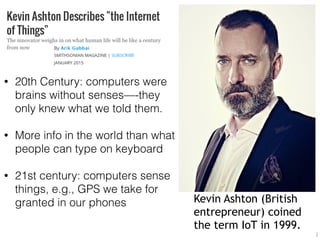
Kevin Ashton (British
entrepreneur) coined
the term IoT in 1999.
2
• 20th Century: computers were
brains without senses—-they
only knew what we told them.
• More info in the world than what
people can type on keyboard
• 21st century: computers sense
things, e.g., GPS we take for
granted in our phones
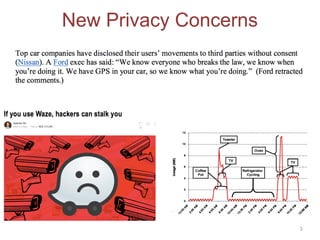
New Privacy Concerns
3
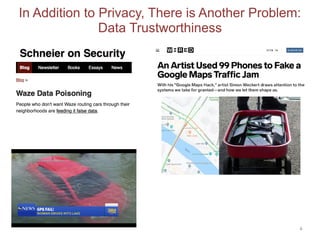
In Addition to Privacy, There is Another Problem:
Data Trustworthiness
4
Privacy
Security
Utility
This work
Privacy vs. Utility
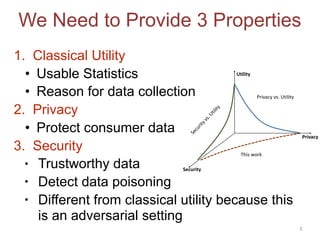
We Need to Provide 3 Properties
1. Classical Utility
• Usable Statistics
• Reason for data collection
2. Privacy
• Protect consumer data
3. Security
• Trustworthy data
• Detect data poisoning
• Different from classical utility because this
is an adversarial setting
5
DP
𝑑1
𝑑2
𝑑𝑛
Database
Query
Response
DP
DP
Sensor 1
Sensor 2
Sensor 3
Sensor n
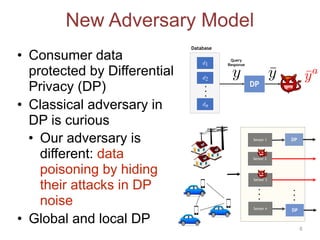
New Adversary Model
• Consumer data
protected by Differential
Privacy (DP)
• Classical adversary in
DP is curious
• Our adversary is
different: data
poisoning by hiding
their attacks in DP
noise
• Global and local DP
6
Adversary Goals
• Intelligently poison the data in a way that is
hard to detect (hide attack in DP noise)
• Achieve maximum damage to the utility of the
system (deviate estimate as much as possible)
7
max
fa
E[Y a
]
s.t.
DKL(fakf0) 
fa 2 F
Classical DP
Attack Goals:
Multi-criteria Optimization
¯Y M(D)
¯Y ⇠ f0
Attack
Y a
instead of ¯Y
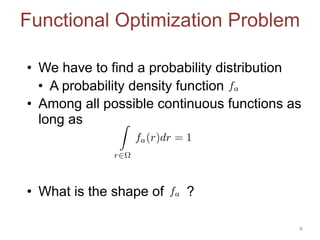
Functional Optimization Problem
• We have to find a probability distribution
• A probability density function
• Among all possible continuous functions as
long as
• What is the shape of ?
8
fa
Z
r2⌦
fa(r)dr = 1
fa
Solution: Variational Methods
• Variational methods are a useful tool to find
the shape of functions or the structure of
matrices
• They replace the function or matrix
optimization problem with a parameterized
perturbation of the function or matrix
• We can then optimize with respect to the
parameter to find the “shape” of the function/
matrix
• The Lagrange multipliers give us the final
parameters of the function
9
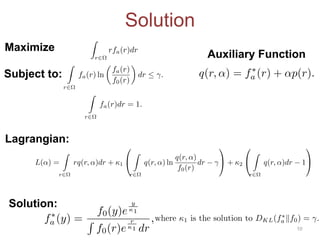
Solution
10
Z
r2⌦
rfa(r)dr
Z
r2⌦
fa(r) ln
✓
fa(r)
f0(r)
◆
dr  .
Z
r2⌦
fa(r)dr = 1.
Maximize
Subject to: q(r, ↵) = f⇤
a (r) + ↵p(r).
Auxiliary Function
Lagrangian:
Solution:
L(↵) =
Z
r2⌦
rq(r, ↵)dr + 1
0
@
Z
r2⌦
q(r, ↵) ln
q(r, ↵)
f0(r)
dr
1
A + 2
0
@
Z
r2⌦
q(r, ↵)dr 1
1
A
f⇤
a (y) =
f0(y)e
y
1
R
f0(r)e
r
1 dr
,where 1 is the solution to DKL(f⇤
a kf0) = .
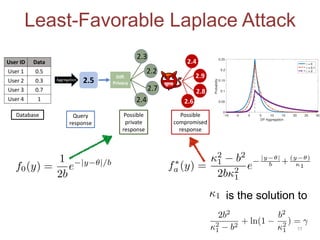
Least-Favorable Laplace Attack
11
User ID Data
User 1 0.5
User 2 0.3
User 3 0.7
User 4 1
2.5
Diff.
Privacy
2.3
2.2
2.7
2.4
2.4
2.9
2.8
2.6
Database Query
response
Possible
private
response
Possible
compromised
response
Aggregation
f0(y) =
1
2b
e |y ✓|/b
f⇤
a (y) =
2
1 b2
2b2
1
e
|y ✓|
b +
(y ✓)
1
2b2
2
1 b2
+ ln(1
b2
2
1
) =
1 is the solution to
-10 -5 0 5 10 15 20 25 30
DP Aggregation
0
0.05
0.1
0.15
0.2
0.25
Probability
= 0
= 0.1
= 2
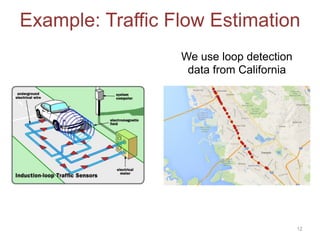
Example: Traffic Flow Estimation
12
-Vehicle count
- Occupancy
We use loop detection
data from California
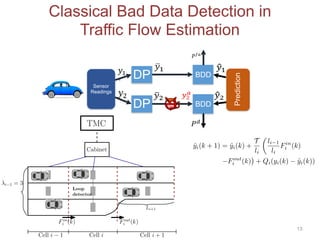
Classical Bad Data Detection in
Traffic Flow Estimation
13
Sensor
Readings
DP
BDD
BDD
DP
Prediction
ˆyi(k + 1) = ˆyi(k) +
T
li
✓
li 1
li
Fin
i (k)
Fout
i (k) + Qi(yi(k) ˆyi(k))
Cabinet
TMC
Fout
i (k)Fin
i (k)
Li+1
Cell i 1 Cell i Cell i + 1
i 1 = 3
Loop
detector
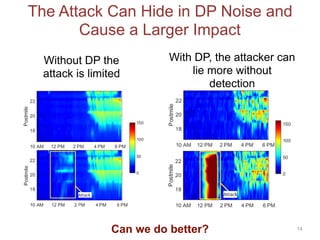
The Attack Can Hide in DP Noise and
Cause a Larger Impact
14
Without DP the
attack is limited
With DP, the attacker can
lie more without
detection
Can we do better?
Defense Against Adversarial (Adaptive)
Distributions
•Player 1 designs classifier D ∈ S minimize Φ(D,A) (e.g.,
Pr[Miss Detection] Subject to fix false alarms)
-Player 1 makes the first move
•Player 2 (attacker) has multiple strategies A∈ F
-Makes the move after observing the move of the classifier
•Player 1 wants provable performance guarantees:
-Once it selects Do by minimizing Φ, it wants proof that no matter what
the attacker does, Φ<m, i.e.
•
15
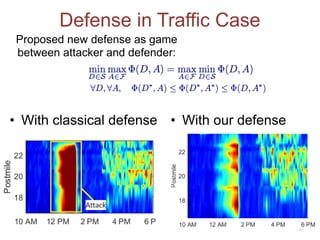
Defense in Traffic Case
• With classical defense
16
Proposed new defense as game
between attacker and defender:
• With our defense
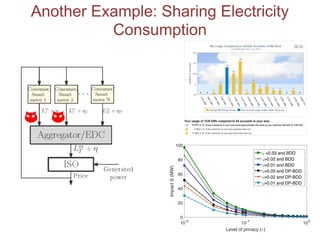
Another Example: Sharing Electricity
Consumption
17
10-2
10-1
100
Level of privacy ( )
0
20
40
60
80
100
ImpactS(MW)
=0.03 and BDD
=0.02 and BDD
=0.01 and BDD
=0.03 and DP-BDD
=0.02 and DP-BDD
=0.01 and DP-BDD
Conclusions
• Growing number of applications where we
need to provide utility, privacy, and security
• In particular, adversarial classification
under differential privacy
• Various possible extensions
• Different quantification of privacy loss
(e.g., Rényi DP)
• Adversary models (noiseless privacy), etc.
• Related work on DP and adversarial ML
• Certified robustness
18

Adversarial Classification Under Differential Privacy

  • 1.
    Adversarial Classification Under DifferentialPrivacy Jairo Giraldo University of Utah Alvaro A. Cardenas UC Santa Cruz Murat Kantarcioglu UT Dallas Jonathan Katz GMU
  • 2.
    Kevin Ashton (British entrepreneur)coined the term IoT in 1999. 2 • 20th Century: computers were brains without senses—-they only knew what we told them. • More info in the world than what people can type on keyboard • 21st century: computers sense things, e.g., GPS we take for granted in our phones
  • 3.
  • 4.
    In Addition toPrivacy, There is Another Problem: Data Trustworthiness 4
  • 5.
    Privacy Security Utility This work Privacy vs.Utility We Need to Provide 3 Properties 1. Classical Utility • Usable Statistics • Reason for data collection 2. Privacy • Protect consumer data 3. Security • Trustworthy data • Detect data poisoning • Different from classical utility because this is an adversarial setting 5
  • 6.
    DP 𝑑1 𝑑2 𝑑𝑛 Database Query Response DP DP Sensor 1 Sensor 2 Sensor3 Sensor n New Adversary Model • Consumer data protected by Differential Privacy (DP) • Classical adversary in DP is curious • Our adversary is different: data poisoning by hiding their attacks in DP noise • Global and local DP 6
  • 7.
    Adversary Goals • Intelligentlypoison the data in a way that is hard to detect (hide attack in DP noise) • Achieve maximum damage to the utility of the system (deviate estimate as much as possible) 7 max fa E[Y a ] s.t. DKL(fakf0)  fa 2 F Classical DP Attack Goals: Multi-criteria Optimization ¯Y M(D) ¯Y ⇠ f0 Attack Y a instead of ¯Y
  • 8.
    Functional Optimization Problem •We have to find a probability distribution • A probability density function • Among all possible continuous functions as long as • What is the shape of ? 8 fa Z r2⌦ fa(r)dr = 1 fa
  • 9.
    Solution: Variational Methods •Variational methods are a useful tool to find the shape of functions or the structure of matrices • They replace the function or matrix optimization problem with a parameterized perturbation of the function or matrix • We can then optimize with respect to the parameter to find the “shape” of the function/ matrix • The Lagrange multipliers give us the final parameters of the function 9
  • 10.
    Solution 10 Z r2⌦ rfa(r)dr Z r2⌦ fa(r) ln ✓ fa(r) f0(r) ◆ dr . Z r2⌦ fa(r)dr = 1. Maximize Subject to: q(r, ↵) = f⇤ a (r) + ↵p(r). Auxiliary Function Lagrangian: Solution: L(↵) = Z r2⌦ rq(r, ↵)dr + 1 0 @ Z r2⌦ q(r, ↵) ln q(r, ↵) f0(r) dr 1 A + 2 0 @ Z r2⌦ q(r, ↵)dr 1 1 A f⇤ a (y) = f0(y)e y 1 R f0(r)e r 1 dr ,where 1 is the solution to DKL(f⇤ a kf0) = .
  • 11.
    Least-Favorable Laplace Attack 11 UserID Data User 1 0.5 User 2 0.3 User 3 0.7 User 4 1 2.5 Diff. Privacy 2.3 2.2 2.7 2.4 2.4 2.9 2.8 2.6 Database Query response Possible private response Possible compromised response Aggregation f0(y) = 1 2b e |y ✓|/b f⇤ a (y) = 2 1 b2 2b2 1 e |y ✓| b + (y ✓) 1 2b2 2 1 b2 + ln(1 b2 2 1 ) = 1 is the solution to -10 -5 0 5 10 15 20 25 30 DP Aggregation 0 0.05 0.1 0.15 0.2 0.25 Probability = 0 = 0.1 = 2
  • 12.
    Example: Traffic FlowEstimation 12 -Vehicle count - Occupancy We use loop detection data from California
  • 13.
    Classical Bad DataDetection in Traffic Flow Estimation 13 Sensor Readings DP BDD BDD DP Prediction ˆyi(k + 1) = ˆyi(k) + T li ✓ li 1 li Fin i (k) Fout i (k) + Qi(yi(k) ˆyi(k)) Cabinet TMC Fout i (k)Fin i (k) Li+1 Cell i 1 Cell i Cell i + 1 i 1 = 3 Loop detector
  • 14.
    The Attack CanHide in DP Noise and Cause a Larger Impact 14 Without DP the attack is limited With DP, the attacker can lie more without detection Can we do better?
  • 15.
    Defense Against Adversarial(Adaptive) Distributions •Player 1 designs classifier D ∈ S minimize Φ(D,A) (e.g., Pr[Miss Detection] Subject to fix false alarms) -Player 1 makes the first move •Player 2 (attacker) has multiple strategies A∈ F -Makes the move after observing the move of the classifier •Player 1 wants provable performance guarantees: -Once it selects Do by minimizing Φ, it wants proof that no matter what the attacker does, Φ<m, i.e. • 15
  • 16.
    Defense in TrafficCase • With classical defense 16 Proposed new defense as game between attacker and defender: • With our defense
  • 17.
    Another Example: SharingElectricity Consumption 17 10-2 10-1 100 Level of privacy ( ) 0 20 40 60 80 100 ImpactS(MW) =0.03 and BDD =0.02 and BDD =0.01 and BDD =0.03 and DP-BDD =0.02 and DP-BDD =0.01 and DP-BDD
  • 18.
    Conclusions • Growing numberof applications where we need to provide utility, privacy, and security • In particular, adversarial classification under differential privacy • Various possible extensions • Different quantification of privacy loss (e.g., Rényi DP) • Adversary models (noiseless privacy), etc. • Related work on DP and adversarial ML • Certified robustness 18