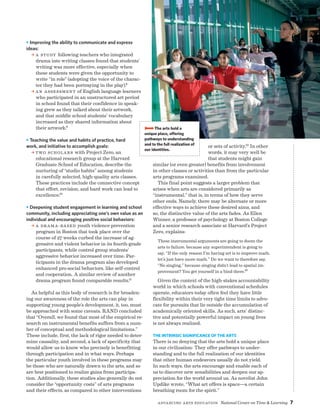

Lessons from Five Schools➻
Advancing
Arts Education
through an
Expanded
School Day
2 National Center on Time & Learning Advancing Arts Education
As children play music, as they paint or
draw or design, as they dance or act or
sing, many develop new passions, come to
express themselves in original ways, and
discover innovative pathways to success.
National Center on Time & Learning
The National Center on Time &
Learning (NCTL) is dedicated to
expanding learning time to improve
student achievement and enable a
well-rounded education. Through
research, public policy, and technical
assistance, NCTL supports national,
state, and local initiatives that add
significantly more school time to help
children meet the demands of the 21st
century and prepare for success in
college and career.
THE WALLACE FOUNDATION
The Wallace Foundation is a
national philanthropy that seeks to
improve education and enrichment
for disadvantaged children. The
foundation funds projects to test
innovative ideas for solving important
social problems, conducts research
to find out what works and what
doesn’t and to fill key knowledge
gaps—and then communicates the
results to help others.
IN appreciation
We are very grateful to the
administrators, teachers, community
partners, and students in the five
profiled schools for welcoming us into
their buildings, generously sharing
their valuable time, and demonstrating
their commitment to improving arts
education for all.
Contents
	 4	The Frame: A Study of Arts Education
	 5 	Why Arts in Schools?
	 9 	Arts Education Today	
	 10	 A National Study
	 12 	Key Findings
		
	14	 Portraits of Five Schools		
	 14 	Berkshire Arts  Technology Charter
Public School (BART)
	 22 	Clarence Edwards Middle School
	 32 	Metropolitan Arts and Technology
Charter High School (Metro)
	 42 	Cole Arts and Sciences Academy (CASA)
	 50 	Roger Williams Middle School
	
58		Lasting Impressions:
Valuing Time for the Arts
	
Advancing
Arts Education
through an
Expanded
School Day:
Lessons from Five Schools
➻
www.timeandlearning.org www.wallacefoundation.org
Prelude
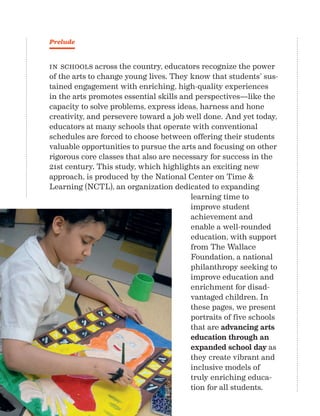
in schools across the country, educators recognize the power
of the arts to change young lives. They know that students’ sus-
tained engagement with enriching, high-quality experiences
in the arts promotes essential skills and perspectives—like the
capacity to solve problems, express ideas, harness and hone
creativity, and persevere toward a job well done. And yet today,
educators at many schools that operate with conventional
schedules are forced to choose between offering their students
valuable opportunities to pursue the arts and focusing on other
rigorous core classes that also are necessary for success in the
21st century. This study, which highlights an exciting new
approach, is produced by the National Center on Time 
Learning (NCTL), an organization dedicated to expanding
learning time to
improve student
achievement and
enable a well-rounded
education, with support
from The Wallace
Foundation, a national
philanthropy seeking to
improve education and
enrichment for disad-
vantaged children. In
these pages, we present
portraits of five schools
that are advancing arts
education through an
expanded school day as
they create vibrant and
inclusive models of
truly enriching educa-
tion for all students.
4 National Center on Time  Learning Advancing Arts Education
For young people, the arts can open up a whole new world
of possibilities. As children play music, as they paint or draw
or design, as they dance or act or sing, many develop new
passions, come to express themselves in creative ways, and
discover innovative pathways to success. Indeed, some research
evidence suggests that the skills, practices, pursuits, and habits
of mind that students gain through sustained encounters
and engagement with high-quality experiences in the arts
can promote the kind of intellectual growth that we value
throughout their school years and beyond. Moreover, creating
and learning through the arts offer children and adolescents
access to an invaluable endeavor: a means to connect
emotionally with others and deepen their understanding of the
human condition.
Yet, when it comes to instituting the arts in public education,
classes in dance, drawing, theater, and even music often hold a
fragile place. Over the last 30 years—and, in particular, during
the last decade, when there has been intense focus on achiev-
ing proficiency in reading and math above all—arts education
has occupied a shrinking place in the life of schools. The de-
cline comes as today’s educators often feel compelled to make
a choice between providing their students with instruction in
tested subjects or being able to offer a well-rounded, enriched
education that encompasses the arts. Consequently, the two
theframe:
A Study
of Arts
Education
Realizing a well-rounded education through
an expanded and redesigned school day
Advancing Arts Education National Center on Time  Learning 5
arenas of academics and the arts are often positioned
as competitors in a kind of zero-sum game, rather
than as partners in a potential educational synergy
that holds both intrinsic and instrumental benefits
for students. One of the essential questions facing
American public education, going forward, is how
to reconcile our commitment to raising academic
achievement with our simultaneous desire to make
available a wide array of learning opportunities that
will help students lead full, enriched lives as mem-
bers of their families, workplaces, communities, and
the interconnected global society.
Around the country, a growing number of schools
are finding ways to respond to this question through
the power of a redesigned and expanded school
schedule. This report presents portraits of five such
schools, whose longer student and teacher days allow
them to prioritize and expand time for arts education
as they improve overall academic instruction and
individual student results, the vision of educational
excellence laid out in the 1994 Goals 2000: Educate
America Act and re-codified in the No Child Left Be-
hind Act.1
Educators at these schools believe that the
arts can contribute appreciably to students’ capac-
ity to solve problems, acquire and apply knowledge,
deepen engagement, and develop the persistence and
dedication that are hallmarks of good scholarship
and learning. And, as they broaden students’ experi-
ences and enable them to sharpen skills in diverse
areas, these educators have imagined and imple-
mented learning environments where the arts can
reveal what education is really about—kindling in
young people the passion to learn and improve who
they are and what they can do.
The schools in this study,
each of which serves a
predominantly low-income student body, offer their
students substantially more learning time than con-
ventional schools, which operate with, on average,
just 180 six-and-a-half-hour days. Although each
of the profiled schools has come to allocate more
time and implement a specific educational model via
different paths, these expanded-time schools—and
the more than 1,000 expanded-time schools now
spread across the American educational landscape—
do share one overriding attribute. With more time,
these schools gain the potential both to improve
academics and to provide students engaging, high-
quality arts programs. As the five schools in this
study demonstrate, making available extra minutes,
hours, and days offers new possibilities to build a full
range of arts activities and courses into the curricu-
lum while still ensuring that students spend the time
they need to succeed in academics. The rewarding
result, benefiting students and educators alike, takes
shape as these schools are able to realize what is all
too uncommon in schools serving children from dis-
advantaged backgrounds—a truly well-rounded and
enriched education.
Why Arts in Schools?
Educators see two fundamental reasons to include
arts education within the curricular program of
their schools. The first reason revolves around what
is called the “instrumental value” of arts education.
When students engage with the arts, they may be
able to develop skills that facilitate and enhance
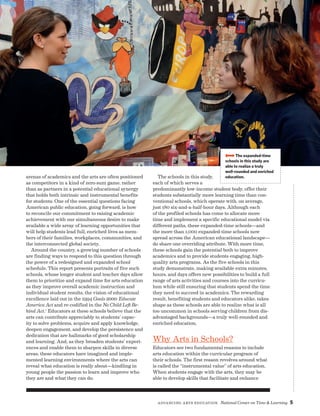
BBBBThe expanded-time
schools in this study are
able to realize a truly
well-rounded and enriched
education.
6 National Center on Time  Learning Advancing Arts Education
their learning throughout the school day and that
will benefit them throughout their lives. From im-
proving their ability to express themselves and hon-
ing their creativity, to promoting the value of hard
work in achieving certain objectives, arts education
can push children and adolescents to become more
effective students and, in the long run, can better
prepare them to navigate the challenges of the 21st
century.
The second reason for arts education speaks less
to how the arts prepare students for productive lives
and more to how the arts enable individuals, young
and old, to enhance personal engagement with our
broader society. Interaction with, and appreciation
of, the arts can sharpen and nuance our sense of
empathy, not to mention captivate our minds and
enliven our spirits. The arts offer a unique “intrinsic
value” that children deserve to access and delight in,
and schools, which have a mission to educate their
students about the wider world, hold an obligation to
furnish such essential and vital opportunities.
For educators, these two different perspectives on
the role and place of the arts as a means for attaining
our broader educational goals need not be in conflict;
indeed, a school’s commitment to robust arts educa-
tion can be strongly rooted in both its instrumental
and intrinsic significance.
The Instrumental Effects of the Arts
A body of recent research lends support to the idea
that high-quality arts education can sometimes pro-
vide opportunities to help children develop skills that
can enhance learning—whether contributing to hab-
its of persistence through careful practice; greater
awareness of how to collaborate (by preparing a play,
for example); or learning how to internalize and
apply feedback by mastering a particular skill (say,
a dance step) with the help of an instructor. Gifts of
the Muse, a 2004 study by the RAND Corporation,
notes that in the “doing” of art, students must acquire
new skills and concepts, monitor their own learning,
and recognize how feedback from others can be es-
sential to their own progress. As RAND puts it,
students “must develop the ability to know when they
understand what they learn. And feedback is key in
this context. Both elements are essential to learning
how to learn, which is perhaps the most important
instrumental benefit of arts education.”2
However, evidence for the direct impact of arts
education on student test scores is weak. There is
research—most notably, the work done by James
Catterall and colleagues of a series of analyses of na-
tional databases, which together include over 25,000
students—that finds correlations between a more
consistent study of the arts and higher achievement,
but the interpretation of these correlations is far
from clear.3 It may very well be that those inclined
to participate in the arts are the same students who
are more likely to enjoy school and seek to do well
there, regardless, or perhaps that schools with sub-
stantial opportunities in the arts are also more likely
to provide a quality education overall. Ellen Winner
and Monica Cooper (among others) point out that
uncertainty underlies these studies because the cor-
relational studies do not use rigorous experimental
designs, which means they cannot be relied on to
demonstrate causal links, especially
when it comes to academic outcomes.4 As
RAND concluded in its own assessment
of the research field, “[O]f the claimed
cognitive effects of arts participation on
children, the enhancement of learning
skills is more likely to occur than is the
enhancement of knowledge acquisition
in non-arts subjects (like the development
of mathematical skills).”5
For these reasons, many researchers
argue that, instead of employing
conventional academic metrics to
understand the possible impact of arts
education on young people, we should focus on
how the arts might enhance primary or underlying
competencies and perspectives in students that
support cognitive growth (and that then may or
may not be captured through the traditional ways
of measuring achievement in school).6 These
instrumental benefits of arts education tend to
be framed as four broad, somewhat overlapping
categories. Illustrated by one or two examples of the
more reliable research studies from the field, the
four instrumental benefits of arts education can be
described as follows:
O Encouraging problem solving through creativity, multi-
disciplinary thought, and visualization:
a A study found that students participating in a spe-
cialized program to promote visual thinking dem-
onstrated an increase in awareness of the subjec-
tive nature of interpretation, a decrease in the use
of circular reasoning, and an increase in evidential
reasoning (using evidence to support an explana-
tion or interpretation) in both arts and science.7
A Study of Arts Education
With more time, these schools can
pursue an agenda that seeks both to
improve academics and to afford students
engaging, high-quality arts programs.
Advancing Arts Education National Center on Time  Learning 7
O Improving the ability to communicate and express
ideas:
a A study following teachers who integrated
drama into writing classes found that students’
writing was more effective, especially when
these students were given the opportunity to
write “in role” (adopting the voice of the charac-
ter they had been portraying in the play).8
a aN Assessment of English language learners
who participated in an unstructured art period
in school found that their confidence in speak-
ing grew as they talked about their artwork,
and that middle school students’ vocabulary
increased as they shared information about
their artwork.9
O Teaching the value and habits of practice, hard
work, and initiative to accomplish goals:
a Two scholars with Project Zero, an
educational research group at the Harvard
Graduate School of Education, describe the
nurturing of “studio habits” among students
in carefully selected, high-quality arts classes.
These practices include the connective concept
that effort, revision, and hard work can lead to
excellence.10
O Deepening student engagement in learning and school
community, including appreciating one’s own value as an
individual and encouraging positive social behaviors:
a A drama-based youth violence prevention
program in Boston that took place over the
course of 27 weeks curbed the increase of ag-
gressive and violent behavior in its fourth-grade
participants, while control group students’
aggressive behavior increased over time. Par-
ticipants in the drama program also developed
enhanced pro-social behaviors, like self-control
and cooperation. A similar review of another
drama program found comparable results.11
As helpful as this body of research is for broaden-
ing our awareness of the role the arts can play in
supporting young people’s development, it, too, must
be approached with some caveats. RAND concluded
that “Overall, we found that most of the empirical re-
search on instrumental benefits suffers from a num-
ber of conceptual and methodological limitations.”
These include, first, the lack of rigor needed to deter-
mine causality, and second, a lack of specificity that
would allow us to know who precisely is benefitting
through participation and in what ways. Perhaps
the particular youth involved in these programs may
be those who are naturally drawn to the arts, and so
are best positioned to realize gains from participa-
tion. Additionally, these studies also generally do not
consider the “opportunity costs” of arts programs
and their effects, as compared to other interventions
or sets of activity.12 In other
words, it may very well be
that students might gain
similar (or even greater) benefits from involvement
in other classes or activities than from the particular
arts programs examined.
This final point suggests a larger problem that
arises when arts are considered primarily as
“instrumental,” that is, in terms of how they serve
other ends. Namely, there may be alternate or more
effective ways to achieve these desired aims, and
so, the distinctive value of the arts fades. As Ellen
Winner, a professor of psychology at Boston College
and a senior research associate at Harvard’s Project
Zero, explains:
These instrumental arguments are going to doom the
arts to failure, because any superintendent is going to
say, “If the only reason I’m having art is to improve math,
let’s just have more math.” Do we want to therefore say,
“No singing,” because singing didn’t lead to spatial im-
provement? You get yourself in a bind there.13
Given the context of the high-stakes accountability
world in which schools with conventional schedules
operate, educators today often feel they have little
flexibility within their very tight time limits to advo-
cate for pursuits that lie outside the accumulation of
academically oriented skills. As such, arts’ distinc-
tive and potentially powerful impact on young lives
is not always realized.
The Intrinsic Significance of the Arts
There is no denying that the arts hold a unique place
in our civilization: They offer pathways to under-
standing and to the full realization of our identities
that other human endeavors usually do not yield.
In such ways, the arts encourage and enable each of
us to discover new sensibilities and deepen our ap-
preciation for the world around us. As novelist John
Updike wrote, “What art offers is space—a certain
breathing room for the spirit.”
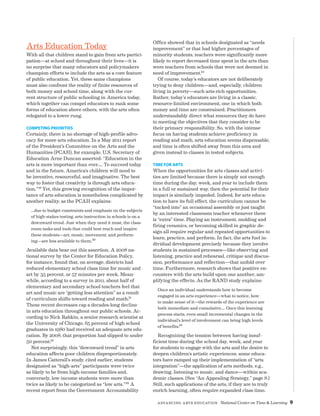
BBBBThe arts hold a
unique place, offering
pathways to understanding
and to the full realization of
our identities.
8 National Center on Time  Learning Advancing Arts Education
The President’s Committee
on Arts and the Humanities
(PCAH) identifies arts
integration as having
“unique potential as an
education reform model,”
one that involves employing
the skills and strategies
typically practiced in
the arts across different
disciplines and in ways
that seamlessly combine
arts and academic content.
Although the idea has
been around for decades,
the approach has become
increasingly formalized and
structured over the last few
years, because it seems to
hold such promise as a way
to imbue academic classes
with the sense of joy and
discovery that are inherent
to the arts, all within the
constraints of the standard
school schedule.
Examples of arts integra-
tion include observational
drawing in science class,
using music notation as part
of a lesson in fractions, and
acting out episodes from a
novel to understand their
meaning. Arts integration
is not intended to replace
the teaching of the arts for
their own sake, but rather to
incorporate artistic media
and blend creative self-
expression with core subject
matter to solve problems
and advance proficiency.
Because arts integration
as a formal approach is just
in its early phases of imple-
mentation, and because
high-quality arts integration
demands a complex mix
of content knowledge and
artistic sensibilities, teach-
ers will need significant
professional development
in order to help arts integra-
tion reach its full potential.
As the PCAH pointed out in
its 2009 report, the “pos-
sibilities for learning other
subjects through the arts
are limitless.” a
Still, edu­
cators and school adminis-
trators also must be careful
not to view arts integration
as replacing arts classes,
for, as Ellen Winner and
Lois Hetland warn, “[I]f we
become swayed by today’s
testing mentality and come
to believe that the arts are
important only (or even
primarily) because they but-
tress abilities considered
more basic than the arts,
we will unwittingly be writ-
ing the arts right out of the
curriculum.” b
a President’s Committee on the Arts
and the Humanities, Reinvesting in
Arts Education, p. 39.
b Lois Hetland and Ellen Winner,
“Cognitive Transfer from Arts Educa-
tion to Non-arts Outcomes: Research
Evidence and Policy Implications” in
E. Eisner and M. Day, eds., Handbook
on Research and Policy in Art Education
(Reston, VA: National Art Education
Association, 2004), p. 50.
An Appealing Strategy
Arts Integration
Encounters with the arts may support people in
their emotional development. Elliot Eisner, a leading
scholar of arts education, has argued, “The arts en-
able us to have experience we can have from no oth-
er source and through such experience to discover
the range and variety of what we are capable of feel-
ing.”14 Psychologist Mihaly Csikszentmihalyi, in his
study of creativity, found that artists would enthusi-
astically describe creation itself as a joyous, exciting
act, which derives fulfillment from the attainment of
excellence in a particular activity.15
A study by Project Zero maintains further that,
through the arts, individuals come to “make qualita-
tive discernments and judgments…and to actively
shape their own aesthetic environments.”16 The
arts, in other words, enable each of us to appreciate
how the details of an object, a visual representation,
or an aural experience can instill in all of us both
a concept and a perception of excellence. With this
broader understanding and insight, the arts teach us
to know the good, the beautiful, and the profound.
Especially on an emotional level, the arts also
shape our lives by intensifying connections between
and among individuals. Novelist Andrew Harrison
remarks that “A work of art is…a bridge, however
tenuous, between one mind and another.”17 That is,
as the RAND authors describe in Gifts of the Muse,
art is a “communicative experience”:
Unlike most human communication, which takes
place through formalized discourse, art communicates
through direct experience; the heart of our response is a
kind of sensing (similar to the sense of wonder we may
feel when we come across great natural beauty). This im-
mediate encounter becomes enriched by reflection upon
it: the aesthetic experience is not limited to passive spec-
tatorship—it typically stimulates curiosity, questioning,
and the search for explanation.18
As powerful as these effects may be, it is difficult
to trace exactly how these intrinsic benefits of the
arts might support students in school settings. Not
only are such areas of individual growth almost
impossible to measure on their own, their influence
on what might be considered narrower domains of
academic achievement is so intricate and nebulous
that the connections are speculative, at best. None-
theless, given the acknowledged inherent value of
the arts—their power to deepen thinking, enhance
communication, motivate, and even to transform us
as human beings—it seems only fitting that schools
should be responsible for providing these enriching
opportunities to all their students.
A Study of Arts Education
Advancing Arts Education National Center on Time  Learning 9
Arts Education Today
With all that children stand to gain from arts partici-
pation—at school and throughout their lives—it is
no surprise that many educators and policymakers
champion efforts to include the arts as a core feature
of public education. Yet, these same champions
must also confront the reality of finite resources of
both money and school time, along with the cur-
rent structure of public schooling in America today,
which together can compel educators to rank some
forms of education above others, with the arts often
relegated to a lower rung.
Competing Priorities
Certainly, there is no shortage of high-profile advo-
cacy for more arts education. In a May 2011 report
of the President’s Committee on the Arts and the
Humanities (PCAH), for example, U.S. Secretary of
Education Arne Duncan asserted: “Education in the
arts is more important than ever…. To succeed today
and in the future, America’s children will need to
be inventive, resourceful, and imaginative. The best
way to foster that creativity is through arts educa-
tion.”19 Yet, this growing recognition of the impor-
tance of arts education is nonetheless complicated by
another reality, as the PCAH explains:
…due to budget constraints and emphasis on the subjects
of high-stakes testing, arts instruction in schools is on a
downward trend. Just when they need it most, the class-
room tasks and tools that could best reach and inspire
these students—art, music, movement, and perform-
ing—are less available to them.20
Available data bear out this assertion. A 2008 na-
tional survey by the Center for Education Policy,
for instance, found that, on average, districts had
reduced elementary school class time for music and
art by 35 percent, or 57 minutes per week. Mean-
while, according to a survey in 2011, about half of
elementary and secondary school teachers feel that
art and music are “getting less attention” as a result
of curriculum shifts toward reading and math.21
These recent decreases cap a decades-long decline
in arts education throughout our public schools. Ac-
cording to Nick Rabkin, a senior research scientist at
the University of Chicago, 65 percent of high school
graduates in 1980 had received an adequate arts edu-
cation. By 2008, that proportion had slipped to under
50 percent.22
Not surprisingly, this “downward trend” in arts
education affects poor children disproportionately.
In James Catterall’s study, cited earlier, students
designated as “high-arts” participants were twice
as likely to be from high-income families and,
conversely, low-income students were more than
twice as likely to be categorized as “low arts.”23 A
recent report from the Government Accountability
Office showed that in schools designated as “needs
improvement” or that had higher percentages of
minority students, teachers were significantly more
likely to report decreased time spent in the arts than
were teachers from schools that were not deemed in
need of improvement.24
Of course, today’s educators are not deliberately
trying to deny children—and, especially, children
living in poverty—such arts-rich opportunities.
Rather, today’s educators are living in a classic,
resource-limited environment, one in which both
money and time are constrained. Practitioners
understandably direct what resources they do have
to meeting the objectives that they consider to be
their primary responsibility. So, with the intense
focus on having students achieve proficiency in
reading and math, arts education seems dispensable,
and time is often shifted away from this area and
given instead to classes in tested subjects.
Time for Arts
When the opportunities for arts classes and activi-
ties are limited because there is simply not enough
time during the day, week, and year to include them
in a full or sustained way, then the potential for their
impact is similarly impeded. Indeed, for arts educa-
tion to have its full effect, the curriculum cannot be
“tucked into” an occasional assembly or just taught
by an interested classroom teacher whenever there
is “extra” time. Playing an instrument, molding and
firing ceramics, or becoming skilled in graphic de-
sign all require regular and repeated opportunities to
learn, practice, and perform. In fact, the arts fuel in-
dividual development precisely because they involve
students in sustained processes—like observing and
listening, practice and rehearsal, critique and discus-
sion, performance and reflection—that unfold over
time. Furthermore, research shows that positive en-
counters with the arts build upon one another, am-
plifying the effects. As the RAND study explains:
Once an individual understands how to become
engaged in an arts experience—what to notice, how
to make sense of it—the rewards of the experience are
both immediate and cumulative…. Once this learning
process starts, even small incremental changes in the
individual’s level of involvement can bring high levels
of benefits.25
Recognizing the tension between having insuf-
ficient time during the school day, week, and year
for students to engage with the arts and the desire to
deepen children’s artistic experiences, some educa-
tors have ramped up their implementation of “arts
integration”—the application of arts methods, e.g.,
drawing, listening to music, and dance—within aca-
demic classes. (See “An Appealing Strategy,” page 8.)
Still, such applications of the arts, if they are to truly
enrich learning, often require expanded class time.
10 National Center on Time  Learning Advancing Arts Education
Teaching observational drawing as a part of biol-
ogy, for example, requires time to collect specimens,
learn to use a microscope, study samples of scientific
illustrations, produce drawings, and discuss what
these drawings reveal about adaptations to the sur-
rounding environment.
Yet, providing students with sufficient time to
truly participate in the arts is not simply a matter
of quantity. As a report from researchers at Project
Zero concludes, the amount of time students are
given to engage with the arts is intricately bound up
with the quality of the experience:
Virtually all of the elements of student learning and
teaching…(artistic exploration, emotional openness, the
development of a sense of ownership, and reflective prac-
tices, for example) are dependent on adequate time. This
is true, too, at the micro level—the time available within
a particular class session. The length of the session and
the plan for how much to do within that time influence
the speed and depth of the work, as well as the nature of
the interactions….26
Further, these researchers link time directly to the
powerful relationships that might develop between
teacher and students, which so often form the pivot
point upon which quality arts experiences balance:
Time also allows deeper social experiences and stronger
bonds to form among participants…. Indeed, figuring out
how to help a student takes considerable artistic and ped-
agogical experience, but it can also take time to figure
out, through interactions and experiences together, how
to approach and talk with young artists and what their
interests, standards, and ambitions might be. Time is an
essential ingredient in the soil in which artistic identity,
sophistication, and accomplishment grow.27
For these reasons, the reduction of time for arts in
our nation’s schools diminishes not only students’
opportunities to experience, engage, and practice
these endeavors, but also educators’ capacity to make
these classes and activities worthwhile.
Fortunately, not all schools are facing such time
pressures. Instead, a growing number of schools
have expanded their hours to open opportunities
for both a robust core academic curriculum and
vibrant arts programming. These schools have com-
mitted more time to the arts and, in so doing, have
increased the likelihood that these experiences are
of higher quality. As the five schools profiled in this
report demonstrate, with sufficient time, schools
can achieve a new synergy—one that enables both
strong student performance in academics and inten-
sive student engagement in the arts.
A National Study
According to the latest count from the National
Center on Time  Learning (NCTL), more than
1,000 schools across the nation feature a school
day that is at least seven hours long and a day and/
or year that is meaningfully longer than those of
surrounding public schools. These expanded-time
schools have come into being through a variety of
policy and structural mechanisms. Many are charter
schools that, with the flexibilities allowed through
their autonomous status, have crafted schedules
which more closely reflect the educational needs
of their students. Other schools have taken similar
paths by staking out autonomies, even within
centralized districts, creating recently named
“innovation districts,” in several states. Still others
have taken advantage of private or public initiatives
that deliberately fund schools to expand time. A
rapidly growing cohort of expanded-time schools
include those receiving federal dollars through
the School Improvement Grant (SIG) program,
a funding stream targeted to improve (or “turn
around”) chronically low-performing schools.
“Increased learning time” is one of several strategies
that SIG schools adopting the “Turnaround” or
“Transformation” models are required to implement.
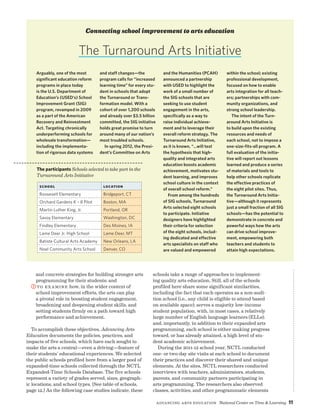
(See “The Turnaround Arts Initiative,” page 11.) As
a result, an increasing number of educators around
the country have come to appreciate the value of
more school time.
Now, with support from The Wallace Foundation,
NCTL has conducted this qualitative research study,
exploring five schools where educators are leverag-
ing an expanded school schedule to realize their
aspirations and commitments to deliver a quality
arts program to their students. The
purpose of this study is three-fold:
1 To describe how these
schools are making the most of
nontraditional, expanded-time
schedules to activate and embed
the arts throughout their educa-
tional programs;
2 To identify the common com-
ponents of these diverse schools’
curricula, programs, and pro-
cesses so that practitioners at other
schools can draw both inspiration
A Study of Arts Education
The amount of time students are given to
engage with the arts is intricately bound
up with the quality of the experience.
Advancing Arts Education National Center on Time  Learning 11
Arguably, one of the most
significant education reform
programs in place today
is the U.S. Department of
Education’s (USED’s) School
Improvement Grant (SIG)
program, revamped in 2009
as a part of the American
Recovery and Reinvestment
Act. Targeting chronically
underperforming schools for
wholesale transformation—
including the implementa-
tion of rigorous data systems
and staff changes—the
program calls for “increased
learning time” for every stu-
dent in schools that adopt
the Turnaround or Trans-
formation model. With a
cohort of over 1,200 schools
and already over $3.5 billion
committed, the SIG initiative
holds great promise to turn
around many of our nation’s
most troubled schools.
In spring 2012, the Presi-
dent’s Committee on Arts
and the Humanities (PCAH)
announced a partnership
with USED to highlight the
work of a small number of
the SIG schools that are
seeking to use student
engagement in the arts,
specifically as a way to
raise individual achieve-
ment and to leverage their
overall reform strategy. The
Turnaround Arts Initiative,
as it is known, “…will test
the hypothesis that high-
quality and integrated arts
education boosts academic
achievement, motivates stu-
dent learning, and improves
school culture in the context
of overall school reform.”
From among the hundreds
of SIG schools, Turnaround
Arts selected eight schools
to participate. Initiative
designers have highlighted
their criteria for selection
of the eight schools, includ-
ing dedicated and effective
arts specialists on staff who
are valued and empowered
within the school; existing
professional development,
focused on how to enable
arts integration for all teach-
ers; partnerships with com-
munity organizations, and
strong school leadership.
The intent of the Turn-
around Arts Initiative is
to build upon the existing
resources and needs of
each school, not to impose a
one-size-fits-all program. A
full evaluation of the initia-
tive will report out lessons
learned and produce a series
of materials and tools to
help other schools replicate
the effective practices of
the eight pilot sites. Thus,
the Turnaround Arts Initia-
tive—although it represents
just a small fraction of all SIG
schools—has the potential to
demonstrate in concrete and
powerful ways how the arts
can drive school improve-
ment, empowering both
teachers and students to
attain high expectations.
The Turnaround Arts Initiative
Connecting school improvement to arts education
School Location
Roosevelt Elementary Bridgeport, CT
Orchard Gardens K – 8 Pilot Boston, MA
Martin Luther King, Jr. Portland, OR
Savoy Elementary Washington, DC
Findley Elementary Des Moines, IA
Lame Deer Jr. High School Lame Deer, MT
Batiste Cultural Arts Academy New Orleans, LA
Noel Community Arts School Denver, CO
The participants Schools selected to take part in the
Turnaround Arts Initiative
and concrete strategies for building stronger arts
programming for their students; and
3 To examine how, in the wider context of
school improvement efforts, the arts can play
a pivotal role in boosting student engagement,
broadening and deepening student skills, and
setting students firmly on a path toward high
performance and achievement.
To accomplish these objectives, Advancing Arts
Education documents the policies, practices, and
impacts of five schools, which have each sought to
make the arts a central—even a driving—feature of
their students’ educational experiences. We selected
the public schools profiled here from a larger pool of
expanded-time schools collected through the NCTL
Expanded-Time Schools Database. The five schools
represent a variety of grades served, sizes, geograph-
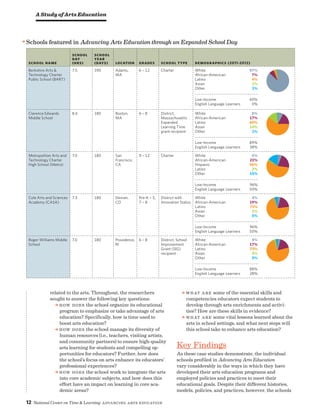
ic locations, and school types. (See table of schools,
page 12.) As the following case studies indicate, these
schools take a range of approaches to implement-
ing quality arts education. Still, all of the schools
profiled here share some significant similarities,
including the fact that each operates as a non-audi-
tion school (i.e., any child is eligible to attend based
on available space); serves a majority low-income
student population, with, in most cases, a relatively
large number of English language learners (ELLs);
and, importantly, in addition to their expanded arts
programming, each school is either making progress
toward, or has already attained, a high level of stu-
dent academic achievement.
During the 2011-12 school year, NCTL conducted
one- or two-day site visits at each school to document
their practices and discover their shared and unique
elements. At the sites, NCTL researchers conducted
interviews with teachers, administrators, students,
parents, and community partners participating in
arts programming. The researchers also observed
classes, activities, and other programmatic elements
12 National Center on Time  Learning Advancing Arts Education
related to the arts. Throughout, the researchers
sought to answer the following key questions:
a How does the school organize its educational
program to emphasize or take advantage of arts
education? Specifically, how is time used to
boost arts education?
a How does the school manage its diversity of
human resources (i.e., teachers, visiting artists,
and community partners) to ensure high-quality
arts learning for students and compelling op-
portunities for educators? Further, how does
the school’s focus on arts enhance its educators’
professional experiences?
a How does the school work to integrate the arts
into core academic subjects, and how does this
effort have an impact on learning in core aca-
demic areas?
a What are some of the essential skills and
competencies educators expect students to
develop through arts enrichments and activi-
ties? How are these skills in evidence?
a What are some vital lessons learned about the
arts in school settings, and what next steps will
this school take to enhance arts education?
Key Findings
As these case studies demonstrate, the individual
schools profiled in Advancing Arts Education
vary considerably in the ways in which they have
developed their arts education programs and
employed policies and practices to meet their
educational goals. Despite their different histories,
models, policies, and practices, however, the schools
SCHOOL NAME
School
day
(hrs)
school
year
(days) LOCATION GRADES SCHOOL TYPE DEMOGRAPHICS (2011-2012)
Berkshire Arts 
Technology Charter
Public School (BART)
7.5 190 Adams,
MA
6 – 12 Charter White	 87%
African-American	 7%
Latino	 4%
Asian	 1%
Other	 1%
87+7+4+1+1Low-Income	60%
English Language Learners 	0%
Clarence Edwards
Middle School
8.6 180 Boston,
MA
6 – 8 District,
Massachusetts
Expanded
Learning Time
grant recipient
White	 8%
African-American	 17%
Latino	 60%
Asian	 14%
Other	 1%
8+17+60+14+1Low-Income	89%
English Language Learners	38%
Metropolitan Arts and
Technology Charter
High School (Metro)
7.0 180 San
Francisco,
CA
9 – 12 Charter White	 6%
African-American	 21%
Hispanic	 56%
Latino	 2%
Other	 15%
6+21+56+2+15Low-Income	96%
English Language Learners	50%
Cole Arts and Sciences
Academy (CASA)
7.3 180 Denver,
CO
Pre-K – 5,
7 – 8
District with
Innovation Status
White	 4%
African-American	 19%
Latino	 71%
Asian	 1%
Other	 5%
4+19+71+1+5Low-Income	96%
English Language Learners	50%
Roger Williams Middle
School
7.0 180 Providence,
RI
6 – 8 District, School
Improvement
Grant (SIG)
recipient
White	 4%
African-American	 17%
Latino	 73%
Asian	 3%
Other	 3%
4+17+73+3+3Low-Income	88%
English Language Learners 	28%
A Study of Arts Education
a Schools featured in Advancing Arts Education through an Expanded School Day
Advancing Arts Education National Center on Time  Learning 13
share three essential approaches to arts education.
These approaches, designed to ensure maximum
engagement and impact, can be described as follows:
1 Educators at the five schools consider arts classes
to be a core feature of their comprehensive educational
program.
a The arts are not considered “extras,” and
teachers and specialists in the arts (including
visual arts, music, drama, and dance) set high
expectations for student performance.
a Appreciating the pivotal role the arts can
play in student engagement and success, teach-
ers seek opportunities to integrate arts education
into academic classes.
a Communicating the importance of excelling
in the arts, educators value how these experienc-
es help to develop in students the skills they need
for school and lifelong success (e.g., persistence,
problem solving, etc.).
2 Educators at these schools organize their school day
and staffing to reflect the central role of the arts and
dedicate ample time to their practice.
a Because they will not gain sufficiently from
only intermittent participation in arts education,
students participate in at least one hour daily of
arts-specific classes.
a For both philosophical and practical purposes,
all students are required to participate in arts
classes. In turn, these classes, unlike some en-
richment programs in traditional schools, will
not be taken away from students because of poor
academic or behavioral performance in other
courses.
a To ensure high-quality arts education, schools
hire arts “specialists,” or arts teachers, who are
both talented artists and effective educators.
a Arts specialists are held to the same high
performance expectations as faculty members
who teach other core courses, including under-
going the same evaluation process and meeting
the same requirements to submit lesson plans to
administrators for review.
a To support and supplement their arts pro-
gramming, schools bring in staff from museums,
cultural institutions, and other community part-
ner organizations, along with individual teaching
artists; these external arts educators are held to
the same expectations for high-quality instruc-
tion as are all school faculty.
3 These educators value how the arts can leverage
engagement and achievement in school.
a Acting on a deep appreciation that engagement
with the arts can enable children to discover their
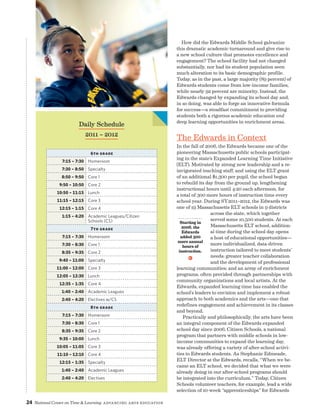
passions, these educators build in multiple oppor-
tunities for choice within their arts programs.
a These schools offer a wide variety of arts
activities and classes so that each student can ex-
periment with, and pursue a number of different
forms of, art—from visual and performing arts to
multimedia and design projects.
a The educators in these schools—especially
those serving older students—emphasize the
development of artistic skills over time, so that
students’ interests and passions can result in real
proficiency in a particular art form.
a As students develop a broader array of skills
through their engagements with various forms of
art classes and activities (e.g., music appreciation,
complex drawing, etc.), academic teachers intro-
duce content in new ways that tap their students’
proficiencies and sensibilities.
Finally, one overarching theme emerges
from our study: More time allows educators to
reconcile the tension between strong academics and
a well-rounded education. Like all public schools, the
five profiled in this report operate in an environment
that measures their effectiveness primarily through
proficiency rates on state assessments. Nevertheless,
the leaders of these schools do not feel that they
have to forgo time spent on arts education in order to
ensure that their students meet prescribed achieve-
ment targets. Certainly, these school leaders have
had to make some challenging choices about how to
structure their school’s time, but these choices are not
considered in an “either/or framework.” Rather, with
more time, the educators find a win-win scenario—
one where they simultaneously pursue the goals of
strong academics and enriched education through
the arts.
We have arranged the five case studies that fol-
low to start with the schools that have had their
expanded-time model in place the greatest number of
years—up to a decade—and end with the school that
is now in its third year of operating with a longer day.
Not coincidentally, this order also reflects the approx-
imate degree of development of these schools’ arts
programs. Each case study follows the same basic
four-part outline: (a) an introduction providing some
historical and cultural context; (b) a description and
analysis of why and how the school commits to arts
education, in which echoes of both the instrumental
and the intrinsic significance of the arts resound;
(c) details explaining how the school leverages its
available time, striving for maximal effect; and (d) a
brief discussion of where the school has identified ar-
eas for improvement and growth. Following the case
studies, this report’s final chapter explores in greater
depth the cross-cutting findings described above,
with the goal of helping both educators and policy-
makers take meaningful steps toward leveraging
the movement and opportunities of expanded school
time to bring arts education to its full potential.
14 National Center on Time  Learning Advancing Arts Education
CASE1 Berkshire Arts  Technology Charter Public School (BART)
❝I had never
met classroom
teachers with
that kind of
commitment
to the arts
as a way of
knowing. Right
away, I knew I
could balance
my life as an
artist and as a
teacher there.”
Curtis Asch,
Sixth-grade math
teacher at BART,
poet, and perform-
ing artist
Buildinga
Bridgebetween
Artsandthe
Community
Focusing on arts to drive student
mastery and a deep dedication to learning
Berkshire Arts  Technology Charter
Public School (BART) serves grades 6 – 12 and
seeks to prepare students for college by promoting
a mastery of arts and technology, as well as of
academic subjects. With its core belief in the
Aristotelian principle that “Excellence is a habit,” the
school pushes its students to develop the distinctive
combination of creativity and effort that yields the
highest results. And because achieving this degree
of mastery takes considerable time, as well as effort,
BART relies on an expanded school day and year to
help ensure that the arts play a central, rather than
just a marginal, role in achieving that excellence.
Over the last few years, BART has consistently
ranked as one of the highest-performing schools in
the state, but it was not always so. In its early years—
the school was founded in 2004—BART educators
Adams, Massachusetts
Advancing Arts Education National Center on Time  Learning 15
confronted the reality that their intentions to try
to build a new kind of school that would promote
high achievement, while also engaging students in
inquiry-based learning, had fallen flat. Student pro-
ficiency at BART was unacceptably low. Rather than
throw up their hands in despair, however, the educa-
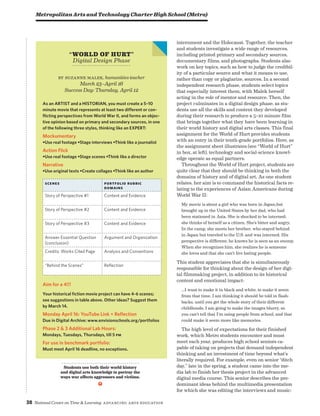
tors at the school worked to fully revamp both their
model and instructional methods. With a renewed
commitment to providing an excellent academic
education wrapped in the context of developing
21st-century skills—including creativity, teamwork,
and problem solving—BART now stands as a model
of how a focus on arts can drive student mastery and
a deep dedication to learning.
BART in Context
BART is located in a former small business center,
built as part of the endeavor to revitalize downtown
Adams, Massachusetts. With its long history as a
mill town, Adams was once filled with shoe manu-
facturers, brickyards, sawmills, cabinetmakers, and
small machine shops. When the mills shuttered,
residents hoped that either consumer electronics or
the region’s long history as home to craftspeople and
artists would provide new streams of income. But
growth has been slow. In 2010, one in six young peo-
ple was living beneath the poverty line in Adams,
and the median household income hovered at half
the average for the state.
Against this background, BART was designed
to be a “bridge” institution. Its students represent
the link between an older Adams—where their
grandparents and parents had held, and then lost,
dependable, living-wage jobs in manufacturing—and
a new Adams that harbors both the human capacity
and the environment of innovation to incubate start-
up companies and vital cultural organizations. For
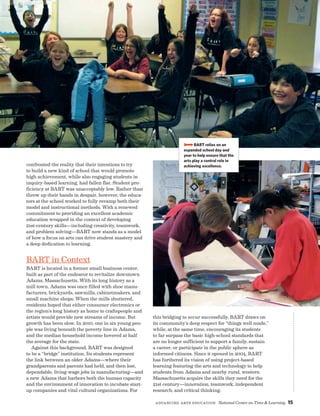
BBBBBART relies on an
expanded school day and
year to help ensure that the
arts play a central role in
achieving excellence.
this bridging to occur successfully, BART draws on
its community’s deep respect for “things well made,”
while, at the same time, encouraging its students
to far surpass the basic high-school standards that
are no longer sufficient to support a family, sustain
a career, or participate in the public sphere as
informed citizens. Since it opened in 2004, BART
has furthered its vision of using project-based
learning featuring the arts and technology to help
students from Adams and nearby rural, western
Massachusetts acquire the skills they need for the
21st century—innovation, teamwork, independent
research, and critical thinking.
16 National Center on Time  Learning Advancing Arts Education
educators to view the arts as central
to their efforts—a kind of conduit
through which to revitalize and re-
engage. As Julia Bowen, Executive
Director of BART, explains:
We looked at the young people we
wanted to serve and realized that if we
stuck with a standard curriculum, few of
them would be able to take advantage of
the opportunities that were percolating
in the region—technology start-ups, tele-
commuting for entrepreneurial firms in
Boston and New York, and the arts or the
cultural organizations that populate the
Berkshires. If our students were going
to design for Apple from their desktops
in Adams, we had to look at an arts-rich
curriculum. Creativity had to permeate
our teaching; learning was going to have
to be a more collaborative experience;
and students were going to have to learn
to communicate orally and visually.
With this vision as their foundation,
BART’s faculty and administration
then built an educational program
to help realize this understanding of
the school’s potential impact.
Inquiry-Based Learning
Very simply, BART runs on inquiry—a cross-disci-
plinary, project-based approach to developing skills
and knowledge at once. BART teachers know that to
become researchers and original thinkers, their stu-
dents will need the capacity to apply, not just operate,
technology—such as understanding the different
proficiencies needed to diagnose and treat a patient,
developing energy legislation, or designing afford-
able housing. These teachers want their students to
read and communicate visually, interrogate maps,
query databases, and explore documents.
J. P. Henkle’s technology classes offer a good ex-
ample. There, students don’t just learn software pro-
grams for their own sake, spending valuable hours
on software drills or raw keyboarding skills. Instead,
Henkle gives assignments that demand these skills,
wrapped inside a larger, inquiry-based project that
is also rooted in the development of artistic sensibili-
ties. For instance, while learning to use digital cam-
eras and work in Photoshop, students are asked to
explore two questions:
a Where is there beauty in nature?
a Is there beauty in the man-made world?
Their answers take the form of large hallway
displays of student photographs of the surrounding
Berkshire Hills landscape and of the crafted and
manufactured world. This same commitment to
inquiry is evident not only in its specialized classes,
BART Charter Public School
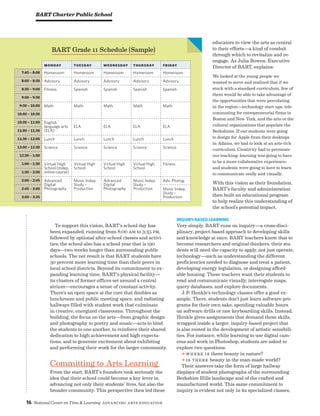
To support this vision, BART’s school day has
been expanded, running from 8:00 am to 3:35 pm,
followed by optional after-school classes and activi-
ties; the school also has a school year that is 190
days—two weeks longer than surrounding public
schools. The net result is that BART students have
30 percent more learning time than their peers in
local school districts. Beyond its commitment to ex-
panding learning time, BART’s physical facility—
its clusters of former offices set around a central
atrium—encourages a sense of constant activity.
There’s an open space at the core that doubles as
lunchroom and public meeting space, and radiating
hallways filled with student work that culminate
in creative, energized classrooms. Throughout the
building, the focus on the arts—from graphic design
and photography to poetry and music—acts to bind
the students to one another, to reinforce their shared
dedication to high achievement and high expecta-
tions, and to generate excitement about exhibiting
and performing their work for the larger community.
Committing to Arts Learning
From the start, BART’s founders took seriously the
idea that their school could become a key lever in
advancing not only their students’ lives, but also the
broader community. This perspective then led these
Monday Tuesday Wednesday Thursday Friday
7:45 – 8:00 Homeroom Homeroom Homeroom Homeroom Homeroom
8:00 – 8:30 Advisory Advisory Advisory Advisory Advisory
8:30 – 9:00 Fitness Spanish Spanish Spanish Spanish
9:00 – 9:30
9:30 – 10:00 Math Math Math Math Math
10:00 – 10:30
10:30 – 11:00 English
language arts
(ELA)
ELA ELA ELA ELA
11:00 – 11:30
11:30 – 12:00 Lunch Lunch Lunch Lunch Lunch
12:00 – 12:30 Science Science Science Science Science
12:30 – 1:00
1:00 – 1:30 Virtual High
School (Indep.
online course)
Virtual High
School
Virtual High
School
Virtual High
School
Fitness
1:30 – 2:00
2:00 – 2:45 Advanced
Digital
Photography
Music Indep.
Study –
Production
Advanced
Digital
Photography
Music Indep.
Study –
Production
Adv. Photog.
2:45 – 3:00 Music Indep.
Study –
Production3:00 – 3:35
BART Grade 11 Schedule (Sample)
but also in BART’s more traditional academic
courses. For example, in a sixth-grade math class,
students made videos, in which they “performed”
geometric concepts like symmetry and rotation,
against the grid of tiles in the school’s atrium, film-
ing from the school’s second-floor balcony.
Of particular note, BART secured funding from
the National Endowment for the Arts for a multi-
year project called “Asking Big Questions.” During
the 2011–12 school year, each eighth and eleventh
grader selected a local building or parcel of land
and researched its history and uses over the last
250 years. As part of the project, every student is
developing a set of investigative strategies matched
to their building or parcel. In the fall, students be-
gan learning from visiting historians, architects,
and librarians about how to unearth the history of
particular places. They are learning to “read” the
implications of deeds, maps, and old photographs. By
pooling their findings in the second semester, each
class then develops a deeper understanding of the
history of the larger community of Adams and the
surrounding region.
At the heart of the project stands an effort to en-
gage young people in pursuing original questions
by tapping both their digital-arts and humanities
skills. For BART students, their inquiries have led to
learning the region’s history, and also, because these
projects are given the time they need to develop fully,
multiple opportunities to reflect on their own capaci-
ties as researchers and learners. An eighth grader
describes the process:
I’m researching a farm near my house where I always
played in the fields and the woods growing up. I was
always curious about what it must have been like when
it was a real farm. To find out what I wanted to know, I
interviewed a woman, now in her nineties, who is the
last living person to reside there. I also looked up old
maps and realized how big the farm used to be.
I walked all over the farmland. That’s how I
discovered the heap of bricks that is now almost
grown over, which was the original brickyard
that made the bricks for the house. Doing this,
I realized what kind of an investigator I am. I
like doing things, like walking over the land,
to satisfy my curiosity and to get a feel for how
things are.
The process also works in what might
be considered more traditional arts classes,
where students are pushed to engage with
content in ways that tap problem-solving
skills. Consider the class of Erin Milne, a
former music teacher at BART and now an
administrator and planner at the school, who
set out to prove that composing music is not
a rare talent, but a universal form of human
communication that is open to anyone who
makes the effort. In her foundations class, which
she taught to all sixth graders, Milne introduced her
students to world music, using the program “Garage
Band” to help them analyze the music of different
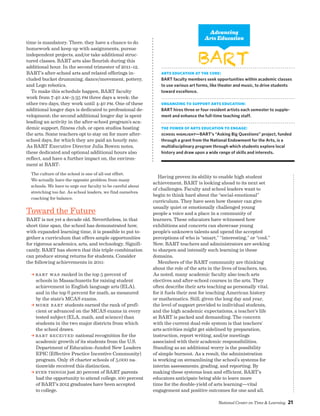
cultures. For the culmination of the course, Milne
designed an exploration of classical Indian music, in-
viting students to work both individually—in “studio
style”—and in small groups to develop their pieces.
Reflecting on this project, Milne remarked, “Every-
one composed a raga. No one quit or failed. I think
this demonstrates a key commitment at BART: The
arts are languages that, with effort and engagement,
everyone can learn how to ‘speak’ well.” (See box,
page 18, for “Indian Composition Assignment.”)
Many BART teachers attest to the critical role
that the arts play in making the case that effort can
lead to excellence. This link is particularly strong for
students who face major challenges to their achieve-
ment and progress, either because of the lack of
preparation they received in prior schools or because
they have special needs. By helping them to develop
an academic identity and to see themselves as people
with experiences and ideas worth communicating,
the arts enable these students to gain courage and
self-awareness. Anna Bean, a BART high school
English language arts (ELA) teacher, recounts one
such story:
I have a student who is diagnosed with ADD and au-
tism. His sometimes aggressive persona is not always
appropriate during the school day. But in drama class,
I give him roles that tap into his rare ability to say and
act upon what he feels. His last role was as Pozzo, the
whip-snapping, slave-driving master that Estragon and
Vladmir encounter in [the play] Waiting for Godot. My
student scared us all to death, which is exactly what the
character must do. And by venting appropriately during
the scene, he was calmer afterward, almost to the point
of being serene.
BBBB For many BART students, the arts provide the
vehicles through which they come to strive for excellence.
18 National Center on Time  Learning Advancing Arts Education
For many BART students, then, the arts provide the
vehicles through which they come to understand
and strive for excellence and the media that enable
them to express themselves with conviction.
Staffing for the Arts
BART has a corps of highly talented individuals who
work with students as they participate in the arts.
The school’s full-time faculty includes choral music
and visual art teachers who provide core instruction.
Additionally, BART budgets annually for three or
four artists-in-residence who extend, particularly
at the high school level, the variety and sequence of
arts offerings the school can provide, including in
digital photography and creative writing.
BART educators also have found ways to think
creatively about part-time and composite positions to
support an arts-rich curriculum.
One of the English language arts
teachers, for example, works
three-quarters time in ELA and
one-quarter in drama. Mean-
while, the technology teacher
who maintains many of the
digital arts projects spends half
his time in the classroom and
half as IT director for the whole
school. In addition to being cost-effective, this prac-
tice enables many BART teachers to achieve balance
in their educational and artistic lives. For instance,
Curtis Asch, the sixth-grade mathematics teacher
who also offers slam poetry and writing for film
courses in the after-school program, notes: “I moved
back to the Berkshires and then into classroom
teaching at BART because living here and working
at the school allowed me to be an educator, a work-
ing artist, and a father all at once, without feeling
like I was skimping on any of those roles.” Not insig-
nificantly, such arrangements also offer students an
understanding of the role that the arts can play in an
adult’s full life, whether that person is a professional
artist or a teacher with a creative side.
Still, BART administration and faculty realize that
the school’s emphasis on the arts and technology
itself must be balanced with the wide range of skills
that young people also need to experience success in
school and beyond. Projects like “Asking Big Ques-
tions” require skilled reading, close reasoning, and
clear writing. Similarly, projects in math and science
require calculation, number sense, and measure-
ment. The arts and technology teaching positions,
therefore, have important complements in a reading
coach, a mathematics tutor, special education roles at
both the middle- and high-school levels, and a direc-
tor of instructional logistics (who designs and imple-
ments the school’s internal and external assessments,
including time for teachers to reflect on the implica-
tions of results for instruction). In short, BART is
BART Charter Public School
Indian Composition
Assignment
By Erin Milne, (former) music teacher
In class this week, you will use Garage Band to compose
a piece of music in the style of a piece of classical music
from India. Follow the steps below:
1 Open the starter file from Courses:
• This file already contains the beginning of a drone
part.
• BEFORE YOU DO ANYTHING, immediately save this
file as Last name_India.band in your documents folder.
2 Expand the drone tracks so they last for the
entire piece:
• You may have to go back and adjust the length of the
drones as you write the piece.
• Let the drone play by itself for the first 10 or so sec-
onds of the piece.
3 Select and record your raga:
• Begin on any white key on the keyboard, and go up the
next seven.
• Play around to find one you like that works with the
drone.
• Your piece should start with about 30 seconds of
slowly going up and down your raga.
• You may use any instrument you like; there is no sitar
patch on Garage Band.
4 Add a tala part using loops:
• These should start about 40 seconds into the piece.
• They should start off simple and repeating at the be-
ginning—use one and stick with it for a while before
you change it.
• Loop ideas: Bongo Groove, Ceramic Drum, Conga
Groove, Dumbek Beat, Indian Tabla—all of these will
work well.
5 Make the raga part and the tala part more complicated
and faster:
• Use loops to make your raga more interesting. Sugges-
tions: Exotic Sarod, Middle Eastern Oud
• Add more or different drum parts.
• Add more instruments. Suggestion: Medieval Flute
(close to a venu)
6 Go back and make sure all the elements of your piece
work well and sound good together. As long as your
piece follows this format, it does not have to sound
“Indian.” See the rubric on the back to know how you
will be graded. Remember to save your work often, on
your own student account. Have fun!
bbbb At BART,
making music
is considered
not a rare
talent, but a
form of human
communication
open to all.
Advancing Arts Education National Center on Time  Learning 19
like a well-made watch, where every part is
carefully crafted and connects to every other
part—curriculum design, schedule, staffing,
and funding are all vital, interlocking, integral
components of the whole.
Connecting Students to the Wider World
BART faculty members are keenly aware
that as their students grow up in a small town
situated in the midst of a rural area, they
sometimes doubt that they can make it in the
larger, “outside” world and may limit their
expectations prematurely. Erin Milne, the former
music teacher (and now administrator), provides an
example of how the arts have linked her students to
rising expectations and to additional opportunities to
learn. She recalls:
A number of my choral students wanted to try out for
the regional choir. They came back from those tryouts
shocked by how poorly they thought they did in the
sight-reading portion. So we decided to add that to our
practices. Every week, I built in a sight-reading exercise,
with [the exercises] getting harder and harder over time.
The students grew as they practiced and tried out again,
a number of them successfully. Now, they’re singing
with that bigger choir, which I think is great for students
who aren’t attending their local high school. It puts
them in the mix.
Arts-based field trips take students out of class-
rooms and into the community, helping them to de-
velop a sense that they can and will be fully capable
adults and citizens. ELA teacher Anna Bean tells of
taking her students to see a production of the play
“Urinetown” at the Massachusetts College of Liberal
Arts (MCLA). She describes the impact:
They absolutely loved the musical, which was well done
and featured a talk back with the [MCLA] students, di-
rector, and designer. For weeks afterward, I heard from
students how it was the best theater they had seen….
The best takeaway from the experience is that they saw
students who hailed from the same towns as they did
producing high-quality work.
Using Time Well
From its inception, BART had a longer school day
(from 8:00 am until 3:35 pm) and a longer school
year (by two weeks), enabling its students more time
for academic mastery and the integration of arts into
the curriculum. Even though BART administration
and faculty had designed their daily and weekly
schedules carefully and had thought hard about how
a small charter school staffs such an ambitious pro-
gram, they did not immediately achieve their aims.
It took an all-out effort to “reset” their model before
they could maximize the time dedicated to their
school’s full, enriched program.
BART is like a well-made watch,
where every part is carefully crafted
and connects to every other part.
Taking Stock, Making Adjustments
BART’s early results from the Massachusetts Com-
prehensive Assessment System (MCAS) tests were
sobering: Students underperformed when com-
pared to state averages and even when compared
with schools in similar communities. At that point,
BART’s arts-enriched curriculum and expanded
learning time were not yielding the measurable dif-
ference that the school had sought.
And so, BART’s leaders and faculty rethought their
fundamental assumptions about the ways in which
their curriculum was being implemented. They re-
alized that the projects and expectations they had
designed assumed a mastery of basic skills and a set
of learner behaviors that many of their incoming
students had never had the opportunity to develop
during their elementary school years. Moreover, the
educators recognized that the level of arts integration
they had envisioned was not possible, if the school
was to help students to attain academic proficiency
while also developing their higher-order thinking in
various disciplines through targeted use of the arts.
With this new insight and understanding, BART
faculty went back to the drawing board and rede-
signed every major aspect of the school’s functioning
to strengthen fundamental academic instruction
without losing the school’s commitment to the arts
and technology. Their rethinking—centered on a
shared determination to use school time wisely and
well—yielded transformative, school-wide results.
The five components of the redesign include:
a Restructuring the school day to incorporate
multiple blocks of independent learning time
(ILT) that allow for tailor-made tutoring and/or
independent work designed to meet each stu-
dent’s talents and interests;
a having BART’s full-time arts faculty teach the
core curriculum to middle school students and
advanced projects through high school electives,
and hiring visiting artists to teach additional
classes to augment the overall arts offerings at
the school;
a Initiating teacher-developed projects
within academic disciplines that combine higher-
order thinking and creative learning;
20 National Center on Time  Learning
a Establishing an after-school program, rich
in arts activities, that gives students and faculty
additional opportunities to pursue and teach
their artistic passions in another setting; and
a Offering three to four annual artist residen-
cies, raising the school-wide investment in the
arts to a new level.
Together, these new structures and programs,
along with the hires and residencies, have produced
a more intentional and flexible schedule and calen-
dar at BART. Principal Ben Klompus explains that
BART’s continued success since this restructuring
took hold is attributable, at least in part, to a con-
scious cultural shift in the way that everyone at the
school now values time. He says:
We work very hard to teach that time is a valuable
and limited resource. Every minute should
matter. This is the way the faculty works and
the school works. As faculty, we make time for
targeted assessments that we study in order
to know what to assign for individual students
and whole classes. We think hard about the de-
sign of each trimester and the whole year.
This considerable regard for time as a
resource is evident throughout the school,
down to the smallest details. For example,
in each class, students get an overview of
the purposes and goals of their assignments
that week, providing them with the build-
ing blocks to complete larger projects. Then,
within each class, teachers make and share
plans for how they will use every minute of
the full period.
A Day at BART
At BART, each day is a succession
of 90-minute blocks, across its
7.5-hour day. The blocks rotate
daily, so that no one class always
gets the benefit of morning energy
or is made to suffer through after-
lunch slumps. Each day contains
a block devoted to independent
learning time (ILT) that is carefully
used to meet individual students’
learning needs (e.g., tutoring in
math, extra writing time for a
history research paper, a group
collaboration in biology, or an
independent animé project).
All BART middle school students
have a rotation of visual arts, mu-
sic, and technology classes, which
guarantees that learners have the
fundamentals in each arts area,
irrespective of their individual aca-
demic schedules. So, for example,
even though an eighth grader might be taking ad-
ditional support classes in math, she also would still
have music for 150 minutes a week.
For high school students, the BART school sched-
ule includes electives in arts and technology (rather
than required foundational courses) that rotate
across the school’s trimesters. By engaging school
faculty along with visiting artists, BART can provide
a wide variety of classes that allow older students to
pursue their arts interests in depth.
BART’s school schedule does not end when the
final bell rings each afternoon. The after-school pro-
gram, taught by faculty and by local teaching artists,
runs until 4:30. (About one-third of students par-
ticipate in the after-school program at any one time,
and almost all students end up participating during
the year.) For students who need support, this extra
Fall 2011 Electives
Drama 121:
Intro to Acting
Tech 141:
Communicating with
Technology
Creative Writing 152
Poetry, Rap  Spoken
Word
Art 211:
Drawing I
Music 231:
Music Listening 
Appreciation
Music 234:
Chorus
Art 441:
AP Studio Art 2-D
Winter 2012 Electives
Music 131:
Intro to Music
Notation 
Composition
Creative Writing 151:
Intro to Creative
Writing
Art 212:
Painting I
Art 218:
Exploring Theme
Drama 221:
Intro to Directing
Technology 341:
Advanced Digital
Photography
Art 441:
AP Studio Art 2-D
Spring 2012 Electives
Art 111:
Fundamentals of
Design  Color
Drama 225:
An Evening of One-
Acts by David Ives
Music 234:
Chorus
Music 235:
Intro to Music
Notation
Technology 241:
Intro to Digital Media
Creative Writing
255:
From Script to Screen
Art 411:
AP Studio Art
BART offers students a rich selection of electives in the arts:
x
BART Charter Public School
National Center on Time  Learning 21
time is mandatory. There, they have a chance to do
homework and keep up with assignments, pursue
independent projects, and/or take additional struc-
tured classes. BART arts also flourish during this
additional hour. In the second trimester of 2011–12,
BART’s after-school arts and related offerings in-
cluded bucket drumming, dance/movement, pottery,
and Lego robotics.
To make this schedule happen, BART faculty
work from 7:40 am–3:35 pm three days a week; the
other two days, they work until 4:40 pm. One of these
additional longer days is dedicated to professional de-
velopment; the second additional longer day is spent
leading an activity in the after-school program’s aca-
demic support, fitness club, or open studios hosting
the arts. Some teachers opt to stay on for more after-
school days, for which they are paid an hourly rate.
As BART Executive Director Julia Bowen notes,
these dedicated and optional additional hours also
reflect, and have a further impact on, the environ-
ment at BART:
The culture of the school is one of all-out effort.
We actually have the opposite problem from many
schools. We have to urge our faculty to be careful about
stretching too far. As school leaders, we find ourselves
coaching for balance.
Toward the Future
BART is not yet a decade old. Nevertheless, in that
short time span, the school has demonstrated how,
with expanded learning time, it is possible to put to-
gether a curriculum that offers ample opportunities
for rigorous academics, arts, and technology. Signifi-
cantly, BART has shown that this triple combination
can produce strong returns for students. Consider
the following achievements in 2011:
a BART was ranked in the top 5 percent of
schools in Massachusetts for raising student
achievement in English language arts (ELA),
and in the top 6 percent for math, as measured
by the state’s MCAS exams.
a More BART students earned the rank of profi-
cient or advanced on the MCAS exams in every
tested subject (ELA, math, and science) than
students in the two major districts from which
the school draws.
a BART received national recognition for the
academic growth of its students from the U.S.
Department of Education–funded New Leaders
EPIC (Effective Practice Incentive Community)
program. Only 18 charter schools of 5,000 na-
tionwide received this distinction.
a EVEN Though just 20 percent of BART parents
had the opportunity to attend college, 100 percent
of BART’s 2012 graduates have been accepted
to college.
BART
Arts Education at the Core:
BART faculty members seek opportunities within academic classes
to use various art forms, like theater and music, to drive students
toward excellence.
Organizing to Support Arts Education:
BART hires three or four resident artists each semester to supple-
ment and enhance the full-time teaching staff.
The Power of Arts Education to Engage:
School Highlight—BART’s “Asking Big Questions” project, funded
through a grant from the National Endowment for the Arts, is a
multidisciplinary program through which students explore local
history and draw upon a wide range of skills and interests.
Advancing
Arts Education
Having proven its ability to enable high student
achievement, BART is looking ahead to its next set
of challenges. Faculty and school leaders want to
begin to think hard about the “social-emotional”
curriculum. They have seen how theater can give
usually quiet or emotionally challenged young
people a voice and a place in a community of
learners. These educators have witnessed how
exhibitions and concerts can showcase young
people’s unknown talents and upend the accepted
perceptions of who is “smart,” “interesting,” or “cool.”
Now, BART teachers and administrators are seeking
to sharpen and intensify such learning in these
domains.
Members of the BART community are thinking
about the role of the arts in the lives of teachers, too.
As noted, many academic faculty also teach arts
electives and after-school courses in the arts. They
often describe their arts teaching as personally vital,
for it fuels their zest for teaching American history
or mathematics. Still, given the long day and year,
the level of support provided to individual students,
and the high academic expectations, a teacher’s life
at BART is packed and demanding. The concern
with the current dual-role system is that teachers’
arts activities might get sidelined by preparation,
instruction, report writing, and/or meetings
associated with their academic responsibilities.
Standing as an additional worry is the possibility
of simple burnout. As a result, the administration
is working on streamlining the school’s systems for
interim assessments, grading, and reporting. By
making these systems lean and efficient, BART’s
educators anticipate being able to leave more
time for the double-yield of arts learning—vital
engagement and positive outcomes for one and all. 
22 National Center on Time  Learning Advancing Arts Education
CASE2 Clarence Edwards Middle School
❝The arts allow
children to
authentically
open their
minds, express
themselves,
and produce
achievement
in many, many
ways—beyond
the ways
that we can
measure.”
Leo Flanagan, Jr.,
Principal, Clarence
Edwards Middle
School
The“Sanctity
of theArts”
Connecting academics and enrichment to
become a high-performing middle school
By almost any standard of measurement, before
2006, the Clarence Edwards Middle School was
failing. The long-struggling school, located in the
Charlestown neighborhood of Boston, had posted
some of the lowest math scores in the city, while its
achievement in English language arts (ELA) also
was far below the Massachusetts average. Inside the
school’s worn, red-brick building, faculty and student
morale was low, and family engagement almost
nonexistent. Concern grew that the Edwards, open
since the 1930s, was on the verge of being closed.
Just three years later, however, this Boston school
had turned itself around. With test scores increasing
in all subject areas, the school had raised its overall
proficiency rates, narrowing and, in some subjects
and grades, even eliminating, achievement gaps with
the state, as it simultaneously delivered a far more
well-rounded education to every student. Quite
simply, by 2009, the Edwards stood as one of the
highest-performing middle schools in Boston. After
trying unsuccessfully for years to fill its classrooms,
for the first time in its history, the Edwards had a
waiting list, as families of fifth graders from all over
the city sought a slot in the incoming sixth-grade class.
Boston, Massachusetts
Advancing Arts Education National Center on Time  Learning 23
BBBBFrom the diverse
self-portraits that line the
hallways to rehearsals for
the school musical, the arts
are everywhere in evidence
at the Edwards.
24 National Center on Time  Learning Advancing Arts Education
How did the Edwards Middle School galvanize
this dramatic academic turnaround and give rise to
a new school culture that promotes excellence and
engagement? The school facility had not changed
substantially, nor had its student population seen
much alteration to its basic demographic profile.
Today, as in the past, a large majority (89 percent) of
Edwards students come from low-income families,
while nearly 92 percent are minority. Instead, the
Edwards changed by expanding its school day and,
in so doing, was able to forge an innovative formula
for success—a steadfast commitment to providing
students both a rigorous academic education and
deep learning opportunities in enrichment areas.
The Edwards in Context
In the fall of 2006, the Edwards became one of the
pioneering Massachusetts public schools participat-
ing in the state’s Expanded Learning Time Initiative
(ELT). Motivated by strong new leadership and a re-
invigorated teaching staff, and using the ELT grant
of an additional $1,300 per pupil, the school began
to rebuild its day from the ground up, lengthening
instructional hours until 4:20 each afternoon, for
a total of 300 more hours of instruction time every
school year. During SY2011–2012, the Edwards was
one of 19 Massachusetts ELT schools in 9 districts
across the state, which together
served some 10,500 students. At each
Massachusetts ELT school, addition-
al time during the school day opens
a host of educational opportunities—
more individualized, data-driven
instruction tailored to meet students’
needs; greater teacher collaboration
and the development of professional
learning communities; and an array of enrichment
programs, often provided through partnerships with
community organizations and local artists. At the
Edwards, expanded learning time has enabled the
school’s leaders to envision and implement a robust
approach to both academics and the arts—one that
redefines engagement and achievement in its classes
and beyond.
Practically and philosophically, the arts have been
an integral component of the Edwards expanded
school day since 2006. Citizen Schools, a national
program that partners with middle schools in low-
income communities to expand the learning day,
was already offering a variety of after-school activi-
ties to Edwards students. As Stephanie Edmeade,
ELT Director at the Edwards, recalls, “When we be-
came an ELT school, we decided that what we were
already doing in our after-school programs should
be integrated into the curriculum.” Today, Citizen
Schools volunteer teachers, for example, lead a wide
selection of 10-week “apprenticeships” for Edwards
Daily Schedule
2011 – 2012
6th Grade
7:15 – 7:30 Homeroom
7:30 – 8:50 Specialty
8:50 – 9:50 Core 1
9:50 – 10:50 Core 2
10:50 – 11:15 Lunch
11:15 – 12:15 Core 3
12:15 – 1:15 Core 4
1:15 – 4:20 Academic Leagues/Citizen
Schools (CS)
7th Grade
7:15 – 7:30 Homeroom
7:30 – 8:30 Core 1
8:35 – 9:35 Core 2
9:40 – 11:00 Specialty
11:00 – 12:00 Core 3
12:05 – 12:30 Lunch
12:35 – 1:35 Core 4
1:40 – 2:40 Academic Leagues
2:40 – 4:20 Electives w/CS
8th Grade
7:15 – 7:30 Homeroom
7:30 – 8:30 Core 1
8:35 – 9:35 Core 2
9:35 – 10:00 Lunch
10:05 – 11:05 Core 3
11:10 – 12:10 Core 4
12:15 – 1:35 Specialty
1:40 – 2:40 Academic Leagues
2:40 – 4:20 Electives
Starting in
2006, the
Edwards
added 300
more annual
hours of
instruction.
v
Advancing Arts Education National Center on Time  Learning 25
sixth graders—encompassing athletics, health and
wellness, leadership, and science and technology, as
well as arts activities ranging from constructing and
playing musical instruments to yoga, a poetry slam,
and a class on hip-hop and social change. Mean-
while, dozens of other instructors, including school
faculty members and community-based providers,
now offer to Edwards seventh and eighth graders an
ever-changing variety of arts-focused classes, plus
additional “specialties” in such subjects as physical
education, health, and computers.
Today, arts education at the Edwards combines
with increased academic achievement as a vital
force in the school’s rising reputation. During the
Edwards winter recruitment event, for example,
hundreds of Boston fifth-grade students and their
parents come to watch student cheerleaders, musi-
cians, actors, dancers, and visual artists entertain
them. More than a performance, the event offers
families an introduction to the school and a chance
to assess how their own child might fit into what
is widely described as the Edwards’s “very positive
school culture.” Every day, the energy of this culture
reverberates through the classrooms, stages, stu-
dios, and hallways of the Edwards. Born of a deep
institutional belief in the multifaceted, educational
value of arts experiences, this culture also reflects
a wholehearted, enthusiastic commitment, on the
part of educators and students alike, to dedicate time
each day to arts practice. Currently, the Edwards has
three full-time arts faculty—teaching dance, theater
and chorus, and the visual arts, respectively—among
the school’s eight “specialist” teachers.
Committing to Arts Learning
Over the two years he has served as the Edwards
principal, Leo Flanagan, Jr. has emerged as one of
the school’s most passionate proponents of the role of
the arts in education. He suggests the context for his
commitment: “When you look at our standardized
tests, like the MCAS (Massachusetts Comprehensive
Assessment System), that have become so dominant
a force, you see these tests only measure intelligence
in a singular way.” In contrast, “The arts allow
children to authentically open their minds, express
themselves, and produce achievement in many,
many ways—beyond the ways that we can measure.”
The principal recognizes that it may be difficult to
draw a direct connection between a commitment to
the arts and the school’s improving academic perfor-
mance. For this reason, he believes, “It is courageous
for the school to dedicate such time and effort to ac-
tivities whose benefits cannot easily be measured.”
BBBB Everyday, the energy of this positive culture reverberates through
the classrooms, stages, studios, and hallways of the school.
26 National Center on Time  Learning Advancing Arts Education
Making Time for The Arts
On a typical afternoon at the Edwards, the arts are
everywhere in evidence. In a visual arts classroom,
where Top 40 music plays in the background, small
groups of seventh and eighth graders are celebrat-
ing Earth Day by collaboratively creating a flock of
giant hummingbirds from recycled magazines and
newspapers. Down a hallway studded with student
art, step dancers are practically spilling out of two
adjacent classrooms as they hone the routines they
will present in a few weeks at a local college. At the
same time, in the school’s nearby basement theater,
dozens of students are on the stage learning the lyr-
ics and the choreography for “Good Morning Balti-
more,” the opening number of Hairspray, the 1960s-
style Broadway musical that they will perform for
the school’s other students, their own families, and
members of the Charlestown community.
Undergirding and framing this wide range of arts
activities is the Edwards Middle School’s expanded
day. When, in 2006, the Edwards joined the state’s
Expanded Learning Time Initiative,
the school’s leaders envisioned a well-
rounded education that would dedicate
time to both academics and to the study
and practice of the arts in many forms.
Consequently, all Edwards students have
a designated 80-minute period for arts
“specialties” in the first half of the day
and then conclude each afternoon with a
1 hour 40 minute period
devoted to one elective
pursuit. For this period,
some choose to immerse
themselves in sports like
swimming or tennis; oth-
ers take classes in engi-
neering, math, financial
literacy, or foreign lan-
guages; still other students
do community outreach
and service. Meanwhile, a
significant portion of students select from
the array of visual and performing arts
activities—extending from animé, archi-
tecture, and fashion design through con-
cert and rock band, to ballet and break
dancing. Together, these arts and enrich-
ment opportunities are woven into an
academic day that features an hour each
of English, math, science and social stud-
ies, as well as the Edwards “Academic
Leagues”—the individualized, tiered aca-
demic support all students receive.
Edwards educators agree that their
school’s meaningful embrace of the arts
would not be possible without the ex-
panded school day. In turn, many of these
educators say their school’s significant commitment
to the arts has re-engaged their students in learn-
ing and transformed their own teaching role. Cindy
McKeen, who has taught theater, chorus, and musi-
cal theater at the Edwards since 1999, paints compel-
ling before-and-after pictures:
Before the expanded day, theater was just the place
where kids would come to vent and use their voice to say
what they needed to say in a way that would make you
listen…. Now, with expanded learning, students have the
opportunity to come to theater very prepared and want-
ing to do well. As a result, I’ve had to change the way I
teach—my students now are ready to learn.
Valuing Choice in the Arts
Along with having more time, which enables a daily
double dose of arts-oriented learning, the educators
here claim the element of choice is fundamental to
the flourishing of the school’s arts program. Twice a
year, Edwards students choose which apprenticeship
“Name that Beat”
by Emily Bryan, English language arts (ELA) teacher
name that beat is a PowerPoint game in which students listen to popular
hip-hop, rock, and pop music (beats only) while reading a few lines of the
lyrics to the song. Each set of lines is presented on a slide with pictures of
the artist and a countdown timer. Every slide contains multiple examples
of figurative language and sound devices that the students, working in
groups, must identify. They receive extra points for naming the artists. 
The music and PowerPoint slides play for two minutes each, during
which time students work with their peers to analyze the lyrics. When the
music stops, everyone must be silent, and a name is pulled out of a hat. The
student whose name is pulled provides all the answers the group has
generated, while also explaining his/her own thinking. For example, the
student should say something like: “‘I’m an itch they can’t scratch’ is a line
by Eminem, and it’s a metaphor because it is comparing him to something
else—an itch—without using the words ‘like’ or ‘as.’”
Because it engages every type of learner at every proficiency level, this
is a very effective classroom game. Students who are shy to contribute, or
are hard to engage, become excited and contribute their knowledge of mu-
sic to the group, while they listen to and learn from the more advanced stu-
dents, who focus on tutoring everyone in the group when a name is pulled. 
Students are asked to identify similes, metaphors, personification, idi-
oms, hyperbole, alliteration, repetition, rhyme, onomatopoeia, etc., for the
following artists/lyrics:
% “Baby, you’re a firework, come on, let your colors burst, make ‘em go
‘oh, oh oh,’”—Katie Perry
% “Coming from the deep black like the Loch Ness, now I bring apoca-
lypse like the Heart of Darkness”—Talib Kweli
% “You’re my devil, you’re my angel, you’re my heaven, you’re my hell,
you’re my now, you’re my forever, you’re my freedom, you’re my jail”
—Kanye West
% And many more….
Clarence Edwards Middle School
Creating
powerful
connections,
learning, and
engagement
through songs
that capture
a moment or
give voice to
a deeply-felt
emotion
v
Advancing Arts Education National Center on Time  Learning 27
or elective they will participate in during the after-
noons. This selection process allows these students
to discover, experiment, and pursue their passions.
“The students are empowered by the arts choices
they make,” explains Principal Leo Flanagan. “Some
kids, who are particularly confident, will choose an
activity they’re not good at, because they want to try
it. Most will look for some way to shine during the
day.” ELT Director Stephanie Edmeade says that
having these choices, plus the longer enrichment pe-
riods to develop their selections, nurtures a “pipeline
of kids” who forge their own trails through the arts:
While we will always have generalists, many students
discover their niche when they find something they
love and that continues to attract them. This is how they
learn—being chosen for the play, getting really big parts,
being named captain of the step team, being first chair
in band, becoming the best in our school.
Muñeca, an eighth grader who will join several of
her Edwards classmates at Boston Arts Academy
(BAA), a prestigious audition-based public high
school, personifies this progression toward success.
Although generally only older students are admitted
to the Edwards band, Muñeca recounts, “Somehow,
I sneaked into band class in sixth grade, and that’s
where my music passion started. Then I came into
concert band, then rock band, and so I became a
bassist.” Her deep involvement with music
has brought Muñeca additional, perhaps
unanticipated, rewards:
I learned how to communicate by playing in an
ensemble. If you don’t communicate or know
your part, you will clash with the others. You
also get connected with other students and to
your teachers through music because you share
a passion…. Now, when I come home from
school, I often practice the whole rest of
the day.
Cindy McKeen has witnessed first-
hand how giving her students the time
and space to explore their passions
builds their self-confidence. In par-
ticular, McKeen emphasizes the arts’
special gift to students who are eager to com-
municate and express their own ideas:
When you teach students to use their voices—to
connect what they’re thinking to what they want
to say to make you listen—they begin to feel
confident in what they’re doing…. This takes a lot
of courage, especially in middle school. Our step-
pers, our cheerleaders, our poets, our singers, our
musicians—they learn they can handle anything.
McKeen’s words resonate when her stu-
dents are asked about the pivotal role of the
Edwards arts programming in their lives. As
Yvonne, another BAA-bound eighth grader, attests:
My favorite class is musical theater. Ever since sixth
grade, when I auditioned for Grease, musical theater has
taught me how to feel comfortable and communicate
with others. It makes me feel good just being there, like
I’m home. I come to school and do my work, but I can’t
wait to get to theater and express who I am and show my
real personality.
Aubriana, an eighth grader who is captain of the
step dancing team this year and who also has partici-
pated in musical theater, agrees:
Musical theater has opened me up and made me more
outgoing. Now acting is a safety net for me. When I get
upset, acting or stepping helps me to overcome the anger
or what makes me sad, and makes me feel better.
Using Time Well
One of the secrets to the success of arts education
at the Edwards is a certain fluidity in the teaching
approaches and a readiness to share lessons learned
in the arts across all the disciplines. Indeed, the
Edwards is a place of permeable boundaries—where
participation in the arts opens new possibilities
in academic classrooms while the cooperative,
collaborative learning that takes place in core
subject areas shapes and strengthens artistic and
BBBBI don’t
want pretty
pictures.... I
want work that
requires some
thought.”
28 National Center on Time  Learning Advancing Arts Education
other enrichment activities as well. “This is such a
connected school where all the pieces work, and it
creates a really great balance,” says Cindy McKeen.
Even more significantly, Edwards arts and academic
teachers are committed to helping their students
pursue the same learning goals on the stages and
in the studios as they do across the school’s science,
math, and English classrooms.
Building Cross-Curricular Connections
Creative collaborations among teachers from differ-
ent disciplines also produce a strong sense of com-
mon purpose among the academic and arts faculty
members and widespread school support for a vari-
ety of student endeavors. Last summer, for example,
Emily Bryan, a sixth-grade English language arts
(ELA) teacher and grade team leader, collaborated
with technology teacher Heather Campanella to
create a multimedia, cross-disciplinary, sixth-grade
unit on the music, visual art, history, literature, and
culture of the Great Depression.
Such two-way exchanges flow in both directions
here, as academic teachers welcome the infusion of
the arts into their classrooms, while arts teachers
frequently ask students to contextualize their artistic
endeavors in such disparate subjects as American
history, bird biology, the vocabulary words found on
standardized tests, and international current events.
Before she began rehearsals for this year’s spring
production, for instance, Cindy McKeen worked
with some of the social studies teachers to introduce
her actors to U.S. race relations during the early Civil
Rights era so they could appreciate what she calls
“the history of Hairspray.” McKeen recounts:
They had to know this play comes out of ’60s Baltimore
and to understand the history and the language of the
times. I tell them, “Here are the costumes, sets, make-
up—everything you need to feel good about what you’re
doing on stage, but you need to do the backup work, too.”
Moreover, both academic and arts teachers at the
Edwards feel empowered to bring the outside world
into classroom encounters and explorations, creating
a more holistic educational experience overall. Shari
Malgieri, the school’s visual arts teacher and arts/
specialty team leader, offers a prime example. As
her students develop their art projects, Malgieri en-
courages them to conduct research—like looking up
ornithological anatomy and recyclable materials for
their giant hummingbirds—using the computers in
her art classroom. Sometimes her students use cam-
eras and other multimedia apparatuses for their cre-
ations. To make animated movie dictionaries of the
most common words appearing on the MCAS tests,
for example, Malgieri’s seventh-grade filmmakers
first had to find and identify these words, and then
“translate” them visually using stop-motion photog-
raphy, before presenting their definitions in the form
of “mini-movies.” Malgieri holds high expectations
for each student’s performance. “I don’t want pretty
pictures,” she says. “I want work that requires some
thought.”
Meanwhile, students’ involvement in, and ap-
preciation of, the arts also opens up new points of
entry for academic teaching. Emily Bryan reports
how drama came to play a pivotal role in her sixth-
grade ELA curriculum. “Because of the Edwards
theater program, students here know how to read
drama, understand stage directions, and
characterize someone in a play,” she
says. “They can have critical discussions
about this genre of literature.” Their per-
formance experiences give her students
the confidence to “articulate and express
themselves and be less shy about doing
oral presentations in class.” And, Bryan
believes, this enriched learning may also
have a positive impact on her students’
ELA standardized test scores.
Music, which figures so prominently
in the lives of many of Bryan’s students,
has further inspired her to develop a new
approach to teaching poetry. “Name That Beat,” her
original PowerPoint game, invites students to listen
to current popular music so that they can begin to
identify, understand, and analyze poetic rhythm,
figurative language, and sound devices. Using songs
that capture a moment or give voice to a deeply-felt
emotion, this interdisciplinary activity,creates a pow-
erful platform for student connection, learning, and
engagement. (See “Name That Beat” in box, page 26.)
Making Real the Commitment to
High-Quality Arts Education
Two additional components—one practical, the
other philosophical—are essential to the implemen-
tation and enduring impact of arts education at the
Edwards. First, to make available a rich array of
arts offerings and to enable students to learn from
authentic artists, the school partners with some 75
different community organizations and individuals.
From Boston Ballet to a local yoga studio, from the
Clarence Edwards Middle School
Edwards teachers help students pursue
the same learning goals on stages and in
studios as in their academic classes.
Advancing Arts Education National Center on Time  Learning 29
From the opening of the
school year in September
until completing the last
standardized test in May,
our students pay close
attention to domestic and
international headlines,
current events, contempo-
rary media, pop culture,
modern topics of contro-
versy, accomplishments,
and loss. Together, students
compile lists of the nine
months of events, articles,
drawings, and photographs
that will forever remind
them of their eighth grade
at the Edwards Middle
School. As a class team,
they sift through the piles
of memories to collabora-
tively draft and design a
cohesive piece of artwork
that captures one full year
of their history on canvas.
Beyond the visual illustra-
tions that students care-
fully render, conversations
to clarify notable disputes
arise and controversies sur-
face. These issues encour-
age mature discussions
about awareness, values,
perspectives, and beliefs of
people from all different
nations.
Procedures
1 All students contribute to compile one list that names as many memorable
events of the school year as possible. Students refer to newspapers and magazines
and rely heavily on the Internet for research, facts, and details.
2 Students each choose and illustrate one topic from the school year.
3 Students hang their drawings, so we can compare and contrast similarities to
plan a main theme for the mural.
4 Once a theme is agreed upon, it is back to the drawing board to tailor the illustra-
tions to the theme.
5 Each student participates and contributes their artwork to the large canvas.
6 Students work rigorously, with the highest amount of care and attention, up until
the last day of school. The final result is a large scale “Time Capsule” that repre-
sents their life during their last year of middle school.
All sketches, drafts, and articles are essential to collect and keep. These
items represent the process needed to accomplish great things. The displayed
sketches also illustrate achievements through collaboration.
The Edwards
Middle School
Time Capsule:
A Mural
Project
by Shari Malgieri
Visual arts teacher
Sample Events included in the 2011-2012 Mural
Accomplishments
• New World Trade Center
construction marking
the 10-year anniversary
of 9/11
• Edwards Middle School
Football Team defends
the Championship
victory
• Edwards Middle School
Cheerleaders are
awarded 1st place
Controversial
• Trayvon Martin
• Secret Service scandal
International
• Syria
• Gaddafi
• Bin Laden
Local
• Occupy Boston
• Hurricane Irene
• Western Tornadoes
• October Snowstorm
Additional
Anniversaries
• 100-year anniversary of
Titanic
• Fenway Park
Respects/Losses
• Whitney Houston
• Amy Winehouse
• Dick Clark
• Steve Jobs
Sports
• Patriots make it to the
Super Bowl
• Tim Tebow
Entertainment
• Kim Kardashian’s 72-day
Wedding
• Justin Bieber’s “Love
Child”
• Beyonce delivers her
baby
• Adele delivers her gifts
through song
• The Hunger Games movie
Chinese New Year
• Year of the Rabbit (2011)
• Year of the Dragon (2012)
BBBBA cohesive piece
of artwork that captures
one full year on canvas
2010-2011 Edwards Middle School Time Capsule
Bird Street Community Center to an independent
fashion designer, these partners provide meaningful
encounters and experiences with the arts that are as
diverse as students’ interests.
These enrichment partners can be grouped into
four categories:
1 Edwards staff who teach the arts or an
aca­demic subject during the core school day and
continue to “play that role” during the expanded
afternoon
2 Citizen Schools, the national organization
whose teacher volunteers lead the Edwards sixth-
grade apprenticeships
3 Umbrella organizations, such as the Bird Street
Community Center, that subcontract with either
individual experts and/or niche organizations
4 Particular individuals or organizations that
contract directly with the school
Managing these disparate relationships is “a key
piece” to the success of the arts at the school, accord-
ing to Principal Leo Flanagan. This management
includes endeavoring to hold the external educators
to the same expectations for high-quality instruction
that all school faculty are expected to meet, with
the goal of ensuring that an Edwards arts education
exemplifies the highest possible caliber. Perhaps
most significantly, like all deep commitments, this
dedication to the arts also draws strength from a
component that is not written into any contract. It’s
a through-line, a fundamental element based on con-
viction and belief. Flanagan calls this element “the
sanctity of the arts”:
Early on, a philosophical clarification was necessary.
We said that these two blocks for the arts each day are
sanctified times, and we’re going to live with that. So, if a
student is having trouble in math one morning, the math
teacher can’t decide not to send them to step dancing or
Boston Ballet that afternoon. We don’t take away the arts
here; that doesn’t exist…. Because we really believe that
these kids are entitled to these arts experiences, we’re
continually holding that line—the sanctity of the arts in
our world.
Honoring this commitment, the school’s eight
arts/specialty teachers are full-time members of the
faculty. Moreover, arts classes are not considered an
extra, to be squeezed in between higher priorities or
as the incentive in a “carrot-stick” connection where
the value is placed squarely on students’ academic
performance. Instead, as Edwards ELT Director
Stephanie Edmeade points out, “Whenever there’s a
tug and pull between academics and the arts, we try
to respect both.” Edmeade gives an example:
If we have a student who is the lead in a play but failing
in class, then a conversation clearly needs to take place….
But, in the end, the student gets to do the play, and all the
students get to do the arts between 2:40 and 4:20, almost
regardless.
Proactively, at the end of the school year, Edmeade
asks teachers to identify students who may have
struggled in academics while distinguishing
themselves in the arts. Together, the educators
brainstorm ways to “target” and help these students
find more broad-based success in the fall. As ELA
teacher Emily Bryan says, “We want to collaborate
to provide these kids with as many supports
as possible.” Principal Flanagan sums up the
overriding message about arts education for every
Edwards student: “The power of our program is that
we genuinely believe these kids have the right to
have these arts experiences.”
Connecting with the Wider World
through Arts
The permeable boundaries within the Edwards
also extend outward, beyond the school’s visible
walls. Perhaps nowhere is this atmosphere more
palpable than in Shari Malgieri’s visual arts class-
room, where each day she invites her students to
discover new places and ways of learning. Malgieri
describes the scene:
I let them sit with their friends, and the music goes on,
and I play DJ, and it all comes up—about stress and
parents and girlfriends, teachers, bullying, and what-
ever the hot topic of the week may be in the news—
and gets addressed. It’s really a different place than
anywhere else at school…where they come to talk,
produce, and connect.
Every spring, Malgieri’s eighth graders put their
most far-reaching thoughts into the conception,
design, and production of a culminating project.
The Edwards Middle School Time Capsule is a
Clarence Edwards Middle School
BBBB“We genu-
inely believe these
kids have the right
to have these arts
experiences.”
Advancing Arts Education National Center on Time  Learning 31
15-17 foot-long mural that merges individual self-
expression with selected current events from the
past school year to present the students’ shared
perspective on the world and their place in it. From
pop culture to international conflict, from natural di-
sasters to local news, these graduating artists collab-
oratively create a memorable work that captures and
chronicles their time at the Edwards, and that stands
as an enduring testament to their education in the
arts. (See “Time Capsule” in box, page 29.)
Toward the Future
Overall, the signs of success, resulting from an ex-
panded day enriched by the arts, are everywhere in
evidence at the Edwards—from individual student
achievement and eighth graders’ high acceptance
rates at Boston Arts Academy and the city’s com-
petitive exam schools to the noteworthy caliber of
the Edwards’s arts exhibitions and performances.
The 2010–11 Boston Public Schools Student Climate
survey rated the Edwards more highly than other
middle schools for identification with, and overall
perceptions of, school, as well as for principal and
teacher effectiveness and student enthusiasm for
learning.
This enthusiasm, especially, can be heard in the
voices of Edwards students. Arielle, an eighth-grade
dancer and guitarist, attests, “The arts are a moti-
vation and a passion that everyone at this school
shares.” Adds her classmate Yvonne, “This school
is like my second home, and our arts teachers are
wonderful. They help me to build up my strength, to
express myself, and to think about my future.” And
Jonathan, another eighth-grader, declares, “Before I
came to this school, I used to do nothing—just home-
work and watched TV all day…. Being able to be in
musical theater changed my life!”
Still, as many here acknowledge, excelling in
both academics and the arts at high levels, over the
course of a longer day, can be challenging; in theater
teacher Cindy McKeen’s words, such efforts “require
tremendous stamina.” Finding individual success
in the arts, as in other endeavors, takes an enduring
commitment, McKeen says, adding, “That may be
EdwardsThe
Arts Education at the Core:
Educators at the Edwards believe in what the principal calls “the
sanctity of the arts,” meaning that time in arts classes is not treated
as a reward for doing well academically, nor can it be taken away to
meet academic needs; instead, participation in the arts is treated as
a right of every student.
Organizing to Support Arts Education:
In addition to its highly skilled, full-time arts faculty, the school
boasts dozens of partnerships with organizations and individuals—
from the extensive apprenticeships with Citizen Schools to hiring
particular artists—that enhance the arts curriculum.
The Power of Arts Education to Engage:
School Highlight—“Name that Beat,” an interactive, collaborative
sixth-grade English lesson, integrates pop music with literacy skills.
Advancing
Arts Education
the secret—long hours, hard work, and not stop-
ping.... I never want to hear, ‘Oh that was good for a
middle school’; I want to hear, ‘That was fantastic!’”
How to continue to elevate expectations and
achieve greater rigor in the arts is also the challenge
facing the Edwards Middle School overall. Toward
this goal, the principal and the members of the arts/
specialty team have been developing a rubric for
teaching and learning in this arena. The rubric will
identify how students can move from simply be-
ing “present” to demonstrated proficiency in skills
taught during arts classes. Students will be assessed
in four categories: class preparation, participation
and perseverance, collaboration and cooperation,
and reflection. To reach the highest level in each
category, students will need to perform the requisite
skills, using the correct cues and without reminders.
At the Edwards, Flanagan says, “We’re not just
‘exposing’ students to the arts; that’s my least favorite
word for it. Instead, we want to see excellence in
the arts. I think we have to insist
on it.” And while they cannot
always trace a direct line from
their commitment to the arts
and their school’s impressive
academic performance, this
principal, along with the staff,
teachers, and students here,
express the conviction that
providing an expanded, well-
rounded education is a continuing
and essential element in the
Edwards’s success.
“Before I came to this school, I used
to do nothing—just homework and
watched TV.... Being able to be in
musical theater changed my life.”
32 National Center on Time  Learning Advancing Arts Education
CASE3 Metropolitan Arts and Technology Charter High School (Metro)
❝We have four
years to take
our students
from what
may be weak
or uneven
skills to being
college-ready.
Motivation is
everything.
The arts,
combined with
technology,
are an instant
entry point.”
Nick
Kappelhoff,
Principal,
Metro
Preparing
Studentsforthe
21st Century
Presenting challenging content and honing
students’ digital and performance skills
San Francisco, California
the Metropolitan Arts and Technology Charter
High School (Metro) sits atop a peak in the Bayview-
Hunters Point neighborhood of San Francisco. From
there, “You can see forever”—the bay, the bridges, and
the skyline are all postcard sharp. And there is
another “forever,” as well, on this campus—the
horizon of educational opportunity. As part of
the Envision Education network of California high
schools, Metro promotes a system of rigorous
academics, enriched by the arts. Across this network,
nine out of ten students are attending and persisting
in college—irrespective of their previous school
histories or family incomes, or the challenges of their
personal backgrounds.
These students’ success is sparked by the motivating
power of arts and technology, combined with project-
based learning. “On the books,” Metro features a day
that is, on average, about seven hours long—the equiv-
alent in total hours to that of other high schools in this
district. Yet, with the addition of some of the school’s
required elements, like exhibitions and internships,
Metro students spend more time in formal learning
environments than most of their San Francisco peers.
Advancing Arts Education National Center on Time  Learning 33
The real genius of Metro’s approach is how the
school uses its scheduled time creatively and to
maximum effect. Here, well-designed units of study
enable teachers to present challenging content
while developing students’ digital and performance
skills. An ongoing portfolio system rivets student
and faculty attention to growth over time. A “studio
culture” encourages students to come in early and
to stay after school to invest in and complete their
ongoing projects in order to meet a high standard
of excellence. Exhibitions of student work, coupled
with placements and internships in the community,
build the expectation that learning can and should
be a 24/7 enterprise. The net result is a school where
young people are motivated to set goals, invest time
and effort, and acquire both the foundational skills
they may lack and the creative and critical skills that
will make them effective thinkers, who are capable
of being successful in college, career, and life.
Metro in Context
Metro is situated in, and surrounded by, an area
with a troubled history. Located at the southeast-
ern extreme of the city, the Bayview-Hunters Point
neighborhood has often been marginalized—first as
Butcherstown, home to slaughterhouses zoned out-
side San Francisco proper, then as the site of heavy
industrial enterprises and shipyards up through the
years of World War II. While these enterprises pro-
vided working incomes for African-American and
other minority families, rapid de-industrialization,
the loss of jobs, and environmental decay due to ra-
dioactivity and industrial wastes created what the
author James Baldwin called “the San Francisco
America pretends does not exist.” From the 1960s
through the 1980s, Bayview-Hunters Point became
the poorest and most dangerous area of the city,
where young people often grew up suffering from
health problems, substance abuse, exposure to gangs,
and poor public schools. Beginning in the 1990s,
though, residents and the city began an effort to
bring the neighborhood back—with public transpor-
tation, the first supermarkets providing fresh food,
community gardens, and affordable housing.
Founded in 2005, Metro is an integral part of this
neighborhood effort. The school is housed on the
Gloria R. Davis campus, named for the San Fran­
cisco educator, city commissioner, and political
activist who devoted her teaching career to helping
children achieve academic excellence. Metro is the
area’s first high school, signaling the city’s recogni-
tion of the role of strong public education in the com-
munity’s revitalization. The school is clearly “of the
neighborhood”—75 percent of Metro’s students are
eligible for free and reduced-price lunch, and most of
BBBBA “studio culture” encourages students to
come in early and stay after school to invest in
and complete their work to meet a high standard.
34 National Center on Time  Learning Advancing Arts Education
the students are minority (50 percent Latino, 30 per-
cent African-American, and only 10 percent White).
The majority of Metro’s students entering ninth
grade perform below grade level.
While the school’s standardized test scores have
spiked and fallen from year to year, college-going
data make it clear that Metro and its fellow Envision
charter schools do well by their students.* To gradu-
ate, every Envision student has to meet the require-
ments for entering the state’s college and university
system, making them eligible for the best public
post-secondary education in the state. (Statewide,
only 25 percent of students meet these criteria.)
These high expectations reflect the view of Metro
educators, like those in other Envision schools, that
their school must be responsible for the lifetime out-
comes of its graduates.
Committing to Arts Learning
Many high schools respond to low ninth-grade
performance by enrolling students needing
additional support in double periods of remedial
math and reading, a strategy that often eliminates
the possibility of elective courses, such as those in
the arts. Metro educators, however, share the strong
belief that arts and technology can provide students
with both the needed skills and the challenges that
will engage them in learning literacy and numeracy.
By adopting a thoughtful, creative, and adaptable
approach to using time well, Metro achieves
this dual focus on academics and the arts, while
operating within the same basic time frame as other
San Francisco high schools.
The schedule itself reflects this resourceful
approach to time use. On Monday and Tuesday,
when energy is high and assignments are new,
the school day runs from 8:30 am–3:50 pm. Then,
on Wednesday, the regular school day ends at
1:15, allowing for staff meetings and a mandatory
three-hour block for out-of-school learning projects
(service learning in grades 9 and 10; work place
learning in grades 11 and 12). These projects mean
that on Wednesdays, the learning day effectively
ends after 4:00. On Thursdays and Fridays, school
runs from 8:30 am–3:10 pm. Throughout the week,
there are regular “advisory” classes, where faculty
advisors support students in keeping up, setting
goals, and managing their time on a variety of long-
term projects. Students can also meet with peers and
* Metro is one of eight high schools of the Oakland-based Envision Education,
which was founded in 2002 by Bob Lenz and Daniel McLaughlin. Each Envision
school embeds rigorous college-preparatory curricula and personalized learning
environments within a model that emphasizes project-based learning, develop-
ment of 21st-century skills, integration of arts and technology into core subjects,
real-world experience in workplaces, and a rigorous assessment system. Envision
Education operates four college-prep charter public high schools in the Bay Area
that together serve 1,300 students, including 60 percent who are first-generation
college bound students, 42 percent who are African-American students, 36 per-
cent who are Latino students, and 61 percent low-income students. 
mon tue wed thu fri
8:30 - 9:40 8:30 - 9:35 8:30 - 10:10 8:30 - 10:10 8:30 - 9:40
Algebra 1 Drama Algebra 1 Physics Drama
9:40 - 10:45
9:45 - 10:55 Global
Literature
9:45 - 10:55
English Global
Literature
10:10 - 10:30 10:15 - 11:55
Extended
break
Global
Literature
10:35 - 12:15
10:50 - 11:55 English
11:00 - 12:10 Physics 11:00 - 12:10
Physics Physics
11:55 - 12:25 11:55 - 12:25
12:10 - 12:40 Lunch Lunch 12:10 - 12:40
Lunch 12:20 - 1:15 Lunch
12:30 - 1:30 Advisory /
seminar
12:30 - 2:10
12:45 - 1:20 Advisory /
seminar
Drama 12:45 - 1:55
Advisory /
seminar
English
1:25 - 2:35 1:45 - 4:45
Global
Literature
1:35 - 2:40 Service
learning
(students)
Prof.
Develop-
ment
(staff)
English
2:00 - 3:10
2:15 - 3:10 Algebra 1
Advisory /
seminar
2:40 - 3:50
Drama 2:45 - 3:50
Algebra 1
Metro’s
Weekly Schedule
for Grade 9
Metropolitan Arts and Technology Charter High School (Metro)
The schedule itself reflects the school’s
resourceful approach to time use.
j
Advancing Arts Education National Center on Time  Learning 35
a shared faculty advisor during 35-minute advisory
periods and 30-minute lunch breaks. The order of
classes rotates through the week, so that no one
subject is too frequently affected negatively by late
arrivals or late-afternoon drowsiness.
the Arts as core
At Metro, the arts are required, not optional. More-
over, these requirements begin in the ninth grade,
when every student must take a performing arts
class in order to engage them in classroom and
school life. Principal Nick Kappelhoff explains the
rationale:
We see this performing arts class as the most powerful
way to get [young people] to form an individual academic
identity. The course gets them up on stage, speaking
out, collaborating, contributing to scripts, and making
production decisions. But this is not your regular theater
class where they are putting on Shakespeare or The Wiz.
Everything they do is connected to the content that they
are studying.
Using a similar strategy, all Metro tenth graders
are required to take an introductory digital arts class.
The school’s educators know that their students will
need an array of digital tools for conducting and
presenting their projects, and that they should begin
to think about how to find, evaluate, and synthesize
existing information and how to create, format, and
present original thinking. In this class, all students
negotiate a series of increasingly challenging project
assignments. According to digital arts teacher
Phyllis Wong, these assignments include:
a Creating and uploading a blog
a Making a short video that addresses the ques-
tion “What makes me happy?”
Envision
Education
views creative
work as
essential to
every student’s
success.
v
36 National Center on Time  Learning Advancing Arts Education
a Composing and editing an audio track that is
an original song about a major math concept
a Designing, editing, and formatting a poster
highlighting a specific form of technology
a Making a short movie, done in conjunction
with the world history class, portraying two con-
trasting perspectives from the World War II era
Beyond this basic digital arts course, many Metro
students enroll in advanced arts courses. In fact, one
of the ways in which Metro signals the importance
of the arts is by creating a sequential pathway for
this kind of learning throughout the four years of
high school. Additionally, every year, these students
continue to be involved in cross-disciplinary projects
that call on their performance and digital arts skills.
Portfolios: Growth Over Time
Metro structures learning around the development
of student portfolios. In fact, portfolios and exhibi-
tions of student work provide the evaluative basis for
promotion from tenth to eleventh grade at Metro and
for graduation itself. At each of these levels, in addi-
tion to taking and passing their required academic
courses, the students have to present and defend a
body of work that demonstrates their mastery of a
set of five school-wide standards, including creative
expression. A page from the school’s portfolio hand-
book, taken from the Envision Education model,
BBBBMetro students
have to present and
defend a body of work
that demonstrates
their mastery of a set
of five school-wide
standards.
Advancing Arts Education National Center on Time  Learning 37
makes clear that Metro educators view creative work
as essential to every student’s success. (See “Creative
Expression Performance Task” in box, page 35.)†
To help advance their efforts, Metro structures in-
dividual classes as deliberate progressions in which
each assignment builds on prior learning. Again,
Wong’s Introduction to Digital Media offers a prime
example. The entire course is organized around an
ongoing essential question: “How do you harness
digital technology to communicate effectively?”
Every module within the course is an opportunity
for students to revisit this fundamental question by
meeting a series of different, and increasingly dif-
ficult, challenges. For each module, there is a list of
skills to master in a specific digital format, and stu-
dents have the responsibility to generate a finished
product. Even for the entry-level assignment of writ-
ing a blog, they are expected to work on skills they
will continue to use throughout the course—such as
navigating basic Mac 101, keyboarding, and develop-
ing an understanding of how mastheads, sidebars,
pages, and archives work in the world of blogging.
This combination of explicit and high expectations
means that even students who are new to computers,
or wholly dependent on the machines and software
available to them at school, can produce sophisti-
cated and compelling digital projects.
Here, and at the end of every Metro course,
students draw from their final projects to build
their “body of evidence.” At the end of tenth
grade, for example, students present their work
to a panel of their peers, school faculty members,
and outside jurors to demonstrate that they have
made substantial progress toward graduation
requirements and are ready to enter the upper
division of the school. If their work is not judged
proficient, students must return to the drawing
boards—re-selecting, editing, and sharpening their
products for a second jury. As one of the school
mantras indicates: “Work hard. Succeed. Repeat.”
The same process occurs again as students prepare
to graduate.
Deepening EngagemenT: Arts Integration
At Metro, academic and arts faculty members con-
tinually strive to balance traditional literacy skills,
† Envision Schools and Stanford Center for Assessment, Learning and Equity.
(2011). Envision Schools’ College Success Portfolio Handbook: A Performance Assess-
ment Model for Envision Schools. Oakland, CA: Envision Schools.
like reading and writing, with 21st-century literacies,
such as the critical use of Web-based information,
digital presentation, design, video and audio produc-
tion, and editing. As humanities teacher Suzanne
Malek points out:
We don’t teach new technologies in isolation. Students
learn different applications so that they can communi-
cate their ideas and their insights. No one is just learning
Photoshop or Garage Band. We want them to leave here
as thinkers and writers, not just as people who have
technical skills. That’s what will make them survive—
and stand out—in college.
To achieve the essential goal of engaging students
in academic learning and recognizing that they
will need many ways to communicate their ideas,
Metro administrators and faculty use every
opportunity to integrate the arts. Integration begins
right away, in ninth grade. For example, Bill Alan,
an English teacher, knows that a major challenge
for his entering students is to go beyond the literal
comprehension of texts. He uses theater arts to push
his students to understand literature more deeply, at
more than the “who, what, when, and where” level.
Alan details student involvement in one class:
When they read Lord of the Flies, they had to dramatize
it. That means being able to pick out the core actions
from the background. Moreover, I asked them to re-set
it in contemporary San Francisco. So they translated
the tale of the island to a ward of a public hospital here,
where there was too little vaccine for bird flu to go
around for all the patients. That demands that they un-
derstand the themes and the human issues at the heart
of the novel: What do scarcity and power do?
Throughout the many “straight-up” academic
classes at Metro—biology, physics, math, and social
studies—teachers leverage additional learning time
by incorporating high-quality arts projects into
traditional disciplines. One example is the “World of
Hurt” humanities unit, where Suzanne Malek gives
her students the opportunity to use their world his-
tory and digital arts knowledge to portray the many
ways in which war affects the lives of both the ag-
gressors and victims.
The project begins with a guided research phase,
in which Malek helps tenth graders acquire inquiry
and research skills through the exploration of top-
ics related to World War II, such as the Japanese
Blog Animation Audio Presentation Thesis Project
How can a blog serve
to organize and
expose ideas and
creativity?
How can you convey
ideas and emotions
through animation?
How do you create a
narrative with audio
tools?
How do you create
a convincing multi-
media presentation?
Students develop
and pursue their own
essential question in
a digital format.
Intro to Digital Media “How do you harness digital technology to communicate effectively?”
38 National Center on Time  Learning Advancing Arts Education
internment and the Holocaust. Together, the teacher
and students investigate a wide range of resources,
including printed primary and secondary sources,
documentary films, and photographs. Students also
work on key topics, such as how to judge the credibil-
ity of a particular source and what it means to use,
rather than copy or plagiarize, sources. In a second
independent research phase, students select topics
that especially interest them, with Malek herself
acting in the role of mentor and resource. Then, the
project culminates in a digital design phase, as stu-
dents use all the skills and content they developed
during their research to produce a 5–10 minute film
that brings together what they have been learning in
their world history and digital arts classes. This final
assignment for the World of Hurt provides students
with an entry in their tenth-grade portfolios. Here, as
the assignment sheet illustrates (see “World of Hurt”
in box, at left), technology and social-science knowl-
edge operate as equal partners.
Throughout the World of Hurt project, students are
quite clear that they should be thinking in both the
domains of history and of digital art. As one student
relates, her aim is to command the historical facts re-
lating to the experiences of Asian Americans during
World War II:
My movie is about a girl who was born in Japan,but
brought up in the United States by her dad, who had
been stationed in Asia. She is shocked to be interned;
she thinks of herself as a citizen. She’s bitter and angry.
In the camp, she meets her brother, who stayed behind
in Japan but traveled to the U.S. and was interned. His
perspective is different; he knows he is seen as an enemy.
When she recognizes him, she realizes he is someone
she loves and that she can’t live hating people.
This student appreciates that she is simultaneously
responsible for thinking about the design of her digi-
tal filmmaking project, in addition to its historical
content and emotional impact:
…I want to make it in black and white, to make it seem
from that time. I am thinking it should be told in flash-
backs, until you get the whole story of their different
childhoods. I am going to make the images blurry, so
you can’t tell that I’m using people from school, and that
could make it seem more like memories.
The high level of expectations for their finished
work, which Metro students encounter and must
meet each year, produces high school seniors ca-
pable of taking on projects that demand independent
thinking and an investment of time beyond what’s
literally required. For example, even on senior “ditch
day,” late in the spring, a student came into the me-
dia lab to finish her thesis project in the advanced
digital media course. This senior describes the pre-
dominant ideas behind the multimedia presentation
for which she was editing the interviews and music:
“world of Hurt”
Digital Design Phase
by Suzanne Malek, humanities teacher
March 23–April 16
Success Day: Thursday, April 12
As an ARTIST and a HISTORIAN, you must create a 5–10
minute movie that represents at least two different or con-
flicting perspectives from World War II, and forms an objec-
tive opinion based on primary and secondary sources, in one
of the following three styles, thinking like an EXPERT:
Mockumentary
•Use real footage •Stage interviews •Think like a journalist
Action Flick
•Use real footage •Stage scenes •Think like a director
Narrative
•Use original texts •Create collages •Think like an author
Scenes portfolio rubric
domains
Story of Perspective #1 Content and Evidence
Story of Perspective #2 Content and Evidence
Story of Perspective #3 Content and Evidence
Answer Essential Question
(conclusion)
Argument and Organization
Credits: Works Cited Page Analysis and Conventions
“Behind the Scenes” Reflection
Aim for a 4!!!
Your historical fiction movie project can have 4-6 scenes;
see suggestions in table above. Other ideas? Suggest them
by March 14.
Monday April 16: YouTube Link + Reflection
Due in Digital Archive: www.envisionschools.org/portfolios
Phase 2  3 Additional Lab Hours:
Mondays, Tuesdays, Thursdays, till 5 pm
for use in benchmark portfolio:
Must meet April 16 deadline, no exceptions.
Metropolitan Arts and Technology Charter High School (Metro)
Students use both their world history
and digital arts knowledge to portray the
ways war affects aggressors and victims.
j
Advancing Arts Education National Center on Time  Learning 39
I chose the issue of graffiti. I wanted to ask whether it
was art or vandalism. So I interviewed a friend of mine
who is a really skilled tagger. I asked him to talk about
whether what he did was creative or destructive, and
I edited the interviews to make a portrait of how I saw
him. Right now, I am creating the audio track. I am try-
ing to get the feeling of him being a kind of roaming,
renegade spirit. The final project for my portfolio will
be a slide show of photos of his work, pieces of the inter-
view, and the sound track.
This student developed her project throughout
an entire semester—assembling the storyboard, the
interviews, the visuals, and the audio track, and then
editing these components into a coherent whole.
Through her art and technology work, she is acquir-
ing the skills of self-directed learning that will help
her succeed in college and the workplace.
Using TimeWell
At Metro, educators think about in-school hours in
flexible ways. All classes meet four times a week, but
in variable time blocks (65 minutes and 100 minutes
once a week; 70 minutes twice a week). Thus, every
class is at least 20 minutes longer than typical
high school sessions, allowing time for discussion,
collaboration, and reflection. Moreover, the longer
100-minute periods allow students to dive into
project-based learning—whether that is developing a
dramatic scene or drafting a design for a poster.
BBBBAt Metro, rather
than seat time or due
dates, mastery defines
“finished” work.
“Studio Culture” to Expand Learning
With the school’s flexible use of time and its em-
phasis on portfolios, Metro has developed what
might well be called a studio, rather than a schedule,
culture. Here, educators and students alike under-
stand that, rather than seat time or due dates, levels
of mastery truly define “finished” work. The clear,
school-wide expectation is that Metro students, mo-
tivated to make an effort, will use their time in and
out of school to:
a Attend their own and other students’ exhibi-
tions (even though these occur in the evenings
after dismissal);
a Do “as much as it takes” in their Wednesday
service learning or work placements;
a Come in early, use their lunch periods, or stay
after school to prepare and rehearse for the port-
folio exhibitions or finish long-term projects;
and
a Put in the extra time to bring unfinished or
unacceptable work up to standard for promotion
and/or graduation.
As a result, learning becomes a 24/7 activity, with
students motivated to dedicate time and energy to
their work well outside the confines of the school.
One tenth-grade student illustrates how, halfway
through high school, such round-the-clock learning
has become reflexive for her:
We were reading Of Mice and Men and some poems that
went with it, and we each had to come up with what we
thought was the central theme. I had my assignment
40 National Center on Time  Learning Advancing Arts Education
done, but my friend was still working on hers. I was in the
Learning Center and I got some ideas about evidence she
could use, so I wrote notes about it on my phone so that I
could text them to her and we could talk about it later.
Metro educators know that these skills—making
a sustained effort, planning, and self-monitoring—
which are related to the use of time, are ones that
students urgently need to succeed beyond the highly
structured world of high school. As the data on col-
lege persistence indicates, Metro students and stu-
dents across the Envision Education network (from
which Metro receives guidance on how to imple-
ment its skill-based curriculum) are remarkably
successful in this arena. That success may occur, in
part, because Envision students have what amounts
to a four-year curriculum in learning to value time
and in the understanding that doing good work often
demands working beyond the end of the scheduled
school day.
Teaching at Metro
Just as students develop the notion that their work is
both multifaceted and does not end when the school
bell rings, so, too, Metro teachers operate with simi-
lar expectations. Following along these lines, every
teacher takes on several roles. They:
a Teach their academic classes
a Act as advisors for cohorts of students
a Supervise out-of-school placements
a Volunteer to be available before and after
school and during added “labs,” particularly in
the run-up to portfolio reviews
a Serve on exhibition juries
Such a range of professional responsibilties is, no
doubt, demanding. But when asked about these de-
mands, Metro teachers often point out that there are
compensating rewards:
Working across different roles can be tiring, but it is also
refreshing. I supervise service learning for ninth- and
tenth-grade students while I also teach English. For me,
teaching Lord of the Flies is enriched because I can talk to
my students about the choices people make to do good or
evil in this world. Without the service-learning part, that
discussion could just fall flat. — Bill Alan, ninth-grade
English teacher
When I sit on juries [the system of observing and rat-
ing students’ oral performances], I can see where my
tenth graders have gotten. I see where my investments
have made a difference. I don’t think I could go back to
working any other way. — Suzanne Malek, tenth-grade
humanities teacher
The demands run high, no questions about that, but so
do the rewards. Because of the way we work here, I can
see the results every day. My students make amazing
stuff, and it gets better with each project. — Phyllis
Wong, digital arts teacher
Connecting to the Wider world
The faculty at Metro has been eager to forge a
working relationship with the neighborhood in the
school’s Bayview-Hunters Point setting. Specifi-
cally, educators have strived to attract neighborhood
students who, up until the establishment of Metro,
had to fan out across the city to go to high school.
Plus, these teachers and administra-
tors have worked to destigmatize the
school’s location, about which many
families had questions, and to con-
nect their students to community
resources while, at the same time,
presenting the school as a resource for
the community. In this context, every
Metro eleventh and twelfth grader
must complete a “Work Learning Ex-
perience” for his or her portfolio. It’s a
requirement that depends on commu-
nity businesses and nonprofits being
willing to open their doors to Metro
students.
To inaugurate this interactive
process with the community, the
first set of Metro student exhibitions
were held at a historic neighborhood
landmark, the Bayview Opera House.
Ninth graders showcased their litera-
cy and research skills by first learning
the basic history of the neighborhood
and then working with the elders who
attend the adult day-care center on
Metropolitan Arts and Technology Charter High School (Metro)
Advancing Arts Education National Center on Time  Learning 41
the building’s first floor, many of whom grew up and
worked in Bayview-Hunters Point before World War
II. Based on these interviews, the students developed
their own short plays to dramatize the residents’ per-
sonal stories and to bring to light the larger history
of the neighborhood as a productive, working-class
community.
Tenth graders, meanwhile, investigated the effects
of industrialization and de-industrialization on the
neighborhood—examining how city services like
schools, transportation, and green spaces were af-
fected as the neighborhood was marginalized. Using
their digital arts skills, these students selected, and
then altered historical photos to suggest what the
neighborhood could become. At the exhibition, they
presented their work in conversations at different
stations, as in a science fair.
During this event, eleventh graders used their
knowledge of American history—as well as the
original research of ninth and tenth graders—to
create newspapers about Bayview-Hunters Point in
the World War II era. The students contrasted the
historical accounts in their articles with current con-
ditions to show how dramatically different the neigh-
borhood is now from its bustling past.
Twelfth graders contributed to the event by
creating a complete five-act play that sought to
portray the experiences of a family that has lived
in Bayview-Hunters Point. The play follows the
family—at first, thriving when jobs were plentiful,
and then struggling through job loss, poverty, and
displacement. As playwrights, these seniors drew
on the original research done by the other grades,
then used their performing arts and creative writing
skills to portray how neighborhood and individual
fates are intertwined.
Through this inaugural exhibition, students
learned a good deal about their school’s host com-
munity, and Bayview-Hunters Point employers who
attended had the opportunity to see what these stu-
dents can present and produce. The next step will be
turning this mutual acquaintanceship into work ex-
perience opportunities, where students can put their
school-based skills to real-world applications.
Toward the Future
For years, leaders have been warning that American
high school students are underprepared to be inde-
pendent learners and, in turn, to face the challenges
of college and tomorrow’s workplaces. Metro and
other Envision schools have taken on this challenge,
using a variety of approaches and resources to devel-
op in young people the motivation and the skills to
succeed. The proven track record of Envision gradu-
ates persisting in college suggests that the network’s
investments in the arts and technology as motivating
forces—a process of building portfolios, presenting
Metro
Arts Education at the Core:
By structuring learning around the development of portfolios, Metro
emphasizes the “studio culture” as central to the high school’s arts
education.
Organizing to Support Arts Education:
Teachers at Metro take on multiple roles, including as academic
instructors, personal advisors, and also as supervisors of students’
out-of-school arts-oriented internships.
The Power of Arts Education to Engage:
School Highlight—The multidisciplinary “World of Hurt” project
motivates students to draw on a broad range of skills and to develop
an aesthetic eye in their study of history and community.
Advancing
Arts Education
exhibitions, and building links between in- and out-
of-school learning—may become key elements in a
successful, post-secondary experience as well.
Metro, in particular, has much to celebrate. The
school is now in a long-term facility that will enable
it to build a stable community in its own Bayview-
Hunters Point neighborhood. This community now
includes a group of families who know and trust
Metro and its increasingly positive local reputation.
Indeed, the number of applicants to the charter high
school has reached unprecedented levels.
Metro will not rest on its laurels, however. With
a steady and growing student population—and
sustained good work—the school is seeking to find
new indicators of its success. Along with maintain-
ing strong rates of college entrance and persistence,
Metro’s new definition of success means:
a Demonstrating that the school can attract
and maintain a larger student body;
a Developing evidence of individual student
progress from year to year; and
a Making school-wide progress on student
achievement on both the CAHSEE (California
High School Exit Examination) and the CST
(California Standards Test).
As Principal Nick Kappelhoff asserts:
We are proud of what we have been able to do for our
students in terms of graduation and college-going rates.
But we also want them to have the skills to shine on all
kinds of assessments, including standardized measures.
Some of our students will want to go on to civil service,
for example, and we want to be able to make a larger
argument that this kind of project-based learning yields
foundational skills, as well as creative thinking.
42 National Center on Time  Learning Advancing Arts Education
CASE4 Cole Arts and Sciences Academy (CASA)
❝“Children
need to come
to school to
turn on their
creativity
and turn on
their thinking,
and the arts
have become
the conduit
through which
we are able
to make this
happen.”
Julie Murgel,
Principal, CASA
“Infusing”
the Arts
toRevitalize
Learning
Fostering higher-order thinking skills
through creativity and engagement
Denver, Colorado
The grand brick school building which houses
Cole Arts and Sciences Academy (CASA) rises above a
neighborhood dense with single-story homes and apart-
ment buildings. Sitting among playing fields, tennis
courts, and playgrounds, sporting columns and a bell
tower, the school strikes a contrast to the poverty that
marks the surroundings. Inside, with the high ceilings,
broad hallways lined with colorful student artwork, and
facilities that include an interactive Promethean board®
in every room and a library with roughly 30 updated
desktop computers, the school might appear to be situ-
ated in an upscale suburban district. But, in this area,
the highest-crime zip code in Denver, 96 percent of
the students who fill the classrooms qualify for free or
reduced-price lunch, and fully one-third of the students
are English language learners.
Since Cole re-opened in fall 2008, after a history of
underperformance, the school has turned around its
Advancing Arts Education National Center on Time  Learning 43
reputation; CASA is now highly desired by parents
and has become the pride of the community. Part of
the school’s transformation stems from the commit-
ment of administrators and faculty to providing stu-
dents a well-rounded education, rather than one that
will enable students just to pass state tests in reading
and math. The community has demanded that the
school deliver the kind of opportunities that children
in the neighborhood often lack, and CASA’s arts and
enrichment programming go a long way toward sat-
isfying that demand.
CASA in Context
In 2004, Cole Middle School became the first dis-
trict school in Colorado history to be taken over by
the state on account of poor performance. The state
transferred management of Cole to KIPP, the nation-
ally renowned charter school network, bringing in
its high-performing model to turn around the school.
But within a couple of years, the national charter
management organization decided to pull up stakes
when it was unable to secure stable leadership.
Control of Cole passed back to the Denver Public
Schools, which, as part of its broader reform plan,
resolved to once again open it as a district school in
August 2008.
The new principal that the district had hired to
restart the troubled school, Julie Murgel, a veteran
school leader in the Denver Public Schools, un-
derstood that her first task was to “reboot” Cole’s
reputation. Murgel had to prove that the “new”
school—now serving kindergarten through eighth
grade—would be a place of both serious learning
and vital nurturing.* In spring 2008, Murgel con-
vened parents with educators to craft a design plan
for the school. When members of the group sat down
together, they set out their aspirations. As Murgel
recalls:
In figuring out how to prepare students for the 21st
century, we wanted to make sure they would become
creative, that they would be able to solve problems, and
that they would inquire and demonstrate higher-order
thinking. We knew we would need more time to cover
the basics, because our students come in so far behind,
but we didn’t want to focus on just reading and math at
the expense of children having more opportunities to
practice higher-order thinking. These opportunities in
school are key. Students need places where they can be
creative and can investigate.
To capture these hopes, the planners decided to
adopt the name Cole Arts and Sciences Academy.
Focused on achieving CASA’s educational goals,
Julie Murgel worked with the district to apply for
“innovation status.” This designation from the
state—something the school earned in its first year
of operation—enabled Cole to bypass some of the
usual rules regulating schools, the most notable of
which are scheduling, budgeting, and staffing. In
practical terms, budget flexibility meant that the
school could fund a larger number of staff positions
than a typical school of its size and offer a longer
school schedule. Because it had been exempted
* CASA is currently transitioning back to a K-5 school. Starting in the 2011-12
school year, Cole no longer had sixth grade, and served only seventh and eighth
grades. Starting in SY2012 - 13, the school is serving only eighth grade, along with
its elementary levels. In SY2013 – 14, Cole will be entirely without middle grades.
BBBB“A lot of people choose
to come to Cole because
of the ‘fun factor’ and the
‘specials’ team has great
rapport with the students.
The arts are a huge draw.”
44 National Center on Time  Learning Advancing Arts Education
from the placement rules of the collective-bargaining
agreement, CASA had the ability to recruit, hire, and
retain staff who are committed to the school vision.
Despite being in a relatively strong position struc-
turally, from the beginning, Cole educators knew
they had a steep hill to climb to get all students to
achieve at high levels. During the first year, the
school posted proficiency rates on reading and math
tests that were only in the teens. Since then, the per-
centages of students scoring proficient on the state
standardized tests have increased steadily—and the
school has hit its growth targets—but, because the
rates started so low, the proportion of students achiev-
ing proficiency in the tested subjects still hovers be-
low 50 percent.
CASA has also seen some other key successes
over its four-year history—including its high rate of
parental involvement, methodical tracking of stu-
dent behavior, and, perhaps most significantly, its
development of a positive, learner-centered culture
in which the arts play an important role. In fact,
says Rob Clemens, the school’s manager of business
and operations, “A lot of people—both students and
parents—choose to come to Cole because of the ‘fun
factor.’ And the ‘specials team’ has great rapport
with the students. The arts are a huge draw.” Parents
concur, and the level of satisfaction with the school is
very high—a degree of support nearly unimaginable
four years ago.
Committing to Arts Learning
Elevating the role of the arts in learning is a core goal
of CASA. “By having ‘arts’ in the name of our school,
we really put it out there that we are evaluating
arts along with core curriculum,” contends Anne
Nestor, Cole’s math and science coach. “When it’s
in your name, you have to do more than if this were
just a ‘regular’ school.” In several respects, CASA
demonstrates this valuing of the arts, both in the
ways that the educational program is organized and
staffed and in the attitudes that faculty members and
administrators tap to build the practices and policies
of the school.
A clear benefit of holding innovation status within
Colorado is that schools are able to set their own
schedules. For each of the past four years, Cole has
added 15 minutes to the daily schedule, so that it now
boasts a school day about one hour longer than the
typical Denver public school, with Cole’s day ending
at almost 4:00 pm instead of before 3:00 pm. The
expanded day gives Cole the opportunity to include
at least one “specials” class every day (a rotation of
arts, music, physical education, and library) and
still reserve nearly six hours for academics. These
specials are held throughout the day, with the classes
for older students typically taking place in the
morning and the younger grades having afternoon
specials. On Fridays, the school shortens other
classes to allow for 75-minute “Infusions”—electives
in areas related to science, the arts, and athletics—in
the afternoon. Most Fridays also feature a community
meeting when the whole student body gathers
to share successes and build camaraderie. (See
“Schedule,” above.)
Specials Classes
Within the specials classes, in particular, Cole
holds the arts to a high standard. In both music
and visual arts, students are deeply engaged in the
task at hand, while the talented specials team of
teachers is fully committed to having each of their
classes be a meaningful learning experience. The
specials atmosphere frequently seems more relaxed.
Visual arts teacher Jessica Stellish, for instance,
plays popular music from speakers attached to her
iPod during class and often lets her students choose
what they want to work on, but the educational
Schedule – Grades 4 and 5
8:15–
11:00
11:05–
11:55
12:00–
12:30
12:30–
2:00
2:00–
2:15
2:15–
3:55
MONDAY–Thursday
Reading/
Writing
Specials
(PE, Music,
Visual Art)
Lunch Math/
Science
Recess Math/
Science
FRIDAY
Reading/
Writing
Specials Lunch Math/
Science
Community
Meeting
Arts/Sci/PE
Infusions
Cole now has
a school day
about one hour
longer than the
typical Denver
elementary
school.
v
Cole Arts and Sciences Academy (CASA)
Advancing Arts Education National Center on Time  Learning 45
components here are anything but casual. As
Stellish thoughtfully explains:
I would like students to gain three things from my class:
First, problem solving—I want students to work on
their own ideas and to voice their own opinions. Second,
empowerment—I want them to take ownership over the
art room so that they can be artists there. And, finally,
engagement—I want students to be interested in art, so I
try to pick themes that I know they will like, such as pop
art or grafitti.
Music class lacks the informality of the two art
rooms, but Celesta Cairns, the teacher, is still able
to convey a real sense of joy and exploration, as the
students sing continually. With her first graders,
for instance, Cairns moves seamlessly from having
students sing an introductory song about shapes
to a game where these children repeat the names
and symbols of the musical notes (do, re, mi, etc.).
Although Cairns does not tolerate speaking out of
turn or straying attention, she exudes anything but
rigidity; instead, her classroom resounds with the
excitement of learning. (See “Music Lesson Plan,”
at right.)
Because the expectations in CASA’s specials class-
es are no less substantial than those for academics,
the learning appears to take hold just as thoroughly.
Additionally, because the very methods that specials
teachers employ intentionally mirror those in place
in literacy or math classes, the students can more
easily translate the knowledge and skills they gain
through specials to other subjects. A technique like
“turn and talk,” where students reflect in pairs on
what they are learning, for example, is put into prac-
tice in nearly all Cole classrooms, whether they are
academic courses or specials.
Administrator Stephanie Chavira, who coordi-
nates the corps of teachers in training (“teacher
residents”) in the school, recalls an incident that
demonstrated the rigorous expectations of the arts
curriculum—not to mention the extension of the arts
curriculum into core academics—when she was ob-
serving a third-grade literacy class one day:
I remember that the teacher resident showed a book of
Picasso’s art to demonstrate to students how to visual-
ize details so that they could put them down in writing.
After that, the kids rattled off another four or five major
artists—like Rembrandt and Monet—and the ways in
which they painted. One student said, for example, that
Monet painted “like pillows.” We couldn’t believe our
ears. The whole scene showed us just how much the
students are learning in art class and that even children
as young as third graders are expected to learn way more
than just drawing pictures.
Principal Julie Murgel explains that the act of
paying attention to small details—a fixture in visual
arts—and the specials teachers’ practice of having
Week of: january 17–21
Grade: 5
Weekly Objective
Students will be able to identify the form of two different
African-American spirituals, play “When the Saints Go
Marching In” on the keyboard with intervals in the left,
and learn “50 Nifty United States,” as per their classroom
teacher request.
Activities
% Learn “50 Nifty United States”
% Review seating charts, left and right hand position,
posture, tempo, dynamics
% Play “ When the Saints Go Marching In”
% Listen: John Henry and Underground Railroad
% Group assessment: Identify the chorus and verse at
proper times
% Individual Assessment: Listen to each student play
“When the Saints Go Marching In” on the keyboard.
Higher-Level Thinking
Students are learning how to play notes, read notes, count
rhythms, and listen to others all at the same time. This is a
multiple modality skill. Connecting historical periods with
the art and philosophy of the times encourages empathy and
understanding from students.
Assessment
Listen to students individually. If they can play all the
notes–4; if they are working hard and can play most of the
notes–3; if they can play some of the notes–2; and if they are
not trying–1. Group hands will go up at the correct times to
identify the changes in phrase.
Standards Addressed
1 Expression of Music
2 Creation of Music
3 Theory of Music
4 Aesthetic Valuation of Music
Double Planning
Talk to [name of student] individually about remaining
seated and staying on task. Remind class of practicing tech-
niques and listening strategies.
Big Goal
Announcements should take up only 5 minutes of class so
playing can be more than 50 percent of the time. Cleanup
should take no more than 5 minutes.
Music Lesson Plan
by Celesta Cairns, Music teacher
46
students articulate what they see, helps children in
CASA literacy classes become better at descriptive
writing. “Sometimes the idea of having students
provide more detail can be an abstract thought in
literacy class, but because they have the experience
in art class of discussing what it means to have a lot
of detail, they have a better understanding,” Murgel
says. The principal also suggests that there is an
enormous “spillover effect” from dedicating regular
and serious time to the arts:
In art class, it’s about working really hard and having a
product that you can take pride in. Maybe the first time
it doesn’t look good, but that is okay. You can go back and
make it better…. And the teachers really encourage not
giving up. It’s really about practice, practice, practice.
And then, once you do enough practice, you’re going to
get where you want to be. So I think it translates back
into the classroom in developing a “can-do attitude.” In
literacy class, say, the student thinks, “Maybe I’m not
reading it right the first time, but I know I can go back
and practice and get it right because I’ve seen myself
practice at something and get better.”
For students, the psychological effect of knowing
they can excel in arts classes has positive impacts
elsewhere in school, too. As Murgel explains: “If you
are struggling in math class, for example, but you
know that in a half hour you’ll get to music and will
be able to succeed there and feel good, then you are
able to get through the challenging part of the day.
I’ve seen students translate that self-confidence they
feel in specials classes back to other classrooms.”
Friday Infusions
“Infusions” are a key component of CASA’s arts
programming. These eight-week elective courses
are designed not only to broaden students’ exposure
to different enrichment opportunities, but also to
introduce choice into their education. As Principal
Murgel explains, “We believe that if children have
choice it gets them to be more creative. It also gives
teachers more time to be creative and share their
gifts with the students.” The level of choice varies
by grade, with the primary classes (grades 1 and
2) choosing from among a list of possible subjects
that their teachers will explore in Infusions, while
students in grade 3 and higher have the opportunity
to choose from a long list of courses taught by other
Cole faculty members, who may or may not be these
children’s regular teachers.
Although the mechanics of the Infusions have
changed from year to year, their basic structure has
not. Students’ own testimonies provide compelling
evidence for why CASA has maintained this edu-
cational opportunity. An eighth-grade girl, describ-
ing her computer drawing class, declares, “Having
the chance to learn about drawing on the computer
makes me want to do it more. I’m going to try to do
more of it in high school.” Another student, sitting
nearby, pipes in, “I take Shakespeare because I like
acting.” And has studying Shakespearean literature
in the Infusion helped this student in English class?
“Definitely,” she responds. “I speak up much more,
not only in English class, but in all my classes. I just
feel more confident in expressing myself.”
Cole Arts and Sciences Academy (CASA)
BBBBMusic class lacks the
informality of the art rooms,
but the teacher is still able to
convey a real sense of joy and
exploration.
Advancing Arts Education National Center on Time  Learning 47
During the 2011–12 academic
year, CASA implemented two
distinct processes that each
had the effect of increasing
time spent on teaching and
learning. The first of these
was a deliberate effort of
Cole’s administration to ana-
lyze where the school might
be losing time to inefficien-
cies—a process that began
with collecting data during
two weeks to track time use
in the school. Every teacher,
given a stop watch and clip-
board, was asked to docu-
ment how they used time in a
number of broad categories
(lecture, group discussion,
disciplining students, transi-
tions, etc.). Administrators
then compiled the data to
produce a composite of how
teachers across the school,
including the specials teach-
ers, used their available time.
This process had a
two-fold purpose: First,
administrators were hoping
to develop awareness among
the teachers themselves
concerning how they were
spending their time each day.
“Where is the time leakage?
Where is the time being used
in ways that do not support
instruction?” as Business
and Operations Manager Rob
Clemens asks. Awareness,
however, was only the first
step. The next phase involved
taking specific actions to
change time use. Clemens
notes that teachers leading
the younger grades have
changed their class bathroom
procedures, for example, to
send more children to the
bathroom at one time so that
the entire group would not
spend as much time going
through the routine.
CASA also implemented a
very methodical student
behavior tracking system,
which has already had signifi-
cant implications on time use
in classrooms. Introduced by
Cole Assistant Principal Ben
Cairns, the system is intended
to moderate student disrup-
tions and misbehavior before
they escalate too far. Addi-
tionally, the structure was put
in place to force consistency
of expectations across all
school classrooms.
The system is working.
CASA saw its total disciplin-
ary actions—that is, referrals
to the front office—drop
from over 900 in the 2010–11
school year (SY) to roughly
300 in SY2011–12. Contrary
to what one might expect,
imposing this strict code of
conduct has actually enliv-
ened what’s happening in
Cole classes. As Anne Nestor,
the math and science coach,
attests, “Now that you have
the class quiet, you cannot
give a mediocre lesson. You
have to engage the students
and make it fun. The conver-
sations among teachers are
about how to pace lessons
so that they incorporate
higher-level thinking.” In
other words, getting better
control of student behavior
has helped to ensure that
time is being used produc-
tively. Instead of taking time
from teaching to discipline
students, teachers can focus
exclusively on quality instruc-
tion. And the effect extends
throughout the whole school,
including in specials classes,
where the behavior protocols
are treated just as seriously
and consistently as they are
in the core academic classes.
Recovering “Lost Time”
Two processes that increase time spent on teaching and learning
Frequently, an element of pride shines through as
students describe their experiences participating in
Infusions. Some students happily talk of the skills
they gain in photography classes; others speak of
their performances in the Gilbert and Sullivan oper-
etta Pirates of Penzance last spring. In fact, this arts
event emerged as a school-wide celebration—a real-
ity that became readily apparent during rehearsal
when students cheered loudly in response to their di-
rector (Celesta Cairns, the music teacher) reminding
them that their premiere show was only a few weeks
away. If students were nervous about performing or
apprehensive about having to finish learning their
lines, their excitement clearly outweighed such fears.
Using TimeWell
To realize CASA’s goals—well-rounded education
and higher-order thinking enabled through arts and
science opportunities—the administration has fo-
cused intently on making sure that both the school’s
policies and its people are aligned with this purpose.
These educators know that while Cole’s longer day is
a gift they can use to develop their educational pro-
gram, they must work hard to harness its potential.
Valuing the Specials at CASA
For CASA Principal Julie Murgel, the commitment
to the arts starts with staffing. “A school is only as
good as the people in it,” she asserts. By all accounts,
the 7 specials teachers (2 visual arts, 2 physical edu-
cation, 1 each of music, library, and technology) are
among the most talented and experienced of the 55
teachers in the school. The specials faculty also dem-
onstrate remarkable camaraderie—continually seek-
ing to coordinate their lessons with one another. For
example, the physical education teachers and library
specialist have collaborated on several lessons, incor-
porating themes from children’s literature into their
physical play activities.
Because the educational philosophy of CASA ex-
plicitly values the arts along with other enrichments,
and because the members of this group of specials
teachers all deliver high-quality instruction, the
whole team is respected throughout the school. As
Zach Rahn, one of Cole’s assistant principals, notes:
We have worked over the last four years to bring in great
people, and that is the root of why the specials program
has taken off. The cohesiveness of the specials teachers
and their relentless spirit to improve their craft and to
bring opportunities to the kids are hugely important.
48 National Center on Time  Learning Advancing Arts Education
This sentiment is shared by many at CASA. School-
wide faculty surveys consistently show that the
specials team gets the strongest overall rating for
their contributions to the Cole community. “I’ve seen
schools where the specialists are basically treated as
glorified babysitters,” says library specialist Jennifer
Fakolt. “But here we are equals to the subject teach-
ers. We feel totally integrated.”
The work of the CASA specialists is also sup-
ported by the school policy that ensures students are
not taken out of special classes to receive academic
support or to get counseling or other services. As
Julie Murgel says, “You value that [specials] time
just like all the other classes, and that sends a mes-
sage.” And the message extends in two directions.
First, students understand that their time in specials
classes is considered an essential component of their
education: Art or music is not an extra that can or
should be taken away. And the specials teachers,
knowing that their classes are embedded within the
core of the Cole educational program, take very seri-
ously their responsibility to provide students with a
meaningful learning experience.†
Integrating Arts Across the Curriculum
At CASA, the arts also play a recognizable role in
the educational program through the integration of
their various modes into academic classes. In fact,
the primary push for integrating arts with academic
subjects comes from the specialist teachers, rather
than the other way around. Art teacher Brian Rem-
ing describes having fifth graders study how to
depict trees as they were writing essays in literacy
class about Arbor Day, while music teacher Celesta
Cairns has sought to connect the music that she
teaches with the social studies curriculum (e.g., key
pieces from the 20th-century American songbook).
Additionally, Cairns sends out to all Cole faculty a
† In actuality, this policy of keeping students in specials classes was not always in
effect. During the first two years of CASA’s existence, students who needed extra
services (“interventions”) were pulled from their specials classes for a number
of weeks. This arrangement meant that students often would enter their art or
music class mid-semester, having missed several weeks of lessons. The specials
teachers objected strenuously to the practice, because the unregulated flow of
students in and out of their classes interrupted their instruction. Further, the
students felt uncomfortable entering the class in the middle of projects, the spe-
cialist teachers contended.
“song of the week,” in which she highlights how a
particular song might be used as a resource in math,
science, or literacy classes.
In a similar vein, library teacher Jennifer Fakolt
has developed several units that combine art, tech-
nology, and literacy. For example, in the third grade,
she asks students to read a few fairytales and pick
out some of the key themes and story elements.
Then, Fakolt assigns each student to use a computer
drawing program to design a fairytale house of their
own. Some students even seek to integrate videos
downloaded from YouTube into their artwork.
On Fridays, the specials teachers often run day-
long, community-building themed “Dream Time”
events. (“D.R.E.A.M.”—which stands for Discover,
Respect, Empathize, Achieve, and Motivate—is the
school’s motto.) Recently, the specials teachers led
“Dr. Seuss Day,” which connected hands-on activi-
ties in the students’ library and physical education
periods with core literacy content. This specials
program invited students to rotate through a dozen
stations, each with some game or contest that tested
both their physical and intellectual prowess. Stations
included the “Cat in the Hat Treasure
Hunt”—a kind of memory game that also
involved problem solving—and the “Hor-
ton Hatches the Egg” music game, where
students could practice the skills they
had learned during the prior few weeks
in music class.
Toward the Future
Because CASA is in the midst of a transi-
tion from a K–8 school to one that serves
only grades K–5, the smaller student
population will mean that the school no
longer needs a second visual arts or a second physi-
cal education teacher.‡ It is unclear what the impact
of shrinking the specials team from seven to five
teachers will have on Cole’s school culture and on its
arts program. Certainly, the specials team members
who are staying at the school expect that they will
feel the loss of their close colleagues.
So a second challenge—that of building a culture
that pushes students toward higher achievement
while not becoming overly rigid—remains. Even
parents of Cole students, who are very supportive of
the school’s approach to upholding high academic
expectations, note that CASA can sometimes be too
strict with discipline. The consensus among these
adults is that the specials classes, where teachers
seem more able to naturally maintain high expecta-
‡ The change is coming about because Cole will be giving up its middle grades
to its neighbor, the Denver School of Science and Technology (DSST), which oc-
cupies the rear section of the large building. The arrangement was the result of
negotiations between CASA and DSST to work in partnership within the single
school building, so that students might experience a somewhat seamless edu-
cation from K–12, even though they would be attending two different schools.
Cole Arts and Sciences Academy (CASA)
“The cohesiveness of the specials teach-
ers and their relentless spirit to improve
their craft...are hugely important.”
49
tions for student conduct while allowing the joy of
learning to flourish, might serve as a model for other
classrooms throughout the school.
There is also room for growth in the area of arts
integration. Many academic teachers admit that
they still do not include enough arts content in their
classes, acknowledging that they could be leverag-
ing their time with students to find complementary
artistic approaches—such as using drawing to help
students better understand scientific concepts—that
deepen educational content. While they appreciate
that the specials team in the building provides a
strong resource for this kind of integration, many of
Cole’s academic teachers have yet to take full advan-
tage of their colleagues’ talents and time.
Finally, CASA, like other schools serving
disadvantaged populations, continues to struggle
with finding the right balance between raising
basic proficiency levels and building more depth
and higher-order thinking into the curriculum. At
present, administrators believe that the arts can
help accelerate and strengthen students’ learning,
but most academic teachers still perceive the
arts primarily as a supplement to their lessons—
playing songs in the background while studying
science or drawing pictures on book report covers,
for example—rather than viewing the arts as the
medium through which students can enhance
their understanding of core content or, even better,
attain higher-order thinking skills. Cole’s academic
teachers report that, even with the expanded
day, they do not “have enough time” to add arts
components, so they have yet to fully integrate the
arts into robust lessons.
Even with these challenges, CASA has experi-
enced a remarkable rebirth over the last four years.
With an administrative team that appreciates how
the arts can support both breadth and depth of learn-
ing, Cole is on a clear path toward having the arts
become a driving force of its educational program.
As the school’s teaching force becomes more expe-
rienced and the administration works to enhance
teachers’ professional development, the dream of
a school that encourages and enables higher-order
thinking—in large part, through and with the arts—
promises to become real.
CASA
Arts Education at the Core:
“Specials” teachers drive many curricular elements throughout the
school’s educational program, while these teachers also often align
curricula in their own classes with content that students encounter
in their academic courses.
Organizing to Support Arts Education:
Dedicating substantial time on Friday afternoons for enrichments
through classes called “Infusions” ensures that all Cole students
have opportunities to choose arts activities that they prefer.
The Power of Arts Education to Engage:
School Highlight—“Dr. Seuss Day,” conceived of and managed by
the specials teachers, offered students an opportunity to integrate
lessons in literature, music, and visual arts.
Advancing
Arts Education
50 National Center on Time  Learning Advancing Arts Education
CASE5 Roger Williams Middle School
❝Our
partnerships
with local arts
organizations
add creativity
and depth to
both arts
classes and
academic
classes.… All of
this will make
a lifelong
impact on our
students.”
Brearn Wright,
Principal, Roger
Williams Middle
School
Featuringthe
Artsina
School
Turnaround
Committing to a well-rounded education
while striving to raise academic achievement
After spending years as an “underperformer,”
Roger Williams Middle School in Providence,
Rhode Island, was designated by the state as a
“turnaround” school in 2009. With this new status,
Roger Williams was awarded a School Improvement
Grant (SIG), which directs additional federal
funds to low-performing schools for the purpose of
introducing substantial reforms, including expanded
time. Educators at Roger Williams have taken full
advantage of this opportunity to overhaul their
educational program—concentrating on raising
student achievement while also working hard to
engage students in the arts. Joining forces with two
community partners—Providence ¡CityArts! for
Youth and the Providence After School Alliance—to
help integrate the arts across the curriculum, the
Providence, Rhode Island
Advancing Arts Education National Center on Time  Learning 51
school’s principal and faculty are collaborating to
ensure that their students will be fully prepared for
high school and beyond. Given that well over 1,000
schools in America have been awarded SIG funding
since 2009, and that they have faced similarly steep
challenges to become more effective, Roger Williams
can serve as a test case for how the combination of
expanded learning time and the presence of the arts
can—if used wisely and well—contribute to improve-
ments in a school’s culture and student achievement.
Roger Williams in Context
Roger Williams Middle School is located in the
neighborhood know as Lower South Providence.
Built in the 1930s, like many schools of that period,
Roger Williams features a brick façade and col-
umned steps. The entrance that welcomes visitors
with a wide flight of interior steps culminates in an
elegant, mural-lined foyer that faces an auditorium
boasting a proscenium stage. Constructed at a time
when schools were centers of civic activity, Roger
Williams now stands as one of the few concrete
anchors left in an area that has been battered by the
changing economic fortunes of the neighborhood
and the city as a whole. Once home to many small
industries and the families they supported, South
Providence has, over the last decades, been depleted
by out-migration to surrounding suburbs and the con-
struction of Interstate 95, which has isolated the area
from both downtown and the waterfront. Meanwhile,
the neighborhood has become the refuge for poor
minorities displaced by redevelopment occurring in
other, thriving sections of the city.
Currently, one in three Lower South Providence
residents is foreign-born, and half of all residents
speak a language other than English at home. Only
50 percent of adults here have completed high school.
The median local family income hovers around
$20,000, or about one-third lower than the city-wide
median. Poverty has been increasing over the past
decade, leaving nearly a third of children living in
Lower South Providence at or below the poverty line.
As a result, family mobility is high.
The school population at Roger Williams reflects
these vital statistics. Most of the school’s students are
poor (91 percent qualify for free and reduced-price
lunch); many are from non-English speaking homes
(22 percent receive ESL or bilingual instruction); and
almost one quarter (23 percent) receive special educa-
tion services.
As expectations have risen for public education
over the past two decades, like many schools with
similar student populations, Roger Williams has
struggled. In 2009, after the school had failed to make
BBBBRoger Williams serves as a test case for how the combi-
nation of expanded learning time and the presence of the arts
can—if used wisely and well—contribute to improvements in a
school’s culture and student achievement.
52 National Center on Time  Learning Advancing Arts Education
adequate yearly progress for two years, it was desig-
nated as “chronically underperforming.” So Roger
Williams then became eligible to receive federal
funding (via the state) to implement a turnaround
process, with a clear goal to substantially improve
student achievement. At the start of this process, the
district hired a new principal, Brearn Wright, and
granted him new levels of operational flexibility,
most notably in staffing, scheduling, and budgeting.
Within this mandate for change—including the
requirement to increase learning time—Wright and
his faculty made three bold choices. They opted to:
a Expand the school day by a full period (one
additional hour daily) to meet student needs and
enrich the curriculum;
a Ensure that the arts continued as an integral
part of the curriculum; and
a Build a network of community partnerships
(with ¡CityArts! and the Providence After
School Alliance) to support the school in its im-
provement efforts.
Committing to Arts Learning
Even though they know they must build students’
basic skills in mathematics, reading, and writing,
Roger Williams educators are inspired by their
Time Period Class
8:00-8:03 Locker
8:05-8:56 Period 1 English 6
8:59-9:50 Period 2 Literacy Intervention
9:53-10:15 Advisory
10:18-11:09 Period 3 Social Studies
11:12-11:42 Period 4 A lunch Music (Phys Ed TR)
11:45-12:15 Period 4 B Lunch Music (Phys Ed TR)
12:15-12:48 Period 4 C Lunch Lunch
12:51-1:42 Period 5 Math
1:44-2:35 Period 6 Science
2:37-3:28 Period 7 Math Intervention/
Arts Elective
After school
Monday + Wednesday Art Explosion (EDTAP)
Tuesday + Thursday ¡CityArts! Dance Jam
Roger Williams Middle School
Schedule of Typical Sixth Grader
Roger Williams has committed to using the whole day in
ways that will best serve students’ learning needs.
j
school’s historical commitment to being a center for
the arts in the community. Indeed, the principal and
faculty are determined to reclaim the connection
between the arts and high academic expectations. As
skilled middle school educators, they know they need
a curriculum that features many modes of learning
and many forms of expressing understanding.
The recent Roger Williams curriculum revision
started with a change in the school day. Using
federal funding from the School Improvement
Grant (SIG) program, Principal Brearn Wright has
expanded the school day to seven periods, adding an
additional full period, five days a week. All Roger
Williams students now stay at school until about
3:30 pm, instead of 2:30 pm, as they had in previous
academic years. The school’s principal and faculty
have committed to using the additional hour—and,
indeed, the time across the whole day—in ways that
will best serve students’ learning needs.
Moving Toward the Arts for All
In an era when struggling schools too often cut the
arts in order to make room for remedial classes, the
Roger Williams faculty maintains three full-time
specialists—one each in music, visual arts, and
theater. The result is that, along with courses like
technology and Spanish, the majority of students
here have daily “specials” classes that rotate each
quarter, and the school faculty is in the process of
figuring out how that majority can come to include
all. Roger Williams educators also acknowledge that
because the school is still in the early stages of its
turnaround, they will continue to prioritize teaching
time in academics, so that their students who are
very far behind can begin to perform at grade-level
expectations.
To implement academic intervention, Roger
Williams educators assign students to one of three
tiers based on their learning needs. Tier 1 students
are substantially behind in both reading and math;
their extra period gives them time for concentrated
and targeted work in both core subjects. Students
in Tier 2 have major needs in one of these two
areas; the expanded school day gives them added
time for working on skills where they are weakest
and also opens up an opportunity for electives that
include the arts, science, Spanish, and current
events. Tier 3 students are succeeding in both
major academic domains. For them, seventh period
opens up even more opportunities for enrichment
courses in the areas of the arts, science, Spanish,
and current events, which keep these students
challenged and engaged.
A significant point is that these tiers are not fixed
at Roger Williams. Students in Tiers 1 and 2 have the
opportunity to move up as their performances im-
prove. As English language arts (ELA) teacher Kaydi
McQuade points out:
Advancing Arts Education National Center on Time  Learning 53
This [tiered system] gives me the carrot that I have been
wanting. Now, as a teacher, I can say to my students who
are skating by, “Work hard. Get yourself into Tier 3.
Then see what opens up for you.”
Yet many Roger Williams faculty currently feel
that such an arrangement does not live up to their
aspirations to have every student benefit from expo-
sure to, and deeper engagement with, the arts. These
educators share a longer-term vision in which all
students, not only those who are already proficient
in math and reading, participate in a growing range
of elective courses, including classes in the arts. As
social studies teacher Dina Capalli explains:
We’re in discussion as a faculty about the next genera-
tion of seventh period. For me there are three important
issues: First, I am behind a vision where there would be
a full menu of enrichment activities—Audubon, Save the
Bay, music, theater, you name it. The second part is that
these activities should be available to everyone, not just
the 60 or 70 students in Tier 3. As far as I am concerned,
students who are struggling need a range of approaches,
not twice the amount of time with the same approach.
If we want them to understand measuring, they should
come out to the pond. If we want students to write
better, we should ask them to create the journal of a
young Native American on the Trail of Tears.
Integrating Arts Across the Curriculum
One of the most notable features of the educational
program at Roger Williams is the school’s com-
mitment to arts integration—wrapping modes and
methods used in the arts into academic classes.
Indeed, this philosophical and practical approach
sometimes makes it difficult to distinguish between
classes in the two arenas at the school.
Kaydi McQuade’s sixth-grade English class offers
a compelling example, as students learn how to be-
come better readers and better thinkers through the
medium of plays. One set of lessons enabled students
to blend history, writing, and performance, culmi-
nating in the students’ presentation of a collaborative
production at an all-school assembly that celebrated
Martin Luther King, Jr. Day and Black History
Month. Drawing their materials from the Teaching
Tolerance curriculum of the Southern Poverty Law
Center, McQuade and her 20 students viewed a film
documentary about the Children’s March of 1963.*
Students were then asked to think about how they
would put together a short, but moving, re-enact-
ment of this historic event.
Three groups of students tackled the performance
from different angles. One group developed the
script for several major scenes, beginning with the
moment when waves of children left their homes to
join the march, watched over by anxious parents. A
second group worked on choreography for a move-
ment section to depict the confrontation between the
police with water hoses and the marching children.
* On May 2, 1963, the children of Birmingham, Alabama, took to the streets to
challenge segregation. The march eventually led to two significant public speech-
es—one by the Reverend Martin Luther King, Jr. and one by President John F.
Kennedy. Both leaders were upset by the news footage of children being attacked
with water hoses on the streets of the city. Their speeches called for the end of
racial segregation and its terrible costs to young people.
BBBBArts integration is
one of the most notable
features of the educational
program at the school.
54 National Center on Time  Learning Advancing Arts Education
And the third group conducted
research on the Internet to find
photographs of the signs that the
young marchers carried so that
the students could reproduce
some of them, recreating the
look and feel of Birmingham,
Alabama, in 1963.
At the scriptwriters’ table,
McQuade’s students debated the
tone and content of the dialogue
between the young marchers and
their parents, thinking through
what would have been realistic:
McQuade: What scenes will it be
important to show? What scene do
you want for an opener?
Student 1: When the kids are leav-
ing for the march.
Student 2: Yeah, I want to be the one that yells, “Bye Ma,
I’m going to be arrested.”
Student 3: Nobody would say that; their mother wouldn’t
let them go.
Student 2: No, it was in the movie.
Student 1: Remember, the mother said she wanted her
kids to go.
Student 3: But that was after, when they were safe and
grown, and it was over.
Overall, McQuade describes this project as a multi-
faceted, combined theater-and-literacy experience
for her sixth graders:
Many of the students in this class are still in the process
of learning English. They speak it fine for the hallways,
the gym, and their everyday lives. But they don’t always
have the English they need for academic learning—liter-
ate and literary English. My class is an opportunity for
them to be engaged and motivated in acquiring that sec-
ond layer of English. To write the script for those scenes,
they have to work on their grammar and vocabulary. To
re-create the signs, they have to read well enough to nav-
igate the Internet and then to select the most powerful
examples. To put together the choreography, they have to
be able to offer, discuss, and choose from among the dif-
ferent moves they invent.
Another example of arts integration at Roger
Williams takes place in Dina Capalli’s social studies
class. There, students are studying human-environ-
mental interactions and thinking about the impact
of people’s daily habits, such as the way they dispose
of waste. Capalli, in partnership with teaching artist
Caitlin Magner, developed a set of visual arts proj-
ects that drive home how serious an issue respon-
sible waste disposal can be, particularly in a heavily
populated urban neighborhood. At the core of each
of these projects is the question of what makes a
powerful visual representation of a phenomenon.
In one project, students discussed how they could
drive home the impact of casual littering. For 20
minutes, students collected trash that had been
dropped on the school campus. Next, they built a
“trash tower,” from the material they had collected,
creating a hulking vertical display to stand as a
convincing symbol of this human impact on our
surrounding environment. Students then practiced
reasoning and mathematical skills to extrapolate
the amounts of trash they and their fellow students
generate in a day, month, and year, using their visu-
alization skills to imagine row upon row of similar
trash towers. Following up, the students conducted
a second observational exercise—an environmental
survey of trash containers in and around the school
building. Much to their surprise, they discovered
how few trash containers there are at the school,
and how difficult they were to locate. As a result,
the class prepared a presentation for the faculty re-
questing funding for more receptacles, and they also
designed a poster campaign to motivate their fellow
students to dispose of trash there. Capalli recounts:
The students really gathered their facts: They re-
searched the costs and how many containers it would
take inside the school and outside on the street. They
rehearsed and were totally prepared and articulate. I
don’t think the faculty had ever heard them so well
spoken. Students were disappointed when there weren’t
the funds to make it happen. But in some ways, I think
that fired them up to keep trying. It was a lesson in
what it takes to carry the day.
The Identity Project
Such arts integration approaches are particularly
effective with the school’s high number of English
language learners (ELLs). The “Identity Project,” a
six-week performance workshop series developed
by teaching artist and AmeriCorps team member
Alessandra Zsiba, is a focal point of the faculty’s
Roger Williams Middle School
BBBBThese educators are
reclaiming the connection
between the arts and high
academic expectations.
Advancing Arts Education National Center on Time  Learning 55
conscious effort to prompt their ELL students to
communicate experience and share ideas using
academic English—the vocabulary, grammar, and
strategies for organizing information that make for
school success. In this arts-oriented endeavor, sixth-
grade ELL students are organized as a performing
ensemble to create an original theater piece that
explores personal and cultural identity. Students are
given written, visual, and movement-based prompts
to examine their beliefs, values, opinions, hopes,
fears, joys, and personal histories. Encouraged to
use poetic language, supported by gesture and pho-
tographs, students practice new levels of vocabulary,
more advanced grammar, and the expression of
original, complex ideas. Zsiba describes the essence
of the project:
At its core, the Identity Project presents an opportunity
for young people to speak about themselves in a safe
space. Through this project...students find that their
voices are worthy of being heard, worthy of a stage.
Ultimately, this course is about building a creative fam-
ily, taking risks, becoming proud, and learning how to
surprise yourself.
Indeed, students’ writing for the project is power-
ful and expressive, as evident in this excerpt from
a collective class poem titled “I Am From Us,” in
which they reflect on their experiences as strangers
and immigrants:
I am from the place where people love to dance
And no one judges you because of who you are
I am from the nightfall, from the further,
From becoming lost and traveling too far
I am from no certain place
No certain space or face
It has no name…but like a memory, it is stuck in
my mind 

In composing this poem, the students worked
hard to find the vocabulary that would capture
their experience: no one judges, nightfall, traveling, no
certain space. At the same time, they collaborated
on sequencing their individual contributions into a
larger whole. While a poem is not an essay, this kind
of careful choosing and sequencing provides fun-
damental practice in using a second language to go
beyond literal communications. That students in the
class think about learning English and about how
they can improve their own language skills testifies
to the project’s effectiveness. One sixth grader ex-
presses the personal impact: “In the Identity Project,
I learned that I was smart. I learned that I can do
new things—that I can dance and write a poem. I
didn’t know that, but now I know!”
Using Time Well
Roger Williams educators ensure that the time their
students spend engaged with the arts (and in aca-
demic subjects that integrate the arts) is valuable,
through three deep partnerships that the school has
forged with local institutions. These partnerships
operate on two levels: First, they supplement school
personnel with artists, and, in so doing, they raise
the quality level of programming available during
the regular school day. Second, the partnerships
extend and diversify the school’s educational pro-
grams, thanks to a wide range of out-of-school and
after-school activities.
An Expanded Partnership for Learning
The three partners each bring their own special
focus and capacity to these students. For the past two
decades, the first partner, Providence ¡CityArts! for
Youth, has been a community arts organization with
a mission to provide free professional arts education
to local young people between the ages of 8 and 14.
Acknowledging the need for arts learning both in
and out of school, ¡CityArts! wrote and won a three-
year AmeriCorps grant to fund the Expanded Day
Teaching Artist Project (EDTAP). This project sup-
ports 5 full-time (1,700 hours/year) and 21 part-time
(300 hours/year) AmeriCorps fellows to work as
teaching artists at Roger Williams and at a second
Providence middle school. Three of the Roger Wil-
liams fellows work both as teaching assistants to the
school’s three arts teachers and as arts-integration
specialists to academic classroom teachers. The fel-
lows also help to coordinate special arts events at
the school and teach arts-based classes in the after-
school program that is located at
Roger Williams.
Fellow Charlene Pratt, a recent
graduate from the theater program
at Rhode Island College, helps out
in Kaydi McQuade’s classroom. As
students prepared their Children’s
March performance, Pratt was on
hand to help them learn the basic
vocabulary of stagecraft, as well
as the core concepts of dramatic
presentations (e.g., “What are the
most important dramatic moments?
“The Identity Project is about building
a creative family, taking risks...and
learning how to surprise yourself.”
56 National Center on Time  Learning Advancing Arts Education
You can’t show it all; which ones really communicate
why we should be remembering this event?”). In return,
Pratt received both a stipend and valuable teaching
experience.
The second partnership revolves around out-of-
school activities. Roger Williams Middle School is
the South Providence campus for the Providence
After School Alliance (PASA), which provides out-
of-school learning in the form of elective courses
throughout the school year and for four weeks of
the summer. A city-wide initiative with the mission
to expand and improve after-school opportunities,
PASA organizes a system designed to give all youth
access to high-quality programs. The organization
has developed a site management model that brings
together a community-based organization designed
to oversee the day-to-day operation of what PASA
calls its “AfterZone,” or after-school “campus,” which
is “anchored” by one or more schools. Each of these
AfterZones offers a network of providers that have
come together to furnish after-school learning for
middle school students. In South Providence, the
Boys  Girls Clubs of Providence and the Roger Wil-
liams Middle School are PASA AfterZone partners.
Programs are offered at the school site and also at
other locations throughout the neighborhood. The
South Providence AfterZone providers include:
a Audubon Society of Rhode Island
a The College Crusade of Rhode Island
a City Year, Rhode Island
a Hispanic United Development Organization
a Providence ¡City Arts! for Youth
a Center for Dynamic Learning
a Save the Bay
a Inspiring Minds
a YMCA of Greater Providence
a Deep Righteous Records
All of these programs are free, and they offer
snacks and transportation. Students sign up on a
first-come, first-served basis for school-year sessions
that run 10 weeks, as well as a 4-week summer ses-
sion. As many as 1 in 3 Roger Williams students (i.e.,
about 300) stay on campus to participate. During the
2012 winter session, fully half of all the AfterZone
offerings (8 of 16) focused on the arts:
a Drum Circle
a ¡CityArts! Dance Jam
a Bling Bling: Jewelry Design
a AfterZone Cinema
a Roger Williams Yearbook Club
a ¡CityArts!/EDTAP CRAFTernoon Delight
a Latin Dance
a Teen Art Riot
The availability of free, on-campus learning op-
portunities means that students have access to arts
learning in venues they know and that their families
trust. As recent PASA research shows, students who
continue to participate in successive sessions demon-
strate more positive effects—both in terms of their
own social development and on their attendance re-
cords—than students who attend more infrequently.
In a third collaboration, Roger Williams also part-
ners with a nearby high school to provide middle
school students with a direct link to older mentors
and to offer them a concrete path for furthering their
education. The Met High School is a charter school
featuring internship-based learning. Twice a week,
two students from the Met spend a morning intern-
ing in Kaydi McQuade’s English/drama class. Dur-
ing these periods, the older students support Roger
Williams’s arts-integrated learning, while they also
work to strengthen their own individual knowledge
and skills. Their internships will earn these students
credits, so they can transition from the entry level
(grades 9–10) to the senior level (grades 11–12) divi-
sions of their high school. Moreover, the older stu-
dents stand as role models for the middle school-
ers at Roger Williams. As teaching assistants,
they help to facilitate the programmatic elements
that support inquiry-based education. The result
is a system of interlocking arts-learning opportu-
nities for all.
For the Children’s March project, for example,
one high school intern worked closely with the
group conducting research on the signs and
slogans of the Civil Rights era. A second intern
helped out with the choreography for the key dra-
matic moments, and found that this experience
became a serendipitous opportunity to research
and think about a separate project she is doing on
bullying. Watching the successful peer-to-peer
collaboration on the theater piece, the high school
student considered strategies that might reduce
student tensions at any school.
Roger Williams Middle School
Advancing Arts Education National Center on Time  Learning 57
More “tough-minded” arts integration: The ¡CityArts!
AmeriCorps program continues during the 2012–13
academic year. For a new group of team members
joining the faculty at Roger Williams, the emphasis
continues to be on projects where the arts can make
a unique and powerful contribution to academic
learning. As Victoria Rey, one of the former Ameri-
Corps team members, points out:
There are degrees of arts integration. Sometimes [bring-
ing the arts into academic classrooms] just assists or
illustrates, and other times, it can really drive the chal-
lenge and the learning. We want the work from ¡City-
Arts! to be on the driving end of that spectrum. Now that
teachers have seen what the arts can do for interest and
effort in their classrooms, they are ready for the next
step. We have built a digital archive of our work, so next
year’s team members can stand on our shoulders.
Vacation and summer learning: As research shows
and experience teaches, progress in learning made
over the course of the academic year often erodes
over school breaks—especially during longer periods
like summer vacation. Both ¡CityArts! and PASA
are working on strategies to enroll more Roger
Williams students in learning opportunities during
these break periods to keep engagement up and
achievement high.
There is no question that Roger Williams Middle
School still has much to accomplish. But these days,
when one walks down the history-steeped halls,
there is a sense here of a fresh start: a new road map,
one that both expanded learning time and the arts
have helped to chart.
Toward the Future
Roger Williams Middle School is at the beginning
of a journey. The faculty strive to convert what has
been increasing student motivation and engagement,
fueled, in part, by the arts, into real impact on stu-
dent achievement. And there is evidence of progress.
The school’s 2011 test scores in both reading and
math showed improvements from the beginning of
seventh grade to the beginning of eighth grade. The
percentages of students scoring at the lowest level
(Tier 1) dropped from 41 to 24 in reading and from 70
to 58 in math. Correspondingly, the percentages of
students scoring at the proficient level (Tier 3) and
above rose from 23 to 36 in reading and from 11 to 20
in math. Since 2009, when Roger Williams became
a turnaround school, its students have averaged
60-point gains on district-wide formative assess-
ments in the new intervention math classes. These
gains are the highest of any middle school in the
district. While the absolute levels of student achieve-
ment here are still unacceptably low, clearly there is
movement in the right direction.
Beyond these increases in proficiency among
Roger Williams students, there are additional signs
that the school has begun to be more effective:
a Classroom observations conducted by the
principal and district staff, for example, show
that, since the beginning of the 2011-12 school
year, teachers are 75 percent more likely to
require that students use critical thinking skills
like application, analysis, and synthesis.
a observations also show that more than
twice as many classrooms have highly engaged
students.
a Chronic absenteeism has dropped from
42 percent to 29 percent.
a Discipline referrals have decreased by
10 percent.
Of course, educators at Roger Williams know their
work to strengthen student achievement and engage-
ment is far from over. They acknowledge that even
as the arts have contributed significantly to starting
the school’s turnaround, what is happening now in
their building and with their students does not yet
meet their hopes of all that could be. Their vision—
a school where both academic skills and creative
thinking skills improve significantly—includes the
following elements:
Enrichment for all: The faculty recognizes that en-
richment activities and electives are now reaching
students who are already among the most successful
students at the school. Their challenge is to develop
a schedule and staffing plan that would provide
students at every achievement level with motivating
and engaging arts experiences, alongside equally im-
portant intervention and academic support sessions.
WilliamsRoger
Arts Education at the Core:
Many academic classes integrate arts activities and sensibilities,
like the dramatic renderings of the Civil Rights movement, into their
curriculum.
Organizing to Support Arts Education:
Three central community partnerships supplement and enhance
arts integration and bring a second layer of staffing to the school.
The Power of Arts Education to Engage:
School Highlight—The “Identity Project” offers students ways to
find their own voices, through staging dramatic productions and
writing poetry.
Advancing
Arts Education
58 National Center on Time  Learning Advancing Arts Education
For the past several years, leaders in policy and
education alike have focused intensively on how to
implement higher standards of learning, raise stu-
dent achievement, and increase teacher effective-
ness. However, as they strive toward these laudable
and necessary goals, many educators have become
concerned that something vital may be lost. Op-
erating within a traditional school day and year,
these teachers and administrators find it difficult,
if not impossible, to maintain a laser-like focus on
proficiency in reading and math while simultane-
ously engaging and enlightening students through
a wider, deeper range of competencies and pursuits.
Such constraints stem not from a lack of imagina-
tion on the educators’ part, but instead from the
reality that the conventional school calendar limits
what they can reasonably accomplish. Indeed, with-
out sufficient time to furnish both strong academ-
ics and deep enrichment, most schools—especially
those that serve large populations of low-income
students—may be structurally incapable of offering
a truly well-rounded education.
The case studies in Advancing Arts Education
through An Expanded School Day show how five
LastingImpressions
ValuingTime
fortheArts
Drawing information, inspiration,
and guidance from five schools
dedicated to arts education
BBBBIt is possible to set high
academic expectations and
provide students opportunities
to pursue their passions.
60 National Center on Time  Learning Advancing Arts Education
schools are reconciling this tension.
They prove it is possible to construct
an educational program that sets high
expectations for academics and one
that furnishes students with abundant
opportunities to pursue their artistic
passions. At these schools, students can
advance in math and reading, even as
they engage with music, dance, theater,
painting, graphic design, and any
number of other art forms. The leaders
at these schools are the first to admit that
sustaining this dual commitment—or,
more accurately, a singular commitment
to multifaceted student growth—is not
easy. Embedding and continuously
strengthening high-quality arts
education requires steady leadership,
highly effective teachers, and sufficient
time within the school day and year for
students to realize, advance, and apply a
diverse range of skills and knowledge.
As the five schools profiled in this
report demonstrate, sustaining such a
commitment is eminently achievable,
and, for this reason, they have much to
teach us. Through their experiences,
we can discern three distinct, though
interdependent, streams of policy
and practice that make possible their
educational success. Together, these key
findings, described here, form a kind
of map that other educators can follow
in pursuit of a well-rounded, enriched
education, one that also enables strong
academic achievement. With the right
structure and supports and, significantly,
the time to innovate and implement
approaches that best meet the needs of
all students, schools can indeed create
meaningful arts education programs.
Valuing Time for the Arts
Key findings
1 Educators at the profiled
schools consider arts classes
to be a core feature of their
comprehensive educational
program.
Across the five schools, administrators
and teachers share a common outlook on the pivotal
role the arts can play in life and in learning. These
educators believe that a well-rounded education—
by which they mean an educational program that
allows for exploration and discovery in a wide range
of activities and venues, with a particular emphasis
on the arts—is what their students need and deserve.
Beyond any particular programmatic element, this
perspective shapes the ways that arts are valued and
prioritized at these individual schools. Essentially,
students are held to similarly high expectations in
both their arts classes and their academic courses.
Within their shared commitment to strong per-
formance, the academic and arts teachers at these
schools focus on helping their students to develop
and hone certain skills and to attain a recognized,
school-wide set of goals. Philosophically and practi-
cally, these schools’ faculties value arts endeavors,
understanding how such engagement can help to
advance a variety of competencies—from problem-
solving to teamwork—even if these advancements
cannot be easily measured. Indeed, the educators
talk confidently about what students gain from
participation in, and study of, the arts—including
increased persistence, improved communication
skills, boosted self-confidence, and a well-developed
ability to work collaboratively.
As a result of these educators’ outlook and shared
commitment, the arts play a key role in the educa-
tional programs at these schools, while also provid-
ing academic teachers with new avenues to connect
with students. Moreover, no matter what the subject
matter, teachers at the five featured schools are
ready, willing, and able to collaborate with their col-
leagues to bring arts-oriented curricular elements
into academic classrooms. Projects like the Edwards
Middle School’s collaborative unit on the culture
of the Great Depression, or the multidisciplinary
“World of Hurt” curriculum at Metro, or the Roger
Williams dramatic production of a key moment in
the civil rights movement, illustrate how faculty
members at these schools feel encouraged to design
lessons that push students to think beyond a com-
partmentalized approach to learning.
These teachers’ strong collaborative relation-
ships further ensure that the high regard given to
Advancing Arts Education National Center on Time  Learning 61
the arts at their schools will have staying
power. The significant place that “specials”
(typically, visual arts, music, library, and
physical education) maintain within these
schools’ structures underscores the con-
tinued prominence of the arts. Further,
specials and, especially, the specialist teach-
ers, do not occupy a lower place in the tacit
hierarchy that often exists within schools.
Rather, as the library teacher at Cole Arts
and Sciences Academy (CASA) put it, “I’ve
seen schools where the specialists are basically treat-
ed as glorified babysitters.... But here we are equals
to the subject teachers. We feel totally integrated.”
2 Educators organize
their school days and staffing
to reflect the central role of
the arts and dedicate
sufficient time to their
practice.
Because the arts are seen as essential to
a high-quality education and the schools have a
longer school day, students have considerable time to
encounter, experience, and engage with a wide range
of arts activities where they can develop considerable
aptitude. To be sure, these educators are not attempt-
ing to turn all of their students into artists or musi-
cians or performers. Instead, faculty at these schools
believe that for educational experiences in the arts
to produce their intended beneficial effects, students
need ample time to explore, practice, and internal-
ize the arts-inspired competencies and perspectives.
Further, these educators feel that students who do
wish to forge and follow artistic paths should be giv-
en enough dedicated time to pursue these endeavors,
and to move toward proficiency and even mastery.
In concrete terms, this time commitment means
that each school profiled in these pages devotes at
least one hour each day to classes in the arts. For
two of the schools—Edwards Middle School and
The schools ensure that students
have considerable time to encounter,
experience, and engage with the arts.
62 National Center on Time  Learning Advancing Arts Education
Berkshire Arts  Technology Charter Public School
(BART)—the time students engage in the arts can be
closer to three hours daily. Additionally, because the
arts are viewed as more than merely enjoyable activ-
ities that are “nice to have,” and more than “rewards”
for good academic performance, at four of these
schools, all students participate in the arts, just as
they do in English and math, while the fifth school is
seeking to shift toward universal student participa-
tion. Ultimately, the educators in all these schools
respect, to use the words of Edwards Principal Leo
Flannagan, Jr., the “sanctity of the arts.”
Even allocating an ample quantity of time for the
arts, in and of itself, is not sufficient to have real
educational impact, however; the time spent must be
of high quality. For this reason, the schools featured
in Advancing Arts Education put in place three
general practices to augment the likelihood that the
arts will remain meaningful. First, the schools hire
full-time teachers of visual and performing arts, who
are not only talented artists in their own right, but
also competent educators. Typically, these teachers
are quite adept at conveying a certain playful
weightiness to their craft. That is, they
do not take lightly the substantial effort
that both they and their students should
put into their work, yet they appreciate
that such endeavors should also evoke
comfort and joy. As one educator/artist
at BART remembers thinking when he
first arrived at the school: “I had never
met classroom teachers with that kind of
commitment to the arts as a way of knowing. Right
away, I knew I could balance my life as an artist and
as a teacher there.”
The second method that schools employ in order
to raise the caliber of their arts education is to hold
their arts and academic teachers to equally high
performance expectations. In practice, this means
that the arts specialists are overseen (i.e., evaluated
and coached) with the same intensity as all full-time
teachers are, including regular classroom visits
from administrators and concomitant review and
feedback on lesson plans. At CASA, for example, the
principal maintains primary responsibility for the
professional development of the specialist teachers.
At Edwards Middle School, administrators and
specialty teachers have collaborated on a rubric to
define and measure progress and proficiency in
skills taught through the arts.
Third, the educators at these schools recognize
that the specialist teachers, for all their capacity,
often cannot, on their own, provide a superior degree
of instruction across the full range of arts-oriented
activities. Therefore, schools frequently bring in
Allowing ample time for the arts is not
sufficient to have real impact; the time
spent must be of high quality.
Advancing Arts Education National Center on Time  Learning 63
community partners to connect and engage students
with professional artists, musicians, and performers.
Dance students at the Edwards, for example, work
with instructors from the Boston Ballet, while social
studies classes at Roger Williams benefit from hav-
ing their teacher collaborate with a visual artist to
enhance the curriculum.
3 Educators value how
the arts leverage engagement
and achievement in school.
Engagement flows in two directions. For arts
education to inspire them to learn in new ways and
to broaden their perspective, students must first feel
invested in these opportunities. The mechanism of
choice is one of the most powerful levers schools
have to capture students’ attention and interest.
Endowing students with the authority to choose
the art forms they wish to pursue almost inevitably
means that they approach these endeavors with
some sense of ownership. Such “buy-in” stands as a
foundation on which the schools build enrichment
programming to further and deepen students’
involvement with, and pursuit of, the arts. Quite
simply, the more motivated students are to take
on the challenge of developing their aptitude and
talents in a particular art form, the more likely they
are to succeed. An arts program based on choice
increases the likelihood that such motivation is
present from the start.
Providing students ample choice is not as simple
as it sounds, of course, and it implies that two com-
ponents of a school’s arts program are in place. First,
schools must offer a broad array of arts opportuni-
ties; if there were only a few options to choose from,
the activator of choice would be hollow. At Metro,
for example, the possibilities include filmmaking,
graphic design, and theater; at Roger Williams,
classes include jewelry design, drum circle, and
Latin dance. The lists of offerings, at these schools
and the others featured here, go on and on. Furnish-
ing these many options takes central coordination
and the involvement of numerous partners that
bring outside resources and personnel to supplement
what the school is able to offer on its own.
At its root, engagement in the arts offers individu-
als the chance to discover their niche, their passion.
For many older students and those most excited by
the arts, breadth of choice often yields to a yearning
for deeper opportunities. And so, schools strive to
provide a second component: paths where students
can continuously develop and hone their talents,
progressing along a course that demands increasing
degrees of artistry. Educators in these schools often
view engagement with the arts as a way to cultivate
students’ interests in particular pursuits and as a
means to further learning more generally. As such,
academic teachers will frequently guide students to
access content through art forms, while arts teachers
will help students come to appreciate that knowledge
gained through their traditional academic classes
can be instrumental to artistic pursuits. At Metro, for
example, a history project evolves into the making of
a documentary film; at BART, geometry principles
are applied to a specialty course on architecture. In
this way, the arts open new avenues for educational
success that can be accessible to all.
With their emphasis on decompartmentalizing
education, these schools also seek to ease and extend
the boundaries between them and their surrounding
communities, frequently using the arts again as the
vehicle to forge and further these connections. The
BART high school students who explore the
history of local parcels of land in rural western
Massachusetts and the middle schoolers at Roger
Williams who have produced artwork for ¡CityArts!,
the Providence artists’ collaborative, are given
multiple occasions to apply what they learn in class
to what they see and know in their hometowns.
The Impact of Expanded Time
These attitudes and practices are intricately woven
into the fabric of schools that offer more learning
time in their daily schedules and throughout the
academic year. Why is more time so essential? In a
word—opportunity. More time gives educators innu-
merable opportunities to offer students more classes
and activities in the arts, without cutting back on
English language arts, math, science, or other aca-
demic subjects. Yet, it is far from a guarantee that
these many enriched and diverse opportunities will
produce the positive outcomes envisioned. Indeed,
the educators at the schools profiled in this report
are continuously shaping and reshaping their ap-
proaches and their programs to enable these possi-
bilities to be realized and these prospects to flourish.
The history of BART is especially instructive.
Administrators and faculty confronted the reality
that, in its first years, their school was not success-
ful at raising student achievement or providing a
fully enriched education. Even though they had
anticipated that maintaining a focus on the arts and
technology, while also expanding total in-school
time, should have led to a robust student learning
environment, such an outcome did not occur. So,
with heavy doses of self-reflection and a willingness
to rethink and redesign the implementation of their
educational program and the policies and personnel
to support it, BART educators moved to better lever-
age their school’s assets—including more time—to
improve individual student achievement, as well as
school outcomes overall.
64 National Center on Time  Learning Advancing Arts Education
Just as the quality of
implementation—how
educators come to set high
expectations and then
work continuously to meet them—can be the pivot
point between success and disappointment, so, too,
developing sound implementation plans at the outset
is also essential, and this is a process that takes some
time. School personnel cannot expect that an excel-
lent educational model will magically emerge just
because they wish it would. Instead, schools must
build in time for thinking about, and tinkering with,
different components of their model to allow them to
take full shape. At Cole, for example, administrators
worked with teachers to collect real data about time
use in the school, including how teachers allotted
time within their classrooms and how many min-
utes throughout the day were spent on transitions
between classes and other non-instructional activi-
ties. The purpose of the exercise was, first, to identify
those moments in the day when time was not being
directed effectively toward student learning, and
then, to reconfigure the schedule toward the goal of
maximizing learning time.
Finally, the question that inevitably emerges
from studying schools that create an enriched, well-
rounded education through the arts is how they
(and we) are to measure short- and long-term suc-
cess. This challenge has prompted the high schools
featured in these pages—BART and Metro—to
integrate portfolios as a means of demonstrating
and tracking their students’ growth. Meanwhile, Ed-
wards Middle School is developing teaching rubrics
to raise the quality of instruction in arts classes and
ensure that student expectations are clear. Despite
such innovations, however, education leaders at all
five schools acknowledge that, in the final
analysis, it is somewhat difficult to ac-
count quantitatively for the ways in which
arts education is generating positive im-
pacts on individual student learning.
While these educators are certainly
proud of their students’ strong (or
improving) test scores, and while they
assert that such results offer proof that
the intensive focus on arts does not
take away from academic learning and
accomplishment, these outcomes are not
what justifies their strong commitment to
arts education. Indeed, the practitioners
do not generally believe that there is a
direct (that is to say, causal) relationship
between, for example, acting in a play
and achieving proficiency on an English
test. Rather, their rationale encompasses
the more intangible benefits of arts
education, benefits that operate on
two levels. First, educators in these
schools highlight some of the very same underlying
instrumental advantages of arts education that
researchers have put forward. In arts classes and
activities, they observe their students developing
persistence and a willingness to work hard, gaining
self-confidence and an improved capacity to express
themselves clearly, while honing their abilities to
solve problems.
Second, the principal and teachers at these schools
also extol how arts education supports what they
take to be their own broader mission: to provide the
children and adolescents in their charge with op-
portunities that teach them about the wider world,
help them to discover and nurture their passions,
and enliven their spirits. These educators view the
arts as uniquely positioned to offer these benefits,
even as their intrinsic value is difficult to account for
in any precise way. As the principal of the Edwards
maintains, “It is courageous…to dedicate such time
and effort to activities whose benefits cannot easily
be measured.” Still, watching what his students have
accomplished—both in their artistic pursuits and in
their academic classes—gives him supreme confi-
dence, as it does for educators across the five schools,
that this “courageous” effort is wholly worthwhile.
Arts education, when it is approached with the
seriousness of purpose exemplified by the schools
profiled in this report, can be a powerful medium
through which students come to love learning, strive
for excellence, and imagine a fulfilling, purposeful
life. As one eighth grader we interviewed warmly
describes, “This school is like my second home and
our arts teachers are wonderful. They help me to
build up my strength, to express myself, and to think
about my future.” What more could we ask from
education than that?
BBBBSchools must build in
time for thinking about, and
tinkering with, components
of their model to allow them
to take full shape.
Valuing Time for the Arts
1 Goals 2000 includes the following as a
component of the identified “national
educational goals”: “By the year 2000, all
students will leave grades 4, 8, and 12 hav-
ing demonstrated competency over chal-
lenging subject matter including English,
mathematics, science, foreign languages,
civics and government, economics, arts,
history, and geography”. (Emphasis
added.) For more information, see the
Americans for the Arts Online Resource
Center at http://www.americansforth-
earts.org/information_services/arts_edu-
cation_community/resource_center_009.
asp and for information about national
and state standards in the arts, see http://
artsedge.kennedy-center.org/educators/
standards.aspx
2 Kevin F. McCarthy, Elizabeth H.
Dondaatje, Laura Zakaras, and Arthur
Brooks, Gifts of the Muse: Reframing the
Debate About the Benefits of the Arts (Santa
Monica, CA: The RAND Corporation,
2004), p. 27.
3 James Catterall, Richard Chapleau
and John Iwanaga, “Involvement in the
Arts and Human Development: General
Involvement and Intensive Involvement
in Music and Theater Arts,” in Edward
Fiske, ed., Champions of Change: The Im-
pact of the Arts on Learning (Washington,
DC: President’s Committee on the Arts
and Humanities, 1999). Their investiga-
tion found that students’ participation
in a “high arts” cohort (i.e., students who
took two or three art classes in school over
the course of 8th and 10th grades and who
also may have participated in art activities
out of school) was correlated for unknown
reasons with getting somewhat more As
and Bs in 8th grade and on higher math
and reading scores in tenth grade. The
study also found correlation between a
lower drop-out rate and high arts partici-
pation, along with a greater likelihood to
express a desire to be active in the com-
munity. Other studies that uncovered
associations between participation in
particular arts programs or classes and
higher academic outcomes include B.J.
Whitehead, The Effect of Music-intensive
Intervention on Mathematics Scores of Mid-
dle and High School Students. Unpublished
dissertation, Dissertation Abstracts In-
ternational, 62 (08), 2710A; Donald A.
Hodges and Debra S. O’Connell, “The
Impact of Music Education on Academic
Achievement,” in Sounds of Learning: The
Impact of Music Education (Carlsbad, CA:
International Foundation for Music Re-
search, 2005); and M.F. Gardiner, et al,
“Learning Improved by Arts Training,”
Nature, 381 (1996), 284.
4 Ellen Winner and Monica Cooper,
“Mute Those Claims: No Evidence (Yet)
for a Causal Link between Arts Study and
Academic Achievement,” Journal of Aes-
thetic Education, 34:3 (Fall–Winter 2000),
pp. 11–75. Also see, Richard J. Deasy, ed.,
Critical Links: Learning in the Arts and
Student Academic and Social Development
(Washington, DC: Arts Education Part-
nership, 2002).
5 McCarthy, et al, Gifts of the Muse, p. 34.
6 See, for example, Deasy, ed., Critical
Links. As Deasy argues in the introduc-
tion, the scholars featured in the com-
pendium, “repeatedly make the point
that knowing the full range of effects of
arts learning requires assessment instru-
ments that can validly and reliably iden-
tify and measure the outcomes of arts
instruction.” (p. iv).
7 S. Tishman, D. MacGillivray, and P.
Palmer, Investigating the Educational Im-
pact and Potential of the Museum of Modern
Art’s Visual Thinking Curriculum: Final
Report (Cambridge, MA: Harvard Project
Zero, 1999). In addition, two meta-anal-
yses determined that listening to music
definitively enhances students’ ability to
visualize and mentally manipulate pat-
terns, a skill necessary for solving multi-
step problems. (Lois Hetland, “Listening
to Music Enhances Spatial-temporal Rea-
soning: Evidence for the ‘Mozart-Effect,’”
The Journal of Aesthetic Education, 34:3
(Fall–Winter 2000), pp. 105–148.)
8 Teresa Cremin, et al, “Connecting
Drama and Writing: Seizing the Moment
to Write,” Research in Drama Education:
The Journal of Applied Theatre and Perfor-
mance, 11:3 (November 2006) pp. 273–291.
9 Dorothy Valcarcel Craig and Johnna
Paraiso, “Dual Diaspora and Barrio Art:
Arts an Avenue for Learning English,”
Journal for Learning through the Arts, 4:1
(2008).
10 Lois Hetland, et al, Studio Habits: The
Real Benefits of Visual Arts Education
(New York, NY: Teachers College Press,
2007).
11 Cassandra Kisiel, et al, “Evaluation
of a Theater-based Youth Violence Pre-
vention Program for Elementary School
Children,” Journal of School Violence, 5:2
(2006), pp. 19–36. See also: M. Gervais,
“Exploring Moral Values with Young
Adolescents through Process Drama,”
International Journal of Education  the
Arts, 7:2 (2006).
12 McCarthy, et al, Gifts of the Muse, pp.
xiv–xv.
13QuotedinRobinPogrebin,“BookTack-
les Old Debate: Role of Art in Schools,”
The New York Times, 4 August 2007.
14 Elliot Eisner, The Arts and the Creation
ofMind, (New Haven, CT: Yale University
Press, 2002), p. 90.
15 Mihaly Csikszentmihalyi, Creativity:
Flow and the Psychology of Discovery and
Invention (New York: HarperCollins,
1997).
16 Steve Seidel, Shari Tishman, Ellen
Winner, Lois Hetland, and Patricia Palm-
er, The Qualities of Quality: Understanding
Excellence in Arts Education (Cambridge,
MA: Harvard Graduate School of Educa-
tion, 2011), p. 21.
17 Andrew Harrison quoted in Wayne C.
Booth, TheCompanyWeKeep:AnEthicsof
Fiction (Los Angeles: University of Cali-
fornia, 1988), p. 1.
18 McCarthy, et al, Gifts of the Muse, pp.
40–42.
19 President’s Committee on the Arts and
the Humanities, Reinvesting in Arts Edu-
cation: Winning America’s Future through
Creative Schools (Washington, DC: Au-
thor, 2009), p. 1– 2.
20 Ibid., p. 2.
21 Jennifer McMurre, Instructional Time
in Elementary Schools: A Closer Look at
Changes for Specific Subjects (Washington,
DC: Center on Education Policy, Febru-
ary 2008). Farkas Duffet Research Group,
Learning Less: Public School Teachers De-
scribe a Narrowing Curriculum (Washing-
ton, DC: Common Core, 2011).
22 Nick Rabkin, “Looking for Mr. Good
Argument: The Arts and the Search for
a Leg to Stand on in Public Education.”
Address delivered at the Thought Leader
Forum on Arts and Education, 24 June
2010, Baltimore, MD.
23 Catterall, Chapleau, and Iwanaga, “In-
volvement in the Arts,” p. 7.
24 Government Accountability Office,
Access to Arts Education: Inclusion of Ad-
ditional Questions in Education’s Planned
ResearchWouldHelpExplainWhyInstruc-
tion Time Has Decreased for Some Students
(Washington, DC: Author, 2009).
25 McCarthy, et al, Gifts of the Muse, pp.
64–65.
26 Seidel, et al, The Qualities of Quality,
pp. 44–45.
27 Ibid., p. 45.
Endnotes Acknowledgements
Advancing Arts Education
through an Expanded School
Day: Lessons from Five Schools
AUTHORS
David Farbman
Senior Researcher, NCTL
“The Frame”
Cole Arts and Sciences Academy
“Lasting Impressions”
Dennie Palmer Wolf
Principal, WolfBrown
Berkshire Arts  Technology
Metropolitan Arts and Technology
Roger Williams
Diane Sherlock
Editorial Director, NCTL
Clarence Edwards Middle School
NCTL PROJECT DIRECTORS
Jennifer Davis
Co-Founder  President
Claire Kaplan
Vice President for Knowledge
Management  Strategy
DESIGN
Ronn Campisi Design
PHOTOGRAPHY
Gustav Freedman
John Gillooly, PeiPhoto
Additional photography provided by the
five profiled schools
We wish to thank three individuals
from The Wallace Foundation for their
expertise and insights in developing
this study:
Lucas Bernays Held
Director of Communications
Edward Pauly
Director of Research and Evaluation
Nina Sonenberg
Communications Officer
We also appreciate the contributions
of the following members of the NCTL
team:
Blair Brown
Director of Communications  External
Affairs
George Mastoras
Manager of Communications
Megan Welch
Manager of Strategic Development
National Center on Time  Learning
24 School Street, 3rd floor
Boston, MA 02108
Tel (617) 378-3940 Fax (617) 723-6746
www.timeandlearning.org
Join us on Facebook
@expanding_time
The Wallace Foundation
5 Penn Plaza, 7th floor
New York, NY 10001
Tel (212) 251-9700 Fax (212) 679-6990
www.wallacefoundation.org
Join us on Facebook
@WallaceFdn

Advancing Arts Education through an Expanded School Day.

  • 1.
    Lessons from FiveSchools➻ Advancing Arts Education through an Expanded School Day
  • 2.
    2 National Centeron Time & Learning Advancing Arts Education
  • 3.
    As children playmusic, as they paint or draw or design, as they dance or act or sing, many develop new passions, come to express themselves in original ways, and discover innovative pathways to success.
  • 4.
    National Center onTime & Learning The National Center on Time & Learning (NCTL) is dedicated to expanding learning time to improve student achievement and enable a well-rounded education. Through research, public policy, and technical assistance, NCTL supports national, state, and local initiatives that add significantly more school time to help children meet the demands of the 21st century and prepare for success in college and career. THE WALLACE FOUNDATION The Wallace Foundation is a national philanthropy that seeks to improve education and enrichment for disadvantaged children. The foundation funds projects to test innovative ideas for solving important social problems, conducts research to find out what works and what doesn’t and to fill key knowledge gaps—and then communicates the results to help others. IN appreciation We are very grateful to the administrators, teachers, community partners, and students in the five profiled schools for welcoming us into their buildings, generously sharing their valuable time, and demonstrating their commitment to improving arts education for all. Contents 4 The Frame: A Study of Arts Education 5 Why Arts in Schools? 9 Arts Education Today 10 A National Study 12 Key Findings 14 Portraits of Five Schools 14 Berkshire Arts Technology Charter Public School (BART) 22 Clarence Edwards Middle School 32 Metropolitan Arts and Technology Charter High School (Metro) 42 Cole Arts and Sciences Academy (CASA) 50 Roger Williams Middle School 58 Lasting Impressions: Valuing Time for the Arts Advancing Arts Education through an Expanded School Day: Lessons from Five Schools ➻ www.timeandlearning.org www.wallacefoundation.org
  • 5.
    Prelude in schools acrossthe country, educators recognize the power of the arts to change young lives. They know that students’ sus- tained engagement with enriching, high-quality experiences in the arts promotes essential skills and perspectives—like the capacity to solve problems, express ideas, harness and hone creativity, and persevere toward a job well done. And yet today, educators at many schools that operate with conventional schedules are forced to choose between offering their students valuable opportunities to pursue the arts and focusing on other rigorous core classes that also are necessary for success in the 21st century. This study, which highlights an exciting new approach, is produced by the National Center on Time Learning (NCTL), an organization dedicated to expanding learning time to improve student achievement and enable a well-rounded education, with support from The Wallace Foundation, a national philanthropy seeking to improve education and enrichment for disad- vantaged children. In these pages, we present portraits of five schools that are advancing arts education through an expanded school day as they create vibrant and inclusive models of truly enriching educa- tion for all students.
  • 6.
    4 National Centeron Time Learning Advancing Arts Education For young people, the arts can open up a whole new world of possibilities. As children play music, as they paint or draw or design, as they dance or act or sing, many develop new passions, come to express themselves in creative ways, and discover innovative pathways to success. Indeed, some research evidence suggests that the skills, practices, pursuits, and habits of mind that students gain through sustained encounters and engagement with high-quality experiences in the arts can promote the kind of intellectual growth that we value throughout their school years and beyond. Moreover, creating and learning through the arts offer children and adolescents access to an invaluable endeavor: a means to connect emotionally with others and deepen their understanding of the human condition. Yet, when it comes to instituting the arts in public education, classes in dance, drawing, theater, and even music often hold a fragile place. Over the last 30 years—and, in particular, during the last decade, when there has been intense focus on achiev- ing proficiency in reading and math above all—arts education has occupied a shrinking place in the life of schools. The de- cline comes as today’s educators often feel compelled to make a choice between providing their students with instruction in tested subjects or being able to offer a well-rounded, enriched education that encompasses the arts. Consequently, the two theframe: A Study of Arts Education Realizing a well-rounded education through an expanded and redesigned school day
  • 7.
    Advancing Arts EducationNational Center on Time Learning 5 arenas of academics and the arts are often positioned as competitors in a kind of zero-sum game, rather than as partners in a potential educational synergy that holds both intrinsic and instrumental benefits for students. One of the essential questions facing American public education, going forward, is how to reconcile our commitment to raising academic achievement with our simultaneous desire to make available a wide array of learning opportunities that will help students lead full, enriched lives as mem- bers of their families, workplaces, communities, and the interconnected global society. Around the country, a growing number of schools are finding ways to respond to this question through the power of a redesigned and expanded school schedule. This report presents portraits of five such schools, whose longer student and teacher days allow them to prioritize and expand time for arts education as they improve overall academic instruction and individual student results, the vision of educational excellence laid out in the 1994 Goals 2000: Educate America Act and re-codified in the No Child Left Be- hind Act.1 Educators at these schools believe that the arts can contribute appreciably to students’ capac- ity to solve problems, acquire and apply knowledge, deepen engagement, and develop the persistence and dedication that are hallmarks of good scholarship and learning. And, as they broaden students’ experi- ences and enable them to sharpen skills in diverse areas, these educators have imagined and imple- mented learning environments where the arts can reveal what education is really about—kindling in young people the passion to learn and improve who they are and what they can do. The schools in this study, each of which serves a predominantly low-income student body, offer their students substantially more learning time than con- ventional schools, which operate with, on average, just 180 six-and-a-half-hour days. Although each of the profiled schools has come to allocate more time and implement a specific educational model via different paths, these expanded-time schools—and the more than 1,000 expanded-time schools now spread across the American educational landscape— do share one overriding attribute. With more time, these schools gain the potential both to improve academics and to provide students engaging, high- quality arts programs. As the five schools in this study demonstrate, making available extra minutes, hours, and days offers new possibilities to build a full range of arts activities and courses into the curricu- lum while still ensuring that students spend the time they need to succeed in academics. The rewarding result, benefiting students and educators alike, takes shape as these schools are able to realize what is all too uncommon in schools serving children from dis- advantaged backgrounds—a truly well-rounded and enriched education. Why Arts in Schools? Educators see two fundamental reasons to include arts education within the curricular program of their schools. The first reason revolves around what is called the “instrumental value” of arts education. When students engage with the arts, they may be able to develop skills that facilitate and enhance BBBBThe expanded-time schools in this study are able to realize a truly well-rounded and enriched education.
  • 8.
    6 National Centeron Time Learning Advancing Arts Education their learning throughout the school day and that will benefit them throughout their lives. From im- proving their ability to express themselves and hon- ing their creativity, to promoting the value of hard work in achieving certain objectives, arts education can push children and adolescents to become more effective students and, in the long run, can better prepare them to navigate the challenges of the 21st century. The second reason for arts education speaks less to how the arts prepare students for productive lives and more to how the arts enable individuals, young and old, to enhance personal engagement with our broader society. Interaction with, and appreciation of, the arts can sharpen and nuance our sense of empathy, not to mention captivate our minds and enliven our spirits. The arts offer a unique “intrinsic value” that children deserve to access and delight in, and schools, which have a mission to educate their students about the wider world, hold an obligation to furnish such essential and vital opportunities. For educators, these two different perspectives on the role and place of the arts as a means for attaining our broader educational goals need not be in conflict; indeed, a school’s commitment to robust arts educa- tion can be strongly rooted in both its instrumental and intrinsic significance. The Instrumental Effects of the Arts A body of recent research lends support to the idea that high-quality arts education can sometimes pro- vide opportunities to help children develop skills that can enhance learning—whether contributing to hab- its of persistence through careful practice; greater awareness of how to collaborate (by preparing a play, for example); or learning how to internalize and apply feedback by mastering a particular skill (say, a dance step) with the help of an instructor. Gifts of the Muse, a 2004 study by the RAND Corporation, notes that in the “doing” of art, students must acquire new skills and concepts, monitor their own learning, and recognize how feedback from others can be es- sential to their own progress. As RAND puts it, students “must develop the ability to know when they understand what they learn. And feedback is key in this context. Both elements are essential to learning how to learn, which is perhaps the most important instrumental benefit of arts education.”2 However, evidence for the direct impact of arts education on student test scores is weak. There is research—most notably, the work done by James Catterall and colleagues of a series of analyses of na- tional databases, which together include over 25,000 students—that finds correlations between a more consistent study of the arts and higher achievement, but the interpretation of these correlations is far from clear.3 It may very well be that those inclined to participate in the arts are the same students who are more likely to enjoy school and seek to do well there, regardless, or perhaps that schools with sub- stantial opportunities in the arts are also more likely to provide a quality education overall. Ellen Winner and Monica Cooper (among others) point out that uncertainty underlies these studies because the cor- relational studies do not use rigorous experimental designs, which means they cannot be relied on to demonstrate causal links, especially when it comes to academic outcomes.4 As RAND concluded in its own assessment of the research field, “[O]f the claimed cognitive effects of arts participation on children, the enhancement of learning skills is more likely to occur than is the enhancement of knowledge acquisition in non-arts subjects (like the development of mathematical skills).”5 For these reasons, many researchers argue that, instead of employing conventional academic metrics to understand the possible impact of arts education on young people, we should focus on how the arts might enhance primary or underlying competencies and perspectives in students that support cognitive growth (and that then may or may not be captured through the traditional ways of measuring achievement in school).6 These instrumental benefits of arts education tend to be framed as four broad, somewhat overlapping categories. Illustrated by one or two examples of the more reliable research studies from the field, the four instrumental benefits of arts education can be described as follows: O Encouraging problem solving through creativity, multi- disciplinary thought, and visualization: a A study found that students participating in a spe- cialized program to promote visual thinking dem- onstrated an increase in awareness of the subjec- tive nature of interpretation, a decrease in the use of circular reasoning, and an increase in evidential reasoning (using evidence to support an explana- tion or interpretation) in both arts and science.7 A Study of Arts Education With more time, these schools can pursue an agenda that seeks both to improve academics and to afford students engaging, high-quality arts programs.
  • 9.
    Advancing Arts EducationNational Center on Time Learning 7 O Improving the ability to communicate and express ideas: a A study following teachers who integrated drama into writing classes found that students’ writing was more effective, especially when these students were given the opportunity to write “in role” (adopting the voice of the charac- ter they had been portraying in the play).8 a aN Assessment of English language learners who participated in an unstructured art period in school found that their confidence in speak- ing grew as they talked about their artwork, and that middle school students’ vocabulary increased as they shared information about their artwork.9 O Teaching the value and habits of practice, hard work, and initiative to accomplish goals: a Two scholars with Project Zero, an educational research group at the Harvard Graduate School of Education, describe the nurturing of “studio habits” among students in carefully selected, high-quality arts classes. These practices include the connective concept that effort, revision, and hard work can lead to excellence.10 O Deepening student engagement in learning and school community, including appreciating one’s own value as an individual and encouraging positive social behaviors: a A drama-based youth violence prevention program in Boston that took place over the course of 27 weeks curbed the increase of ag- gressive and violent behavior in its fourth-grade participants, while control group students’ aggressive behavior increased over time. Par- ticipants in the drama program also developed enhanced pro-social behaviors, like self-control and cooperation. A similar review of another drama program found comparable results.11 As helpful as this body of research is for broaden- ing our awareness of the role the arts can play in supporting young people’s development, it, too, must be approached with some caveats. RAND concluded that “Overall, we found that most of the empirical re- search on instrumental benefits suffers from a num- ber of conceptual and methodological limitations.” These include, first, the lack of rigor needed to deter- mine causality, and second, a lack of specificity that would allow us to know who precisely is benefitting through participation and in what ways. Perhaps the particular youth involved in these programs may be those who are naturally drawn to the arts, and so are best positioned to realize gains from participa- tion. Additionally, these studies also generally do not consider the “opportunity costs” of arts programs and their effects, as compared to other interventions or sets of activity.12 In other words, it may very well be that students might gain similar (or even greater) benefits from involvement in other classes or activities than from the particular arts programs examined. This final point suggests a larger problem that arises when arts are considered primarily as “instrumental,” that is, in terms of how they serve other ends. Namely, there may be alternate or more effective ways to achieve these desired aims, and so, the distinctive value of the arts fades. As Ellen Winner, a professor of psychology at Boston College and a senior research associate at Harvard’s Project Zero, explains: These instrumental arguments are going to doom the arts to failure, because any superintendent is going to say, “If the only reason I’m having art is to improve math, let’s just have more math.” Do we want to therefore say, “No singing,” because singing didn’t lead to spatial im- provement? You get yourself in a bind there.13 Given the context of the high-stakes accountability world in which schools with conventional schedules operate, educators today often feel they have little flexibility within their very tight time limits to advo- cate for pursuits that lie outside the accumulation of academically oriented skills. As such, arts’ distinc- tive and potentially powerful impact on young lives is not always realized. The Intrinsic Significance of the Arts There is no denying that the arts hold a unique place in our civilization: They offer pathways to under- standing and to the full realization of our identities that other human endeavors usually do not yield. In such ways, the arts encourage and enable each of us to discover new sensibilities and deepen our ap- preciation for the world around us. As novelist John Updike wrote, “What art offers is space—a certain breathing room for the spirit.” BBBBThe arts hold a unique place, offering pathways to understanding and to the full realization of our identities.
  • 10.
    8 National Centeron Time Learning Advancing Arts Education The President’s Committee on Arts and the Humanities (PCAH) identifies arts integration as having “unique potential as an education reform model,” one that involves employing the skills and strategies typically practiced in the arts across different disciplines and in ways that seamlessly combine arts and academic content. Although the idea has been around for decades, the approach has become increasingly formalized and structured over the last few years, because it seems to hold such promise as a way to imbue academic classes with the sense of joy and discovery that are inherent to the arts, all within the constraints of the standard school schedule. Examples of arts integra- tion include observational drawing in science class, using music notation as part of a lesson in fractions, and acting out episodes from a novel to understand their meaning. Arts integration is not intended to replace the teaching of the arts for their own sake, but rather to incorporate artistic media and blend creative self- expression with core subject matter to solve problems and advance proficiency. Because arts integration as a formal approach is just in its early phases of imple- mentation, and because high-quality arts integration demands a complex mix of content knowledge and artistic sensibilities, teach- ers will need significant professional development in order to help arts integra- tion reach its full potential. As the PCAH pointed out in its 2009 report, the “pos- sibilities for learning other subjects through the arts are limitless.” a Still, edu­ cators and school adminis- trators also must be careful not to view arts integration as replacing arts classes, for, as Ellen Winner and Lois Hetland warn, “[I]f we become swayed by today’s testing mentality and come to believe that the arts are important only (or even primarily) because they but- tress abilities considered more basic than the arts, we will unwittingly be writ- ing the arts right out of the curriculum.” b a President’s Committee on the Arts and the Humanities, Reinvesting in Arts Education, p. 39. b Lois Hetland and Ellen Winner, “Cognitive Transfer from Arts Educa- tion to Non-arts Outcomes: Research Evidence and Policy Implications” in E. Eisner and M. Day, eds., Handbook on Research and Policy in Art Education (Reston, VA: National Art Education Association, 2004), p. 50. An Appealing Strategy Arts Integration Encounters with the arts may support people in their emotional development. Elliot Eisner, a leading scholar of arts education, has argued, “The arts en- able us to have experience we can have from no oth- er source and through such experience to discover the range and variety of what we are capable of feel- ing.”14 Psychologist Mihaly Csikszentmihalyi, in his study of creativity, found that artists would enthusi- astically describe creation itself as a joyous, exciting act, which derives fulfillment from the attainment of excellence in a particular activity.15 A study by Project Zero maintains further that, through the arts, individuals come to “make qualita- tive discernments and judgments…and to actively shape their own aesthetic environments.”16 The arts, in other words, enable each of us to appreciate how the details of an object, a visual representation, or an aural experience can instill in all of us both a concept and a perception of excellence. With this broader understanding and insight, the arts teach us to know the good, the beautiful, and the profound. Especially on an emotional level, the arts also shape our lives by intensifying connections between and among individuals. Novelist Andrew Harrison remarks that “A work of art is…a bridge, however tenuous, between one mind and another.”17 That is, as the RAND authors describe in Gifts of the Muse, art is a “communicative experience”: Unlike most human communication, which takes place through formalized discourse, art communicates through direct experience; the heart of our response is a kind of sensing (similar to the sense of wonder we may feel when we come across great natural beauty). This im- mediate encounter becomes enriched by reflection upon it: the aesthetic experience is not limited to passive spec- tatorship—it typically stimulates curiosity, questioning, and the search for explanation.18 As powerful as these effects may be, it is difficult to trace exactly how these intrinsic benefits of the arts might support students in school settings. Not only are such areas of individual growth almost impossible to measure on their own, their influence on what might be considered narrower domains of academic achievement is so intricate and nebulous that the connections are speculative, at best. None- theless, given the acknowledged inherent value of the arts—their power to deepen thinking, enhance communication, motivate, and even to transform us as human beings—it seems only fitting that schools should be responsible for providing these enriching opportunities to all their students. A Study of Arts Education
  • 11.
    Advancing Arts EducationNational Center on Time Learning 9 Arts Education Today With all that children stand to gain from arts partici- pation—at school and throughout their lives—it is no surprise that many educators and policymakers champion efforts to include the arts as a core feature of public education. Yet, these same champions must also confront the reality of finite resources of both money and school time, along with the cur- rent structure of public schooling in America today, which together can compel educators to rank some forms of education above others, with the arts often relegated to a lower rung. Competing Priorities Certainly, there is no shortage of high-profile advo- cacy for more arts education. In a May 2011 report of the President’s Committee on the Arts and the Humanities (PCAH), for example, U.S. Secretary of Education Arne Duncan asserted: “Education in the arts is more important than ever…. To succeed today and in the future, America’s children will need to be inventive, resourceful, and imaginative. The best way to foster that creativity is through arts educa- tion.”19 Yet, this growing recognition of the impor- tance of arts education is nonetheless complicated by another reality, as the PCAH explains: …due to budget constraints and emphasis on the subjects of high-stakes testing, arts instruction in schools is on a downward trend. Just when they need it most, the class- room tasks and tools that could best reach and inspire these students—art, music, movement, and perform- ing—are less available to them.20 Available data bear out this assertion. A 2008 na- tional survey by the Center for Education Policy, for instance, found that, on average, districts had reduced elementary school class time for music and art by 35 percent, or 57 minutes per week. Mean- while, according to a survey in 2011, about half of elementary and secondary school teachers feel that art and music are “getting less attention” as a result of curriculum shifts toward reading and math.21 These recent decreases cap a decades-long decline in arts education throughout our public schools. Ac- cording to Nick Rabkin, a senior research scientist at the University of Chicago, 65 percent of high school graduates in 1980 had received an adequate arts edu- cation. By 2008, that proportion had slipped to under 50 percent.22 Not surprisingly, this “downward trend” in arts education affects poor children disproportionately. In James Catterall’s study, cited earlier, students designated as “high-arts” participants were twice as likely to be from high-income families and, conversely, low-income students were more than twice as likely to be categorized as “low arts.”23 A recent report from the Government Accountability Office showed that in schools designated as “needs improvement” or that had higher percentages of minority students, teachers were significantly more likely to report decreased time spent in the arts than were teachers from schools that were not deemed in need of improvement.24 Of course, today’s educators are not deliberately trying to deny children—and, especially, children living in poverty—such arts-rich opportunities. Rather, today’s educators are living in a classic, resource-limited environment, one in which both money and time are constrained. Practitioners understandably direct what resources they do have to meeting the objectives that they consider to be their primary responsibility. So, with the intense focus on having students achieve proficiency in reading and math, arts education seems dispensable, and time is often shifted away from this area and given instead to classes in tested subjects. Time for Arts When the opportunities for arts classes and activi- ties are limited because there is simply not enough time during the day, week, and year to include them in a full or sustained way, then the potential for their impact is similarly impeded. Indeed, for arts educa- tion to have its full effect, the curriculum cannot be “tucked into” an occasional assembly or just taught by an interested classroom teacher whenever there is “extra” time. Playing an instrument, molding and firing ceramics, or becoming skilled in graphic de- sign all require regular and repeated opportunities to learn, practice, and perform. In fact, the arts fuel in- dividual development precisely because they involve students in sustained processes—like observing and listening, practice and rehearsal, critique and discus- sion, performance and reflection—that unfold over time. Furthermore, research shows that positive en- counters with the arts build upon one another, am- plifying the effects. As the RAND study explains: Once an individual understands how to become engaged in an arts experience—what to notice, how to make sense of it—the rewards of the experience are both immediate and cumulative…. Once this learning process starts, even small incremental changes in the individual’s level of involvement can bring high levels of benefits.25 Recognizing the tension between having insuf- ficient time during the school day, week, and year for students to engage with the arts and the desire to deepen children’s artistic experiences, some educa- tors have ramped up their implementation of “arts integration”—the application of arts methods, e.g., drawing, listening to music, and dance—within aca- demic classes. (See “An Appealing Strategy,” page 8.) Still, such applications of the arts, if they are to truly enrich learning, often require expanded class time.
  • 12.
    10 National Centeron Time Learning Advancing Arts Education Teaching observational drawing as a part of biol- ogy, for example, requires time to collect specimens, learn to use a microscope, study samples of scientific illustrations, produce drawings, and discuss what these drawings reveal about adaptations to the sur- rounding environment. Yet, providing students with sufficient time to truly participate in the arts is not simply a matter of quantity. As a report from researchers at Project Zero concludes, the amount of time students are given to engage with the arts is intricately bound up with the quality of the experience: Virtually all of the elements of student learning and teaching…(artistic exploration, emotional openness, the development of a sense of ownership, and reflective prac- tices, for example) are dependent on adequate time. This is true, too, at the micro level—the time available within a particular class session. The length of the session and the plan for how much to do within that time influence the speed and depth of the work, as well as the nature of the interactions….26 Further, these researchers link time directly to the powerful relationships that might develop between teacher and students, which so often form the pivot point upon which quality arts experiences balance: Time also allows deeper social experiences and stronger bonds to form among participants…. Indeed, figuring out how to help a student takes considerable artistic and ped- agogical experience, but it can also take time to figure out, through interactions and experiences together, how to approach and talk with young artists and what their interests, standards, and ambitions might be. Time is an essential ingredient in the soil in which artistic identity, sophistication, and accomplishment grow.27 For these reasons, the reduction of time for arts in our nation’s schools diminishes not only students’ opportunities to experience, engage, and practice these endeavors, but also educators’ capacity to make these classes and activities worthwhile. Fortunately, not all schools are facing such time pressures. Instead, a growing number of schools have expanded their hours to open opportunities for both a robust core academic curriculum and vibrant arts programming. These schools have com- mitted more time to the arts and, in so doing, have increased the likelihood that these experiences are of higher quality. As the five schools profiled in this report demonstrate, with sufficient time, schools can achieve a new synergy—one that enables both strong student performance in academics and inten- sive student engagement in the arts. A National Study According to the latest count from the National Center on Time Learning (NCTL), more than 1,000 schools across the nation feature a school day that is at least seven hours long and a day and/ or year that is meaningfully longer than those of surrounding public schools. These expanded-time schools have come into being through a variety of policy and structural mechanisms. Many are charter schools that, with the flexibilities allowed through their autonomous status, have crafted schedules which more closely reflect the educational needs of their students. Other schools have taken similar paths by staking out autonomies, even within centralized districts, creating recently named “innovation districts,” in several states. Still others have taken advantage of private or public initiatives that deliberately fund schools to expand time. A rapidly growing cohort of expanded-time schools include those receiving federal dollars through the School Improvement Grant (SIG) program, a funding stream targeted to improve (or “turn around”) chronically low-performing schools. “Increased learning time” is one of several strategies that SIG schools adopting the “Turnaround” or “Transformation” models are required to implement. (See “The Turnaround Arts Initiative,” page 11.) As a result, an increasing number of educators around the country have come to appreciate the value of more school time. Now, with support from The Wallace Foundation, NCTL has conducted this qualitative research study, exploring five schools where educators are leverag- ing an expanded school schedule to realize their aspirations and commitments to deliver a quality arts program to their students. The purpose of this study is three-fold: 1 To describe how these schools are making the most of nontraditional, expanded-time schedules to activate and embed the arts throughout their educa- tional programs; 2 To identify the common com- ponents of these diverse schools’ curricula, programs, and pro- cesses so that practitioners at other schools can draw both inspiration A Study of Arts Education The amount of time students are given to engage with the arts is intricately bound up with the quality of the experience.
  • 13.
    Advancing Arts EducationNational Center on Time Learning 11 Arguably, one of the most significant education reform programs in place today is the U.S. Department of Education’s (USED’s) School Improvement Grant (SIG) program, revamped in 2009 as a part of the American Recovery and Reinvestment Act. Targeting chronically underperforming schools for wholesale transformation— including the implementa- tion of rigorous data systems and staff changes—the program calls for “increased learning time” for every stu- dent in schools that adopt the Turnaround or Trans- formation model. With a cohort of over 1,200 schools and already over $3.5 billion committed, the SIG initiative holds great promise to turn around many of our nation’s most troubled schools. In spring 2012, the Presi- dent’s Committee on Arts and the Humanities (PCAH) announced a partnership with USED to highlight the work of a small number of the SIG schools that are seeking to use student engagement in the arts, specifically as a way to raise individual achieve- ment and to leverage their overall reform strategy. The Turnaround Arts Initiative, as it is known, “…will test the hypothesis that high- quality and integrated arts education boosts academic achievement, motivates stu- dent learning, and improves school culture in the context of overall school reform.” From among the hundreds of SIG schools, Turnaround Arts selected eight schools to participate. Initiative designers have highlighted their criteria for selection of the eight schools, includ- ing dedicated and effective arts specialists on staff who are valued and empowered within the school; existing professional development, focused on how to enable arts integration for all teach- ers; partnerships with com- munity organizations, and strong school leadership. The intent of the Turn- around Arts Initiative is to build upon the existing resources and needs of each school, not to impose a one-size-fits-all program. A full evaluation of the initia- tive will report out lessons learned and produce a series of materials and tools to help other schools replicate the effective practices of the eight pilot sites. Thus, the Turnaround Arts Initia- tive—although it represents just a small fraction of all SIG schools—has the potential to demonstrate in concrete and powerful ways how the arts can drive school improve- ment, empowering both teachers and students to attain high expectations. The Turnaround Arts Initiative Connecting school improvement to arts education School Location Roosevelt Elementary Bridgeport, CT Orchard Gardens K – 8 Pilot Boston, MA Martin Luther King, Jr. Portland, OR Savoy Elementary Washington, DC Findley Elementary Des Moines, IA Lame Deer Jr. High School Lame Deer, MT Batiste Cultural Arts Academy New Orleans, LA Noel Community Arts School Denver, CO The participants Schools selected to take part in the Turnaround Arts Initiative and concrete strategies for building stronger arts programming for their students; and 3 To examine how, in the wider context of school improvement efforts, the arts can play a pivotal role in boosting student engagement, broadening and deepening student skills, and setting students firmly on a path toward high performance and achievement. To accomplish these objectives, Advancing Arts Education documents the policies, practices, and impacts of five schools, which have each sought to make the arts a central—even a driving—feature of their students’ educational experiences. We selected the public schools profiled here from a larger pool of expanded-time schools collected through the NCTL Expanded-Time Schools Database. The five schools represent a variety of grades served, sizes, geograph- ic locations, and school types. (See table of schools, page 12.) As the following case studies indicate, these schools take a range of approaches to implement- ing quality arts education. Still, all of the schools profiled here share some significant similarities, including the fact that each operates as a non-audi- tion school (i.e., any child is eligible to attend based on available space); serves a majority low-income student population, with, in most cases, a relatively large number of English language learners (ELLs); and, importantly, in addition to their expanded arts programming, each school is either making progress toward, or has already attained, a high level of stu- dent academic achievement. During the 2011-12 school year, NCTL conducted one- or two-day site visits at each school to document their practices and discover their shared and unique elements. At the sites, NCTL researchers conducted interviews with teachers, administrators, students, parents, and community partners participating in arts programming. The researchers also observed classes, activities, and other programmatic elements
  • 14.
    12 National Centeron Time Learning Advancing Arts Education related to the arts. Throughout, the researchers sought to answer the following key questions: a How does the school organize its educational program to emphasize or take advantage of arts education? Specifically, how is time used to boost arts education? a How does the school manage its diversity of human resources (i.e., teachers, visiting artists, and community partners) to ensure high-quality arts learning for students and compelling op- portunities for educators? Further, how does the school’s focus on arts enhance its educators’ professional experiences? a How does the school work to integrate the arts into core academic subjects, and how does this effort have an impact on learning in core aca- demic areas? a What are some of the essential skills and competencies educators expect students to develop through arts enrichments and activi- ties? How are these skills in evidence? a What are some vital lessons learned about the arts in school settings, and what next steps will this school take to enhance arts education? Key Findings As these case studies demonstrate, the individual schools profiled in Advancing Arts Education vary considerably in the ways in which they have developed their arts education programs and employed policies and practices to meet their educational goals. Despite their different histories, models, policies, and practices, however, the schools SCHOOL NAME School day (hrs) school year (days) LOCATION GRADES SCHOOL TYPE DEMOGRAPHICS (2011-2012) Berkshire Arts Technology Charter Public School (BART) 7.5 190 Adams, MA 6 – 12 Charter White 87% African-American 7% Latino 4% Asian 1% Other 1% 87+7+4+1+1Low-Income 60% English Language Learners 0% Clarence Edwards Middle School 8.6 180 Boston, MA 6 – 8 District, Massachusetts Expanded Learning Time grant recipient White 8% African-American 17% Latino 60% Asian 14% Other 1% 8+17+60+14+1Low-Income 89% English Language Learners 38% Metropolitan Arts and Technology Charter High School (Metro) 7.0 180 San Francisco, CA 9 – 12 Charter White 6% African-American 21% Hispanic 56% Latino 2% Other 15% 6+21+56+2+15Low-Income 96% English Language Learners 50% Cole Arts and Sciences Academy (CASA) 7.3 180 Denver, CO Pre-K – 5, 7 – 8 District with Innovation Status White 4% African-American 19% Latino 71% Asian 1% Other 5% 4+19+71+1+5Low-Income 96% English Language Learners 50% Roger Williams Middle School 7.0 180 Providence, RI 6 – 8 District, School Improvement Grant (SIG) recipient White 4% African-American 17% Latino 73% Asian 3% Other 3% 4+17+73+3+3Low-Income 88% English Language Learners 28% A Study of Arts Education a Schools featured in Advancing Arts Education through an Expanded School Day
  • 15.
    Advancing Arts EducationNational Center on Time Learning 13 share three essential approaches to arts education. These approaches, designed to ensure maximum engagement and impact, can be described as follows: 1 Educators at the five schools consider arts classes to be a core feature of their comprehensive educational program. a The arts are not considered “extras,” and teachers and specialists in the arts (including visual arts, music, drama, and dance) set high expectations for student performance. a Appreciating the pivotal role the arts can play in student engagement and success, teach- ers seek opportunities to integrate arts education into academic classes. a Communicating the importance of excelling in the arts, educators value how these experienc- es help to develop in students the skills they need for school and lifelong success (e.g., persistence, problem solving, etc.). 2 Educators at these schools organize their school day and staffing to reflect the central role of the arts and dedicate ample time to their practice. a Because they will not gain sufficiently from only intermittent participation in arts education, students participate in at least one hour daily of arts-specific classes. a For both philosophical and practical purposes, all students are required to participate in arts classes. In turn, these classes, unlike some en- richment programs in traditional schools, will not be taken away from students because of poor academic or behavioral performance in other courses. a To ensure high-quality arts education, schools hire arts “specialists,” or arts teachers, who are both talented artists and effective educators. a Arts specialists are held to the same high performance expectations as faculty members who teach other core courses, including under- going the same evaluation process and meeting the same requirements to submit lesson plans to administrators for review. a To support and supplement their arts pro- gramming, schools bring in staff from museums, cultural institutions, and other community part- ner organizations, along with individual teaching artists; these external arts educators are held to the same expectations for high-quality instruc- tion as are all school faculty. 3 These educators value how the arts can leverage engagement and achievement in school. a Acting on a deep appreciation that engagement with the arts can enable children to discover their passions, these educators build in multiple oppor- tunities for choice within their arts programs. a These schools offer a wide variety of arts activities and classes so that each student can ex- periment with, and pursue a number of different forms of, art—from visual and performing arts to multimedia and design projects. a The educators in these schools—especially those serving older students—emphasize the development of artistic skills over time, so that students’ interests and passions can result in real proficiency in a particular art form. a As students develop a broader array of skills through their engagements with various forms of art classes and activities (e.g., music appreciation, complex drawing, etc.), academic teachers intro- duce content in new ways that tap their students’ proficiencies and sensibilities. Finally, one overarching theme emerges from our study: More time allows educators to reconcile the tension between strong academics and a well-rounded education. Like all public schools, the five profiled in this report operate in an environment that measures their effectiveness primarily through proficiency rates on state assessments. Nevertheless, the leaders of these schools do not feel that they have to forgo time spent on arts education in order to ensure that their students meet prescribed achieve- ment targets. Certainly, these school leaders have had to make some challenging choices about how to structure their school’s time, but these choices are not considered in an “either/or framework.” Rather, with more time, the educators find a win-win scenario— one where they simultaneously pursue the goals of strong academics and enriched education through the arts. We have arranged the five case studies that fol- low to start with the schools that have had their expanded-time model in place the greatest number of years—up to a decade—and end with the school that is now in its third year of operating with a longer day. Not coincidentally, this order also reflects the approx- imate degree of development of these schools’ arts programs. Each case study follows the same basic four-part outline: (a) an introduction providing some historical and cultural context; (b) a description and analysis of why and how the school commits to arts education, in which echoes of both the instrumental and the intrinsic significance of the arts resound; (c) details explaining how the school leverages its available time, striving for maximal effect; and (d) a brief discussion of where the school has identified ar- eas for improvement and growth. Following the case studies, this report’s final chapter explores in greater depth the cross-cutting findings described above, with the goal of helping both educators and policy- makers take meaningful steps toward leveraging the movement and opportunities of expanded school time to bring arts education to its full potential.
  • 16.
    14 National Centeron Time Learning Advancing Arts Education CASE1 Berkshire Arts Technology Charter Public School (BART) ❝I had never met classroom teachers with that kind of commitment to the arts as a way of knowing. Right away, I knew I could balance my life as an artist and as a teacher there.” Curtis Asch, Sixth-grade math teacher at BART, poet, and perform- ing artist Buildinga Bridgebetween Artsandthe Community Focusing on arts to drive student mastery and a deep dedication to learning Berkshire Arts Technology Charter Public School (BART) serves grades 6 – 12 and seeks to prepare students for college by promoting a mastery of arts and technology, as well as of academic subjects. With its core belief in the Aristotelian principle that “Excellence is a habit,” the school pushes its students to develop the distinctive combination of creativity and effort that yields the highest results. And because achieving this degree of mastery takes considerable time, as well as effort, BART relies on an expanded school day and year to help ensure that the arts play a central, rather than just a marginal, role in achieving that excellence. Over the last few years, BART has consistently ranked as one of the highest-performing schools in the state, but it was not always so. In its early years— the school was founded in 2004—BART educators Adams, Massachusetts
  • 17.
    Advancing Arts EducationNational Center on Time Learning 15 confronted the reality that their intentions to try to build a new kind of school that would promote high achievement, while also engaging students in inquiry-based learning, had fallen flat. Student pro- ficiency at BART was unacceptably low. Rather than throw up their hands in despair, however, the educa- tors at the school worked to fully revamp both their model and instructional methods. With a renewed commitment to providing an excellent academic education wrapped in the context of developing 21st-century skills—including creativity, teamwork, and problem solving—BART now stands as a model of how a focus on arts can drive student mastery and a deep dedication to learning. BART in Context BART is located in a former small business center, built as part of the endeavor to revitalize downtown Adams, Massachusetts. With its long history as a mill town, Adams was once filled with shoe manu- facturers, brickyards, sawmills, cabinetmakers, and small machine shops. When the mills shuttered, residents hoped that either consumer electronics or the region’s long history as home to craftspeople and artists would provide new streams of income. But growth has been slow. In 2010, one in six young peo- ple was living beneath the poverty line in Adams, and the median household income hovered at half the average for the state. Against this background, BART was designed to be a “bridge” institution. Its students represent the link between an older Adams—where their grandparents and parents had held, and then lost, dependable, living-wage jobs in manufacturing—and a new Adams that harbors both the human capacity and the environment of innovation to incubate start- up companies and vital cultural organizations. For BBBBBART relies on an expanded school day and year to help ensure that the arts play a central role in achieving excellence. this bridging to occur successfully, BART draws on its community’s deep respect for “things well made,” while, at the same time, encouraging its students to far surpass the basic high-school standards that are no longer sufficient to support a family, sustain a career, or participate in the public sphere as informed citizens. Since it opened in 2004, BART has furthered its vision of using project-based learning featuring the arts and technology to help students from Adams and nearby rural, western Massachusetts acquire the skills they need for the 21st century—innovation, teamwork, independent research, and critical thinking.
  • 18.
    16 National Centeron Time Learning Advancing Arts Education educators to view the arts as central to their efforts—a kind of conduit through which to revitalize and re- engage. As Julia Bowen, Executive Director of BART, explains: We looked at the young people we wanted to serve and realized that if we stuck with a standard curriculum, few of them would be able to take advantage of the opportunities that were percolating in the region—technology start-ups, tele- commuting for entrepreneurial firms in Boston and New York, and the arts or the cultural organizations that populate the Berkshires. If our students were going to design for Apple from their desktops in Adams, we had to look at an arts-rich curriculum. Creativity had to permeate our teaching; learning was going to have to be a more collaborative experience; and students were going to have to learn to communicate orally and visually. With this vision as their foundation, BART’s faculty and administration then built an educational program to help realize this understanding of the school’s potential impact. Inquiry-Based Learning Very simply, BART runs on inquiry—a cross-disci- plinary, project-based approach to developing skills and knowledge at once. BART teachers know that to become researchers and original thinkers, their stu- dents will need the capacity to apply, not just operate, technology—such as understanding the different proficiencies needed to diagnose and treat a patient, developing energy legislation, or designing afford- able housing. These teachers want their students to read and communicate visually, interrogate maps, query databases, and explore documents. J. P. Henkle’s technology classes offer a good ex- ample. There, students don’t just learn software pro- grams for their own sake, spending valuable hours on software drills or raw keyboarding skills. Instead, Henkle gives assignments that demand these skills, wrapped inside a larger, inquiry-based project that is also rooted in the development of artistic sensibili- ties. For instance, while learning to use digital cam- eras and work in Photoshop, students are asked to explore two questions: a Where is there beauty in nature? a Is there beauty in the man-made world? Their answers take the form of large hallway displays of student photographs of the surrounding Berkshire Hills landscape and of the crafted and manufactured world. This same commitment to inquiry is evident not only in its specialized classes, BART Charter Public School To support this vision, BART’s school day has been expanded, running from 8:00 am to 3:35 pm, followed by optional after-school classes and activi- ties; the school also has a school year that is 190 days—two weeks longer than surrounding public schools. The net result is that BART students have 30 percent more learning time than their peers in local school districts. Beyond its commitment to ex- panding learning time, BART’s physical facility— its clusters of former offices set around a central atrium—encourages a sense of constant activity. There’s an open space at the core that doubles as lunchroom and public meeting space, and radiating hallways filled with student work that culminate in creative, energized classrooms. Throughout the building, the focus on the arts—from graphic design and photography to poetry and music—acts to bind the students to one another, to reinforce their shared dedication to high achievement and high expecta- tions, and to generate excitement about exhibiting and performing their work for the larger community. Committing to Arts Learning From the start, BART’s founders took seriously the idea that their school could become a key lever in advancing not only their students’ lives, but also the broader community. This perspective then led these Monday Tuesday Wednesday Thursday Friday 7:45 – 8:00 Homeroom Homeroom Homeroom Homeroom Homeroom 8:00 – 8:30 Advisory Advisory Advisory Advisory Advisory 8:30 – 9:00 Fitness Spanish Spanish Spanish Spanish 9:00 – 9:30 9:30 – 10:00 Math Math Math Math Math 10:00 – 10:30 10:30 – 11:00 English language arts (ELA) ELA ELA ELA ELA 11:00 – 11:30 11:30 – 12:00 Lunch Lunch Lunch Lunch Lunch 12:00 – 12:30 Science Science Science Science Science 12:30 – 1:00 1:00 – 1:30 Virtual High School (Indep. online course) Virtual High School Virtual High School Virtual High School Fitness 1:30 – 2:00 2:00 – 2:45 Advanced Digital Photography Music Indep. Study – Production Advanced Digital Photography Music Indep. Study – Production Adv. Photog. 2:45 – 3:00 Music Indep. Study – Production3:00 – 3:35 BART Grade 11 Schedule (Sample)
  • 19.
    but also inBART’s more traditional academic courses. For example, in a sixth-grade math class, students made videos, in which they “performed” geometric concepts like symmetry and rotation, against the grid of tiles in the school’s atrium, film- ing from the school’s second-floor balcony. Of particular note, BART secured funding from the National Endowment for the Arts for a multi- year project called “Asking Big Questions.” During the 2011–12 school year, each eighth and eleventh grader selected a local building or parcel of land and researched its history and uses over the last 250 years. As part of the project, every student is developing a set of investigative strategies matched to their building or parcel. In the fall, students be- gan learning from visiting historians, architects, and librarians about how to unearth the history of particular places. They are learning to “read” the implications of deeds, maps, and old photographs. By pooling their findings in the second semester, each class then develops a deeper understanding of the history of the larger community of Adams and the surrounding region. At the heart of the project stands an effort to en- gage young people in pursuing original questions by tapping both their digital-arts and humanities skills. For BART students, their inquiries have led to learning the region’s history, and also, because these projects are given the time they need to develop fully, multiple opportunities to reflect on their own capaci- ties as researchers and learners. An eighth grader describes the process: I’m researching a farm near my house where I always played in the fields and the woods growing up. I was always curious about what it must have been like when it was a real farm. To find out what I wanted to know, I interviewed a woman, now in her nineties, who is the last living person to reside there. I also looked up old maps and realized how big the farm used to be. I walked all over the farmland. That’s how I discovered the heap of bricks that is now almost grown over, which was the original brickyard that made the bricks for the house. Doing this, I realized what kind of an investigator I am. I like doing things, like walking over the land, to satisfy my curiosity and to get a feel for how things are. The process also works in what might be considered more traditional arts classes, where students are pushed to engage with content in ways that tap problem-solving skills. Consider the class of Erin Milne, a former music teacher at BART and now an administrator and planner at the school, who set out to prove that composing music is not a rare talent, but a universal form of human communication that is open to anyone who makes the effort. In her foundations class, which she taught to all sixth graders, Milne introduced her students to world music, using the program “Garage Band” to help them analyze the music of different cultures. For the culmination of the course, Milne designed an exploration of classical Indian music, in- viting students to work both individually—in “studio style”—and in small groups to develop their pieces. Reflecting on this project, Milne remarked, “Every- one composed a raga. No one quit or failed. I think this demonstrates a key commitment at BART: The arts are languages that, with effort and engagement, everyone can learn how to ‘speak’ well.” (See box, page 18, for “Indian Composition Assignment.”) Many BART teachers attest to the critical role that the arts play in making the case that effort can lead to excellence. This link is particularly strong for students who face major challenges to their achieve- ment and progress, either because of the lack of preparation they received in prior schools or because they have special needs. By helping them to develop an academic identity and to see themselves as people with experiences and ideas worth communicating, the arts enable these students to gain courage and self-awareness. Anna Bean, a BART high school English language arts (ELA) teacher, recounts one such story: I have a student who is diagnosed with ADD and au- tism. His sometimes aggressive persona is not always appropriate during the school day. But in drama class, I give him roles that tap into his rare ability to say and act upon what he feels. His last role was as Pozzo, the whip-snapping, slave-driving master that Estragon and Vladmir encounter in [the play] Waiting for Godot. My student scared us all to death, which is exactly what the character must do. And by venting appropriately during the scene, he was calmer afterward, almost to the point of being serene. BBBB For many BART students, the arts provide the vehicles through which they come to strive for excellence.
  • 20.
    18 National Centeron Time Learning Advancing Arts Education For many BART students, then, the arts provide the vehicles through which they come to understand and strive for excellence and the media that enable them to express themselves with conviction. Staffing for the Arts BART has a corps of highly talented individuals who work with students as they participate in the arts. The school’s full-time faculty includes choral music and visual art teachers who provide core instruction. Additionally, BART budgets annually for three or four artists-in-residence who extend, particularly at the high school level, the variety and sequence of arts offerings the school can provide, including in digital photography and creative writing. BART educators also have found ways to think creatively about part-time and composite positions to support an arts-rich curriculum. One of the English language arts teachers, for example, works three-quarters time in ELA and one-quarter in drama. Mean- while, the technology teacher who maintains many of the digital arts projects spends half his time in the classroom and half as IT director for the whole school. In addition to being cost-effective, this prac- tice enables many BART teachers to achieve balance in their educational and artistic lives. For instance, Curtis Asch, the sixth-grade mathematics teacher who also offers slam poetry and writing for film courses in the after-school program, notes: “I moved back to the Berkshires and then into classroom teaching at BART because living here and working at the school allowed me to be an educator, a work- ing artist, and a father all at once, without feeling like I was skimping on any of those roles.” Not insig- nificantly, such arrangements also offer students an understanding of the role that the arts can play in an adult’s full life, whether that person is a professional artist or a teacher with a creative side. Still, BART administration and faculty realize that the school’s emphasis on the arts and technology itself must be balanced with the wide range of skills that young people also need to experience success in school and beyond. Projects like “Asking Big Ques- tions” require skilled reading, close reasoning, and clear writing. Similarly, projects in math and science require calculation, number sense, and measure- ment. The arts and technology teaching positions, therefore, have important complements in a reading coach, a mathematics tutor, special education roles at both the middle- and high-school levels, and a direc- tor of instructional logistics (who designs and imple- ments the school’s internal and external assessments, including time for teachers to reflect on the implica- tions of results for instruction). In short, BART is BART Charter Public School Indian Composition Assignment By Erin Milne, (former) music teacher In class this week, you will use Garage Band to compose a piece of music in the style of a piece of classical music from India. Follow the steps below: 1 Open the starter file from Courses: • This file already contains the beginning of a drone part. • BEFORE YOU DO ANYTHING, immediately save this file as Last name_India.band in your documents folder. 2 Expand the drone tracks so they last for the entire piece: • You may have to go back and adjust the length of the drones as you write the piece. • Let the drone play by itself for the first 10 or so sec- onds of the piece. 3 Select and record your raga: • Begin on any white key on the keyboard, and go up the next seven. • Play around to find one you like that works with the drone. • Your piece should start with about 30 seconds of slowly going up and down your raga. • You may use any instrument you like; there is no sitar patch on Garage Band. 4 Add a tala part using loops: • These should start about 40 seconds into the piece. • They should start off simple and repeating at the be- ginning—use one and stick with it for a while before you change it. • Loop ideas: Bongo Groove, Ceramic Drum, Conga Groove, Dumbek Beat, Indian Tabla—all of these will work well. 5 Make the raga part and the tala part more complicated and faster: • Use loops to make your raga more interesting. Sugges- tions: Exotic Sarod, Middle Eastern Oud • Add more or different drum parts. • Add more instruments. Suggestion: Medieval Flute (close to a venu) 6 Go back and make sure all the elements of your piece work well and sound good together. As long as your piece follows this format, it does not have to sound “Indian.” See the rubric on the back to know how you will be graded. Remember to save your work often, on your own student account. Have fun! bbbb At BART, making music is considered not a rare talent, but a form of human communication open to all.
  • 21.
    Advancing Arts EducationNational Center on Time Learning 19 like a well-made watch, where every part is carefully crafted and connects to every other part—curriculum design, schedule, staffing, and funding are all vital, interlocking, integral components of the whole. Connecting Students to the Wider World BART faculty members are keenly aware that as their students grow up in a small town situated in the midst of a rural area, they sometimes doubt that they can make it in the larger, “outside” world and may limit their expectations prematurely. Erin Milne, the former music teacher (and now administrator), provides an example of how the arts have linked her students to rising expectations and to additional opportunities to learn. She recalls: A number of my choral students wanted to try out for the regional choir. They came back from those tryouts shocked by how poorly they thought they did in the sight-reading portion. So we decided to add that to our practices. Every week, I built in a sight-reading exercise, with [the exercises] getting harder and harder over time. The students grew as they practiced and tried out again, a number of them successfully. Now, they’re singing with that bigger choir, which I think is great for students who aren’t attending their local high school. It puts them in the mix. Arts-based field trips take students out of class- rooms and into the community, helping them to de- velop a sense that they can and will be fully capable adults and citizens. ELA teacher Anna Bean tells of taking her students to see a production of the play “Urinetown” at the Massachusetts College of Liberal Arts (MCLA). She describes the impact: They absolutely loved the musical, which was well done and featured a talk back with the [MCLA] students, di- rector, and designer. For weeks afterward, I heard from students how it was the best theater they had seen…. The best takeaway from the experience is that they saw students who hailed from the same towns as they did producing high-quality work. Using Time Well From its inception, BART had a longer school day (from 8:00 am until 3:35 pm) and a longer school year (by two weeks), enabling its students more time for academic mastery and the integration of arts into the curriculum. Even though BART administration and faculty had designed their daily and weekly schedules carefully and had thought hard about how a small charter school staffs such an ambitious pro- gram, they did not immediately achieve their aims. It took an all-out effort to “reset” their model before they could maximize the time dedicated to their school’s full, enriched program. BART is like a well-made watch, where every part is carefully crafted and connects to every other part. Taking Stock, Making Adjustments BART’s early results from the Massachusetts Com- prehensive Assessment System (MCAS) tests were sobering: Students underperformed when com- pared to state averages and even when compared with schools in similar communities. At that point, BART’s arts-enriched curriculum and expanded learning time were not yielding the measurable dif- ference that the school had sought. And so, BART’s leaders and faculty rethought their fundamental assumptions about the ways in which their curriculum was being implemented. They re- alized that the projects and expectations they had designed assumed a mastery of basic skills and a set of learner behaviors that many of their incoming students had never had the opportunity to develop during their elementary school years. Moreover, the educators recognized that the level of arts integration they had envisioned was not possible, if the school was to help students to attain academic proficiency while also developing their higher-order thinking in various disciplines through targeted use of the arts. With this new insight and understanding, BART faculty went back to the drawing board and rede- signed every major aspect of the school’s functioning to strengthen fundamental academic instruction without losing the school’s commitment to the arts and technology. Their rethinking—centered on a shared determination to use school time wisely and well—yielded transformative, school-wide results. The five components of the redesign include: a Restructuring the school day to incorporate multiple blocks of independent learning time (ILT) that allow for tailor-made tutoring and/or independent work designed to meet each stu- dent’s talents and interests; a having BART’s full-time arts faculty teach the core curriculum to middle school students and advanced projects through high school electives, and hiring visiting artists to teach additional classes to augment the overall arts offerings at the school; a Initiating teacher-developed projects within academic disciplines that combine higher- order thinking and creative learning;
  • 22.
    20 National Centeron Time Learning a Establishing an after-school program, rich in arts activities, that gives students and faculty additional opportunities to pursue and teach their artistic passions in another setting; and a Offering three to four annual artist residen- cies, raising the school-wide investment in the arts to a new level. Together, these new structures and programs, along with the hires and residencies, have produced a more intentional and flexible schedule and calen- dar at BART. Principal Ben Klompus explains that BART’s continued success since this restructuring took hold is attributable, at least in part, to a con- scious cultural shift in the way that everyone at the school now values time. He says: We work very hard to teach that time is a valuable and limited resource. Every minute should matter. This is the way the faculty works and the school works. As faculty, we make time for targeted assessments that we study in order to know what to assign for individual students and whole classes. We think hard about the de- sign of each trimester and the whole year. This considerable regard for time as a resource is evident throughout the school, down to the smallest details. For example, in each class, students get an overview of the purposes and goals of their assignments that week, providing them with the build- ing blocks to complete larger projects. Then, within each class, teachers make and share plans for how they will use every minute of the full period. A Day at BART At BART, each day is a succession of 90-minute blocks, across its 7.5-hour day. The blocks rotate daily, so that no one class always gets the benefit of morning energy or is made to suffer through after- lunch slumps. Each day contains a block devoted to independent learning time (ILT) that is carefully used to meet individual students’ learning needs (e.g., tutoring in math, extra writing time for a history research paper, a group collaboration in biology, or an independent animé project). All BART middle school students have a rotation of visual arts, mu- sic, and technology classes, which guarantees that learners have the fundamentals in each arts area, irrespective of their individual aca- demic schedules. So, for example, even though an eighth grader might be taking ad- ditional support classes in math, she also would still have music for 150 minutes a week. For high school students, the BART school sched- ule includes electives in arts and technology (rather than required foundational courses) that rotate across the school’s trimesters. By engaging school faculty along with visiting artists, BART can provide a wide variety of classes that allow older students to pursue their arts interests in depth. BART’s school schedule does not end when the final bell rings each afternoon. The after-school pro- gram, taught by faculty and by local teaching artists, runs until 4:30. (About one-third of students par- ticipate in the after-school program at any one time, and almost all students end up participating during the year.) For students who need support, this extra Fall 2011 Electives Drama 121: Intro to Acting Tech 141: Communicating with Technology Creative Writing 152 Poetry, Rap Spoken Word Art 211: Drawing I Music 231: Music Listening Appreciation Music 234: Chorus Art 441: AP Studio Art 2-D Winter 2012 Electives Music 131: Intro to Music Notation Composition Creative Writing 151: Intro to Creative Writing Art 212: Painting I Art 218: Exploring Theme Drama 221: Intro to Directing Technology 341: Advanced Digital Photography Art 441: AP Studio Art 2-D Spring 2012 Electives Art 111: Fundamentals of Design Color Drama 225: An Evening of One- Acts by David Ives Music 234: Chorus Music 235: Intro to Music Notation Technology 241: Intro to Digital Media Creative Writing 255: From Script to Screen Art 411: AP Studio Art BART offers students a rich selection of electives in the arts: x BART Charter Public School
  • 23.
    National Center onTime Learning 21 time is mandatory. There, they have a chance to do homework and keep up with assignments, pursue independent projects, and/or take additional struc- tured classes. BART arts also flourish during this additional hour. In the second trimester of 2011–12, BART’s after-school arts and related offerings in- cluded bucket drumming, dance/movement, pottery, and Lego robotics. To make this schedule happen, BART faculty work from 7:40 am–3:35 pm three days a week; the other two days, they work until 4:40 pm. One of these additional longer days is dedicated to professional de- velopment; the second additional longer day is spent leading an activity in the after-school program’s aca- demic support, fitness club, or open studios hosting the arts. Some teachers opt to stay on for more after- school days, for which they are paid an hourly rate. As BART Executive Director Julia Bowen notes, these dedicated and optional additional hours also reflect, and have a further impact on, the environ- ment at BART: The culture of the school is one of all-out effort. We actually have the opposite problem from many schools. We have to urge our faculty to be careful about stretching too far. As school leaders, we find ourselves coaching for balance. Toward the Future BART is not yet a decade old. Nevertheless, in that short time span, the school has demonstrated how, with expanded learning time, it is possible to put to- gether a curriculum that offers ample opportunities for rigorous academics, arts, and technology. Signifi- cantly, BART has shown that this triple combination can produce strong returns for students. Consider the following achievements in 2011: a BART was ranked in the top 5 percent of schools in Massachusetts for raising student achievement in English language arts (ELA), and in the top 6 percent for math, as measured by the state’s MCAS exams. a More BART students earned the rank of profi- cient or advanced on the MCAS exams in every tested subject (ELA, math, and science) than students in the two major districts from which the school draws. a BART received national recognition for the academic growth of its students from the U.S. Department of Education–funded New Leaders EPIC (Effective Practice Incentive Community) program. Only 18 charter schools of 5,000 na- tionwide received this distinction. a EVEN Though just 20 percent of BART parents had the opportunity to attend college, 100 percent of BART’s 2012 graduates have been accepted to college. BART Arts Education at the Core: BART faculty members seek opportunities within academic classes to use various art forms, like theater and music, to drive students toward excellence. Organizing to Support Arts Education: BART hires three or four resident artists each semester to supple- ment and enhance the full-time teaching staff. The Power of Arts Education to Engage: School Highlight—BART’s “Asking Big Questions” project, funded through a grant from the National Endowment for the Arts, is a multidisciplinary program through which students explore local history and draw upon a wide range of skills and interests. Advancing Arts Education Having proven its ability to enable high student achievement, BART is looking ahead to its next set of challenges. Faculty and school leaders want to begin to think hard about the “social-emotional” curriculum. They have seen how theater can give usually quiet or emotionally challenged young people a voice and a place in a community of learners. These educators have witnessed how exhibitions and concerts can showcase young people’s unknown talents and upend the accepted perceptions of who is “smart,” “interesting,” or “cool.” Now, BART teachers and administrators are seeking to sharpen and intensify such learning in these domains. Members of the BART community are thinking about the role of the arts in the lives of teachers, too. As noted, many academic faculty also teach arts electives and after-school courses in the arts. They often describe their arts teaching as personally vital, for it fuels their zest for teaching American history or mathematics. Still, given the long day and year, the level of support provided to individual students, and the high academic expectations, a teacher’s life at BART is packed and demanding. The concern with the current dual-role system is that teachers’ arts activities might get sidelined by preparation, instruction, report writing, and/or meetings associated with their academic responsibilities. Standing as an additional worry is the possibility of simple burnout. As a result, the administration is working on streamlining the school’s systems for interim assessments, grading, and reporting. By making these systems lean and efficient, BART’s educators anticipate being able to leave more time for the double-yield of arts learning—vital engagement and positive outcomes for one and all. 
  • 24.
    22 National Centeron Time Learning Advancing Arts Education CASE2 Clarence Edwards Middle School ❝The arts allow children to authentically open their minds, express themselves, and produce achievement in many, many ways—beyond the ways that we can measure.” Leo Flanagan, Jr., Principal, Clarence Edwards Middle School The“Sanctity of theArts” Connecting academics and enrichment to become a high-performing middle school By almost any standard of measurement, before 2006, the Clarence Edwards Middle School was failing. The long-struggling school, located in the Charlestown neighborhood of Boston, had posted some of the lowest math scores in the city, while its achievement in English language arts (ELA) also was far below the Massachusetts average. Inside the school’s worn, red-brick building, faculty and student morale was low, and family engagement almost nonexistent. Concern grew that the Edwards, open since the 1930s, was on the verge of being closed. Just three years later, however, this Boston school had turned itself around. With test scores increasing in all subject areas, the school had raised its overall proficiency rates, narrowing and, in some subjects and grades, even eliminating, achievement gaps with the state, as it simultaneously delivered a far more well-rounded education to every student. Quite simply, by 2009, the Edwards stood as one of the highest-performing middle schools in Boston. After trying unsuccessfully for years to fill its classrooms, for the first time in its history, the Edwards had a waiting list, as families of fifth graders from all over the city sought a slot in the incoming sixth-grade class. Boston, Massachusetts
  • 25.
    Advancing Arts EducationNational Center on Time Learning 23 BBBBFrom the diverse self-portraits that line the hallways to rehearsals for the school musical, the arts are everywhere in evidence at the Edwards.
  • 26.
    24 National Centeron Time Learning Advancing Arts Education How did the Edwards Middle School galvanize this dramatic academic turnaround and give rise to a new school culture that promotes excellence and engagement? The school facility had not changed substantially, nor had its student population seen much alteration to its basic demographic profile. Today, as in the past, a large majority (89 percent) of Edwards students come from low-income families, while nearly 92 percent are minority. Instead, the Edwards changed by expanding its school day and, in so doing, was able to forge an innovative formula for success—a steadfast commitment to providing students both a rigorous academic education and deep learning opportunities in enrichment areas. The Edwards in Context In the fall of 2006, the Edwards became one of the pioneering Massachusetts public schools participat- ing in the state’s Expanded Learning Time Initiative (ELT). Motivated by strong new leadership and a re- invigorated teaching staff, and using the ELT grant of an additional $1,300 per pupil, the school began to rebuild its day from the ground up, lengthening instructional hours until 4:20 each afternoon, for a total of 300 more hours of instruction time every school year. During SY2011–2012, the Edwards was one of 19 Massachusetts ELT schools in 9 districts across the state, which together served some 10,500 students. At each Massachusetts ELT school, addition- al time during the school day opens a host of educational opportunities— more individualized, data-driven instruction tailored to meet students’ needs; greater teacher collaboration and the development of professional learning communities; and an array of enrichment programs, often provided through partnerships with community organizations and local artists. At the Edwards, expanded learning time has enabled the school’s leaders to envision and implement a robust approach to both academics and the arts—one that redefines engagement and achievement in its classes and beyond. Practically and philosophically, the arts have been an integral component of the Edwards expanded school day since 2006. Citizen Schools, a national program that partners with middle schools in low- income communities to expand the learning day, was already offering a variety of after-school activi- ties to Edwards students. As Stephanie Edmeade, ELT Director at the Edwards, recalls, “When we be- came an ELT school, we decided that what we were already doing in our after-school programs should be integrated into the curriculum.” Today, Citizen Schools volunteer teachers, for example, lead a wide selection of 10-week “apprenticeships” for Edwards Daily Schedule 2011 – 2012 6th Grade 7:15 – 7:30 Homeroom 7:30 – 8:50 Specialty 8:50 – 9:50 Core 1 9:50 – 10:50 Core 2 10:50 – 11:15 Lunch 11:15 – 12:15 Core 3 12:15 – 1:15 Core 4 1:15 – 4:20 Academic Leagues/Citizen Schools (CS) 7th Grade 7:15 – 7:30 Homeroom 7:30 – 8:30 Core 1 8:35 – 9:35 Core 2 9:40 – 11:00 Specialty 11:00 – 12:00 Core 3 12:05 – 12:30 Lunch 12:35 – 1:35 Core 4 1:40 – 2:40 Academic Leagues 2:40 – 4:20 Electives w/CS 8th Grade 7:15 – 7:30 Homeroom 7:30 – 8:30 Core 1 8:35 – 9:35 Core 2 9:35 – 10:00 Lunch 10:05 – 11:05 Core 3 11:10 – 12:10 Core 4 12:15 – 1:35 Specialty 1:40 – 2:40 Academic Leagues 2:40 – 4:20 Electives Starting in 2006, the Edwards added 300 more annual hours of instruction. v
  • 27.
    Advancing Arts EducationNational Center on Time Learning 25 sixth graders—encompassing athletics, health and wellness, leadership, and science and technology, as well as arts activities ranging from constructing and playing musical instruments to yoga, a poetry slam, and a class on hip-hop and social change. Mean- while, dozens of other instructors, including school faculty members and community-based providers, now offer to Edwards seventh and eighth graders an ever-changing variety of arts-focused classes, plus additional “specialties” in such subjects as physical education, health, and computers. Today, arts education at the Edwards combines with increased academic achievement as a vital force in the school’s rising reputation. During the Edwards winter recruitment event, for example, hundreds of Boston fifth-grade students and their parents come to watch student cheerleaders, musi- cians, actors, dancers, and visual artists entertain them. More than a performance, the event offers families an introduction to the school and a chance to assess how their own child might fit into what is widely described as the Edwards’s “very positive school culture.” Every day, the energy of this culture reverberates through the classrooms, stages, stu- dios, and hallways of the Edwards. Born of a deep institutional belief in the multifaceted, educational value of arts experiences, this culture also reflects a wholehearted, enthusiastic commitment, on the part of educators and students alike, to dedicate time each day to arts practice. Currently, the Edwards has three full-time arts faculty—teaching dance, theater and chorus, and the visual arts, respectively—among the school’s eight “specialist” teachers. Committing to Arts Learning Over the two years he has served as the Edwards principal, Leo Flanagan, Jr. has emerged as one of the school’s most passionate proponents of the role of the arts in education. He suggests the context for his commitment: “When you look at our standardized tests, like the MCAS (Massachusetts Comprehensive Assessment System), that have become so dominant a force, you see these tests only measure intelligence in a singular way.” In contrast, “The arts allow children to authentically open their minds, express themselves, and produce achievement in many, many ways—beyond the ways that we can measure.” The principal recognizes that it may be difficult to draw a direct connection between a commitment to the arts and the school’s improving academic perfor- mance. For this reason, he believes, “It is courageous for the school to dedicate such time and effort to ac- tivities whose benefits cannot easily be measured.” BBBB Everyday, the energy of this positive culture reverberates through the classrooms, stages, studios, and hallways of the school.
  • 28.
    26 National Centeron Time Learning Advancing Arts Education Making Time for The Arts On a typical afternoon at the Edwards, the arts are everywhere in evidence. In a visual arts classroom, where Top 40 music plays in the background, small groups of seventh and eighth graders are celebrat- ing Earth Day by collaboratively creating a flock of giant hummingbirds from recycled magazines and newspapers. Down a hallway studded with student art, step dancers are practically spilling out of two adjacent classrooms as they hone the routines they will present in a few weeks at a local college. At the same time, in the school’s nearby basement theater, dozens of students are on the stage learning the lyr- ics and the choreography for “Good Morning Balti- more,” the opening number of Hairspray, the 1960s- style Broadway musical that they will perform for the school’s other students, their own families, and members of the Charlestown community. Undergirding and framing this wide range of arts activities is the Edwards Middle School’s expanded day. When, in 2006, the Edwards joined the state’s Expanded Learning Time Initiative, the school’s leaders envisioned a well- rounded education that would dedicate time to both academics and to the study and practice of the arts in many forms. Consequently, all Edwards students have a designated 80-minute period for arts “specialties” in the first half of the day and then conclude each afternoon with a 1 hour 40 minute period devoted to one elective pursuit. For this period, some choose to immerse themselves in sports like swimming or tennis; oth- ers take classes in engi- neering, math, financial literacy, or foreign lan- guages; still other students do community outreach and service. Meanwhile, a significant portion of students select from the array of visual and performing arts activities—extending from animé, archi- tecture, and fashion design through con- cert and rock band, to ballet and break dancing. Together, these arts and enrich- ment opportunities are woven into an academic day that features an hour each of English, math, science and social stud- ies, as well as the Edwards “Academic Leagues”—the individualized, tiered aca- demic support all students receive. Edwards educators agree that their school’s meaningful embrace of the arts would not be possible without the ex- panded school day. In turn, many of these educators say their school’s significant commitment to the arts has re-engaged their students in learn- ing and transformed their own teaching role. Cindy McKeen, who has taught theater, chorus, and musi- cal theater at the Edwards since 1999, paints compel- ling before-and-after pictures: Before the expanded day, theater was just the place where kids would come to vent and use their voice to say what they needed to say in a way that would make you listen…. Now, with expanded learning, students have the opportunity to come to theater very prepared and want- ing to do well. As a result, I’ve had to change the way I teach—my students now are ready to learn. Valuing Choice in the Arts Along with having more time, which enables a daily double dose of arts-oriented learning, the educators here claim the element of choice is fundamental to the flourishing of the school’s arts program. Twice a year, Edwards students choose which apprenticeship “Name that Beat” by Emily Bryan, English language arts (ELA) teacher name that beat is a PowerPoint game in which students listen to popular hip-hop, rock, and pop music (beats only) while reading a few lines of the lyrics to the song. Each set of lines is presented on a slide with pictures of the artist and a countdown timer. Every slide contains multiple examples of figurative language and sound devices that the students, working in groups, must identify. They receive extra points for naming the artists.  The music and PowerPoint slides play for two minutes each, during which time students work with their peers to analyze the lyrics. When the music stops, everyone must be silent, and a name is pulled out of a hat. The student whose name is pulled provides all the answers the group has generated, while also explaining his/her own thinking. For example, the student should say something like: “‘I’m an itch they can’t scratch’ is a line by Eminem, and it’s a metaphor because it is comparing him to something else—an itch—without using the words ‘like’ or ‘as.’” Because it engages every type of learner at every proficiency level, this is a very effective classroom game. Students who are shy to contribute, or are hard to engage, become excited and contribute their knowledge of mu- sic to the group, while they listen to and learn from the more advanced stu- dents, who focus on tutoring everyone in the group when a name is pulled.  Students are asked to identify similes, metaphors, personification, idi- oms, hyperbole, alliteration, repetition, rhyme, onomatopoeia, etc., for the following artists/lyrics: % “Baby, you’re a firework, come on, let your colors burst, make ‘em go ‘oh, oh oh,’”—Katie Perry % “Coming from the deep black like the Loch Ness, now I bring apoca- lypse like the Heart of Darkness”—Talib Kweli % “You’re my devil, you’re my angel, you’re my heaven, you’re my hell, you’re my now, you’re my forever, you’re my freedom, you’re my jail” —Kanye West % And many more…. Clarence Edwards Middle School Creating powerful connections, learning, and engagement through songs that capture a moment or give voice to a deeply-felt emotion v
  • 29.
    Advancing Arts EducationNational Center on Time Learning 27 or elective they will participate in during the after- noons. This selection process allows these students to discover, experiment, and pursue their passions. “The students are empowered by the arts choices they make,” explains Principal Leo Flanagan. “Some kids, who are particularly confident, will choose an activity they’re not good at, because they want to try it. Most will look for some way to shine during the day.” ELT Director Stephanie Edmeade says that having these choices, plus the longer enrichment pe- riods to develop their selections, nurtures a “pipeline of kids” who forge their own trails through the arts: While we will always have generalists, many students discover their niche when they find something they love and that continues to attract them. This is how they learn—being chosen for the play, getting really big parts, being named captain of the step team, being first chair in band, becoming the best in our school. Muñeca, an eighth grader who will join several of her Edwards classmates at Boston Arts Academy (BAA), a prestigious audition-based public high school, personifies this progression toward success. Although generally only older students are admitted to the Edwards band, Muñeca recounts, “Somehow, I sneaked into band class in sixth grade, and that’s where my music passion started. Then I came into concert band, then rock band, and so I became a bassist.” Her deep involvement with music has brought Muñeca additional, perhaps unanticipated, rewards: I learned how to communicate by playing in an ensemble. If you don’t communicate or know your part, you will clash with the others. You also get connected with other students and to your teachers through music because you share a passion…. Now, when I come home from school, I often practice the whole rest of the day. Cindy McKeen has witnessed first- hand how giving her students the time and space to explore their passions builds their self-confidence. In par- ticular, McKeen emphasizes the arts’ special gift to students who are eager to com- municate and express their own ideas: When you teach students to use their voices—to connect what they’re thinking to what they want to say to make you listen—they begin to feel confident in what they’re doing…. This takes a lot of courage, especially in middle school. Our step- pers, our cheerleaders, our poets, our singers, our musicians—they learn they can handle anything. McKeen’s words resonate when her stu- dents are asked about the pivotal role of the Edwards arts programming in their lives. As Yvonne, another BAA-bound eighth grader, attests: My favorite class is musical theater. Ever since sixth grade, when I auditioned for Grease, musical theater has taught me how to feel comfortable and communicate with others. It makes me feel good just being there, like I’m home. I come to school and do my work, but I can’t wait to get to theater and express who I am and show my real personality. Aubriana, an eighth grader who is captain of the step dancing team this year and who also has partici- pated in musical theater, agrees: Musical theater has opened me up and made me more outgoing. Now acting is a safety net for me. When I get upset, acting or stepping helps me to overcome the anger or what makes me sad, and makes me feel better. Using Time Well One of the secrets to the success of arts education at the Edwards is a certain fluidity in the teaching approaches and a readiness to share lessons learned in the arts across all the disciplines. Indeed, the Edwards is a place of permeable boundaries—where participation in the arts opens new possibilities in academic classrooms while the cooperative, collaborative learning that takes place in core subject areas shapes and strengthens artistic and BBBBI don’t want pretty pictures.... I want work that requires some thought.”
  • 30.
    28 National Centeron Time Learning Advancing Arts Education other enrichment activities as well. “This is such a connected school where all the pieces work, and it creates a really great balance,” says Cindy McKeen. Even more significantly, Edwards arts and academic teachers are committed to helping their students pursue the same learning goals on the stages and in the studios as they do across the school’s science, math, and English classrooms. Building Cross-Curricular Connections Creative collaborations among teachers from differ- ent disciplines also produce a strong sense of com- mon purpose among the academic and arts faculty members and widespread school support for a vari- ety of student endeavors. Last summer, for example, Emily Bryan, a sixth-grade English language arts (ELA) teacher and grade team leader, collaborated with technology teacher Heather Campanella to create a multimedia, cross-disciplinary, sixth-grade unit on the music, visual art, history, literature, and culture of the Great Depression. Such two-way exchanges flow in both directions here, as academic teachers welcome the infusion of the arts into their classrooms, while arts teachers frequently ask students to contextualize their artistic endeavors in such disparate subjects as American history, bird biology, the vocabulary words found on standardized tests, and international current events. Before she began rehearsals for this year’s spring production, for instance, Cindy McKeen worked with some of the social studies teachers to introduce her actors to U.S. race relations during the early Civil Rights era so they could appreciate what she calls “the history of Hairspray.” McKeen recounts: They had to know this play comes out of ’60s Baltimore and to understand the history and the language of the times. I tell them, “Here are the costumes, sets, make- up—everything you need to feel good about what you’re doing on stage, but you need to do the backup work, too.” Moreover, both academic and arts teachers at the Edwards feel empowered to bring the outside world into classroom encounters and explorations, creating a more holistic educational experience overall. Shari Malgieri, the school’s visual arts teacher and arts/ specialty team leader, offers a prime example. As her students develop their art projects, Malgieri en- courages them to conduct research—like looking up ornithological anatomy and recyclable materials for their giant hummingbirds—using the computers in her art classroom. Sometimes her students use cam- eras and other multimedia apparatuses for their cre- ations. To make animated movie dictionaries of the most common words appearing on the MCAS tests, for example, Malgieri’s seventh-grade filmmakers first had to find and identify these words, and then “translate” them visually using stop-motion photog- raphy, before presenting their definitions in the form of “mini-movies.” Malgieri holds high expectations for each student’s performance. “I don’t want pretty pictures,” she says. “I want work that requires some thought.” Meanwhile, students’ involvement in, and ap- preciation of, the arts also opens up new points of entry for academic teaching. Emily Bryan reports how drama came to play a pivotal role in her sixth- grade ELA curriculum. “Because of the Edwards theater program, students here know how to read drama, understand stage directions, and characterize someone in a play,” she says. “They can have critical discussions about this genre of literature.” Their per- formance experiences give her students the confidence to “articulate and express themselves and be less shy about doing oral presentations in class.” And, Bryan believes, this enriched learning may also have a positive impact on her students’ ELA standardized test scores. Music, which figures so prominently in the lives of many of Bryan’s students, has further inspired her to develop a new approach to teaching poetry. “Name That Beat,” her original PowerPoint game, invites students to listen to current popular music so that they can begin to identify, understand, and analyze poetic rhythm, figurative language, and sound devices. Using songs that capture a moment or give voice to a deeply-felt emotion, this interdisciplinary activity,creates a pow- erful platform for student connection, learning, and engagement. (See “Name That Beat” in box, page 26.) Making Real the Commitment to High-Quality Arts Education Two additional components—one practical, the other philosophical—are essential to the implemen- tation and enduring impact of arts education at the Edwards. First, to make available a rich array of arts offerings and to enable students to learn from authentic artists, the school partners with some 75 different community organizations and individuals. From Boston Ballet to a local yoga studio, from the Clarence Edwards Middle School Edwards teachers help students pursue the same learning goals on stages and in studios as in their academic classes.
  • 31.
    Advancing Arts EducationNational Center on Time Learning 29 From the opening of the school year in September until completing the last standardized test in May, our students pay close attention to domestic and international headlines, current events, contempo- rary media, pop culture, modern topics of contro- versy, accomplishments, and loss. Together, students compile lists of the nine months of events, articles, drawings, and photographs that will forever remind them of their eighth grade at the Edwards Middle School. As a class team, they sift through the piles of memories to collabora- tively draft and design a cohesive piece of artwork that captures one full year of their history on canvas. Beyond the visual illustra- tions that students care- fully render, conversations to clarify notable disputes arise and controversies sur- face. These issues encour- age mature discussions about awareness, values, perspectives, and beliefs of people from all different nations. Procedures 1 All students contribute to compile one list that names as many memorable events of the school year as possible. Students refer to newspapers and magazines and rely heavily on the Internet for research, facts, and details. 2 Students each choose and illustrate one topic from the school year. 3 Students hang their drawings, so we can compare and contrast similarities to plan a main theme for the mural. 4 Once a theme is agreed upon, it is back to the drawing board to tailor the illustra- tions to the theme. 5 Each student participates and contributes their artwork to the large canvas. 6 Students work rigorously, with the highest amount of care and attention, up until the last day of school. The final result is a large scale “Time Capsule” that repre- sents their life during their last year of middle school. All sketches, drafts, and articles are essential to collect and keep. These items represent the process needed to accomplish great things. The displayed sketches also illustrate achievements through collaboration. The Edwards Middle School Time Capsule: A Mural Project by Shari Malgieri Visual arts teacher Sample Events included in the 2011-2012 Mural Accomplishments • New World Trade Center construction marking the 10-year anniversary of 9/11 • Edwards Middle School Football Team defends the Championship victory • Edwards Middle School Cheerleaders are awarded 1st place Controversial • Trayvon Martin • Secret Service scandal International • Syria • Gaddafi • Bin Laden Local • Occupy Boston • Hurricane Irene • Western Tornadoes • October Snowstorm Additional Anniversaries • 100-year anniversary of Titanic • Fenway Park Respects/Losses • Whitney Houston • Amy Winehouse • Dick Clark • Steve Jobs Sports • Patriots make it to the Super Bowl • Tim Tebow Entertainment • Kim Kardashian’s 72-day Wedding • Justin Bieber’s “Love Child” • Beyonce delivers her baby • Adele delivers her gifts through song • The Hunger Games movie Chinese New Year • Year of the Rabbit (2011) • Year of the Dragon (2012) BBBBA cohesive piece of artwork that captures one full year on canvas 2010-2011 Edwards Middle School Time Capsule
  • 32.
    Bird Street CommunityCenter to an independent fashion designer, these partners provide meaningful encounters and experiences with the arts that are as diverse as students’ interests. These enrichment partners can be grouped into four categories: 1 Edwards staff who teach the arts or an aca­demic subject during the core school day and continue to “play that role” during the expanded afternoon 2 Citizen Schools, the national organization whose teacher volunteers lead the Edwards sixth- grade apprenticeships 3 Umbrella organizations, such as the Bird Street Community Center, that subcontract with either individual experts and/or niche organizations 4 Particular individuals or organizations that contract directly with the school Managing these disparate relationships is “a key piece” to the success of the arts at the school, accord- ing to Principal Leo Flanagan. This management includes endeavoring to hold the external educators to the same expectations for high-quality instruction that all school faculty are expected to meet, with the goal of ensuring that an Edwards arts education exemplifies the highest possible caliber. Perhaps most significantly, like all deep commitments, this dedication to the arts also draws strength from a component that is not written into any contract. It’s a through-line, a fundamental element based on con- viction and belief. Flanagan calls this element “the sanctity of the arts”: Early on, a philosophical clarification was necessary. We said that these two blocks for the arts each day are sanctified times, and we’re going to live with that. So, if a student is having trouble in math one morning, the math teacher can’t decide not to send them to step dancing or Boston Ballet that afternoon. We don’t take away the arts here; that doesn’t exist…. Because we really believe that these kids are entitled to these arts experiences, we’re continually holding that line—the sanctity of the arts in our world. Honoring this commitment, the school’s eight arts/specialty teachers are full-time members of the faculty. Moreover, arts classes are not considered an extra, to be squeezed in between higher priorities or as the incentive in a “carrot-stick” connection where the value is placed squarely on students’ academic performance. Instead, as Edwards ELT Director Stephanie Edmeade points out, “Whenever there’s a tug and pull between academics and the arts, we try to respect both.” Edmeade gives an example: If we have a student who is the lead in a play but failing in class, then a conversation clearly needs to take place…. But, in the end, the student gets to do the play, and all the students get to do the arts between 2:40 and 4:20, almost regardless. Proactively, at the end of the school year, Edmeade asks teachers to identify students who may have struggled in academics while distinguishing themselves in the arts. Together, the educators brainstorm ways to “target” and help these students find more broad-based success in the fall. As ELA teacher Emily Bryan says, “We want to collaborate to provide these kids with as many supports as possible.” Principal Flanagan sums up the overriding message about arts education for every Edwards student: “The power of our program is that we genuinely believe these kids have the right to have these arts experiences.” Connecting with the Wider World through Arts The permeable boundaries within the Edwards also extend outward, beyond the school’s visible walls. Perhaps nowhere is this atmosphere more palpable than in Shari Malgieri’s visual arts class- room, where each day she invites her students to discover new places and ways of learning. Malgieri describes the scene: I let them sit with their friends, and the music goes on, and I play DJ, and it all comes up—about stress and parents and girlfriends, teachers, bullying, and what- ever the hot topic of the week may be in the news— and gets addressed. It’s really a different place than anywhere else at school…where they come to talk, produce, and connect. Every spring, Malgieri’s eighth graders put their most far-reaching thoughts into the conception, design, and production of a culminating project. The Edwards Middle School Time Capsule is a Clarence Edwards Middle School BBBB“We genu- inely believe these kids have the right to have these arts experiences.”
  • 33.
    Advancing Arts EducationNational Center on Time Learning 31 15-17 foot-long mural that merges individual self- expression with selected current events from the past school year to present the students’ shared perspective on the world and their place in it. From pop culture to international conflict, from natural di- sasters to local news, these graduating artists collab- oratively create a memorable work that captures and chronicles their time at the Edwards, and that stands as an enduring testament to their education in the arts. (See “Time Capsule” in box, page 29.) Toward the Future Overall, the signs of success, resulting from an ex- panded day enriched by the arts, are everywhere in evidence at the Edwards—from individual student achievement and eighth graders’ high acceptance rates at Boston Arts Academy and the city’s com- petitive exam schools to the noteworthy caliber of the Edwards’s arts exhibitions and performances. The 2010–11 Boston Public Schools Student Climate survey rated the Edwards more highly than other middle schools for identification with, and overall perceptions of, school, as well as for principal and teacher effectiveness and student enthusiasm for learning. This enthusiasm, especially, can be heard in the voices of Edwards students. Arielle, an eighth-grade dancer and guitarist, attests, “The arts are a moti- vation and a passion that everyone at this school shares.” Adds her classmate Yvonne, “This school is like my second home, and our arts teachers are wonderful. They help me to build up my strength, to express myself, and to think about my future.” And Jonathan, another eighth-grader, declares, “Before I came to this school, I used to do nothing—just home- work and watched TV all day…. Being able to be in musical theater changed my life!” Still, as many here acknowledge, excelling in both academics and the arts at high levels, over the course of a longer day, can be challenging; in theater teacher Cindy McKeen’s words, such efforts “require tremendous stamina.” Finding individual success in the arts, as in other endeavors, takes an enduring commitment, McKeen says, adding, “That may be EdwardsThe Arts Education at the Core: Educators at the Edwards believe in what the principal calls “the sanctity of the arts,” meaning that time in arts classes is not treated as a reward for doing well academically, nor can it be taken away to meet academic needs; instead, participation in the arts is treated as a right of every student. Organizing to Support Arts Education: In addition to its highly skilled, full-time arts faculty, the school boasts dozens of partnerships with organizations and individuals— from the extensive apprenticeships with Citizen Schools to hiring particular artists—that enhance the arts curriculum. The Power of Arts Education to Engage: School Highlight—“Name that Beat,” an interactive, collaborative sixth-grade English lesson, integrates pop music with literacy skills. Advancing Arts Education the secret—long hours, hard work, and not stop- ping.... I never want to hear, ‘Oh that was good for a middle school’; I want to hear, ‘That was fantastic!’” How to continue to elevate expectations and achieve greater rigor in the arts is also the challenge facing the Edwards Middle School overall. Toward this goal, the principal and the members of the arts/ specialty team have been developing a rubric for teaching and learning in this arena. The rubric will identify how students can move from simply be- ing “present” to demonstrated proficiency in skills taught during arts classes. Students will be assessed in four categories: class preparation, participation and perseverance, collaboration and cooperation, and reflection. To reach the highest level in each category, students will need to perform the requisite skills, using the correct cues and without reminders. At the Edwards, Flanagan says, “We’re not just ‘exposing’ students to the arts; that’s my least favorite word for it. Instead, we want to see excellence in the arts. I think we have to insist on it.” And while they cannot always trace a direct line from their commitment to the arts and their school’s impressive academic performance, this principal, along with the staff, teachers, and students here, express the conviction that providing an expanded, well- rounded education is a continuing and essential element in the Edwards’s success. “Before I came to this school, I used to do nothing—just homework and watched TV.... Being able to be in musical theater changed my life.”
  • 34.
    32 National Centeron Time Learning Advancing Arts Education CASE3 Metropolitan Arts and Technology Charter High School (Metro) ❝We have four years to take our students from what may be weak or uneven skills to being college-ready. Motivation is everything. The arts, combined with technology, are an instant entry point.” Nick Kappelhoff, Principal, Metro Preparing Studentsforthe 21st Century Presenting challenging content and honing students’ digital and performance skills San Francisco, California the Metropolitan Arts and Technology Charter High School (Metro) sits atop a peak in the Bayview- Hunters Point neighborhood of San Francisco. From there, “You can see forever”—the bay, the bridges, and the skyline are all postcard sharp. And there is another “forever,” as well, on this campus—the horizon of educational opportunity. As part of the Envision Education network of California high schools, Metro promotes a system of rigorous academics, enriched by the arts. Across this network, nine out of ten students are attending and persisting in college—irrespective of their previous school histories or family incomes, or the challenges of their personal backgrounds. These students’ success is sparked by the motivating power of arts and technology, combined with project- based learning. “On the books,” Metro features a day that is, on average, about seven hours long—the equiv- alent in total hours to that of other high schools in this district. Yet, with the addition of some of the school’s required elements, like exhibitions and internships, Metro students spend more time in formal learning environments than most of their San Francisco peers.
  • 35.
    Advancing Arts EducationNational Center on Time Learning 33 The real genius of Metro’s approach is how the school uses its scheduled time creatively and to maximum effect. Here, well-designed units of study enable teachers to present challenging content while developing students’ digital and performance skills. An ongoing portfolio system rivets student and faculty attention to growth over time. A “studio culture” encourages students to come in early and to stay after school to invest in and complete their ongoing projects in order to meet a high standard of excellence. Exhibitions of student work, coupled with placements and internships in the community, build the expectation that learning can and should be a 24/7 enterprise. The net result is a school where young people are motivated to set goals, invest time and effort, and acquire both the foundational skills they may lack and the creative and critical skills that will make them effective thinkers, who are capable of being successful in college, career, and life. Metro in Context Metro is situated in, and surrounded by, an area with a troubled history. Located at the southeast- ern extreme of the city, the Bayview-Hunters Point neighborhood has often been marginalized—first as Butcherstown, home to slaughterhouses zoned out- side San Francisco proper, then as the site of heavy industrial enterprises and shipyards up through the years of World War II. While these enterprises pro- vided working incomes for African-American and other minority families, rapid de-industrialization, the loss of jobs, and environmental decay due to ra- dioactivity and industrial wastes created what the author James Baldwin called “the San Francisco America pretends does not exist.” From the 1960s through the 1980s, Bayview-Hunters Point became the poorest and most dangerous area of the city, where young people often grew up suffering from health problems, substance abuse, exposure to gangs, and poor public schools. Beginning in the 1990s, though, residents and the city began an effort to bring the neighborhood back—with public transpor- tation, the first supermarkets providing fresh food, community gardens, and affordable housing. Founded in 2005, Metro is an integral part of this neighborhood effort. The school is housed on the Gloria R. Davis campus, named for the San Fran­ cisco educator, city commissioner, and political activist who devoted her teaching career to helping children achieve academic excellence. Metro is the area’s first high school, signaling the city’s recogni- tion of the role of strong public education in the com- munity’s revitalization. The school is clearly “of the neighborhood”—75 percent of Metro’s students are eligible for free and reduced-price lunch, and most of BBBBA “studio culture” encourages students to come in early and stay after school to invest in and complete their work to meet a high standard.
  • 36.
    34 National Centeron Time Learning Advancing Arts Education the students are minority (50 percent Latino, 30 per- cent African-American, and only 10 percent White). The majority of Metro’s students entering ninth grade perform below grade level. While the school’s standardized test scores have spiked and fallen from year to year, college-going data make it clear that Metro and its fellow Envision charter schools do well by their students.* To gradu- ate, every Envision student has to meet the require- ments for entering the state’s college and university system, making them eligible for the best public post-secondary education in the state. (Statewide, only 25 percent of students meet these criteria.) These high expectations reflect the view of Metro educators, like those in other Envision schools, that their school must be responsible for the lifetime out- comes of its graduates. Committing to Arts Learning Many high schools respond to low ninth-grade performance by enrolling students needing additional support in double periods of remedial math and reading, a strategy that often eliminates the possibility of elective courses, such as those in the arts. Metro educators, however, share the strong belief that arts and technology can provide students with both the needed skills and the challenges that will engage them in learning literacy and numeracy. By adopting a thoughtful, creative, and adaptable approach to using time well, Metro achieves this dual focus on academics and the arts, while operating within the same basic time frame as other San Francisco high schools. The schedule itself reflects this resourceful approach to time use. On Monday and Tuesday, when energy is high and assignments are new, the school day runs from 8:30 am–3:50 pm. Then, on Wednesday, the regular school day ends at 1:15, allowing for staff meetings and a mandatory three-hour block for out-of-school learning projects (service learning in grades 9 and 10; work place learning in grades 11 and 12). These projects mean that on Wednesdays, the learning day effectively ends after 4:00. On Thursdays and Fridays, school runs from 8:30 am–3:10 pm. Throughout the week, there are regular “advisory” classes, where faculty advisors support students in keeping up, setting goals, and managing their time on a variety of long- term projects. Students can also meet with peers and * Metro is one of eight high schools of the Oakland-based Envision Education, which was founded in 2002 by Bob Lenz and Daniel McLaughlin. Each Envision school embeds rigorous college-preparatory curricula and personalized learning environments within a model that emphasizes project-based learning, develop- ment of 21st-century skills, integration of arts and technology into core subjects, real-world experience in workplaces, and a rigorous assessment system. Envision Education operates four college-prep charter public high schools in the Bay Area that together serve 1,300 students, including 60 percent who are first-generation college bound students, 42 percent who are African-American students, 36 per- cent who are Latino students, and 61 percent low-income students.  mon tue wed thu fri 8:30 - 9:40 8:30 - 9:35 8:30 - 10:10 8:30 - 10:10 8:30 - 9:40 Algebra 1 Drama Algebra 1 Physics Drama 9:40 - 10:45 9:45 - 10:55 Global Literature 9:45 - 10:55 English Global Literature 10:10 - 10:30 10:15 - 11:55 Extended break Global Literature 10:35 - 12:15 10:50 - 11:55 English 11:00 - 12:10 Physics 11:00 - 12:10 Physics Physics 11:55 - 12:25 11:55 - 12:25 12:10 - 12:40 Lunch Lunch 12:10 - 12:40 Lunch 12:20 - 1:15 Lunch 12:30 - 1:30 Advisory / seminar 12:30 - 2:10 12:45 - 1:20 Advisory / seminar Drama 12:45 - 1:55 Advisory / seminar English 1:25 - 2:35 1:45 - 4:45 Global Literature 1:35 - 2:40 Service learning (students) Prof. Develop- ment (staff) English 2:00 - 3:10 2:15 - 3:10 Algebra 1 Advisory / seminar 2:40 - 3:50 Drama 2:45 - 3:50 Algebra 1 Metro’s Weekly Schedule for Grade 9 Metropolitan Arts and Technology Charter High School (Metro) The schedule itself reflects the school’s resourceful approach to time use. j
  • 37.
    Advancing Arts EducationNational Center on Time Learning 35 a shared faculty advisor during 35-minute advisory periods and 30-minute lunch breaks. The order of classes rotates through the week, so that no one subject is too frequently affected negatively by late arrivals or late-afternoon drowsiness. the Arts as core At Metro, the arts are required, not optional. More- over, these requirements begin in the ninth grade, when every student must take a performing arts class in order to engage them in classroom and school life. Principal Nick Kappelhoff explains the rationale: We see this performing arts class as the most powerful way to get [young people] to form an individual academic identity. The course gets them up on stage, speaking out, collaborating, contributing to scripts, and making production decisions. But this is not your regular theater class where they are putting on Shakespeare or The Wiz. Everything they do is connected to the content that they are studying. Using a similar strategy, all Metro tenth graders are required to take an introductory digital arts class. The school’s educators know that their students will need an array of digital tools for conducting and presenting their projects, and that they should begin to think about how to find, evaluate, and synthesize existing information and how to create, format, and present original thinking. In this class, all students negotiate a series of increasingly challenging project assignments. According to digital arts teacher Phyllis Wong, these assignments include: a Creating and uploading a blog a Making a short video that addresses the ques- tion “What makes me happy?” Envision Education views creative work as essential to every student’s success. v
  • 38.
    36 National Centeron Time Learning Advancing Arts Education a Composing and editing an audio track that is an original song about a major math concept a Designing, editing, and formatting a poster highlighting a specific form of technology a Making a short movie, done in conjunction with the world history class, portraying two con- trasting perspectives from the World War II era Beyond this basic digital arts course, many Metro students enroll in advanced arts courses. In fact, one of the ways in which Metro signals the importance of the arts is by creating a sequential pathway for this kind of learning throughout the four years of high school. Additionally, every year, these students continue to be involved in cross-disciplinary projects that call on their performance and digital arts skills. Portfolios: Growth Over Time Metro structures learning around the development of student portfolios. In fact, portfolios and exhibi- tions of student work provide the evaluative basis for promotion from tenth to eleventh grade at Metro and for graduation itself. At each of these levels, in addi- tion to taking and passing their required academic courses, the students have to present and defend a body of work that demonstrates their mastery of a set of five school-wide standards, including creative expression. A page from the school’s portfolio hand- book, taken from the Envision Education model, BBBBMetro students have to present and defend a body of work that demonstrates their mastery of a set of five school-wide standards.
  • 39.
    Advancing Arts EducationNational Center on Time Learning 37 makes clear that Metro educators view creative work as essential to every student’s success. (See “Creative Expression Performance Task” in box, page 35.)† To help advance their efforts, Metro structures in- dividual classes as deliberate progressions in which each assignment builds on prior learning. Again, Wong’s Introduction to Digital Media offers a prime example. The entire course is organized around an ongoing essential question: “How do you harness digital technology to communicate effectively?” Every module within the course is an opportunity for students to revisit this fundamental question by meeting a series of different, and increasingly dif- ficult, challenges. For each module, there is a list of skills to master in a specific digital format, and stu- dents have the responsibility to generate a finished product. Even for the entry-level assignment of writ- ing a blog, they are expected to work on skills they will continue to use throughout the course—such as navigating basic Mac 101, keyboarding, and develop- ing an understanding of how mastheads, sidebars, pages, and archives work in the world of blogging. This combination of explicit and high expectations means that even students who are new to computers, or wholly dependent on the machines and software available to them at school, can produce sophisti- cated and compelling digital projects. Here, and at the end of every Metro course, students draw from their final projects to build their “body of evidence.” At the end of tenth grade, for example, students present their work to a panel of their peers, school faculty members, and outside jurors to demonstrate that they have made substantial progress toward graduation requirements and are ready to enter the upper division of the school. If their work is not judged proficient, students must return to the drawing boards—re-selecting, editing, and sharpening their products for a second jury. As one of the school mantras indicates: “Work hard. Succeed. Repeat.” The same process occurs again as students prepare to graduate. Deepening EngagemenT: Arts Integration At Metro, academic and arts faculty members con- tinually strive to balance traditional literacy skills, † Envision Schools and Stanford Center for Assessment, Learning and Equity. (2011). Envision Schools’ College Success Portfolio Handbook: A Performance Assess- ment Model for Envision Schools. Oakland, CA: Envision Schools. like reading and writing, with 21st-century literacies, such as the critical use of Web-based information, digital presentation, design, video and audio produc- tion, and editing. As humanities teacher Suzanne Malek points out: We don’t teach new technologies in isolation. Students learn different applications so that they can communi- cate their ideas and their insights. No one is just learning Photoshop or Garage Band. We want them to leave here as thinkers and writers, not just as people who have technical skills. That’s what will make them survive— and stand out—in college. To achieve the essential goal of engaging students in academic learning and recognizing that they will need many ways to communicate their ideas, Metro administrators and faculty use every opportunity to integrate the arts. Integration begins right away, in ninth grade. For example, Bill Alan, an English teacher, knows that a major challenge for his entering students is to go beyond the literal comprehension of texts. He uses theater arts to push his students to understand literature more deeply, at more than the “who, what, when, and where” level. Alan details student involvement in one class: When they read Lord of the Flies, they had to dramatize it. That means being able to pick out the core actions from the background. Moreover, I asked them to re-set it in contemporary San Francisco. So they translated the tale of the island to a ward of a public hospital here, where there was too little vaccine for bird flu to go around for all the patients. That demands that they un- derstand the themes and the human issues at the heart of the novel: What do scarcity and power do? Throughout the many “straight-up” academic classes at Metro—biology, physics, math, and social studies—teachers leverage additional learning time by incorporating high-quality arts projects into traditional disciplines. One example is the “World of Hurt” humanities unit, where Suzanne Malek gives her students the opportunity to use their world his- tory and digital arts knowledge to portray the many ways in which war affects the lives of both the ag- gressors and victims. The project begins with a guided research phase, in which Malek helps tenth graders acquire inquiry and research skills through the exploration of top- ics related to World War II, such as the Japanese Blog Animation Audio Presentation Thesis Project How can a blog serve to organize and expose ideas and creativity? How can you convey ideas and emotions through animation? How do you create a narrative with audio tools? How do you create a convincing multi- media presentation? Students develop and pursue their own essential question in a digital format. Intro to Digital Media “How do you harness digital technology to communicate effectively?”
  • 40.
    38 National Centeron Time Learning Advancing Arts Education internment and the Holocaust. Together, the teacher and students investigate a wide range of resources, including printed primary and secondary sources, documentary films, and photographs. Students also work on key topics, such as how to judge the credibil- ity of a particular source and what it means to use, rather than copy or plagiarize, sources. In a second independent research phase, students select topics that especially interest them, with Malek herself acting in the role of mentor and resource. Then, the project culminates in a digital design phase, as stu- dents use all the skills and content they developed during their research to produce a 5–10 minute film that brings together what they have been learning in their world history and digital arts classes. This final assignment for the World of Hurt provides students with an entry in their tenth-grade portfolios. Here, as the assignment sheet illustrates (see “World of Hurt” in box, at left), technology and social-science knowl- edge operate as equal partners. Throughout the World of Hurt project, students are quite clear that they should be thinking in both the domains of history and of digital art. As one student relates, her aim is to command the historical facts re- lating to the experiences of Asian Americans during World War II: My movie is about a girl who was born in Japan,but brought up in the United States by her dad, who had been stationed in Asia. She is shocked to be interned; she thinks of herself as a citizen. She’s bitter and angry. In the camp, she meets her brother, who stayed behind in Japan but traveled to the U.S. and was interned. His perspective is different; he knows he is seen as an enemy. When she recognizes him, she realizes he is someone she loves and that she can’t live hating people. This student appreciates that she is simultaneously responsible for thinking about the design of her digi- tal filmmaking project, in addition to its historical content and emotional impact: …I want to make it in black and white, to make it seem from that time. I am thinking it should be told in flash- backs, until you get the whole story of their different childhoods. I am going to make the images blurry, so you can’t tell that I’m using people from school, and that could make it seem more like memories. The high level of expectations for their finished work, which Metro students encounter and must meet each year, produces high school seniors ca- pable of taking on projects that demand independent thinking and an investment of time beyond what’s literally required. For example, even on senior “ditch day,” late in the spring, a student came into the me- dia lab to finish her thesis project in the advanced digital media course. This senior describes the pre- dominant ideas behind the multimedia presentation for which she was editing the interviews and music: “world of Hurt” Digital Design Phase by Suzanne Malek, humanities teacher March 23–April 16 Success Day: Thursday, April 12 As an ARTIST and a HISTORIAN, you must create a 5–10 minute movie that represents at least two different or con- flicting perspectives from World War II, and forms an objec- tive opinion based on primary and secondary sources, in one of the following three styles, thinking like an EXPERT: Mockumentary •Use real footage •Stage interviews •Think like a journalist Action Flick •Use real footage •Stage scenes •Think like a director Narrative •Use original texts •Create collages •Think like an author Scenes portfolio rubric domains Story of Perspective #1 Content and Evidence Story of Perspective #2 Content and Evidence Story of Perspective #3 Content and Evidence Answer Essential Question (conclusion) Argument and Organization Credits: Works Cited Page Analysis and Conventions “Behind the Scenes” Reflection Aim for a 4!!! Your historical fiction movie project can have 4-6 scenes; see suggestions in table above. Other ideas? Suggest them by March 14. Monday April 16: YouTube Link + Reflection Due in Digital Archive: www.envisionschools.org/portfolios Phase 2 3 Additional Lab Hours: Mondays, Tuesdays, Thursdays, till 5 pm for use in benchmark portfolio: Must meet April 16 deadline, no exceptions. Metropolitan Arts and Technology Charter High School (Metro) Students use both their world history and digital arts knowledge to portray the ways war affects aggressors and victims. j
  • 41.
    Advancing Arts EducationNational Center on Time Learning 39 I chose the issue of graffiti. I wanted to ask whether it was art or vandalism. So I interviewed a friend of mine who is a really skilled tagger. I asked him to talk about whether what he did was creative or destructive, and I edited the interviews to make a portrait of how I saw him. Right now, I am creating the audio track. I am try- ing to get the feeling of him being a kind of roaming, renegade spirit. The final project for my portfolio will be a slide show of photos of his work, pieces of the inter- view, and the sound track. This student developed her project throughout an entire semester—assembling the storyboard, the interviews, the visuals, and the audio track, and then editing these components into a coherent whole. Through her art and technology work, she is acquir- ing the skills of self-directed learning that will help her succeed in college and the workplace. Using TimeWell At Metro, educators think about in-school hours in flexible ways. All classes meet four times a week, but in variable time blocks (65 minutes and 100 minutes once a week; 70 minutes twice a week). Thus, every class is at least 20 minutes longer than typical high school sessions, allowing time for discussion, collaboration, and reflection. Moreover, the longer 100-minute periods allow students to dive into project-based learning—whether that is developing a dramatic scene or drafting a design for a poster. BBBBAt Metro, rather than seat time or due dates, mastery defines “finished” work. “Studio Culture” to Expand Learning With the school’s flexible use of time and its em- phasis on portfolios, Metro has developed what might well be called a studio, rather than a schedule, culture. Here, educators and students alike under- stand that, rather than seat time or due dates, levels of mastery truly define “finished” work. The clear, school-wide expectation is that Metro students, mo- tivated to make an effort, will use their time in and out of school to: a Attend their own and other students’ exhibi- tions (even though these occur in the evenings after dismissal); a Do “as much as it takes” in their Wednesday service learning or work placements; a Come in early, use their lunch periods, or stay after school to prepare and rehearse for the port- folio exhibitions or finish long-term projects; and a Put in the extra time to bring unfinished or unacceptable work up to standard for promotion and/or graduation. As a result, learning becomes a 24/7 activity, with students motivated to dedicate time and energy to their work well outside the confines of the school. One tenth-grade student illustrates how, halfway through high school, such round-the-clock learning has become reflexive for her: We were reading Of Mice and Men and some poems that went with it, and we each had to come up with what we thought was the central theme. I had my assignment
  • 42.
    40 National Centeron Time Learning Advancing Arts Education done, but my friend was still working on hers. I was in the Learning Center and I got some ideas about evidence she could use, so I wrote notes about it on my phone so that I could text them to her and we could talk about it later. Metro educators know that these skills—making a sustained effort, planning, and self-monitoring— which are related to the use of time, are ones that students urgently need to succeed beyond the highly structured world of high school. As the data on col- lege persistence indicates, Metro students and stu- dents across the Envision Education network (from which Metro receives guidance on how to imple- ment its skill-based curriculum) are remarkably successful in this arena. That success may occur, in part, because Envision students have what amounts to a four-year curriculum in learning to value time and in the understanding that doing good work often demands working beyond the end of the scheduled school day. Teaching at Metro Just as students develop the notion that their work is both multifaceted and does not end when the school bell rings, so, too, Metro teachers operate with simi- lar expectations. Following along these lines, every teacher takes on several roles. They: a Teach their academic classes a Act as advisors for cohorts of students a Supervise out-of-school placements a Volunteer to be available before and after school and during added “labs,” particularly in the run-up to portfolio reviews a Serve on exhibition juries Such a range of professional responsibilties is, no doubt, demanding. But when asked about these de- mands, Metro teachers often point out that there are compensating rewards: Working across different roles can be tiring, but it is also refreshing. I supervise service learning for ninth- and tenth-grade students while I also teach English. For me, teaching Lord of the Flies is enriched because I can talk to my students about the choices people make to do good or evil in this world. Without the service-learning part, that discussion could just fall flat. — Bill Alan, ninth-grade English teacher When I sit on juries [the system of observing and rat- ing students’ oral performances], I can see where my tenth graders have gotten. I see where my investments have made a difference. I don’t think I could go back to working any other way. — Suzanne Malek, tenth-grade humanities teacher The demands run high, no questions about that, but so do the rewards. Because of the way we work here, I can see the results every day. My students make amazing stuff, and it gets better with each project. — Phyllis Wong, digital arts teacher Connecting to the Wider world The faculty at Metro has been eager to forge a working relationship with the neighborhood in the school’s Bayview-Hunters Point setting. Specifi- cally, educators have strived to attract neighborhood students who, up until the establishment of Metro, had to fan out across the city to go to high school. Plus, these teachers and administra- tors have worked to destigmatize the school’s location, about which many families had questions, and to con- nect their students to community resources while, at the same time, presenting the school as a resource for the community. In this context, every Metro eleventh and twelfth grader must complete a “Work Learning Ex- perience” for his or her portfolio. It’s a requirement that depends on commu- nity businesses and nonprofits being willing to open their doors to Metro students. To inaugurate this interactive process with the community, the first set of Metro student exhibitions were held at a historic neighborhood landmark, the Bayview Opera House. Ninth graders showcased their litera- cy and research skills by first learning the basic history of the neighborhood and then working with the elders who attend the adult day-care center on Metropolitan Arts and Technology Charter High School (Metro)
  • 43.
    Advancing Arts EducationNational Center on Time Learning 41 the building’s first floor, many of whom grew up and worked in Bayview-Hunters Point before World War II. Based on these interviews, the students developed their own short plays to dramatize the residents’ per- sonal stories and to bring to light the larger history of the neighborhood as a productive, working-class community. Tenth graders, meanwhile, investigated the effects of industrialization and de-industrialization on the neighborhood—examining how city services like schools, transportation, and green spaces were af- fected as the neighborhood was marginalized. Using their digital arts skills, these students selected, and then altered historical photos to suggest what the neighborhood could become. At the exhibition, they presented their work in conversations at different stations, as in a science fair. During this event, eleventh graders used their knowledge of American history—as well as the original research of ninth and tenth graders—to create newspapers about Bayview-Hunters Point in the World War II era. The students contrasted the historical accounts in their articles with current con- ditions to show how dramatically different the neigh- borhood is now from its bustling past. Twelfth graders contributed to the event by creating a complete five-act play that sought to portray the experiences of a family that has lived in Bayview-Hunters Point. The play follows the family—at first, thriving when jobs were plentiful, and then struggling through job loss, poverty, and displacement. As playwrights, these seniors drew on the original research done by the other grades, then used their performing arts and creative writing skills to portray how neighborhood and individual fates are intertwined. Through this inaugural exhibition, students learned a good deal about their school’s host com- munity, and Bayview-Hunters Point employers who attended had the opportunity to see what these stu- dents can present and produce. The next step will be turning this mutual acquaintanceship into work ex- perience opportunities, where students can put their school-based skills to real-world applications. Toward the Future For years, leaders have been warning that American high school students are underprepared to be inde- pendent learners and, in turn, to face the challenges of college and tomorrow’s workplaces. Metro and other Envision schools have taken on this challenge, using a variety of approaches and resources to devel- op in young people the motivation and the skills to succeed. The proven track record of Envision gradu- ates persisting in college suggests that the network’s investments in the arts and technology as motivating forces—a process of building portfolios, presenting Metro Arts Education at the Core: By structuring learning around the development of portfolios, Metro emphasizes the “studio culture” as central to the high school’s arts education. Organizing to Support Arts Education: Teachers at Metro take on multiple roles, including as academic instructors, personal advisors, and also as supervisors of students’ out-of-school arts-oriented internships. The Power of Arts Education to Engage: School Highlight—The multidisciplinary “World of Hurt” project motivates students to draw on a broad range of skills and to develop an aesthetic eye in their study of history and community. Advancing Arts Education exhibitions, and building links between in- and out- of-school learning—may become key elements in a successful, post-secondary experience as well. Metro, in particular, has much to celebrate. The school is now in a long-term facility that will enable it to build a stable community in its own Bayview- Hunters Point neighborhood. This community now includes a group of families who know and trust Metro and its increasingly positive local reputation. Indeed, the number of applicants to the charter high school has reached unprecedented levels. Metro will not rest on its laurels, however. With a steady and growing student population—and sustained good work—the school is seeking to find new indicators of its success. Along with maintain- ing strong rates of college entrance and persistence, Metro’s new definition of success means: a Demonstrating that the school can attract and maintain a larger student body; a Developing evidence of individual student progress from year to year; and a Making school-wide progress on student achievement on both the CAHSEE (California High School Exit Examination) and the CST (California Standards Test). As Principal Nick Kappelhoff asserts: We are proud of what we have been able to do for our students in terms of graduation and college-going rates. But we also want them to have the skills to shine on all kinds of assessments, including standardized measures. Some of our students will want to go on to civil service, for example, and we want to be able to make a larger argument that this kind of project-based learning yields foundational skills, as well as creative thinking.
  • 44.
    42 National Centeron Time Learning Advancing Arts Education CASE4 Cole Arts and Sciences Academy (CASA) ❝“Children need to come to school to turn on their creativity and turn on their thinking, and the arts have become the conduit through which we are able to make this happen.” Julie Murgel, Principal, CASA “Infusing” the Arts toRevitalize Learning Fostering higher-order thinking skills through creativity and engagement Denver, Colorado The grand brick school building which houses Cole Arts and Sciences Academy (CASA) rises above a neighborhood dense with single-story homes and apart- ment buildings. Sitting among playing fields, tennis courts, and playgrounds, sporting columns and a bell tower, the school strikes a contrast to the poverty that marks the surroundings. Inside, with the high ceilings, broad hallways lined with colorful student artwork, and facilities that include an interactive Promethean board® in every room and a library with roughly 30 updated desktop computers, the school might appear to be situ- ated in an upscale suburban district. But, in this area, the highest-crime zip code in Denver, 96 percent of the students who fill the classrooms qualify for free or reduced-price lunch, and fully one-third of the students are English language learners. Since Cole re-opened in fall 2008, after a history of underperformance, the school has turned around its
  • 45.
    Advancing Arts EducationNational Center on Time Learning 43 reputation; CASA is now highly desired by parents and has become the pride of the community. Part of the school’s transformation stems from the commit- ment of administrators and faculty to providing stu- dents a well-rounded education, rather than one that will enable students just to pass state tests in reading and math. The community has demanded that the school deliver the kind of opportunities that children in the neighborhood often lack, and CASA’s arts and enrichment programming go a long way toward sat- isfying that demand. CASA in Context In 2004, Cole Middle School became the first dis- trict school in Colorado history to be taken over by the state on account of poor performance. The state transferred management of Cole to KIPP, the nation- ally renowned charter school network, bringing in its high-performing model to turn around the school. But within a couple of years, the national charter management organization decided to pull up stakes when it was unable to secure stable leadership. Control of Cole passed back to the Denver Public Schools, which, as part of its broader reform plan, resolved to once again open it as a district school in August 2008. The new principal that the district had hired to restart the troubled school, Julie Murgel, a veteran school leader in the Denver Public Schools, un- derstood that her first task was to “reboot” Cole’s reputation. Murgel had to prove that the “new” school—now serving kindergarten through eighth grade—would be a place of both serious learning and vital nurturing.* In spring 2008, Murgel con- vened parents with educators to craft a design plan for the school. When members of the group sat down together, they set out their aspirations. As Murgel recalls: In figuring out how to prepare students for the 21st century, we wanted to make sure they would become creative, that they would be able to solve problems, and that they would inquire and demonstrate higher-order thinking. We knew we would need more time to cover the basics, because our students come in so far behind, but we didn’t want to focus on just reading and math at the expense of children having more opportunities to practice higher-order thinking. These opportunities in school are key. Students need places where they can be creative and can investigate. To capture these hopes, the planners decided to adopt the name Cole Arts and Sciences Academy. Focused on achieving CASA’s educational goals, Julie Murgel worked with the district to apply for “innovation status.” This designation from the state—something the school earned in its first year of operation—enabled Cole to bypass some of the usual rules regulating schools, the most notable of which are scheduling, budgeting, and staffing. In practical terms, budget flexibility meant that the school could fund a larger number of staff positions than a typical school of its size and offer a longer school schedule. Because it had been exempted * CASA is currently transitioning back to a K-5 school. Starting in the 2011-12 school year, Cole no longer had sixth grade, and served only seventh and eighth grades. Starting in SY2012 - 13, the school is serving only eighth grade, along with its elementary levels. In SY2013 – 14, Cole will be entirely without middle grades. BBBB“A lot of people choose to come to Cole because of the ‘fun factor’ and the ‘specials’ team has great rapport with the students. The arts are a huge draw.”
  • 46.
    44 National Centeron Time Learning Advancing Arts Education from the placement rules of the collective-bargaining agreement, CASA had the ability to recruit, hire, and retain staff who are committed to the school vision. Despite being in a relatively strong position struc- turally, from the beginning, Cole educators knew they had a steep hill to climb to get all students to achieve at high levels. During the first year, the school posted proficiency rates on reading and math tests that were only in the teens. Since then, the per- centages of students scoring proficient on the state standardized tests have increased steadily—and the school has hit its growth targets—but, because the rates started so low, the proportion of students achiev- ing proficiency in the tested subjects still hovers be- low 50 percent. CASA has also seen some other key successes over its four-year history—including its high rate of parental involvement, methodical tracking of stu- dent behavior, and, perhaps most significantly, its development of a positive, learner-centered culture in which the arts play an important role. In fact, says Rob Clemens, the school’s manager of business and operations, “A lot of people—both students and parents—choose to come to Cole because of the ‘fun factor.’ And the ‘specials team’ has great rapport with the students. The arts are a huge draw.” Parents concur, and the level of satisfaction with the school is very high—a degree of support nearly unimaginable four years ago. Committing to Arts Learning Elevating the role of the arts in learning is a core goal of CASA. “By having ‘arts’ in the name of our school, we really put it out there that we are evaluating arts along with core curriculum,” contends Anne Nestor, Cole’s math and science coach. “When it’s in your name, you have to do more than if this were just a ‘regular’ school.” In several respects, CASA demonstrates this valuing of the arts, both in the ways that the educational program is organized and staffed and in the attitudes that faculty members and administrators tap to build the practices and policies of the school. A clear benefit of holding innovation status within Colorado is that schools are able to set their own schedules. For each of the past four years, Cole has added 15 minutes to the daily schedule, so that it now boasts a school day about one hour longer than the typical Denver public school, with Cole’s day ending at almost 4:00 pm instead of before 3:00 pm. The expanded day gives Cole the opportunity to include at least one “specials” class every day (a rotation of arts, music, physical education, and library) and still reserve nearly six hours for academics. These specials are held throughout the day, with the classes for older students typically taking place in the morning and the younger grades having afternoon specials. On Fridays, the school shortens other classes to allow for 75-minute “Infusions”—electives in areas related to science, the arts, and athletics—in the afternoon. Most Fridays also feature a community meeting when the whole student body gathers to share successes and build camaraderie. (See “Schedule,” above.) Specials Classes Within the specials classes, in particular, Cole holds the arts to a high standard. In both music and visual arts, students are deeply engaged in the task at hand, while the talented specials team of teachers is fully committed to having each of their classes be a meaningful learning experience. The specials atmosphere frequently seems more relaxed. Visual arts teacher Jessica Stellish, for instance, plays popular music from speakers attached to her iPod during class and often lets her students choose what they want to work on, but the educational Schedule – Grades 4 and 5 8:15– 11:00 11:05– 11:55 12:00– 12:30 12:30– 2:00 2:00– 2:15 2:15– 3:55 MONDAY–Thursday Reading/ Writing Specials (PE, Music, Visual Art) Lunch Math/ Science Recess Math/ Science FRIDAY Reading/ Writing Specials Lunch Math/ Science Community Meeting Arts/Sci/PE Infusions Cole now has a school day about one hour longer than the typical Denver elementary school. v Cole Arts and Sciences Academy (CASA)
  • 47.
    Advancing Arts EducationNational Center on Time Learning 45 components here are anything but casual. As Stellish thoughtfully explains: I would like students to gain three things from my class: First, problem solving—I want students to work on their own ideas and to voice their own opinions. Second, empowerment—I want them to take ownership over the art room so that they can be artists there. And, finally, engagement—I want students to be interested in art, so I try to pick themes that I know they will like, such as pop art or grafitti. Music class lacks the informality of the two art rooms, but Celesta Cairns, the teacher, is still able to convey a real sense of joy and exploration, as the students sing continually. With her first graders, for instance, Cairns moves seamlessly from having students sing an introductory song about shapes to a game where these children repeat the names and symbols of the musical notes (do, re, mi, etc.). Although Cairns does not tolerate speaking out of turn or straying attention, she exudes anything but rigidity; instead, her classroom resounds with the excitement of learning. (See “Music Lesson Plan,” at right.) Because the expectations in CASA’s specials class- es are no less substantial than those for academics, the learning appears to take hold just as thoroughly. Additionally, because the very methods that specials teachers employ intentionally mirror those in place in literacy or math classes, the students can more easily translate the knowledge and skills they gain through specials to other subjects. A technique like “turn and talk,” where students reflect in pairs on what they are learning, for example, is put into prac- tice in nearly all Cole classrooms, whether they are academic courses or specials. Administrator Stephanie Chavira, who coordi- nates the corps of teachers in training (“teacher residents”) in the school, recalls an incident that demonstrated the rigorous expectations of the arts curriculum—not to mention the extension of the arts curriculum into core academics—when she was ob- serving a third-grade literacy class one day: I remember that the teacher resident showed a book of Picasso’s art to demonstrate to students how to visual- ize details so that they could put them down in writing. After that, the kids rattled off another four or five major artists—like Rembrandt and Monet—and the ways in which they painted. One student said, for example, that Monet painted “like pillows.” We couldn’t believe our ears. The whole scene showed us just how much the students are learning in art class and that even children as young as third graders are expected to learn way more than just drawing pictures. Principal Julie Murgel explains that the act of paying attention to small details—a fixture in visual arts—and the specials teachers’ practice of having Week of: january 17–21 Grade: 5 Weekly Objective Students will be able to identify the form of two different African-American spirituals, play “When the Saints Go Marching In” on the keyboard with intervals in the left, and learn “50 Nifty United States,” as per their classroom teacher request. Activities % Learn “50 Nifty United States” % Review seating charts, left and right hand position, posture, tempo, dynamics % Play “ When the Saints Go Marching In” % Listen: John Henry and Underground Railroad % Group assessment: Identify the chorus and verse at proper times % Individual Assessment: Listen to each student play “When the Saints Go Marching In” on the keyboard. Higher-Level Thinking Students are learning how to play notes, read notes, count rhythms, and listen to others all at the same time. This is a multiple modality skill. Connecting historical periods with the art and philosophy of the times encourages empathy and understanding from students. Assessment Listen to students individually. If they can play all the notes–4; if they are working hard and can play most of the notes–3; if they can play some of the notes–2; and if they are not trying–1. Group hands will go up at the correct times to identify the changes in phrase. Standards Addressed 1 Expression of Music 2 Creation of Music 3 Theory of Music 4 Aesthetic Valuation of Music Double Planning Talk to [name of student] individually about remaining seated and staying on task. Remind class of practicing tech- niques and listening strategies. Big Goal Announcements should take up only 5 minutes of class so playing can be more than 50 percent of the time. Cleanup should take no more than 5 minutes. Music Lesson Plan by Celesta Cairns, Music teacher
  • 48.
    46 students articulate whatthey see, helps children in CASA literacy classes become better at descriptive writing. “Sometimes the idea of having students provide more detail can be an abstract thought in literacy class, but because they have the experience in art class of discussing what it means to have a lot of detail, they have a better understanding,” Murgel says. The principal also suggests that there is an enormous “spillover effect” from dedicating regular and serious time to the arts: In art class, it’s about working really hard and having a product that you can take pride in. Maybe the first time it doesn’t look good, but that is okay. You can go back and make it better…. And the teachers really encourage not giving up. It’s really about practice, practice, practice. And then, once you do enough practice, you’re going to get where you want to be. So I think it translates back into the classroom in developing a “can-do attitude.” In literacy class, say, the student thinks, “Maybe I’m not reading it right the first time, but I know I can go back and practice and get it right because I’ve seen myself practice at something and get better.” For students, the psychological effect of knowing they can excel in arts classes has positive impacts elsewhere in school, too. As Murgel explains: “If you are struggling in math class, for example, but you know that in a half hour you’ll get to music and will be able to succeed there and feel good, then you are able to get through the challenging part of the day. I’ve seen students translate that self-confidence they feel in specials classes back to other classrooms.” Friday Infusions “Infusions” are a key component of CASA’s arts programming. These eight-week elective courses are designed not only to broaden students’ exposure to different enrichment opportunities, but also to introduce choice into their education. As Principal Murgel explains, “We believe that if children have choice it gets them to be more creative. It also gives teachers more time to be creative and share their gifts with the students.” The level of choice varies by grade, with the primary classes (grades 1 and 2) choosing from among a list of possible subjects that their teachers will explore in Infusions, while students in grade 3 and higher have the opportunity to choose from a long list of courses taught by other Cole faculty members, who may or may not be these children’s regular teachers. Although the mechanics of the Infusions have changed from year to year, their basic structure has not. Students’ own testimonies provide compelling evidence for why CASA has maintained this edu- cational opportunity. An eighth-grade girl, describ- ing her computer drawing class, declares, “Having the chance to learn about drawing on the computer makes me want to do it more. I’m going to try to do more of it in high school.” Another student, sitting nearby, pipes in, “I take Shakespeare because I like acting.” And has studying Shakespearean literature in the Infusion helped this student in English class? “Definitely,” she responds. “I speak up much more, not only in English class, but in all my classes. I just feel more confident in expressing myself.” Cole Arts and Sciences Academy (CASA) BBBBMusic class lacks the informality of the art rooms, but the teacher is still able to convey a real sense of joy and exploration.
  • 49.
    Advancing Arts EducationNational Center on Time Learning 47 During the 2011–12 academic year, CASA implemented two distinct processes that each had the effect of increasing time spent on teaching and learning. The first of these was a deliberate effort of Cole’s administration to ana- lyze where the school might be losing time to inefficien- cies—a process that began with collecting data during two weeks to track time use in the school. Every teacher, given a stop watch and clip- board, was asked to docu- ment how they used time in a number of broad categories (lecture, group discussion, disciplining students, transi- tions, etc.). Administrators then compiled the data to produce a composite of how teachers across the school, including the specials teach- ers, used their available time. This process had a two-fold purpose: First, administrators were hoping to develop awareness among the teachers themselves concerning how they were spending their time each day. “Where is the time leakage? Where is the time being used in ways that do not support instruction?” as Business and Operations Manager Rob Clemens asks. Awareness, however, was only the first step. The next phase involved taking specific actions to change time use. Clemens notes that teachers leading the younger grades have changed their class bathroom procedures, for example, to send more children to the bathroom at one time so that the entire group would not spend as much time going through the routine. CASA also implemented a very methodical student behavior tracking system, which has already had signifi- cant implications on time use in classrooms. Introduced by Cole Assistant Principal Ben Cairns, the system is intended to moderate student disrup- tions and misbehavior before they escalate too far. Addi- tionally, the structure was put in place to force consistency of expectations across all school classrooms. The system is working. CASA saw its total disciplin- ary actions—that is, referrals to the front office—drop from over 900 in the 2010–11 school year (SY) to roughly 300 in SY2011–12. Contrary to what one might expect, imposing this strict code of conduct has actually enliv- ened what’s happening in Cole classes. As Anne Nestor, the math and science coach, attests, “Now that you have the class quiet, you cannot give a mediocre lesson. You have to engage the students and make it fun. The conver- sations among teachers are about how to pace lessons so that they incorporate higher-level thinking.” In other words, getting better control of student behavior has helped to ensure that time is being used produc- tively. Instead of taking time from teaching to discipline students, teachers can focus exclusively on quality instruc- tion. And the effect extends throughout the whole school, including in specials classes, where the behavior protocols are treated just as seriously and consistently as they are in the core academic classes. Recovering “Lost Time” Two processes that increase time spent on teaching and learning Frequently, an element of pride shines through as students describe their experiences participating in Infusions. Some students happily talk of the skills they gain in photography classes; others speak of their performances in the Gilbert and Sullivan oper- etta Pirates of Penzance last spring. In fact, this arts event emerged as a school-wide celebration—a real- ity that became readily apparent during rehearsal when students cheered loudly in response to their di- rector (Celesta Cairns, the music teacher) reminding them that their premiere show was only a few weeks away. If students were nervous about performing or apprehensive about having to finish learning their lines, their excitement clearly outweighed such fears. Using TimeWell To realize CASA’s goals—well-rounded education and higher-order thinking enabled through arts and science opportunities—the administration has fo- cused intently on making sure that both the school’s policies and its people are aligned with this purpose. These educators know that while Cole’s longer day is a gift they can use to develop their educational pro- gram, they must work hard to harness its potential. Valuing the Specials at CASA For CASA Principal Julie Murgel, the commitment to the arts starts with staffing. “A school is only as good as the people in it,” she asserts. By all accounts, the 7 specials teachers (2 visual arts, 2 physical edu- cation, 1 each of music, library, and technology) are among the most talented and experienced of the 55 teachers in the school. The specials faculty also dem- onstrate remarkable camaraderie—continually seek- ing to coordinate their lessons with one another. For example, the physical education teachers and library specialist have collaborated on several lessons, incor- porating themes from children’s literature into their physical play activities. Because the educational philosophy of CASA ex- plicitly values the arts along with other enrichments, and because the members of this group of specials teachers all deliver high-quality instruction, the whole team is respected throughout the school. As Zach Rahn, one of Cole’s assistant principals, notes: We have worked over the last four years to bring in great people, and that is the root of why the specials program has taken off. The cohesiveness of the specials teachers and their relentless spirit to improve their craft and to bring opportunities to the kids are hugely important.
  • 50.
    48 National Centeron Time Learning Advancing Arts Education This sentiment is shared by many at CASA. School- wide faculty surveys consistently show that the specials team gets the strongest overall rating for their contributions to the Cole community. “I’ve seen schools where the specialists are basically treated as glorified babysitters,” says library specialist Jennifer Fakolt. “But here we are equals to the subject teach- ers. We feel totally integrated.” The work of the CASA specialists is also sup- ported by the school policy that ensures students are not taken out of special classes to receive academic support or to get counseling or other services. As Julie Murgel says, “You value that [specials] time just like all the other classes, and that sends a mes- sage.” And the message extends in two directions. First, students understand that their time in specials classes is considered an essential component of their education: Art or music is not an extra that can or should be taken away. And the specials teachers, knowing that their classes are embedded within the core of the Cole educational program, take very seri- ously their responsibility to provide students with a meaningful learning experience.† Integrating Arts Across the Curriculum At CASA, the arts also play a recognizable role in the educational program through the integration of their various modes into academic classes. In fact, the primary push for integrating arts with academic subjects comes from the specialist teachers, rather than the other way around. Art teacher Brian Rem- ing describes having fifth graders study how to depict trees as they were writing essays in literacy class about Arbor Day, while music teacher Celesta Cairns has sought to connect the music that she teaches with the social studies curriculum (e.g., key pieces from the 20th-century American songbook). Additionally, Cairns sends out to all Cole faculty a † In actuality, this policy of keeping students in specials classes was not always in effect. During the first two years of CASA’s existence, students who needed extra services (“interventions”) were pulled from their specials classes for a number of weeks. This arrangement meant that students often would enter their art or music class mid-semester, having missed several weeks of lessons. The specials teachers objected strenuously to the practice, because the unregulated flow of students in and out of their classes interrupted their instruction. Further, the students felt uncomfortable entering the class in the middle of projects, the spe- cialist teachers contended. “song of the week,” in which she highlights how a particular song might be used as a resource in math, science, or literacy classes. In a similar vein, library teacher Jennifer Fakolt has developed several units that combine art, tech- nology, and literacy. For example, in the third grade, she asks students to read a few fairytales and pick out some of the key themes and story elements. Then, Fakolt assigns each student to use a computer drawing program to design a fairytale house of their own. Some students even seek to integrate videos downloaded from YouTube into their artwork. On Fridays, the specials teachers often run day- long, community-building themed “Dream Time” events. (“D.R.E.A.M.”—which stands for Discover, Respect, Empathize, Achieve, and Motivate—is the school’s motto.) Recently, the specials teachers led “Dr. Seuss Day,” which connected hands-on activi- ties in the students’ library and physical education periods with core literacy content. This specials program invited students to rotate through a dozen stations, each with some game or contest that tested both their physical and intellectual prowess. Stations included the “Cat in the Hat Treasure Hunt”—a kind of memory game that also involved problem solving—and the “Hor- ton Hatches the Egg” music game, where students could practice the skills they had learned during the prior few weeks in music class. Toward the Future Because CASA is in the midst of a transi- tion from a K–8 school to one that serves only grades K–5, the smaller student population will mean that the school no longer needs a second visual arts or a second physi- cal education teacher.‡ It is unclear what the impact of shrinking the specials team from seven to five teachers will have on Cole’s school culture and on its arts program. Certainly, the specials team members who are staying at the school expect that they will feel the loss of their close colleagues. So a second challenge—that of building a culture that pushes students toward higher achievement while not becoming overly rigid—remains. Even parents of Cole students, who are very supportive of the school’s approach to upholding high academic expectations, note that CASA can sometimes be too strict with discipline. The consensus among these adults is that the specials classes, where teachers seem more able to naturally maintain high expecta- ‡ The change is coming about because Cole will be giving up its middle grades to its neighbor, the Denver School of Science and Technology (DSST), which oc- cupies the rear section of the large building. The arrangement was the result of negotiations between CASA and DSST to work in partnership within the single school building, so that students might experience a somewhat seamless edu- cation from K–12, even though they would be attending two different schools. Cole Arts and Sciences Academy (CASA) “The cohesiveness of the specials teach- ers and their relentless spirit to improve their craft...are hugely important.”
  • 51.
    49 tions for studentconduct while allowing the joy of learning to flourish, might serve as a model for other classrooms throughout the school. There is also room for growth in the area of arts integration. Many academic teachers admit that they still do not include enough arts content in their classes, acknowledging that they could be leverag- ing their time with students to find complementary artistic approaches—such as using drawing to help students better understand scientific concepts—that deepen educational content. While they appreciate that the specials team in the building provides a strong resource for this kind of integration, many of Cole’s academic teachers have yet to take full advan- tage of their colleagues’ talents and time. Finally, CASA, like other schools serving disadvantaged populations, continues to struggle with finding the right balance between raising basic proficiency levels and building more depth and higher-order thinking into the curriculum. At present, administrators believe that the arts can help accelerate and strengthen students’ learning, but most academic teachers still perceive the arts primarily as a supplement to their lessons— playing songs in the background while studying science or drawing pictures on book report covers, for example—rather than viewing the arts as the medium through which students can enhance their understanding of core content or, even better, attain higher-order thinking skills. Cole’s academic teachers report that, even with the expanded day, they do not “have enough time” to add arts components, so they have yet to fully integrate the arts into robust lessons. Even with these challenges, CASA has experi- enced a remarkable rebirth over the last four years. With an administrative team that appreciates how the arts can support both breadth and depth of learn- ing, Cole is on a clear path toward having the arts become a driving force of its educational program. As the school’s teaching force becomes more expe- rienced and the administration works to enhance teachers’ professional development, the dream of a school that encourages and enables higher-order thinking—in large part, through and with the arts— promises to become real. CASA Arts Education at the Core: “Specials” teachers drive many curricular elements throughout the school’s educational program, while these teachers also often align curricula in their own classes with content that students encounter in their academic courses. Organizing to Support Arts Education: Dedicating substantial time on Friday afternoons for enrichments through classes called “Infusions” ensures that all Cole students have opportunities to choose arts activities that they prefer. The Power of Arts Education to Engage: School Highlight—“Dr. Seuss Day,” conceived of and managed by the specials teachers, offered students an opportunity to integrate lessons in literature, music, and visual arts. Advancing Arts Education
  • 52.
    50 National Centeron Time Learning Advancing Arts Education CASE5 Roger Williams Middle School ❝Our partnerships with local arts organizations add creativity and depth to both arts classes and academic classes.… All of this will make a lifelong impact on our students.” Brearn Wright, Principal, Roger Williams Middle School Featuringthe Artsina School Turnaround Committing to a well-rounded education while striving to raise academic achievement After spending years as an “underperformer,” Roger Williams Middle School in Providence, Rhode Island, was designated by the state as a “turnaround” school in 2009. With this new status, Roger Williams was awarded a School Improvement Grant (SIG), which directs additional federal funds to low-performing schools for the purpose of introducing substantial reforms, including expanded time. Educators at Roger Williams have taken full advantage of this opportunity to overhaul their educational program—concentrating on raising student achievement while also working hard to engage students in the arts. Joining forces with two community partners—Providence ¡CityArts! for Youth and the Providence After School Alliance—to help integrate the arts across the curriculum, the Providence, Rhode Island
  • 53.
    Advancing Arts EducationNational Center on Time Learning 51 school’s principal and faculty are collaborating to ensure that their students will be fully prepared for high school and beyond. Given that well over 1,000 schools in America have been awarded SIG funding since 2009, and that they have faced similarly steep challenges to become more effective, Roger Williams can serve as a test case for how the combination of expanded learning time and the presence of the arts can—if used wisely and well—contribute to improve- ments in a school’s culture and student achievement. Roger Williams in Context Roger Williams Middle School is located in the neighborhood know as Lower South Providence. Built in the 1930s, like many schools of that period, Roger Williams features a brick façade and col- umned steps. The entrance that welcomes visitors with a wide flight of interior steps culminates in an elegant, mural-lined foyer that faces an auditorium boasting a proscenium stage. Constructed at a time when schools were centers of civic activity, Roger Williams now stands as one of the few concrete anchors left in an area that has been battered by the changing economic fortunes of the neighborhood and the city as a whole. Once home to many small industries and the families they supported, South Providence has, over the last decades, been depleted by out-migration to surrounding suburbs and the con- struction of Interstate 95, which has isolated the area from both downtown and the waterfront. Meanwhile, the neighborhood has become the refuge for poor minorities displaced by redevelopment occurring in other, thriving sections of the city. Currently, one in three Lower South Providence residents is foreign-born, and half of all residents speak a language other than English at home. Only 50 percent of adults here have completed high school. The median local family income hovers around $20,000, or about one-third lower than the city-wide median. Poverty has been increasing over the past decade, leaving nearly a third of children living in Lower South Providence at or below the poverty line. As a result, family mobility is high. The school population at Roger Williams reflects these vital statistics. Most of the school’s students are poor (91 percent qualify for free and reduced-price lunch); many are from non-English speaking homes (22 percent receive ESL or bilingual instruction); and almost one quarter (23 percent) receive special educa- tion services. As expectations have risen for public education over the past two decades, like many schools with similar student populations, Roger Williams has struggled. In 2009, after the school had failed to make BBBBRoger Williams serves as a test case for how the combi- nation of expanded learning time and the presence of the arts can—if used wisely and well—contribute to improvements in a school’s culture and student achievement.
  • 54.
    52 National Centeron Time Learning Advancing Arts Education adequate yearly progress for two years, it was desig- nated as “chronically underperforming.” So Roger Williams then became eligible to receive federal funding (via the state) to implement a turnaround process, with a clear goal to substantially improve student achievement. At the start of this process, the district hired a new principal, Brearn Wright, and granted him new levels of operational flexibility, most notably in staffing, scheduling, and budgeting. Within this mandate for change—including the requirement to increase learning time—Wright and his faculty made three bold choices. They opted to: a Expand the school day by a full period (one additional hour daily) to meet student needs and enrich the curriculum; a Ensure that the arts continued as an integral part of the curriculum; and a Build a network of community partnerships (with ¡CityArts! and the Providence After School Alliance) to support the school in its im- provement efforts. Committing to Arts Learning Even though they know they must build students’ basic skills in mathematics, reading, and writing, Roger Williams educators are inspired by their Time Period Class 8:00-8:03 Locker 8:05-8:56 Period 1 English 6 8:59-9:50 Period 2 Literacy Intervention 9:53-10:15 Advisory 10:18-11:09 Period 3 Social Studies 11:12-11:42 Period 4 A lunch Music (Phys Ed TR) 11:45-12:15 Period 4 B Lunch Music (Phys Ed TR) 12:15-12:48 Period 4 C Lunch Lunch 12:51-1:42 Period 5 Math 1:44-2:35 Period 6 Science 2:37-3:28 Period 7 Math Intervention/ Arts Elective After school Monday + Wednesday Art Explosion (EDTAP) Tuesday + Thursday ¡CityArts! Dance Jam Roger Williams Middle School Schedule of Typical Sixth Grader Roger Williams has committed to using the whole day in ways that will best serve students’ learning needs. j school’s historical commitment to being a center for the arts in the community. Indeed, the principal and faculty are determined to reclaim the connection between the arts and high academic expectations. As skilled middle school educators, they know they need a curriculum that features many modes of learning and many forms of expressing understanding. The recent Roger Williams curriculum revision started with a change in the school day. Using federal funding from the School Improvement Grant (SIG) program, Principal Brearn Wright has expanded the school day to seven periods, adding an additional full period, five days a week. All Roger Williams students now stay at school until about 3:30 pm, instead of 2:30 pm, as they had in previous academic years. The school’s principal and faculty have committed to using the additional hour—and, indeed, the time across the whole day—in ways that will best serve students’ learning needs. Moving Toward the Arts for All In an era when struggling schools too often cut the arts in order to make room for remedial classes, the Roger Williams faculty maintains three full-time specialists—one each in music, visual arts, and theater. The result is that, along with courses like technology and Spanish, the majority of students here have daily “specials” classes that rotate each quarter, and the school faculty is in the process of figuring out how that majority can come to include all. Roger Williams educators also acknowledge that because the school is still in the early stages of its turnaround, they will continue to prioritize teaching time in academics, so that their students who are very far behind can begin to perform at grade-level expectations. To implement academic intervention, Roger Williams educators assign students to one of three tiers based on their learning needs. Tier 1 students are substantially behind in both reading and math; their extra period gives them time for concentrated and targeted work in both core subjects. Students in Tier 2 have major needs in one of these two areas; the expanded school day gives them added time for working on skills where they are weakest and also opens up an opportunity for electives that include the arts, science, Spanish, and current events. Tier 3 students are succeeding in both major academic domains. For them, seventh period opens up even more opportunities for enrichment courses in the areas of the arts, science, Spanish, and current events, which keep these students challenged and engaged. A significant point is that these tiers are not fixed at Roger Williams. Students in Tiers 1 and 2 have the opportunity to move up as their performances im- prove. As English language arts (ELA) teacher Kaydi McQuade points out:
  • 55.
    Advancing Arts EducationNational Center on Time Learning 53 This [tiered system] gives me the carrot that I have been wanting. Now, as a teacher, I can say to my students who are skating by, “Work hard. Get yourself into Tier 3. Then see what opens up for you.” Yet many Roger Williams faculty currently feel that such an arrangement does not live up to their aspirations to have every student benefit from expo- sure to, and deeper engagement with, the arts. These educators share a longer-term vision in which all students, not only those who are already proficient in math and reading, participate in a growing range of elective courses, including classes in the arts. As social studies teacher Dina Capalli explains: We’re in discussion as a faculty about the next genera- tion of seventh period. For me there are three important issues: First, I am behind a vision where there would be a full menu of enrichment activities—Audubon, Save the Bay, music, theater, you name it. The second part is that these activities should be available to everyone, not just the 60 or 70 students in Tier 3. As far as I am concerned, students who are struggling need a range of approaches, not twice the amount of time with the same approach. If we want them to understand measuring, they should come out to the pond. If we want students to write better, we should ask them to create the journal of a young Native American on the Trail of Tears. Integrating Arts Across the Curriculum One of the most notable features of the educational program at Roger Williams is the school’s com- mitment to arts integration—wrapping modes and methods used in the arts into academic classes. Indeed, this philosophical and practical approach sometimes makes it difficult to distinguish between classes in the two arenas at the school. Kaydi McQuade’s sixth-grade English class offers a compelling example, as students learn how to be- come better readers and better thinkers through the medium of plays. One set of lessons enabled students to blend history, writing, and performance, culmi- nating in the students’ presentation of a collaborative production at an all-school assembly that celebrated Martin Luther King, Jr. Day and Black History Month. Drawing their materials from the Teaching Tolerance curriculum of the Southern Poverty Law Center, McQuade and her 20 students viewed a film documentary about the Children’s March of 1963.* Students were then asked to think about how they would put together a short, but moving, re-enact- ment of this historic event. Three groups of students tackled the performance from different angles. One group developed the script for several major scenes, beginning with the moment when waves of children left their homes to join the march, watched over by anxious parents. A second group worked on choreography for a move- ment section to depict the confrontation between the police with water hoses and the marching children. * On May 2, 1963, the children of Birmingham, Alabama, took to the streets to challenge segregation. The march eventually led to two significant public speech- es—one by the Reverend Martin Luther King, Jr. and one by President John F. Kennedy. Both leaders were upset by the news footage of children being attacked with water hoses on the streets of the city. Their speeches called for the end of racial segregation and its terrible costs to young people. BBBBArts integration is one of the most notable features of the educational program at the school.
  • 56.
    54 National Centeron Time Learning Advancing Arts Education And the third group conducted research on the Internet to find photographs of the signs that the young marchers carried so that the students could reproduce some of them, recreating the look and feel of Birmingham, Alabama, in 1963. At the scriptwriters’ table, McQuade’s students debated the tone and content of the dialogue between the young marchers and their parents, thinking through what would have been realistic: McQuade: What scenes will it be important to show? What scene do you want for an opener? Student 1: When the kids are leav- ing for the march. Student 2: Yeah, I want to be the one that yells, “Bye Ma, I’m going to be arrested.” Student 3: Nobody would say that; their mother wouldn’t let them go. Student 2: No, it was in the movie. Student 1: Remember, the mother said she wanted her kids to go. Student 3: But that was after, when they were safe and grown, and it was over. Overall, McQuade describes this project as a multi- faceted, combined theater-and-literacy experience for her sixth graders: Many of the students in this class are still in the process of learning English. They speak it fine for the hallways, the gym, and their everyday lives. But they don’t always have the English they need for academic learning—liter- ate and literary English. My class is an opportunity for them to be engaged and motivated in acquiring that sec- ond layer of English. To write the script for those scenes, they have to work on their grammar and vocabulary. To re-create the signs, they have to read well enough to nav- igate the Internet and then to select the most powerful examples. To put together the choreography, they have to be able to offer, discuss, and choose from among the dif- ferent moves they invent. Another example of arts integration at Roger Williams takes place in Dina Capalli’s social studies class. There, students are studying human-environ- mental interactions and thinking about the impact of people’s daily habits, such as the way they dispose of waste. Capalli, in partnership with teaching artist Caitlin Magner, developed a set of visual arts proj- ects that drive home how serious an issue respon- sible waste disposal can be, particularly in a heavily populated urban neighborhood. At the core of each of these projects is the question of what makes a powerful visual representation of a phenomenon. In one project, students discussed how they could drive home the impact of casual littering. For 20 minutes, students collected trash that had been dropped on the school campus. Next, they built a “trash tower,” from the material they had collected, creating a hulking vertical display to stand as a convincing symbol of this human impact on our surrounding environment. Students then practiced reasoning and mathematical skills to extrapolate the amounts of trash they and their fellow students generate in a day, month, and year, using their visu- alization skills to imagine row upon row of similar trash towers. Following up, the students conducted a second observational exercise—an environmental survey of trash containers in and around the school building. Much to their surprise, they discovered how few trash containers there are at the school, and how difficult they were to locate. As a result, the class prepared a presentation for the faculty re- questing funding for more receptacles, and they also designed a poster campaign to motivate their fellow students to dispose of trash there. Capalli recounts: The students really gathered their facts: They re- searched the costs and how many containers it would take inside the school and outside on the street. They rehearsed and were totally prepared and articulate. I don’t think the faculty had ever heard them so well spoken. Students were disappointed when there weren’t the funds to make it happen. But in some ways, I think that fired them up to keep trying. It was a lesson in what it takes to carry the day. The Identity Project Such arts integration approaches are particularly effective with the school’s high number of English language learners (ELLs). The “Identity Project,” a six-week performance workshop series developed by teaching artist and AmeriCorps team member Alessandra Zsiba, is a focal point of the faculty’s Roger Williams Middle School BBBBThese educators are reclaiming the connection between the arts and high academic expectations.
  • 57.
    Advancing Arts EducationNational Center on Time Learning 55 conscious effort to prompt their ELL students to communicate experience and share ideas using academic English—the vocabulary, grammar, and strategies for organizing information that make for school success. In this arts-oriented endeavor, sixth- grade ELL students are organized as a performing ensemble to create an original theater piece that explores personal and cultural identity. Students are given written, visual, and movement-based prompts to examine their beliefs, values, opinions, hopes, fears, joys, and personal histories. Encouraged to use poetic language, supported by gesture and pho- tographs, students practice new levels of vocabulary, more advanced grammar, and the expression of original, complex ideas. Zsiba describes the essence of the project: At its core, the Identity Project presents an opportunity for young people to speak about themselves in a safe space. Through this project...students find that their voices are worthy of being heard, worthy of a stage. Ultimately, this course is about building a creative fam- ily, taking risks, becoming proud, and learning how to surprise yourself. Indeed, students’ writing for the project is power- ful and expressive, as evident in this excerpt from a collective class poem titled “I Am From Us,” in which they reflect on their experiences as strangers and immigrants: I am from the place where people love to dance And no one judges you because of who you are I am from the nightfall, from the further, From becoming lost and traveling too far I am from no certain place No certain space or face It has no name…but like a memory, it is stuck in my mind 
 In composing this poem, the students worked hard to find the vocabulary that would capture their experience: no one judges, nightfall, traveling, no certain space. At the same time, they collaborated on sequencing their individual contributions into a larger whole. While a poem is not an essay, this kind of careful choosing and sequencing provides fun- damental practice in using a second language to go beyond literal communications. That students in the class think about learning English and about how they can improve their own language skills testifies to the project’s effectiveness. One sixth grader ex- presses the personal impact: “In the Identity Project, I learned that I was smart. I learned that I can do new things—that I can dance and write a poem. I didn’t know that, but now I know!” Using Time Well Roger Williams educators ensure that the time their students spend engaged with the arts (and in aca- demic subjects that integrate the arts) is valuable, through three deep partnerships that the school has forged with local institutions. These partnerships operate on two levels: First, they supplement school personnel with artists, and, in so doing, they raise the quality level of programming available during the regular school day. Second, the partnerships extend and diversify the school’s educational pro- grams, thanks to a wide range of out-of-school and after-school activities. An Expanded Partnership for Learning The three partners each bring their own special focus and capacity to these students. For the past two decades, the first partner, Providence ¡CityArts! for Youth, has been a community arts organization with a mission to provide free professional arts education to local young people between the ages of 8 and 14. Acknowledging the need for arts learning both in and out of school, ¡CityArts! wrote and won a three- year AmeriCorps grant to fund the Expanded Day Teaching Artist Project (EDTAP). This project sup- ports 5 full-time (1,700 hours/year) and 21 part-time (300 hours/year) AmeriCorps fellows to work as teaching artists at Roger Williams and at a second Providence middle school. Three of the Roger Wil- liams fellows work both as teaching assistants to the school’s three arts teachers and as arts-integration specialists to academic classroom teachers. The fel- lows also help to coordinate special arts events at the school and teach arts-based classes in the after- school program that is located at Roger Williams. Fellow Charlene Pratt, a recent graduate from the theater program at Rhode Island College, helps out in Kaydi McQuade’s classroom. As students prepared their Children’s March performance, Pratt was on hand to help them learn the basic vocabulary of stagecraft, as well as the core concepts of dramatic presentations (e.g., “What are the most important dramatic moments? “The Identity Project is about building a creative family, taking risks...and learning how to surprise yourself.”
  • 58.
    56 National Centeron Time Learning Advancing Arts Education You can’t show it all; which ones really communicate why we should be remembering this event?”). In return, Pratt received both a stipend and valuable teaching experience. The second partnership revolves around out-of- school activities. Roger Williams Middle School is the South Providence campus for the Providence After School Alliance (PASA), which provides out- of-school learning in the form of elective courses throughout the school year and for four weeks of the summer. A city-wide initiative with the mission to expand and improve after-school opportunities, PASA organizes a system designed to give all youth access to high-quality programs. The organization has developed a site management model that brings together a community-based organization designed to oversee the day-to-day operation of what PASA calls its “AfterZone,” or after-school “campus,” which is “anchored” by one or more schools. Each of these AfterZones offers a network of providers that have come together to furnish after-school learning for middle school students. In South Providence, the Boys Girls Clubs of Providence and the Roger Wil- liams Middle School are PASA AfterZone partners. Programs are offered at the school site and also at other locations throughout the neighborhood. The South Providence AfterZone providers include: a Audubon Society of Rhode Island a The College Crusade of Rhode Island a City Year, Rhode Island a Hispanic United Development Organization a Providence ¡City Arts! for Youth a Center for Dynamic Learning a Save the Bay a Inspiring Minds a YMCA of Greater Providence a Deep Righteous Records All of these programs are free, and they offer snacks and transportation. Students sign up on a first-come, first-served basis for school-year sessions that run 10 weeks, as well as a 4-week summer ses- sion. As many as 1 in 3 Roger Williams students (i.e., about 300) stay on campus to participate. During the 2012 winter session, fully half of all the AfterZone offerings (8 of 16) focused on the arts: a Drum Circle a ¡CityArts! Dance Jam a Bling Bling: Jewelry Design a AfterZone Cinema a Roger Williams Yearbook Club a ¡CityArts!/EDTAP CRAFTernoon Delight a Latin Dance a Teen Art Riot The availability of free, on-campus learning op- portunities means that students have access to arts learning in venues they know and that their families trust. As recent PASA research shows, students who continue to participate in successive sessions demon- strate more positive effects—both in terms of their own social development and on their attendance re- cords—than students who attend more infrequently. In a third collaboration, Roger Williams also part- ners with a nearby high school to provide middle school students with a direct link to older mentors and to offer them a concrete path for furthering their education. The Met High School is a charter school featuring internship-based learning. Twice a week, two students from the Met spend a morning intern- ing in Kaydi McQuade’s English/drama class. Dur- ing these periods, the older students support Roger Williams’s arts-integrated learning, while they also work to strengthen their own individual knowledge and skills. Their internships will earn these students credits, so they can transition from the entry level (grades 9–10) to the senior level (grades 11–12) divi- sions of their high school. Moreover, the older stu- dents stand as role models for the middle school- ers at Roger Williams. As teaching assistants, they help to facilitate the programmatic elements that support inquiry-based education. The result is a system of interlocking arts-learning opportu- nities for all. For the Children’s March project, for example, one high school intern worked closely with the group conducting research on the signs and slogans of the Civil Rights era. A second intern helped out with the choreography for the key dra- matic moments, and found that this experience became a serendipitous opportunity to research and think about a separate project she is doing on bullying. Watching the successful peer-to-peer collaboration on the theater piece, the high school student considered strategies that might reduce student tensions at any school. Roger Williams Middle School
  • 59.
    Advancing Arts EducationNational Center on Time Learning 57 More “tough-minded” arts integration: The ¡CityArts! AmeriCorps program continues during the 2012–13 academic year. For a new group of team members joining the faculty at Roger Williams, the emphasis continues to be on projects where the arts can make a unique and powerful contribution to academic learning. As Victoria Rey, one of the former Ameri- Corps team members, points out: There are degrees of arts integration. Sometimes [bring- ing the arts into academic classrooms] just assists or illustrates, and other times, it can really drive the chal- lenge and the learning. We want the work from ¡City- Arts! to be on the driving end of that spectrum. Now that teachers have seen what the arts can do for interest and effort in their classrooms, they are ready for the next step. We have built a digital archive of our work, so next year’s team members can stand on our shoulders. Vacation and summer learning: As research shows and experience teaches, progress in learning made over the course of the academic year often erodes over school breaks—especially during longer periods like summer vacation. Both ¡CityArts! and PASA are working on strategies to enroll more Roger Williams students in learning opportunities during these break periods to keep engagement up and achievement high. There is no question that Roger Williams Middle School still has much to accomplish. But these days, when one walks down the history-steeped halls, there is a sense here of a fresh start: a new road map, one that both expanded learning time and the arts have helped to chart. Toward the Future Roger Williams Middle School is at the beginning of a journey. The faculty strive to convert what has been increasing student motivation and engagement, fueled, in part, by the arts, into real impact on stu- dent achievement. And there is evidence of progress. The school’s 2011 test scores in both reading and math showed improvements from the beginning of seventh grade to the beginning of eighth grade. The percentages of students scoring at the lowest level (Tier 1) dropped from 41 to 24 in reading and from 70 to 58 in math. Correspondingly, the percentages of students scoring at the proficient level (Tier 3) and above rose from 23 to 36 in reading and from 11 to 20 in math. Since 2009, when Roger Williams became a turnaround school, its students have averaged 60-point gains on district-wide formative assess- ments in the new intervention math classes. These gains are the highest of any middle school in the district. While the absolute levels of student achieve- ment here are still unacceptably low, clearly there is movement in the right direction. Beyond these increases in proficiency among Roger Williams students, there are additional signs that the school has begun to be more effective: a Classroom observations conducted by the principal and district staff, for example, show that, since the beginning of the 2011-12 school year, teachers are 75 percent more likely to require that students use critical thinking skills like application, analysis, and synthesis. a observations also show that more than twice as many classrooms have highly engaged students. a Chronic absenteeism has dropped from 42 percent to 29 percent. a Discipline referrals have decreased by 10 percent. Of course, educators at Roger Williams know their work to strengthen student achievement and engage- ment is far from over. They acknowledge that even as the arts have contributed significantly to starting the school’s turnaround, what is happening now in their building and with their students does not yet meet their hopes of all that could be. Their vision— a school where both academic skills and creative thinking skills improve significantly—includes the following elements: Enrichment for all: The faculty recognizes that en- richment activities and electives are now reaching students who are already among the most successful students at the school. Their challenge is to develop a schedule and staffing plan that would provide students at every achievement level with motivating and engaging arts experiences, alongside equally im- portant intervention and academic support sessions. WilliamsRoger Arts Education at the Core: Many academic classes integrate arts activities and sensibilities, like the dramatic renderings of the Civil Rights movement, into their curriculum. Organizing to Support Arts Education: Three central community partnerships supplement and enhance arts integration and bring a second layer of staffing to the school. The Power of Arts Education to Engage: School Highlight—The “Identity Project” offers students ways to find their own voices, through staging dramatic productions and writing poetry. Advancing Arts Education
  • 60.
    58 National Centeron Time Learning Advancing Arts Education For the past several years, leaders in policy and education alike have focused intensively on how to implement higher standards of learning, raise stu- dent achievement, and increase teacher effective- ness. However, as they strive toward these laudable and necessary goals, many educators have become concerned that something vital may be lost. Op- erating within a traditional school day and year, these teachers and administrators find it difficult, if not impossible, to maintain a laser-like focus on proficiency in reading and math while simultane- ously engaging and enlightening students through a wider, deeper range of competencies and pursuits. Such constraints stem not from a lack of imagina- tion on the educators’ part, but instead from the reality that the conventional school calendar limits what they can reasonably accomplish. Indeed, with- out sufficient time to furnish both strong academ- ics and deep enrichment, most schools—especially those that serve large populations of low-income students—may be structurally incapable of offering a truly well-rounded education. The case studies in Advancing Arts Education through An Expanded School Day show how five LastingImpressions ValuingTime fortheArts Drawing information, inspiration, and guidance from five schools dedicated to arts education
  • 61.
    BBBBIt is possibleto set high academic expectations and provide students opportunities to pursue their passions.
  • 62.
    60 National Centeron Time Learning Advancing Arts Education schools are reconciling this tension. They prove it is possible to construct an educational program that sets high expectations for academics and one that furnishes students with abundant opportunities to pursue their artistic passions. At these schools, students can advance in math and reading, even as they engage with music, dance, theater, painting, graphic design, and any number of other art forms. The leaders at these schools are the first to admit that sustaining this dual commitment—or, more accurately, a singular commitment to multifaceted student growth—is not easy. Embedding and continuously strengthening high-quality arts education requires steady leadership, highly effective teachers, and sufficient time within the school day and year for students to realize, advance, and apply a diverse range of skills and knowledge. As the five schools profiled in this report demonstrate, sustaining such a commitment is eminently achievable, and, for this reason, they have much to teach us. Through their experiences, we can discern three distinct, though interdependent, streams of policy and practice that make possible their educational success. Together, these key findings, described here, form a kind of map that other educators can follow in pursuit of a well-rounded, enriched education, one that also enables strong academic achievement. With the right structure and supports and, significantly, the time to innovate and implement approaches that best meet the needs of all students, schools can indeed create meaningful arts education programs. Valuing Time for the Arts Key findings 1 Educators at the profiled schools consider arts classes to be a core feature of their comprehensive educational program. Across the five schools, administrators and teachers share a common outlook on the pivotal role the arts can play in life and in learning. These educators believe that a well-rounded education— by which they mean an educational program that allows for exploration and discovery in a wide range of activities and venues, with a particular emphasis on the arts—is what their students need and deserve. Beyond any particular programmatic element, this perspective shapes the ways that arts are valued and prioritized at these individual schools. Essentially, students are held to similarly high expectations in both their arts classes and their academic courses. Within their shared commitment to strong per- formance, the academic and arts teachers at these schools focus on helping their students to develop and hone certain skills and to attain a recognized, school-wide set of goals. Philosophically and practi- cally, these schools’ faculties value arts endeavors, understanding how such engagement can help to advance a variety of competencies—from problem- solving to teamwork—even if these advancements cannot be easily measured. Indeed, the educators talk confidently about what students gain from participation in, and study of, the arts—including increased persistence, improved communication skills, boosted self-confidence, and a well-developed ability to work collaboratively. As a result of these educators’ outlook and shared commitment, the arts play a key role in the educa- tional programs at these schools, while also provid- ing academic teachers with new avenues to connect with students. Moreover, no matter what the subject matter, teachers at the five featured schools are ready, willing, and able to collaborate with their col- leagues to bring arts-oriented curricular elements into academic classrooms. Projects like the Edwards Middle School’s collaborative unit on the culture of the Great Depression, or the multidisciplinary “World of Hurt” curriculum at Metro, or the Roger Williams dramatic production of a key moment in the civil rights movement, illustrate how faculty members at these schools feel encouraged to design lessons that push students to think beyond a com- partmentalized approach to learning. These teachers’ strong collaborative relation- ships further ensure that the high regard given to
  • 63.
    Advancing Arts EducationNational Center on Time Learning 61 the arts at their schools will have staying power. The significant place that “specials” (typically, visual arts, music, library, and physical education) maintain within these schools’ structures underscores the con- tinued prominence of the arts. Further, specials and, especially, the specialist teach- ers, do not occupy a lower place in the tacit hierarchy that often exists within schools. Rather, as the library teacher at Cole Arts and Sciences Academy (CASA) put it, “I’ve seen schools where the specialists are basically treat- ed as glorified babysitters.... But here we are equals to the subject teachers. We feel totally integrated.” 2 Educators organize their school days and staffing to reflect the central role of the arts and dedicate sufficient time to their practice. Because the arts are seen as essential to a high-quality education and the schools have a longer school day, students have considerable time to encounter, experience, and engage with a wide range of arts activities where they can develop considerable aptitude. To be sure, these educators are not attempt- ing to turn all of their students into artists or musi- cians or performers. Instead, faculty at these schools believe that for educational experiences in the arts to produce their intended beneficial effects, students need ample time to explore, practice, and internal- ize the arts-inspired competencies and perspectives. Further, these educators feel that students who do wish to forge and follow artistic paths should be giv- en enough dedicated time to pursue these endeavors, and to move toward proficiency and even mastery. In concrete terms, this time commitment means that each school profiled in these pages devotes at least one hour each day to classes in the arts. For two of the schools—Edwards Middle School and The schools ensure that students have considerable time to encounter, experience, and engage with the arts.
  • 64.
    62 National Centeron Time Learning Advancing Arts Education Berkshire Arts Technology Charter Public School (BART)—the time students engage in the arts can be closer to three hours daily. Additionally, because the arts are viewed as more than merely enjoyable activ- ities that are “nice to have,” and more than “rewards” for good academic performance, at four of these schools, all students participate in the arts, just as they do in English and math, while the fifth school is seeking to shift toward universal student participa- tion. Ultimately, the educators in all these schools respect, to use the words of Edwards Principal Leo Flannagan, Jr., the “sanctity of the arts.” Even allocating an ample quantity of time for the arts, in and of itself, is not sufficient to have real educational impact, however; the time spent must be of high quality. For this reason, the schools featured in Advancing Arts Education put in place three general practices to augment the likelihood that the arts will remain meaningful. First, the schools hire full-time teachers of visual and performing arts, who are not only talented artists in their own right, but also competent educators. Typically, these teachers are quite adept at conveying a certain playful weightiness to their craft. That is, they do not take lightly the substantial effort that both they and their students should put into their work, yet they appreciate that such endeavors should also evoke comfort and joy. As one educator/artist at BART remembers thinking when he first arrived at the school: “I had never met classroom teachers with that kind of commitment to the arts as a way of knowing. Right away, I knew I could balance my life as an artist and as a teacher there.” The second method that schools employ in order to raise the caliber of their arts education is to hold their arts and academic teachers to equally high performance expectations. In practice, this means that the arts specialists are overseen (i.e., evaluated and coached) with the same intensity as all full-time teachers are, including regular classroom visits from administrators and concomitant review and feedback on lesson plans. At CASA, for example, the principal maintains primary responsibility for the professional development of the specialist teachers. At Edwards Middle School, administrators and specialty teachers have collaborated on a rubric to define and measure progress and proficiency in skills taught through the arts. Third, the educators at these schools recognize that the specialist teachers, for all their capacity, often cannot, on their own, provide a superior degree of instruction across the full range of arts-oriented activities. Therefore, schools frequently bring in Allowing ample time for the arts is not sufficient to have real impact; the time spent must be of high quality.
  • 65.
    Advancing Arts EducationNational Center on Time Learning 63 community partners to connect and engage students with professional artists, musicians, and performers. Dance students at the Edwards, for example, work with instructors from the Boston Ballet, while social studies classes at Roger Williams benefit from hav- ing their teacher collaborate with a visual artist to enhance the curriculum. 3 Educators value how the arts leverage engagement and achievement in school. Engagement flows in two directions. For arts education to inspire them to learn in new ways and to broaden their perspective, students must first feel invested in these opportunities. The mechanism of choice is one of the most powerful levers schools have to capture students’ attention and interest. Endowing students with the authority to choose the art forms they wish to pursue almost inevitably means that they approach these endeavors with some sense of ownership. Such “buy-in” stands as a foundation on which the schools build enrichment programming to further and deepen students’ involvement with, and pursuit of, the arts. Quite simply, the more motivated students are to take on the challenge of developing their aptitude and talents in a particular art form, the more likely they are to succeed. An arts program based on choice increases the likelihood that such motivation is present from the start. Providing students ample choice is not as simple as it sounds, of course, and it implies that two com- ponents of a school’s arts program are in place. First, schools must offer a broad array of arts opportuni- ties; if there were only a few options to choose from, the activator of choice would be hollow. At Metro, for example, the possibilities include filmmaking, graphic design, and theater; at Roger Williams, classes include jewelry design, drum circle, and Latin dance. The lists of offerings, at these schools and the others featured here, go on and on. Furnish- ing these many options takes central coordination and the involvement of numerous partners that bring outside resources and personnel to supplement what the school is able to offer on its own. At its root, engagement in the arts offers individu- als the chance to discover their niche, their passion. For many older students and those most excited by the arts, breadth of choice often yields to a yearning for deeper opportunities. And so, schools strive to provide a second component: paths where students can continuously develop and hone their talents, progressing along a course that demands increasing degrees of artistry. Educators in these schools often view engagement with the arts as a way to cultivate students’ interests in particular pursuits and as a means to further learning more generally. As such, academic teachers will frequently guide students to access content through art forms, while arts teachers will help students come to appreciate that knowledge gained through their traditional academic classes can be instrumental to artistic pursuits. At Metro, for example, a history project evolves into the making of a documentary film; at BART, geometry principles are applied to a specialty course on architecture. In this way, the arts open new avenues for educational success that can be accessible to all. With their emphasis on decompartmentalizing education, these schools also seek to ease and extend the boundaries between them and their surrounding communities, frequently using the arts again as the vehicle to forge and further these connections. The BART high school students who explore the history of local parcels of land in rural western Massachusetts and the middle schoolers at Roger Williams who have produced artwork for ¡CityArts!, the Providence artists’ collaborative, are given multiple occasions to apply what they learn in class to what they see and know in their hometowns. The Impact of Expanded Time These attitudes and practices are intricately woven into the fabric of schools that offer more learning time in their daily schedules and throughout the academic year. Why is more time so essential? In a word—opportunity. More time gives educators innu- merable opportunities to offer students more classes and activities in the arts, without cutting back on English language arts, math, science, or other aca- demic subjects. Yet, it is far from a guarantee that these many enriched and diverse opportunities will produce the positive outcomes envisioned. Indeed, the educators at the schools profiled in this report are continuously shaping and reshaping their ap- proaches and their programs to enable these possi- bilities to be realized and these prospects to flourish. The history of BART is especially instructive. Administrators and faculty confronted the reality that, in its first years, their school was not success- ful at raising student achievement or providing a fully enriched education. Even though they had anticipated that maintaining a focus on the arts and technology, while also expanding total in-school time, should have led to a robust student learning environment, such an outcome did not occur. So, with heavy doses of self-reflection and a willingness to rethink and redesign the implementation of their educational program and the policies and personnel to support it, BART educators moved to better lever- age their school’s assets—including more time—to improve individual student achievement, as well as school outcomes overall.
  • 66.
    64 National Centeron Time Learning Advancing Arts Education Just as the quality of implementation—how educators come to set high expectations and then work continuously to meet them—can be the pivot point between success and disappointment, so, too, developing sound implementation plans at the outset is also essential, and this is a process that takes some time. School personnel cannot expect that an excel- lent educational model will magically emerge just because they wish it would. Instead, schools must build in time for thinking about, and tinkering with, different components of their model to allow them to take full shape. At Cole, for example, administrators worked with teachers to collect real data about time use in the school, including how teachers allotted time within their classrooms and how many min- utes throughout the day were spent on transitions between classes and other non-instructional activi- ties. The purpose of the exercise was, first, to identify those moments in the day when time was not being directed effectively toward student learning, and then, to reconfigure the schedule toward the goal of maximizing learning time. Finally, the question that inevitably emerges from studying schools that create an enriched, well- rounded education through the arts is how they (and we) are to measure short- and long-term suc- cess. This challenge has prompted the high schools featured in these pages—BART and Metro—to integrate portfolios as a means of demonstrating and tracking their students’ growth. Meanwhile, Ed- wards Middle School is developing teaching rubrics to raise the quality of instruction in arts classes and ensure that student expectations are clear. Despite such innovations, however, education leaders at all five schools acknowledge that, in the final analysis, it is somewhat difficult to ac- count quantitatively for the ways in which arts education is generating positive im- pacts on individual student learning. While these educators are certainly proud of their students’ strong (or improving) test scores, and while they assert that such results offer proof that the intensive focus on arts does not take away from academic learning and accomplishment, these outcomes are not what justifies their strong commitment to arts education. Indeed, the practitioners do not generally believe that there is a direct (that is to say, causal) relationship between, for example, acting in a play and achieving proficiency on an English test. Rather, their rationale encompasses the more intangible benefits of arts education, benefits that operate on two levels. First, educators in these schools highlight some of the very same underlying instrumental advantages of arts education that researchers have put forward. In arts classes and activities, they observe their students developing persistence and a willingness to work hard, gaining self-confidence and an improved capacity to express themselves clearly, while honing their abilities to solve problems. Second, the principal and teachers at these schools also extol how arts education supports what they take to be their own broader mission: to provide the children and adolescents in their charge with op- portunities that teach them about the wider world, help them to discover and nurture their passions, and enliven their spirits. These educators view the arts as uniquely positioned to offer these benefits, even as their intrinsic value is difficult to account for in any precise way. As the principal of the Edwards maintains, “It is courageous…to dedicate such time and effort to activities whose benefits cannot easily be measured.” Still, watching what his students have accomplished—both in their artistic pursuits and in their academic classes—gives him supreme confi- dence, as it does for educators across the five schools, that this “courageous” effort is wholly worthwhile. Arts education, when it is approached with the seriousness of purpose exemplified by the schools profiled in this report, can be a powerful medium through which students come to love learning, strive for excellence, and imagine a fulfilling, purposeful life. As one eighth grader we interviewed warmly describes, “This school is like my second home and our arts teachers are wonderful. They help me to build up my strength, to express myself, and to think about my future.” What more could we ask from education than that? BBBBSchools must build in time for thinking about, and tinkering with, components of their model to allow them to take full shape. Valuing Time for the Arts
  • 67.
    1 Goals 2000includes the following as a component of the identified “national educational goals”: “By the year 2000, all students will leave grades 4, 8, and 12 hav- ing demonstrated competency over chal- lenging subject matter including English, mathematics, science, foreign languages, civics and government, economics, arts, history, and geography”. (Emphasis added.) For more information, see the Americans for the Arts Online Resource Center at http://www.americansforth- earts.org/information_services/arts_edu- cation_community/resource_center_009. asp and for information about national and state standards in the arts, see http:// artsedge.kennedy-center.org/educators/ standards.aspx 2 Kevin F. McCarthy, Elizabeth H. Dondaatje, Laura Zakaras, and Arthur Brooks, Gifts of the Muse: Reframing the Debate About the Benefits of the Arts (Santa Monica, CA: The RAND Corporation, 2004), p. 27. 3 James Catterall, Richard Chapleau and John Iwanaga, “Involvement in the Arts and Human Development: General Involvement and Intensive Involvement in Music and Theater Arts,” in Edward Fiske, ed., Champions of Change: The Im- pact of the Arts on Learning (Washington, DC: President’s Committee on the Arts and Humanities, 1999). Their investiga- tion found that students’ participation in a “high arts” cohort (i.e., students who took two or three art classes in school over the course of 8th and 10th grades and who also may have participated in art activities out of school) was correlated for unknown reasons with getting somewhat more As and Bs in 8th grade and on higher math and reading scores in tenth grade. The study also found correlation between a lower drop-out rate and high arts partici- pation, along with a greater likelihood to express a desire to be active in the com- munity. Other studies that uncovered associations between participation in particular arts programs or classes and higher academic outcomes include B.J. Whitehead, The Effect of Music-intensive Intervention on Mathematics Scores of Mid- dle and High School Students. Unpublished dissertation, Dissertation Abstracts In- ternational, 62 (08), 2710A; Donald A. Hodges and Debra S. O’Connell, “The Impact of Music Education on Academic Achievement,” in Sounds of Learning: The Impact of Music Education (Carlsbad, CA: International Foundation for Music Re- search, 2005); and M.F. Gardiner, et al, “Learning Improved by Arts Training,” Nature, 381 (1996), 284. 4 Ellen Winner and Monica Cooper, “Mute Those Claims: No Evidence (Yet) for a Causal Link between Arts Study and Academic Achievement,” Journal of Aes- thetic Education, 34:3 (Fall–Winter 2000), pp. 11–75. Also see, Richard J. Deasy, ed., Critical Links: Learning in the Arts and Student Academic and Social Development (Washington, DC: Arts Education Part- nership, 2002). 5 McCarthy, et al, Gifts of the Muse, p. 34. 6 See, for example, Deasy, ed., Critical Links. As Deasy argues in the introduc- tion, the scholars featured in the com- pendium, “repeatedly make the point that knowing the full range of effects of arts learning requires assessment instru- ments that can validly and reliably iden- tify and measure the outcomes of arts instruction.” (p. iv). 7 S. Tishman, D. MacGillivray, and P. Palmer, Investigating the Educational Im- pact and Potential of the Museum of Modern Art’s Visual Thinking Curriculum: Final Report (Cambridge, MA: Harvard Project Zero, 1999). In addition, two meta-anal- yses determined that listening to music definitively enhances students’ ability to visualize and mentally manipulate pat- terns, a skill necessary for solving multi- step problems. (Lois Hetland, “Listening to Music Enhances Spatial-temporal Rea- soning: Evidence for the ‘Mozart-Effect,’” The Journal of Aesthetic Education, 34:3 (Fall–Winter 2000), pp. 105–148.) 8 Teresa Cremin, et al, “Connecting Drama and Writing: Seizing the Moment to Write,” Research in Drama Education: The Journal of Applied Theatre and Perfor- mance, 11:3 (November 2006) pp. 273–291. 9 Dorothy Valcarcel Craig and Johnna Paraiso, “Dual Diaspora and Barrio Art: Arts an Avenue for Learning English,” Journal for Learning through the Arts, 4:1 (2008). 10 Lois Hetland, et al, Studio Habits: The Real Benefits of Visual Arts Education (New York, NY: Teachers College Press, 2007). 11 Cassandra Kisiel, et al, “Evaluation of a Theater-based Youth Violence Pre- vention Program for Elementary School Children,” Journal of School Violence, 5:2 (2006), pp. 19–36. See also: M. Gervais, “Exploring Moral Values with Young Adolescents through Process Drama,” International Journal of Education the Arts, 7:2 (2006). 12 McCarthy, et al, Gifts of the Muse, pp. xiv–xv. 13QuotedinRobinPogrebin,“BookTack- les Old Debate: Role of Art in Schools,” The New York Times, 4 August 2007. 14 Elliot Eisner, The Arts and the Creation ofMind, (New Haven, CT: Yale University Press, 2002), p. 90. 15 Mihaly Csikszentmihalyi, Creativity: Flow and the Psychology of Discovery and Invention (New York: HarperCollins, 1997). 16 Steve Seidel, Shari Tishman, Ellen Winner, Lois Hetland, and Patricia Palm- er, The Qualities of Quality: Understanding Excellence in Arts Education (Cambridge, MA: Harvard Graduate School of Educa- tion, 2011), p. 21. 17 Andrew Harrison quoted in Wayne C. Booth, TheCompanyWeKeep:AnEthicsof Fiction (Los Angeles: University of Cali- fornia, 1988), p. 1. 18 McCarthy, et al, Gifts of the Muse, pp. 40–42. 19 President’s Committee on the Arts and the Humanities, Reinvesting in Arts Edu- cation: Winning America’s Future through Creative Schools (Washington, DC: Au- thor, 2009), p. 1– 2. 20 Ibid., p. 2. 21 Jennifer McMurre, Instructional Time in Elementary Schools: A Closer Look at Changes for Specific Subjects (Washington, DC: Center on Education Policy, Febru- ary 2008). Farkas Duffet Research Group, Learning Less: Public School Teachers De- scribe a Narrowing Curriculum (Washing- ton, DC: Common Core, 2011). 22 Nick Rabkin, “Looking for Mr. Good Argument: The Arts and the Search for a Leg to Stand on in Public Education.” Address delivered at the Thought Leader Forum on Arts and Education, 24 June 2010, Baltimore, MD. 23 Catterall, Chapleau, and Iwanaga, “In- volvement in the Arts,” p. 7. 24 Government Accountability Office, Access to Arts Education: Inclusion of Ad- ditional Questions in Education’s Planned ResearchWouldHelpExplainWhyInstruc- tion Time Has Decreased for Some Students (Washington, DC: Author, 2009). 25 McCarthy, et al, Gifts of the Muse, pp. 64–65. 26 Seidel, et al, The Qualities of Quality, pp. 44–45. 27 Ibid., p. 45. Endnotes Acknowledgements Advancing Arts Education through an Expanded School Day: Lessons from Five Schools AUTHORS David Farbman Senior Researcher, NCTL “The Frame” Cole Arts and Sciences Academy “Lasting Impressions” Dennie Palmer Wolf Principal, WolfBrown Berkshire Arts Technology Metropolitan Arts and Technology Roger Williams Diane Sherlock Editorial Director, NCTL Clarence Edwards Middle School NCTL PROJECT DIRECTORS Jennifer Davis Co-Founder President Claire Kaplan Vice President for Knowledge Management Strategy DESIGN Ronn Campisi Design PHOTOGRAPHY Gustav Freedman John Gillooly, PeiPhoto Additional photography provided by the five profiled schools We wish to thank three individuals from The Wallace Foundation for their expertise and insights in developing this study: Lucas Bernays Held Director of Communications Edward Pauly Director of Research and Evaluation Nina Sonenberg Communications Officer We also appreciate the contributions of the following members of the NCTL team: Blair Brown Director of Communications External Affairs George Mastoras Manager of Communications Megan Welch Manager of Strategic Development
  • 68.
    National Center onTime Learning 24 School Street, 3rd floor Boston, MA 02108 Tel (617) 378-3940 Fax (617) 723-6746 www.timeandlearning.org Join us on Facebook @expanding_time The Wallace Foundation 5 Penn Plaza, 7th floor New York, NY 10001 Tel (212) 251-9700 Fax (212) 679-6990 www.wallacefoundation.org Join us on Facebook @WallaceFdn