MODULE 4
INTENSIFIER TUBES
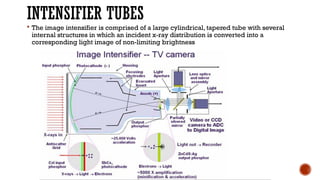
 The image intensifier is comprised of a large cylindrical, tapered tube with several
internal structures in which an incident x-ray distribution is converted into a
corresponding light image of non-limiting brightness
 X-ray to light amplification is achieved in several sequential steps.
 First, x-rays incident on and absorbed by a cesium iodide (CsI) structured phosphor produce a
large number of light photons resulting from the energy difference of x-rays (30-50 keV
average) to light photons (1 -3 eV average).
 Absorption and conversion efficiency is on the order of 60% and 10%, respectively. A fraction of
the light photons interact with an adjacent photocathode layered on the backside of the input
phosphor, releasing a proportional number of electrons (typically on the order of 5 light
photons / electron).
 Being negatively charged, the electrons are accelerated through a potential difference of
approximately 25,000 volts towards the positive anode positioned on the tapered side of the
evacuated tube
 Electro-magnetic focusing grids maintain focus and at the same time minify the electron
distribution as it interacts at the output phosphor structure, producing a large increase in the
light intensity compared to the amount of light originally produced at the input phosphor.
 Overall brightness gain of the II is achieved through the acceleration and kinetic
energy increase of the electrons impacting on the output phosphor (known as
electronic or flux gain) as well as the geometric area reduction of the electron
density from the large area input phosphor to the small area output phosphor
(known as minification gain, equal to the ratio of the input to output phosphor
areas, or ratio of the square of the diameters).
 The combination of electronic and minification gain results on the order of 5000X
increase in brightness.
 Optical coupling of the output phosphor to a TV camera or photospot, cine, or other
light detector allows the detection of the image and subsequent display.
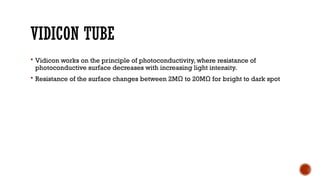
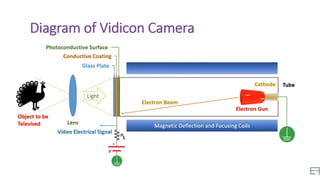
VIDICON TUBE
 Vidicon works on the principle of photoconductivity, where resistance of
photoconductive surface decreases with increasing light intensity.
 Resistance of the surface changes between 2MΩ to 20MΩ for bright to dark spot
VIDICON TUBE
 Most conventional ultrasonic inspections use monocrystal probes with divergent
beams.
 The ultrasonic field propagates along an acoustic axis with a single refracted
angle.The divergence of this beam is the only "additional" angle, which might
contribute to detection and sizing of miss-oriented small cracks.
 Assume the monoblock is cut in many identical elements, each with a width much
smaller than its length. Each small crystal may be considered a line source of
cylindrical waves.The wavefronts of the new acoustic block will interfere,
generating an overall wavefront.
 The small wavefronts can be time-delayed and synchronized for phase and
amplitude, in such a way as to create an ultrasonic focused beam with steering
capability.
DIGITAL RADIOGRAPHY
 Two main methods of real filmless digital imaging can be distinguished:
1. digital radiography by means of phosphor coated semi-flexible imaging plates
(compared with flexible film) in combination with computer processing, so-called
“Computed Radiography”, CR for short
2. digital radiography with rigid flat panel- or flat bed detectors and instant computer
processing, referred to as “Digital Radiography”, DR for short, and considered as the
genuine (true) DR method and sometimes in the field referred to as “Direct
Radiography”.
The major merits of digital radiography compared to conventional film are:
 Shorter exposure times and thus potentially safer
 Faster processing
 No chemicals, thus no environmental pollution
 No consumables, thus low operational costs
 Plates, panels and flat beds can be used repeatedly
 A very wide dynamic exposure range/latitude thus fewer retakes
 Possibility of assisted defect recognition (ADR)
Despite all these positive features, the image resolution of even the most optimised
digital method is (still)not as high as can be achieved with finest grain film.
DIGITIZATION OF X RAY FILMS
 Storing and archiving of chemically processed X-ray films not only demands
special storage conditions, but also takes up quite a bit of space.
 Digitisation of these films provides an excellent alternative that also prevents
degrading.
 Special equipment has been developed for this purpose.
 Current digitization equipment actually consists of a fast computer-controlled
flat bed scanner that scans the film spot wise in a linear pattern, identical to the
formation of a TV image, measuring densities while digitising and storing the
results.
 The spot of the laser beam can be as small as 50 m in diameter (1 m = 1
μ μ
micron, equivalent to one thousand’s of a millimetre), but the equipment can be
adjusted for a coarser scan, for example 500 microns, to achieve shorter
scanning times
 Apart from greatly reduced storage space and (almost) deterioration-free
archiving, digitising also makes it possible to (re)analyse the film’s images on a
computer screen, with the possibility of electronic image adjustment
(enhancement),
 Thus defect indication details not discernible on the original film using a viewing
screen can be made visible
 Archiving of a digitised film, identical to CR- and DR images, is usually done on an
optical mass storage facility e.g.: CD-ROM, DVD etc.
 For uniform application of film digitisation norm EN 14096 has been issued.
COMPUTED RADIOGRAPHY (CR)
 Digital radiography using storage phosphor plates is known as “Computed
Radiography” or CR for short.
 This “filmless” technique is an alternative for the use of medium to coarsegrain X-
ray films.
 In addition to having an extremely wide dynamic range compared to conventional
film, CR technique is much more sensitive to radiation, thus requiring a lower dose.
 This results in shorter exposure times and a reduced controlled area (radiation
exclusion zone).
Two-step digital radiography
 CR is a two-step process.
 The image is not formed directly, but through an intermediate phase as is the case
with conventional X-ray films.
 The image information is, elsewhere and later, converted into light in the CR
scanner by laser stimulation and only then transformed into a digital image.
 Instead of storing the latent image in silver-halide crystals and developing it
chemically, as happens with film, the latent image with CR is stored (the
intermediate semi-stable phase) in a radiation sensitive photo-stimulable
phosphor layer.
 This phosphor layer consists of a mix of bonded fine grains of Fluor, Barium and
Bromium doped with Europium.
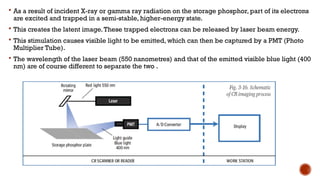
 As a result of incident X-ray or gamma ray radiation on the storage phosphor, part of its electrons
are excited and trapped in a semi-stable, higher-energy state.
 This creates the latent image.These trapped electrons can be released by laser beam energy.
 This stimulation causes visible light to be emitted, which can then be captured by a PMT (Photo
Multiplier Tube).
 The wavelength of the laser beam (550 nanometres) and that of the emitted visible blue light (400
nm) are of course different to separate the two .
 The laser-scanning device used to scan (develop) the latent image contains the
PMT and its electronics, which digitises the analogue light signal that is generated.
 This process as illustrated in figure takes place in the phosphor scanner, or so
called “CR scanner” or “reader”.
 The plate is scanned in a linear pattern similar to the formation of a TV-image and
identical to the film digitisation process
DIGITAL RADIOGRAPHY (DR)
One-step digital radiography
 Digital radiography, DR for short, is also known as “direct” radiography to indicate the
difference with CR, which is a two-step, and thus slower process.
 With DR technology, there is an immediate conversion of radiation intensity into
digital image information.
 Similar to common digital photo cameras, the radiographic image is almost
immediately available.
 Exposure and image formation happen simultaneously, allowing near real-time image
capture, with the radiographic image available for review only seconds after the
exposure.
 This instant availability of results offers immediate feedback to the manufacturing
process to quickly correct production errors
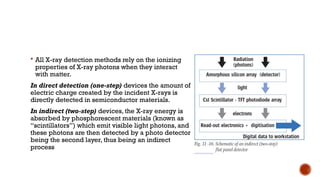
 All X-ray detection methods rely on the ionizing
properties of X-ray photons when they interact
with matter.
In direct detection (one-step) devices the amount of
electric charge created by the incident X-rays is
directly detected in semiconductor materials.
In indirect (two-step) devices, the X-ray energy is
absorbed by phosphorescent materials (known as
“scintillators”) which emit visible light photons, and
these photons are then detected by a photo detector
being the second layer, thus being an indirect
process
COMPARISON OF FILM, CR- AND DR
METHODS
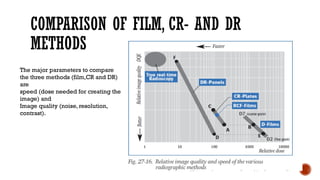
The major parameters to compare
the three methods (film,CR and DR)
are
speed (dose needed for creating the
image) and
Image quality (noise, resolution,
contrast).
 This overview shows that the best image quality (best IQI visibility) of CR plates is
similar to what can be achieved with medium to finer grain film (compare point A
with B) but is appoximately five times faster.
 At point C the quality is less than what can be achieved with coarse grain film but the
speed is more than ten times faster compared to point B.
 RCF films (five to ten times faster than D7-film) are positioned in the same range as
CR plates.
 The graph for DR panels is based on the results obtained with common flat panel
detectors with different numbers of pixels (25 to 400 microns).The best quality that
can be achieved with DR panels comes close to fine grain film D3 (compare point D
to point E).
 The graph also shows that the speed is much higher to achieve the same image
quality of D-type films.
 Depending on the required image quality a time saving of at least a factor 20 (D
against E) and roughly 200 (F against E) can be achieved, however with poorer
quality.
 The range for true real-time (real instant) images shows that exposures can be made
with extremely low dose but at cost of image quality.
COMPUTER TOMOGRAPHY
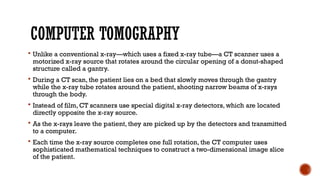
 Unlike a conventional x-ray—which uses a fixed x-ray tube—a CT scanner uses a
motorized x-ray source that rotates around the circular opening of a donut-shaped
structure called a gantry.
 During a CT scan, the patient lies on a bed that slowly moves through the gantry
while the x-ray tube rotates around the patient, shooting narrow beams of x-rays
through the body.
 Instead of film, CT scanners use special digital x-ray detectors, which are located
directly opposite the x-ray source.
 As the x-rays leave the patient, they are picked up by the detectors and transmitted
to a computer.
 Each time the x-ray source completes one full rotation, the CT computer uses
sophisticated mathematical techniques to construct a two-dimensional image slice
of the patient.
 The thickness of the tissue represented in each image slice can vary depending on
the CT machine used, but usually ranges from 1-10 millimeters.
 When a full slice is completed, the image is stored and the motorized bed is moved
forward incrementally into the gantry.The x-ray scanning process is then repeated
to produce another image slice.
 This process continues until the desired number of slices is collected.
 Image slices can either be displayed individually or stacked together by the
computer to generate a 3D image of the patient that shows the skeleton, organs,
and tissues as well as any abnormalities the physician is trying to identify.
 This method has many advantages including the ability to rotate the 3D image in
space or to view slices in succession, making it easier to find the exact place where
a problem may be located.
INDUSTRIAL COMPUTER TOMOGRAPHY (CT)
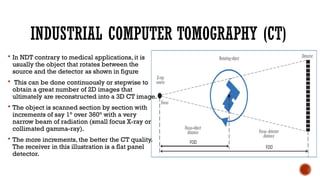
 In NDT contrary to medical applications, it is
usually the object that rotates between the
source and the detector as shown in figure
 This can be done continuously or stepwise to
obtain a great number of 2D images that
ultimately are reconstructed into a 3D CT image.
 The object is scanned section by section with
increments of say 1° over 360° with a very
narrow beam of radiation (small focus X-ray or
collimated gamma-ray).
 The more increments, the better the CT quality.
The receiver in this illustration is a flat panel
detector.
 Each individual detector element measures, during a short exposure period, the total
absorption across a certain angular position of the object.
 This information including the coordinates is used to create a numerical reconstruction
of the volumetric data.
 This process produces a huge data stream to be stored and simultaneously processed,
in particular when an image of high resolution is required.
 A three dimensional representation (3D CT) of the radiographic image requires vast
computing capacity.
 With present day computers, depending on resolution required, the total acquisition
and reconstruction time needed for a 3D image is between a few seconds and 20
minutes.
 CT offers an effective method of mapping the internal structure of components in three
dimensions.
 With this technique, any internal anomaly, often a defect, that results in a difference of
density can be visualized and the image interpreted.
 These properties allow the use of CT as an NDT tool, permitting examination of samples for
internal porosity, cracks, (de)laminations, inclusions and mechanical fit.
 It shows the exact location of the anomaly in the sample providing information on size,
volume and density.
 Due to the fact that CT images are rich in contrast even small defects become detectable.
 CT widely expands the spectrum of X-ray detectable defects in process control and failure
analysis, increasing reliability and safety of components for, e.g., automotive, electronics,
aerospace, and military applications.
 It opens a new dimension for quality assurance and can even partially replace destructive
methods like cross-sectioning: saving costs and time.
 CT is increasingly used as a reverse engineering tool to optimise products and for failure
analysis which otherwise would require destructive examination.
PHASED ARRAY TECHNIQUE
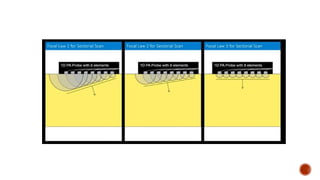
 Phased array ultrasonic testing probes are made up of several piezoelectric crystals that
transmit/receive independently at different times.
 An ultrasonic beam is focused using time delays, which are applied to the elements to
create a constructive interference in the wavefronts.This interference allows the energy to
be focused at any depth and angle in the test specimen.
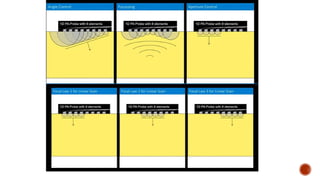
 Each element radiates a spherical wave at a specified time, creating waves that converge
and diverge to create an almost planar wavefront at the specified location.
 Changing the progressive time delay allows the beam to be steered electronically and
swept through the test material like a searchlight.When multiple beams are put together it
creates a visual image that shows a slice through the test object.
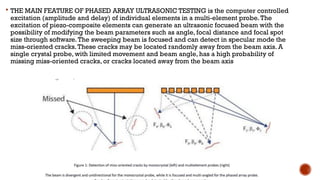
 THE MAIN FEATURE OF PHASED ARRAY ULTRASONIC TESTING is the computer controlled
excitation (amplitude and delay) of individual elements in a multi-element probe.The
excitation of piezo-composite elements can generate an ultrasonic focused beam with the
possibility of modifying the beam parameters such as angle, focal distance and focal spot
size through software.The sweeping beam is focused and can detect in specular mode the
miss-oriented cracks.These cracks may be located randomly away from the beam axis. A
single crystal probe, with limited movement and beam angle, has a high probability of
missing miss-oriented cracks, or cracks located away from the beam axis
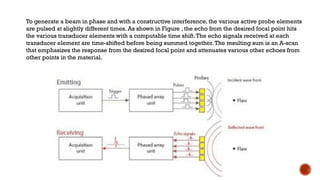
To generate a beam in phase and with a constructive interference, the various active probe elements
are pulsed at slightly different times. As shown in Figure , the echo from the desired focal point hits
the various transducer elements with a computable time shift.The echo signals received at each
transducer element are time-shifted before being summed together.The resulting sum is an A-scan
that emphasizes the response from the desired focal point and attenuates various other echoes from
other points in the material.
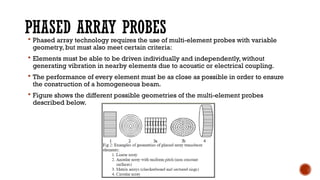
PHASED ARRAY PROBES
 Phased array technology requires the use of multi-element probes with variable
geometry, but must also meet certain criteria:
 Elements must be able to be driven individually and independently, without
generating vibration in nearby elements due to acoustic or electrical coupling.
 The performance of every element must be as close as possible in order to ensure
the construction of a homogeneous beam.
 Figure shows the different possible geometries of the multi-element probes
described below.
Linear array probes
 These probes are made up of a set of elements juxtaposed and aligned along an axis.They enable a
beam to be moved, focused, and deflected along a plane.
Annular array probes
 Annular array probes are made up of a set of concentric rings.They allow the beam to be focused to
different depths along an axis.The surface of the rings is in most cases constant, which implies a
different width for each ring.
Circular array probes
 These probes are made up of a set of elements arranged in a circle.These elements can be directed
either towards the interior, or towards the exterior, or along the axis of symmetry of the circle. In the
latter case, a mirror is generally used to give the beam the required angle of incidence (see figures
3 and 4).
Matrix array probes
 These probes have an active area divided in two dimensions in different elements.This division can,
for example, be in the form of a checkerboard, or sectored rings.These probes allow the ultrasonic
beam to be driven in 3D by combining electronic focusing and deflection.
MAIN CHARACTERISTICS
 Beyond their geometry, Phased Array probes offer the same flexibility of use as
single-element probes.
 They can be used in immersion or in contact, their active area can be flat or
focused, and they can also take into account the strong constraints of the industrial
environment, such as temperature, pressure, vibration and radiation.
SYNTHETIC APERTURE FOCUSING TECHNIQUE (SAFT)
 The Synthetic Aperture Focusing Technique (SAFT) has been used to restore
ultrasonic images obtained either from B or C scans with focusing distortion.With
the use of this technique an improvement of the image resolution can be obtained,
without the use of the traditional ultrasonic lenses.
 For SAFT to work properly, it is necessary to know accurately the path traveled by
the ultrasound from the transducer to target and back again.Therefore a
geometrical model of ultrasonic signal and its correlation to adjacent scan A lines
are used to restore the image. In order to minimize the execution time of this
algorithm, the correlation is calculated only between few lines adjacent to the
analyzed line, in a correlation window.The results obtained with our algorithm
implemented in C language, is quick and efficient in improving the lateral
resolution to the images submitted to it.
TIME OF FLIGHT DIFFRACTION (TOFD)
THEORY OF TOFD
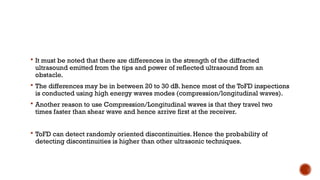
 When ultrasound strikes a boundary/Interface, several interactions are possible.
Reflection, refraction, mode conversion, polarization, attenuation and diffraction are
some of the possible interactions that may occur.
 Diffraction is the most essential interaction considered in ToFD technique. Diffraction
is the ability of waves to spread around corners; diffraction occurs at the edge of the
obstacle.
 It must be noted that there are differences in the strength of the diffracted
ultrasound emitted from the tips and power of reflected ultrasound from an
obstacle.
 The differences may be in between 20 to 30 dB. hence most of the ToFD inspections
is conducted using high energy waves modes (compression/longitudinal waves).
 Another reason to use Compression/Longitudinal waves is that they travel two
times faster than shear wave and hence arrive first at the receiver.
 ToFD can detect randomly oriented discontinuities. Hence the probability of
detecting discontinuities is higher than other ultrasonic techniques.
TOFD PRINCIPLE
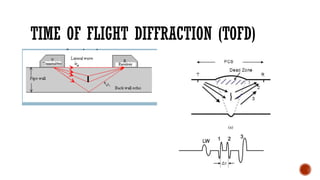
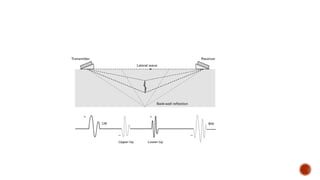
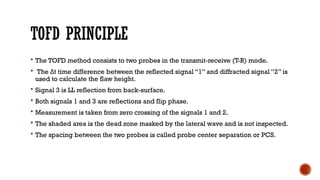
 The TOFD method consists to two probes in the transmit-receive (T-R) mode.
 The t time difference between the reflected signal “1” and diffracted signal “2” is
Δ
used to calculate the flaw height.
 Signal 3 is LL reflection from back-surface.
 Both signals 1 and 3 are reflections and flip phase.
 Measurement is taken from zero crossing of the signals 1 and 2.
 The shaded area is the dead zone masked by the lateral wave and is not inspected.
 The spacing between the two probes is called probe center separation or PCS.
 It uses high angle refracted longitudinal wave probes.
 Typically, for 25 mm thickness, 70° L-wave, 10MHz, 6 mm probes are used.
 Small size probes are selected to maximize beam spread and illuminate the entire weld.
 This results in four received signals as shown in Figure .
 The first is called the lateral wave - LW.
 In reality, this is not a wave but scattering from the near surface microstructure.
 The LW signal is basically used as a reference.
 Two echoes are produced from the flaw.
 Echo 1 is the reflected wave from the top of the flaw.The reflection flips Echo 1 by 180° from the
incident wave.
 Echo 2 is diffraction of the incident beam wave from the bottom of the flaw.There is no phase
change of the diffracted echo.
 The time difference between echoes 1 and 2 received from the top and bottom of the flaw along
with the separation between the two probes are used to calculate flaw height.
 The fourth signal is the longitudinal wave reflection from the far surface, also referred as LL
reflection: incident L-wave and reflected L-wave.This echo also has a phase change from reflection.
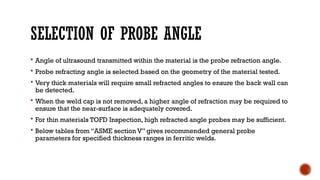
SELECTION OF PROBE ANGLE
 Angle of ultrasound transmitted within the material is the probe refraction angle.
 Probe refracting angle is selected based on the geometry of the material tested.
 Very thick materials will require small refracted angles to ensure the back wall can
be detected.
 When the weld cap is not removed, a higher angle of refraction may be required to
ensure that the near-surface is adequately covered.
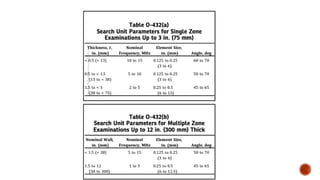
 For thin materials TOFD Inspection, high refracted angle probes may be sufficient.
 Below tables from “ASME section V” gives recommended general probe
parameters for specified thickness ranges in ferritic welds.
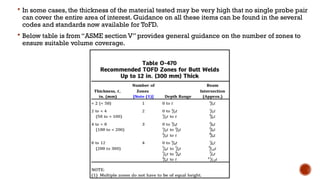
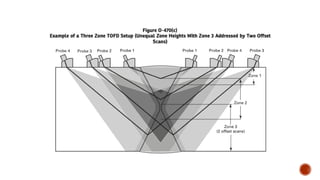
 In some cases, the thickness of the material tested may be very high that no single probe pair
can cover the entire area of interest. Guidance on all these items can be found in the several
codes and standards now available for ToFD.
 Below table is from “ASME section V” provides general guidance on the number of zones to
ensure suitable volume coverage.
TOFD CALIBRATION
 In ultrasonic testing, Before performing the inspection, the NDT inspector must
perform the calibration.
 Calibration is the act of checking the accuracy and precision of the ultrasonic
equipment together with the probe.
 Similar to conventional ultrasonic flaw detectors, TOFD Acquisition units also need
to be checked for both vertical (amplitude) and horizontal (depth or amplitude)
linearity. Performing this calibration ensures the measurement accuracy of the
instrument. Frequency of this check shall be as per applicable standard or code.
 TOFD Inspections rely on accurate timing along the time base
 Amplitude aspects of the signal with respect to reference are not so critical in
TOFD. In TOFD, flaw sizing is not based on the amplitude of the signal received.
 This calibration aims to make sure that signals from discontinuities are within the range of the
digitizer and that the limiting noise is acoustic rather than electronic.
 ToFD requires some means to assure a minimum sensitivity to ensure indications are seen over
the background noise level and also as a means of repeating the sensitivity used in subsequent
inspection.
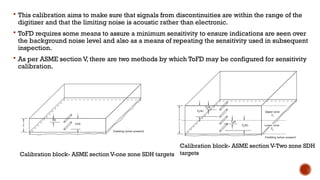
 As per ASME section V, there are two methods by which ToFD may be configured for sensitivity
calibration.
Calibration block- ASME section V-one zone SDH targets
Calibration block- ASME section V-Two zone SDH
targets
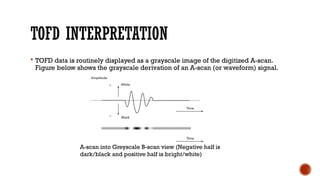
TOFD INTERPRETATION
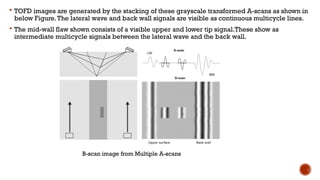
 TOFD data is routinely displayed as a grayscale image of the digitized A-scan.
Figure below shows the grayscale derivation of an A-scan (or waveform) signal.
A-scan into Greyscale B-scan view (Negative half is
dark/black and positive half is bright/white)
 TOFD images are generated by the stacking of these grayscale transformed A-scans as shown in
below Figure.The lateral wave and back wall signals are visible as continuous multicycle lines.
 The mid-wall flaw shown consists of a visible upper and lower tip signal.These show as
intermediate multicycle signals between the lateral wave and the back wall.
B-scan image from Multiple A-scans
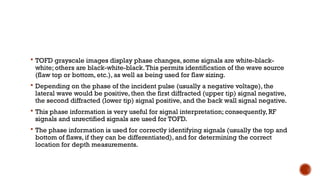
 TOFD grayscale images display phase changes, some signals are white-black-
white; others are black-white-black.This permits identification of the wave source
(flaw top or bottom, etc.), as well as being used for flaw sizing.
 Depending on the phase of the incident pulse (usually a negative voltage), the
lateral wave would be positive, then the first diffracted (upper tip) signal negative,
the second diffracted (lower tip) signal positive, and the back wall signal negative.
 This phase information is very useful for signal interpretation; consequently, RF
signals and unrectified signals are used for TOFD.
 The phase information is used for correctly identifying signals (usually the top and
bottom of flaws, if they can be differentiated), and for determining the correct
location for depth measurements.
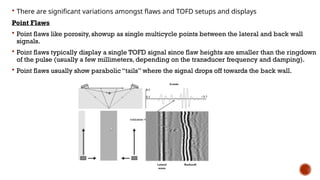
 There are significant variations amongst flaws and TOFD setups and displays
Point Flaws
 Point flaws like porosity, showup as single multicycle points between the lateral and back wall
signals.
 Point flaws typically display a single TOFD signal since flaw heights are smaller than the ringdown
of the pulse (usually a few millimeters, depending on the transducer frequency and damping).
 Point flaws usually show parabolic “tails” where the signal drops off towards the back wall.
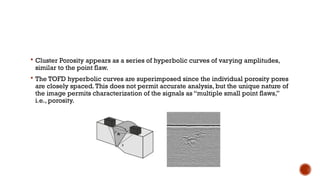
 Cluster Porosity appears as a series of hyperbolic curves of varying amplitudes,
similar to the point flaw.
 The TOFD hyperbolic curves are superimposed since the individual porosity pores
are closely spaced.This does not permit accurate analysis, but the unique nature of
the image permits characterization of the signals as “multiple small point flaws,”
i.e., porosity.
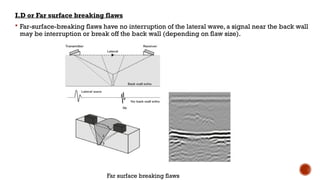
I.D or Far surface breaking flaws
 Far-surface-breaking flaws have no interruption of the lateral wave, a signal near the back wall
may be interruption or break off the back wall (depending on flaw size).
Far surface breaking flaws
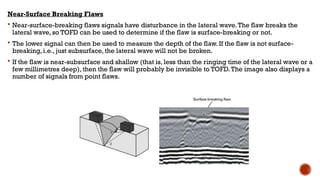
Near-Surface Breaking Flaws
 Near-surface-breaking flaws signals have disturbance in the lateral wave.The flaw breaks the
lateral wave, so TOFD can be used to determine if the flaw is surface-breaking or not.
 The lower signal can then be used to measure the depth of the flaw. If the flaw is not surface-
breaking, i.e., just subsurface, the lateral wave will not be broken.
 If the flaw is near-subsurface and shallow (that is, less than the ringing time of the lateral wave or a
few millimetres deep), then the flaw will probably be invisible to TOFD.The image also displays a
number of signals from point flaws.
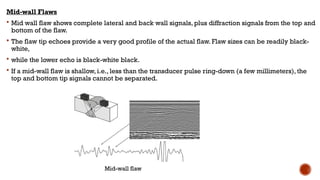
Mid-wall Flaws
 Mid wall flaw shows complete lateral and back wall signals, plus diffraction signals from the top and
bottom of the flaw.
 The flaw tip echoes provide a very good profile of the actual flaw. Flaw sizes can be readily black-
white,
 while the lower echo is black-white black.
 If a mid-wall flaw is shallow, i.e., less than the transducer pulse ring-down (a few millimeters), the
top and bottom tip signals cannot be separated.
Mid-wall flaw
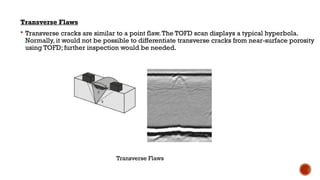
Transverse Flaws
 Transverse cracks are similar to a point flaw.The TOFD scan displays a typical hyperbola.
Normally, it would not be possible to differentiate transverse cracks from near-surface porosity
using TOFD; further inspection would be needed.
Transverse Flaws

advancedradiographic testing methods methods

  • 1.
  • 2.
    INTENSIFIER TUBES  Theimage intensifier is comprised of a large cylindrical, tapered tube with several internal structures in which an incident x-ray distribution is converted into a corresponding light image of non-limiting brightness
  • 3.
     X-ray tolight amplification is achieved in several sequential steps.  First, x-rays incident on and absorbed by a cesium iodide (CsI) structured phosphor produce a large number of light photons resulting from the energy difference of x-rays (30-50 keV average) to light photons (1 -3 eV average).  Absorption and conversion efficiency is on the order of 60% and 10%, respectively. A fraction of the light photons interact with an adjacent photocathode layered on the backside of the input phosphor, releasing a proportional number of electrons (typically on the order of 5 light photons / electron).  Being negatively charged, the electrons are accelerated through a potential difference of approximately 25,000 volts towards the positive anode positioned on the tapered side of the evacuated tube  Electro-magnetic focusing grids maintain focus and at the same time minify the electron distribution as it interacts at the output phosphor structure, producing a large increase in the light intensity compared to the amount of light originally produced at the input phosphor.
  • 4.
     Overall brightnessgain of the II is achieved through the acceleration and kinetic energy increase of the electrons impacting on the output phosphor (known as electronic or flux gain) as well as the geometric area reduction of the electron density from the large area input phosphor to the small area output phosphor (known as minification gain, equal to the ratio of the input to output phosphor areas, or ratio of the square of the diameters).  The combination of electronic and minification gain results on the order of 5000X increase in brightness.  Optical coupling of the output phosphor to a TV camera or photospot, cine, or other light detector allows the detection of the image and subsequent display.
  • 5.
    VIDICON TUBE  Vidiconworks on the principle of photoconductivity, where resistance of photoconductive surface decreases with increasing light intensity.  Resistance of the surface changes between 2MΩ to 20MΩ for bright to dark spot
  • 6.
  • 7.
     Most conventionalultrasonic inspections use monocrystal probes with divergent beams.  The ultrasonic field propagates along an acoustic axis with a single refracted angle.The divergence of this beam is the only "additional" angle, which might contribute to detection and sizing of miss-oriented small cracks.  Assume the monoblock is cut in many identical elements, each with a width much smaller than its length. Each small crystal may be considered a line source of cylindrical waves.The wavefronts of the new acoustic block will interfere, generating an overall wavefront.  The small wavefronts can be time-delayed and synchronized for phase and amplitude, in such a way as to create an ultrasonic focused beam with steering capability.
  • 8.
    DIGITAL RADIOGRAPHY  Twomain methods of real filmless digital imaging can be distinguished: 1. digital radiography by means of phosphor coated semi-flexible imaging plates (compared with flexible film) in combination with computer processing, so-called “Computed Radiography”, CR for short 2. digital radiography with rigid flat panel- or flat bed detectors and instant computer processing, referred to as “Digital Radiography”, DR for short, and considered as the genuine (true) DR method and sometimes in the field referred to as “Direct Radiography”.
  • 9.
    The major meritsof digital radiography compared to conventional film are:  Shorter exposure times and thus potentially safer  Faster processing  No chemicals, thus no environmental pollution  No consumables, thus low operational costs  Plates, panels and flat beds can be used repeatedly  A very wide dynamic exposure range/latitude thus fewer retakes  Possibility of assisted defect recognition (ADR) Despite all these positive features, the image resolution of even the most optimised digital method is (still)not as high as can be achieved with finest grain film.
  • 10.
    DIGITIZATION OF XRAY FILMS  Storing and archiving of chemically processed X-ray films not only demands special storage conditions, but also takes up quite a bit of space.  Digitisation of these films provides an excellent alternative that also prevents degrading.  Special equipment has been developed for this purpose.  Current digitization equipment actually consists of a fast computer-controlled flat bed scanner that scans the film spot wise in a linear pattern, identical to the formation of a TV image, measuring densities while digitising and storing the results.  The spot of the laser beam can be as small as 50 m in diameter (1 m = 1 μ μ micron, equivalent to one thousand’s of a millimetre), but the equipment can be adjusted for a coarser scan, for example 500 microns, to achieve shorter scanning times
  • 11.
     Apart fromgreatly reduced storage space and (almost) deterioration-free archiving, digitising also makes it possible to (re)analyse the film’s images on a computer screen, with the possibility of electronic image adjustment (enhancement),  Thus defect indication details not discernible on the original film using a viewing screen can be made visible  Archiving of a digitised film, identical to CR- and DR images, is usually done on an optical mass storage facility e.g.: CD-ROM, DVD etc.  For uniform application of film digitisation norm EN 14096 has been issued.
  • 12.
    COMPUTED RADIOGRAPHY (CR) Digital radiography using storage phosphor plates is known as “Computed Radiography” or CR for short.  This “filmless” technique is an alternative for the use of medium to coarsegrain X- ray films.  In addition to having an extremely wide dynamic range compared to conventional film, CR technique is much more sensitive to radiation, thus requiring a lower dose.  This results in shorter exposure times and a reduced controlled area (radiation exclusion zone).
  • 13.
    Two-step digital radiography CR is a two-step process.  The image is not formed directly, but through an intermediate phase as is the case with conventional X-ray films.  The image information is, elsewhere and later, converted into light in the CR scanner by laser stimulation and only then transformed into a digital image.  Instead of storing the latent image in silver-halide crystals and developing it chemically, as happens with film, the latent image with CR is stored (the intermediate semi-stable phase) in a radiation sensitive photo-stimulable phosphor layer.  This phosphor layer consists of a mix of bonded fine grains of Fluor, Barium and Bromium doped with Europium.
  • 14.
     As aresult of incident X-ray or gamma ray radiation on the storage phosphor, part of its electrons are excited and trapped in a semi-stable, higher-energy state.  This creates the latent image.These trapped electrons can be released by laser beam energy.  This stimulation causes visible light to be emitted, which can then be captured by a PMT (Photo Multiplier Tube).  The wavelength of the laser beam (550 nanometres) and that of the emitted visible blue light (400 nm) are of course different to separate the two .
  • 15.
     The laser-scanningdevice used to scan (develop) the latent image contains the PMT and its electronics, which digitises the analogue light signal that is generated.  This process as illustrated in figure takes place in the phosphor scanner, or so called “CR scanner” or “reader”.  The plate is scanned in a linear pattern similar to the formation of a TV-image and identical to the film digitisation process
  • 16.
    DIGITAL RADIOGRAPHY (DR) One-stepdigital radiography  Digital radiography, DR for short, is also known as “direct” radiography to indicate the difference with CR, which is a two-step, and thus slower process.  With DR technology, there is an immediate conversion of radiation intensity into digital image information.  Similar to common digital photo cameras, the radiographic image is almost immediately available.  Exposure and image formation happen simultaneously, allowing near real-time image capture, with the radiographic image available for review only seconds after the exposure.  This instant availability of results offers immediate feedback to the manufacturing process to quickly correct production errors
  • 17.
     All X-raydetection methods rely on the ionizing properties of X-ray photons when they interact with matter. In direct detection (one-step) devices the amount of electric charge created by the incident X-rays is directly detected in semiconductor materials. In indirect (two-step) devices, the X-ray energy is absorbed by phosphorescent materials (known as “scintillators”) which emit visible light photons, and these photons are then detected by a photo detector being the second layer, thus being an indirect process
  • 18.
    COMPARISON OF FILM,CR- AND DR METHODS The major parameters to compare the three methods (film,CR and DR) are speed (dose needed for creating the image) and Image quality (noise, resolution, contrast).
  • 19.
     This overviewshows that the best image quality (best IQI visibility) of CR plates is similar to what can be achieved with medium to finer grain film (compare point A with B) but is appoximately five times faster.  At point C the quality is less than what can be achieved with coarse grain film but the speed is more than ten times faster compared to point B.  RCF films (five to ten times faster than D7-film) are positioned in the same range as CR plates.  The graph for DR panels is based on the results obtained with common flat panel detectors with different numbers of pixels (25 to 400 microns).The best quality that can be achieved with DR panels comes close to fine grain film D3 (compare point D to point E).  The graph also shows that the speed is much higher to achieve the same image quality of D-type films.  Depending on the required image quality a time saving of at least a factor 20 (D against E) and roughly 200 (F against E) can be achieved, however with poorer quality.  The range for true real-time (real instant) images shows that exposures can be made with extremely low dose but at cost of image quality.
  • 20.
    COMPUTER TOMOGRAPHY  Unlikea conventional x-ray—which uses a fixed x-ray tube—a CT scanner uses a motorized x-ray source that rotates around the circular opening of a donut-shaped structure called a gantry.  During a CT scan, the patient lies on a bed that slowly moves through the gantry while the x-ray tube rotates around the patient, shooting narrow beams of x-rays through the body.  Instead of film, CT scanners use special digital x-ray detectors, which are located directly opposite the x-ray source.  As the x-rays leave the patient, they are picked up by the detectors and transmitted to a computer.  Each time the x-ray source completes one full rotation, the CT computer uses sophisticated mathematical techniques to construct a two-dimensional image slice of the patient.
  • 21.
     The thicknessof the tissue represented in each image slice can vary depending on the CT machine used, but usually ranges from 1-10 millimeters.  When a full slice is completed, the image is stored and the motorized bed is moved forward incrementally into the gantry.The x-ray scanning process is then repeated to produce another image slice.  This process continues until the desired number of slices is collected.  Image slices can either be displayed individually or stacked together by the computer to generate a 3D image of the patient that shows the skeleton, organs, and tissues as well as any abnormalities the physician is trying to identify.  This method has many advantages including the ability to rotate the 3D image in space or to view slices in succession, making it easier to find the exact place where a problem may be located.
  • 22.
    INDUSTRIAL COMPUTER TOMOGRAPHY(CT)  In NDT contrary to medical applications, it is usually the object that rotates between the source and the detector as shown in figure  This can be done continuously or stepwise to obtain a great number of 2D images that ultimately are reconstructed into a 3D CT image.  The object is scanned section by section with increments of say 1° over 360° with a very narrow beam of radiation (small focus X-ray or collimated gamma-ray).  The more increments, the better the CT quality. The receiver in this illustration is a flat panel detector.
  • 23.
     Each individualdetector element measures, during a short exposure period, the total absorption across a certain angular position of the object.  This information including the coordinates is used to create a numerical reconstruction of the volumetric data.  This process produces a huge data stream to be stored and simultaneously processed, in particular when an image of high resolution is required.  A three dimensional representation (3D CT) of the radiographic image requires vast computing capacity.  With present day computers, depending on resolution required, the total acquisition and reconstruction time needed for a 3D image is between a few seconds and 20 minutes.
  • 24.
     CT offersan effective method of mapping the internal structure of components in three dimensions.  With this technique, any internal anomaly, often a defect, that results in a difference of density can be visualized and the image interpreted.  These properties allow the use of CT as an NDT tool, permitting examination of samples for internal porosity, cracks, (de)laminations, inclusions and mechanical fit.  It shows the exact location of the anomaly in the sample providing information on size, volume and density.  Due to the fact that CT images are rich in contrast even small defects become detectable.  CT widely expands the spectrum of X-ray detectable defects in process control and failure analysis, increasing reliability and safety of components for, e.g., automotive, electronics, aerospace, and military applications.  It opens a new dimension for quality assurance and can even partially replace destructive methods like cross-sectioning: saving costs and time.  CT is increasingly used as a reverse engineering tool to optimise products and for failure analysis which otherwise would require destructive examination.
  • 25.
    PHASED ARRAY TECHNIQUE Phased array ultrasonic testing probes are made up of several piezoelectric crystals that transmit/receive independently at different times.  An ultrasonic beam is focused using time delays, which are applied to the elements to create a constructive interference in the wavefronts.This interference allows the energy to be focused at any depth and angle in the test specimen.  Each element radiates a spherical wave at a specified time, creating waves that converge and diverge to create an almost planar wavefront at the specified location.  Changing the progressive time delay allows the beam to be steered electronically and swept through the test material like a searchlight.When multiple beams are put together it creates a visual image that shows a slice through the test object.
  • 26.
     THE MAINFEATURE OF PHASED ARRAY ULTRASONIC TESTING is the computer controlled excitation (amplitude and delay) of individual elements in a multi-element probe.The excitation of piezo-composite elements can generate an ultrasonic focused beam with the possibility of modifying the beam parameters such as angle, focal distance and focal spot size through software.The sweeping beam is focused and can detect in specular mode the miss-oriented cracks.These cracks may be located randomly away from the beam axis. A single crystal probe, with limited movement and beam angle, has a high probability of missing miss-oriented cracks, or cracks located away from the beam axis
  • 27.
    To generate abeam in phase and with a constructive interference, the various active probe elements are pulsed at slightly different times. As shown in Figure , the echo from the desired focal point hits the various transducer elements with a computable time shift.The echo signals received at each transducer element are time-shifted before being summed together.The resulting sum is an A-scan that emphasizes the response from the desired focal point and attenuates various other echoes from other points in the material.
  • 30.
    PHASED ARRAY PROBES Phased array technology requires the use of multi-element probes with variable geometry, but must also meet certain criteria:  Elements must be able to be driven individually and independently, without generating vibration in nearby elements due to acoustic or electrical coupling.  The performance of every element must be as close as possible in order to ensure the construction of a homogeneous beam.  Figure shows the different possible geometries of the multi-element probes described below.
  • 31.
    Linear array probes These probes are made up of a set of elements juxtaposed and aligned along an axis.They enable a beam to be moved, focused, and deflected along a plane. Annular array probes  Annular array probes are made up of a set of concentric rings.They allow the beam to be focused to different depths along an axis.The surface of the rings is in most cases constant, which implies a different width for each ring. Circular array probes  These probes are made up of a set of elements arranged in a circle.These elements can be directed either towards the interior, or towards the exterior, or along the axis of symmetry of the circle. In the latter case, a mirror is generally used to give the beam the required angle of incidence (see figures 3 and 4). Matrix array probes  These probes have an active area divided in two dimensions in different elements.This division can, for example, be in the form of a checkerboard, or sectored rings.These probes allow the ultrasonic beam to be driven in 3D by combining electronic focusing and deflection.
  • 32.
    MAIN CHARACTERISTICS  Beyondtheir geometry, Phased Array probes offer the same flexibility of use as single-element probes.  They can be used in immersion or in contact, their active area can be flat or focused, and they can also take into account the strong constraints of the industrial environment, such as temperature, pressure, vibration and radiation.
  • 33.
    SYNTHETIC APERTURE FOCUSINGTECHNIQUE (SAFT)  The Synthetic Aperture Focusing Technique (SAFT) has been used to restore ultrasonic images obtained either from B or C scans with focusing distortion.With the use of this technique an improvement of the image resolution can be obtained, without the use of the traditional ultrasonic lenses.  For SAFT to work properly, it is necessary to know accurately the path traveled by the ultrasound from the transducer to target and back again.Therefore a geometrical model of ultrasonic signal and its correlation to adjacent scan A lines are used to restore the image. In order to minimize the execution time of this algorithm, the correlation is calculated only between few lines adjacent to the analyzed line, in a correlation window.The results obtained with our algorithm implemented in C language, is quick and efficient in improving the lateral resolution to the images submitted to it.
  • 34.
    TIME OF FLIGHTDIFFRACTION (TOFD)
  • 35.
    THEORY OF TOFD When ultrasound strikes a boundary/Interface, several interactions are possible. Reflection, refraction, mode conversion, polarization, attenuation and diffraction are some of the possible interactions that may occur.  Diffraction is the most essential interaction considered in ToFD technique. Diffraction is the ability of waves to spread around corners; diffraction occurs at the edge of the obstacle.
  • 36.
     It mustbe noted that there are differences in the strength of the diffracted ultrasound emitted from the tips and power of reflected ultrasound from an obstacle.  The differences may be in between 20 to 30 dB. hence most of the ToFD inspections is conducted using high energy waves modes (compression/longitudinal waves).  Another reason to use Compression/Longitudinal waves is that they travel two times faster than shear wave and hence arrive first at the receiver.  ToFD can detect randomly oriented discontinuities. Hence the probability of detecting discontinuities is higher than other ultrasonic techniques.
  • 37.
    TOFD PRINCIPLE  TheTOFD method consists to two probes in the transmit-receive (T-R) mode.  The t time difference between the reflected signal “1” and diffracted signal “2” is Δ used to calculate the flaw height.  Signal 3 is LL reflection from back-surface.  Both signals 1 and 3 are reflections and flip phase.  Measurement is taken from zero crossing of the signals 1 and 2.  The shaded area is the dead zone masked by the lateral wave and is not inspected.  The spacing between the two probes is called probe center separation or PCS.
  • 38.
     It useshigh angle refracted longitudinal wave probes.  Typically, for 25 mm thickness, 70° L-wave, 10MHz, 6 mm probes are used.  Small size probes are selected to maximize beam spread and illuminate the entire weld.  This results in four received signals as shown in Figure .  The first is called the lateral wave - LW.  In reality, this is not a wave but scattering from the near surface microstructure.  The LW signal is basically used as a reference.  Two echoes are produced from the flaw.  Echo 1 is the reflected wave from the top of the flaw.The reflection flips Echo 1 by 180° from the incident wave.  Echo 2 is diffraction of the incident beam wave from the bottom of the flaw.There is no phase change of the diffracted echo.  The time difference between echoes 1 and 2 received from the top and bottom of the flaw along with the separation between the two probes are used to calculate flaw height.  The fourth signal is the longitudinal wave reflection from the far surface, also referred as LL reflection: incident L-wave and reflected L-wave.This echo also has a phase change from reflection.
  • 39.
    SELECTION OF PROBEANGLE  Angle of ultrasound transmitted within the material is the probe refraction angle.  Probe refracting angle is selected based on the geometry of the material tested.  Very thick materials will require small refracted angles to ensure the back wall can be detected.  When the weld cap is not removed, a higher angle of refraction may be required to ensure that the near-surface is adequately covered.  For thin materials TOFD Inspection, high refracted angle probes may be sufficient.  Below tables from “ASME section V” gives recommended general probe parameters for specified thickness ranges in ferritic welds.
  • 41.
     In somecases, the thickness of the material tested may be very high that no single probe pair can cover the entire area of interest. Guidance on all these items can be found in the several codes and standards now available for ToFD.  Below table is from “ASME section V” provides general guidance on the number of zones to ensure suitable volume coverage.
  • 43.
    TOFD CALIBRATION  Inultrasonic testing, Before performing the inspection, the NDT inspector must perform the calibration.  Calibration is the act of checking the accuracy and precision of the ultrasonic equipment together with the probe.  Similar to conventional ultrasonic flaw detectors, TOFD Acquisition units also need to be checked for both vertical (amplitude) and horizontal (depth or amplitude) linearity. Performing this calibration ensures the measurement accuracy of the instrument. Frequency of this check shall be as per applicable standard or code.  TOFD Inspections rely on accurate timing along the time base  Amplitude aspects of the signal with respect to reference are not so critical in TOFD. In TOFD, flaw sizing is not based on the amplitude of the signal received.
  • 44.
     This calibrationaims to make sure that signals from discontinuities are within the range of the digitizer and that the limiting noise is acoustic rather than electronic.  ToFD requires some means to assure a minimum sensitivity to ensure indications are seen over the background noise level and also as a means of repeating the sensitivity used in subsequent inspection.  As per ASME section V, there are two methods by which ToFD may be configured for sensitivity calibration. Calibration block- ASME section V-one zone SDH targets Calibration block- ASME section V-Two zone SDH targets
  • 45.
    TOFD INTERPRETATION  TOFDdata is routinely displayed as a grayscale image of the digitized A-scan. Figure below shows the grayscale derivation of an A-scan (or waveform) signal. A-scan into Greyscale B-scan view (Negative half is dark/black and positive half is bright/white)
  • 46.
     TOFD imagesare generated by the stacking of these grayscale transformed A-scans as shown in below Figure.The lateral wave and back wall signals are visible as continuous multicycle lines.  The mid-wall flaw shown consists of a visible upper and lower tip signal.These show as intermediate multicycle signals between the lateral wave and the back wall. B-scan image from Multiple A-scans
  • 47.
     TOFD grayscaleimages display phase changes, some signals are white-black- white; others are black-white-black.This permits identification of the wave source (flaw top or bottom, etc.), as well as being used for flaw sizing.  Depending on the phase of the incident pulse (usually a negative voltage), the lateral wave would be positive, then the first diffracted (upper tip) signal negative, the second diffracted (lower tip) signal positive, and the back wall signal negative.  This phase information is very useful for signal interpretation; consequently, RF signals and unrectified signals are used for TOFD.  The phase information is used for correctly identifying signals (usually the top and bottom of flaws, if they can be differentiated), and for determining the correct location for depth measurements.
  • 49.
     There aresignificant variations amongst flaws and TOFD setups and displays Point Flaws  Point flaws like porosity, showup as single multicycle points between the lateral and back wall signals.  Point flaws typically display a single TOFD signal since flaw heights are smaller than the ringdown of the pulse (usually a few millimeters, depending on the transducer frequency and damping).  Point flaws usually show parabolic “tails” where the signal drops off towards the back wall.
  • 50.
     Cluster Porosityappears as a series of hyperbolic curves of varying amplitudes, similar to the point flaw.  The TOFD hyperbolic curves are superimposed since the individual porosity pores are closely spaced.This does not permit accurate analysis, but the unique nature of the image permits characterization of the signals as “multiple small point flaws,” i.e., porosity.
  • 51.
    I.D or Farsurface breaking flaws  Far-surface-breaking flaws have no interruption of the lateral wave, a signal near the back wall may be interruption or break off the back wall (depending on flaw size). Far surface breaking flaws
  • 52.
    Near-Surface Breaking Flaws Near-surface-breaking flaws signals have disturbance in the lateral wave.The flaw breaks the lateral wave, so TOFD can be used to determine if the flaw is surface-breaking or not.  The lower signal can then be used to measure the depth of the flaw. If the flaw is not surface- breaking, i.e., just subsurface, the lateral wave will not be broken.  If the flaw is near-subsurface and shallow (that is, less than the ringing time of the lateral wave or a few millimetres deep), then the flaw will probably be invisible to TOFD.The image also displays a number of signals from point flaws.
  • 53.
    Mid-wall Flaws  Midwall flaw shows complete lateral and back wall signals, plus diffraction signals from the top and bottom of the flaw.  The flaw tip echoes provide a very good profile of the actual flaw. Flaw sizes can be readily black- white,  while the lower echo is black-white black.  If a mid-wall flaw is shallow, i.e., less than the transducer pulse ring-down (a few millimeters), the top and bottom tip signals cannot be separated. Mid-wall flaw
  • 54.
    Transverse Flaws  Transversecracks are similar to a point flaw.The TOFD scan displays a typical hyperbola. Normally, it would not be possible to differentiate transverse cracks from near-surface porosity using TOFD; further inspection would be needed. Transverse Flaws