This document provides an overview of advanced sampling techniques:
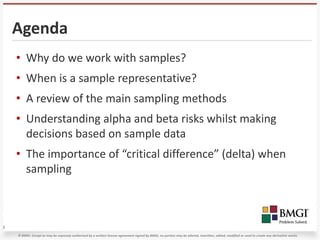
1. It discusses why samples are used instead of entire populations, and when a sample can be considered representative of the population. Key factors are applying the appropriate sampling method and having a large enough sample size.
2. Several common sampling methods are reviewed, including simple random sampling, stratified sampling, clustered sampling, and systematic sampling.
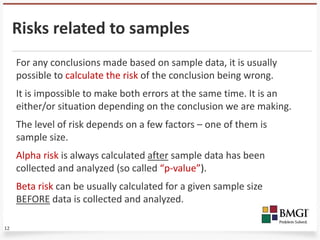
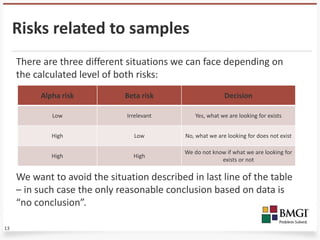
3. The document also covers risks associated with making conclusions about a population based on sample data, such as type I and type II errors. It stresses the importance of determining an acceptable critical difference and sample size to reliably detect real effects while minimizing error risks.