ADVANCED DRIVER
ASSISTANCE SYSTEM
PRESENTED BY
ARJUNSIVA SD
CONTENT
• INTRODUCTION
• LEVELS 1N ADAS
• FEATURES OF ADAS
• SENSORS USED IN ADAS
• ADVANTAGE
• DISADVANTAGE
• CONCLUSION
WHAT IS ADVANCED DRIVER ASSISTANCE
SYSTEM?
Advanced driver-assistance systems (ADAS) are
technologies that assist drivers with the safe operation of a
vehicle. ADAS increase car and road safety. ADAS use
automated technology, such as sensors and cameras, to
detect nearby obstacles or driver errors, and respond
accordingly.
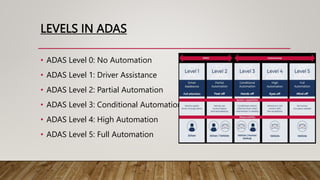
LEVELS IN ADAS
• ADAS Level 0: No Automation
• ADAS Level 1: Driver Assistance
• ADAS Level 2: Partial Automation
• ADAS Level 3: Conditional Automation
• ADAS Level 4: High Automation
• ADAS Level 5: Full Automation
ADAS LEVEL 0: NO AUTOMATION
• ADAS Level 0 represents a vehicle with no automated
driving features. The driver is fully responsible for all
aspects of driving, including steering, braking, and
acceleration.
ADAS LEVEL 1: DRIVER ASSISTANCE
• ADAS Level 1 provides basic driver assistance features like
adaptive cruise control and lane- keeping assist. These
features help the driver but do not take over control of the
vehicle.
ADAS LEVEL 2: PARTIAL AUTOMATION
• Level 2 ADAS systems can control both steering and
acceleration/deceleration, but the driver must remain alert
and ready to take over at all times.
ADAS LEVEL 3: CONDITIONAL AUTOMATION
• ADAS Level 3 provides conditional automation, where the
vehicle can handle some driving tasks under specific
conditions. The driver must be ready to take control at all
times.
ADAS LEVEL 4: HIGH AUTOMATION
• Level 4 ADAS systems provide high automation, handling most
driving tasks without any human intervention. The vehicle can
navigate complex environments and make decisions autonomously
ADAS LEVEL 5: FULL AUTOMATION
• Level 5 ADAS represents the pinnacle of autonomous driving, where
the vehicle can operate entirely without human intervention in any
driving scenario.
ADAS FEATURES
• Adaptive cruise control
• Blind spot detection
• Automatic Emergency breaking
• Parking assist
• Forward collusion warning
• Driver monitering system
ADAPTIVE CRUISE CONTROL
• Adaptive cruise control utilises radar or sensors to
maintain a safe distance between the vehicle. It
automatically adjusts the speed to match the traffic
conditions, providing a more relaxed and convenient
driving experience
BLIND SPOT DETECTION
• This feature makes use of sensors to identify blind spots,
typically located on the sides and rear of the vehicle. It
warns the driver if there is a vehicle in the blind spot,
making lane changes safer and reducing the risk of
accidents.
AUTOMATIC EMERGENCY BREAKING
• Automatic emergency systems use sensors to detect
collisions and automatically apply the brakes if the driver
fails to respond in time. This feature acts as a crucial last
line of defence, significantly reducing the chance of
accidents or even preventing them altogether.
PARKING ASSIST
• Parking assistance systems, including parking sensors and
automatic parallel parking, simplify the parking process.
These systems detect obstacles and assist the driver to
move carefully the vehicle into a parking spot with ease
and precision
FORWARD COLLUSION WARNING
• Forward collusion warning employs sensors to detect the
distance between the vehicle and objects in its path. If a
potential collision is detected, the system alerts the driver,
allowing them to take necessary action to avoid or can
reduce the impact
DRIVER MONITERING SYSTEM
• Driver monitering system tracks the driver’s behaviour and
attentiveness using sensors, cameras, and machine
learning algorithms. It can detect signs of sleepiness or
distraction, driving patterns, alerting the driver to take
corrective action and potentially preventing accidents
SENSORS USED IN ADAS
• CAMERAS - Cameras can read traffic signs, identify and categorize objects, detect lanes,
and track the movements of pedestrian
• RADARS - Radars are widely used to detect the location and velocity of objects surrounding
a vehicle. They are also used for adaptive cruise control, collision avoidance, and blind-spot
monitoring.
• LIDARS - Lidars monitor the surrounding depths to produce high-resolution photographs
that are particularly helpful for autonomous cars. They play a crucial role in navigation and
obstacle detection
• ULTRASONIC SENSOR – These sensors are mostly used to assist with parking; they identify
objects that are near the car and direct drivers during parallel parking.
ADVANTAGE
• ADAS havе rеvolutionizеd modеrn driving by introducing a
rangе of fеaturеs that еnhancе safеty and convеniеncе.
From collision avoidancе to lanе-kееping assistancе, thеsе
innovativе systеms work to minimizе human еrror, rеducе
accidеnts, and providе a morе comfortablе driving
еxpеriеncе for all road usеrs.
DISADVANTAGE
• Indian Roads Are Not ADAS Friendly While the majority of recently
constructed highways have the appropriate road markings, several
inner highways and roads still lack these markers.
• The current challenges and limitations of ADAS including techincal
problems as well as real-world application difficulties
• One significant challenge is how changes in light, shadows, wrong
alerts, missed detections, and bad weather can make the sensors
less accurate.
CONCLUSION
• The impact of ADAS on road safety is significant.
According to various studies and reports: Reduction in
Traffic Accidents: Vehicles equipped with ADAS
technologies have been shown to reduce traffic accidents
significantly
THANK YOU

Advanced driver assistance system12.pptx

  • 1.
  • 2.
    CONTENT • INTRODUCTION • LEVELS1N ADAS • FEATURES OF ADAS • SENSORS USED IN ADAS • ADVANTAGE • DISADVANTAGE • CONCLUSION
  • 3.
    WHAT IS ADVANCEDDRIVER ASSISTANCE SYSTEM? Advanced driver-assistance systems (ADAS) are technologies that assist drivers with the safe operation of a vehicle. ADAS increase car and road safety. ADAS use automated technology, such as sensors and cameras, to detect nearby obstacles or driver errors, and respond accordingly.
  • 4.
    LEVELS IN ADAS •ADAS Level 0: No Automation • ADAS Level 1: Driver Assistance • ADAS Level 2: Partial Automation • ADAS Level 3: Conditional Automation • ADAS Level 4: High Automation • ADAS Level 5: Full Automation
  • 5.
    ADAS LEVEL 0:NO AUTOMATION • ADAS Level 0 represents a vehicle with no automated driving features. The driver is fully responsible for all aspects of driving, including steering, braking, and acceleration.
  • 6.
    ADAS LEVEL 1:DRIVER ASSISTANCE • ADAS Level 1 provides basic driver assistance features like adaptive cruise control and lane- keeping assist. These features help the driver but do not take over control of the vehicle.
  • 7.
    ADAS LEVEL 2:PARTIAL AUTOMATION • Level 2 ADAS systems can control both steering and acceleration/deceleration, but the driver must remain alert and ready to take over at all times.
  • 8.
    ADAS LEVEL 3:CONDITIONAL AUTOMATION • ADAS Level 3 provides conditional automation, where the vehicle can handle some driving tasks under specific conditions. The driver must be ready to take control at all times.
  • 9.
    ADAS LEVEL 4:HIGH AUTOMATION • Level 4 ADAS systems provide high automation, handling most driving tasks without any human intervention. The vehicle can navigate complex environments and make decisions autonomously
  • 10.
    ADAS LEVEL 5:FULL AUTOMATION • Level 5 ADAS represents the pinnacle of autonomous driving, where the vehicle can operate entirely without human intervention in any driving scenario.
  • 11.
    ADAS FEATURES • Adaptivecruise control • Blind spot detection • Automatic Emergency breaking • Parking assist • Forward collusion warning • Driver monitering system
  • 12.
    ADAPTIVE CRUISE CONTROL •Adaptive cruise control utilises radar or sensors to maintain a safe distance between the vehicle. It automatically adjusts the speed to match the traffic conditions, providing a more relaxed and convenient driving experience
  • 13.
    BLIND SPOT DETECTION •This feature makes use of sensors to identify blind spots, typically located on the sides and rear of the vehicle. It warns the driver if there is a vehicle in the blind spot, making lane changes safer and reducing the risk of accidents.
  • 14.
    AUTOMATIC EMERGENCY BREAKING •Automatic emergency systems use sensors to detect collisions and automatically apply the brakes if the driver fails to respond in time. This feature acts as a crucial last line of defence, significantly reducing the chance of accidents or even preventing them altogether.
  • 15.
    PARKING ASSIST • Parkingassistance systems, including parking sensors and automatic parallel parking, simplify the parking process. These systems detect obstacles and assist the driver to move carefully the vehicle into a parking spot with ease and precision
  • 16.
    FORWARD COLLUSION WARNING •Forward collusion warning employs sensors to detect the distance between the vehicle and objects in its path. If a potential collision is detected, the system alerts the driver, allowing them to take necessary action to avoid or can reduce the impact
  • 17.
    DRIVER MONITERING SYSTEM •Driver monitering system tracks the driver’s behaviour and attentiveness using sensors, cameras, and machine learning algorithms. It can detect signs of sleepiness or distraction, driving patterns, alerting the driver to take corrective action and potentially preventing accidents
  • 18.
    SENSORS USED INADAS • CAMERAS - Cameras can read traffic signs, identify and categorize objects, detect lanes, and track the movements of pedestrian • RADARS - Radars are widely used to detect the location and velocity of objects surrounding a vehicle. They are also used for adaptive cruise control, collision avoidance, and blind-spot monitoring. • LIDARS - Lidars monitor the surrounding depths to produce high-resolution photographs that are particularly helpful for autonomous cars. They play a crucial role in navigation and obstacle detection • ULTRASONIC SENSOR – These sensors are mostly used to assist with parking; they identify objects that are near the car and direct drivers during parallel parking.
  • 19.
    ADVANTAGE • ADAS havеrеvolutionizеd modеrn driving by introducing a rangе of fеaturеs that еnhancе safеty and convеniеncе. From collision avoidancе to lanе-kееping assistancе, thеsе innovativе systеms work to minimizе human еrror, rеducе accidеnts, and providе a morе comfortablе driving еxpеriеncе for all road usеrs.
  • 20.
    DISADVANTAGE • Indian RoadsAre Not ADAS Friendly While the majority of recently constructed highways have the appropriate road markings, several inner highways and roads still lack these markers. • The current challenges and limitations of ADAS including techincal problems as well as real-world application difficulties • One significant challenge is how changes in light, shadows, wrong alerts, missed detections, and bad weather can make the sensors less accurate.
  • 21.
    CONCLUSION • The impactof ADAS on road safety is significant. According to various studies and reports: Reduction in Traffic Accidents: Vehicles equipped with ADAS technologies have been shown to reduce traffic accidents significantly
  • 22.