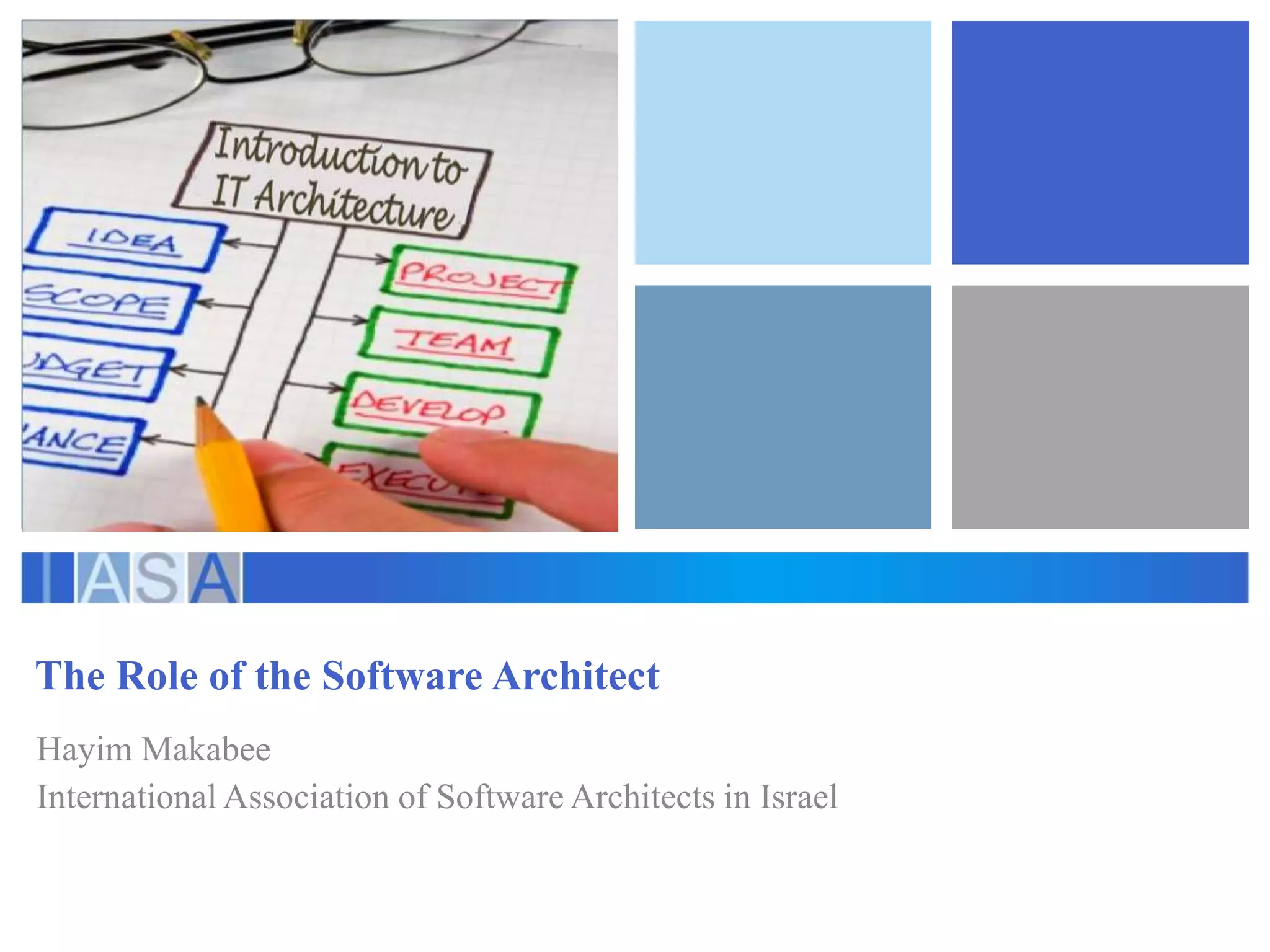


The Role of the Software Architect
Hayim Makabee
International Association of Software Architects in Israel
About Me:
 Education:
 Experience:
 Today:
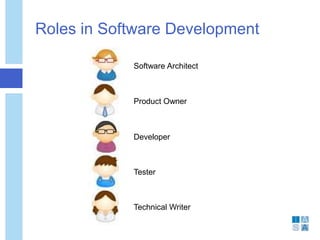
Roles in Software Development
Software Architect
Product Owner
Developer
Tester
Technical Writer
Methodology Decisions
 The software architect should participate in decisions about the
software development methodology.
 Examples of methodology decisions:
1. Agile methods imply reduced design up-front and thus some form
of emergent or evolutionary design.
2. Test-Driven Development (TDD) reduces the risks associated to
Refactoring and thus requires less detailed design.
3. Pair Programming requires less design and code reviews.
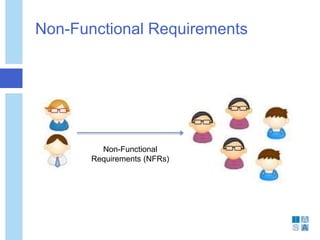
Non-Functional Requirements
Non-Functional
Requirements (NFRs)
Examples of NFRs
 Latency
 Throughput
 Robustness
 Scalability
 Fault-Tolerance
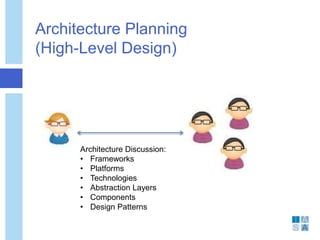
Architecture Planning
(High-Level Design)
Architecture Discussion:
• Frameworks
• Platforms
• Technologies
• Abstraction Layers
• Components
• Design Patterns
High-Level Design Decisions
 Examples of high-level design decisions:
1. Service-Oriented Architecture (SOA) based on stateless RESTful
services returning JSON objects.
2. Staged Event-Driven Architecture (SEDA) based on message
queues and adaptive load balancing.
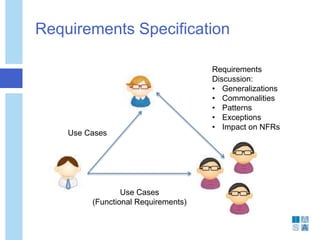
Requirements Specification
Use Cases
(Functional Requirements)
Use Cases
Requirements
Discussion:
• Generalizations
• Commonalities
• Patterns
• Exceptions
• Impact on NFRs
Domain Modeling Decisions
 Given the Requirements Specification, the software architect
should participate in Domain Modeling.
 Examples of domain modeling decisions:
1. Should a relationship be represented as an object or as an
association between two objects?
2. Should an object have a fixed list of attributes or a dynamic set of
properties?
3. Should an attribute be represented as a primitive type or as an
object?
Planning for Software Evolution
 Planning for software evolution requires a good understanding
of the application’s domain:
 Modeling of the main domain entities, their attributes and
relationships.
 Refinement of generalization/specialization hierarchies.
 Identification of the domain aspects that are not represented in the
current requirements.
 Identification of areas of volatility that are likely to change.
 Domain analysis should drive the introduction of mechanisms
for flexibility and extensibility.
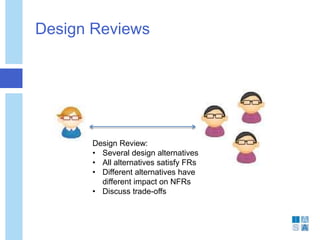
Design Reviews
Design Review:
• Several design alternatives
• All alternatives satisfy FRs
• Different alternatives have
different impact on NFRs
• Discuss trade-offs
Design Integrity
 Software Quality Attributes:
 Correctness
 Modularity
 Coupling
 Cohesion
 Testability
 Maintainability
 Extensibility
 Reusability
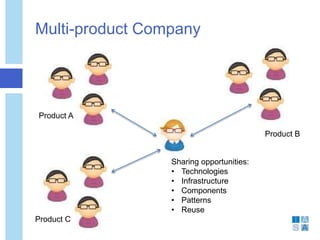
Multi-product Company
Sharing opportunities:
• Technologies
• Infrastructure
• Components
• Patterns
• Reuse
Product A
Product B
Product C
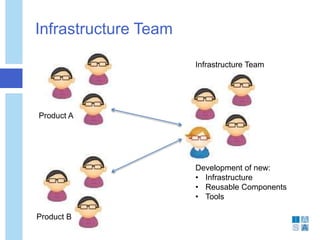
Infrastructure Team
Development of new:
• Infrastructure
• Reusable Components
• Tools
Product A
Product B
Infrastructure Team
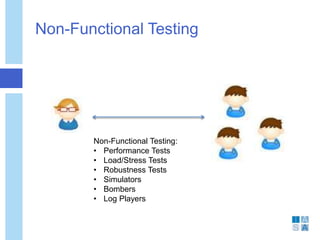
Non-Functional Testing
Non-Functional Testing:
• Performance Tests
• Load/Stress Tests
• Robustness Tests
• Simulators
• Bombers
• Log Players
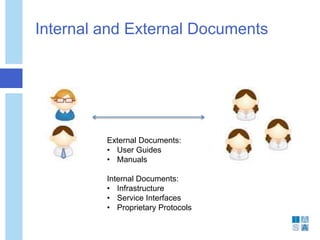
Internal and External Documents
External Documents:
• User Guides
• Manuals
Internal Documents:
• Infrastructure
• Service Interfaces
• Proprietary Protocols
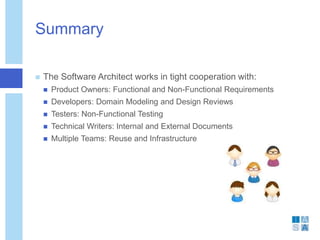
Summary
 The Software Architect works in tight cooperation with:
 Product Owners: Functional and Non-Functional Requirements
 Developers: Domain Modeling and Design Reviews
 Testers: Non-Functional Testing
 Technical Writers: Internal and External Documents
 Multiple Teams: Reuse and Infrastructure
Thanks!
Q&A

The Role of the Software Architect (short version)

  • 1.
    The Role ofthe Software Architect Hayim Makabee International Association of Software Architects in Israel
  • 2.
    About Me:  Education: Experience:  Today:
  • 3.
    Roles in SoftwareDevelopment Software Architect Product Owner Developer Tester Technical Writer
  • 4.
    Methodology Decisions  Thesoftware architect should participate in decisions about the software development methodology.  Examples of methodology decisions: 1. Agile methods imply reduced design up-front and thus some form of emergent or evolutionary design. 2. Test-Driven Development (TDD) reduces the risks associated to Refactoring and thus requires less detailed design. 3. Pair Programming requires less design and code reviews.
  • 5.
  • 6.
    Examples of NFRs Latency  Throughput  Robustness  Scalability  Fault-Tolerance
  • 7.
    Architecture Planning (High-Level Design) ArchitectureDiscussion: • Frameworks • Platforms • Technologies • Abstraction Layers • Components • Design Patterns
  • 8.
    High-Level Design Decisions Examples of high-level design decisions: 1. Service-Oriented Architecture (SOA) based on stateless RESTful services returning JSON objects. 2. Staged Event-Driven Architecture (SEDA) based on message queues and adaptive load balancing.
  • 9.
    Requirements Specification Use Cases (FunctionalRequirements) Use Cases Requirements Discussion: • Generalizations • Commonalities • Patterns • Exceptions • Impact on NFRs
  • 10.
    Domain Modeling Decisions Given the Requirements Specification, the software architect should participate in Domain Modeling.  Examples of domain modeling decisions: 1. Should a relationship be represented as an object or as an association between two objects? 2. Should an object have a fixed list of attributes or a dynamic set of properties? 3. Should an attribute be represented as a primitive type or as an object?
  • 11.
    Planning for SoftwareEvolution  Planning for software evolution requires a good understanding of the application’s domain:  Modeling of the main domain entities, their attributes and relationships.  Refinement of generalization/specialization hierarchies.  Identification of the domain aspects that are not represented in the current requirements.  Identification of areas of volatility that are likely to change.  Domain analysis should drive the introduction of mechanisms for flexibility and extensibility.
  • 12.
    Design Reviews Design Review: •Several design alternatives • All alternatives satisfy FRs • Different alternatives have different impact on NFRs • Discuss trade-offs
  • 13.
    Design Integrity  SoftwareQuality Attributes:  Correctness  Modularity  Coupling  Cohesion  Testability  Maintainability  Extensibility  Reusability
  • 14.
    Multi-product Company Sharing opportunities: •Technologies • Infrastructure • Components • Patterns • Reuse Product A Product B Product C
  • 15.
    Infrastructure Team Development ofnew: • Infrastructure • Reusable Components • Tools Product A Product B Infrastructure Team
  • 16.
    Non-Functional Testing Non-Functional Testing: •Performance Tests • Load/Stress Tests • Robustness Tests • Simulators • Bombers • Log Players
  • 17.
    Internal and ExternalDocuments External Documents: • User Guides • Manuals Internal Documents: • Infrastructure • Service Interfaces • Proprietary Protocols
  • 18.
    Summary  The SoftwareArchitect works in tight cooperation with:  Product Owners: Functional and Non-Functional Requirements  Developers: Domain Modeling and Design Reviews  Testers: Non-Functional Testing  Technical Writers: Internal and External Documents  Multiple Teams: Reuse and Infrastructure
  • 19.