Today: The Kineticsof Heterogeneous Catalysis, cont’d
Adsorption Isotherms
Rate Equations
“What adsorption properties must be balanced for an effective catalyst?”
ChemE 2200 – Chemical Kinetics Lecture
16
Recap: The Basic Mechanism of Heterogeneous Catalysis
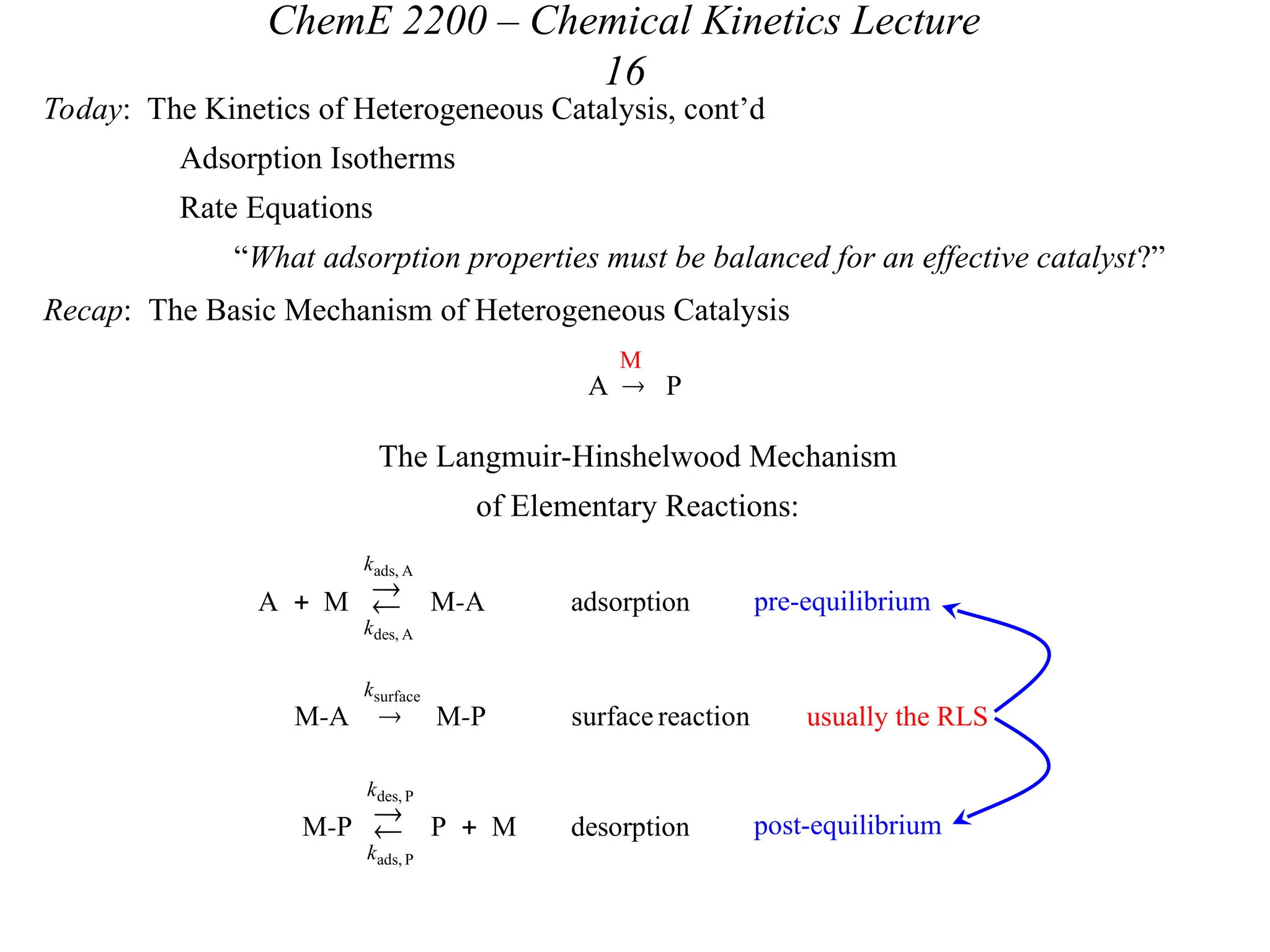
The Langmuir-Hinshelwood Mechanism
of Elementary Reactions:
A P
M
adsorption
A
M
M
A
A
ads,
A
des,
-
k
k
reaction
surface
P
M
A
M
surface
-
-
k
desorption
M
P
P
M
P
des,
P
ads,
k
k
-
usually the RLS
pre-equilibrium
post-equilibrium
2.
The Thermodynamics of
Adsorption
Oftenin equilibrium.
will ignore
in ChemE 2200
A
M
M
A
A
ads,
A
des,
-
k
k
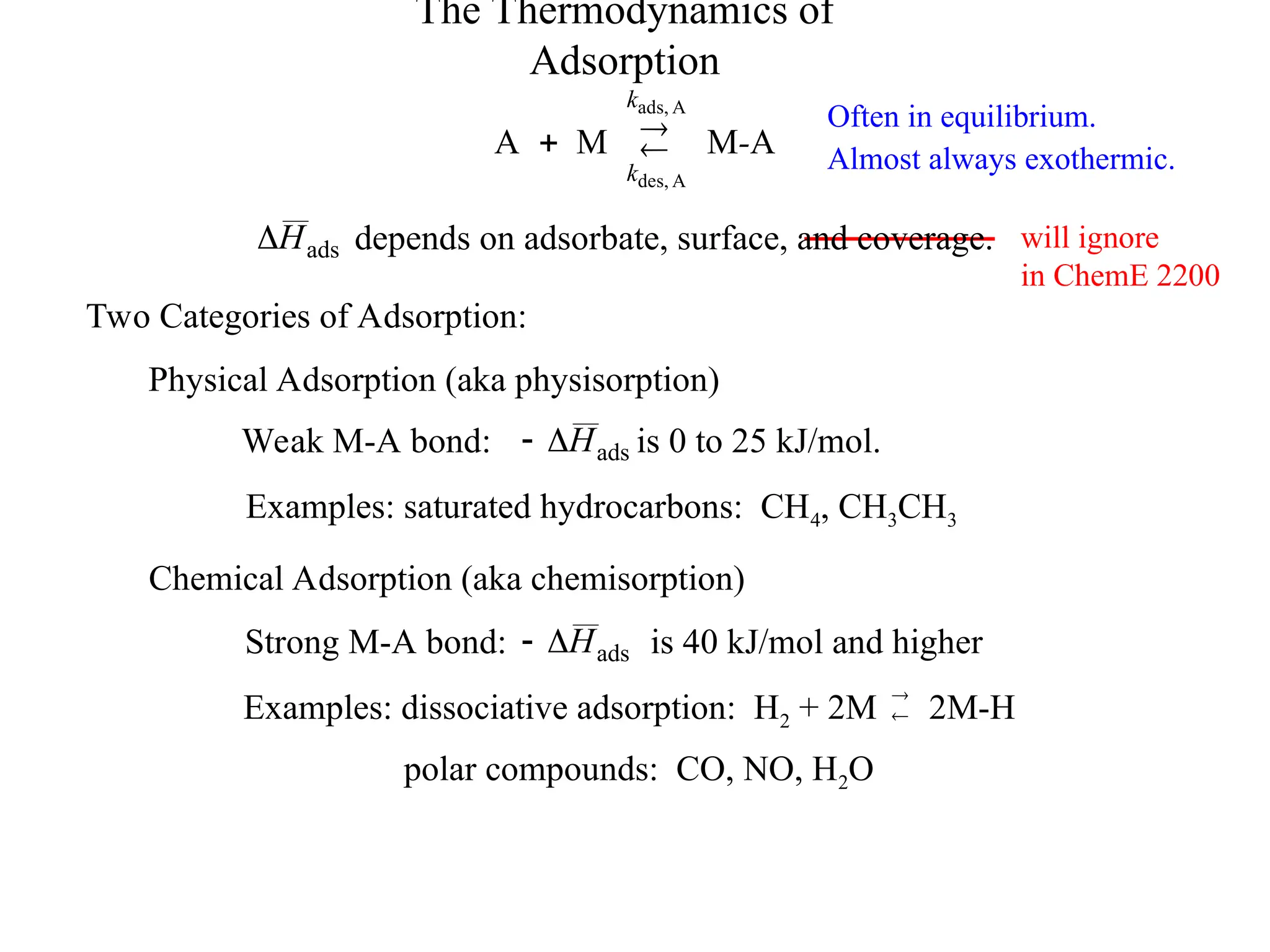
depends on adsorbate, surface, and coverage.
ads
H
Two Categories of Adsorption:
Physical Adsorption (aka physisorption)
Weak M-A bond: ads
H
is 0 to 25 kJ/mol.
Examples: saturated hydrocarbons: CH4, CH3CH3
Chemical Adsorption (aka chemisorption)
Strong M-A bond: ads
H
is 40 kJ/mol and higher
Examples: dissociative adsorption: H2 + 2M 2M-H
polar compounds: CO, NO, H2O
Almost always exothermic.
3.
The Thermodynamics ofAdsorption,
cont’d
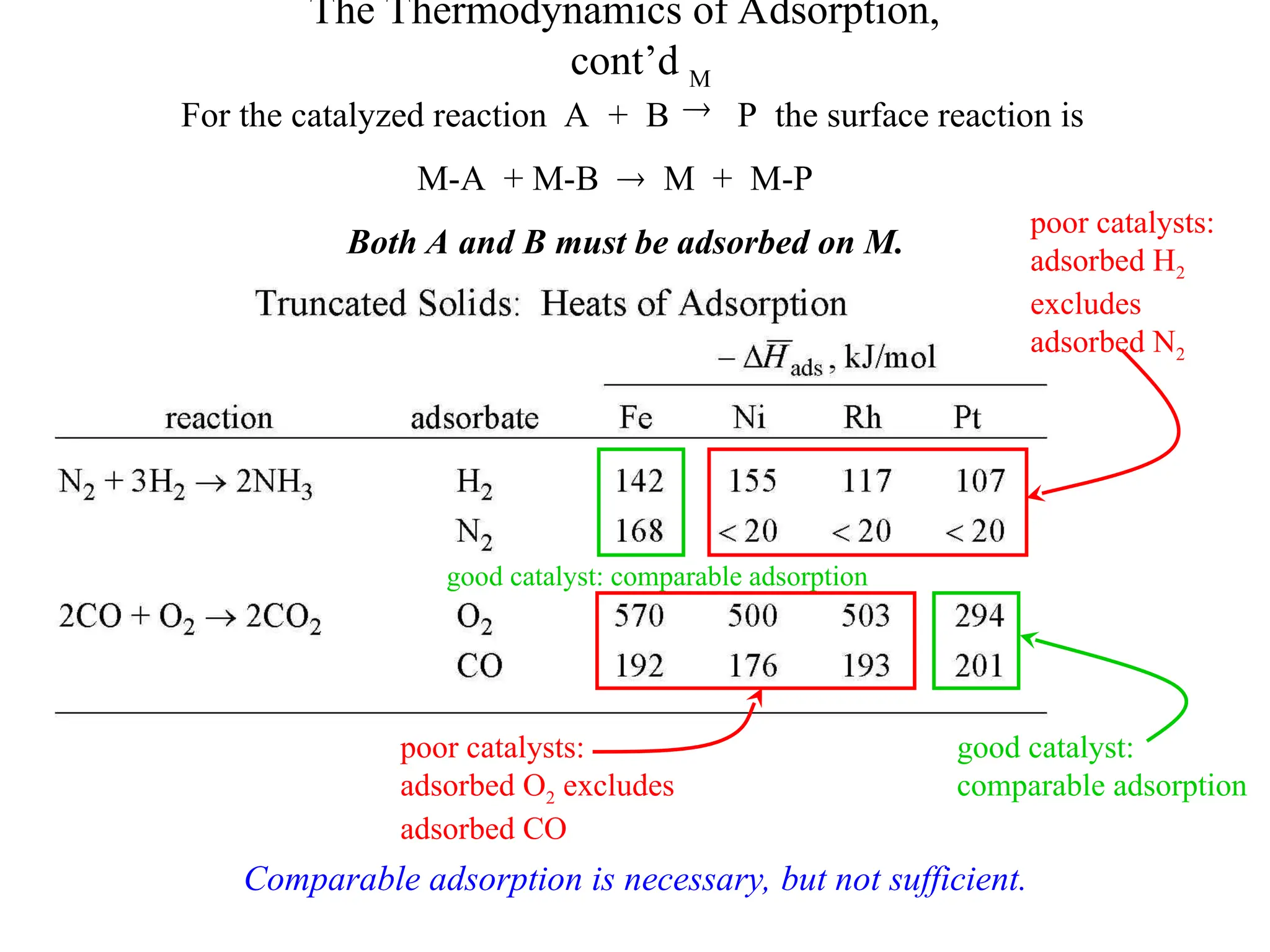
good catalyst: comparable adsorption
poor catalysts:
adsorbed H2
excludes
adsorbed N2
poor catalysts:
adsorbed O2 excludes
adsorbed CO
good catalyst:
comparable adsorption
Comparable adsorption is necessary, but not sufficient.
For the catalyzed reaction A + B
M
P the surface reaction is
M-A + M-B M + M-P
Both A and B must be adsorbed on M.
4.
The Thermodynamics ofAdsorption,
cont’d
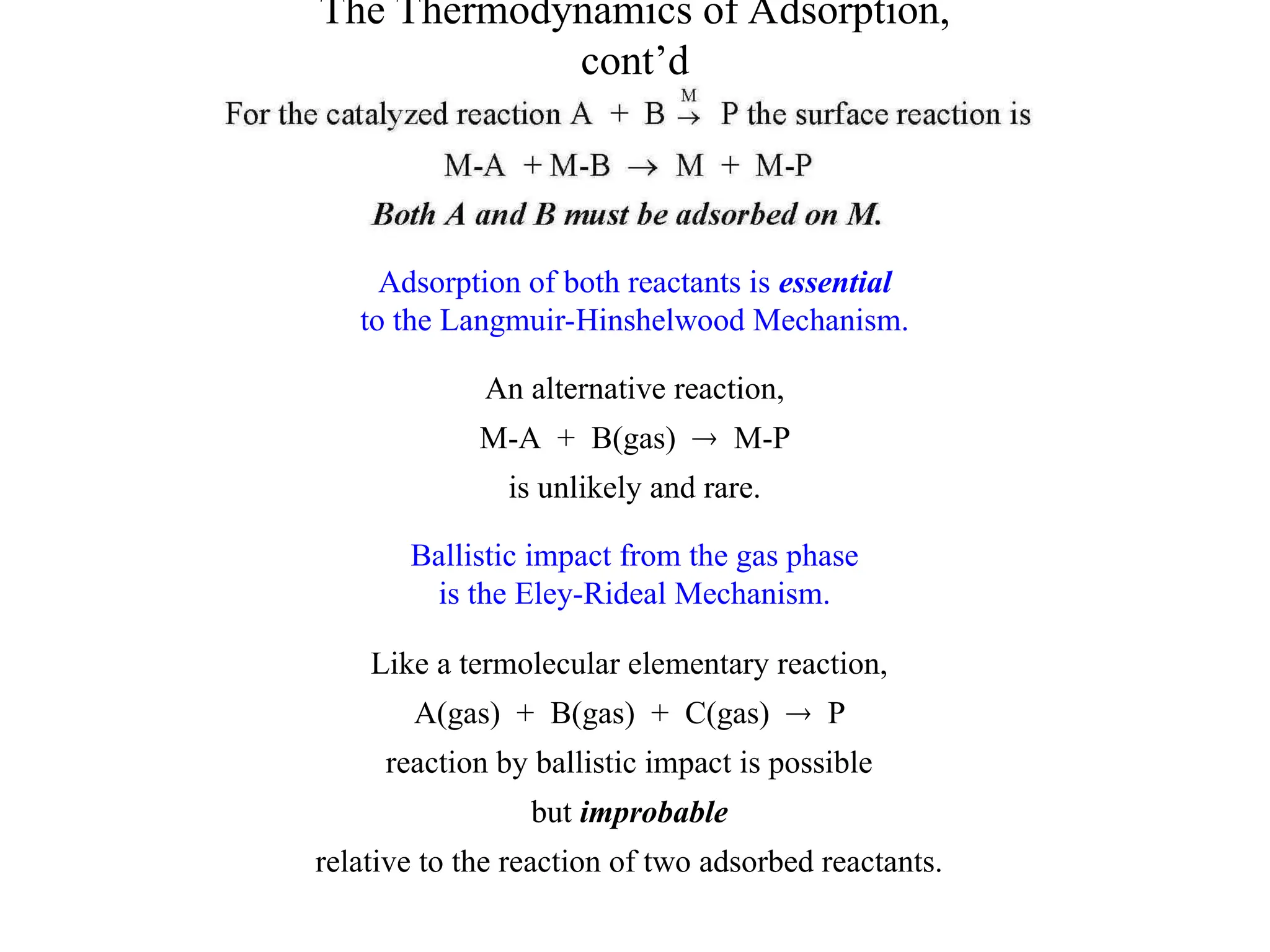
Adsorption of both reactants is essential
to the Langmuir-Hinshelwood Mechanism.
An alternative reaction,
M-A + B(gas) M-P
is unlikely and rare.
Ballistic impact from the gas phase
is the Eley-Rideal Mechanism.
Like a termolecular elementary reaction,
A(gas) + B(gas) + C(gas) P
reaction by ballistic impact is possible
but improbable
relative to the reaction of two adsorbed reactants.
5.
The Thermodynamics ofAdsorption - Adsorption
Isotherms constant T
A
PA
need A = f(PA)
M M M M M M M
M M M M M M M
M M M M M M M
A
A A
A
A A A A
A
A
need [M] …, [M-A] …
excellent model for
PA < vapor pressure of A.
sites
adsorption
total
A
by
occupied
sites
adsorption
A
of
Coverage
Fractional A
Langmuir Isotherm.
Assumes ads
H
is independent of surface coverage.
Assumes only a single layer of adsorbed A.
A
M
M
A
A
ads,
A
des,
-
k
k
At equilibrium: ]
A
M
[
]
M
][
A
[ A
des,
A
ads, -
k
k
6.
KA[A](1A) A
0
A
A
des,
0
A
A
ads,]
M
[
]
M
)[
1
](
A
[
k
k
The Thermodynamics of Adsorption - Adsorption
Isotherms
from the definition of A:
substitute
[A] is
awkward
for
reactor
design.
A
M
M
A
A
ads,
A
des,
-
k
k
need [M] …, [M-A] …
At equilibrium: ]
A
M
[
]
M
][
A
[ A
des,
A
ads, -
k
k
total concentration of adsorption sites [M]0 [M] + [M-A]
0
A
]
M
[
]
A
M
[ -
[M-A] A[M]0
0
0
A
]
M
[
]
M
[
]
M
[
[M] (1A)[M]0
A
des,
A
ads,
A
Define
k
k
K
]
A
[
1
A]
[
A
A
A
K
K
Convert [A] to PA:
RT
P
V
n A
A
A]
[
A
A
A
A
A
1 P
RT
K
P
RT
K
7.
The Thermodynamics ofAdsorption - Adsorption
Isotherms
Using the Langmuir Isotherm in Rate Equations.
Need expressions for [M-A] and [M-P] to derive the rate equation.
Assume Langmuir Isotherms for the adsorption/desorption of A and P.
This assumption allows one to write
kads, A[M][A] kdes, A[M-A] and kads, P[M][P] kdes, P[M-P]
A Langmuir-Hinshelwood
Mechanism of
Elementary Reactions:
This assumption yields two useful expressions:
[M-A] Kads, A[M][A] and [M-P] Kads, P[M][P]
Overall Reaction: (gas)
M
(gas) P
A
A
M
M
A
A
ads,
A
des,
-
k
k
adsorption
surface reaction
P
M
P
M
P
des,
P
,
ads
k
k
- desorption
P
M
A
M
surface
-
-
k
8.
Rate Equations forHeterogeneously-Catalyzed
Reactions
Recall our goal for Chemical Kinetics:
Given the Overall Reaction and Rate Equation,
devise a Mechanism of Elementary Reactions.
Recall our Strategy:
Gain experience by starting with
a Mechanism of Elementary Reactions
and deriving the Rate Equation.
9.
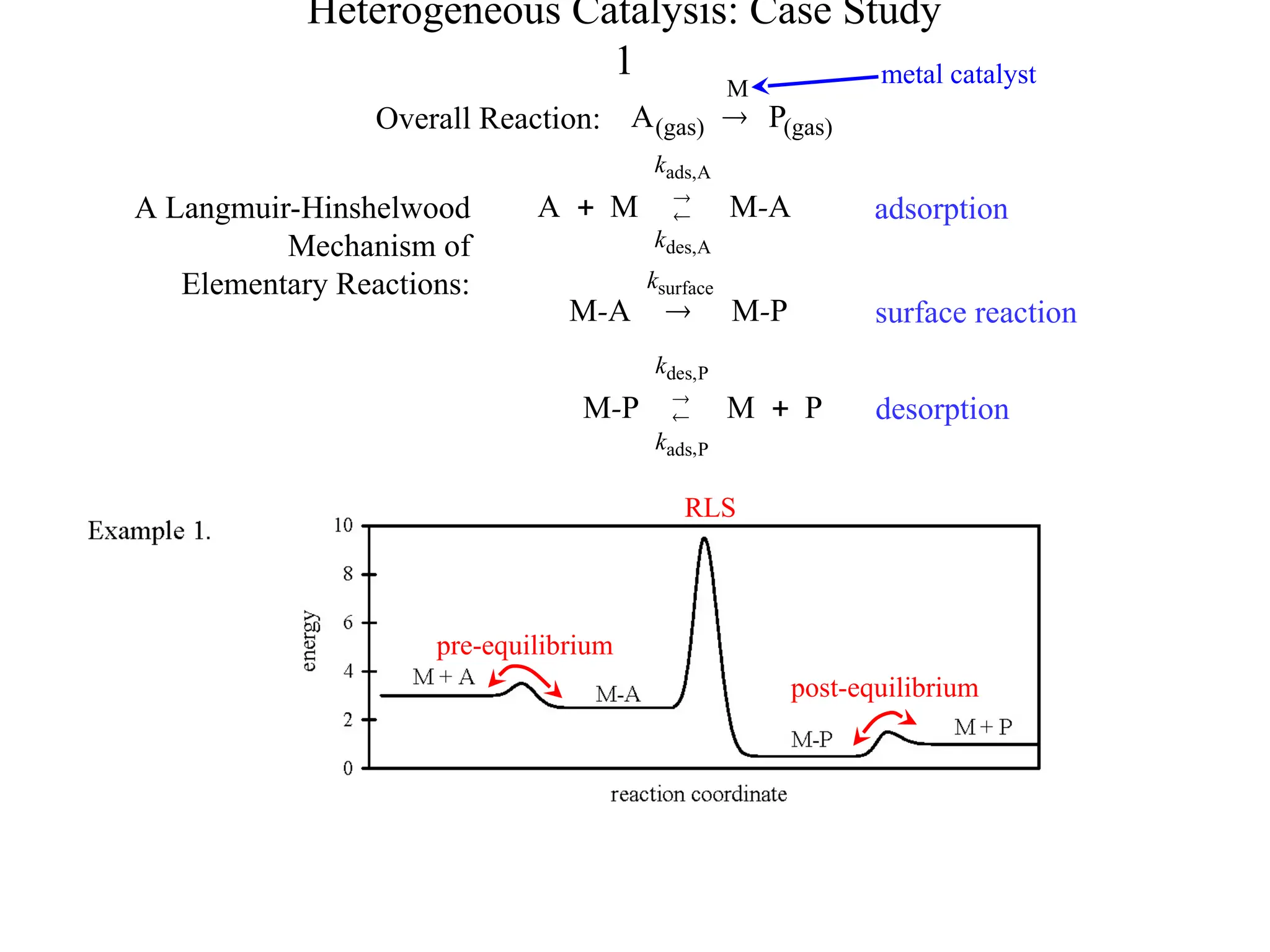
Heterogeneous Catalysis: CaseStudy
1 metal catalyst
RLS
pre-equilibrium
post-equilibrium
Overall Reaction: (gas)
M
(gas) P
A
A Langmuir-Hinshelwood
Mechanism of
Elementary Reactions:
A
M
M
A
A
ads,
A
des,
-
k
k
adsorption
surface reaction
P
M
P
M
P
des,
P
,
ads
k
k
- desorption
P
M
A
M
surface
-
-
k
Heterogeneous Catalysis: CaseStudy 1 - Example
2
RLS
pre-equilibrium
post-equilibrium
0
ads
G
okay?
0
and
because
0
have
may
c),
(exothermi
0
although
ads
ads
ads
ads
ads
ads
S
S
T
H
G
G
H
A and P are
weakly adsorbed.
surface sites are
mostly unoccupied.
RLS 0 0
clue in rate equation:
denominator 1
[M] » [M-A], [M-P] 1 » Kads,A, Kads, P
]
A
M
[
]
P
[
s -
k
dt
d
0
P
ads,
A
ads,
A
ads,
s
]
M
[
]
P
[
]
A
[
1
]
A
[
K
K
K
k
0
A
ads,
s ]
M
][
A
[
K
k
assume
Langmuir isotherms
12.
0
P
ads,
A
ads,
A
ads,
s
]
M
[
]
P
[
]
A
[
1
]
A
[
K
K
K
k
Heterogeneous Catalysis: CaseStudy 1 - Example
3
RLS
pre-equilibrium post-equilibrium
A is strongly adsorbed.
P is weakly adsorbed.
surface sites are
mostly occupied by A.
0 0
Rate is independent of [A]! How can this be?
The RLS is proportional to [M-A]. Increasing
[A] does not increase [M-A] because the
surface is saturated with adsorbed A.
Clues in rate equation:
1. denominator = 1
2. No [A] term.
[M-A] » [M], [M-P] Kads,A » 1, Kads, P
assume
Langmuir isotherms
RLS
]
A
M
[
]
P
[
s -
k
dt
d
0
s ]
M
[
k
13.
]
A
M
[
]
P
[
s -
k
dt
d
0
P
ads,
A
ads,
A
ads,
s
]
M
[
]
P
[
]
A
[
1
]
A
[
K
K
K
k
HeterogeneousCatalysis: Case Study 1 - Example
4
RLS
pre-equilibrium
post-equilibrium
A is weakly adsorbed.
P is strongly adsorbed.
surface sites are
mostly occupied by P.
0 0
The product P in an irreversible reaction
hinders the reaction! How can this be?
P monopolizes the surface sites,
which reduces [M-A].
clue in rate equation:
denominator contains
only a [P] term.
[M-P] » [M], [M-A] Kads,P » 1, Kads, A
assume
Langmuir isotherms
RLS
0
P
ads,
A
ads,
s
]
M
[
]
P
[
]
A
[
K
K
k
14.
0
empty ]
M
[
θ
]
M
[
0
P
ads,
P
ads,
s
s
]
M
[
]
M
][
P
[
]
M
][
P
[
]
M
[
]
M
[
]
M
[
K
K
k
k-
]
M
][
P
[
]
P
M
[ P
ads,
K
-
0
]
M
[
]
P
M
[
]
A
M
[
]
M
[
]
M
[
-
-
Heterogeneous Catalysis: Case Study 1 - Example
5
RLS
post-equilibrium post-equilibrium
RLS:
by definition
RLS
clues in rate equation: denominator contains ‘unoccupied sites” term and [P] term.
]
M
][
A
[
]
P
[
A
ads,
k
dt
d
Assume Langmuir Isotherm for P.
Assume post-equilibrium for surface reaction: ]
P
M
[
]
A
M
[ s
s -
k
-
k -
]
M
][
P
[
P
ads,
sK
k-
0
s
s
P
ads,
]
M
[
]
P
[
1
1
1
k
k
K -
]
M
][
A
[
]
P
[
A
ads,
k
dt
d
0
s
s
P
ads,
A
ads,
]
M
[
]
P
[
1
1
]
A
[
k
k
K
k
-
![The Thermodynamics of Adsorption - Adsorption
Isotherms constant T
A
PA
need A = f(PA)
M M M M M M M
M M M M M M M
M M M M M M M
A
A A
A
A A A A
A
A
need [M] …, [M-A] …
excellent model for
PA < vapor pressure of A.
sites
adsorption
total
A
by
occupied
sites
adsorption
A
of
Coverage
Fractional A
Langmuir Isotherm.
Assumes ads
H
is independent of surface coverage.
Assumes only a single layer of adsorbed A.
A
M
M
A
A
ads,
A
des,
-
k
k
At equilibrium: ]
A
M
[
]
M
][
A
[ A
des,
A
ads, -
k
k ](https://image.slidesharecdn.com/cheme2200lecturek16-250422052336-bee41963/75/ChemE_2200_lecture_K16my-presentation-ppt-5-2048.jpg)
 A
0
A
A
des,
0
A
A
ads, ]
M
[
]
M
)[
1
](
A
[
k
k
The Thermodynamics of Adsorption - Adsorption
Isotherms
from the definition of A:
substitute
[A] is
awkward
for
reactor
design.
A
M
M
A
A
ads,
A
des,
-
k
k
need [M] …, [M-A] …
At equilibrium: ]
A
M
[
]
M
][
A
[ A
des,
A
ads, -
k
k
total concentration of adsorption sites [M]0 [M] + [M-A]
0
A
]
M
[
]
A
M
[ -
[M-A] A[M]0
0
0
A
]
M
[
]
M
[
]
M
[
[M] (1A)[M]0
A
des,
A
ads,
A
Define
k
k
K
]
A
[
1
A]
[
A
A
A
K
K
Convert [A] to PA:
RT
P
V
n A
A
A]
[
A
A
A
A
A
1 P
RT
K
P
RT
K
](https://image.slidesharecdn.com/cheme2200lecturek16-250422052336-bee41963/75/ChemE_2200_lecture_K16my-presentation-ppt-6-2048.jpg)
![The Thermodynamics of Adsorption - Adsorption
Isotherms
Using the Langmuir Isotherm in Rate Equations.
Need expressions for [M-A] and [M-P] to derive the rate equation.
Assume Langmuir Isotherms for the adsorption/desorption of A and P.
This assumption allows one to write
kads, A[M][A] kdes, A[M-A] and kads, P[M][P] kdes, P[M-P]
A Langmuir-Hinshelwood
Mechanism of
Elementary Reactions:
This assumption yields two useful expressions:
[M-A] Kads, A[M][A] and [M-P] Kads, P[M][P]
Overall Reaction: (gas)
M
(gas) P
A
A
M
M
A
A
ads,
A
des,
-
k
k
adsorption
surface reaction
P
M
P
M
P
des,
P
,
ads
k
k
- desorption
P
M
A
M
surface
-
-
k
](https://image.slidesharecdn.com/cheme2200lecturek16-250422052336-bee41963/75/ChemE_2200_lecture_K16my-presentation-ppt-7-2048.jpg)
![0
P
ads,
A
ads,
A
ads,
]
M
[
]
P
[
]
A
[
1
]
A
[
]
A
M
[
K
K
K
-
0
P
ads,
A
ads,
A
ads,
]
M
[
]
M
][
P
[
]
M
][
A
[
]
M
[
]
M
][
A
[
K
K
K
Heterogeneous Catalysis: Case Study 1 - Example
1
Because the surface reaction is the RLS:
instead, jump to this
unoccupied M sites M-A sites M-P sites
Overall Reaction: (gas)
M
(gas) P
A
RLS
pre-equilibrium
post-equilibrium
]
A
M
[
]
P
[
s -
k
dt
d
0
A ]
M
[
θ
]
A
M
[
- 0
]
M
[
]
P
M
[
]
A
M
[
]
M
[
]
A
M
[
-
-
-
Assume Langmuir Isotherms for A and P.
]
A
M
[
]
P
[
s -
k
dt
d
0
P
ads,
A
ads,
A
ads,
s
]
M
[
]
P
[
]
A
[
1
]
A
[
K
K
K
k
](https://image.slidesharecdn.com/cheme2200lecturek16-250422052336-bee41963/75/ChemE_2200_lecture_K16my-presentation-ppt-10-2048.jpg)
![Heterogeneous Catalysis: Case Study 1 - Example
2
RLS
pre-equilibrium
post-equilibrium
0
ads
G
okay?
0
and
because
0
have
may
c),
(exothermi
0
although
ads
ads
ads
ads
ads
ads
S
S
T
H
G
G
H
A and P are
weakly adsorbed.
surface sites are
mostly unoccupied.
RLS 0 0
clue in rate equation:
denominator 1
[M] » [M-A], [M-P] 1 » Kads,A, Kads, P
]
A
M
[
]
P
[
s -
k
dt
d
0
P
ads,
A
ads,
A
ads,
s
]
M
[
]
P
[
]
A
[
1
]
A
[
K
K
K
k
0
A
ads,
s ]
M
][
A
[
K
k
assume
Langmuir isotherms](https://image.slidesharecdn.com/cheme2200lecturek16-250422052336-bee41963/75/ChemE_2200_lecture_K16my-presentation-ppt-11-2048.jpg)
![0
P
ads,
A
ads,
A
ads,
s
]
M
[
]
P
[
]
A
[
1
]
A
[
K
K
K
k
Heterogeneous Catalysis: Case Study 1 - Example
3
RLS
pre-equilibrium post-equilibrium
A is strongly adsorbed.
P is weakly adsorbed.
surface sites are
mostly occupied by A.
0 0
Rate is independent of [A]! How can this be?
The RLS is proportional to [M-A]. Increasing
[A] does not increase [M-A] because the
surface is saturated with adsorbed A.
Clues in rate equation:
1. denominator = 1
2. No [A] term.
[M-A] » [M], [M-P] Kads,A » 1, Kads, P
assume
Langmuir isotherms
RLS
]
A
M
[
]
P
[
s -
k
dt
d
0
s ]
M
[
k
](https://image.slidesharecdn.com/cheme2200lecturek16-250422052336-bee41963/75/ChemE_2200_lecture_K16my-presentation-ppt-12-2048.jpg)
![]
A
M
[
]
P
[
s -
k
dt
d
0
P
ads,
A
ads,
A
ads,
s
]
M
[
]
P
[
]
A
[
1
]
A
[
K
K
K
k
Heterogeneous Catalysis: Case Study 1 - Example
4
RLS
pre-equilibrium
post-equilibrium
A is weakly adsorbed.
P is strongly adsorbed.
surface sites are
mostly occupied by P.
0 0
The product P in an irreversible reaction
hinders the reaction! How can this be?
P monopolizes the surface sites,
which reduces [M-A].
clue in rate equation:
denominator contains
only a [P] term.
[M-P] » [M], [M-A] Kads,P » 1, Kads, A
assume
Langmuir isotherms
RLS
0
P
ads,
A
ads,
s
]
M
[
]
P
[
]
A
[
K
K
k
](https://image.slidesharecdn.com/cheme2200lecturek16-250422052336-bee41963/75/ChemE_2200_lecture_K16my-presentation-ppt-13-2048.jpg)
![0
empty ]
M
[
θ
]
M
[
0
P
ads,
P
ads,
s
s
]
M
[
]
M
][
P
[
]
M
][
P
[
]
M
[
]
M
[
]
M
[
K
K
k
k-
]
M
][
P
[
]
P
M
[ P
ads,
K
-
0
]
M
[
]
P
M
[
]
A
M
[
]
M
[
]
M
[
-
-
Heterogeneous Catalysis: Case Study 1 - Example
5
RLS
post-equilibrium post-equilibrium
RLS:
by definition
RLS
clues in rate equation: denominator contains ‘unoccupied sites” term and [P] term.
]
M
][
A
[
]
P
[
A
ads,
k
dt
d
Assume Langmuir Isotherm for P.
Assume post-equilibrium for surface reaction: ]
P
M
[
]
A
M
[ s
s -
k
-
k -
]
M
][
P
[
P
ads,
sK
k-
0
s
s
P
ads,
]
M
[
]
P
[
1
1
1
k
k
K -
]
M
][
A
[
]
P
[
A
ads,
k
dt
d
0
s
s
P
ads,
A
ads,
]
M
[
]
P
[
1
1
]
A
[
k
k
K
k
-](https://image.slidesharecdn.com/cheme2200lecturek16-250422052336-bee41963/75/ChemE_2200_lecture_K16my-presentation-ppt-14-2048.jpg)


