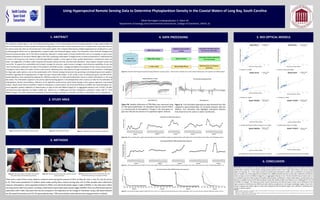
This study evaluated various bio-optical models for predicting chlorophyll a concentrations in the turbid coastal waters of Long Bay, South Carolina using hyperspectral remote sensing data. Water quality samples were collected from 15 stations during 5 cruises in the summer of 2013. In situ measurements and laboratory analyses were used to determine chlorophyll a, total suspended sediments, and colored dissolved organic matter concentrations. The best performing two-band blue-green model was Oc4v4 with an R2 of 0.64. Red-NIR based models performed even better, with a modified version of the Dekker and Gitelson model achieving the highest R2 of 0.79. This study demonstrated the potential of remote sensing for


![Chaentine poster[1]](https://cdn.slidesharecdn.com/ss_thumbnails/0cfabf86-d9fa-403b-b704-eda06f068c51-150908100448-lva1-app6892-thumbnail.jpg?width=640&height=640&fit=bounds)


