ADRENAL MEDULLA - MECHANISM
OF ACTION OF HORMONES
Dr. Anupam Mittal
MBBS, MD
King George’s Medical University,
Lucknow
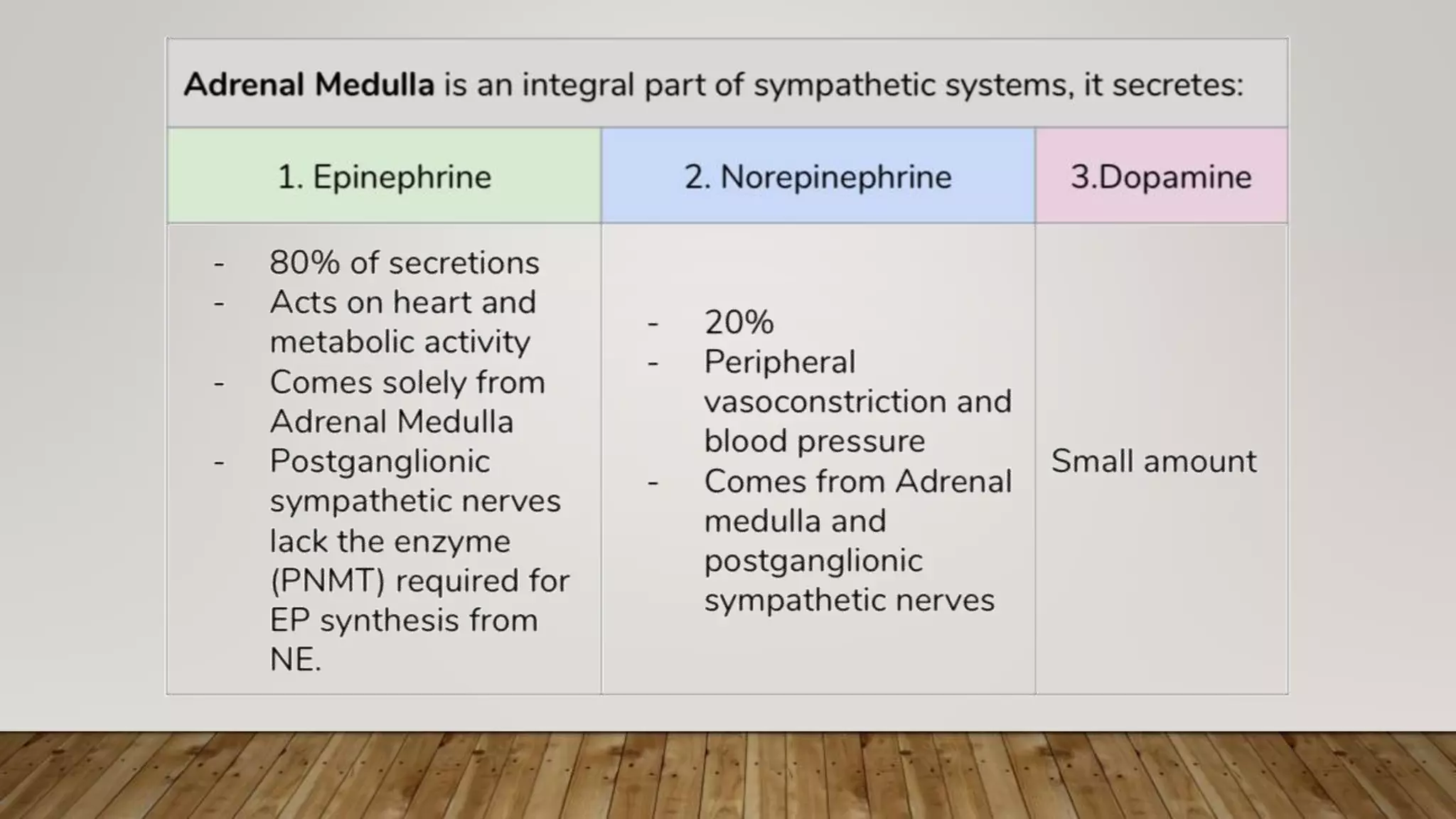
HORMONES OF ADRENAL MEDULLA
1. Adrenaline or epinephrine
2. Noradrenaline or
norepinephrine
3. Dopamine.
ACTIONS OF ADRENALINE AND NORADRENALINE
• Stimulate the nervous system.
• Significant effects on metabolic functions
• Significant effects on cardiovascular system
Adrenergic receptors - types:
1. Alpha-adrenergic receptors, which are subdivided into alpha-1 and alpha-2
receptors.
2. Beta-adrenergic receptors, which are subdivided into beta-1 and beta-2 receptors.
Actions of Adrenal Medullary Hormones
1. ON METABOLISM (VIA ALPHA AND BETA
RECEPTORS)
• Adrenaline influences the metabolic functions more than noradrenaline.
1. General metabolism:
• Adrenaline increases oxygen consumption and carbon dioxide removal.It increases basal metabolic rate,
so called calorigenic hormone
2. Carbohydrate metabolism
• Adrenaline increases the blood glucose level by increasing the glycogenolysis in liver and muscle.
• So, a large quantity of glucose enters the circulation.
3. Fat Metabolism
• Adrenaline causes mobilization of free fatty acids from adipose tissues.
• Catecholamines need the presence of glucocorticoids for this action
2. ON BLOOD (VIA BETA RECEPTORS)
• Adrenaline decreases blood
coagulation time
• It increases RBC count in blood by
contracting smooth muscles of
splenic capsule and releasing RBCs
from spleen into circulation
3. ON HEART (VIA BETA RECEPTORS)
• Adrenaline has stronger effects on heart
than noradrenaline.
• It increases overall activity of the heart, i.e
1. Heart rate (chronotropic effect)
2. Force of contraction (inotropic effect)
3. Excitability of heart muscle (bathmotropic
effect)
4. Conductivity in heart muscle (dromotropic
effect)
4.ON BLOOD VESSELS (VIA ALPHA AND BETA-2
RECEPTORS)
• Noradrenaline has strong effects on blood
vessels.
• It causes constriction of blood vessels
throughout the body via alpha receptors.
• So it is called ‘general vasoconstrictor’.
• Vasoconstrictor effect of noradrenaline
increases total peripheral resistance.
• Adrenaline also causes constriction of blood
vessels.
5. ON BLOOD PRESSURE (VIA ALPHA AND
BETARECEPTORS)
• Adrenaline increases systolic blood pressure by increasing the force of
contraction of the heart and cardiac output.
• But, it decreases diastolic blood pressure by reducing the total peripheral
resistance.
• Noradrenaline increases diastolic pressure due to general vasoconstrictor effect
by increasing the total peripheral resistance.
• It also increases the systolic blood pressure to a slight extent by its actions on
heart.
• The action of catecholamines on blood pressure needs the presence of
glucocorticoids.
• Thus, hypersecretion of catecholamines leads to hypertension
6. ON RESPIRATION (VIA BETA-2 RECEPTORS)
• Adrenaline increases rate and force of respiration.
• Adrenaline injection produces apnea, which is known as adrenaline apnea.
• It also causes bronchodilation.
7. ON SKIN (VIA ALPHA AND BETA-2 RECEPTORS)
• Adrenaline causes contraction of arrector pili.
• It also increases the secretion of sweat.
8. ON SKELETAL MUSCLE (VIA ALPHA AND BETA-2
RECEPTORS)
• Adrenaline causes severe contraction and quick fatigue of skeletal muscle.
• It increases glycogenolysis and release of glucose from muscle into blood. It also
causes vasodilatation in skeletal muscles.
9. ON SMOOTH MUSCLE (VIA ALPHA AND
BETARECEPTORS)
• Catecholamines cause contraction of smooth muscles in the following organs:
1. Splenic capsule
2. Sphincters of gastrointestinal (GI) tract
3. Arrector pili of skin
4. Gallbladder
5. Uterus
6. Dilator pupillae of iris
• Catecholamines cause relaxation of smooth muscles in the following organs:
1. Non-sphincteric part of Gl tract (esophagus, stomach and intestine)
2. Bronchioles
3. Urinary bladder
10. ON CENTRAL NERVOUS SYSTEM (VIA
BETARECEPTORS)
• Adrenaline increases the activity of brain.
• Adrenaline secretion increases during 'fight or flight reactions' after exposure to
stress,
• It enhances the cortical arousal and other facilitatory functions of central nervous
system.
OTHER EFFECTS OF CATECHOLAMINES
• On salivary glands (via alpha and beta-2receptors):
• Cause vasoconstriction in salivary gland, leading to mild increase in salivary secretion
• On sweat glands (via beta-2 receptors):
• Increase the secretion of apocrine sweat glands
• On lacrimal glands (via alpha receptors):
• Increase the secretion of tears
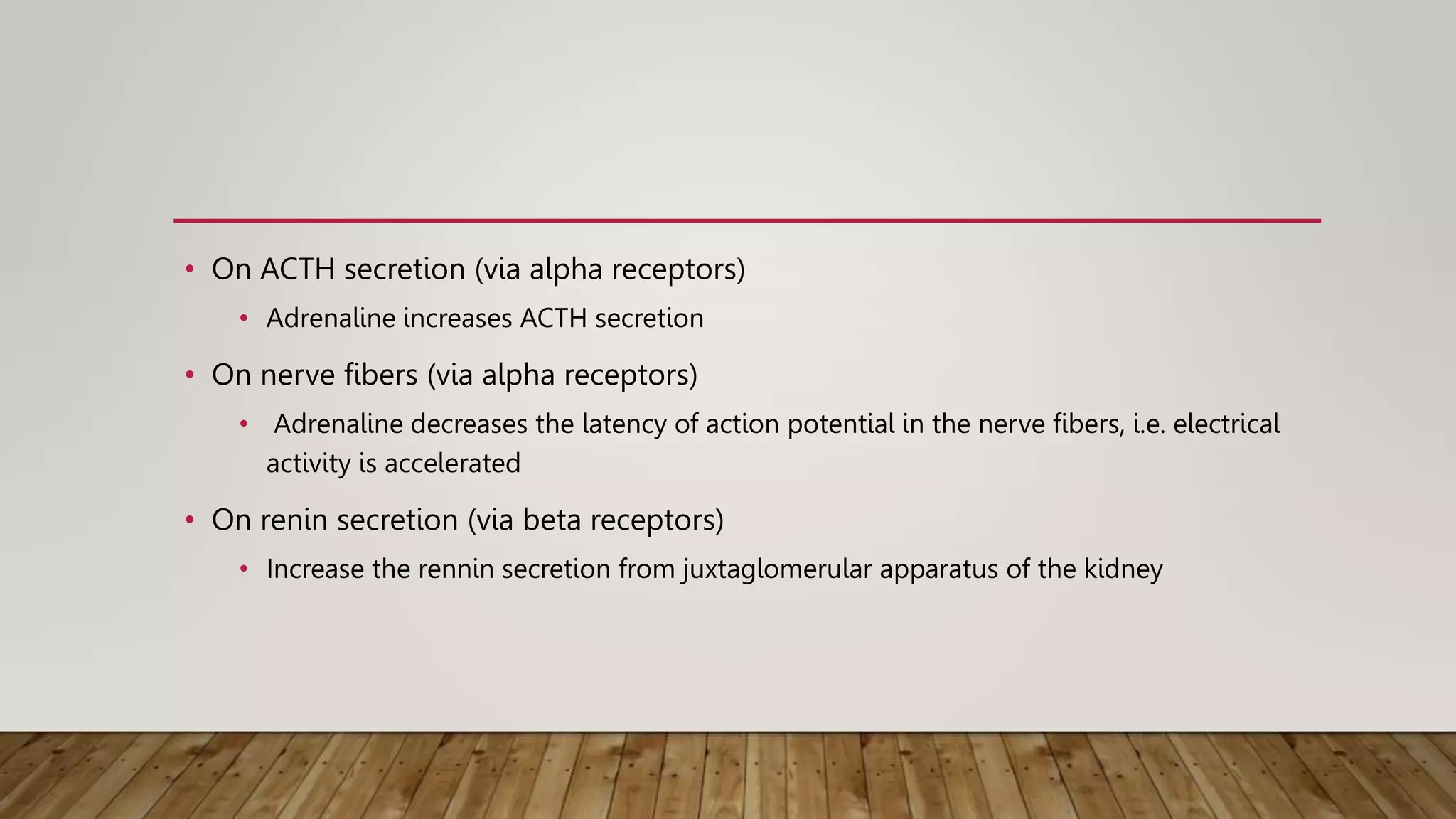
• On ACTH secretion (via alpha receptors)
• Adrenaline increases ACTH secretion
• On nerve fibers (via alpha receptors)
• Adrenaline decreases the latency of action potential in the nerve fibers, i.e. electrical
activity is accelerated
• On renin secretion (via beta receptors)
• Increase the rennin secretion from juxtaglomerular apparatus of the kidney
DOPAMINE
• Secreted by adrenal medulla.
• Also secreted by dopaminergic neurons in some areas of brain, particularly basal
ganglia.
• In brain, this hormone acts as a neurotransmitter.
• PRODUCE FOLLOWING EFFECTS
1. Vasoconstriction by releasing norepinephrine
2. Vasodilatation in mesentery
3. Increase in heart rate via beta receptors
4. Increase in systolic blood pressure but does not affect diastolic blood pressure.

Adrenal medulla and hormone work

  • 1.
    ADRENAL MEDULLA -MECHANISM OF ACTION OF HORMONES Dr. Anupam Mittal MBBS, MD King George’s Medical University, Lucknow
  • 2.
    HORMONES OF ADRENALMEDULLA 1. Adrenaline or epinephrine 2. Noradrenaline or norepinephrine 3. Dopamine.
  • 5.
    ACTIONS OF ADRENALINEAND NORADRENALINE • Stimulate the nervous system. • Significant effects on metabolic functions • Significant effects on cardiovascular system Adrenergic receptors - types: 1. Alpha-adrenergic receptors, which are subdivided into alpha-1 and alpha-2 receptors. 2. Beta-adrenergic receptors, which are subdivided into beta-1 and beta-2 receptors.
  • 6.
    Actions of AdrenalMedullary Hormones
  • 7.
    Actions of AdrenalMedullary Hormones
  • 9.
    1. ON METABOLISM(VIA ALPHA AND BETA RECEPTORS) • Adrenaline influences the metabolic functions more than noradrenaline. 1. General metabolism: • Adrenaline increases oxygen consumption and carbon dioxide removal.It increases basal metabolic rate, so called calorigenic hormone 2. Carbohydrate metabolism • Adrenaline increases the blood glucose level by increasing the glycogenolysis in liver and muscle. • So, a large quantity of glucose enters the circulation. 3. Fat Metabolism • Adrenaline causes mobilization of free fatty acids from adipose tissues. • Catecholamines need the presence of glucocorticoids for this action
  • 10.
    2. ON BLOOD(VIA BETA RECEPTORS) • Adrenaline decreases blood coagulation time • It increases RBC count in blood by contracting smooth muscles of splenic capsule and releasing RBCs from spleen into circulation
  • 11.
    3. ON HEART(VIA BETA RECEPTORS) • Adrenaline has stronger effects on heart than noradrenaline. • It increases overall activity of the heart, i.e 1. Heart rate (chronotropic effect) 2. Force of contraction (inotropic effect) 3. Excitability of heart muscle (bathmotropic effect) 4. Conductivity in heart muscle (dromotropic effect)
  • 12.
    4.ON BLOOD VESSELS(VIA ALPHA AND BETA-2 RECEPTORS) • Noradrenaline has strong effects on blood vessels. • It causes constriction of blood vessels throughout the body via alpha receptors. • So it is called ‘general vasoconstrictor’. • Vasoconstrictor effect of noradrenaline increases total peripheral resistance. • Adrenaline also causes constriction of blood vessels.
  • 13.
    5. ON BLOODPRESSURE (VIA ALPHA AND BETARECEPTORS) • Adrenaline increases systolic blood pressure by increasing the force of contraction of the heart and cardiac output. • But, it decreases diastolic blood pressure by reducing the total peripheral resistance. • Noradrenaline increases diastolic pressure due to general vasoconstrictor effect by increasing the total peripheral resistance. • It also increases the systolic blood pressure to a slight extent by its actions on heart. • The action of catecholamines on blood pressure needs the presence of glucocorticoids. • Thus, hypersecretion of catecholamines leads to hypertension
  • 14.
    6. ON RESPIRATION(VIA BETA-2 RECEPTORS) • Adrenaline increases rate and force of respiration. • Adrenaline injection produces apnea, which is known as adrenaline apnea. • It also causes bronchodilation.
  • 15.
    7. ON SKIN(VIA ALPHA AND BETA-2 RECEPTORS) • Adrenaline causes contraction of arrector pili. • It also increases the secretion of sweat.
  • 16.
    8. ON SKELETALMUSCLE (VIA ALPHA AND BETA-2 RECEPTORS) • Adrenaline causes severe contraction and quick fatigue of skeletal muscle. • It increases glycogenolysis and release of glucose from muscle into blood. It also causes vasodilatation in skeletal muscles.
  • 17.
    9. ON SMOOTHMUSCLE (VIA ALPHA AND BETARECEPTORS) • Catecholamines cause contraction of smooth muscles in the following organs: 1. Splenic capsule 2. Sphincters of gastrointestinal (GI) tract 3. Arrector pili of skin 4. Gallbladder 5. Uterus 6. Dilator pupillae of iris
  • 18.
    • Catecholamines causerelaxation of smooth muscles in the following organs: 1. Non-sphincteric part of Gl tract (esophagus, stomach and intestine) 2. Bronchioles 3. Urinary bladder
  • 19.
    10. ON CENTRALNERVOUS SYSTEM (VIA BETARECEPTORS) • Adrenaline increases the activity of brain. • Adrenaline secretion increases during 'fight or flight reactions' after exposure to stress, • It enhances the cortical arousal and other facilitatory functions of central nervous system.
  • 20.
    OTHER EFFECTS OFCATECHOLAMINES • On salivary glands (via alpha and beta-2receptors): • Cause vasoconstriction in salivary gland, leading to mild increase in salivary secretion • On sweat glands (via beta-2 receptors): • Increase the secretion of apocrine sweat glands • On lacrimal glands (via alpha receptors): • Increase the secretion of tears
  • 21.
    • On ACTHsecretion (via alpha receptors) • Adrenaline increases ACTH secretion • On nerve fibers (via alpha receptors) • Adrenaline decreases the latency of action potential in the nerve fibers, i.e. electrical activity is accelerated • On renin secretion (via beta receptors) • Increase the rennin secretion from juxtaglomerular apparatus of the kidney
  • 22.
    DOPAMINE • Secreted byadrenal medulla. • Also secreted by dopaminergic neurons in some areas of brain, particularly basal ganglia. • In brain, this hormone acts as a neurotransmitter.
  • 23.
    • PRODUCE FOLLOWINGEFFECTS 1. Vasoconstriction by releasing norepinephrine 2. Vasodilatation in mesentery 3. Increase in heart rate via beta receptors 4. Increase in systolic blood pressure but does not affect diastolic blood pressure.

Editor's Notes

  • #2 Medulla, the inner part of adrenal gland 20% of the mass of adrenal gland. Made up of interlacing cords of cells known as chromaffin cells / pheochrome cells / chromophil cells Contain fine granules Adrenal medulla is formed by two types of chromaffin cells Adrenaline-secreting cells (90%) Noradrenaline-secreting cells (10%)
  • #3 They are the amines derived from catechol So these hormones are called catecholamines. Catecholamines secreted by adrenal medulla Adrenaline or epinephrine Noradrenaline or norepinephrine Dopamine.
  • #6 Mode Of Action Of Adrenaline & Noradrenaline Adrenergic Receptors Actions of adrenaline and noradrenaline are executed by binding with receptors called adrenergic receptors, which are present in the target organs Circulating adrenaline and noradrenaline have similar effect of sympathetic stimulation. Effect of adrenal hormones is prolonged 10 times more than that of sympathetic stimulation. It is because of the slow inactivation, slow degradation and slow removal of these hormones. Effects of adrenaline and noradrenaline on various target organs depend upon the type of receptors present in the cells of the organs.
  • #13 However, it causes dilatation of blood vessels in skeletal muscle, liver and heart through beta-2receptors. So, the total peripheral resistance is decreased by adrenaline. Catecholamines need the presence of glucocorticoids, for these vascular effects