ADJUVANT THERAPY
AND
CLINICAL TRIALS
Sapna Patel, M.D.
Melanoma Medical Oncology
7th Annual
Eyes on a Cure:
Ocular Melanoma Patient and
Caregiver Symposium
April 21, 2018
ADJUVANT THERAPY
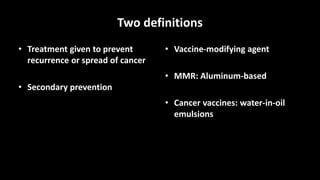
Two definitions
• Treatment given to prevent
recurrence or spread of cancer
• Secondary prevention
• Vaccine-modifying agent
• MMR: Aluminum-based
• Cancer vaccines: water-in-oil
emulsions
Adjuvant Trial Design:
How do we do this?
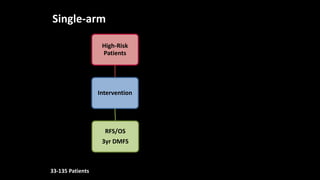
High-Risk
Patients
Intervention
RFS/OS
3yr DMFS
Single-arm
33-135 Patients
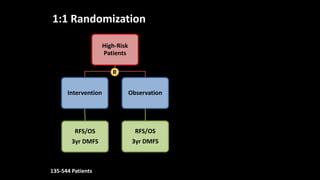
High-Risk
Patients
Intervention
RFS/OS
3yr DMFS
Observation
RFS/OS
3yr DMFS
1:1 Randomization
135-544 Patients
R
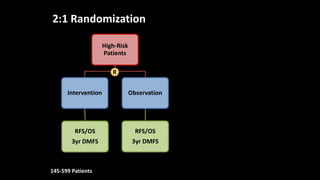
High-Risk
Patients
Intervention
RFS/OS
3yr DMFS
Observation
RFS/OS
3yr DMFS
2:1 Randomization
145-599 Patients
R
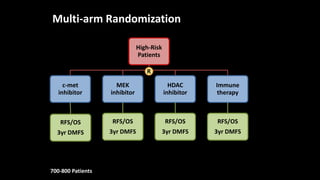
High-Risk
Patients
c-met
inhibitor
RFS/OS
3yr DMFS
MEK
inhibitor
RFS/OS
3yr DMFS
HDAC
inhibitor
RFS/OS
3yr DMFS
Immune
therapy
RFS/OS
3yr DMFS
Multi-arm Randomization
700-800 Patients
R
Appropriate Adjuvant
Therapies
Trial
Design
Targets
High-risk
Population
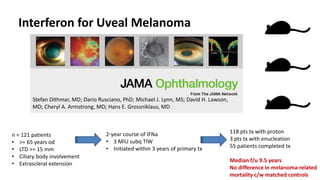
Interferon for Uveal Melanoma
Stefan Dithmar, MD; Dario Rusciano, PhD; Michael J. Lynn, MS; David H. Lawson,
MD; Cheryl A. Armstrong, MD; Hans E. Grossniklaus, MD
2-year course of IFNa
• 3 MIU subq TIW
• Initiated within 3 years of primary tx
n = 121 patients
• >= 65 years od
• LTD >= 15 mm
• Ciliary body involvement
• Extrascleral extension
118 pts tx with proton
3 pts tx with enucleation
55 patients completed tx
Median f/u 9.5 years
No difference in melanoma-related
mortality c/w matched controls
Adjuvant DTIC plus IFNa in High Risk UM
• Iris, Ciliary Body, or Choroid melanoma
• Monosomy 3
• Completed primary therapy, no distant disease
• Enrolled within 56 days (8 weeks) of primary therapy
• DTIC 850 mg/m2 IV Day 1 and Day 28
• IFNa 3 million IU SQ TIW x 24 weeks beginning Week 9
Awaiting results
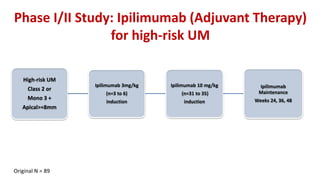
High-risk UM
Class 2 or
Mono 3 +
Apical>=8mm
Ipilimumab 3mg/kg
(n=3 to 6)
induction
Ipilimumab 10 mg/kg
(n=31 to 35)
induction
Ipilimumab
Maintenance
Weeks 24, 36, 48
Phase I/II Study: Ipilimumab (Adjuvant Therapy)
for high-risk UM
Original N = 89
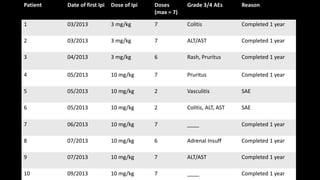
Patient Date of first Ipi Dose of Ipi Doses
(max = 7)
Grade 3/4 AEs Reason
1 03/2013 3 mg/kg 7 Colitis Completed 1 year
2 03/2013 3 mg/kg 7 ALT/AST Completed 1 year
3 04/2013 3 mg/kg 6 Rash, Pruritus Completed 1 year
4 05/2013 10 mg/kg 7 Pruritus Completed 1 year
5 05/2013 10 mg/kg 2 Vasculitis SAE
6 05/2013 10 mg/kg 2 Colitis, ALT, AST SAE
7 06/2013 10 mg/kg 7 ____ Completed 1 year
8 07/2013 10 mg/kg 6 Adrenal Insuff Completed 1 year
9 07/2013 10 mg/kg 7 ALT/AST Completed 1 year
10 09/2013 10 mg/kg 7 ____ Completed 1 year
Hepatic radiation
• Mon-Fri x 20 minutes for up to 10 fractions over 2 weeks
• Planned enrollment of 50 patients
Terminated after 1 year for slow
enrollment
Peptide vaccine
• MART-1, gp100, Tyr, NA17-A
• Planned enrollment of 600 patients randomized to vaccine or
observation
Terminated for slow enrollment
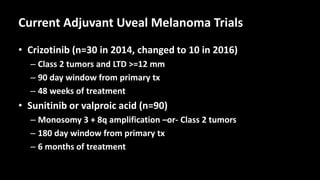
Current Adjuvant Uveal Melanoma Trials
• Crizotinib (n=30 in 2014, changed to 10 in 2016)
– Class 2 tumors and LTD >=12 mm
– 90 day window from primary tx
– 48 weeks of treatment
• Sunitinib or valproic acid (n=90)
– Monosomy 3 + 8q amplification –or- Class 2 tumors
– 180 day window from primary tx
– 6 months of treatment
Future options
• Adjuvant peptide vaccine
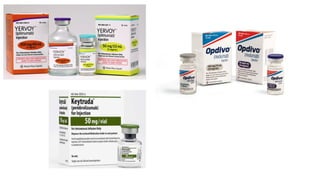
• Adjuvant nivolumab + ipilimumab
• Immunocore IMC gp100 (HLA*A:0201)
Laboratory based trials
• HDAC inhibitor assays
• Liquid biopsy
• Microbiome
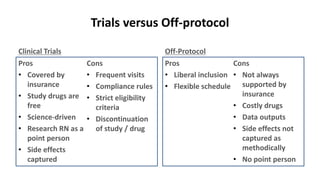
Trials versus Off-protocol
Clinical Trials
Pros
• Covered by
insurance
• Study drugs are
free
• Science-driven
• Research RN as a
point person
• Side effects
captured
Cons
• Frequent visits
• Compliance rules
• Strict eligibility
criteria
• Discontinuation
of study / drug
Off-Protocol
Pros
• Liberal inclusion
• Flexible schedule
Cons
• Not always
supported by
insurance
• Costly drugs
• Data outputs
• Side effects not
captured as
methodically
• No point person
ACKNOWLEDGEMENTS
• Patients and Families who participate in clinical trials
• Faculty, Staff, Researchers at MD Anderson Cancer Center
• Collaborators outside MD Anderson
• Melanoma and Skin Center: (713) 563-9716

Adjuvant Therapy and Clinical Trials

  • 1.
    ADJUVANT THERAPY AND CLINICAL TRIALS SapnaPatel, M.D. Melanoma Medical Oncology 7th Annual Eyes on a Cure: Ocular Melanoma Patient and Caregiver Symposium April 21, 2018
  • 2.
  • 3.
    Two definitions • Treatmentgiven to prevent recurrence or spread of cancer • Secondary prevention • Vaccine-modifying agent • MMR: Aluminum-based • Cancer vaccines: water-in-oil emulsions
  • 4.
  • 5.
  • 6.
  • 7.
  • 8.
    High-Risk Patients c-met inhibitor RFS/OS 3yr DMFS MEK inhibitor RFS/OS 3yr DMFS HDAC inhibitor RFS/OS 3yrDMFS Immune therapy RFS/OS 3yr DMFS Multi-arm Randomization 700-800 Patients R
  • 9.
  • 11.
    Interferon for UvealMelanoma Stefan Dithmar, MD; Dario Rusciano, PhD; Michael J. Lynn, MS; David H. Lawson, MD; Cheryl A. Armstrong, MD; Hans E. Grossniklaus, MD 2-year course of IFNa • 3 MIU subq TIW • Initiated within 3 years of primary tx n = 121 patients • >= 65 years od • LTD >= 15 mm • Ciliary body involvement • Extrascleral extension 118 pts tx with proton 3 pts tx with enucleation 55 patients completed tx Median f/u 9.5 years No difference in melanoma-related mortality c/w matched controls
  • 12.
    Adjuvant DTIC plusIFNa in High Risk UM • Iris, Ciliary Body, or Choroid melanoma • Monosomy 3 • Completed primary therapy, no distant disease • Enrolled within 56 days (8 weeks) of primary therapy • DTIC 850 mg/m2 IV Day 1 and Day 28 • IFNa 3 million IU SQ TIW x 24 weeks beginning Week 9 Awaiting results
  • 14.
    High-risk UM Class 2or Mono 3 + Apical>=8mm Ipilimumab 3mg/kg (n=3 to 6) induction Ipilimumab 10 mg/kg (n=31 to 35) induction Ipilimumab Maintenance Weeks 24, 36, 48 Phase I/II Study: Ipilimumab (Adjuvant Therapy) for high-risk UM Original N = 89
  • 15.
    Patient Date offirst Ipi Dose of Ipi Doses (max = 7) Grade 3/4 AEs Reason 1 03/2013 3 mg/kg 7 Colitis Completed 1 year 2 03/2013 3 mg/kg 7 ALT/AST Completed 1 year 3 04/2013 3 mg/kg 6 Rash, Pruritus Completed 1 year 4 05/2013 10 mg/kg 7 Pruritus Completed 1 year 5 05/2013 10 mg/kg 2 Vasculitis SAE 6 05/2013 10 mg/kg 2 Colitis, ALT, AST SAE 7 06/2013 10 mg/kg 7 ____ Completed 1 year 8 07/2013 10 mg/kg 6 Adrenal Insuff Completed 1 year 9 07/2013 10 mg/kg 7 ALT/AST Completed 1 year 10 09/2013 10 mg/kg 7 ____ Completed 1 year
  • 16.
    Hepatic radiation • Mon-Frix 20 minutes for up to 10 fractions over 2 weeks • Planned enrollment of 50 patients Terminated after 1 year for slow enrollment
  • 17.
    Peptide vaccine • MART-1,gp100, Tyr, NA17-A • Planned enrollment of 600 patients randomized to vaccine or observation Terminated for slow enrollment
  • 18.
    Current Adjuvant UvealMelanoma Trials • Crizotinib (n=30 in 2014, changed to 10 in 2016) – Class 2 tumors and LTD >=12 mm – 90 day window from primary tx – 48 weeks of treatment • Sunitinib or valproic acid (n=90) – Monosomy 3 + 8q amplification –or- Class 2 tumors – 180 day window from primary tx – 6 months of treatment
  • 19.
    Future options • Adjuvantpeptide vaccine • Adjuvant nivolumab + ipilimumab • Immunocore IMC gp100 (HLA*A:0201)
  • 20.
    Laboratory based trials •HDAC inhibitor assays • Liquid biopsy • Microbiome
  • 21.
    Trials versus Off-protocol ClinicalTrials Pros • Covered by insurance • Study drugs are free • Science-driven • Research RN as a point person • Side effects captured Cons • Frequent visits • Compliance rules • Strict eligibility criteria • Discontinuation of study / drug Off-Protocol Pros • Liberal inclusion • Flexible schedule Cons • Not always supported by insurance • Costly drugs • Data outputs • Side effects not captured as methodically • No point person
  • 22.
    ACKNOWLEDGEMENTS • Patients andFamilies who participate in clinical trials • Faculty, Staff, Researchers at MD Anderson Cancer Center • Collaborators outside MD Anderson • Melanoma and Skin Center: (713) 563-9716