ASSALAMU’ALAIKUM Wr. Wb .
ADJECTIVE
LECTURER: ERIK PEBRIKARLEPI S.S. M.Pd
DI SUSUN OLEH:
. EKA INDA SARI 2020. 01. 083
. INDAH PUTRIANA 2020. 01. 098
. MESI PRAMESIA PUTRI 2020. 01. 113
. MUHAMMAD NABIL 2020. 01. 118
. M. RIDHO ALMADHANI 2020. 01. 119
ADJECTIVE
Adjective is a word that describes a
noun by giving some information about
an object’s , size, shape, age, color,
origin or material. Adjective usually
positioned before noun or pronoun
that described by an adjective.
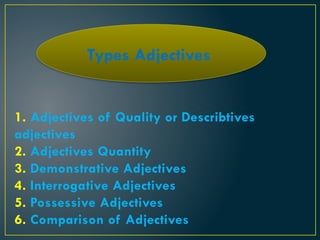
1. Adjectives of Quality or Describtives
adjectives
2. Adjectives Quantity
3. Demonstrative Adjectives
4. Interrogative Adjectives
5. Possessive Adjectives
6. Comparison of Adjectives
Types Adjectives
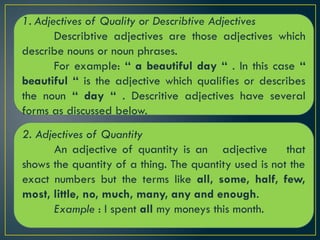
1. Adjectives of Quality or Describtive Adjectives
Describtive adjectives are those adjectives which
describe nouns or noun phrases.
For example: “ a beautiful day “ . In this case “
beautiful “ is the adjective which qualifies or describes
the noun “ day “ . Descritive adjectives have several
forms as discussed below.
2. Adjectives of Quantity
An adjective of quantity is an adjective that
shows the quantity of a thing. The quantity used is not the
exact numbers but the terms like all, some, half, few,
most, little, no, much, many, any and enough.
Example : I spent all my moneys this month.
3. Demonstrative Adjectives
Demonstrative adjectives are adjectives used to point to people or
things that are near or farther from us. The terms used are this, that, these
and those.
for example:
. I like this soft drink
. These books are mine
. That blue car is my uncle’s car.
. Those people are talking about Grammys Award
4. Interrogative Adjectives
Interrogative adjectives, ask questions about the nouns or relating
to the nouns in the sentence. They are; what, which, and whose. The words
are similar with interrogative pronoun. The difference is that interrogative
adjective can’t stand on their own.
For example:
- what food do you want to eat for breakfast?
- which subject do you like the most?
- whose bag is this?
5. Possessive Adjectives
Possessive adjectives show possession or ownership: my, her, his,
its, our, their, your because they are used with nouns and do the work of
Adjectives. Possessive adjectives always go before the noun.
For example:
• my laptop is purple.
• Her wallet is expensive and elegant
• His hat has an initial “H”.
• our teachers were having fun with us last week
• Their bags are kept in lockers.
• Your new glasses fit perfect to you.
• Its tail wagging smoothly.
6. Comparison of Adjectives
a. positive degree, example : he is a rich man.
b. Comparative (-er and more) and Superlative Degree (-est ang most)
c. Irrigular Comparisons
SUMMARY
A. PENGERTIAN ADJECTIVE
Adjective adalah kata yang di
gunakan untuk memberikan sifat pada kata benda
atau kata ganti.
B. MACAM – MACAM ADJECTIVE
1. KATA SIFAT KUALITAS DAN KATA SIFAT DESKRIPTIF
2. KATA SIFAT KUANTITAS
3. KATA SIFAT DEMONSTRATIF
4. KATA SIFAT INTEROGATIF
5. KATA SIFAT KEPUNYAAN
6. KATA SIFAT PERBANDINGAN ( TINGKAT SETARA,
LEBIH / PALING, PERBANDINGAN TIDAK BERATURAN )
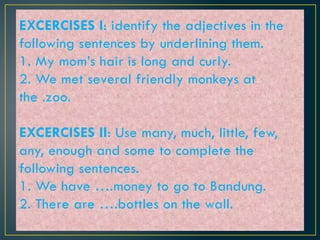
EXCERCISES I: identify the adjectives in the
following sentences by underlining them.
1. My mom’s hair is long and curly.
2. We met several friendly monkeys at
the .zoo.
EXCERCISES II: Use many, much, little, few,
any, enough and some to complete the
following sentences.
1. We have ….money to go to Bandung.
2. There are ….bottles on the wall.
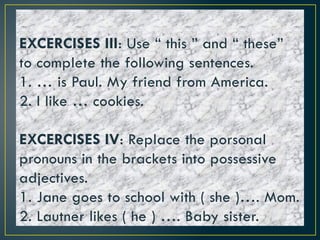
EXCERCISES III: Use “ this ” and “ these”
to complete the following sentences.
1. … is Paul. My friend from America.
2. I like … cookies.
EXCERCISES IV: Replace the porsonal
pronouns in the brackets into possessive
adjectives.
1. Jane goes to school with ( she )…. Mom.
2. Lautner likes ( he ) …. Baby sister.
Khotib, Ahmat Jum’a dan Sunarti Derieny Tambunan. 2017. Basic English.
Jakarta. Azkiyah.
Febriananelma. Blogspot . com
REFERENCES

adjective for young learners Indonesia.pptx

  • 1.
    ASSALAMU’ALAIKUM Wr. Wb. ADJECTIVE LECTURER: ERIK PEBRIKARLEPI S.S. M.Pd DI SUSUN OLEH: . EKA INDA SARI 2020. 01. 083 . INDAH PUTRIANA 2020. 01. 098 . MESI PRAMESIA PUTRI 2020. 01. 113 . MUHAMMAD NABIL 2020. 01. 118 . M. RIDHO ALMADHANI 2020. 01. 119
  • 2.
    ADJECTIVE Adjective is aword that describes a noun by giving some information about an object’s , size, shape, age, color, origin or material. Adjective usually positioned before noun or pronoun that described by an adjective.
  • 3.
    1. Adjectives ofQuality or Describtives adjectives 2. Adjectives Quantity 3. Demonstrative Adjectives 4. Interrogative Adjectives 5. Possessive Adjectives 6. Comparison of Adjectives Types Adjectives
  • 4.
    1. Adjectives ofQuality or Describtive Adjectives Describtive adjectives are those adjectives which describe nouns or noun phrases. For example: “ a beautiful day “ . In this case “ beautiful “ is the adjective which qualifies or describes the noun “ day “ . Descritive adjectives have several forms as discussed below. 2. Adjectives of Quantity An adjective of quantity is an adjective that shows the quantity of a thing. The quantity used is not the exact numbers but the terms like all, some, half, few, most, little, no, much, many, any and enough. Example : I spent all my moneys this month.
  • 5.
    3. Demonstrative Adjectives Demonstrativeadjectives are adjectives used to point to people or things that are near or farther from us. The terms used are this, that, these and those. for example: . I like this soft drink . These books are mine . That blue car is my uncle’s car. . Those people are talking about Grammys Award 4. Interrogative Adjectives Interrogative adjectives, ask questions about the nouns or relating to the nouns in the sentence. They are; what, which, and whose. The words are similar with interrogative pronoun. The difference is that interrogative adjective can’t stand on their own. For example: - what food do you want to eat for breakfast? - which subject do you like the most? - whose bag is this?
  • 6.
    5. Possessive Adjectives Possessiveadjectives show possession or ownership: my, her, his, its, our, their, your because they are used with nouns and do the work of Adjectives. Possessive adjectives always go before the noun. For example: • my laptop is purple. • Her wallet is expensive and elegant • His hat has an initial “H”. • our teachers were having fun with us last week • Their bags are kept in lockers. • Your new glasses fit perfect to you. • Its tail wagging smoothly.
  • 7.
    6. Comparison ofAdjectives a. positive degree, example : he is a rich man. b. Comparative (-er and more) and Superlative Degree (-est ang most) c. Irrigular Comparisons
  • 8.
    SUMMARY A. PENGERTIAN ADJECTIVE Adjectiveadalah kata yang di gunakan untuk memberikan sifat pada kata benda atau kata ganti. B. MACAM – MACAM ADJECTIVE 1. KATA SIFAT KUALITAS DAN KATA SIFAT DESKRIPTIF 2. KATA SIFAT KUANTITAS 3. KATA SIFAT DEMONSTRATIF 4. KATA SIFAT INTEROGATIF 5. KATA SIFAT KEPUNYAAN 6. KATA SIFAT PERBANDINGAN ( TINGKAT SETARA, LEBIH / PALING, PERBANDINGAN TIDAK BERATURAN )
  • 9.
    EXCERCISES I: identifythe adjectives in the following sentences by underlining them. 1. My mom’s hair is long and curly. 2. We met several friendly monkeys at the .zoo. EXCERCISES II: Use many, much, little, few, any, enough and some to complete the following sentences. 1. We have ….money to go to Bandung. 2. There are ….bottles on the wall.
  • 10.
    EXCERCISES III: Use“ this ” and “ these” to complete the following sentences. 1. … is Paul. My friend from America. 2. I like … cookies. EXCERCISES IV: Replace the porsonal pronouns in the brackets into possessive adjectives. 1. Jane goes to school with ( she )…. Mom. 2. Lautner likes ( he ) …. Baby sister.
  • 11.
    Khotib, Ahmat Jum’adan Sunarti Derieny Tambunan. 2017. Basic English. Jakarta. Azkiyah. Febriananelma. Blogspot . com REFERENCES