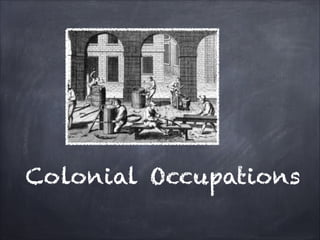
Colonial Occupations
The Carpenter
By, Shai Goldberg Kellman and Noam Siegel
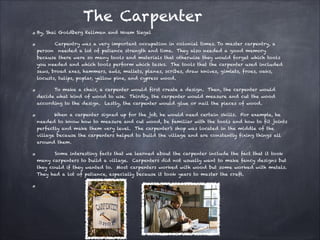
Carpentry was a very important occupation in colonial times. To master carpentry, a
person needed a lot of patience strength and time. They also needed a good memory
because there were so many tools and materials that otherwise they would forget which tools
you needed and which tools perform which tasks. The tools that the carpenter used included
saws, broad axes, hammers, awls, mallets, planes, scribes, draw knives, gimlets, froes, oaks,
locusts, tulips, poplar, yellow pine, and cypress wood.
To make a chair, a carpenter would first create a design. Then, the carpenter would
decide what kind of wood to use. Thirdly, the carpenter would measure and cut the wood
according to the design. Lastly, the carpenter would glue or nail the pieces of wood.
When a carpenter signed up for the job, he would need certain skills. For example, he
needed to know how to measure and cut wood, be familiar with the tools and how to fit joints
perfectly and make them very level. The carpenter’s shop was located in the middle of the
village because the carpenters helped to build the village and are constantly fixing things all
around them.
Some interesting facts that we learned about the carpenter include the fact that it took
many carpenters to build a village. Carpenters did not usually want to make fancy designs but
they could if they wanted to. Most carpenters worked with wood but some worked with metals.
They had a lot of patience, especially because it took years to master the craft.
The Silversmith
By, Emet Hirsch Hoffman and Riva Kranz
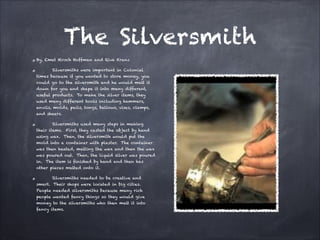
Silversmiths were important in Colonial
times because if you wanted to store money, you
could go to the silversmith and he would melt it
down for you and shape it into many different,
useful products. To make the silver items, they
used many different tools including hammers,
anvils, molds, pails, tongs, bellows, vises, clamps,
and sheers.
Silversmiths used many steps in making
their items. First, they casted the object by hand
using wax. Then, the silversmith would put the
mold into a container with plaster. The container
was then heated, melting the wax and then the wax
was poured out. Then, the liquid silver was poured
in. The item is finished by hand and then has
other pieces melted onto it.
Silversmiths needed to be creative and
smart. Their shops were located in big cities.
People needed silversmiths because many rich
people wanted fancy things so they would give
money to the silversmiths who then melt it into
fancy items.
The Basket Maker
By, Zehava Shapiro
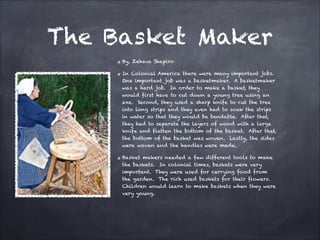
In Colonial America there were many important jobs.
One important job was a basketmaker. A basketmaker
was a hard job. In order to make a basket, they
would first have to cut down a young tree using an
axe. Second, they used a sharp knife to cut the tree
into long strips and they even had to soak the strips
in water so that they would be bendable. After that,
they had to separate the layers of wood with a large
knife and flatten the bottom of the basket. After that,
the bottom of the basket was woven. Lastly, the sides
were woven and the handles were made.
Basket makers needed a few different tools to make
the baskets. In colonial times, baskets were very
important. They were used for carrying food from
the garden. The rich used baskets for their flowers.
Children would learn to make baskets when they were
very young.
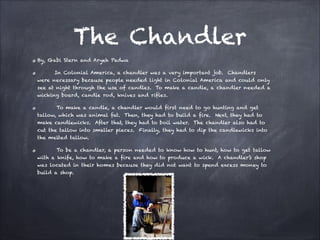
The Chandler
By, Gabi Stern and Aryeh Padwa
In Colonial America, a chandler was a very important job. Chandlers
were necessary because people needed light in Colonial America and could only
see at night through the use of candles. To make a candle, a chandler needed a
wicking board, candle rod, knives and rifles.
To make a candle, a chandler would first need to go hunting and get
tallow, which was animal fat. Then, they had to build a fire. Next, they had to
make candlewicks. After that, they had to boil water. The chandler also had to
cut the tallow into smaller pieces. Finally, they had to dip the candlewicks into
the melted tallow.
To be a chandler, a person needed to know how to hunt, how to get tallow
with a knife, how to make a fire and how to produce a wick. A chandler’s shop
was located in their homes because they did not want to spend excess money to
build a shop.
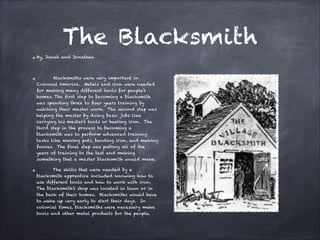
The Blacksmith
By, Jonah and Jonathan


Blacksmiths were very important in
Colonial America. Metals and iron were needed
for making many different tools for people’s
homes. The first step to becoming a blacksmith
was spending three to four years training by
watching their master work. The second step was
helping the master by doing basic jobs like
carrying his master’s tools or heating iron. The
third step in the process to becoming a
blacksmith was to perform advanced training
tasks like making pots, bending iron, and making
fences. The final step was putting all of the
years of training to the test and making
something that a master blacksmith would make.
The skills that were needed by a
blacksmith apprentice included knowing how to
use different tools and how to work with iron.
The blacksmith’s shop was located in town or in
the back of their homes. Blacksmiths would have
to wake up very early to start their days. In
colonial times, blacksmiths were necessary make
tools and other metal products for the people.
The Tailor
By, Sarah and Emma S.
Tailors were very important in Colonial America
because they made and sewed clothing for people to
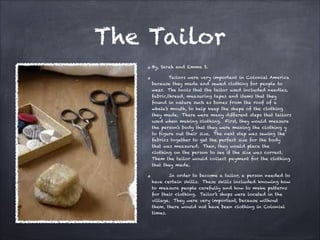
wear. The tools that the tailor used included needles,
fabric,thread, measuring tapes and items that they
found in nature such as bones from the roof of a
whale’s mouth, to help keep the shape of the clothing
they made. There were many different steps that tailors
used when making clothing. First, they would measure
the person’s body that they were making the clothing y
to figure out their size. The next step was sewing the
fabrics together to get the perfect size for the body
that was measured. Then, they would place the
clothing on the person to see if the size was correct.
Them the tailor would collect payment for the clothing
that they made.
In order to become a tailor, a person needed to
have certain skills. These skills included knowing how
to measure people carefully and how to make patterns
for their clothing. Tailor’s shops were located in the
village. They were very important, because without
them, there would not have been clothing in Colonial
times.
The Wigmaker
By, Leora Brasch and Noa G


If you were a wigmaker in Colonial
America, you would need many different skills.
You would need to know how to use a needle,
and how to cut horse, sheep or human hair. You
would also need to know how to style hair using
animal grease, powder the hair, how to sew a
hairnet, how to clean wigs and how to maintain
and run a good business.
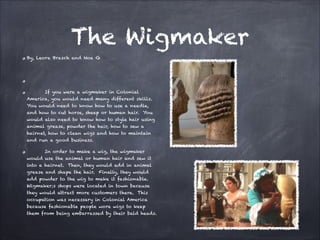
In order to make a wig, the wigmaker
would use the animal or human hair and sew it
into a hairnet. Then, they would add in animal
grease and shape the hair. Finally, they would
add powder to the wig to make it fashionable.
Wigmaker;s shops were located in town because
they would attract more customers there. This
occupation was necessary in Colonial America
because fashionable people wore wigs to keep
them from being embarrassed by their bald heads.
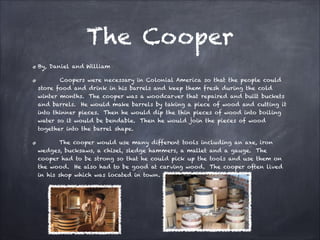
The Cooper

By, Daniel and William
Coopers were necessary in Colonial America so that the people could
store food and drink in his barrels and keep them fresh during the cold
winter months. The cooper was a woodcarver that repaired and built buckets
and barrels. He would make barrels by taking a piece of wood and cutting it
into thinner pieces. Then he would dip the thin pieces of wood into boiling
water so it would be bendable. Then he would join the pieces of wood
together into the barrel shape.
The cooper would use many different tools including an axe, iron
wedges, bucksaws, a chisel, sledge hammers, a mallet and a gauge. The
cooper had to be strong so that he could pick up the tools and use them on
the wood. He also had to be good at carving wood. The cooper often lived
in his shop which was located in town.
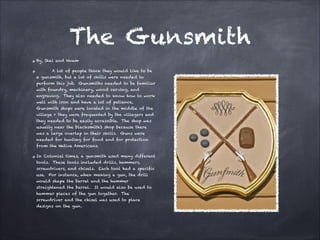
The Gunsmith
By, Shai and Noam
A lot of people think they would like to be
a gunsmith, but a lot of skills were needed to
perform this job. Gunsmiths needed to be familiar
with foundry, machinery, wood carving, and
engraving. They also needed to know how to work
well with iron and have a lot of patience.
Gunsmith shops were located in the middle of the
village r they were frequented by the villagers and
they needed to be easily accessible. The shop was
usually near the blacksmith’s shop because there
was a large overlap in their skills. Guns were
needed for hunting for food and for protection
from the Native Americans.
In Colonial times, a gunsmith used many different
tools. These tools included drills, hammers,
screwdrivers, and chisels. Each tool had a specific
use. For instance, when making a gun, the drill
would shape the barrel and the hammer
straightened the barrel. It would also be used to
hammer pieces of the gun together. The
screwdriver and the chisel was used to place
designs on the gun.
The cobbler and weaver
The Cobbler
By, Aryeh Padwa
In Colonial Times, the cobbler was a very important job. A
cobbler used many different tool in their craft. They used
hammers, water, oil and a last shaped piece of wood that a
cobbler would carve into the same size as the customer’s foot. In
the process of making shoes, the cobbler would first take leather,
nails, water, oil and jos hammer. He would use the last to make
the shoes the correct size. He would then cut a piece of leather
called an upper and soak it in oil and water. Last, he would nail
the upper portion to the last. he would wait 2-3 hours to let the
leather dry in the last.
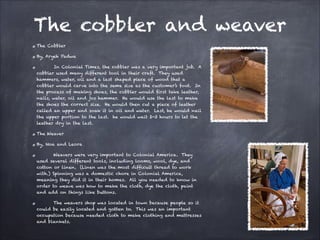
The Weaver
By, Noa and Leora
Weavers were very important to Colonial America. They
used several different tools, including looms, wool, dye, and
cotton or linen. (Linen was the most difficult thread to work
with.) Spinning was a domestic chore in Colonial America,
meaning they did it in their homes. All you needed to know in
order to weave was how to make the cloth, dye the cloth, paint
and add on things like buttons.
The weavers shop was located in town because people so it
could be easily located and gotten to. This was an important
occupation because needed cloth to make clothing and mattresses
and blankets.
The Brickmaker
and Wheelwright

The Brickmaker

By, Jonah and Daniel
Brickmakers were necessary in Colonial America for a variety of reasons. The brickmakers used
many different tools in their craft and even used their hands as feet as tools. The first step in making
bricks was to shovel clay into a trading pit. After the clay was mixed with other ingredients, it was pulled
from the pit and piled upon a molding table. Bricks were formed there into the different shapes that were
needed.


The Wheelwright
By, Emet and Jonathan
Colonial Wheelwrights made wheels for the wagons in Colonial America. They would use many
different tools to make the wheels including hammers, chisels, and spokes.
In order to make the wheels, they would first trade others to get all of the materials that they
needed. Once they had all of the materials, they would heat an iron circle so that it can be shaped into
the correct size. Next, the wheelwright would make wheels by crafting two circles of different sizes and
poke holes in them. He would attach the circles with wooden sticks. This was so that they would not break
when the wheels were used.
To be a wheelwright you needed to be strong, to have ingenuity and to have the same skills as a
carpenter and a blacksmith. Their shop was located in the village because lots of people needed wheels.
Wheels were needed in order to travel or to move heavy goods from one place to the next.
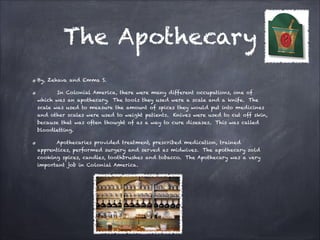
The Apothecary
By, Zehava and Emma S.
In Colonial America, there were many different occupations, one of
which was an apothecary. The tools they used were a scale and a knife. The
scale was used to measure the amount of spices they would put into medicines
and other scales were used to weight patients. Knives were used to cut off skin,
because that was often thought of as a way to cure diseases. This was called
bloodletting.
Apothecaries provided treatment, prescribed medication, trained
apprentices, performed surgery and served as midwives. The apothecary sold
cooking spices, candles, toothbrushes and tobacco. The Apothecary was a very
important job in Colonial America.
TheCabinetmaker
and Printer

The Cabinet Mater

By, Sarah and Riva

Cabinet makers were important people in Colonial America. They made
really nice furniture. To make furniture, they needed different tools
including saws, a drawknife, a lanthe, steel wool hammers and glue. There

were four steps in making furniture. First, the wood had to be carved into the
correct shape. Then, the pieces were attached together. Third, cloth was placed
in the attached pieces. Finally, the furniture would be sold to the customers.
If you wanted to be a cabinet maker, you needed to have certain skills.
For example, you needed to know how to work with wood, how to use the
tools, and how to clean up properly at the end of the day. Cabinet maker’s
shops were usually located in the villages. This occupation was necessary
because without furniture, they were required to sit on the floor.
The Printer
By, Gabi Stern and William Haberman
The printer was a very important job in Colonial times. Some tools that
the printer needed were ink, paper, metal, composing sticks, ink pads, press
and stone. The first step taken in printing was putting the type into a tray
called a case. Then, the letters were set into words. They were slid in and
spaced out evenly. The type was then inked. The type was locked in a form
which was then ready to go to press. The printer places the form in something
called the coffin. The printer would ink it again. He then placed the paper on
the tympan and folded the frisket. The printing page would be removed to
dry after the ink was pressed to the paper. being a printer in Colonial times
was not an easy job because there were a lot of steps involved.

Colonial Occupations

  • 1.
  • 2.
    The Carpenter By, ShaiGoldberg Kellman and Noam Siegel Carpentry was a very important occupation in colonial times. To master carpentry, a person needed a lot of patience strength and time. They also needed a good memory because there were so many tools and materials that otherwise they would forget which tools you needed and which tools perform which tasks. The tools that the carpenter used included saws, broad axes, hammers, awls, mallets, planes, scribes, draw knives, gimlets, froes, oaks, locusts, tulips, poplar, yellow pine, and cypress wood. To make a chair, a carpenter would first create a design. Then, the carpenter would decide what kind of wood to use. Thirdly, the carpenter would measure and cut the wood according to the design. Lastly, the carpenter would glue or nail the pieces of wood. When a carpenter signed up for the job, he would need certain skills. For example, he needed to know how to measure and cut wood, be familiar with the tools and how to fit joints perfectly and make them very level. The carpenter’s shop was located in the middle of the village because the carpenters helped to build the village and are constantly fixing things all around them. Some interesting facts that we learned about the carpenter include the fact that it took many carpenters to build a village. Carpenters did not usually want to make fancy designs but they could if they wanted to. Most carpenters worked with wood but some worked with metals. They had a lot of patience, especially because it took years to master the craft.
  • 3.
    The Silversmith By, EmetHirsch Hoffman and Riva Kranz Silversmiths were important in Colonial times because if you wanted to store money, you could go to the silversmith and he would melt it down for you and shape it into many different, useful products. To make the silver items, they used many different tools including hammers, anvils, molds, pails, tongs, bellows, vises, clamps, and sheers. Silversmiths used many steps in making their items. First, they casted the object by hand using wax. Then, the silversmith would put the mold into a container with plaster. The container was then heated, melting the wax and then the wax was poured out. Then, the liquid silver was poured in. The item is finished by hand and then has other pieces melted onto it. Silversmiths needed to be creative and smart. Their shops were located in big cities. People needed silversmiths because many rich people wanted fancy things so they would give money to the silversmiths who then melt it into fancy items.
  • 4.
    The Basket Maker By,Zehava Shapiro In Colonial America there were many important jobs. One important job was a basketmaker. A basketmaker was a hard job. In order to make a basket, they would first have to cut down a young tree using an axe. Second, they used a sharp knife to cut the tree into long strips and they even had to soak the strips in water so that they would be bendable. After that, they had to separate the layers of wood with a large knife and flatten the bottom of the basket. After that, the bottom of the basket was woven. Lastly, the sides were woven and the handles were made. Basket makers needed a few different tools to make the baskets. In colonial times, baskets were very important. They were used for carrying food from the garden. The rich used baskets for their flowers. Children would learn to make baskets when they were very young.
  • 5.
    The Chandler By, GabiStern and Aryeh Padwa In Colonial America, a chandler was a very important job. Chandlers were necessary because people needed light in Colonial America and could only see at night through the use of candles. To make a candle, a chandler needed a wicking board, candle rod, knives and rifles. To make a candle, a chandler would first need to go hunting and get tallow, which was animal fat. Then, they had to build a fire. Next, they had to make candlewicks. After that, they had to boil water. The chandler also had to cut the tallow into smaller pieces. Finally, they had to dip the candlewicks into the melted tallow. To be a chandler, a person needed to know how to hunt, how to get tallow with a knife, how to make a fire and how to produce a wick. A chandler’s shop was located in their homes because they did not want to spend excess money to build a shop.
  • 6.
    The Blacksmith By, Jonahand Jonathan Blacksmiths were very important in Colonial America. Metals and iron were needed for making many different tools for people’s homes. The first step to becoming a blacksmith was spending three to four years training by watching their master work. The second step was helping the master by doing basic jobs like carrying his master’s tools or heating iron. The third step in the process to becoming a blacksmith was to perform advanced training tasks like making pots, bending iron, and making fences. The final step was putting all of the years of training to the test and making something that a master blacksmith would make. The skills that were needed by a blacksmith apprentice included knowing how to use different tools and how to work with iron. The blacksmith’s shop was located in town or in the back of their homes. Blacksmiths would have to wake up very early to start their days. In colonial times, blacksmiths were necessary make tools and other metal products for the people.
  • 7.
    The Tailor By, Sarahand Emma S. Tailors were very important in Colonial America because they made and sewed clothing for people to wear. The tools that the tailor used included needles, fabric,thread, measuring tapes and items that they found in nature such as bones from the roof of a whale’s mouth, to help keep the shape of the clothing they made. There were many different steps that tailors used when making clothing. First, they would measure the person’s body that they were making the clothing y to figure out their size. The next step was sewing the fabrics together to get the perfect size for the body that was measured. Then, they would place the clothing on the person to see if the size was correct. Them the tailor would collect payment for the clothing that they made. In order to become a tailor, a person needed to have certain skills. These skills included knowing how to measure people carefully and how to make patterns for their clothing. Tailor’s shops were located in the village. They were very important, because without them, there would not have been clothing in Colonial times.
  • 8.
    The Wigmaker By, LeoraBrasch and Noa G If you were a wigmaker in Colonial America, you would need many different skills. You would need to know how to use a needle, and how to cut horse, sheep or human hair. You would also need to know how to style hair using animal grease, powder the hair, how to sew a hairnet, how to clean wigs and how to maintain and run a good business. In order to make a wig, the wigmaker would use the animal or human hair and sew it into a hairnet. Then, they would add in animal grease and shape the hair. Finally, they would add powder to the wig to make it fashionable. Wigmaker;s shops were located in town because they would attract more customers there. This occupation was necessary in Colonial America because fashionable people wore wigs to keep them from being embarrassed by their bald heads.
  • 9.
    The Cooper By, Danieland William Coopers were necessary in Colonial America so that the people could store food and drink in his barrels and keep them fresh during the cold winter months. The cooper was a woodcarver that repaired and built buckets and barrels. He would make barrels by taking a piece of wood and cutting it into thinner pieces. Then he would dip the thin pieces of wood into boiling water so it would be bendable. Then he would join the pieces of wood together into the barrel shape. The cooper would use many different tools including an axe, iron wedges, bucksaws, a chisel, sledge hammers, a mallet and a gauge. The cooper had to be strong so that he could pick up the tools and use them on the wood. He also had to be good at carving wood. The cooper often lived in his shop which was located in town.
  • 10.
    The Gunsmith By, Shaiand Noam A lot of people think they would like to be a gunsmith, but a lot of skills were needed to perform this job. Gunsmiths needed to be familiar with foundry, machinery, wood carving, and engraving. They also needed to know how to work well with iron and have a lot of patience. Gunsmith shops were located in the middle of the village r they were frequented by the villagers and they needed to be easily accessible. The shop was usually near the blacksmith’s shop because there was a large overlap in their skills. Guns were needed for hunting for food and for protection from the Native Americans. In Colonial times, a gunsmith used many different tools. These tools included drills, hammers, screwdrivers, and chisels. Each tool had a specific use. For instance, when making a gun, the drill would shape the barrel and the hammer straightened the barrel. It would also be used to hammer pieces of the gun together. The screwdriver and the chisel was used to place designs on the gun.
  • 11.
    The cobbler andweaver The Cobbler By, Aryeh Padwa In Colonial Times, the cobbler was a very important job. A cobbler used many different tool in their craft. They used hammers, water, oil and a last shaped piece of wood that a cobbler would carve into the same size as the customer’s foot. In the process of making shoes, the cobbler would first take leather, nails, water, oil and jos hammer. He would use the last to make the shoes the correct size. He would then cut a piece of leather called an upper and soak it in oil and water. Last, he would nail the upper portion to the last. he would wait 2-3 hours to let the leather dry in the last. The Weaver By, Noa and Leora Weavers were very important to Colonial America. They used several different tools, including looms, wool, dye, and cotton or linen. (Linen was the most difficult thread to work with.) Spinning was a domestic chore in Colonial America, meaning they did it in their homes. All you needed to know in order to weave was how to make the cloth, dye the cloth, paint and add on things like buttons. The weavers shop was located in town because people so it could be easily located and gotten to. This was an important occupation because needed cloth to make clothing and mattresses and blankets.
  • 12.
    The Brickmaker and Wheelwright TheBrickmaker By, Jonah and Daniel Brickmakers were necessary in Colonial America for a variety of reasons. The brickmakers used many different tools in their craft and even used their hands as feet as tools. The first step in making bricks was to shovel clay into a trading pit. After the clay was mixed with other ingredients, it was pulled from the pit and piled upon a molding table. Bricks were formed there into the different shapes that were needed. The Wheelwright By, Emet and Jonathan Colonial Wheelwrights made wheels for the wagons in Colonial America. They would use many different tools to make the wheels including hammers, chisels, and spokes. In order to make the wheels, they would first trade others to get all of the materials that they needed. Once they had all of the materials, they would heat an iron circle so that it can be shaped into the correct size. Next, the wheelwright would make wheels by crafting two circles of different sizes and poke holes in them. He would attach the circles with wooden sticks. This was so that they would not break when the wheels were used. To be a wheelwright you needed to be strong, to have ingenuity and to have the same skills as a carpenter and a blacksmith. Their shop was located in the village because lots of people needed wheels. Wheels were needed in order to travel or to move heavy goods from one place to the next.
  • 13.
    The Apothecary By, Zehavaand Emma S. In Colonial America, there were many different occupations, one of which was an apothecary. The tools they used were a scale and a knife. The scale was used to measure the amount of spices they would put into medicines and other scales were used to weight patients. Knives were used to cut off skin, because that was often thought of as a way to cure diseases. This was called bloodletting. Apothecaries provided treatment, prescribed medication, trained apprentices, performed surgery and served as midwives. The apothecary sold cooking spices, candles, toothbrushes and tobacco. The Apothecary was a very important job in Colonial America.
  • 14.
    TheCabinetmaker and Printer The CabinetMater By, Sarah and Riva Cabinet makers were important people in Colonial America. They made really nice furniture. To make furniture, they needed different tools including saws, a drawknife, a lanthe, steel wool hammers and glue. There were four steps in making furniture. First, the wood had to be carved into the correct shape. Then, the pieces were attached together. Third, cloth was placed in the attached pieces. Finally, the furniture would be sold to the customers. If you wanted to be a cabinet maker, you needed to have certain skills. For example, you needed to know how to work with wood, how to use the tools, and how to clean up properly at the end of the day. Cabinet maker’s shops were usually located in the villages. This occupation was necessary because without furniture, they were required to sit on the floor. The Printer By, Gabi Stern and William Haberman The printer was a very important job in Colonial times. Some tools that the printer needed were ink, paper, metal, composing sticks, ink pads, press and stone. The first step taken in printing was putting the type into a tray called a case. Then, the letters were set into words. They were slid in and spaced out evenly. The type was then inked. The type was locked in a form which was then ready to go to press. The printer places the form in something called the coffin. The printer would ink it again. He then placed the paper on the tympan and folded the frisket. The printing page would be removed to dry after the ink was pressed to the paper. being a printer in Colonial times was not an easy job because there were a lot of steps involved.