ADJECTIVE
TYPES OF ADJECTIVES
ARTICLES USED AS AN ADJECTIVE
DEGREE OF ADJECTIVES
ORDER OF ADJECTIVES
• An adjective is a part of speech which describes,
identifies and quantifies a noun or pronoun.
Examples:
• The teamhas a dangerous batsman. (What kind?)
• I have ten candies in my pocket. (Howmany?)
• I loved that red car. (Whichone?)
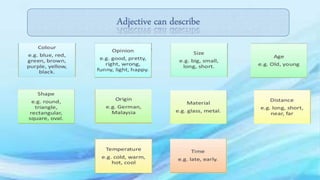
Adjective can describe
Used with nouns to ask
question.
Examples: What, Whose, Where,
Why, How and Which
1. Whose pen is this?
2. Where shall we go?
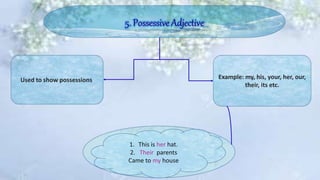
Used to show possessions.
Example: my, his, your, her, our,
their, its etc.
1. This is her hat.
2. Their parents
Came to my house
To show that persons or
things are counted
collectively.
Refer to members of a
group as an individuals.
Normally used with
singular nouns.
Examples: each, either,
every and neither.
1. Each participant was asked a
question.
2. Neither of you will go to trip.
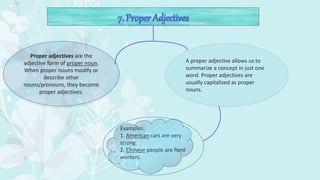
Proper adjectives are the
adjective form of proper noun.
When proper nouns modify or
describe other
nouns/pronouns, they become
proper adjectives.
A proper adjective allows us to
summarize a concept in just one
word. Proper adjectives are
usually capitalized as proper
nouns.
Examples:
1. American cars are very
strong.
2. Chinese people are hard
workers.
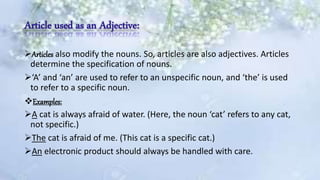
Articles also modify the nouns. So, articles are also adjectives. Articles
determine the specification of nouns.
‘A’ and ‘an’ are used to refer to an unspecific noun, and ‘the’ is used
to refer to a specific noun.
Examples:
A cat is always afraid of water. (Here, the noun ‘cat’ refers to any cat,
not specific.)
The cat is afraid of me. (This cat is a specific cat.)
An electronic product should always be handled with care.
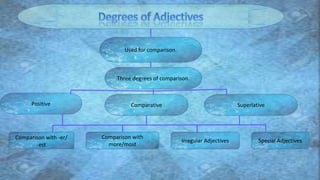
Used for comparison.
Three degrees of comparison.
Positive Comparative Superlative
Comparison with -er/
-est
Comparison with
more/most
Irregular Adjectives Special Adjectives
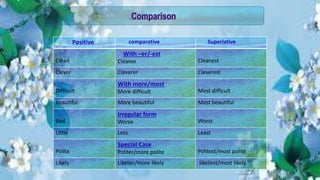
Positive comparative Superlative
Clean
With –er/-est
Cleaner Cleanest
Clever Cleverer Cleverest
Difficult
With more/most
More difficult Most difficult
Beautiful More beautiful Most beautiful
Bad
Irregular form
Worse Worst
Little Less Least
Polite
Special Case
Politer/more polite Politest/most polite
Likely Likelier/more likely likeliest/most likely
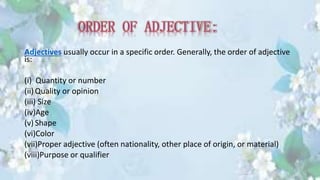
Adjectives usually occur in a specific order. Generally, the order of adjective
is:
(i) Quantity or number
(ii)Quality or opinion
(iii) Size
(iv)Age
(v) Shape
(vi)Color
(vii)Proper adjective (often nationality, other place of origin, or material)
(viii)Purpose or qualifier
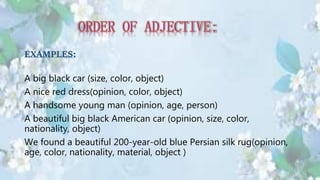
EXAMPLES:
A big black car (size, color, object)
A nice red dress(opinion, color, object)
A handsome young man (opinion, age, person)
A beautiful big black American car (opinion, size, color,
nationality, object)
We found a beautiful 200-year-old blue Persian silk rug(opinion,
age, color, nationality, material, object )
Adjective and types
Adjective and types

Adjective and types

  • 3.
    ADJECTIVE TYPES OF ADJECTIVES ARTICLESUSED AS AN ADJECTIVE DEGREE OF ADJECTIVES ORDER OF ADJECTIVES
  • 4.
    • An adjectiveis a part of speech which describes, identifies and quantifies a noun or pronoun. Examples: • The teamhas a dangerous batsman. (What kind?) • I have ten candies in my pocket. (Howmany?) • I loved that red car. (Whichone?)
  • 5.
  • 10.
    Used with nounsto ask question. Examples: What, Whose, Where, Why, How and Which 1. Whose pen is this? 2. Where shall we go?
  • 11.
    Used to showpossessions. Example: my, his, your, her, our, their, its etc. 1. This is her hat. 2. Their parents Came to my house
  • 12.
    To show thatpersons or things are counted collectively. Refer to members of a group as an individuals. Normally used with singular nouns. Examples: each, either, every and neither. 1. Each participant was asked a question. 2. Neither of you will go to trip.
  • 13.
    Proper adjectives arethe adjective form of proper noun. When proper nouns modify or describe other nouns/pronouns, they become proper adjectives. A proper adjective allows us to summarize a concept in just one word. Proper adjectives are usually capitalized as proper nouns. Examples: 1. American cars are very strong. 2. Chinese people are hard workers.
  • 14.
    Articles also modifythe nouns. So, articles are also adjectives. Articles determine the specification of nouns. ‘A’ and ‘an’ are used to refer to an unspecific noun, and ‘the’ is used to refer to a specific noun. Examples: A cat is always afraid of water. (Here, the noun ‘cat’ refers to any cat, not specific.) The cat is afraid of me. (This cat is a specific cat.) An electronic product should always be handled with care.
  • 15.
    Used for comparison. Threedegrees of comparison. Positive Comparative Superlative Comparison with -er/ -est Comparison with more/most Irregular Adjectives Special Adjectives
  • 16.
    Positive comparative Superlative Clean With–er/-est Cleaner Cleanest Clever Cleverer Cleverest Difficult With more/most More difficult Most difficult Beautiful More beautiful Most beautiful Bad Irregular form Worse Worst Little Less Least Polite Special Case Politer/more polite Politest/most polite Likely Likelier/more likely likeliest/most likely
  • 17.
    Adjectives usually occurin a specific order. Generally, the order of adjective is: (i) Quantity or number (ii)Quality or opinion (iii) Size (iv)Age (v) Shape (vi)Color (vii)Proper adjective (often nationality, other place of origin, or material) (viii)Purpose or qualifier
  • 18.
    EXAMPLES: A big blackcar (size, color, object) A nice red dress(opinion, color, object) A handsome young man (opinion, age, person) A beautiful big black American car (opinion, size, color, nationality, object) We found a beautiful 200-year-old blue Persian silk rug(opinion, age, color, nationality, material, object )